engine light FIAT 500 2019 Owner handbook (in English)
[x] Cancel search | Manufacturer: FIAT, Model Year: 2019, Model line: 500, Model: FIAT 500 2019Pages: 228, PDF Size: 6.01 MB
Page 112 of 228
FUEL TANK CAP
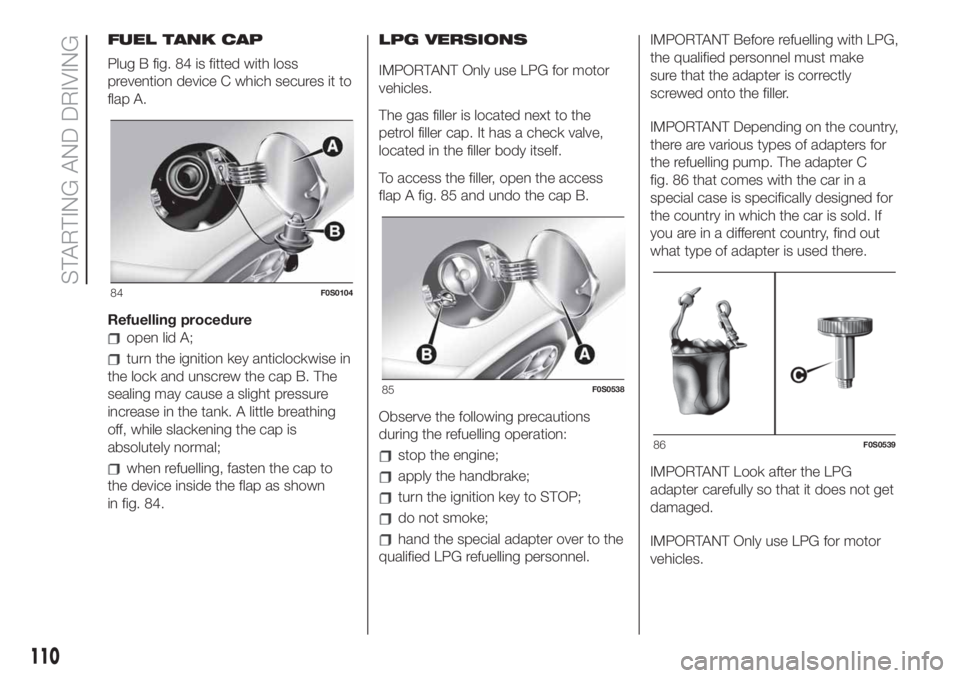
Plug B fig. 84 is fitted with loss
prevention device C which secures it to
flap A.
Refuelling procedure
open lid A;
turn the ignition key anticlockwise in
the lock and unscrew the cap B. The
sealing may cause a slight pressure
increase in the tank. A little breathing
off, while slackening the cap is
absolutely normal;
when refuelling, fasten the cap to
the device inside the flap as shown
in fig. 84.LPG VERSIONS
IMPORTANT Only use LPG for motor
vehicles.
The gas filler is located next to the
petrol filler cap. It has a check valve,
located in the filler body itself.
To access the filler, open the access
flap A fig. 85 and undo the cap B.
Observe the following precautions
during the refuelling operation:stop the engine;
apply the handbrake;
turn the ignition key to STOP;
do not smoke;
hand the special adapter over to the
qualified LPG refuelling personnel.IMPORTANT Before refuelling with LPG,
the qualified personnel must make
sure that the adapter is correctly
screwed onto the filler.
IMPORTANT Depending on the country,
there are various types of adapters for
the refuelling pump. The adapter C
fig. 86 that comes with the car in a
special case is specifically designed for
the country in which the car is sold. If
you are in a different country, find out
what type of adapter is used there.
IMPORTANT Look after the LPG
adapter carefully so that it does not get
damaged.
IMPORTANT Only use LPG for motor
vehicles.
84F0S0104
85F0S0538
86F0S0539
110
STARTING AND DRIVING
Page 114 of 228
TOWING TRAILERS
(for versions/markets, where provided)
141) 142)
IMPORTANT NOTES
For towing caravans or trailers the car
must be fitted with an approved tow
hook and an adequate electrical
system. Installation should be carried
out by specialised technicians who will
issue the required papers for travelling
on roads.
Install any specific and/or additional
door mirrors as specified by the
Highway Code.
Remember that, when towing a trailer,
steep hills are harder to climb, braking
distances increase and overtaking
takes longer depending on the overall
weight of the trailer. Engage a low gear
when driving downhill, rather than
constantly using the brake.
The weight the trailer exerts on the car
tow hook reduces the car's loading
capacity by the same amount. To make
sure that the maximum towable weight
is not exceeded (given in the vehicle
registration document) account should
be taken of the fully laden trailer,
including accessories and luggage.Respect the speed limits specific to
each country for cars towing trailers. In
any case, the top speed must not
exceed 100 km/h.
IMPORTANT The engine must be
running when using auxiliary loads other
than external lights.
IMPORTANT To install a tow hook
contact a Fiat Dealership.
WARNING
141)The ABS with which the car is
equipped will not control the braking
system of the trailer. Particular caution is
required on slippery roads.
142)Never modify the braking system of
the vehicle to control the trailer brake. The
trailer braking system must be fully
independent of the vehicle’s hydraulic
system.
112
STARTING AND DRIVING
Page 119 of 228
REPLACING AN
EXTERNAL BULB
FRONT LIGHT CLUSTERS
The front light clusters contain side
lights, dipped headlights, main beam
headlights and direction indicator bulbs.
Front direction indicators
(POP versions only)
To replace the bulb, proceed as follows:
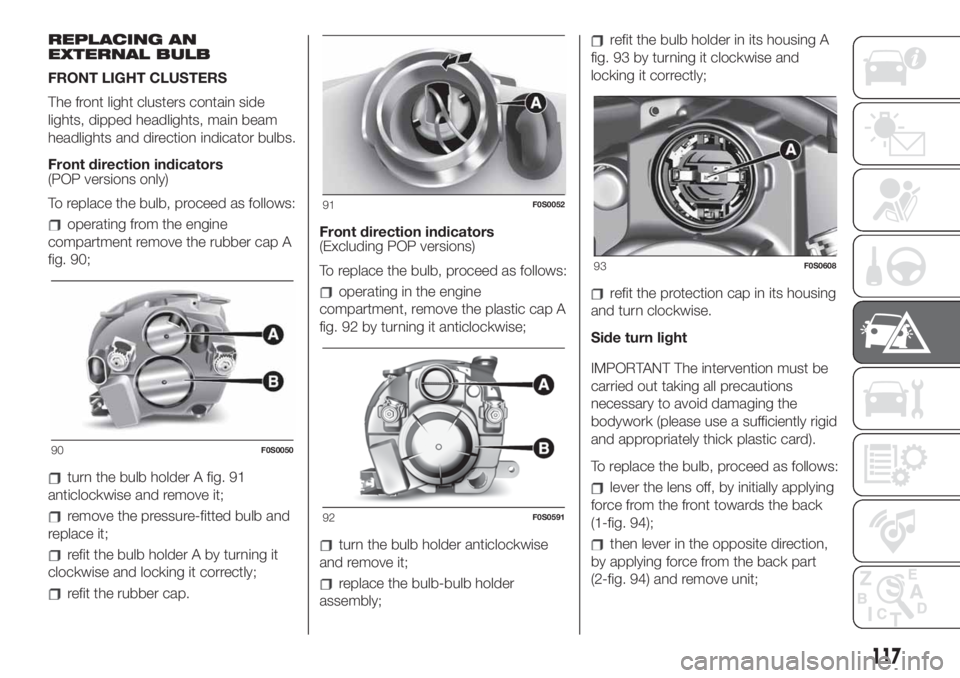
operating from the engine
compartment remove the rubber cap A
fig. 90;
turn the bulb holder A fig. 91
anticlockwise and remove it;
remove the pressure-fitted bulb and
replace it;
refit the bulb holder A by turning it
clockwise and locking it correctly;
refit the rubber cap.Front direction indicators
(Excluding POP versions)
To replace the bulb, proceed as follows:
operating in the engine
compartment, remove the plastic cap A
fig. 92 by turning it anticlockwise;
turn the bulb holder anticlockwise
and remove it;
replace the bulb-bulb holder
assembly;
refit the bulb holder in its housing A
fig. 93 by turning it clockwise and
locking it correctly;
refit the protection cap in its housing
and turn clockwise.
Side turn light
IMPORTANT The intervention must be
carried out taking all precautions
necessary to avoid damaging the
bodywork (please use a sufficiently rigid
and appropriately thick plastic card).
To replace the bulb, proceed as follows:
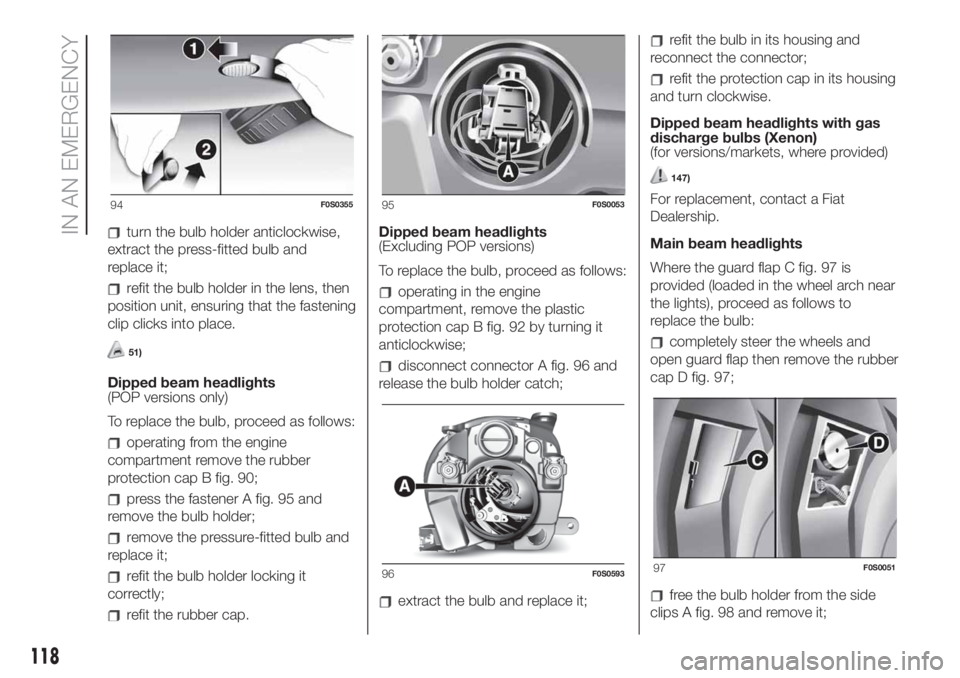
lever the lens off, by initially applying
force from the front towards the back
(1-fig. 94);
then lever in the opposite direction,
by applying force from the back part
(2-fig. 94) and remove unit;
90F0S0050
91F0S0052
92F0S0591
93F0S0608
117
Page 120 of 228
turn the bulb holder anticlockwise,
extract the press-fitted bulb and
replace it;
refit the bulb holder in the lens, then
position unit, ensuring that the fastening
clip clicks into place.
51)
Dipped beam headlights
(POP versions only)
To replace the bulb, proceed as follows:
operating from the engine
compartment remove the rubber
protection cap B fig. 90;
press the fastener A fig. 95 and
remove the bulb holder;
remove the pressure-fitted bulb and
replace it;
refit the bulb holder locking it
correctly;
refit the rubber cap.Dipped beam headlights
(Excluding POP versions)
To replace the bulb, proceed as follows:
operating in the engine
compartment, remove the plastic
protection cap B fig. 92 by turning it
anticlockwise;
disconnect connector A fig. 96 and
release the bulb holder catch;
extract the bulb and replace it;
refit the bulb in its housing and
reconnect the connector;
refit the protection cap in its housing
and turn clockwise.
Dipped beam headlights with gas
discharge bulbs (Xenon)
(for versions/markets, where provided)
147)
For replacement, contact a Fiat
Dealership.
Main beam headlights
Where the guard flap C fig. 97 is
provided (loaded in the wheel arch near
the lights), proceed as follows to
replace the bulb:
completely steer the wheels and
open guard flap then remove the rubber
cap D fig. 97;
free the bulb holder from the side
clips A fig. 98 and remove it;
94F0S035595F0S0053
96F0S059397F0S0051
118
IN AN EMERGENCY
Page 123 of 228
WARNING
143)Modifications or repairs to the electric
system that are not carried out properly
or do not take the system technical
specifications into account can cause
malfunctions leading to the risk of fire.
144)Halogen bulbs contain pressurised
gas, in the case of breakage they may
burst causing glass fragments to be
projected outwards.
145)Only replace the light bulbs when the
engine is off and in a position that does
not interfere with traffic and lets you safely
replace them (see the description in the
“Replacement” paragraph). Also ensure
that the engine is cold, to prevent the risk
of burns.
146)Before replacing the bulb, wait for the
exhaust ducts to cool down: DANGER
OF SCALDING!147)Due to the high power supply voltage,
gas discharge bulbs (Xenon) should only
be replaced by specialised personnel:
danger of death! Contact a Fiat Dealership.
WARNING
49)Halogen bulbs must be handled
holding the metallic part only. Touching the
transparent part of the bulb with your
fingers may reduce the intensity of the
emitted light and even reduce the lifespan
of the bulb. In the event of accidental
contact, wipe the bulb with a cloth
moistened with alcohol and let the bulb
dry.
50)Where possible, it is advisable to have
bulbs changed at a Fiat Dealership. The
correct operation and direction of the
external lights are absolutely essential for
the safety of the car and of compliance
with the law.
51)The intervention must be carried out
taking all precautions necessary to avoid
damaging the bodywork (please use a
sufficiently rigid and appropriately thick
plastic card).
REPLACING FUSES
148) 149) 150) 151) 152) 153)
DASHBOARD FUSE BOX
To access the fuses you must remove
the press-fitted cover A fig. 107.
The 5 A fuse B for door mirror
demisting is located in the diagnosis
socket area, as shown in fig. 108.
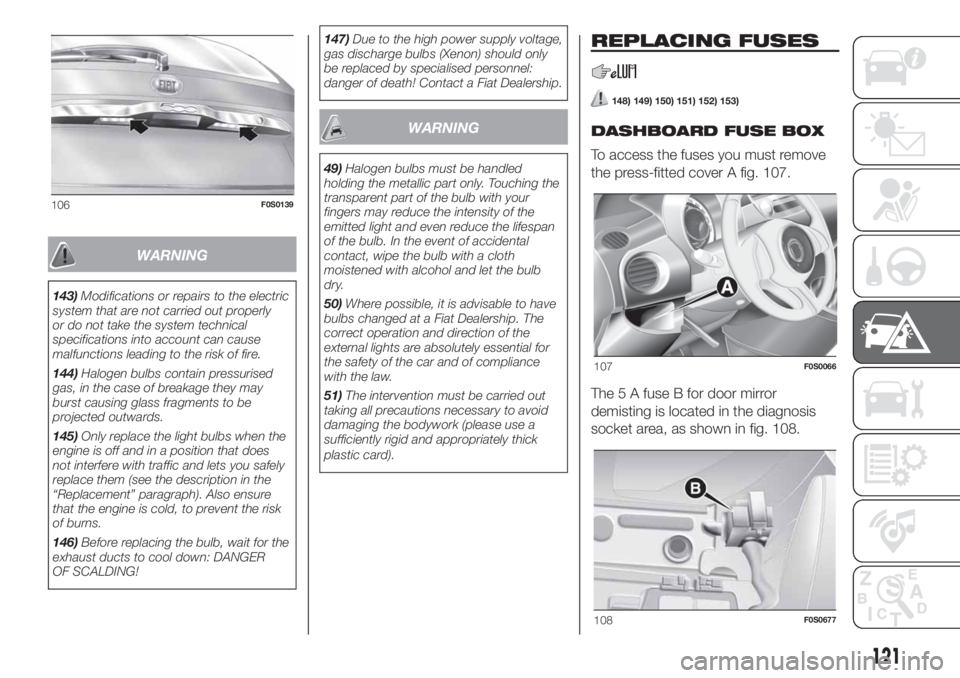
106F0S0139
107F0S0066
108F0S0677
121
Page 127 of 228
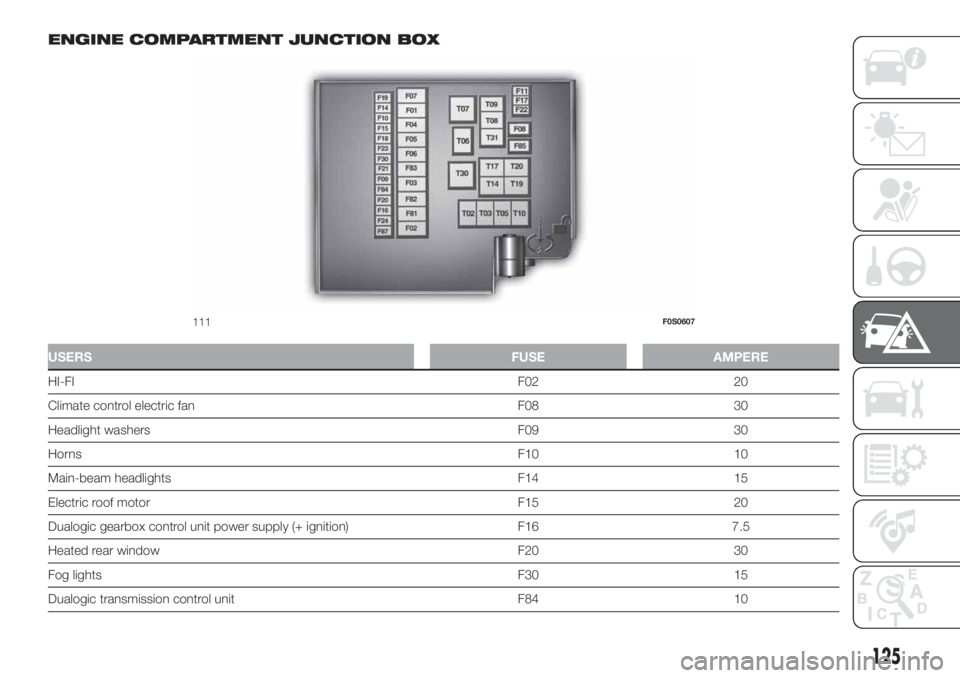
ENGINE COMPARTMENT JUNCTION BOX
USERSFUSE AMPERE
HI-FIF02 20
Climate control electric fan F08 30
Headlight washers F09 30
HornsF10 10
Main-beam headlights F14 15
Electric roof motor F15 20
Dualogic gearbox control unit power supply (+ ignition) F16 7.5
Heated rear window F20 30
Fog lightsF30 15
Dualogic transmission control unit F84 10
111F0S0607
125
Page 134 of 228
REPAIR PROCEDURE
Proceed as follows:
stop the car in a position that is not
dangerous for oncoming traffic where
you can carry out the procedure safely.
The ground must be flat and sufficiently
compact;
stop the engine, engage the hazard
warning lights and the parking brake;
wear the reflective safety jacket
before getting out of the car (anyway
comply with the laws in force in the
country you are driving in);
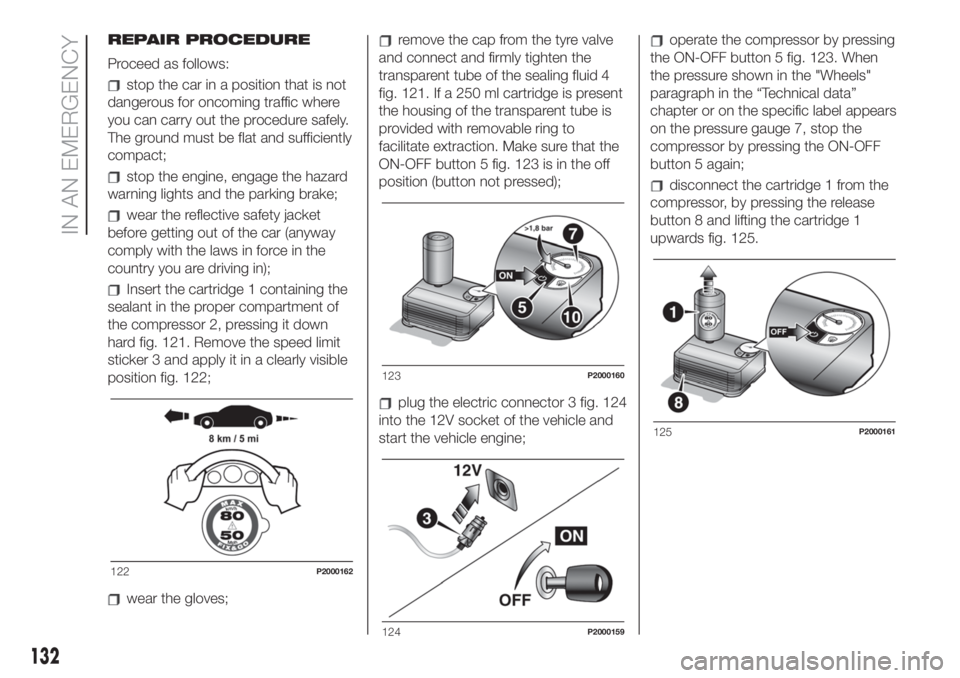
Insert the cartridge 1 containing the
sealant in the proper compartment of
the compressor 2, pressing it down
hard fig. 121. Remove the speed limit
sticker 3 and apply it in a clearly visible
position fig. 122;
wear the gloves;
remove the cap from the tyre valve
and connect and firmly tighten the
transparent tube of the sealing fluid 4
fig. 121. If a 250 ml cartridge is present
the housing of the transparent tube is
provided with removable ring to
facilitate extraction. Make sure that the
ON-OFF button 5 fig. 123 is in the off
position (button not pressed);
plug the electric connector 3 fig. 124
into the 12V socket of the vehicle and
start the vehicle engine;
operate the compressor by pressing
the ON-OFF button 5 fig. 123. When
the pressure shown in the "Wheels"
paragraph in the “Technical data”
chapter or on the specific label appears
on the pressure gauge 7, stop the
compressor by pressing the ON-OFF
button 5 again;
disconnect the cartridge 1 from the
compressor, by pressing the release
button 8 and lifting the cartridge 1
upwards fig. 125.
122P2000162
123P2000160
124P2000159
125P2000161
132
IN AN EMERGENCY
Page 137 of 228
WARNING
166)This starting procedure must be
performed by expert personnel because
incorrect actions could cause electrical
discharge of considerable intensity.
Furthermore, battery fluid is poisonous and
corrosive: avoid contact with skin and
eyes. Keep naked flames and lighted
cigarettes away from the battery and do
not cause sparks.
167)Remove any metal objects (e.g. rings,
watches, bracelets), that might cause an
accidental electrical contact and cause
serious injury.
168)Do not attempt to charge a frozen
battery: it must be thawed first, otherwise it
may explode. If freezing has occurred, the
battery should be checked by skilled
personnel to make sure that the internal
elements are not damaged and that the
body is not cracked, with the risk of leaking
poisonous and corrosive acid.
WARNING
56)Never use a fast battery-charger to
start the engine as this could damage the
electronic systems of your vehicle,
particularly the ignition and engine fuel
supply control units.57)Do not connect the cable to the
negative terminal (–) of the flat battery. The
following spark could lead to battery
explosion and cause serious harm. Only
use the specific earth point; do not use any
other exposed metallic part.
58)Never bump start the engine by
pushing, towing or coasting downhill. This
could cause fuel to flow into the catalytic
converter and damage it beyond repair.
FUEL CUT-OFF
SYSTEM
169)
This intervenes in the case of an impact
causing:
the fuel supply cut-off with the
engine consequently switching off
the automatic unlocking of the doors
turning on of the lights inside the
vehicle;
The intervention of the system is
indicated by a message shown on the
display.
IMPORTANT Carefully check the car for
fuel leaks, for instance in the engine
compartment, under the car or near the
tank area. After a collision, turn the
ignition key to STOP position to prevent
the battery from running down.
To restore the correct operation of the
vehicle, proceed as follows:
turn the ignition key to the MAR-ON
position
activate the right direction indicator
deactivate the right direction
indicator
activate the left direction indicator
deactivate the left direction indicator
135
Page 142 of 228
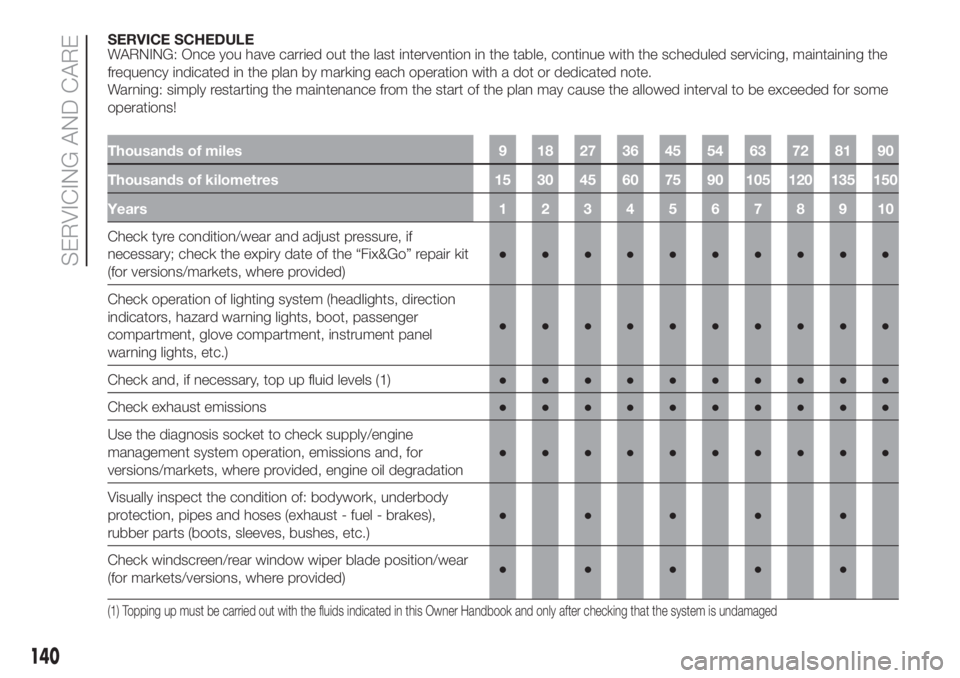
SERVICE SCHEDULE
WARNING: Once you have carried out the last intervention in the table, continue with the scheduled servicing, maintaining the
frequency indicated in the plan by marking each operation with a dot or dedicated note.
Warning: simply restarting the maintenance from the start of the plan may cause the allowed interval to be exceeded for some
operations!
Thousands of miles 9 18 27 36 45 54 63 72 81 90
Thousands of kilometres 15 30 45 60 75 90 105 120 135 150
Years12345678910
Check tyre condition/wear and adjust pressure, if
necessary; check the expiry date of the “Fix&Go” repair kit
(for versions/markets, where provided)●●●●●●●●●●
Check operation of lighting system (headlights, direction
indicators, hazard warning lights, boot, passenger
compartment, glove compartment, instrument panel
warning lights, etc.)●●●●●●●●●●
Check and, if necessary, top up fluid levels (1)●●●●●●●●●●
Check exhaust emissions●●●●●●●●●●
Use the diagnosis socket to check supply/engine
management system operation, emissions and, for
versions/markets, where provided, engine oil degradation●●●●●●●●●●
Visually inspect the condition of: bodywork, underbody
protection, pipes and hoses (exhaust - fuel - brakes),
rubber parts (boots, sleeves, bushes, etc.)●●●●●
Check windscreen/rear window wiper blade position/wear
(for markets/versions, where provided)●●●●●
(1) Topping up must be carried out with the fluids indicated in this Owner Handbook and only after checking that the system is undamaged
140
SERVICING AND CARE
Page 146 of 228
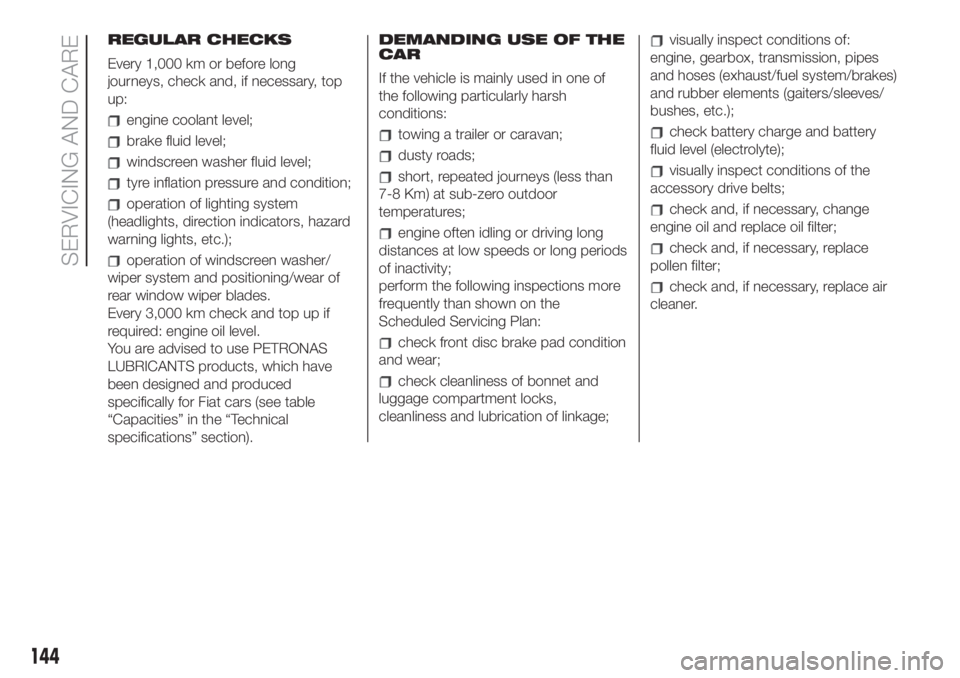
REGULAR CHECKS
Every 1,000 km or before long
journeys, check and, if necessary, top
up:
engine coolant level;
brake fluid level;
windscreen washer fluid level;
tyre inflation pressure and condition;
operation of lighting system
(headlights, direction indicators, hazard
warning lights, etc.);
operation of windscreen washer/
wiper system and positioning/wear of
rear window wiper blades.
Every 3,000 km check and top up if
required: engine oil level.
You are advised to use PETRONAS
LUBRICANTS products, which have
been designed and produced
specifically for Fiat cars (see table
“Capacities” in the “Technical
specifications” section).DEMANDING USE OF THE
CAR
If the vehicle is mainly used in one of
the following particularly harsh
conditions:
towing a trailer or caravan;
dusty roads;
short, repeated journeys (less than
7-8 Km) at sub-zero outdoor
temperatures;
engine often idling or driving long
distances at low speeds or long periods
of inactivity;
perform the following inspections more
frequently than shown on the
Scheduled Servicing Plan:
check front disc brake pad condition
and wear;
check cleanliness of bonnet and
luggage compartment locks,
cleanliness and lubrication of linkage;
visually inspect conditions of:
engine, gearbox, transmission, pipes
and hoses (exhaust/fuel system/brakes)
and rubber elements (gaiters/sleeves/
bushes, etc.);
check battery charge and battery
fluid level (electrolyte);
visually inspect conditions of the
accessory drive belts;
check and, if necessary, change
engine oil and replace oil filter;
check and, if necessary, replace
pollen filter;
check and, if necessary, replace air
cleaner.
144
SERVICING AND CARE