steering FIAT 500 ABARTH 2012 2.G Owner's Guide
[x] Cancel search | Manufacturer: FIAT, Model Year: 2012, Model line: 500 ABARTH, Model: FIAT 500 ABARTH 2012 2.GPages: 358, PDF Size: 2.59 MB
Page 212 of 358
WARNING!
There may be situations on minor hills (i.e., less than
2.5%), with a loaded vehicle, or while pulling a
trailer, when the system will not activate and slight
rolling may occur. This could cause a collision with
another vehicle or object. Always remember the
driver is responsible for braking the vehicle.
Disabling/Enabling HSA
If you wish to turn the HSA system on or off, it can be
done using the Customer Programmable Features in the
Electronic Vehicle Information Center (EVIC). Refer to
“Electronic Vehicle Information Center (EVIC)” in “Un-
derstanding Your Instrument Panel” for further
information.
Electronic Stability Control (ESC)
This system enhances directional control and stability of
the vehicle under various driving conditions. ESC cor-
rects for oversteering or understeering of the vehicle by
applying the brake of the appropriate wheel to assist in
counteracting the oversteering or understeering condi-
tion. Engine power may also be reduced to help the
vehicle maintain the desired path. ESC uses sensors in
the vehicle to determine the vehicle path intended by the
driver and compares it to the actual path of the vehicle.
When the actual path does not match the intended path,
ESC applies the brake of the appropriate wheel to assist
in counteracting the oversteer or understeer condition.
•Oversteer - when the vehicle is turning more than
appropriate for the steering wheel position.
•Understeer - when the vehicle is turning less than
appropriate for the steering wheel position.
210 STARTING AND OPERATING
Page 225 of 358
WARNING!
Overloading of your tires is dangerous. Overloading
can cause tire failure, affect vehicle handling, and
increase your stopping distance. Use tires of the
recommended load capacity for your vehicle. Never
overload them.
TIRES — GENERAL INFORMATION
Tire Pressure
Proper tire inflation pressure is essential to the safe and
satisfactory operation of your vehicle. Three primary
areas are affected by improper tire pressure:
Safety
WARNING!
•Improperly inflated tires are dangerous and can
cause accidents.
•Under-inflation increases tire flexing and can re-
sult in over-heating and tire failure.
•Over-inflation reduces a tire’s ability to cushion
shock. Objects on the road and chuckholes can
cause damage that result in tire failure.
•Unequal tire pressures can cause steering prob-
lems. You could lose control of your vehicle.
•Over-inflated or under-inflated tires can affect
vehicle handling and can fail suddenly, resulting
in loss of vehicle control.(Continued)
5
STARTING AND OPERATING 223
Page 233 of 358
WARNING!
•Do not use a tire, wheel size or rating other than
that specified for your vehicle. Some combinations
of unapproved tires and wheels may change sus-
pension dimensions and performance characteris-
tics, resulting in changes to steering, handling, and
braking of your vehicle. This can cause unpredict-
able handling and stress to steering and suspen-
sion components. You could lose control and have
an accident resulting in serious injury or death.
Use only the tire and wheel sizes with load ratings
approved for your vehicle.
•Never use a tire with a smaller load index or
capacity other than what was originally equipped
on your vehicle. Using a tire with a smaller load
index could result in tire overloading and failure.
You could lose control and have an accident.(Continued)
WARNING! (Continued)
•Failure to equip your vehicle with tires having
adequate speed capability can result in sudden tire
failure and loss of vehicle control.
CAUTION!
Replacing original tires with tires of a different size
may result in false speedometer and odometer read-
ings.
5
STARTING AND OPERATING 231
Page 234 of 358
TIRE CHAINS
Due to limited clearance, tire chains are not recom-
mended.
CAUTION!
Damage to the vehicle may result if tire chains are
used.
TIRE ROTATION RECOMMENDATIONS
The tires on the front and rear of your vehicle operate at
different loads and perform different steering, driving,
and braking functions. For these reasons, they wear at
unequal rates and tend to develop irregular wear pat-
terns.These effects can be reduced by timely rotation of tires.
The benefits of rotation are especially worthwhile with
aggressive tread designs such as those on all season type
tires. Rotation will increase tread life, help to maintain
mud, snow and wet traction levels, and contribute to a
smooth, quiet ride.
Refer to the “Maintenance Schedule” for the proper
maintenance intervals. More frequent rotation is permis-
sible if desired. The reasons for any rapid or unusual
wear should be corrected prior to rotation being per-
formed.
232 STARTING AND OPERATING
Page 272 of 358
FREEING A STUCK VEHICLE
If your vehicle becomes stuck in mud, sand or snow, it
can often be moved by a rocking motion. Turn your
steering wheel right and left to clear the area around the
front wheels. Then shift back and forth between 1st gear
and REVERSE. Using minimal accelerator pedal pressure
to maintain the rocking motion, without spinning the
wheels, is most effective.
CAUTION!
Racing the engine or spinning the wheels may lead to
transmission overheating and failure. Allow the en-
gine to idle with the shift lever in NEUTRAL for at
least one minute after every five rocking-motion
cycles. This will minimize overheating and reduce
the risk of clutch or transmission failure during
prolonged efforts to free a stuck vehicle.NOTE:
Turn the Electronic Stability Control (ESC) sys-
tem OFF before attempting to “rock” the vehicle.
CAUTION!
•When “rocking” a stuck vehicle by moving be-
tween 1st gear and REVERSE, do not spin the
wheels faster than 15 mph (24 km/h), or drivetrain
damage may result.
•Revving the engine or spinning the wheels too fast
may lead to transmission or clutch overheating
and failure. It can also damage the tires. Do not
spin the wheels above 30 mph (48 km/h) while in
gear (no transmission shifting occurring).
270 WHAT TO DO IN EMERGENCIES
Page 273 of 358
WARNING!
Fast spinning tires can be dangerous. Forces gener-
ated by excessive wheel speeds may cause damage, or
even failure, of the axle and tires. A tire could
explode and injure someone. Do not spin your vehi-
cle’s wheels faster than 30 mph (48 km/h) or for
longer than 30 seconds continuously without stop-
ping when you are stuck and do not let anyone near
a spinning wheel, no matter what the speed.
TOWING A DISABLED VEHICLE
With Ignition Key
Manual Transmission
•
Vehicle can be flat towed (all four wheels on the
ground) with the transmission in NEUTRAL.
•Vehicle can be towed with the front wheels elevated.
•Vehicle can be towed on a flatbed truck (all wheels off
the ground).
If it is necessary to use the accessories while being towed
(wipers, defrosters, etc.), the key must be in the ON/
RUN position. Make certain the transmission remains in
NEUTRAL.
CAUTION!
•If the vehicle being towed requires steering, the
ignition switch must be in the ON/RUN position.
•Do not attempt to use sling-type equipment when
towing. When securing the vehicle to a flatbed
truck, do not attach to front or rear suspension
components. Damage to your vehicle may result
from improper towing.6
WHAT TO DO IN EMERGENCIES 271
Page 310 of 358
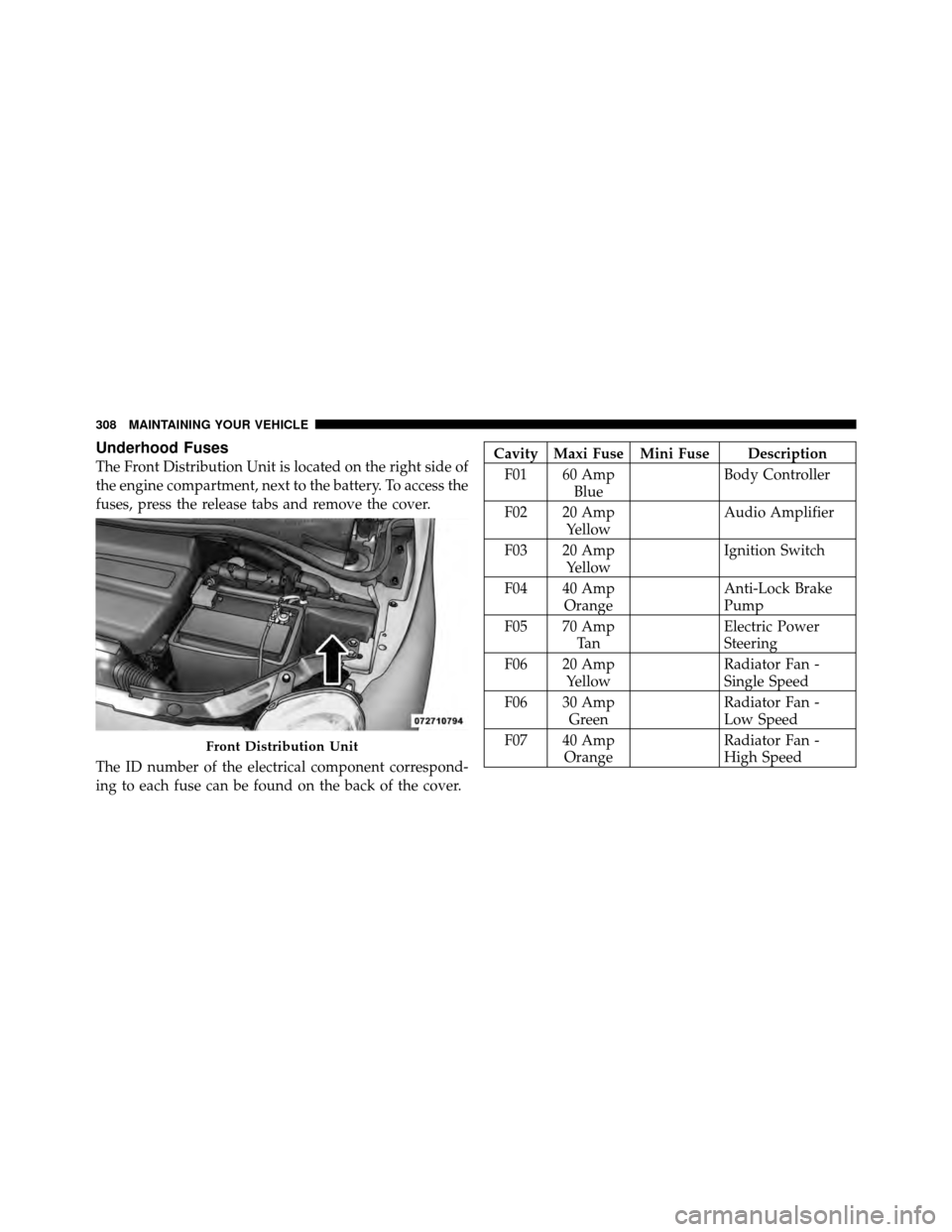
Underhood Fuses
The Front Distribution Unit is located on the right side of
the engine compartment, next to the battery. To access the
fuses, press the release tabs and remove the cover.
The ID number of the electrical component correspond-
ing to each fuse can be found on the back of the cover.Cavity Maxi Fuse Mini Fuse DescriptionF01 60 Amp Blue Body Controller
F02 20 Amp Yellow Audio Amplifier
F03 20 Amp Yellow Ignition Switch
F04 40 Amp Orange Anti-Lock Brake
Pump
F05 70 Amp Ta n Electric Power
Steering
F06 20 Amp Yellow Radiator Fan -
Single Speed
F06 30 Amp Green Radiator Fan -
Low Speed
F07 40 Amp Orange Radiator Fan -
High Speed
Front Distribution Unit
308 MAINTAINING YOUR VEHICLE
Page 314 of 358
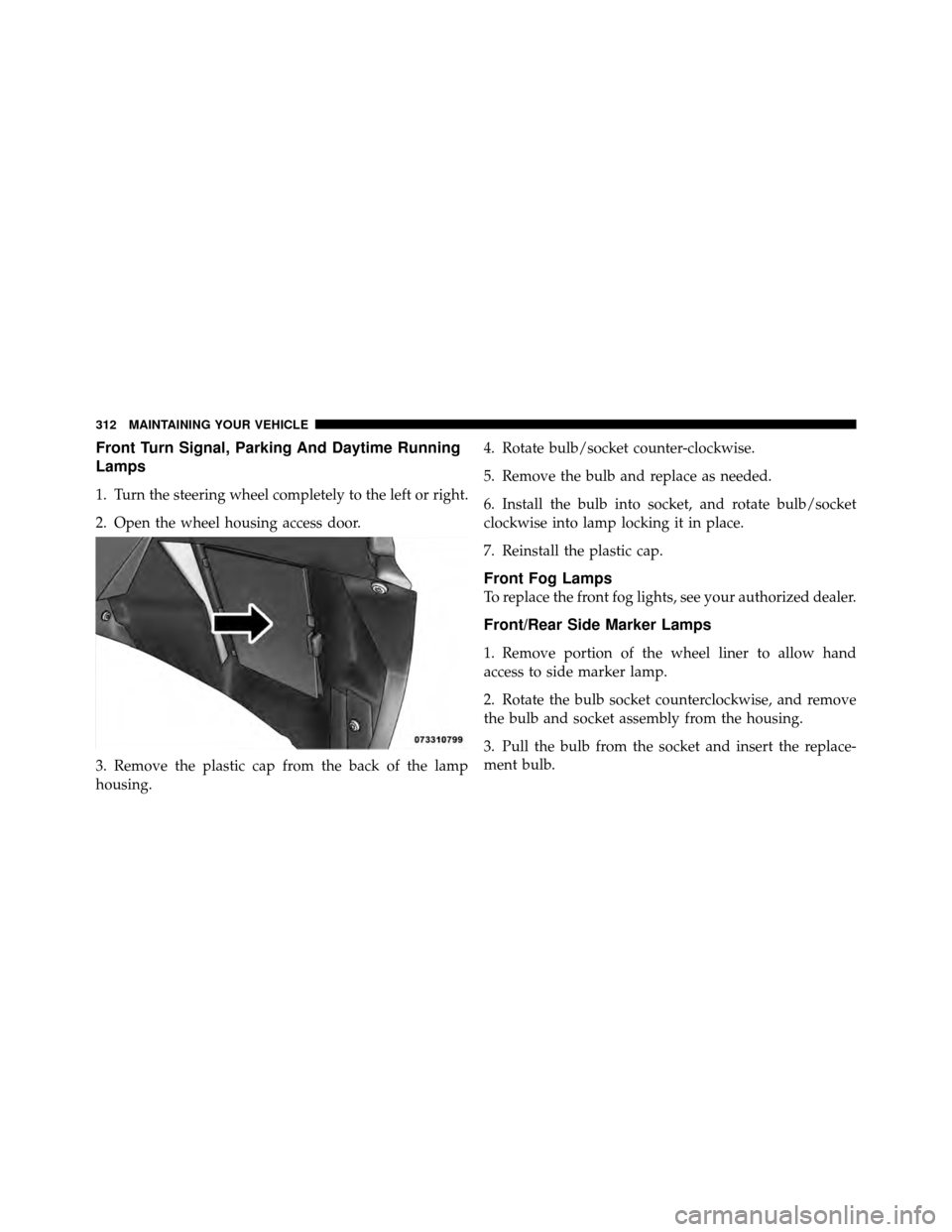
Front Turn Signal, Parking And Daytime Running
Lamps
1. Turn the steering wheel completely to the left or right.
2. Open the wheel housing access door.
3. Remove the plastic cap from the back of the lamp
housing.4. Rotate bulb/socket counter-clockwise.
5. Remove the bulb and replace as needed.
6. Install the bulb into socket, and rotate bulb/socket
clockwise into lamp locking it in place.
7. Reinstall the plastic cap.
Front Fog Lamps
To replace the front fog lights, see your authorized dealer.
Front/Rear Side Marker Lamps
1. Remove portion of the wheel liner to allow hand
access to side marker lamp.
2. Rotate the bulb socket counterclockwise, and remove
the bulb and socket assembly from the housing.
3. Pull the bulb from the socket and insert the replace-
ment bulb.
312 MAINTAINING YOUR VEHICLE
Page 352 of 358
Onboard Diagnostic System................ 276
Operator Manual (Owner’s Manual) ............ 4
Overheating, Engine ................... 133,248
Owner’s Manual (Operator Manual) .........4,336
Paint Care ............................. 300
Parking Brake .......................... 202
Pets .................................. 63
Placard, Tire and Loading Information ......... 219
Power Door Locks ......................... 20
Mirrors ............................ 74
Outlet (Auxiliary Electrical Outlet) ........ 112
Steering ........................... 202
Sunroof ........................... 109
Windows ........................... 22
Power Steering Fluid ..................... 316
Pregnant Women and Seat Belts .............. 37
Preparation for Jacking .................... 260 Pretensioners
Seat Belts ........................... 35
Radial Ply Tires ......................... 226
Radio (Sound Systems) .................... 151
Radio Operation ...................... 151,179
Radio Reception ........................ 151
Rear Liftgate (Sedan) ...................... 23
Recorder, Event Data ...................... 52
Recreational Towing ...................... 245
Refrigerant ............................ 286
Release, Hood ........................... 89
Reminder, Seat Belt ....................... 35
Remote Sound System (Radio) Controls ........ 177
Replacement Keys ........................ 14
Replacement Parts ....................... 278
Replacement Tires ....................... 230
Reporting Safety Defects ................... 335
Restraints, Child ....................... 53,58
350 INDEX
Page 354 of 358
Sport Mode............................ 204
Starting ............................... 196
Cold Weather ....................... 197
Engine Fails to Start .................. 198
Manual Transmission .................. 196
Steering Power ............................ 202
Tilt Column ........................ 100
Wheel, Tilt ......................... 100
Steering Wheel Audio Controls .............. 177
Steering Wheel Mounted Sound System
Controls .............................. 177
Storage ............................... 310
Storage, Vehicle ...................... 191,310
Storing Your Vehicle ...................... 310
Stuck, Freeing .......................... 270
Sun Roof .............................. 109
Supplemental Restraint System - Airbag ........ 37Tachometer
............................ 135
Temperature Control, Automatic (ATC) ........ 184
Temperature Gauge, Engine Coolant .......133,249
Tether Anchor, Child Restraint ............... 57
Tilt Steering Column ..................... 100
Tire and Loading Information Placard ......... 219
Tire Identification Number (TIN) ............. 217
Tire Markings .......................... 214
Tire Safety Information .................... 214
TIREFIT .............................. 249
Tires ............................ 68,223,337
Aging (Life of Tires) .................. 229
Air Pressure ........................ 223
Chains ............................ 232
Changing .......................... 259
General Information .................. 223
High Speed ......................... 225
Inflation Pressures .................... 224
Jacking ............................ 259
352 INDEX