cooling FIAT 500 ABARTH 2014 2.G User Guide
[x] Cancel search | Manufacturer: FIAT, Model Year: 2014, Model line: 500 ABARTH, Model: FIAT 500 ABARTH 2014 2.GPages: 392, PDF Size: 8.74 MB
Page 332 of 392
Coolant Checks
Check engine coolant (antifreeze) protection every 12
months (before the onset of freezing weather, where
applicable). If the engine coolant (antifreeze) is dirty or
rusty in appearance, the system should be drained,
flushed and refilled with fresh engine coolant (anti-
freeze). Check the front of the A/C condenser for any
accumulation of bugs, leaves, etc. If dirty, clean by gently
spraying water from a garden hose vertically down the
face of the condenser.
Cooling System — Drain, Flush, And Refill
If the engine coolant (antifreeze) is dirty or contains
visible sediment, have an authorized dealer clean and
flush with OAT coolant (antifreeze) (conforming to MS-
12106).
Refer to the “Maintenance Schedule” for the proper
maintenance intervals.
NOTE:Some vehicles require special tools to add cool-
ant properly. Failure to fill these systems properly could
lead to severe internal engine damage. If any coolant is
needed to be added to the system please contact your
local authorized dealer.
Selection Of Coolant
Refer to “Fluids, Lubricants, and Genuine Parts” in
“Maintaining Your Vehicle” for further information.
330 MAINTAINING YOUR VEHICLE
Page 333 of 392
CAUTION!
•Mixing of engine coolant (antifreeze) other than
specified Organic Additive Technology (OAT) en-
gine coolant (antifreeze), may result in engine
damage and may decrease corrosion protection.
Organic Additive Technology (OAT) engine cool-
ant is different and should not be mixed with
Hybrid Organic Additive Technology (HOAT) en-
gine coolant (antifreeze) or any “globally compat-
ible” coolant (antifreeze). If a non-OAT engine
coolant (antifreeze) is introduced into the cooling
system in an emergency, the cooling system will
need to be drained, flushed, and refilled with fresh
OAT coolant (conforming to MS-12106), by an
authorized dealer as soon as possible.
(Continued)
CAUTION!(Continued)
•Do not use water alone or alcohol-based engine
coolant (antifreeze) products. Do not use additional
rust inhibitors or antirust products, as they may not
be compatible with the radiator engine coolant and
may plug the radiator.
•This vehicle has not been designed for use with
propylene glycol-based engine coolant (antifreeze).
Use of propylene glycol-based engine coolant (an-
tifreeze) is not recommended.
Adding Coolant
Your vehicle has been built with an improved engine
coolant (OAT coolant conforming to MS-12106) that
allows extended maintenance intervals. This engine cool-
ant (antifreeze) can be used up to ten years or 150,000
miles (240,000 km) before replacement. To prevent reduc-
ing this extended maintenance period, it is important that
7
MAINTAINING YOUR VEHICLE 331
Page 334 of 392
you use the same engine coolant (OAT coolant conform-
ing to MS-12106) throughout the life of your vehicle.
Please review these recommendations for using Organic
Additive Technology (OAT) engine coolant (antifreeze)
that meets the requirements of Chrysler Material Stan-
dard MS-12106. When adding engine coolant (antifreeze):
•We recommend using MOPAR® Antifreeze/Coolant
10 Year/150,000 Mile Formula OAT (Organic Additive
Technology) that meets the requirements of Chrysler
Material Standard MS-12106.
•Mix a minimum solution of 50% OAT engine coolant
that meets the requirements of Chrysler Material Stan-
dard MS-12106 and distilled water. Use higher concen-
trations (not to exceed 70%) if temperatures below
−34° F (−37° C) are anticipated.
•Use only high purity water such as distilled or deion-
ized water when mixing the water/engine coolant
(antifreeze) solution. The use of lower quality water
will reduce the amount of corrosion protection in the
engine cooling system.
Please note that it is the owner’s responsibility to main-
tain the proper level of protection against freezing ac-
cording to the temperatures occurring in the area where
the vehicle is operated.
NOTE:
•Some vehicles require special tools to add coolant
properly. Failure to fill these systems properly could
lead to severe internal engine damage. If any coolant is
needed to be added to the system please contact your
local authorized dealer.
•Mixing engine coolant (antifreeze) types is not recom-
mended and can result in cooling system damage. If
HOAT and OAT coolant are mixed in an emergency,
332 MAINTAINING YOUR VEHICLE
Page 335 of 392
have a authorized dealer drain, flush, and refill with
OAT coolant (conforming to MS-12106) as soon as
possible.
Cooling System Pressure Cap
The cap must be fully tightened to prevent loss of engine
coolant (antifreeze) and to ensure that engine coolant
(antifreeze) remains pressurized.
The cap should be inspected and cleaned if there is any
accumulation of foreign material on the sealing surfaces.
WARNING!
•The warning words “DO NOT OPEN HOT” on the
cooling system pressure cap are a safety precaution.
Never add engine coolant (antifreeze) when the
engine is overheated. Do not loosen or remove the
cap to cool an overheated engine. Heat causes
pressure to build up in the cooling system. To
prevent scalding or injury, do not remove the
pressure cap while the system is hot or under
pressure.
•Do not use a pressure cap other than the one
specified for your vehicle. Personal injury or en-
gine damage may result.
7
MAINTAINING YOUR VEHICLE 333
Page 337 of 392
•Do not overfill the coolant expansion bottle.
•Check the coolant freeze point in the radiator and in
the coolant expansion bottle. If engine coolant (anti-
freeze) needs to be added, the contents of the coolant
expansion bottle must also be protected against freez-
ing.
•If frequent engine coolant (antifreeze) additions are
required, the cooling system should be pressure tested
for leaks.
•Maintain engine coolant (antifreeze) concentration at a
minimum of 50% OAT coolant (conforming to MS-
12106) and distilled water for proper corrosion protec-
tion of your engine which contains aluminum compo-
nents.
•Make sure that the coolant expansion bottle overflow
hoses are not kinked or obstructed.
•Keep the front of the radiator clean. If your vehicle is
equipped with air conditioning, keep the front of the
condenser clean.
•Do not change the thermostat for Summer or Winter
operation. If replacement is ever necessary, install
ONLY the correct type thermostat. Other designs may
result in unsatisfactory engine coolant (antifreeze)
performance, poor gas mileage, and increased emis-
sions.
Brake System
In order to assure brake system performance, all brake
system components should be inspected periodically.
Refer to the “Maintenance Schedule” for the proper
maintenance intervals.
7
MAINTAINING YOUR VEHICLE 335
Page 352 of 392
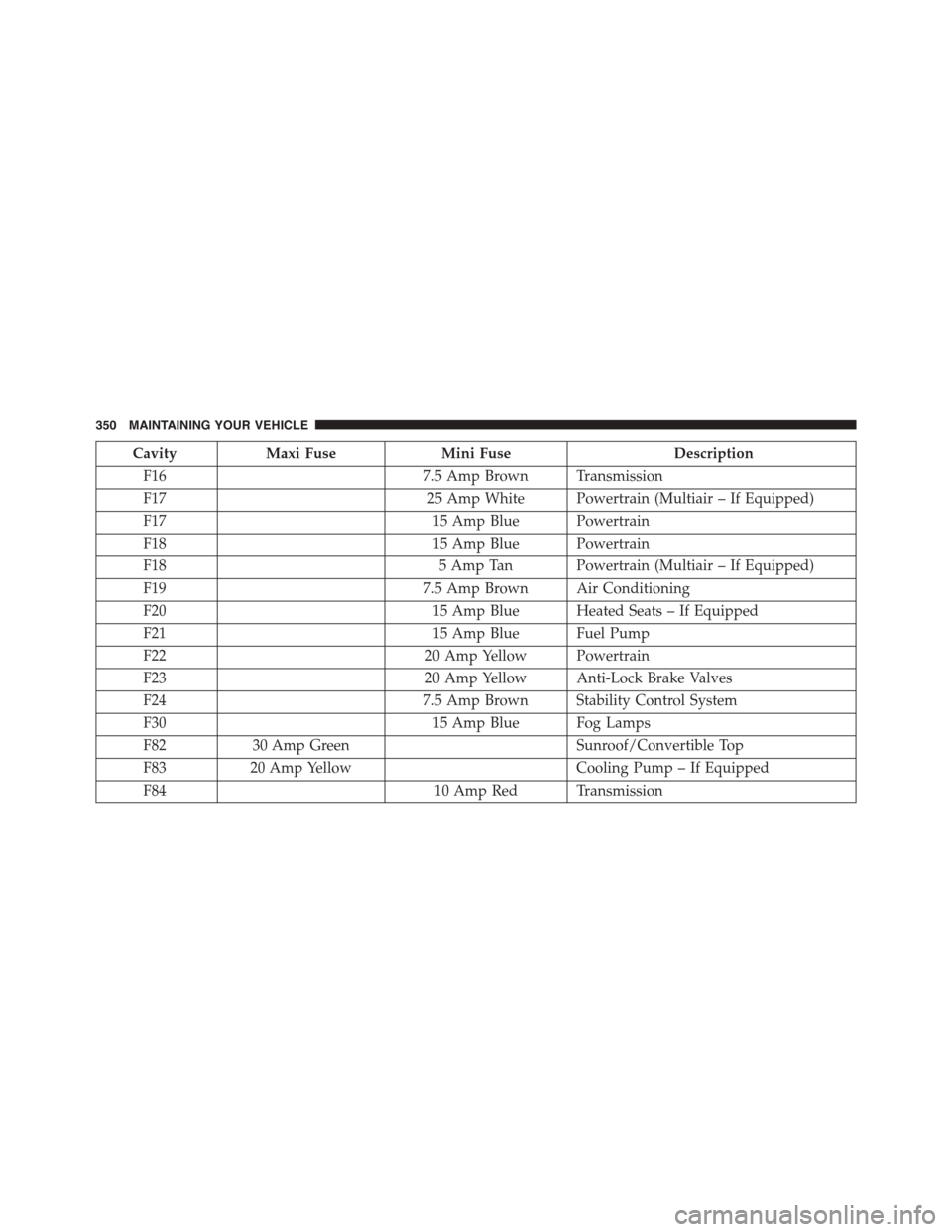
CavityMaxi FuseMini FuseDescription
F167.5 Amp Brown Transmission
F1725 Amp White Powertrain (Multiair – If Equipped)
F1715 Amp Blue Powertrain
F1815 Amp Blue Powertrain
F185 Amp Tan Powertrain (Multiair – If Equipped)
F197.5 Amp Brown Air Conditioning
F2015 Amp Blue Heated Seats – If Equipped
F2115 Amp Blue Fuel Pump
F2220 Amp Yellow Powertrain
F2320 Amp Yellow Anti-Lock Brake Valves
F247.5 Amp Brown Stability Control System
F3015 Amp Blue Fog Lamps
F8230 Amp GreenSunroof/Convertible Top
F8320 Amp YellowCooling Pump – If Equipped
F8410 Amp Red Transmission
350 MAINTAINING YOUR VEHICLE
Page 358 of 392
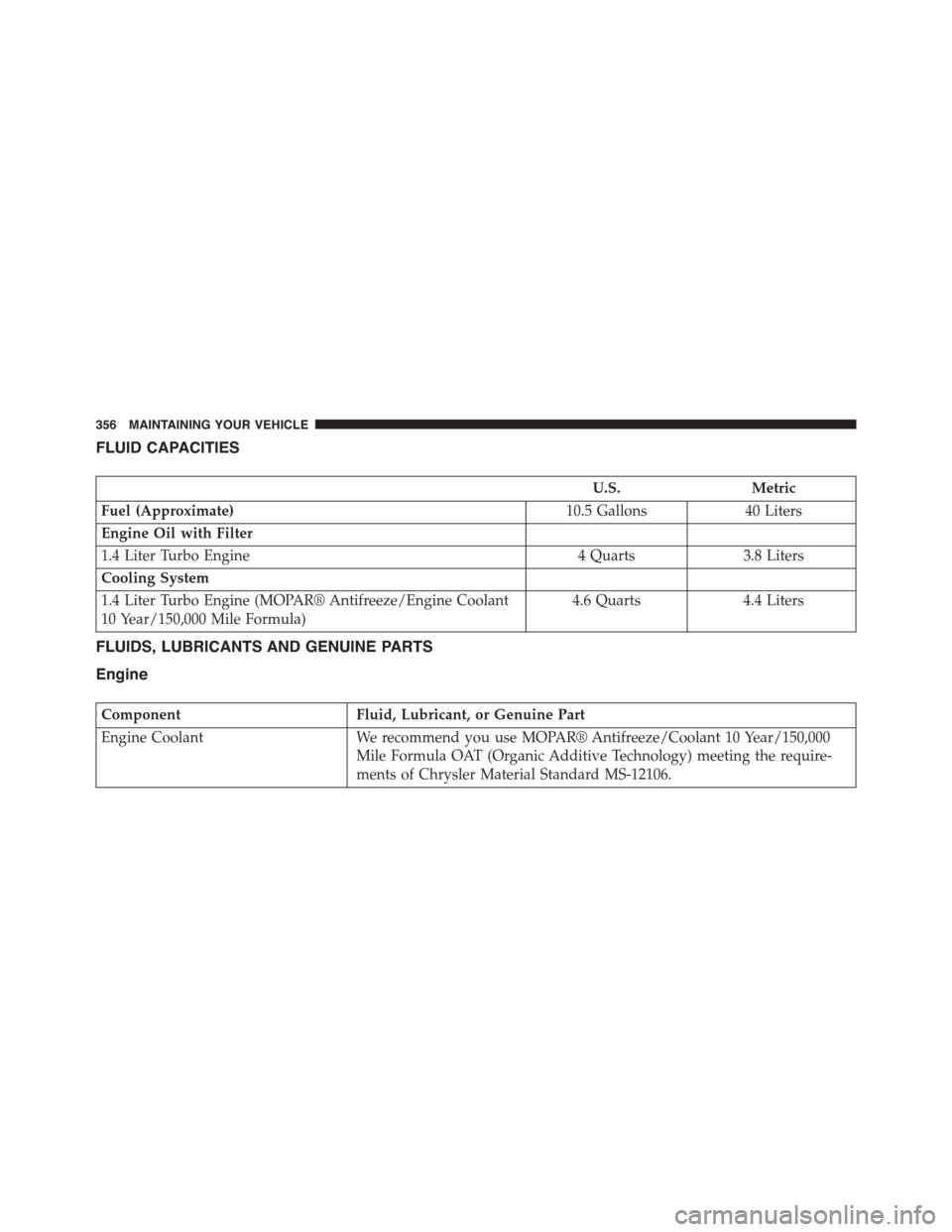
FLUID CAPACITIES
U.S.Metric
Fuel (Approximate)10.5 Gallons40 Liters
Engine Oil with Filter
1.4 Liter Turbo Engine4 Quarts3.8 Liters
Cooling System
1.4 Liter Turbo Engine (MOPAR® Antifreeze/Engine Coolant
10 Year/150,000 Mile Formula)
4.6 Quarts4.4 Liters
FLUIDS, LUBRICANTS AND GENUINE PARTS
Engine
ComponentFluid, Lubricant, or Genuine Part
Engine CoolantWe recommend you use MOPAR® Antifreeze/Coolant 10 Year/150,000
Mile Formula OAT (Organic Additive Technology) meeting the require-
ments of Chrysler Material Standard MS-12106.
356 MAINTAINING YOUR VEHICLE
Page 363 of 392
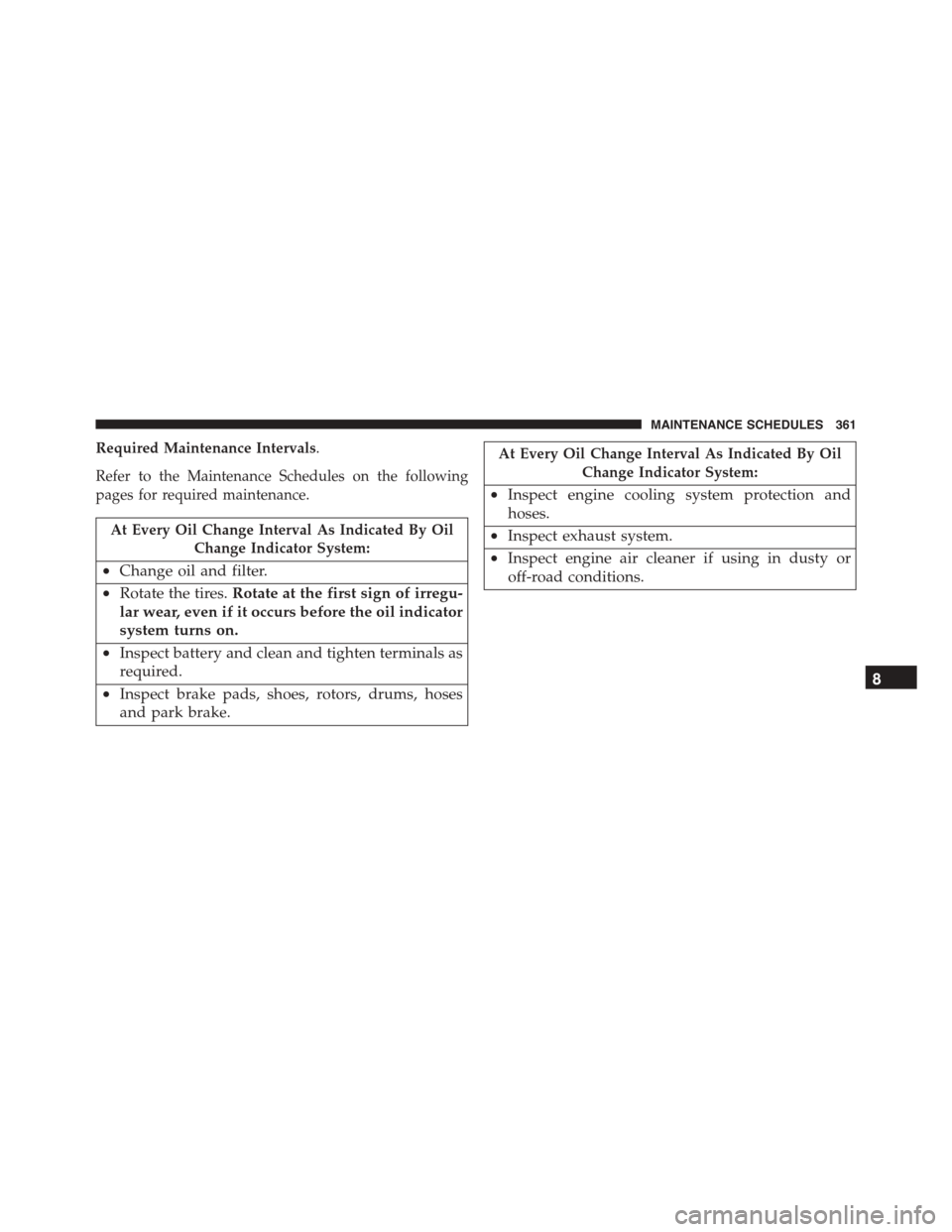
Required Maintenance Intervals.
Refer to the Maintenance Schedules on the following
pages for required maintenance.
At Every Oil Change Interval As Indicated By Oil
Change Indicator System:
•Change oil and filter.
•Rotate the tires.Rotate at the first sign of irregu-
lar wear, even if it occurs before the oil indicator
system turns on.
•Inspect battery and clean and tighten terminals as
required.
•Inspect brake pads, shoes, rotors, drums, hoses
and park brake.
At Every Oil Change Interval As Indicated By Oil
Change Indicator System:
•Inspect engine cooling system protection and
hoses.
•Inspect exhaust system.
•Inspect engine air cleaner if using in dusty or
off-road conditions.
8
MAINTENANCE SCHEDULES 361
Page 380 of 392
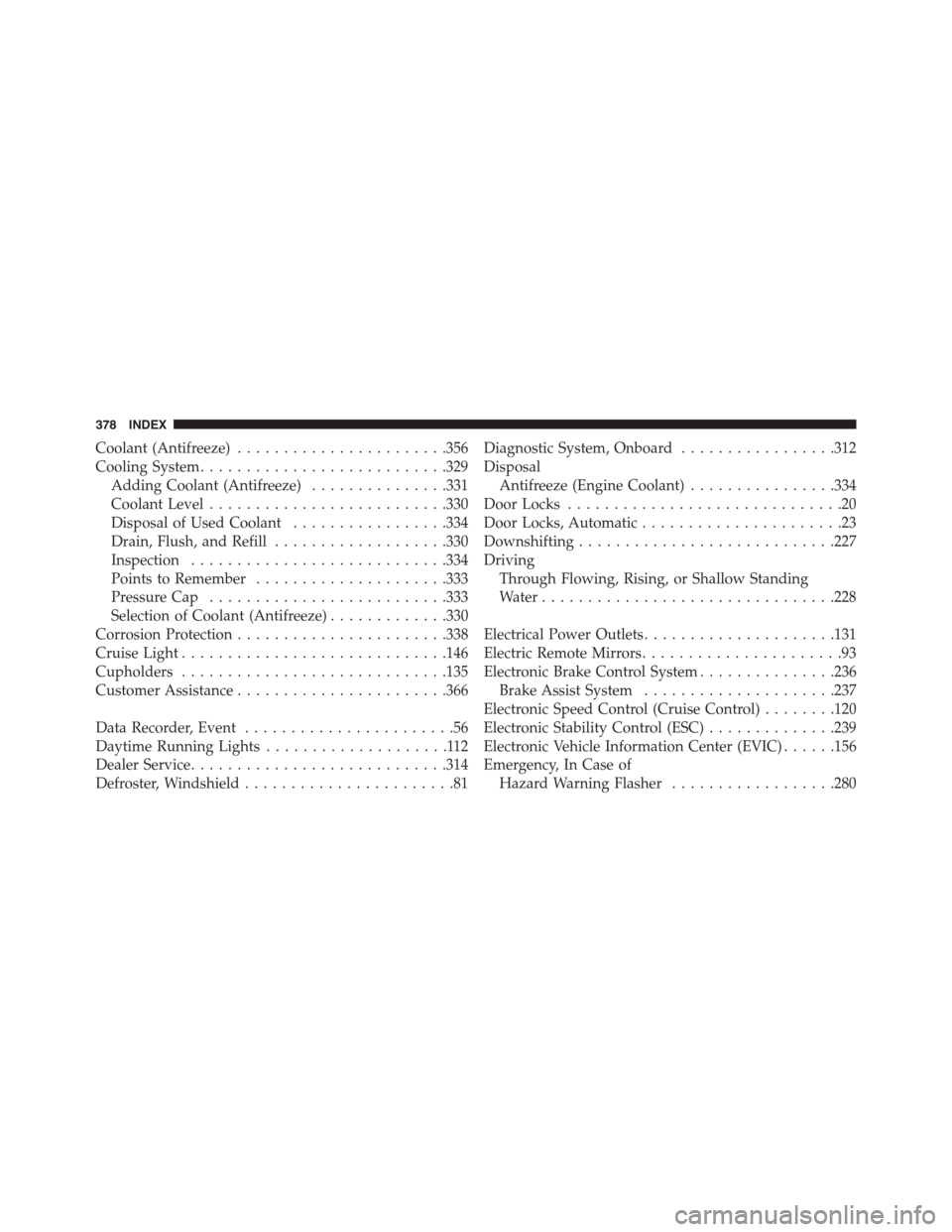
Coolant (Antifreeze).......................356
Cooling System...........................329
Adding Coolant (Antifreeze)...............331
Coolant Level..........................330
Disposal of Used Coolant.................334
Drain, Flush, and Refill...................330
Inspection............................334
Points to Remember.....................333
Pressure Cap..........................333
Selection of Coolant (Antifreeze).............330
Corrosion Protection.......................338
Cruise Light.............................146
Cupholders.............................135
Customer Assistance.......................366
Data Recorder, Event.......................56
Daytime Running Lights....................112
Dealer Service............................314
Defroster, Windshield.......................81
Diagnostic System, Onboard.................312
Disposal
Antifreeze (Engine Coolant)................334
Door Locks..............................20
Door Locks, Automatic......................23
Downshifting............................227
Driving
Through Flowing, Rising, or Shallow Standing
Water................................228
Electrical Power Outlets.....................131
Electric Remote Mirrors......................93
Electronic Brake Control System...............236
Brake Assist System.....................237
Electronic Speed Control (Cruise Control)........120
Electronic Stability Control (ESC)..............239
Electronic Vehicle Information Center (EVIC)......156
Emergency, In Case of
Hazard Warning Flasher..................280
378 INDEX
Page 381 of 392
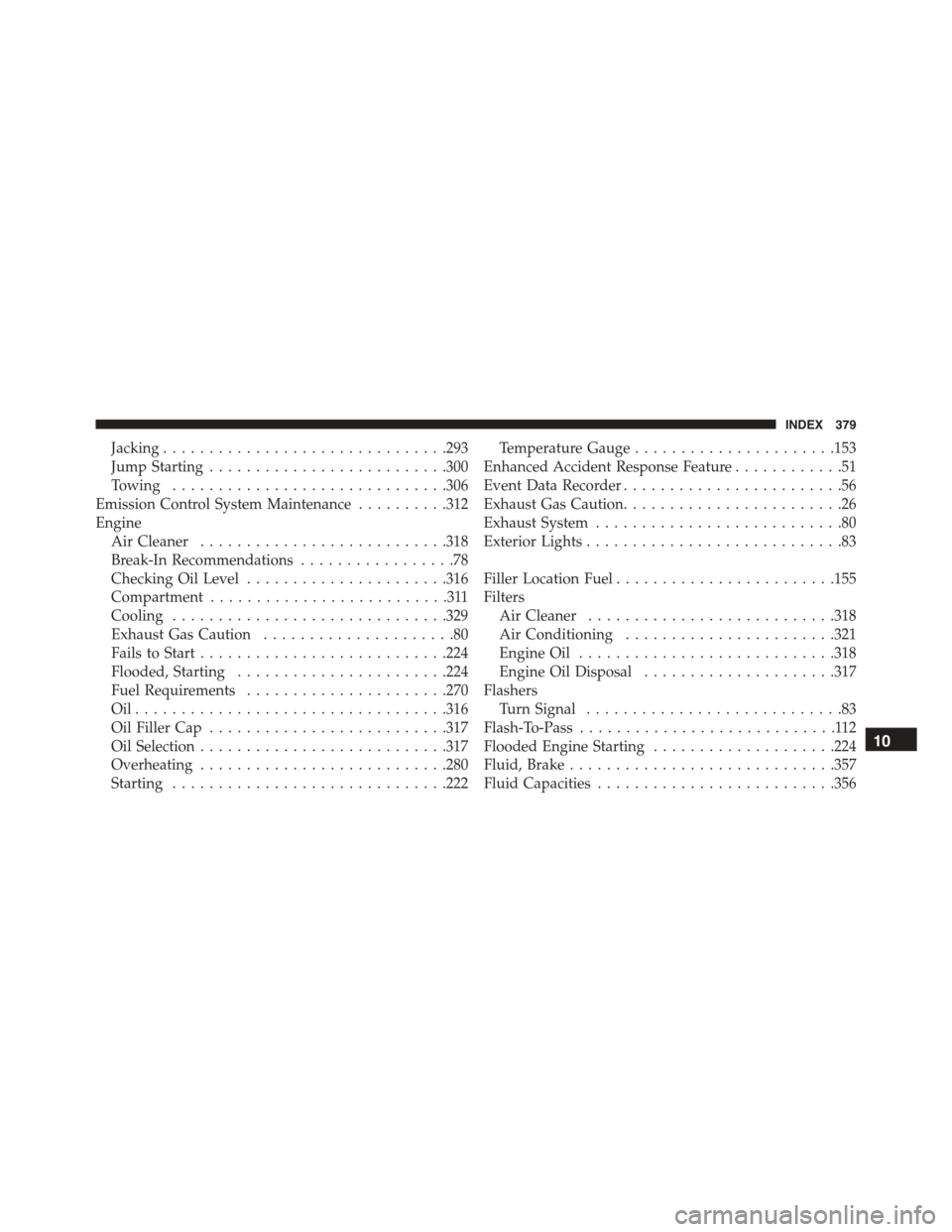
Jacking...............................293
Jump Starting..........................300
Towing..............................306
Emission Control System Maintenance..........312
Engine
Air Cleaner...........................318
Break-In Recommendations.................78
Checking Oil Level......................316
Compartment..........................311
Cooling..............................329
Exhaust Gas Caution.....................80
Fails to Start...........................224
Flooded, Starting.......................224
Fuel Requirements......................270
Oil . . . . . . . . . . . . . . . . . . . . . . . . . . . . . . . . ..316
Oil Filler Cap..........................317
Oil Selection...........................317
Overheating...........................280
Starting..............................222
Temperature Gauge......................153
Enhanced Accident Response Feature............51
Event Data Recorder........................56
Exhaust Gas Caution........................26
Exhaust System...........................80
Exterior Lights............................83
Filler Location Fuel........................155
Filters
Air Cleaner...........................318
Air Conditioning.......................321
Engine Oil............................318
Engine Oil Disposal.....................317
Flashers
Turn Signal............................83
Flash-To-Pass............................112
Flooded Engine Starting....................224
Fluid, Brake.............................357
Fluid Capacities..........................356
10
INDEX 379