seats FIAT 500 ABARTH 2014 2.G User Guide
[x] Cancel search | Manufacturer: FIAT, Model Year: 2014, Model line: 500 ABARTH, Model: FIAT 500 ABARTH 2014 2.GPages: 392, PDF Size: 8.74 MB
Page 72 of 392
3. Place the child seat between the lower anchorages for
that seating position. For some second row seats, you
may need to recline the seat and / or raise the head
restraint to get a better fit. If the rear seat can be moved
forward and rearward in the vehicle, you may wish to
move it to its rear-most position to make room for the
child seat. You may also move the front seat forward
to allow more room for the car seat.
4. Attach the lower hooks or connectors of the child
restraint to the lower anchorages in the selected seat-
ing position.
5. If the child restraint has a tether strap, connect it to the
top tether anchorage. See the section “Installing Child
Restraints Using the Top Tether Anchorage” for direc-
tions to attach a tether anchor.
6. Tighten all of the straps as you push the child restraint
rearward and downward into the seat. Remove slack
in the straps according to the child restraint manufac-
turer ’s instructions.
7. Test that the child restraint is installed tightly by
pulling back and forth on the child seat at the belt
path. It should not move more than 1 inch (25.4 mm)
in any direction.
70 THINGS TO KNOW BEFORE STARTING YOUR VEHICLE
Page 76 of 392
Installing A Child Restraint With A Switchable
Automatic Locking Retractor (ALR)
1. Place the child seat in the center of the seating
position. For some second row seats, you may need to
recline the seat and/or raise the head restraint to get a
better fit. If the rear seat can be moved forward and
rearward in the vehicle, you may wish to move it to its
rear-most position to make room for the child seat.
You may also move the front seat forward to allow
more room for the car seat.
2. Pull enough of the seat belt webbing from the retractor
to pass it through the belt path of the child restraint.
Do not twist the belt webbing in the belt path.
3. Slide the latch plate into the buckle until you hear a
“click.”
4. Pull on the webbing to make the lap portion tight
against the child seat.
5. To lock the seat belt, pull down on the shoulder part of
the belt until you have pulled all the seat belt webbing
out of the retractor. Then, allow the webbing to retract
back into the retractor. As the webbing retracts, you
will hear a clicking sound. This means the seat belt is
now in the Automatic Locking mode.
6. Try to pull the webbing out of the retractor. If it is
locked, you should not be able to pull out any web-
bing. If the retractor is not locked, repeat step 5.
7. Finally, pull up on any excess webbing to tighten the
lap portion around the child restraint while you push
the child restraint rearward and downward into the
vehicle seat.
8. If the child restraint has a top tether strap and the
seating position has a top tether anchorage, connect
the tether strap to the anchorage and tighten the tether
74 THINGS TO KNOW BEFORE STARTING YOUR VEHICLE
Page 77 of 392
strap. See the section “Installing Child Restraints
Using the Top Tether Anchorage” for directions to
attach a tether anchor.
9. Test that the child restraint is installed tightly by
pulling back and forth on the child seat at the belt
path. It should not move more than 1 inch (25.4 mm)
in any direction.
Any seat belt system will loosen with time, so check the
belt occasionally, and pull it tight if necessary.
Installing A Child Restraint With A Cinching
Latch Plate (CINCH) — If Equipped
1. Place the child seat in the center of the seating
position. For some second row seats, you may need to
recline the seat and / or raise the head restraint to get
a better fit. If the rear seat can be moved forward and
rearward in the vehicle, you may wish to move it to its
rear-most position to make room for the child seat.
You may also move the front seat forward to allow
more room for the car seat.
2. Next, pull enough of the seat belt webbing from the
retractor to pass it through the belt path of the child
restraint. Do not twist the belt webbing in the belt
path.
3. Slide the latch plate into the buckle until you hear a
“click.”
4. Finally, pull up on any excess webbing to tighten the
lap portion around the child restraint while you push
the child restraint rearward and downward into the
vehicle seat.
5. If the child restraint has a top tether strap and the
seating position has a top tether anchorage, connect
the tether strap to the anchorage and tighten the tether
2
THINGS TO KNOW BEFORE STARTING YOUR VEHICLE 75
Page 81 of 392
NOTE:A new engine may consume some oil during its
first few thousand miles (kilometers) of operation. This
should be considered a normal part of the break-in and
not interpreted as an indication of difficulty.
SAFETY TIPS
Transporting Passengers
NEVER TRANSPORT PASSENGERS IN THE CARGO
AREA.
WARNING!
•Do not leave children or animals inside parked
vehicles in hot weather. Interior heat build-up may
cause serious injury or death.
•It is extremely dangerous to ride in a cargo area,
inside or outside of a vehicle. In a collision, people
riding in these areas are more likely to be seriously
injured or killed.
•Do not allow people to ride in any area of your
vehicle that is not equipped with seats and seat
belts.
•Be sure everyone in your vehicle is in a seat and
using a seat belt properly.
2
THINGS TO KNOW BEFORE STARTING YOUR VEHICLE 79
Page 87 of 392
UNDERSTANDING THE FEATURES OF YOUR VEHICLE
CONTENTS
!POWER CONVERTIBLE TOP — IF EQUIPPED . .88
▫Lowering The Power Top.................88
▫Raising The Power Top..................89
▫Power Convertible Top Relearn Procedure.....90
▫Wind Stop...........................91
!MIRRORS.............................91
▫Inside Day/Night Mirror.................91
▫Automatic Dimming Mirror — If Equipped . . .92
▫Power Mirrors........................93
▫Folding Mirrors........................95
▫Heated Mirrors — If Equipped............95
▫Sun Visors...........................95
!BLUE&ME™ HANDS-FREE COMMUNICATION —
IF EQUIPPED..........................96
▫Overview............................96
▫The Hands-Free Kit.....................97
!SEATS . . . . . . . . . . . . . . . . . . . . . . . . . . . . ..103
▫Front Seats Forward/Rearward Adjustment . . .103
▫Recline Adjustment....................104
▫Seat Height Adjustment.................105
3
Page 88 of 392
▫EZ Entry Feature......................106
▫Memory Feature......................106
▫Heated Seats — If Equipped.............107
▫Head Restraints.......................108
!TO OPEN AND CLOSE THE HOOD.........108
!LIGHTS.............................111
▫Multifunction Lever....................111
▫Headlights..........................111
▫High Beams.........................112
▫Flash-To-Pass........................112
▫Parking Lights.......................112
▫Daytime Running Lights — If Equipped.....112
▫Turn Signals.........................112
▫Lane Change Assist....................113
▫Follow Me Home/Headlight Delay.........113
▫Interior Lights.......................114
▫Front Fog Lights — If Equipped...........115
!WINDSHIELD WIPERS AND WASHERS......116
▫Front Windshield Wiper Operation.........116
▫Rear Windshield Wiper.................118
!TILT STEERING COLUMN — IF EQUIPPED . . .119
!ELECTRONIC SPEED CONTROL...........120
▫To Activate..........................121
▫To Set A Desired Speed.................121
▫To Deactivate........................122
▫To Resume Speed.....................122
86 UNDERSTANDING THE FEATURES OF YOUR VEHICLE
Page 105 of 392
WARNING!(Continued)
•Keep the Owner ’s Manual in the car: when kept in
the car, the Owner ’s Manual will be a ready refer-
ence for you and other users unfamiliar with the
system. Please make certain that before using the
system for the first time, all persons have access to
the Owner ’s Manual and read its instructions and
safety information carefully.
SEATS
Seats are a part of the Occupant Restraint System of the
vehicle.
WARNING!
•It is dangerous to ride in a cargo area, inside or
outside of a vehicle. In a collision, people riding in
these areas are more likely to be seriously injured
or killed.
•Do not allow people to ride in any area of your
vehicle that is not equipped with seats and seat
belts. In a collision, people riding in these areas are
more likely to be seriously injured or killed.
•Be sure everyone in your vehicle is in a seat and
using a seat belt properly.
Front Seats Forward/Rearward Adjustment
The adjusting bar is located at the front of the seats, near
the floor.
3
UNDERSTANDING THE FEATURES OF YOUR VEHICLE 103
Page 106 of 392
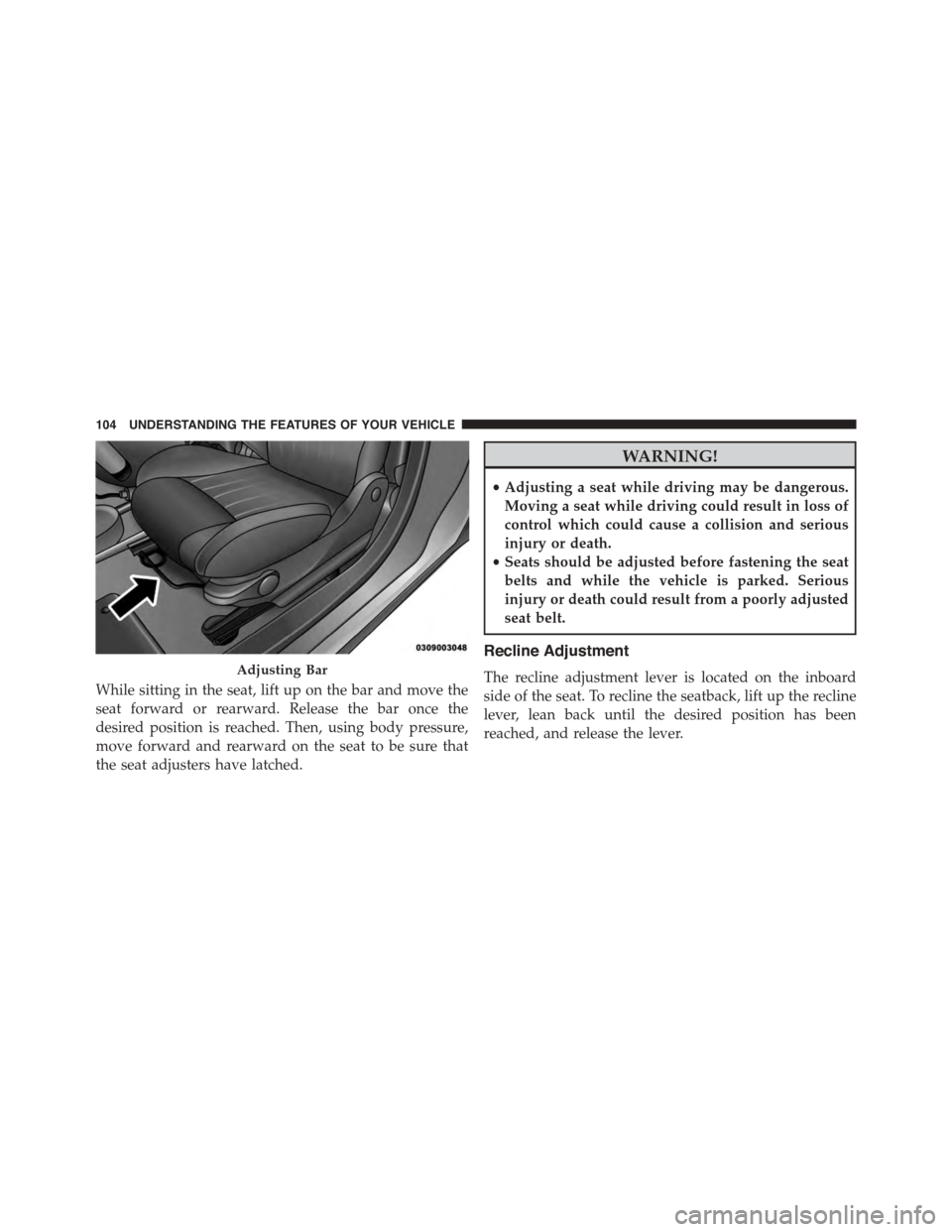
While sitting in the seat, lift up on the bar and move the
seat forward or rearward. Release the bar once the
desired position is reached. Then, using body pressure,
move forward and rearward on the seat to be sure that
the seat adjusters have latched.
WARNING!
•Adjusting a seat while driving may be dangerous.
Moving a seat while driving could result in loss of
control which could cause a collision and serious
injury or death.
•Seats should be adjusted before fastening the seat
belts and while the vehicle is parked. Serious
injury or death could result from a poorly adjusted
seat belt.
Recline Adjustment
The recline adjustment lever is located on the inboard
side of the seat. To recline the seatback, lift up the recline
lever, lean back until the desired position has been
reached, and release the lever.
Adjusting Bar
104 UNDERSTANDING THE FEATURES OF YOUR VEHICLE
Page 108 of 392
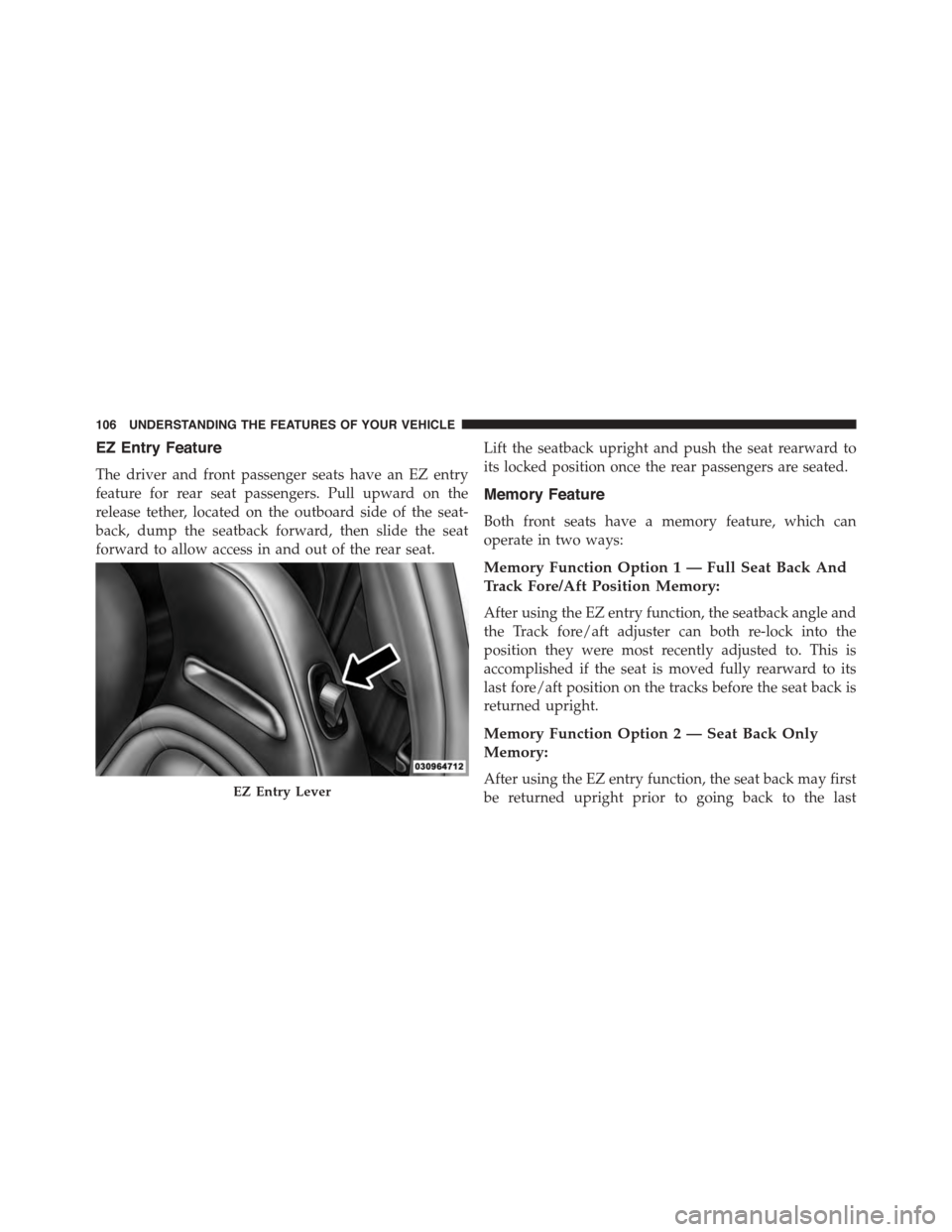
EZ Entry Feature
The driver and front passenger seats have an EZ entry
feature for rear seat passengers. Pull upward on the
release tether, located on the outboard side of the seat-
back, dump the seatback forward, then slide the seat
forward to allow access in and out of the rear seat.
Lift the seatback upright and push the seat rearward to
its locked position once the rear passengers are seated.
Memory Feature
Both front seats have a memory feature, which can
operate in two ways:
Memory Function Option 1 — Full Seat Back And
Track Fore/Aft Position Memory:
After using the EZ entry function, the seatback angle and
the Track fore/aft adjuster can both re-lock into the
position they were most recently adjusted to. This is
accomplished if the seat is moved fully rearward to its
last fore/aft position on the tracks before the seat back is
returned upright.
Memory Function Option 2 — Seat Back Only
Memory:
After using the EZ entry function, the seat back may first
be returned upright prior to going back to the lastEZ Entry Lever
106 UNDERSTANDING THE FEATURES OF YOUR VEHICLE
Page 109 of 392
fore/aft (memory) position on the tracks. This results in
the seat back memory being set only – The track will then
be locked forward of its last set fore/aft memory posi-
tion. To then reset the fore/aft track memory feature (to
reestablish Memory Function Option 1), the seat has to be
returned fully rearward to its last fore/aft memory track
position as described in Memory Function Option 1.
Heated Seats — If Equipped
On some models, the front driver and passenger seats
may be equipped with heaters in both the seat cushions
and seatbacks. The controls for the front heated seats are
located on the center instrument panel area.
Press the switch once to turn on the heated
seats. Press the switch a second time to shut the
heating elements off.
NOTE:Once a heat setting is selected, heat will be felt
within two to five minutes.
WARNING!
•Persons who are unable to feel pain to the skin
because of advanced age, chronic illness, diabetes,
spinal cord injury, medication, alcohol use, exhaus-
tion or other physical condition must exercise care
when using the seat heater. It may cause burns
even at low temperatures, especially if used for
long periods of time.
•Do not place anything on the seat or seatback that
insulates against heat, such as a blanket or cushion.
This may cause the seat heater to overheat. Sitting
in a seat that has been overheated could cause
serious burns due to the increased surface tempera-
ture of the seat.
3
UNDERSTANDING THE FEATURES OF YOUR VEHICLE 107