engine oil FIAT 500 ABARTH 2014 2.G Owner's Manual
[x] Cancel search | Manufacturer: FIAT, Model Year: 2014, Model line: 500 ABARTH, Model: FIAT 500 ABARTH 2014 2.GPages: 392, PDF Size: 8.74 MB
Page 320 of 392
Engine Oil Filter
The engine oil filter should be replaced with a new filter
at every engine oil change.
Engine Oil Filter Selection
This manufacturer’s engines have a full-flow type dispos-
able oil filter. Use a filter of this type for replacement. The
quality of replacement filters varies considerably. Only
high quality filters should be used to assure most efficient
service. MOPAR® engine oil filters are high quality oil
filters and are recommended.
Engine Air Cleaner Filter
Refer to the “Maintenance Schedule” for the proper
maintenance intervals.
WARNING!
The air induction system (air cleaner, hoses, etc.) can
provide a measure of protection in the case of engine
backfire. Do not remove the air induction system (air
cleaner, hoses, etc.) unless such removal is necessary
for repair or maintenance. Make sure that no one is
near the engine compartment before starting the
vehicle with the air induction system (air cleaner,
hoses, etc.) removed. Failure to do so can result in
serious personal injury.
Engine Air Cleaner Filter Selection
The quality of replacement engine air cleaner filters
varies considerably. Only high quality filters should be
used to assure most efficient service. MOPAR® engine air
cleaner filters are a high quality filter and are recom-
mended.
318 MAINTAINING YOUR VEHICLE
Page 327 of 392
Operation of the wipers on dry glass for long periods
may cause deterioration of the wiper blades. Always use
washer fluid when using the wipers to remove salt or dirt
from a dry windshield.
Avoid using the wiper blades to remove frost or ice from
the windshield. Keep the blade rubber out of contact with
petroleum products such as engine oil, gasoline, etc.
NOTE:Life expectancy of wiper blades varies depend-
ing on geographical area and frequency of use. Poor
performance of blades may be present with chattering,
marks, water lines or wet spots. If any of these conditions
are present, clean the wiper blades or replace as neces-
sary.
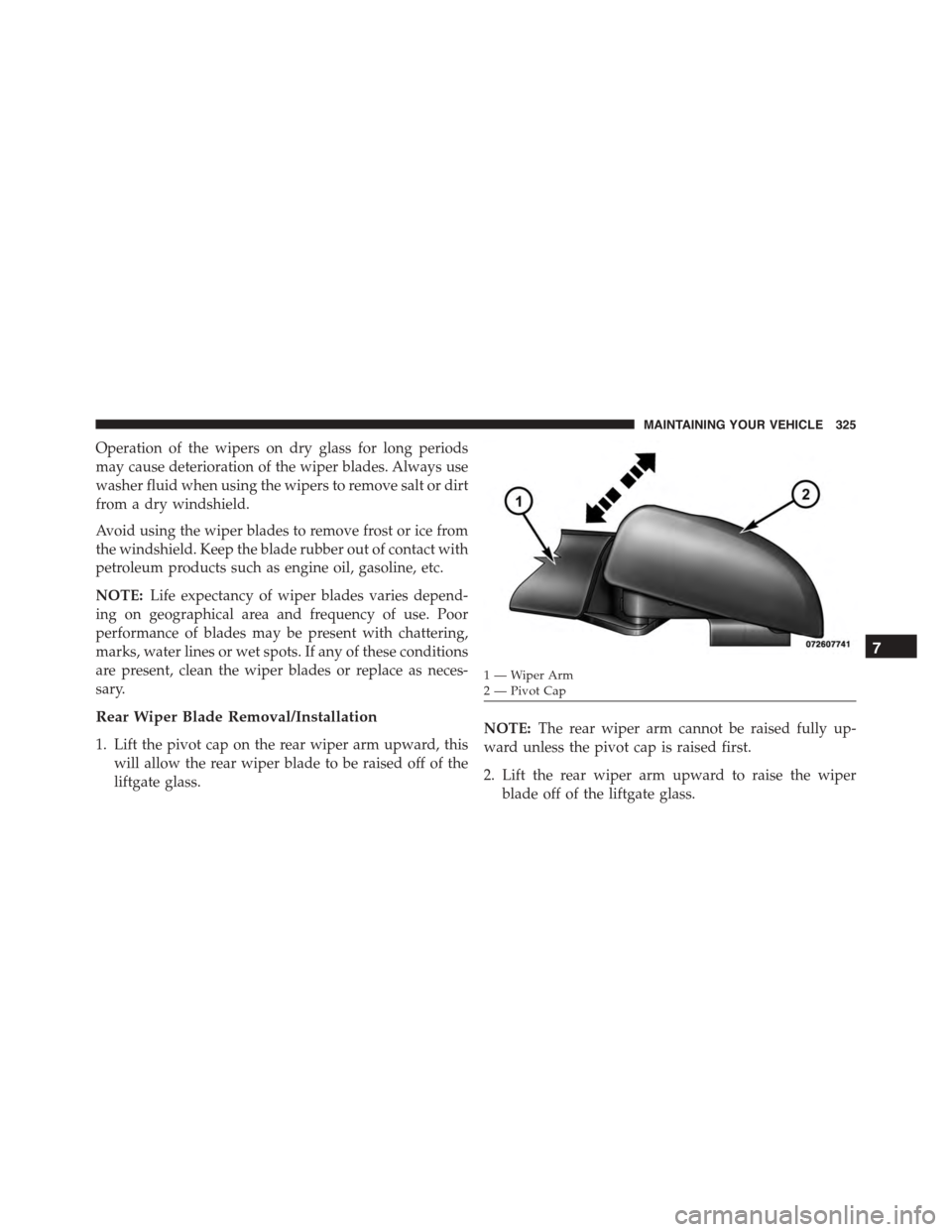
Rear Wiper Blade Removal/Installation
1. Lift the pivot cap on the rear wiper arm upward, this
will allow the rear wiper blade to be raised off of the
liftgate glass.
NOTE:The rear wiper arm cannot be raised fully up-
ward unless the pivot cap is raised first.
2. Lift the rear wiper arm upward to raise the wiper
blade off of the liftgate glass.
1—WiperArm2 — Pivot Cap
7
MAINTAINING YOUR VEHICLE 325
Page 329 of 392
WARNING!(Continued)
must be exercised when filling or working around
the washer solution.
Exhaust System
The best protection against carbon monoxide entry into
the vehicle body is a properly maintained engine exhaust
system.
If you notice a change in the sound of the exhaust system;
or if the exhaust fumes can be detected inside the vehicle;
or when the underside or rear of the vehicle is damaged;
have an authorized technician inspect the complete ex-
haust system and adjacent body areas for broken, dam-
aged, deteriorated, or mispositioned parts. Open seams
or loose connections could permit exhaust fumes to seep
into the passenger compartment. In addition, have the
exhaust system inspected each time the vehicle is raised
for lubrication or oil change. Replace as required.
WARNING!
•Exhaust gases can injure or kill. They contain
carbon monoxide (CO), which is colorless and
odorless. Breathing it can make you unconscious
and can eventually poison you. To avoid breathing
CO, refer to “Safety Tips/Exhaust Gas” in “Things
To Know Before Starting Your Vehicle” for further
information.
•A hot exhaust system can start a fire if you park
over materials that can burn. Such materials might
be grass or leaves coming into contact with your
exhaust system. Do not park or operate your ve-
hicle in areas where your exhaust system can con-
tact anything that can burn.
7
MAINTAINING YOUR VEHICLE 327
Page 339 of 392
WARNING!
•Use only manufacturer’s recommended brake
fluid. Refer to “Fluids, Lubricants, and Genuine
Parts” in “Maintaining Your Vehicle” for further
information. Using the wrong type of brake fluid
can severely damage your brake system and/or
impair its performance. The proper type of brake
fluid for your vehicle is also identified on the
original factory installed hydraulic master cylinder
reservoir.
•To avoid contamination from foreign matter or
moisture, use only new brake fluid or fluid that has
been in a tightly closed container. Keep the master
cylinder reservoir cap secured at all times. Brake
fluid in a open container absorbs moisture from the
air resulting in a lower boiling point. This may
(Continued)
WARNING!(Continued)
cause it to boil unexpectedly during hard or pro-
longed braking, resulting in sudden brake failure.
This could result in a collision.
•Overfilling the brake fluid reservoir can result in
spilling brake fluid on hot engine parts, causing
the brake fluid to catch fire. Brake fluid can also
damage painted and vinyl surfaces, care should be
taken to avoid its contact with these surfaces.
•Do not allow petroleum-based fluid to contaminate
the brake fluid. Brake seal components could be
damaged, causing partial or complete brake failure.
This could result in a collision.
7
MAINTAINING YOUR VEHICLE 337
Page 358 of 392
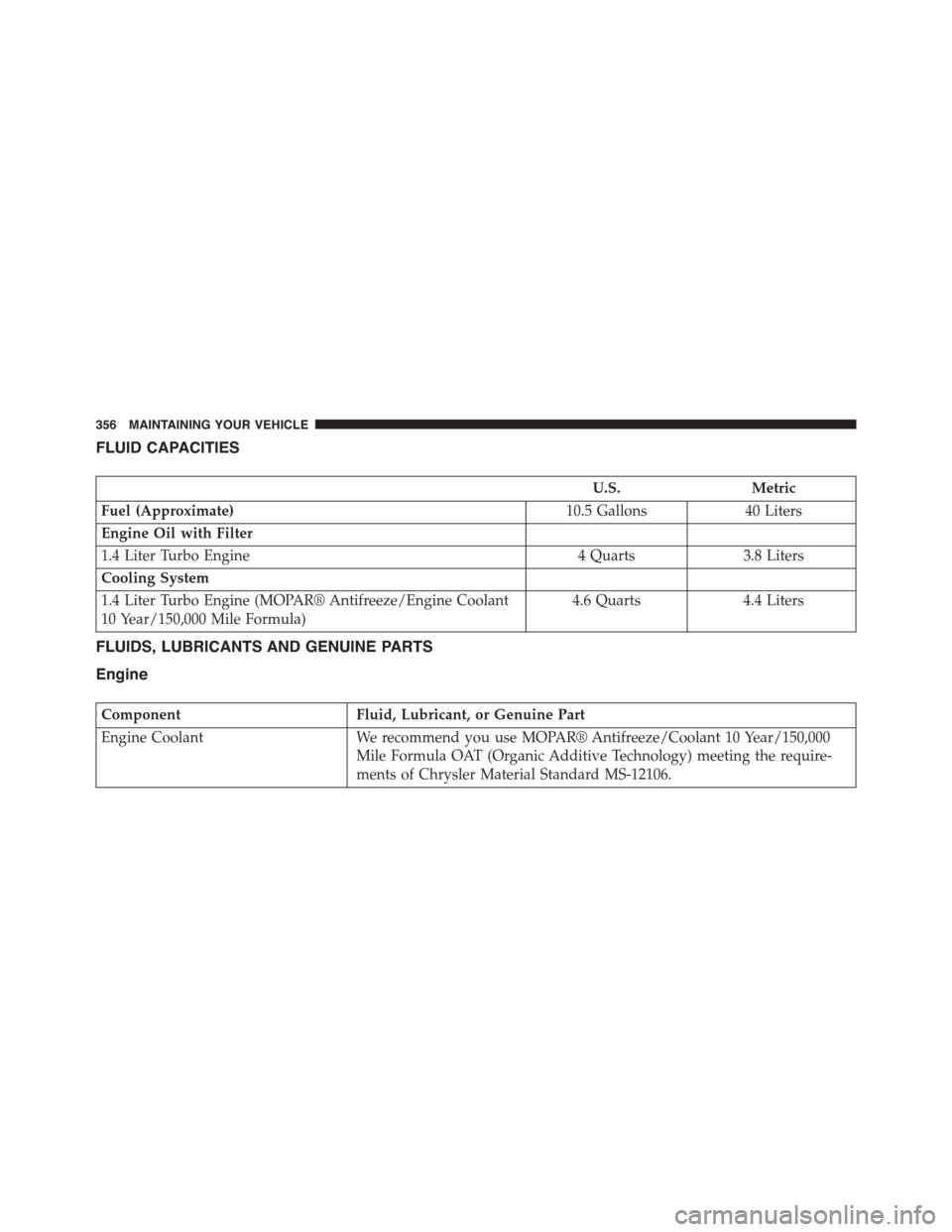
FLUID CAPACITIES
U.S.Metric
Fuel (Approximate)10.5 Gallons40 Liters
Engine Oil with Filter
1.4 Liter Turbo Engine4 Quarts3.8 Liters
Cooling System
1.4 Liter Turbo Engine (MOPAR® Antifreeze/Engine Coolant
10 Year/150,000 Mile Formula)
4.6 Quarts4.4 Liters
FLUIDS, LUBRICANTS AND GENUINE PARTS
Engine
ComponentFluid, Lubricant, or Genuine Part
Engine CoolantWe recommend you use MOPAR® Antifreeze/Coolant 10 Year/150,000
Mile Formula OAT (Organic Additive Technology) meeting the require-
ments of Chrysler Material Standard MS-12106.
356 MAINTAINING YOUR VEHICLE
Page 359 of 392
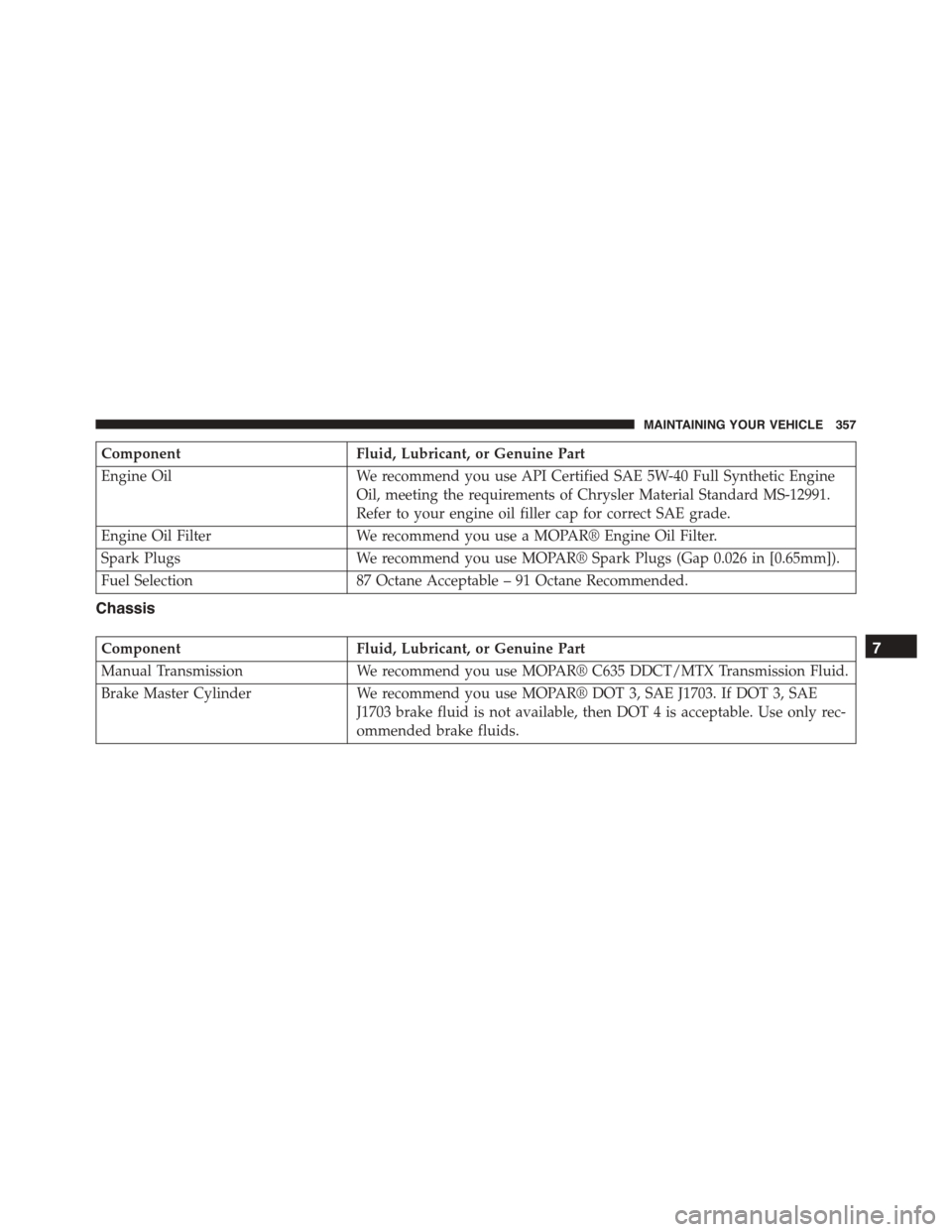
ComponentFluid, Lubricant, or Genuine Part
Engine OilWe recommend you use API Certified SAE 5W-40 Full Synthetic Engine
Oil, meeting the requirements of Chrysler Material Standard MS-12991.
Refer to your engine oil filler cap for correct SAE grade.
Engine Oil FilterWe recommend you use a MOPAR® Engine Oil Filter.
Spark PlugsWe recommend you use MOPAR® Spark Plugs (Gap 0.026 in [0.65mm]).
Fuel Selection87 Octane Acceptable – 91 Octane Recommended.
Chassis
ComponentFluid, Lubricant, or Genuine Part
Manual TransmissionWe recommend you use MOPAR® C635 DDCT/MTX Transmission Fluid.
Brake Master CylinderWe recommend you use MOPAR® DOT 3, SAE J1703. If DOT 3, SAE
J1703 brake fluid is not available, then DOT 4 is acceptable. Use only rec-
ommended brake fluids.
7
MAINTAINING YOUR VEHICLE 357
Page 362 of 392
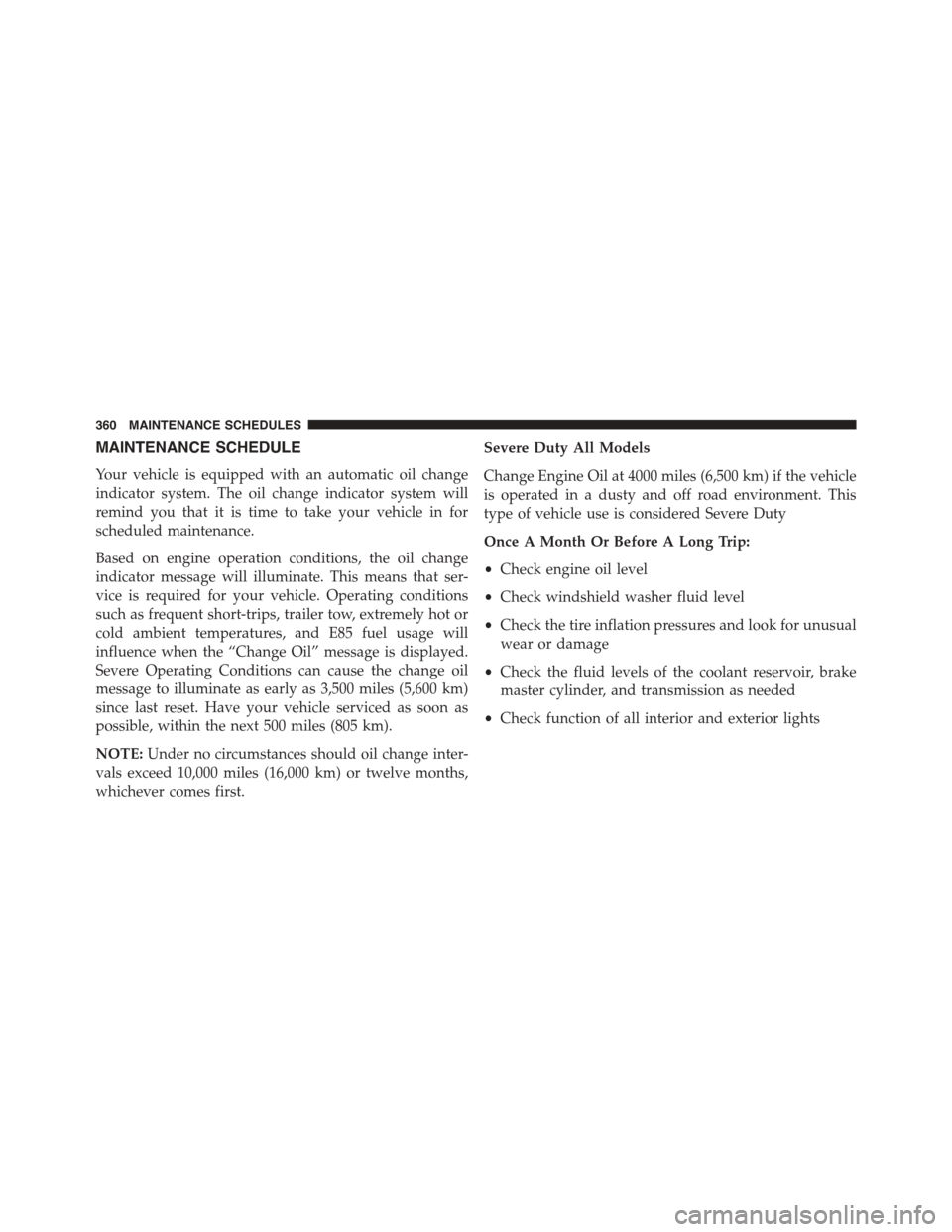
MAINTENANCE SCHEDULE
Your vehicle is equipped with an automatic oil change
indicator system. The oil change indicator system will
remind you that it is time to take your vehicle in for
scheduled maintenance.
Based on engine operation conditions, the oil change
indicator message will illuminate. This means that ser-
vice is required for your vehicle. Operating conditions
such as frequent short-trips, trailer tow, extremely hot or
cold ambient temperatures, and E85 fuel usage will
influence when the “Change Oil” message is displayed.
Severe Operating Conditions can cause the change oil
message to illuminate as early as 3,500 miles (5,600 km)
since last reset. Have your vehicle serviced as soon as
possible, within the next 500 miles (805 km).
NOTE:Under no circumstances should oil change inter-
vals exceed 10,000 miles (16,000 km) or twelve months,
whichever comes first.
Severe Duty All Models
Change Engine Oil at 4000 miles (6,500 km) if the vehicle
is operated in a dusty and off road environment. This
type of vehicle use is considered Severe Duty
Once A Month Or Before A Long Trip:
•Check engine oil level
•Check windshield washer fluid level
•Check the tire inflation pressures and look for unusual
wear or damage
•Check the fluid levels of the coolant reservoir, brake
master cylinder, and transmission as needed
•Check function of all interior and exterior lights
360 MAINTENANCE SCHEDULES
Page 363 of 392
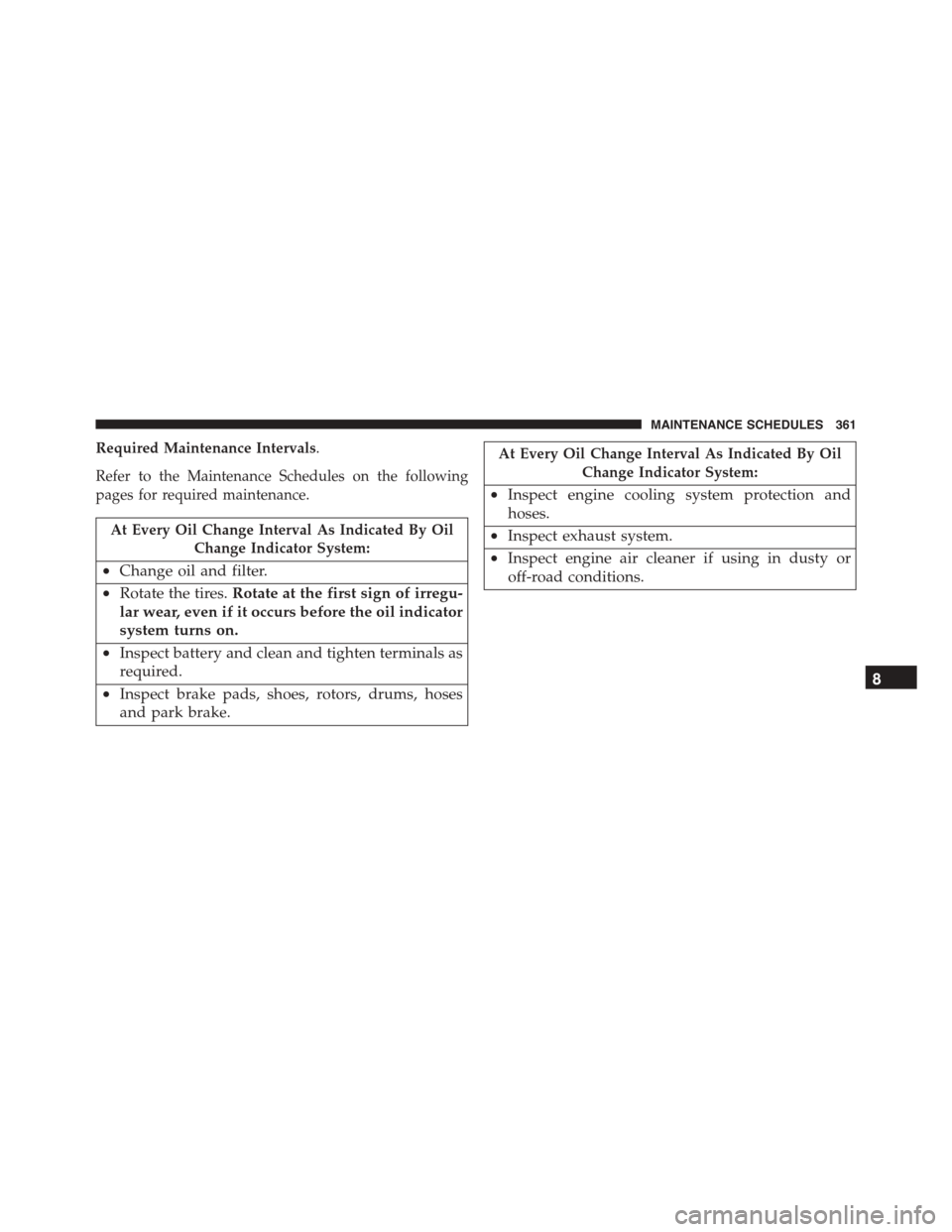
Required Maintenance Intervals.
Refer to the Maintenance Schedules on the following
pages for required maintenance.
At Every Oil Change Interval As Indicated By Oil
Change Indicator System:
•Change oil and filter.
•Rotate the tires.Rotate at the first sign of irregu-
lar wear, even if it occurs before the oil indicator
system turns on.
•Inspect battery and clean and tighten terminals as
required.
•Inspect brake pads, shoes, rotors, drums, hoses
and park brake.
At Every Oil Change Interval As Indicated By Oil
Change Indicator System:
•Inspect engine cooling system protection and
hoses.
•Inspect exhaust system.
•Inspect engine air cleaner if using in dusty or
off-road conditions.
8
MAINTENANCE SCHEDULES 361
Page 379 of 392
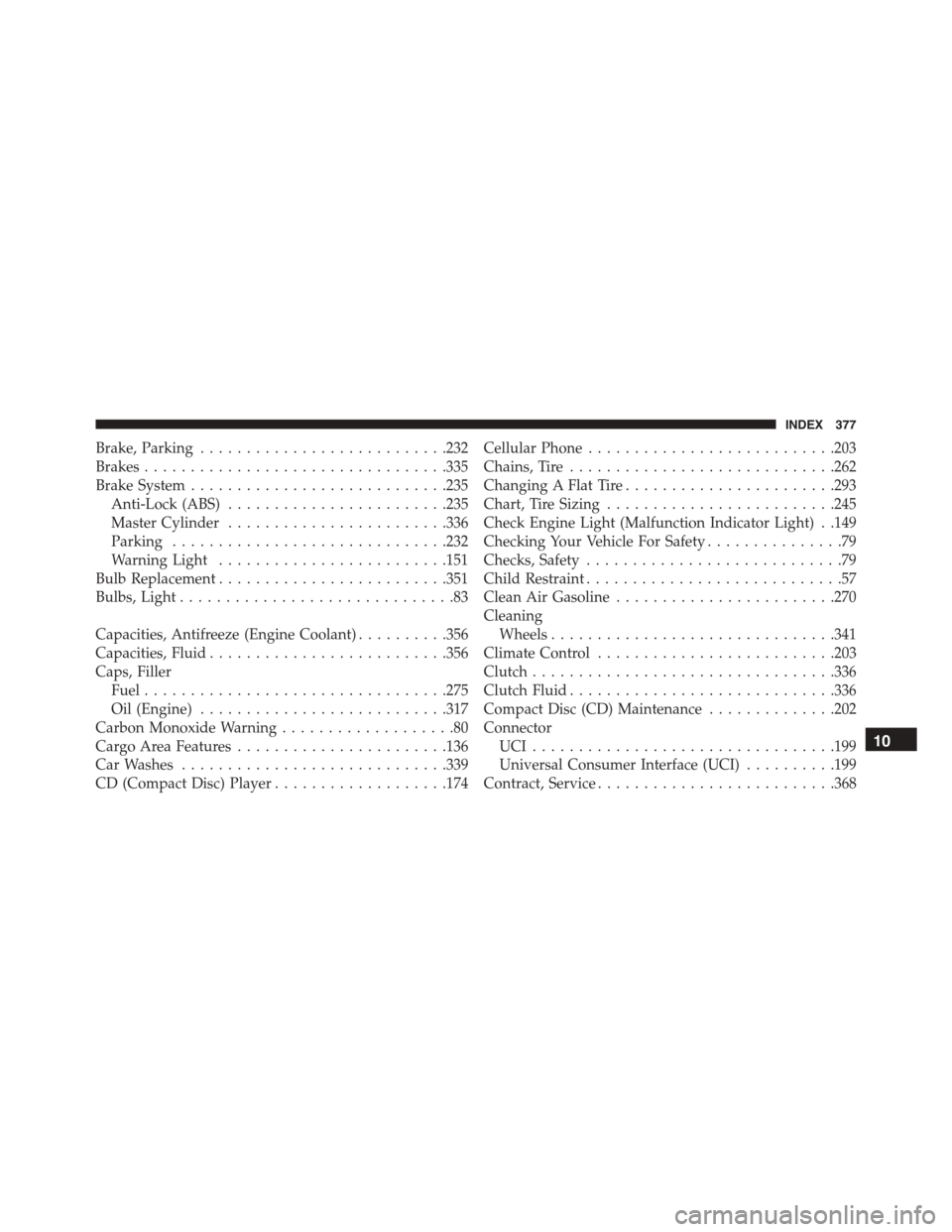
Brake, Parking...........................232
Brakes.................................335
Brake System............................235
Anti-Lock (ABS)........................235
Master Cylinder........................336
Parking..............................232
Warning Light.........................151
Bulb Replacement.........................351
Bulbs, Light..............................83
Capacities, Antifreeze (Engine Coolant)..........356
Capacities, Fluid..........................356
Caps, Filler
Fuel.................................275
Oil (Engine)...........................317
Carbon Monoxide Warning...................80
Cargo Area Features.......................136
Car Washes.............................339
CD (Compact Disc) Player...................174
Cellular Phone...........................203
Chains, Tire.............................262
Changing A Flat Tire.......................293
Chart, Tire Sizing.........................245
Check Engine Light (Malfunction Indicator Light) . .149
Checking Your Vehicle For Safety...............79
Checks, Safety............................79
Child Restraint............................57
Clean Air Gasoline........................270
Cleaning
Wheels...............................341
Climate Control..........................203
Clutch.................................336
Clutch Fluid.............................336
Compact Disc (CD) Maintenance..............202
Connector
UCI . . . . . . . . . . . . . . . . . . . . . . . . . . . . . . . ..199
Universal Consumer Interface (UCI)..........199
Contract, Service..........................368
10
INDEX 377
Page 381 of 392
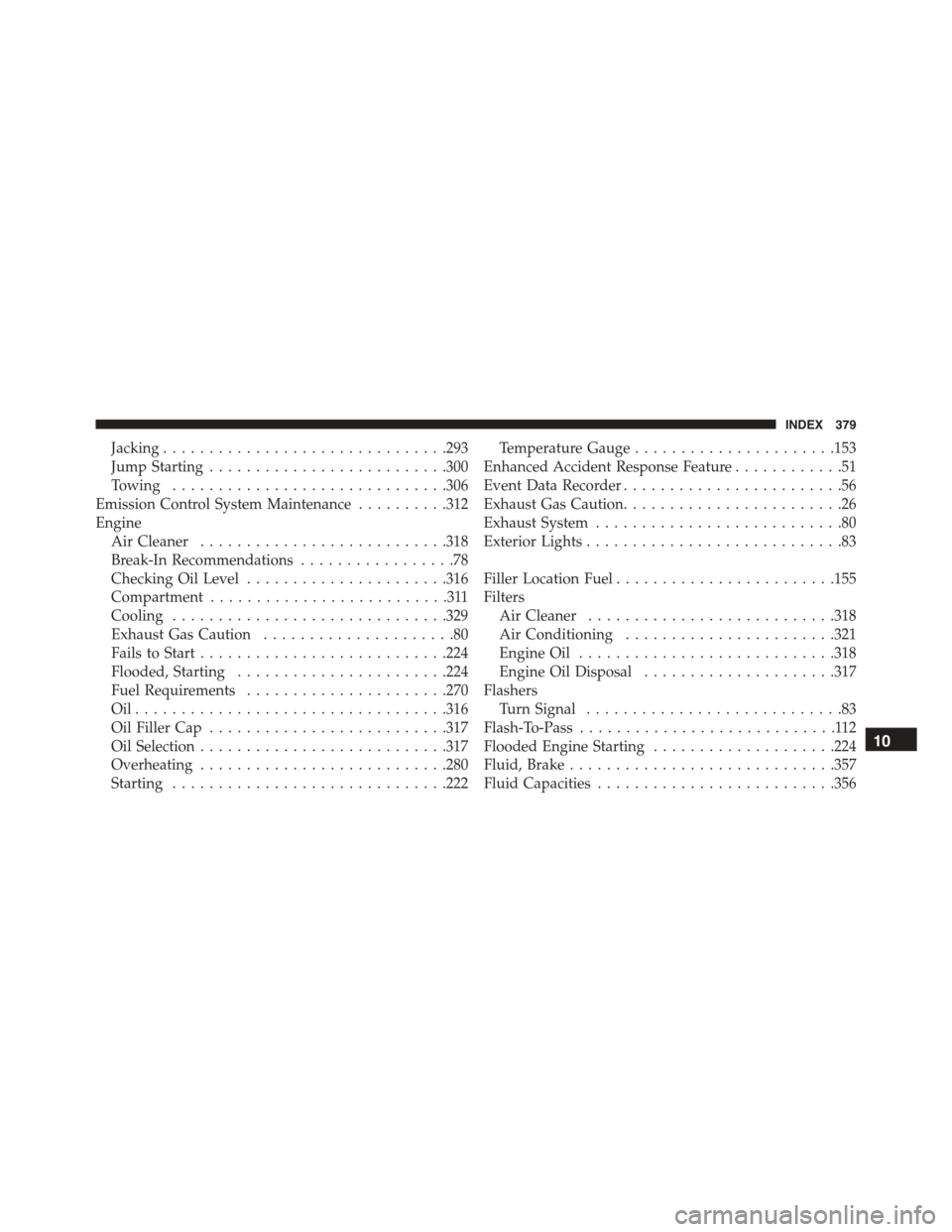
Jacking...............................293
Jump Starting..........................300
Towing..............................306
Emission Control System Maintenance..........312
Engine
Air Cleaner...........................318
Break-In Recommendations.................78
Checking Oil Level......................316
Compartment..........................311
Cooling..............................329
Exhaust Gas Caution.....................80
Fails to Start...........................224
Flooded, Starting.......................224
Fuel Requirements......................270
Oil . . . . . . . . . . . . . . . . . . . . . . . . . . . . . . . . ..316
Oil Filler Cap..........................317
Oil Selection...........................317
Overheating...........................280
Starting..............................222
Temperature Gauge......................153
Enhanced Accident Response Feature............51
Event Data Recorder........................56
Exhaust Gas Caution........................26
Exhaust System...........................80
Exterior Lights............................83
Filler Location Fuel........................155
Filters
Air Cleaner...........................318
Air Conditioning.......................321
Engine Oil............................318
Engine Oil Disposal.....................317
Flashers
Turn Signal............................83
Flash-To-Pass............................112
Flooded Engine Starting....................224
Fluid, Brake.............................357
Fluid Capacities..........................356
10
INDEX 379