oil FIAT 500 ABARTH 2014 2.G Owner's Manual
[x] Cancel search | Manufacturer: FIAT, Model Year: 2014, Model line: 500 ABARTH, Model: FIAT 500 ABARTH 2014 2.GPages: 88, PDF Size: 5.56 MB
Page 60 of 88
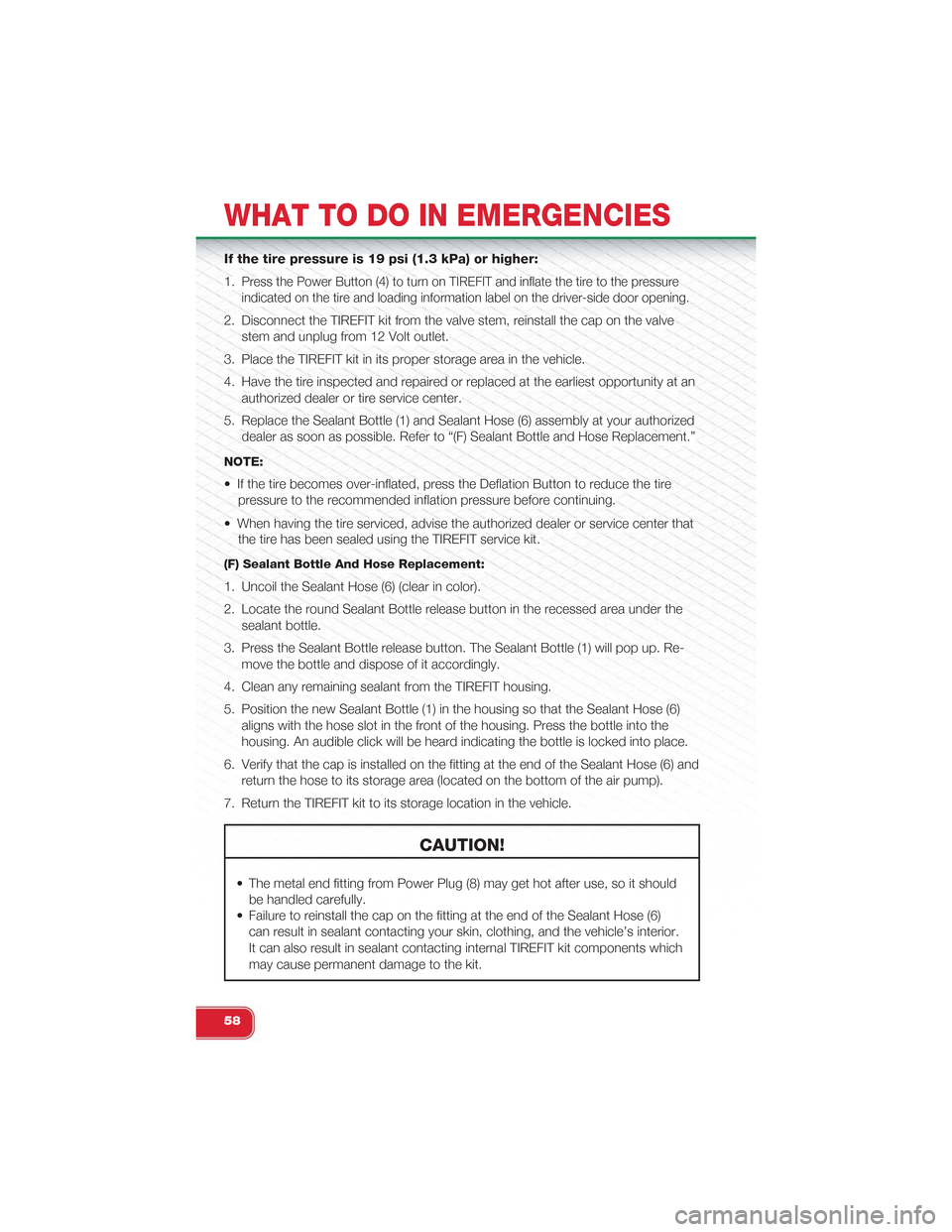
If the tire pressure is 19 psi (1.3 kPa) or higher:
1.Press the Power Button (4) to turn on TIREFIT and inflate the tire to the pressure
indicated on the tire and loading information label on the driver-side door opening.
2. Disconnect the TIREFIT kit from the valve stem, reinstall the cap on the valve
stem and unplug from 12 Volt outlet.
3. Place the TIREFIT kit in its proper storage area in the vehicle.
4. Have the tire inspected and repaired or replaced at the earliest opportunity at an
authorized dealer or tire service center.
5. Replace the Sealant Bottle (1) and Sealant Hose (6) assembly at your authorized
dealer as soon as possible. Refer to “(F) Sealant Bottle and Hose Replacement.”
NOTE:
• If the tire becomes over-inflated, press the Deflation Button to reduce the tire
pressure to the recommended inflation pressure before continuing.
• When having the tire serviced, advise the authorized dealer or service center that
the tire has been sealed using the TIREFIT service kit.
(F) Sealant Bottle And Hose Replacement:
1. Uncoil the Sealant Hose (6) (clear in color).
2. Locate the round Sealant Bottle release button in the recessed area under the
sealant bottle.
3. Press the Sealant Bottle release button. The Sealant Bottle (1) will pop up. Re-
move the bottle and dispose of it accordingly.
4. Clean any remaining sealant from the TIREFIT housing.
5. Position the new Sealant Bottle (1) in the housing so that the Sealant Hose (6)
aligns with the hose slot in the front of the housing. Press the bottle into the
housing. An audible click will be heard indicating the bottle is locked into place.
6. Verify that the cap is installed on the fitting at the end of the Sealant Hose (6) and
return the hose to its storage area (located on the bottom of the air pump).
7. Return the TIREFIT kit to its storage location in the vehicle.
CAUTION!
• The metal end fitting from Power Plug (8) may get hot after use, so it should
be handled carefully.
• Failure to reinstall the cap on the fitting at the end of the Sealant Hose (6)
can result in sealant contacting your skin, clothing, and the vehicle’s interior.
It can also result in sealant contacting internal TIREFIT kit components which
may cause permanent damage to the kit.
WHAT TO DO IN EMERGENCIES
58
Page 70 of 88
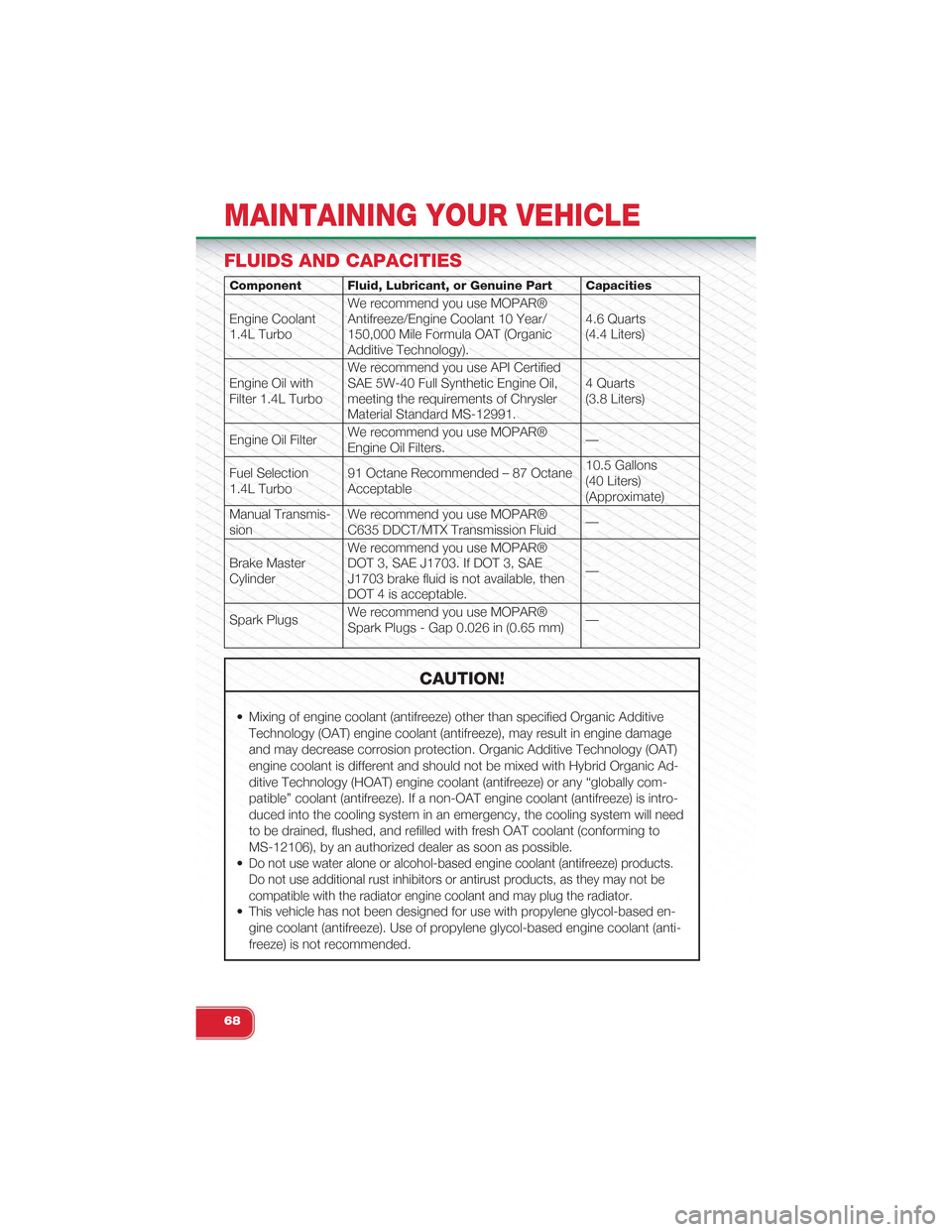
FLUIDS AND CAPACITIES
Component Fluid, Lubricant, or Genuine Part Capacities
Engine Coolant1.4L Turbo
We recommend you use MOPAR®Antifreeze/Engine Coolant 10 Year/150,000 Mile Formula OAT (OrganicAdditive Technology).
4.6 Quarts(4.4 Liters)
Engine Oil withFilter 1.4L Turbo
We recommend you use API CertifiedSAE 5W-40 Full Synthetic Engine Oil,meeting the requirements of ChryslerMaterial Standard MS-12991.
4 Quarts(3.8 Liters)
Engine Oil FilterWe recommend you use MOPAR®Engine Oil Filters.—
Fuel Selection1.4L Turbo91 Octane Recommended – 87 OctaneAcceptable
10.5 Gallons(40 Liters)(Approximate)
Manual Transmis-sionWe recommend you use MOPAR®C635 DDCT/MTX Transmission Fluid—
Brake MasterCylinder
We recommend you use MOPAR®DOT 3, SAE J1703. If DOT 3, SAEJ1703 brake fluid is not available, thenDOT 4 is acceptable.
—
Spark PlugsWe recommend you use MOPAR®Spark Plugs - Gap 0.026 in (0.65 mm)—
CAUTION!
• Mixing of engine coolant (antifreeze) other than specified Organic Additive
Technology (OAT) engine coolant (antifreeze), may result in engine damage
and may decrease corrosion protection. Organic Additive Technology (OAT)
engine coolant is different and should not be mixed with Hybrid Organic Ad-
ditive Technology (HOAT) engine coolant (antifreeze) or any “globally com-
patible” coolant (antifreeze). If a non-OAT engine coolant (antifreeze) is intro-
duced into the cooling system in an emergency, the cooling system will need
to be drained, flushed, and refilled with fresh OAT coolant (conforming to
MS-12106), by an authorized dealer as soon as possible.
•Do not use water alone or alcohol-based engine coolant (antifreeze) products.
Do not use additional rust inhibitors or antirust products, as they may not be
compatible with the radiator engine coolant and may plug the radiator.
• This vehicle has not been designed for use with propylene glycol-based en-
gine coolant (antifreeze). Use of propylene glycol-based engine coolant (anti-
freeze) is not recommended.
MAINTAINING YOUR VEHICLE
68
Page 71 of 88
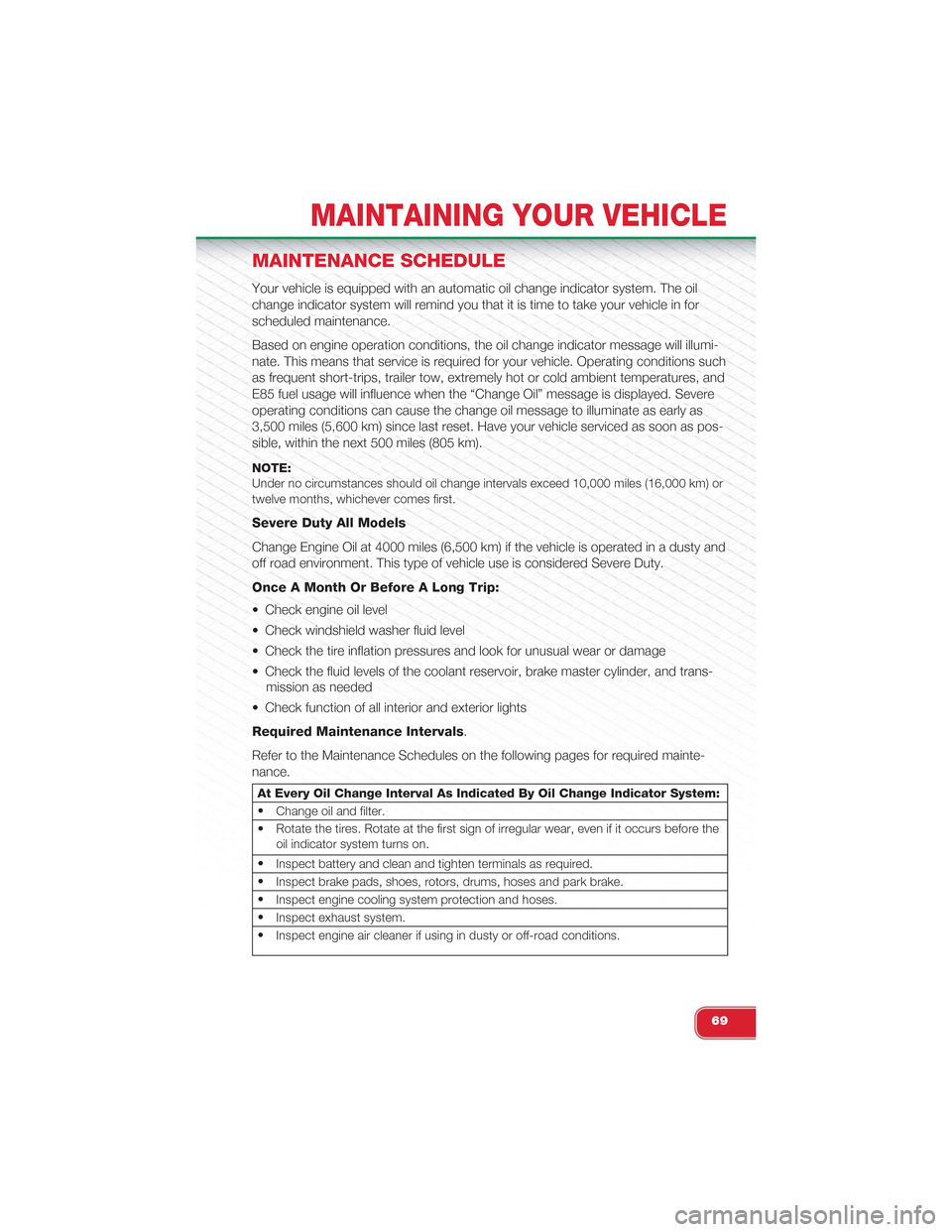
MAINTENANCE SCHEDULE
Your vehicle is equipped with an automatic oil change indicator system. The oil
change indicator system will remind you that it is time to take your vehicle in for
scheduled maintenance.
Based on engine operation conditions, the oil change indicator message will illumi-
nate. This means that service is required for your vehicle. Operating conditions such
as frequent short-trips, trailer tow, extremely hot or cold ambient temperatures, and
E85 fuel usage will influence when the “Change Oil” message is displayed. Severe
operating conditions can cause the change oil message to illuminate as early as
3,500 miles (5,600 km) since last reset. Have your vehicle serviced as soon as pos-
sible, within the next 500 miles (805 km).
NOTE:Under no circumstances should oil change intervals exceed 10,000 miles (16,000 km) ortwelve months, whichever comes first.
Severe Duty All Models
Change Engine Oil at 4000 miles (6,500 km) if the vehicle is operated in a dusty and
off road environment. This type of vehicle use is considered Severe Duty.
Once A Month Or Before A Long Trip:
• Check engine oil level
• Check windshield washer fluid level
• Check the tire inflation pressures and look for unusual wear or damage
• Check the fluid levels of the coolant reservoir, brake master cylinder, and trans-
mission as needed
• Check function of all interior and exterior lights
Required Maintenance Intervals.
Refer to the Maintenance Schedules on the following pages for required mainte-
nance.
At Every Oil Change Interval As Indicated By Oil Change Indicator System:
•Change oil and filter.
• Rotate the tires. Rotate at the first sign of irregular wear, even if it occurs before theoil indicator system turns on.
•Inspect battery and clean and tighten terminals as required.
•Inspect brake pads, shoes, rotors, drums, hoses and park brake.
•Inspect engine cooling system protection and hoses.
•Inspect exhaust system.
•Inspect engine air cleaner if using in dusty or off-road conditions.
MAINTAINING YOUR VEHICLE
69
Page 78 of 88
SUMMER/THREE-SEASON TIRES
• This vehicle may be equipped with wheels and tires to enhance traction in both
wet and dry conditions.
• Summer tires are not intended to be driven in snow or on ice.
• Use summer tires only in sets of four.
NOTE:
Summer tires will not contain the “all season” designation or mountain/snowflake
symbol on the sidewall of the tire.
WARNING!
Do not use summer tires in snow/ice conditions. You could lose control, resulting
in severe injury or death.
WHEEL AND WHEEL TRIM CARE
• All wheels and wheel trim, especially aluminum and chrome plated wheels,
should be cleaned regularly with a mild soap and water to prevent corrosion.
• To remove heavy soil and/or excessive brake dust, use a wheel cleaner or
equivalent or select a non-abrasive, non-acidic cleaner.
CAUTION!
Do not use scouring pads, steel wool, a bristle brush, or metal polishes. Do not
use oven cleaner. These products may damage the wheel's protective finish.
Avoid automatic car washes that use acidic solutions or harsh brushes that may
damage the wheel's protective finish.
MAINTAINING YOUR VEHICLE
76
Page 83 of 88
FREQUENTLY ASKED QUESTIONS
GETTING STARTED
• How do I install my LATCH Equipped Child Seat? pg. 13
• How do I fold down my rear seat? pg. 18
ELECTRONICS
• What Sound System do I have? pg. 34
• How do I set the presets on my radio? pg. 37
• How do I connect my portable media player/iPod/MP3? pg. 43
• How do I pair my cell phone via Bluetooth® with the BLUE&ME™ Hands-Free
Communication System? pg. 40
WHAT TO DO IN EMERGENCIES
• What do I do if my TPMS warning light is blinking? pg. 50
• How do I Jump-Start my vehicle? pg. 60
MAINTAINING YOUR VEHICLE
• Where is my underhood fuse block located? pg. 74
• Where is my interior fuse block located? pg. 73
• What type of oil do I use? pg. 68
• How often should I change my engines oil? pg. 69
• What should my tire pressure be set at? pg. 75
FAQ (How To?)
81
Page 84 of 88
Alarm (Security Alarm). . . . . . . . . . .10
Automatic Temperature Control (ATC) . .27
Automatic Transmission
Fluid Type. . . . . . . . . . . . . . .68
Belts, Seat. . . . . . . . . . . . . . . . .10
BLUE&ME™ Hands-Free
Communication. . . . . . . . . . . .38
Brake Fluid. . . . . . . . . . . . . . . . .68
Break-In Recommendations,New Vehicle. . . . . . . . . . . . . .19Bulb Replacement. . . . . . . . . . . . .77
Child Restraint. . . . . . . . . . . . . . .12Cooling SystemCoolant Capacity. . . . . . . . . . .68Cruise Control (Speed Control). . . . . .23Cruise Light. . . . . . . . . . . . . . . .23Customer Assistance. . . . . . . . . . .78
Defects, Reporting. . . . . . . . . . . .79Disarming, Security System. . . . . . .10
ElectronicsYour Vehicle's Sound System. . . .34Electronic Speed Control(Cruise Control). . . . . . . . . . . . .23Electronic Throttle Control WarningLight. . . . . . . . . . . . . . . . . . .49Electronic Vehicle InformationCenter (EVIC). . . . . . . . . . . . . .44Emergency, In Case ofBrake Warning Light. . . . . . . . .51Towing. . . . . . . . . . . . . . . . .62EngineBreak-In Recommendations . . . . .19Compartment. . . . . . . . . . . . .67Oil Selection. . . . . . . . . . . . . .68Overheating. . . . . . . . . . . . . .53Enhanced Accident ResponseFeature. . . . . . . . . . . . . . . . .62Event Data Recorder. . . . . . . . . . .65Exterior Lights. . . . . . . . . . . . . . .77
Flash-To-Pass. . . . . . . . . . . . . . .20Fluid Capacities. . . . . . . . . . . . . .68Fluids. . . . . . . . . . . . . . . . . . . .68Folding Rear Seat. . . . . . . . . . . . .18
Freeing A Stuck Vehicle . . .. . . . . . .64
Fuel
Specifications . . . .. . . . . . . . .68
Fuse . . . .. . . . . . . . . . . . . . . .73
Fuses . . . .. . . . . . . . . . . . . . . .73
Hands-Free Communication —
BLUE&ME™. . . . . . . . . . . . . .38
Heated Mirrors . . . . .. . . . . . . . . .26
Hood Release . .. . . . . . . . . . . . .66
Instrument Cluster . .. . . . . . . . . . .7Instrument Cluster Warning Lights . .6, 48Interior and Instrument Lights. . . . . .4, 5Introduction. . . . . . . . . . . . . . . . .2iPod®/USB/MP3 Control .. . . . . . . .43
Key Fob . . . . . . . . . . . . . . . . . . .8
Lane Change Assist. . . . . . . . . . . .20Lap/Shoulder Belts. . . . . . . . . . . .10LATCH (Lower Anchors and Tether forCHildren)..........12, 13, 14, 15LightsTurn Signal . . . . .. . . . . . . . .20Warning (Instrument ClusterDescription) .. . . . . . . . . . . . . .6Lower Anchors and Tether for CHildren(LATCH). . . . . . . . . . . . . . . . .13
Maintenance Record .. . . . . . . . . .72Maintenance Schedule. . . . . . . . . .69Malfunction Indicator Light(Check Engine). . . . . . . . . . . . .52Manual Transmission. . . . . . . . . . .28MirrorsHeated . . .. . . . . . . . . . . . . .26MOPAR® Accessories. . . . . . . . . .80
New Vehicle Break-In Period. . . . . . .19
Oil, EngineCapacity. . . . . . . . . . . . . . . .68OutletPower. . . . . . . . . . . . . . . . .46Overheating, Engine . .. . . . . . . . . .53
Placard, Tire and Loading Information . .75
INDEX
82