engine FIAT 500 ABARTH 2015 2.G User Guide
[x] Cancel search | Manufacturer: FIAT, Model Year: 2015, Model line: 500 ABARTH, Model: FIAT 500 ABARTH 2015 2.GPages: 426, PDF Size: 9.89 MB
Page 83 of 426
Periodic Safety Checks You Should Make Outside
The Vehicle
Tires
Examine tires for excessive tread wear and uneven wear
patterns. Check for stones, nails, glass, or other objects
lodged in the tread or sidewall. Inspect the tread for cuts
and cracks. Inspect sidewalls for cuts, cracks and bulges.
Check the wheel bolts for tightness. Check the tires for
proper cold inflation pressure.
Lights
Have someone observe the operation of brake lights and
exterior lights while you work the controls. Check turn
signal and high beam indicator lights on the instrument
panel.
Door Latches
Check for positive closing, latching, and locking.
Fluid Leaks
Check area under vehicle after overnight parking for fuel,
engine coolant, oil, or other fluid leaks. Also, if gasoline
fumes are detected or if fuel, power steering fluid (if
equipped), or brake fluid leaks are suspected. The cause
should be located and corrected immediately.
2
THINGS TO KNOW BEFORE STARTING YOUR VEHICLE 81
Page 110 of 426
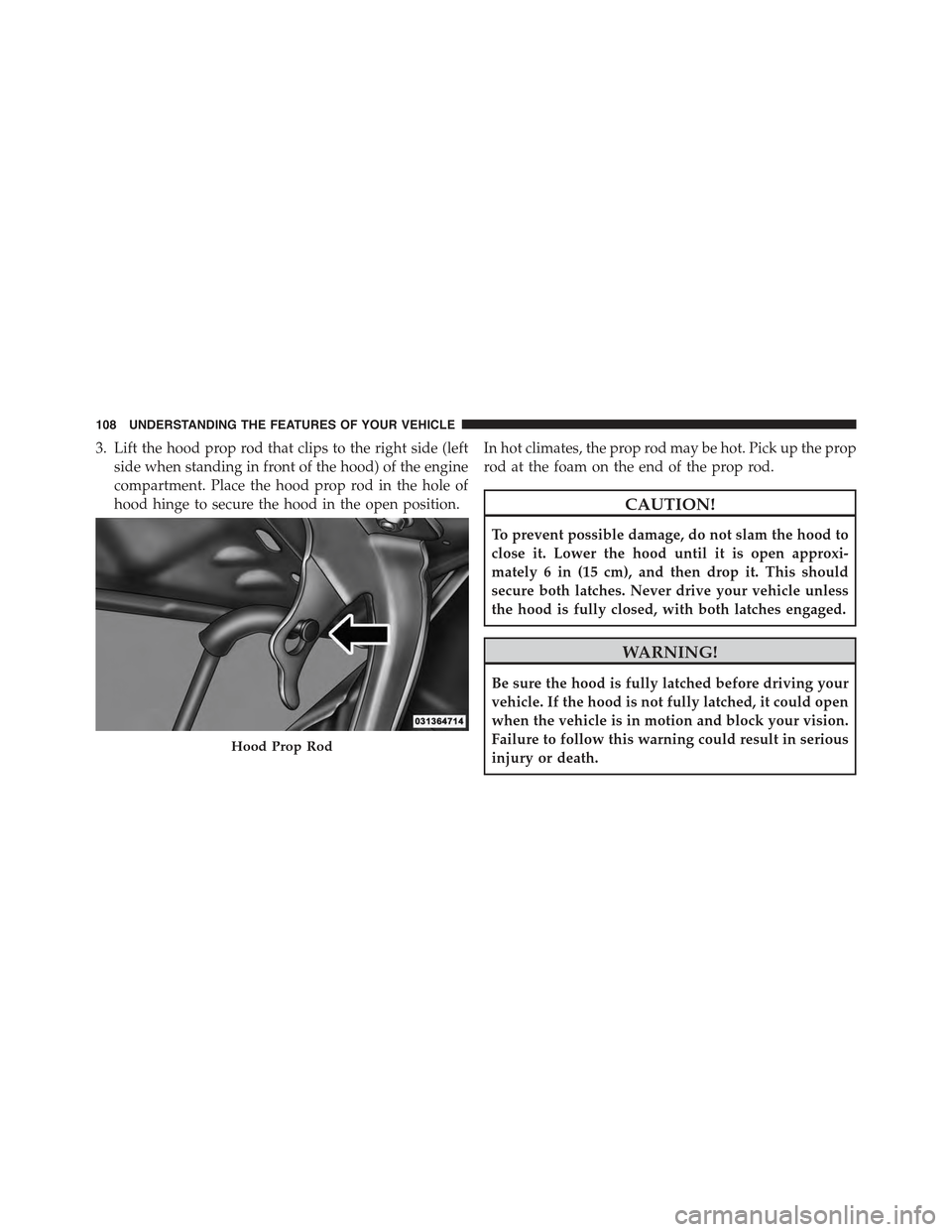
3. Lift the hood prop rod that clips to the right side (left
side when standing in front of the hood) of the engine
compartment. Place the hood prop rod in the hole of
hood hinge to secure the hood in the open position.
In hot climates, the prop rod may be hot. Pick up the prop
rod at the foam on the end of the prop rod.
CAUTION!
To prevent possible damage, do not slam the hood to
close it. Lower the hood until it is open approxi-
mately 6 in (15 cm), and then drop it. This should
secure both latches. Never drive your vehicle unless
the hood is fully closed, with both latches engaged.
WARNING!
Be sure the hood is fully latched before driving your
vehicle. If the hood is not fully latched, it could open
when the vehicle is in motion and block your vision.
Failure to follow this warning could result in serious
injury or death.Hood Prop Rod
108 UNDERSTANDING THE FEATURES OF YOUR VEHICLE
Page 117 of 426
NOTE:The Intermittent function only has one detent
but wiper delay will vary with changes in vehicle speed.
As vehicle speed increases the delay time will decrease.
Low Speed
Push the lever downward to the second detent. The
wipers will operate at low speed.
High Speed
Push the lever downward to the third detent. The wipers
will operate at high speed.
Manual High Speed/Mist
Push the lever upward from the off position. The wipers
will operate at high speed to clear off road mist or spray
from a passing vehicle. This operation will continue until
the lever is released. When the lever is released, the
wipers will return to the off position and automatically
shut off.
Front Windshield Washer Operation
Pull the windshield wiper/washer lever toward the
steering wheel to activate the washers. The wipers will
activate automatically for three cycles after the lever is
released.
CAUTION!
•Turn the windshield wipers off when driving
through an automatic car wash. Damage to the
windshield wipers may result if the wiper control
is left in any position other than off.
•In cold weather, always turn off the wiper switch
and allow the wipers to return to the “Park” posi-
tion before turning off the engine. If the wiper
switch is left on and the wipers freeze to the
windshield, damage to the wiper motor may occur
when the vehicle is restarted.
(Continued)
3
UNDERSTANDING THE FEATURES OF YOUR VEHICLE 115
Page 136 of 426
CAUTION!
•Many accessories that can be plugged in draw
power from the vehicle’s battery, even when not in
use (i.e., cellular phones, etc.). Eventually, if
plugged in long enough, the vehicle’s battery will
discharge sufficiently to degrade battery life and/or
prevent the engine from starting.
•Accessories that draw higher power (i.e., coolers,
vacuum cleaners, lights, etc.) will degrade the bat-
tery even more quickly. Only use these intermit-
tently and with great caution.
•After the use of high power draw accessories, or
long periods of the vehicle not being started (with
accessories still plugged in), the vehicle must be
driven a sufficient length of time to allow the
generator to recharge the vehicle’s battery.
CIGAR LIGHTER — IF EQUIPPED
This is located on the center console, in front of the cup
holders. To activate the cigar lighter, push and release the
knob. After a few seconds the knob automatically returns
to its initial position, and the cigar lighter is ready for use.
WARNING!
When the cigar lighter is in use it becomes very hot.
To avoid serious injury, handle the cigar lighter with
care. Always check that the cigar lighter has turned
off.
134 UNDERSTANDING THE FEATURES OF YOUR VEHICLE
Page 140 of 426
REAR WINDOW FEATURES
Rear Window Defroster
The rear window defroster button is located in the
center of the instrument panel, below the radio.
Press this button to turn on the rear window defroster.
An indicator in the instrument cluster will illuminate
when the rear window defroster is on. The rear window
defroster automatically turns off after approximately 20
minutes. To manually shut the defroster off, push the
button a second time.
NOTE:To prevent excessive battery drain, use the rear
window defroster only when the engine is operating.
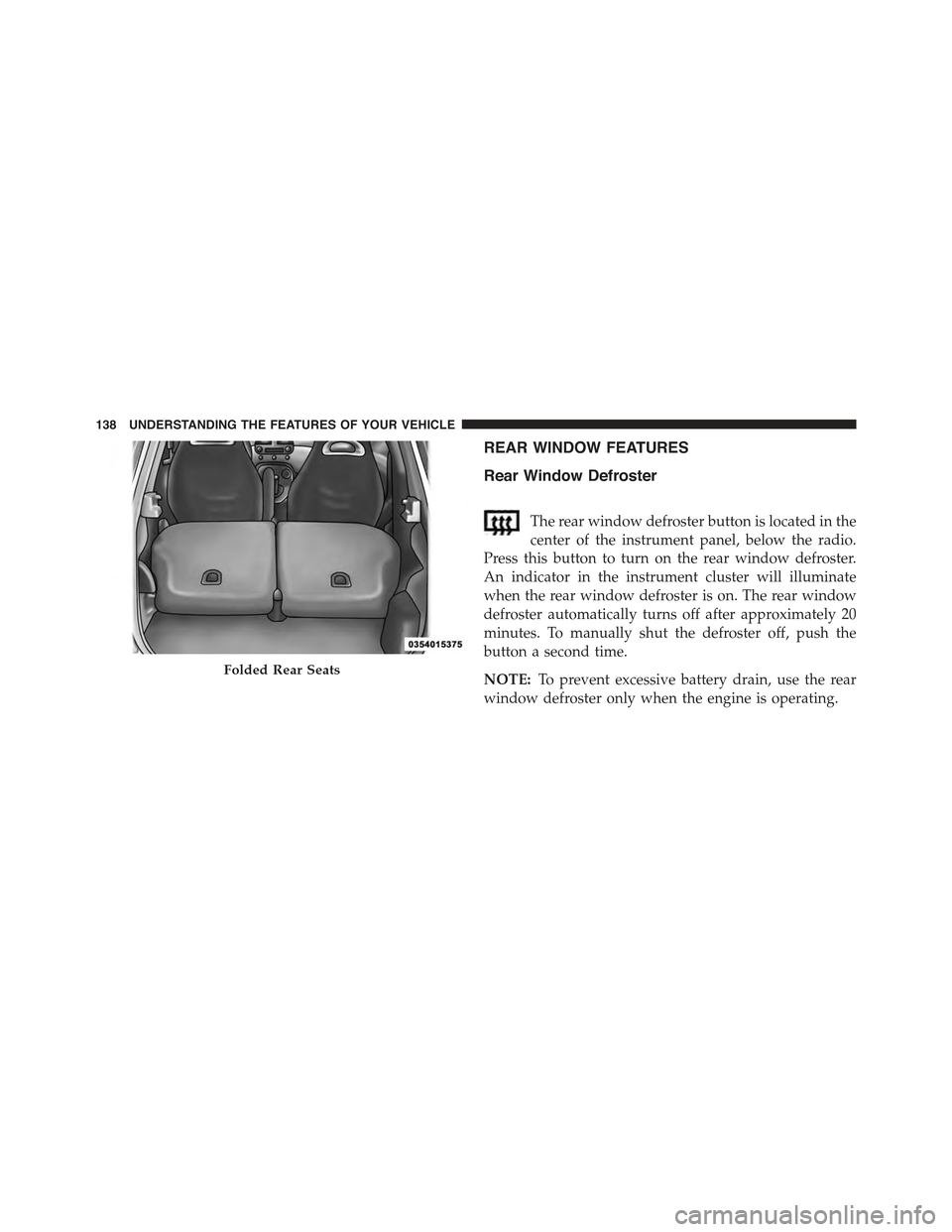
Folded Rear Seats
138 UNDERSTANDING THE FEATURES OF YOUR VEHICLE
Page 143 of 426
UNDERSTANDING YOUR INSTRUMENT PANEL
CONTENTS
!INSTRUMENT PANEL FEATURES..........143
!TURBO BOOST GAUGE..................144
!INSTRUMENT CLUSTER — ECO...........145
!INSTRUMENT CLUSTER — POP, LOUNGE,
500C................................146
!INSTRUMENT CLUSTER.................147
!INSTRUMENT CLUSTER DESCRIPTIONS.....148
!ELECTRONIC VEHICLE INFORMATION CENTER
(EVIC)..............................161
▫EVIC Displays.......................162
▫EVIC Control Buttons..................163
▫Electronic Vehicle Information Center (EVIC)
Setup Menu.........................164
▫Change Engine Oil Indicator System........165
▫Trip Computer.......................166
▫Trip Button..........................166
▫Trip Functions.......................167
▫Values Displayed......................168
▫Personal Settings (Customer-Programmable
Features)............................169
4
Page 146 of 426
TURBO BOOST GAUGE
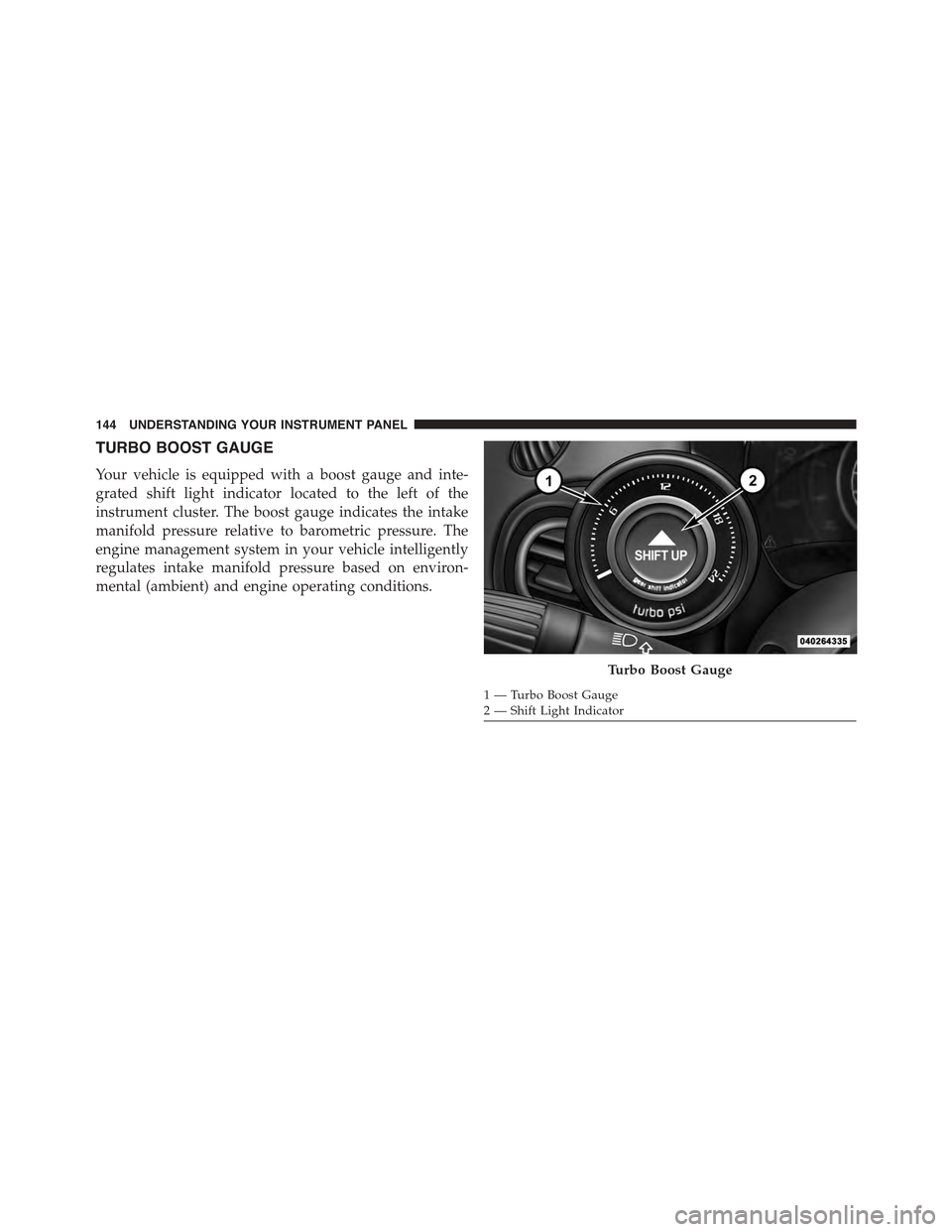
Your vehicle is equipped with a boost gauge and inte-
grated shift light indicator located to the left of the
instrument cluster. The boost gauge indicates the intake
manifold pressure relative to barometric pressure. The
engine management system in your vehicle intelligently
regulates intake manifold pressure based on environ-
mental (ambient) and engine operating conditions.
Turbo Boost Gauge
1—TurboBoostGauge2—ShiftLightIndicator
144 UNDERSTANDING YOUR INSTRUMENT PANEL
Page 152 of 426
NOTE:
•A continuous chime will sound if the vehicle is
driven more than 1 mile (1.6 km) with either turn
signal on.
•Check for an inoperative outside light bulb if either
indicator remains on and does not flash, or flashes at
a rapid rate.
4. Electronic Stability Control (ESC) Activation/
Malfunction Indicator Light
The “ESC Activation/Malfunction Indicator
Light” in the instrument cluster will come on
when the ignition switch is turned to the
ON/RUN position. It should go out with the
engine running. If the “ESC Activation/Malfunction In-
dicator Light” comes on continuously with the engine
running, a malfunction has been detected in the ESC
system. If this light remains on after several ignition
cycles, and the vehicle has been driven several miles
(kilometers) at speeds greater than 30 mph (48 km/h), see
your authorized dealer as soon as possible to have the
problem diagnosed and corrected.
NOTE:
•The “ESC Off Indicator Light” and the “ESC
Activation/Malfunction Indicator Light” come on
momentarily each time the ignition switch is turned
to ON/RUN.
•Each time the ignition is turned to ON/RUN, the
ESC system will be ON, even if it was turned off
previously.
•The ESC system will make buzzing or clicking
sounds when it is active. This is normal; the sounds
will stop when ESC becomes inactive following the
maneuver that caused the ESC activation.
150 UNDERSTANDING YOUR INSTRUMENT PANEL
Page 154 of 426
9. Malfunction Indicator Light (MIL)
The Malfunction Indicator Light (MIL) is part
of an onboard diagnostic (OBDII) system
which monitors the emissions and engine con-
trol system. If the vehicle is ready for emissions
testing, the light will come on when the ignition is first
turned on and remain on, as a bulb check, until the
engine is started. If the vehicle is not ready for emissions
testing the light will come on when the ignition is first
turned on and remain on for 15 seconds, then blink for 5
seconds, and remain on until the vehicle is started. If the
bulb does not come on during starting, have the condi-
tion investigated promptly.
If this light comes on and remains on while driving, it
suggests a potential engine control problem and the need
for system service.
Although your vehicle will usually be drivable and not
need towing, see your authorized dealer for service as
soon as possible.
CAUTION!
Prolonged driving with the Malfunction Indicator
Light (MIL) on could cause damage to the engine
control system. It also could affect fuel economy and
driveability. If the MIL is flashing, severe catalytic
converter damage and power loss will soon occur.
Immediate service is required.
WARNING!
A malfunctioning catalytic converter, as referenced
above, can reach higher temperatures than in normal
operating conditions. This can cause a fire if you
drive slowly or park over flammable substances such
as dry plants, wood, cardboard, etc. This could result
in death or serious injury to the driver, occupants or
others.
152 UNDERSTANDING YOUR INSTRUMENT PANEL
Page 158 of 426
16. Gas Pedal Percentage Gauge/Turbo Gauge/ECO In-
dex Gauge
Depending on what options and trim level, your vehicle
is equipped with there are three gauges available.
•Gas Pedal Percentage Gauge: This gauge shows
what percent the gas pedal is currently depressed at.
•Turbo Gauge: This gauge shows the current turbo
usage.
•ECO Index Gauge: The ECO Index gauge allows the
driver to monitor their driving style in order to
increase fuel economy. The efficiency of the driving
style is displayed on a gauge located on the right
side of the instrument cluster and ranges from a
minimum value of 0 up to a maximum value of 5 (0
= low, 5 = high). A higher “ECO” index indicates a
more fuel efficient drive style and will increase your
fuel economy. A lower “ECO” index indicates fre-
quent accelerations/decelerations and will decrease
your fuel economy. The index is recalculated ap-
proximately every second and takes into account a
combination of the instant fuel economy and your
driving style during the current trip.
NOTE:Different trips may have different values even if
the same driving style is maintained. Some factors that
may impact the calculated index value are:
•Traffic conditions
•Trip duration
•Temperature (engine and ambient)
17. Fuel Gauge
Shows level of fuel in tank when ignition switch is in the
ON/RUN position.
156 UNDERSTANDING YOUR INSTRUMENT PANEL