ECU FIAT 500 ABARTH 2015 2.G Owner's Manual
[x] Cancel search | Manufacturer: FIAT, Model Year: 2015, Model line: 500 ABARTH, Model: FIAT 500 ABARTH 2015 2.GPages: 426, PDF Size: 9.89 MB
Page 329 of 426
WARNING!
To avoid the risk of forcing the vehicle off the jack,
do not fully tighten the wheel bolts until the vehicle
has been lowered. Failure to follow this warning may
result in personal injury.
7. Install the wheel and wheel bolts with the cone shaped
end of the bolts toward the wheel. Lightly tighten the
bolts. To avoid the risk of forcing the vehicle off the
jack, do not tighten the bolts fully until the vehicle has
been lowered.
8. Lower the vehicle by turning the jack screw to the left.
9. Finish tightening the bolts. Push down on the wrench
while tightening the wheel bolts. Alternate bolts until
each bolt has been tightened twice. Refer to “Torque
Specifications” in this section for proper lug bolt
torque. If you doubt that you have tightened the bolts
correctly, have them checked with a torque wrench by
your authorized dealer or service station.
10. Disassemble the jack and tools and place them in the
bag. Stow it under the driver’s seat and secure the
bag to the floor with the straps attached to the floor
of the vehicle.
11. Check the tire pressure as soon as possible. Correct
the tire pressure as required.
JUMP-STARTING PROCEDURE
If your vehicle has a discharged battery, it can be jump-
started using a set of jumper cables and a battery in
another vehicle or by using a portable battery booster
pack. Jump-starting can be dangerous if done improperly
so please follow the procedures in this section carefully.
6
WHAT TO DO IN EMERGENCIES 327
Page 337 of 426
If you must use the accessories (wipers, defrosters, etc.)
while being towed, the ignition must be in the ON/RUN
position.
CAUTION!
•Do not use sling-type equipment when towing.
Vehicle damage may occur.
•When securing the vehicle to a flatbed truck, do not
attach to front or rear suspension components.
Damage to your vehicle may result from improper
towing.
Automatic Transmission
•Vehicle can be towed with the front wheels elevated.
•Vehicle can be towed on a flatbed truck (all wheels off
the ground).
If the ignition key is unavailable, or the battery is
discharged, refer to “Shift Lever Override” in this section
for instructions on shifting the transmission out of PARK
in order to move the vehicle.
CAUTION!
•DO NOT flat tow any vehicle equipped with a
conventional automatic transmission. Damage to
the drivetrain will result. If these vehicles require
towing, make sure all drive wheels are OFF the
ground.
•Towing this vehicle in violation of the above re-
quirements can cause severe transmission damage.
Damage from improper towing is not covered un-
der the New Vehicle Limited Warranty.
6
WHAT TO DO IN EMERGENCIES 335
Page 353 of 426
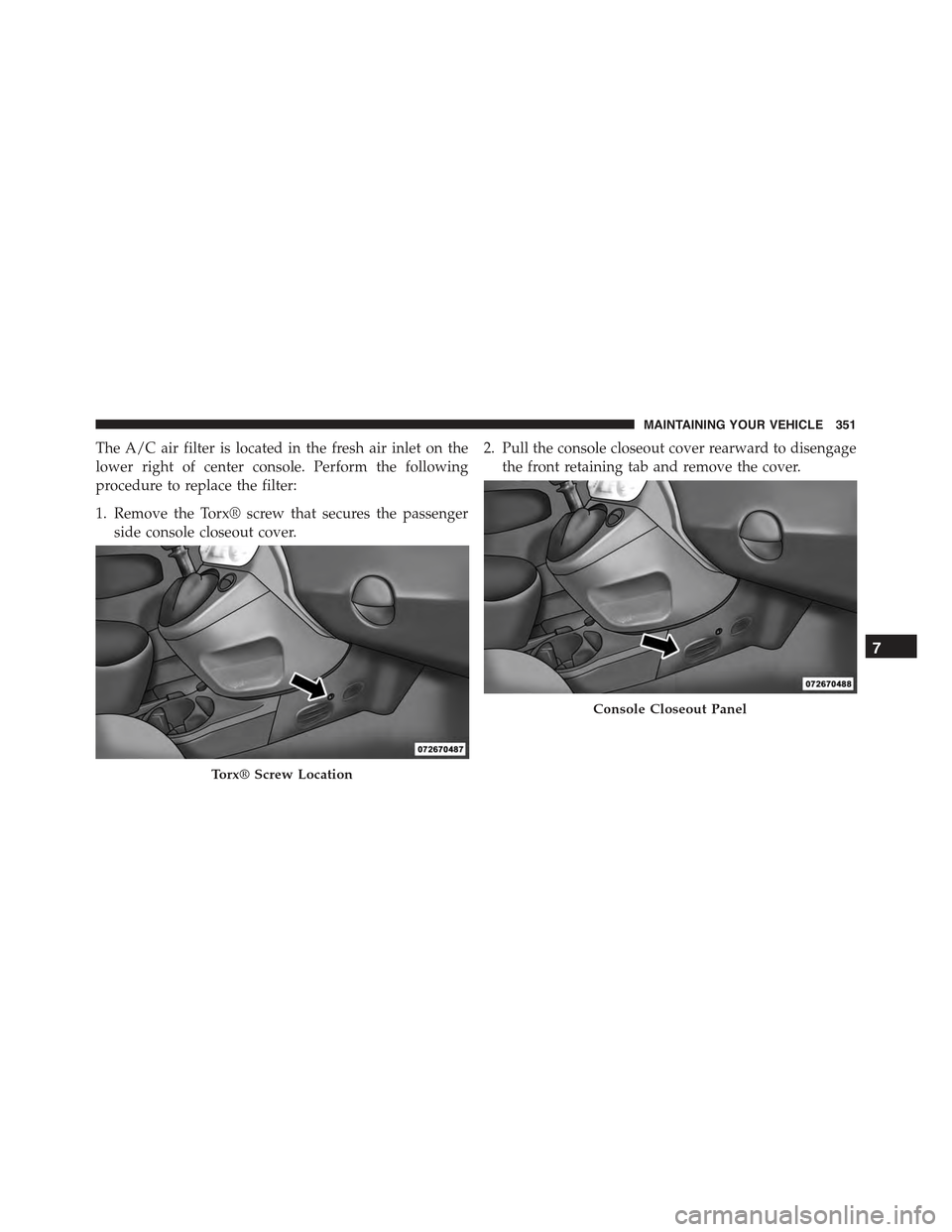
The A/C air filter is located in the fresh air inlet on the
lower right of center console. Perform the following
procedure to replace the filter:
1. Remove the Torx® screw that secures the passenger
side console closeout cover.
2. Pull the console closeout cover rearward to disengage
the front retaining tab and remove the cover.
Torx® Screw Location
Console Closeout Panel
7
MAINTAINING YOUR VEHICLE 351
Page 354 of 426
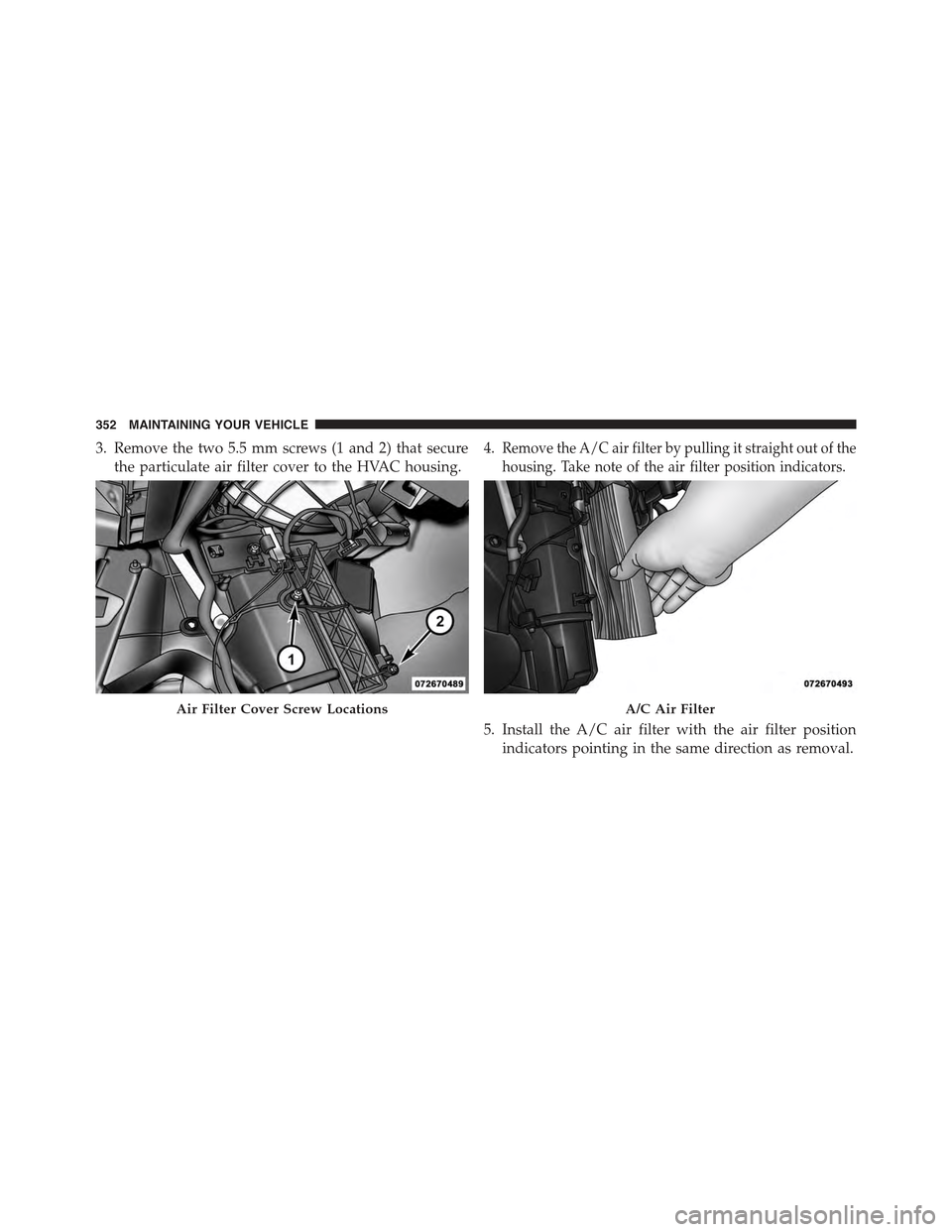
3. Remove the two 5.5 mm screws (1 and 2) that secure
the particulate air filter cover to the HVAC housing.
4.Remove the A/C air filter by pulling it straight out of the
housing. Take note of the air filter position indicators.
5. Install the A/C air filter with the air filter position
indicators pointing in the same direction as removal.
Air Filter Cover Screw LocationsA/C Air Filter
352 MAINTAINING YOUR VEHICLE
Page 368 of 426
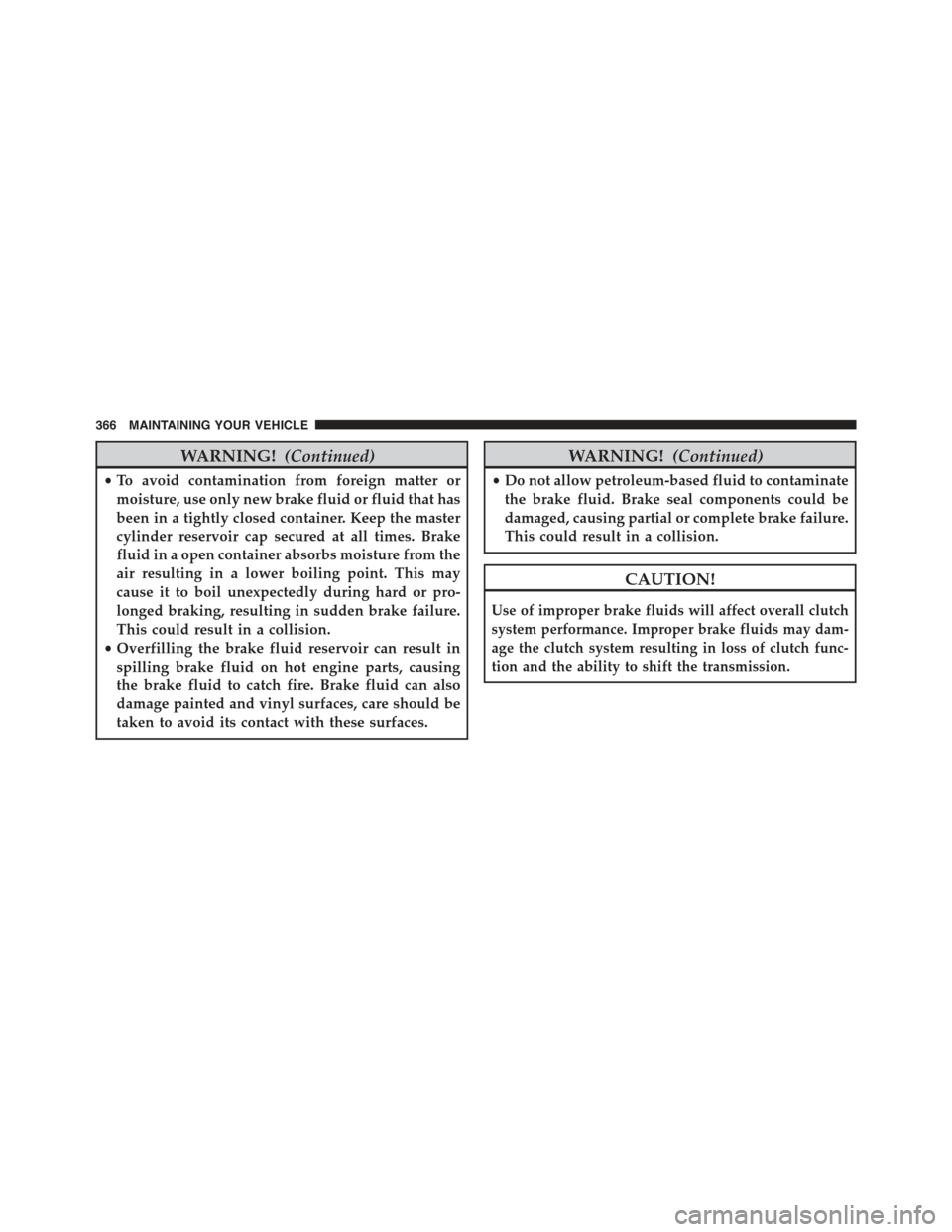
WARNING!(Continued)
•To avoid contamination from foreign matter or
moisture, use only new brake fluid or fluid that has
been in a tightly closed container. Keep the master
cylinder reservoir cap secured at all times. Brake
fluid in a open container absorbs moisture from the
air resulting in a lower boiling point. This may
cause it to boil unexpectedly during hard or pro-
longed braking, resulting in sudden brake failure.
This could result in a collision.
•Overfilling the brake fluid reservoir can result in
spilling brake fluid on hot engine parts, causing
the brake fluid to catch fire. Brake fluid can also
damage painted and vinyl surfaces, care should be
taken to avoid its contact with these surfaces.
WARNING!(Continued)
•Do not allow petroleum-based fluid to contaminate
the brake fluid. Brake seal components could be
damaged, causing partial or complete brake failure.
This could result in a collision.
CAUTION!
Use of improper brake fluids will affect overall clutch
system performance. Improper brake fluids may dam-
age the clutch system resulting in loss of clutch func-
tion and the ability to shift the transmission.
366 MAINTAINING YOUR VEHICLE