cylinder FIAT 500 ABARTH 2015 2.G Owners Manual
[x] Cancel search | Manufacturer: FIAT, Model Year: 2015, Model line: 500 ABARTH, Model: FIAT 500 ABARTH 2015 2.GPages: 426, PDF Size: 9.89 MB
Page 14 of 426
6. Remove the key from the ignition switch lock cylinder.
7. Release the clutch pedal.
WARNING!
•Before exiting a vehicle, always turn the ignition to
the OFF/LOCK position, apply the parking brake,
shift the transmission into REVERSE gear, and
remove the Key Fob from the vehicle. When leav-
ing the vehicle, always lock your vehicle.
•Never leave children alone in a vehicle, or with
access to an unlocked vehicle.
•Allowing children to be in a vehicle unattended is
dangerous for a number of reasons. A child or
others could be seriously or fatally injured. Chil-
dren should be warned not to touch the parking
brake, brake pedal or the gear selector.
•Do not leave the Key Fob in or near the vehicle, or
in a location accessible to children. A child could
operate power windows, other controls, or move
the vehicle.
(Continued)
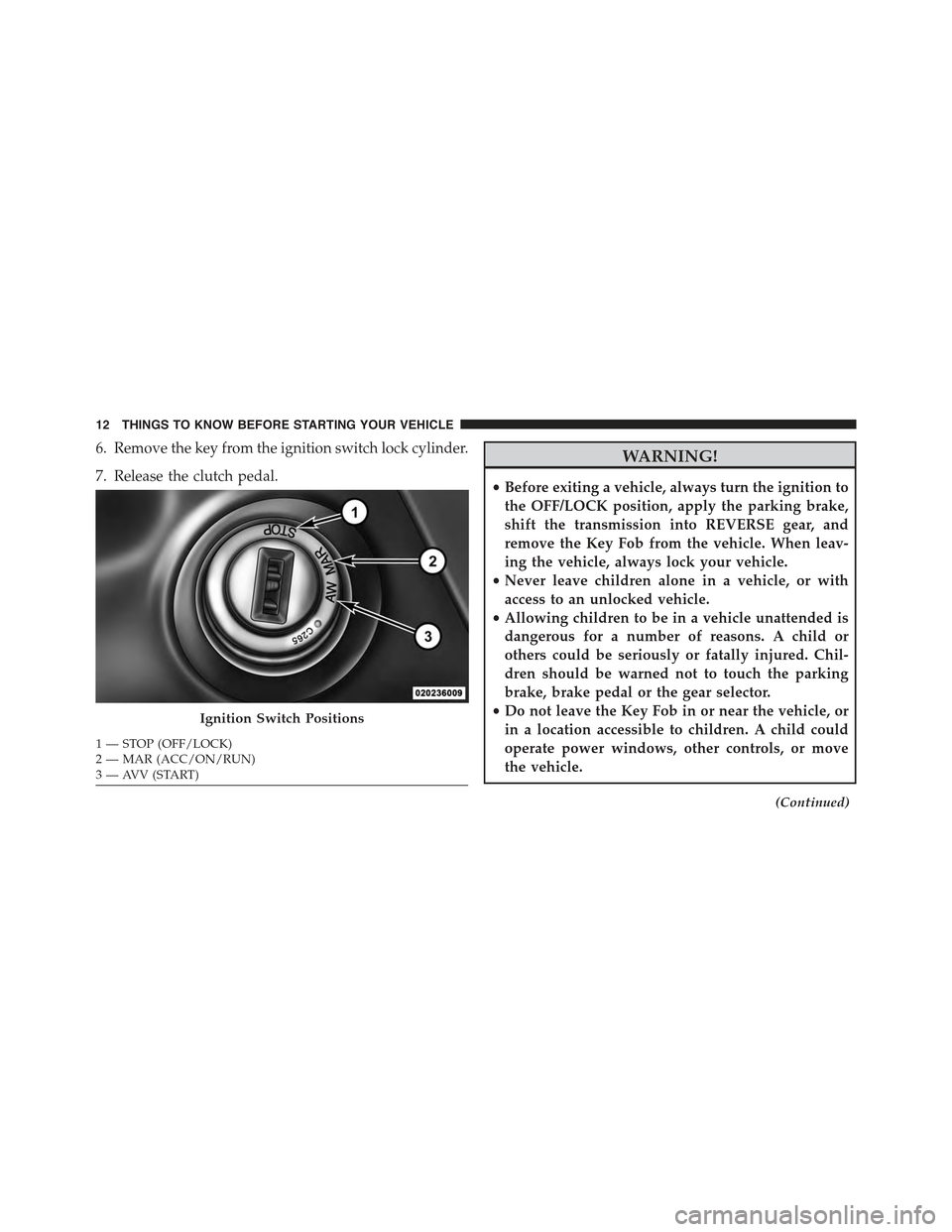
Ignition Switch Positions
1—STOP(OFF/LOCK)2—MAR(ACC/ON/RUN)3—AVV(START)
12 THINGS TO KNOW BEFORE STARTING YOUR VEHICLE
Page 16 of 426
NOTE:A key which has not been programmed is also
considered an invalid key, even if it is cut to fit the
ignition switch lock cylinder for that vehicle.
If the Vehicle Security Light is on after the key is turned
to the ON/RUN position, it indicates that there is a
problem with the electronics.
CAUTION!
•Always remove the Sentry Key® from the vehicle
and lock all doors when leaving the vehicle unat-
tended.
•The Sentry Key® Immobilizer system is not com-
patible with some aftermarket remote starting sys-
tems. Use of these systems may result in vehicle
starting problems and loss of security protection.
All of the keys provided with your new vehicle have
been programmed to the vehicle electronics.
Replacement Keys
NOTE:Only keys that have been programmed to the
vehicle electronics can be used to start the vehicle. Once
a Sentry Key® has been programmed to a vehicle, it
cannot be programmed to any other vehicle. When hav-
ing the Sentry Key® Immobilizer System serviced, bring
all vehicle keys with you to an authorized dealer.
The VIN is required for authorized dealer replacement of
keys. Duplication of keys may be performed at an
authorized dealer.
General Information
The Sentry Key® system complies with FCC rules part 15
and with RSS-210 of Industry Canada. Operation is
subject to the following conditions:
•This device may not cause harmful interference.
14 THINGS TO KNOW BEFORE STARTING YOUR VEHICLE
Page 156 of 426
indicate that the parking brake is applied, that the brake
fluid level is low, or that there is a problem with the
Anti-lock Brake System reservoir.
If the light remains on when the parking brake has been
disengaged, and the fluid level is at the full mark on the
master cylinder reservoir, it indicates a possible brake
hydraulic system malfunction or that a problem with the
Brake Booster has been detected by the Anti-Lock Brake
System (ABS) / Electronic Stability Control (ESC) system.
In this case, the light will remain on until the condition
has been corrected. If the problem is related to the brake
booster, the ABS pump will run when applying the brake
and a brake pedal pulsation may be felt during each stop.
The dual brake system provides a reserve braking capac-
ity in the event of a failure to a portion of the hydraulic
system. A leak in either half of the dual brake system is
indicated by the Brake Warning Light, which will turn on
when the brake fluid level in the master cylinder has
dropped below a specified level.
The light will remain on until the cause is corrected.
NOTE:The light may flash momentarily during sharp
cornering maneuvers, which change fluid level condi-
tions. The vehicle should have service performed, and
the brake fluid level checked.
If brake failure is indicated, immediate repair is neces-
sary.
WARNING!
Driving a vehicle with the red brake light on is
dangerous. Part of the brake system may have failed.
It will take longer to stop the vehicle. You could have
a collision. Have the vehicle checked immediately.
Vehicles equipped with the ABS, are also equipped with
Electronic Brake Force Distribution (EBD). In the event of
154 UNDERSTANDING YOUR INSTRUMENT PANEL
Page 355 of 426
CAUTION!
The A/C air filter is identified with an arrow to
indicate airflow direction through the filter. Failure
to properly install the filter will result in the need to
replace it more often.
6. Install the passenger side console closeout.
Refer to the “Maintenance Schedule” for the proper
maintenance intervals.
Body Lubrication
Locks and all body pivot points, including such items as
seat tracks, door hinge pivot points and rollers, liftgate,
tailgate, decklid, sliding doors and hood hinges, should
be lubricated periodically with a lithium based grease,
such as MOPAR® Spray White Lube to assure quiet, easy
operation and to protect against rust and wear. Prior to
the application of any lubricant, the parts concerned
should be wiped clean to remove dust and grit; after
lubricating excess oil and grease should be removed.
Particular attention should also be given to hood latching
components to ensure proper function. When performing
other underhood services, the hood latch, release mecha-
nism and safety catch should be cleaned and lubricated.
The external lock cylinders should be lubricated twice a
year, preferably in the Fall and Spring. Apply a small
amount of a high quality lubricant, such as MOPAR®
Lock Cylinder Lubricant directly into the lock cylinder.
Windshield Wiper Blades
Clean the rubber edges of the wiper blades and the
windshield periodically with a sponge or soft cloth and a
mild nonabrasive cleaner. This will remove accumula-
tions of salt or road film.
7
MAINTAINING YOUR VEHICLE 353
Page 366 of 426
•If frequent engine coolant (antifreeze) additions are
required, the cooling system should be pressure tested
for leaks.
•Maintain engine coolant (antifreeze) concentration at a
minimum of 50% OAT coolant (conforming to
MS.90032) and distilled water for proper corrosion
protection of your engine which contains aluminum
components.
•Make sure that the coolant expansion bottle overflow
hoses are not kinked or obstructed.
•Keep the front of the radiator clean. If your vehicle is
equipped with air conditioning, keep the front of the
condenser clean.
•Do not change the thermostat for Summer or Winter
operation. If replacement is ever necessary, install ONLY
the correct type thermostat. Other designs may result in
unsatisfactory engine coolant (antifreeze) performance,
poor gas mileage, and increased emissions.
Brake System
In order to assure brake system performance, all brake
system components should be inspected periodically.
Refer to the “Maintenance Schedule” for the proper
maintenance intervals.
WARNING!
Riding the brakes can lead to brake failure and
possibly a collision. Driving with your foot resting or
riding on the brake pedal can result in abnormally
high brake temperatures, excessive lining wear, and
possible brake damage. Riding the brakes may also
reduce braking capacity in an emergency.
Brake Master Cylinder
The fluid level in the master cylinder should be checked
when performing under hood services, or immediately if
the “Brake Warning Light” is on.
364 MAINTAINING YOUR VEHICLE
Page 367 of 426
Be sure to clean the top of the master cylinder area before
removing the cap. If necessary, add fluid to bring the
fluid level up to the requirements described on the brake
fluid reservoir. Fluid level can be expected to fall as the
brake pads wear. The brake fluid level should be checked
when the pads are replaced. However, low fluid level
may be caused by a leak and a checkup may be needed.
NOTE:If your vehicle is equipped with amanual trans-
mission, the brake fluid reservoir supplies fluid to both
the brake system and the clutch release system. The two
systems are separated in the reservoir, and a leak in one
system will not affect the other system. Themanual
transmissionclutch release system should not require
fluid replacement during the life of the vehicle. If the
brake fluid reservoir is low and the brake system does
not indicate any leaks or other problems, it may be a
result of a leak in the hydraulic clutch release system.
See your local authorized dealer for service.
Use only manufacturer’s recommended brake fluid.
Refer to “Fluids, Lubricants, and Genuine Parts” in
“Maintaining Your Vehicle” for further information.
WARNING!
•Use only manufacturer’s recommended brake
fluid. Refer to “Fluids, Lubricants, and Genuine
Parts” in “Maintaining Your Vehicle” for further
information. Using the wrong type of brake fluid
can severely damage your brake system and/or
impair its performance. The proper type of brake
fluid for your vehicle is also identified on the
original factory installed hydraulic master cylinder
reservoir.
(Continued)
7
MAINTAINING YOUR VEHICLE 365
Page 368 of 426
WARNING!(Continued)
•To avoid contamination from foreign matter or
moisture, use only new brake fluid or fluid that has
been in a tightly closed container. Keep the master
cylinder reservoir cap secured at all times. Brake
fluid in a open container absorbs moisture from the
air resulting in a lower boiling point. This may
cause it to boil unexpectedly during hard or pro-
longed braking, resulting in sudden brake failure.
This could result in a collision.
•Overfilling the brake fluid reservoir can result in
spilling brake fluid on hot engine parts, causing
the brake fluid to catch fire. Brake fluid can also
damage painted and vinyl surfaces, care should be
taken to avoid its contact with these surfaces.
WARNING!(Continued)
•Do not allow petroleum-based fluid to contaminate
the brake fluid. Brake seal components could be
damaged, causing partial or complete brake failure.
This could result in a collision.
CAUTION!
Use of improper brake fluids will affect overall clutch
system performance. Improper brake fluids may dam-
age the clutch system resulting in loss of clutch func-
tion and the ability to shift the transmission.
366 MAINTAINING YOUR VEHICLE
Page 392 of 426
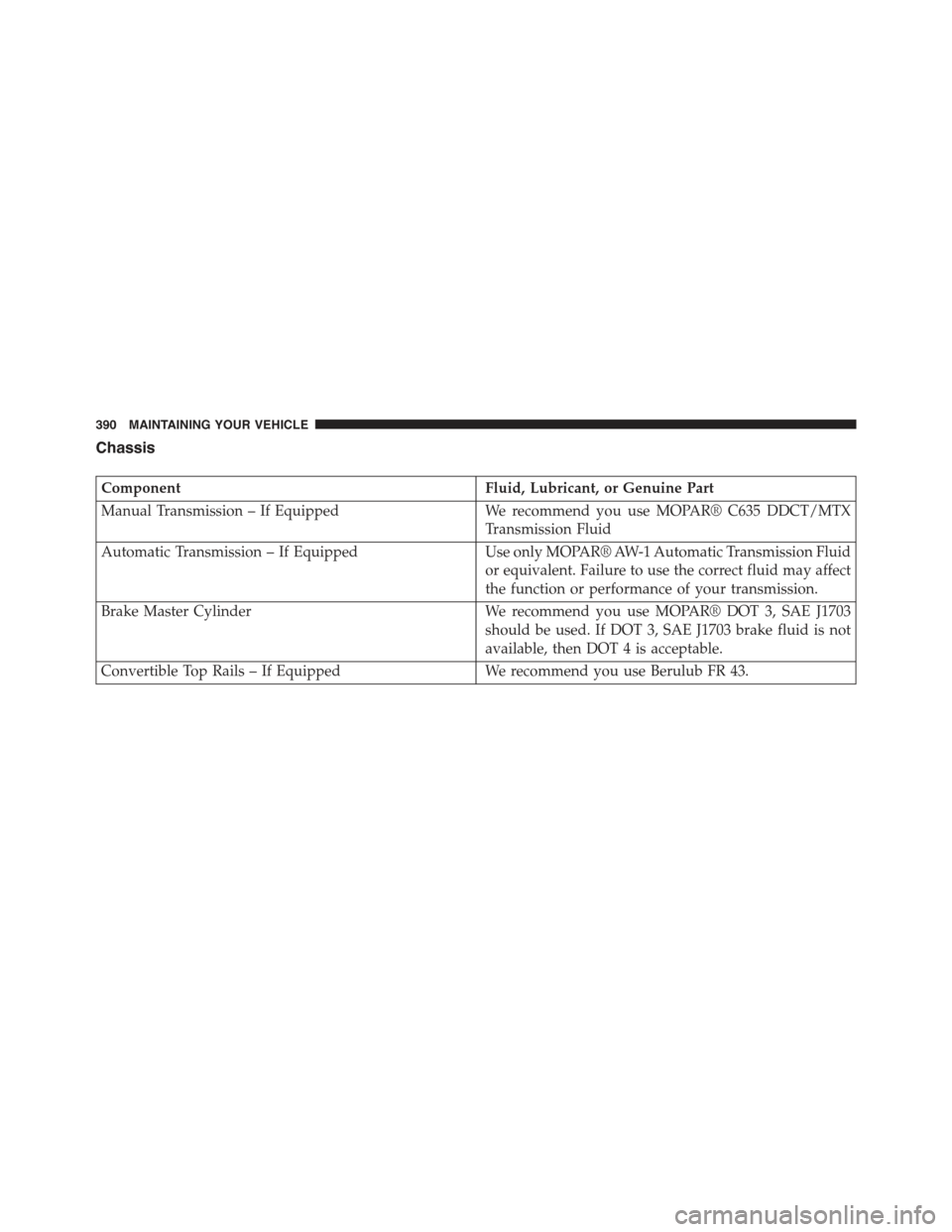
Chassis
ComponentFluid, Lubricant, or Genuine Part
Manual Transmission – If EquippedWe recommend you use MOPAR® C635 DDCT/MTX
Transmission Fluid
Automatic Transmission – If EquippedUse only MOPAR® AW-1 Automatic Transmission Fluid
or equivalent. Failure to use the correct fluid may affect
the function or performance of your transmission.
Brake Master CylinderWe recommend you use MOPAR® DOT 3, SAE J1703
should be used. If DOT 3, SAE J1703 brake fluid is not
available, then DOT 4 is acceptable.
Convertible Top Rails – If EquippedWe recommend you use Berulub FR 43.
390 MAINTAINING YOUR VEHICLE
Page 395 of 426
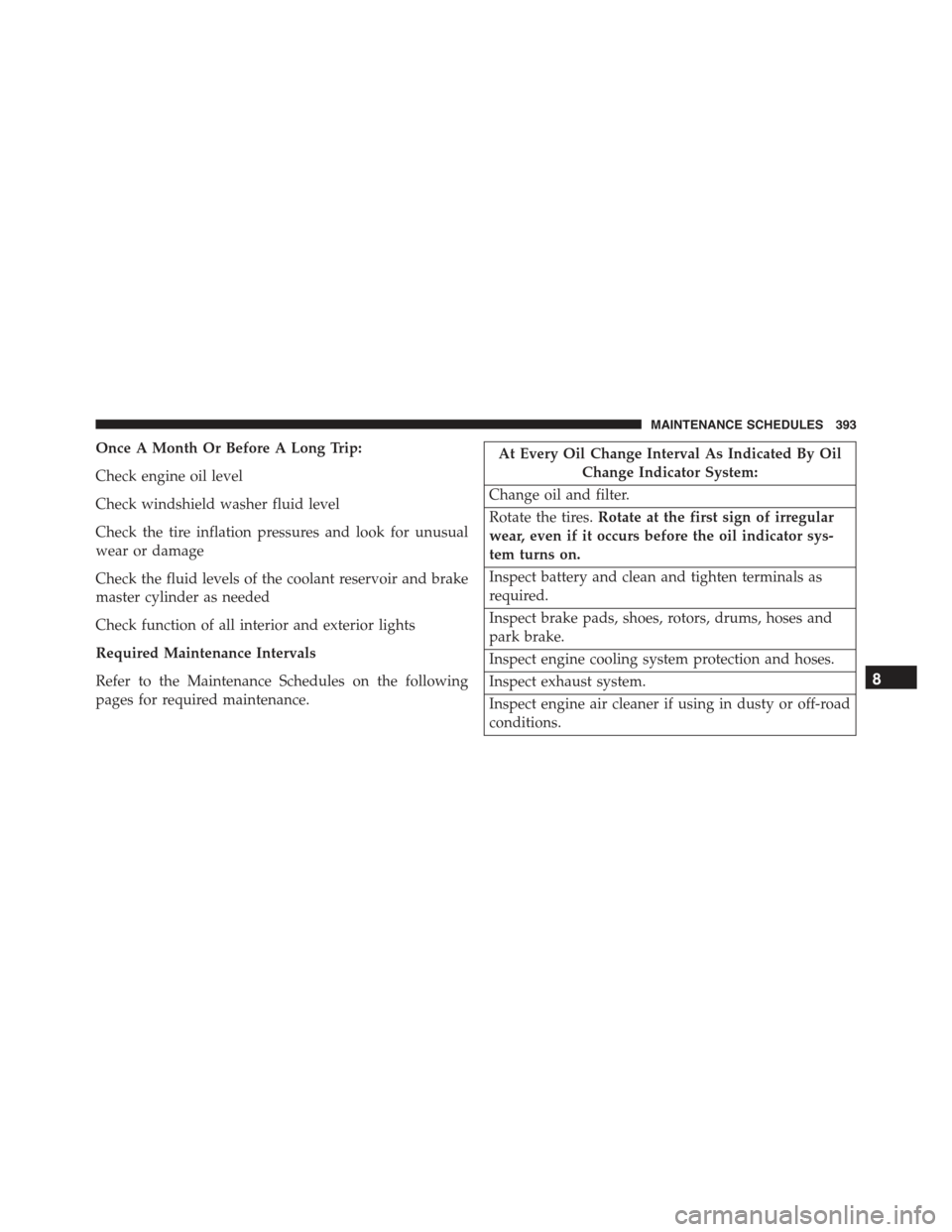
Once A Month Or Before A Long Trip:
Check engine oil level
Check windshield washer fluid level
Check the tire inflation pressures and look for unusual
wear or damage
Check the fluid levels of the coolant reservoir and brake
master cylinder as needed
Check function of all interior and exterior lights
Required Maintenance Intervals
Refer to the Maintenance Schedules on the following
pages for required maintenance.
At Every Oil Change Interval As Indicated By Oil
Change Indicator System:
Change oil and filter.
Rotate the tires.Rotate at the first sign of irregular
wear, even if it occurs before the oil indicator sys-
tem turns on.
Inspect battery and clean and tighten terminals as
required.
Inspect brake pads, shoes, rotors, drums, hoses and
park brake.
Inspect engine cooling system protection and hoses.
Inspect exhaust system.
Inspect engine air cleaner if using in dusty or off-road
conditions.
8
MAINTENANCE SCHEDULES 393
Page 411 of 426
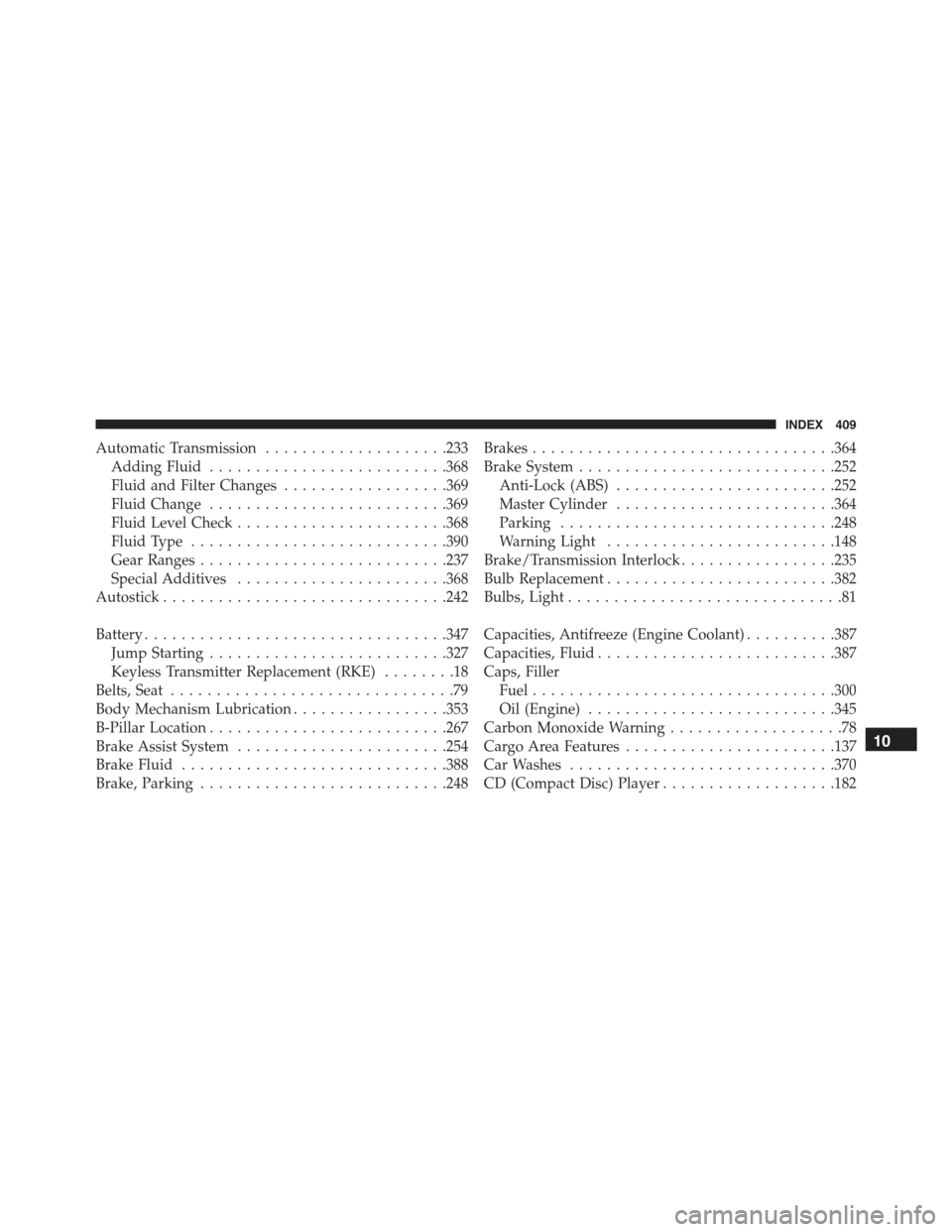
Automatic Transmission....................233
Adding Fluid..........................368
Fluid and Filter Changes..................369
Fluid Change..........................369
Fluid Level Check.......................368
Fluid Type............................390
Gear Ranges...........................237
Special Additives.......................368
Autostick...............................242
Battery.................................347
Jump Starting..........................327
Keyless Transmitter Replacement (RKE)........18
Belts, Seat...............................79
Body Mechanism Lubrication.................353
B-Pillar Location..........................267
Brake Assist System.......................254
Brake Fluid.............................388
Brake, Parking...........................248
Brakes.................................364
Brake System............................252
Anti-Lock (ABS)........................252
Master Cylinder........................364
Parking..............................248
Warning Light.........................148
Brake/Transmission Interlock.................235
Bulb Replacement.........................382
Bulbs, Light..............................81
Capacities, Antifreeze (Engine Coolant)..........387
Capacities, Fluid..........................387
Caps, Filler
Fuel.................................300
Oil (Engine)...........................345
Carbon Monoxide Warning...................78
Cargo Area Features.......................137
Car Washes.............................370
CD (Compact Disc) Player...................182
10
INDEX 409