air condition FIAT 500 ABARTH 2015 2.G User Guide
[x] Cancel search | Manufacturer: FIAT, Model Year: 2015, Model line: 500 ABARTH, Model: FIAT 500 ABARTH 2015 2.GPages: 108, PDF Size: 2.63 MB
Page 14 of 108
Advanced Front Air Bags
• This vehicle has Advanced Front Air Bags for both the driver and front passenger
as a supplement to the seat belt restraint systems. The Advanced Front Air Bags
will not deploy in every type of collision.
• Advanced Front Air Bags are designed to provide additional protection by supple-
menting the seat belts. Advanced Front Air Bags are not expected to reduce the
risk of injury in rear, side, or rollover collisions.
• The Advanced Front Air Bags will not deploy in all frontal collisions, including
some that may produce substantial vehicle damage — for example, some pole
collisions, truck underrides, and angle offset collisions.
• On the other hand, depending on the type and location of impact, Advanced
Front Air Bags may deploy in crashes with little vehicle front-end damage but that
produce a severe initial deceleration.
• Because air bag sensors measure vehicle deceleration over time, vehicle speed
and damage by themselves are not good indicators of whether or not an air bag
should have deployed.
• Seat belts are necessary for your protection in all collisions, and also are needed
to help keep you in position, away from an inflating air bag.
• The air bags must be ready to inflate for your protection in a collision. The Occu-
pant Restraint Controller (ORC) monitors the internal circuits and interconnecting
wiring associated with air bag system electrical components.
• The ORC turns on the Air Bag Warning Light in the instrument panel for approxi-
mately four to eight seconds for a self-check when the ignition switch is first
turned to the ON/RUN position. After the self-check, the Air Bag Warning Light
will turn off. If the ORC detects a malfunction in any part of the system, it turns on
the Air Bag Warning Light, either momentarily or continuously. A single chime will
sound to alert you if the light comes on again after initial startup.
• The ORC monitors the readiness of the electronic parts of the air bag system
whenever the ignition switch is in the START or ON/RUN position. If the ignition
switch is in the OFF position or in the ACC position, the air bag system is not on
and the air bags will not inflate.
• If the Air Bag Warning Light in the instrument panel is not on during the four to
eight seconds when the ignition switch is first turned to the ON/RUN position,
stays on, or turns on while driving, have the vehicle serviced by an authorized
service center immediately.
NOTE:If the speedometer, tachometer, or any engine related gauges are not working, the Oc-cupant Restraint Controller (ORC) may also be disabled. In this condition the air bagsmay not be ready to inflate for your protection. Have an authorized dealer service the airbag system immediately.
• After any collision, the vehicle should be taken to an authorized dealer immedi-
ately.
GETTING STARTED
12
Page 59 of 108
NOTE:
Tire pressures change by approximately 1 psi (7 kPa) per 12° F (7° C) of air temperature
change. Keep this in mind when checking tire pressure inside a garage, especially in the
Winter. Example: If garage temperature is 68°F (20°C), and the outside temperature is
32°F (0°C), then the cold tire inflation pressure should be increased by 3 psi (21 kPa),
which equals 1 psi (7 kPa) for every 12°F (7°C) for this outside temperature condition.
CAUTION!
The TPMS has been optimized for the original equipment tires and wheels. TPMS
pressures and warning have been established for the tire size equipped on your
vehicle. Undesirable system operation or sensor damage may result when using
replacement equipment that is not of the same size, type, and/or style. Aftermar-
ket wheels can cause sensor damage. Do not use tire sealant from a can, or bal-
ance beads if your vehicle is equipped with a TPMS, as damage to the sensors
may result.
- Engine Temperature Warning Light
This light warns of an overheated engine condition.
If the light turns on or flashes continuously while driving, safely pull over and stop
the vehicle. If the A/C system is on, turn it off. Also, shift the transmission into NEU-
TRAL and idle the vehicle. If the temperature reading does not return to normal, turn
the engine off immediately.
We recommend that you do not operate the vehicle or engine damage will occur.
Have the vehicle serviced immediately.
WARNING!
A hot engine cooling system is dangerous. You or others could be badly burned
by steam or boiling coolant.
- Seat Belt Reminder Light
When the ignition switch is first turned to the ON/RUN position, this light will turn on
for four to eight seconds as a bulb check. During the bulb check, if the driver's seat
belt is unbuckled, a chime will sound. After the bulb check or when driving, if the
driver or front passenger seat belt remains unbuckled, the Seat Belt Indicator Light
will flash or remain on continuously. Refer to “Seat Belt Systems” in “Things To
Know Before Starting” in your Owner’s Manual on the DVD for further information.
WHAT TO DO IN EMERGENCIES
57
Page 60 of 108
- Brake Warning Light
This light monitors various brake functions, including brake fluid level and parking
brake application. If the brake light turns on, it may indicate that the parking brake is
applied, that the brake fluid level is low, or that there is a problem with the anti-lock
brake system reservoir.
If the light remains on when the parking brake has been disengaged, and the fluid
level is at the full mark on the master cylinder reservoir, it indicates a possible brake
hydraulic system malfunction or that a problem with the Brake Booster has been
detected by the Anti-Lock Brake System (ABS)/Electronic Stability Control (ESC)
system. In this case, the light will remain on until the condition has been corrected.
If the problem is related to the brake booster, the ABS pump will run when applying
the brake, and a brake pedal pulsation may be felt during each stop.
The dual brake system provides a reserve braking capacity in the event of a failure
to a portion of the hydraulic system. A leak in either half of the dual brake system is
indicated by the Brake Warning Light, which will turn on when the brake fluid level in
the master cylinder has dropped below a specified level. The light will remain on
until the cause is corrected.
Vehicles equipped with the Anti-Lock Brake System (ABS) are also equipped with
Electronic Brake Force Distribution (EBD). In the event of an EBD failure, the Brake
Warning Light will turn on along with the ABS Light. Immediate repair to the ABS
system is required.
Operation of the Brake Warning Light can be checked by turning the ignition switch
from the OFF position to the ON/RUN position. The light should illuminate for ap-
proximately two seconds. The light should then turn off unless the parking brake is
applied or a brake fault is detected. If the light does not illuminate, have the light
inspected by an authorized dealer.
The light also will turn on when the parking brake is applied with the ignition switch
in the ON/RUN position.
NOTE:
This light shows only that the parking brake is applied. It does not show the degree of
brake application.
WARNING!
Driving a vehicle with the red brake light on is dangerous. Part of the brake sys-
tem may have failed. It will take longer to stop the vehicle. You could have a colli-
sion. Have the vehicle checked immediately.
WHAT TO DO IN EMERGENCIES
58
Page 64 of 108
IF YOUR ENGINE OVERHEATS
In any of the following situations, you can reduce the potential for overheating by
taking the appropriate action:
• On the highways — slow down.
• In city traffic — while stopped, shift transmission into NEUTRAL, but do not in-
crease engine idle speed.
NOTE:There are steps that you can take to slow down an overheat condition:
• If your air conditioner (A/C) is on, turn it off. The A/C system adds heat to the en-
gine cooling system and turning the A/C off can help remove this heat.
• You can also turn the Temperature control to maximum heat, the Mode control to
floor and the Fan control to high. This allows the heater core to act as a supple-
ment to the radiator and aids in removing heat from the engine cooling system.
• If the temperature reading does not return to normal, turn the engine off immedi-
ately.
• We recommend that you do not operate the vehicle or engine damage will occur.
Have the vehicle serviced immediately.
CAUTION!
Driving with a hot cooling system could damage your vehicle. If the temperature
gauge reads hot, pull over and stop the vehicle. Idle the vehicle with the air condi-
tioner turned off until the pointer drops back into the normal range. If the pointer
remains on hot, turn the engine off immediately and call for service.
WARNING!
You or others can be badly burned by hot engine coolant (antifreeze) or steam
from your radiator. If you see or hear steam coming from under the hood, do not
open the hood until the radiator has had time to cool. Never try to open a cooling
system pressure cap when the radiator or coolant bottle is hot.
WHAT TO DO IN EMERGENCIES
62
Page 70 of 108
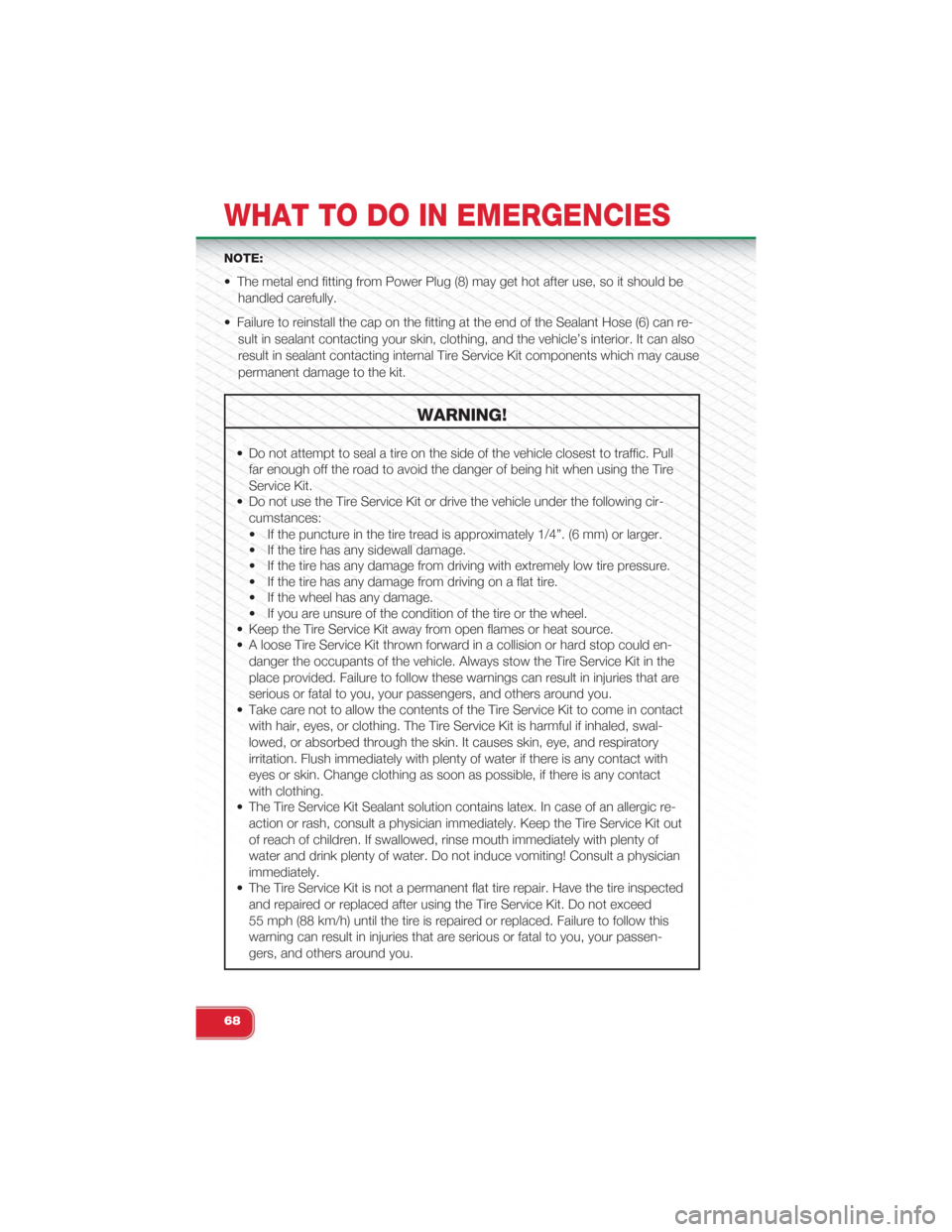
NOTE:
• The metal end fitting from Power Plug (8) may get hot after use, so it should be
handled carefully.
• Failure to reinstall the cap on the fitting at the end of the Sealant Hose (6) can re-
sult in sealant contacting your skin, clothing, and the vehicle’s interior. It can also
result in sealant contacting internal Tire Service Kit components which may cause
permanent damage to the kit.
WARNING!
• Do not attempt to seal a tire on the side of the vehicle closest to traffic. Pull
far enough off the road to avoid the danger of being hit when using the Tire
Service Kit.
• Do not use the Tire Service Kit or drive the vehicle under the following cir-
cumstances:
• If the puncture in the tire tread is approximately 1/4”. (6 mm) or larger.
• If the tire has any sidewall damage.
• If the tire has any damage from driving with extremely low tire pressure.
• If the tire has any damage from driving on a flat tire.
• If the wheel has any damage.
• If you are unsure of the condition of the tire or the wheel.
• Keep the Tire Service Kit away from open flames or heat source.
• A loose Tire Service Kit thrown forward in a collision or hard stop could en-
danger the occupants of the vehicle. Always stow the Tire Service Kit in the
place provided. Failure to follow these warnings can result in injuries that are
serious or fatal to you, your passengers, and others around you.
• Take care not to allow the contents of the Tire Service Kit to come in contact
with hair, eyes, or clothing. The Tire Service Kit is harmful if inhaled, swal-
lowed, or absorbed through the skin. It causes skin, eye, and respiratory
irritation. Flush immediately with plenty of water if there is any contact with
eyes or skin. Change clothing as soon as possible, if there is any contact
with clothing.
• The Tire Service Kit Sealant solution contains latex. In case of an allergic re-
action or rash, consult a physician immediately. Keep the Tire Service Kit out
of reach of children. If swallowed, rinse mouth immediately with plenty of
water and drink plenty of water. Do not induce vomiting! Consult a physician
immediately.
• The Tire Service Kit is not a permanent flat tire repair. Have the tire inspected
and repaired or replaced after using the Tire Service Kit. Do not exceed
55 mph (88 km/h) until the tire is repaired or replaced. Failure to follow this
warning can result in injuries that are serious or fatal to you, your passen-
gers, and others around you.
WHAT TO DO IN EMERGENCIES
68
Page 78 of 108
EVENT DATA RECORDER (EDR)
This vehicle is equipped with an Event Data Recorder (EDR). The main purpose of
an EDR is to record, in certain crash or near crash-like situations, such as an air bag
deployment or hitting a road obstacle, data that will assist in understanding how a
vehicle’s systems performed. The EDR is designed to record data related to vehicle
dynamics and safety systems for a short period of time, typically 30 seconds or
less. The EDR in this vehicle is designed to record such data as:
• How various systems in your vehicle were operating.
• Whether or not the driver and passenger safety belts were buckled/fastened.
• How far (if at all) the driver was depressing the accelerator and/or brake pedal.
• How fast the vehicle was traveling.
These data can help provide a better understanding of the circumstances in which
crashes and injuries occur.
NOTE:EDR data is recorded by your vehicle only if a non-trivial crash situation occurs; no datais recorded by the EDR under normal driving conditions and no personal data (e.g. name,gender, age, and crash location) is recorded. However, other parties, such as law en-forcement, could combine the EDR data with the type of personally identifying data rou-tinely acquired during a crash investigation.
To read data recorded by an EDR, special equipment is required, and access to the
vehicle or the EDR is needed. In addition to the vehicle manufacturer, other parties
such as law enforcement, that have the special equipment, can read the information
if they have access to the vehicle or the EDR.
WHAT TO DO IN EMERGENCIES
76
Page 85 of 108
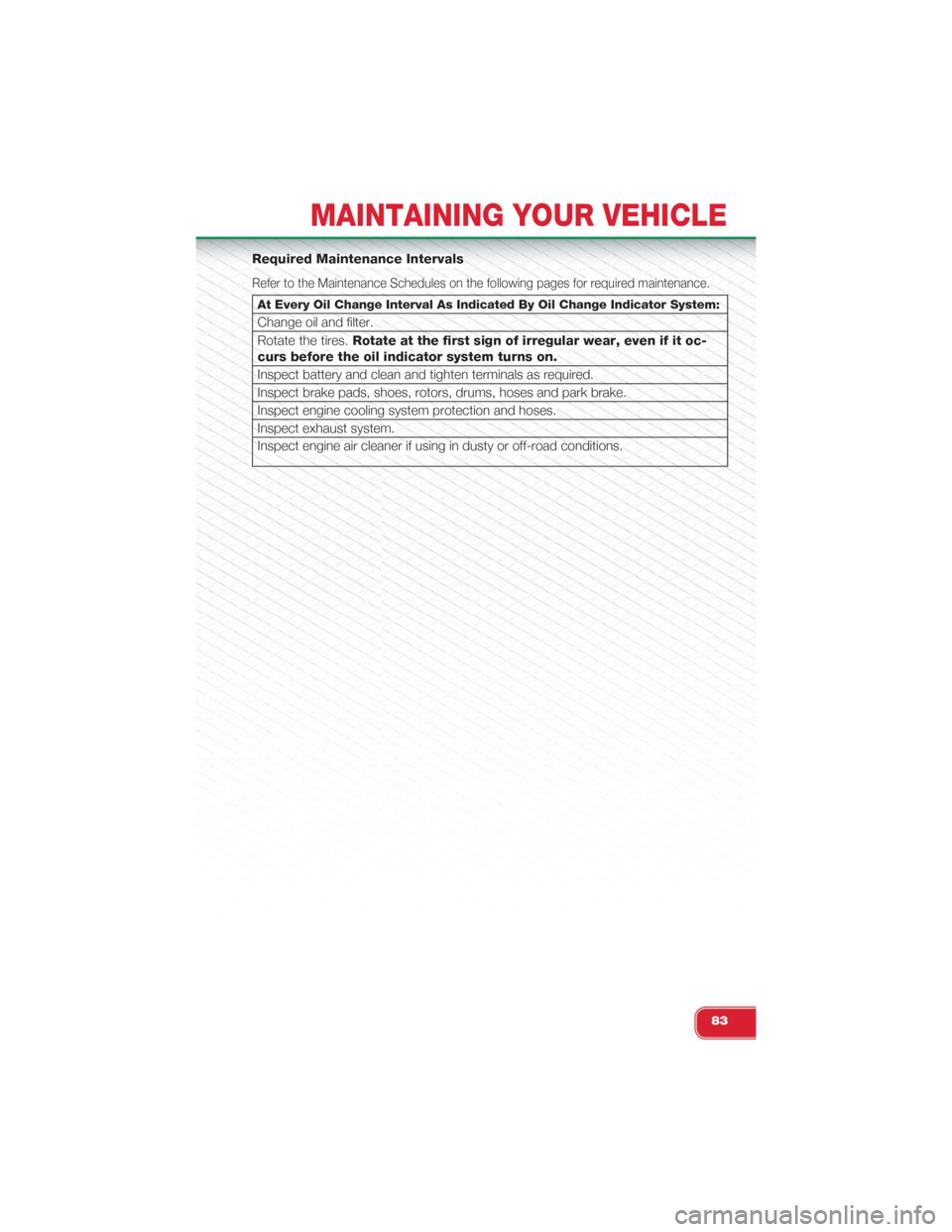
Required Maintenance Intervals
Refer to the Maintenance Schedules on the following pages for required maintenance.
At Every Oil Change Interval As Indicated By Oil Change Indicator System:
Change oil and filter.
Rotate the tires.Rotate at the first sign of irregular wear, even if it oc-
curs before the oil indicator system turns on.
Inspect battery and clean and tighten terminals as required.
Inspect brake pads, shoes, rotors, drums, hoses and park brake.
Inspect engine cooling system protection and hoses.
Inspect exhaust system.
Inspect engine air cleaner if using in dusty or off-road conditions.
MAINTAINING YOUR VEHICLE
83
Page 86 of 108
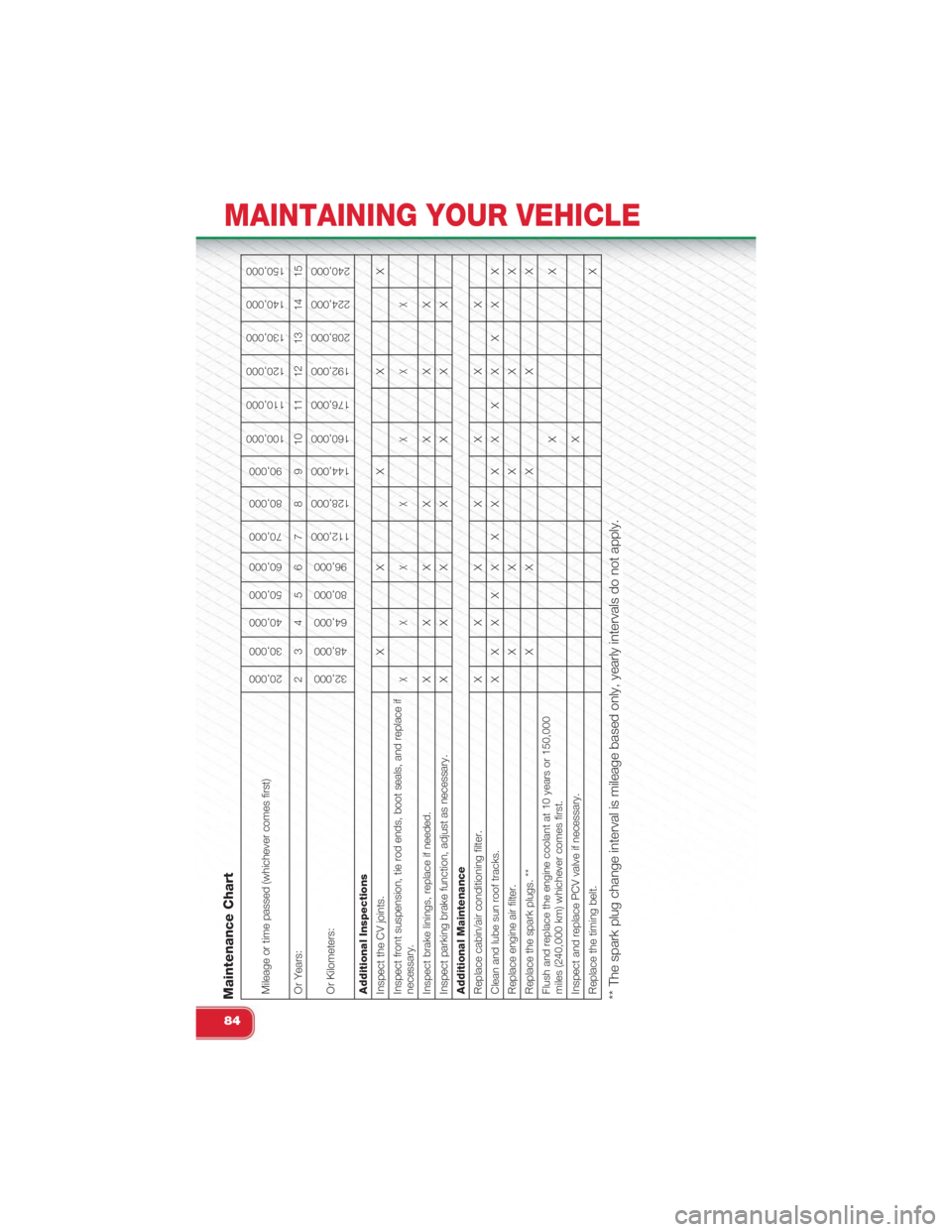
Maintenance ChartMileage or time passed (whichever comes first)
20,000
30,000
40,000
50,000
60,000
70,000
80,000
90,000
100,000
110,000
120,000
130,000
140,000
150,000
Or Years: 2 3 4 5 6 7 8 9 10 11 12 13 14 15Or Kilometers:
32,000
48,000
64,000
80,000
96,000
112,000
128,000
144,000
160,000
176,000
192,000
208,000
224,000
240,000
Additional InspectionsInspect the CV joints. X X X X XInspect front suspension, tie rod ends, boot seals, and replace ifnecessary.
XXX X X X X
Inspect brake linings, replace if needed. X X X X X X XInspect parking brake function, adjust as necessary. X X X X X X XAdditional MaintenanceReplace cabin/air conditioning filter. X X X X X X XClean and lube sun roof tracks. X X X X X X X X X X X X X XReplace engine air filter. X X X X XReplace the spark plugs. ** X X X X XFlush and replace the engine coolant at 10 years or 150,000miles (240,000 km) whichever comes first.
XX
Inspect and replace PCV valve if necessary.
X
Replace the timing belt.
X
** The spark plug change interval is mileage based only, yearly intervals do not apply.
MAINTAINING YOUR VEHICLE
84
Page 90 of 108
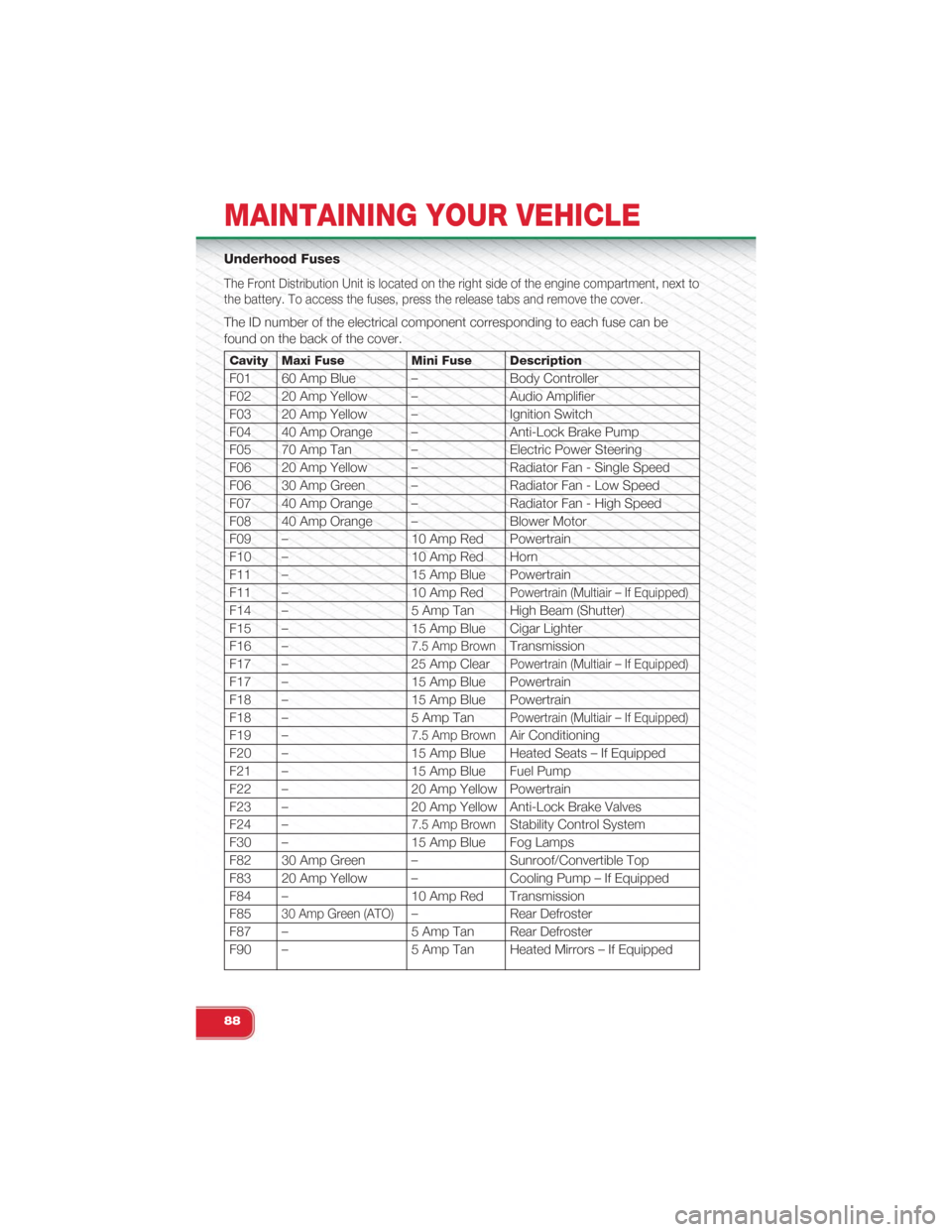
Underhood Fuses
The Front Distribution Unit is located on the right side of the engine compartment, next to
the battery. To access the fuses, press the release tabs and remove the cover.
The ID number of the electrical component corresponding to each fuse can be
found on the back of the cover.
Cavity Maxi Fuse Mini Fuse Description
F01 60 Amp Blue – Body Controller
F02 20 Amp Yellow – Audio Amplifier
F03 20 Amp Yellow – Ignition Switch
F04 40 Amp Orange – Anti-Lock Brake Pump
F05 70 Amp Tan – Electric Power Steering
F06 20 Amp Yellow – Radiator Fan - Single Speed
F06 30 Amp Green – Radiator Fan - Low Speed
F07 40 Amp Orange – Radiator Fan - High Speed
F08 40 Amp Orange – Blower Motor
F09 – 10 Amp Red Powertrain
F10 – 10 Amp Red Horn
F11 – 15 Amp Blue Powertrain
F11 – 10 Amp RedPowertrain (Multiair – If Equipped)
F14 – 5 Amp Tan High Beam (Shutter)
F15 – 15 Amp Blue Cigar Lighter
F16 –7.5 Amp BrownTransmission
F17 – 25 Amp ClearPowertrain (Multiair – If Equipped)
F17 – 15 Amp Blue Powertrain
F18 – 15 Amp Blue Powertrain
F18 – 5 Amp TanPowertrain (Multiair – If Equipped)
F19 –7.5 Amp BrownAir Conditioning
F20 – 15 Amp Blue Heated Seats – If Equipped
F21 – 15 Amp Blue Fuel Pump
F22 – 20 Amp Yellow Powertrain
F23 – 20 Amp Yellow Anti-Lock Brake Valves
F24 –7.5 Amp BrownStability Control System
F30 – 15 Amp Blue Fog Lamps
F82 30 Amp Green – Sunroof/Convertible Top
F83 20 Amp Yellow – Cooling Pump – If Equipped
F84 – 10 Amp Red Transmission
F8530 Amp Green (ATO)– Rear Defroster
F87 – 5 Amp Tan Rear Defroster
F90 – 5 Amp Tan Heated Mirrors – If Equipped
MAINTAINING YOUR VEHICLE
88
Page 99 of 108
Adding Engine Coolant (Antifreeze) . . .81Adding Washer Fluid. . . . . . . . . . .81Air BagAdvanced Front Air Bag . . . . . . .12Advance Front Air Bag. . . . . . . .11Air Bags. . . . . . . . . . . . . . . .11Air Bag Warning Light. . . . . . . . .11Driver Knee Air Bag. . . . . . . . . .13Front Air Bag. . . . . . . . . . . . .11Passenger Knee Air Bag . . . . . . .13Rollover. . . . . . . . . . . . . . . . .11Side Impacts. . . . . . . . . . . . . .11Air bag Light. . . . . . . . . . . . . . . .55Air Cleaner, Engine (Engine Air CleanerFilter). . . . . . . . . . . . . . . . . . .81Air Conditioner Maintenance . .. . . . .81Air Conditioning Refrigerant. . . . . . . .81Air Conditioning System. . . . . . . . .81AlarmDisarm The System. . . . . . . . . .10Vehicle Security Alarm .. . . . . . .10Alarm (Security Alarm)........10, 60Antifreeze (Engine Coolant) . .. . . .80, 81Capacities. . . . . . . . . . . . . . .80Disposal. . . . . . . . . . . . . . . .81Anti-Lock Warning Light. . . . . . . . .55Appearance Care. . . . . . . . . . . . .81Automatic Temperature Control (ATC). . .31Automatic TransmissionFluid Type. . . . . . . . . . . . . . .81
Battery. . . . . . . . . . . . . . . . . . .81BLUE&ME™ Hands-FreeCommunication. . . . . . . . . . . .43Body Mechanism Lubrication. . . . . .81Brake Fluid...............80, 81Brakes. . . . . . . . . . . . . . . . . . .81Brake System. . . . . . . . . . . . . . .81Master Cylinder. . . . . . . . . . . .81Warning Light. . . . . . . . . . . . .58Break-In Recommendations, NewVehicle. . . . . . . . . . . . . . . . .24Bulb Replacement. . . . . . . . . . . . .92Bulbs, Light. . . . . . . . . . . . . . . .92
Capacities, Antifreeze (Engine Coolant). .80Capacities, Fluid. . . . . . . . . . . . . .80
Caps, FillerOil (Engine) . .. . . . . . . . . . . .81Car Washes . .. . . . . . . . . . . . . .81Charging System Light . .. . . . . . . .55Child Restraint . . .. . . . . . . . . . . .14Child RestraintsInstalling Child Restraints Using TheVehicle Seat Belt . .. . . . . . . . . .16Lower Anchors And Tethers ForChildren. . . . . . . . . . . . . . . .16Using The Top Tether Anchorage . .16CleaningWheels. . . . . . . . . . . . . . . . .81Windshield Wiper Blades. . . . . . .81Climate Control . .. . . . . . . . . . . .30Automatic. . . . . . . . . . . . . . .31Manual. . . . . . . . . . . . . . . . .30Cluster Warning/Indicator LightsAnti-Lock Brake (ABS) Light. . . . .55Brake Warning Light . .. . . . . . . .58Charging System Light . . .. . . . .55Electronic Speed Control SETIndicator . .. . . . . . . . . . . . . .60Electronic Throttle Control (ETC)Indicator Light. . . . . . . . . . . . .59Engine Temperature Warning Light. .57Front Fog Light Indicator. . . . . . .60High Beam Indicator. . . . . . . . .60Malfunction Indicator Light (MIL) . . .59Oil Pressure Warning Light. . . . . .55Park/Headlight ON Indicator. . . . .61Tire Pressure Monitoring System(TPMS) Light. . . . . . . . . . . . .56Turn Signal Indicator. . . . . . . . .60Vehicle Security Light . .. . . . . . .60Clutch.. . . . . . . . . . . . . . . . . . .81Clutch Fluid .. . . . . . . . . . . . . . .81Compact Spare Tire . . . . . . .. . . . .90Coolant (Antifreeze) . .. . . . . . . . . .80Cooling System . . .. . . . . . . . . . .81Adding Coolant (Antifreeze). . . . .81Coolant Level .. . . . . . . . . . . .81Disposal of Used Coolant. . . . . .81Drain, Flush, and Refill . . .. . . . .81Inspection. . . . . . . . . . . . . . .81Points to Remember . .. . . . . . .81Pressure Cap . .. . . . . . . . . . .81
INDEX
97