oil pressure FIAT 500 ABARTH 2015 2.G User Guide
[x] Cancel search | Manufacturer: FIAT, Model Year: 2015, Model line: 500 ABARTH, Model: FIAT 500 ABARTH 2015 2.GPages: 108, PDF Size: 2.63 MB
Page 37 of 108
Raising The Power Top
Auto Close
From the convertible top fully open position, push the top close button for approxi-
mately one second for the three-quarter open/spoiler position. Push the top close
button for approximately one second a second time for the one-quarter open posi-
tion. Push and hold close button to fully close convertible top.
Manual Close
For manual close, push and hold the close button until desired position until one-
quarter open position. Push and hold again for full close position.
NOTE:
Rail lubrication is recommended every 2000 cycles, or if scratching noises due to
dust are present. Refer to “Fluids, Lubes, and Genuine Part” in “Maintaining Your
Vehicle” in the Owner’s Manual on the DVD for information.
CAUTION!
Failure to follow these cautions may cause interior water damage, stains or mil-
dew on the top material:
• Avoid high-pressure car washes, as they can damage the top material. Also,
increased water pressure may force water past the weather strips.
• Remove any standing water from the top and dry the surface before opening
it. Operating the top, opening a door or lowering a window while the top is
wet may allow water to drip into the vehicle’s interior.
• Use care when washing the vehicle, water pressure directed at the weather
strip seals may cause water to leak into the vehicle’s interior.
WARNING!
The convertible top does not provide the structural protection that a reinforced
metal roof does and the fabric top cannot be expected to prevent the ejection
of the occupants in a collision. Therefore, it is important that all occupants wear
their seat belts at all times. Death or serious injuries could occur if you are
ejected from the vehicle during a collision.
OPERATING YOUR VEHICLE
35
Page 57 of 108
ROADSIDE ASSISTANCE
• If your Abarth requires jump start assistance, out of gas/fuel delivery, tire service,
lockout service or towing due to a defect covered under the Basic Limited War-
ranty, dial toll-free 1-888-242-6342 or 1-800-363-4869 for Canadian Residents.
See your Warranty booklet for further details.
• Provide your name, vehicle identification number and license plate number.
• Provide your location, including telephone number, from which you are calling.
• Briefly describe the nature of the problem and answer a few simple questions.
• You will be given the name of the service provider and an estimated time of ar-
rival. If you feel you are in an “unsafe situation,” please let us know. With your
consent, we will contact local police or safety authorities.
INSTRUMENT CLUSTER WARNING LIGHTS
- Low Fuel Warning Light
This warning light indicates when the fuel level reaches approximately 2.0 gal
(7.8 L). This light will turn on and a single chime will sound.
- Charging System Light
This light shows the status of the electrical charging system. If the charging system
light remains on, it means that the vehicle is experiencing a problem with the charg-
ing system.
We recommend you do not continue driving if the charging system light is on. Have
the vehicle serviced immediately.
- Oil Pressure Warning Light
This light indicates low engine oil pressure. If the light turns on while driving, stop
the vehicle and shut off the engine as soon as possible. A chime will sound when
this light turns on.
We recommend you do not operate the vehicle or engine damage will occur. Have
the vehicle serviced immediately.
- Anti-Lock Brake (ABS) Light
This light monitors the Anti-Lock Brake System (ABS).
If the light is not on during starting, stays on or turns on while driving, we recom-
mend you contact the nearest authorized dealer and have the vehicle serviced
immediately.
- Air Bag Warning Light
If the light is not on during starting, stays on, or turns on while driving, have the ve-
hicle serviced by an authorized dealer immediately.
WHAT TO DO IN EMERGENCIES
55
Page 59 of 108
NOTE:
Tire pressures change by approximately 1 psi (7 kPa) per 12° F (7° C) of air temperature
change. Keep this in mind when checking tire pressure inside a garage, especially in the
Winter. Example: If garage temperature is 68°F (20°C), and the outside temperature is
32°F (0°C), then the cold tire inflation pressure should be increased by 3 psi (21 kPa),
which equals 1 psi (7 kPa) for every 12°F (7°C) for this outside temperature condition.
CAUTION!
The TPMS has been optimized for the original equipment tires and wheels. TPMS
pressures and warning have been established for the tire size equipped on your
vehicle. Undesirable system operation or sensor damage may result when using
replacement equipment that is not of the same size, type, and/or style. Aftermar-
ket wheels can cause sensor damage. Do not use tire sealant from a can, or bal-
ance beads if your vehicle is equipped with a TPMS, as damage to the sensors
may result.
- Engine Temperature Warning Light
This light warns of an overheated engine condition.
If the light turns on or flashes continuously while driving, safely pull over and stop
the vehicle. If the A/C system is on, turn it off. Also, shift the transmission into NEU-
TRAL and idle the vehicle. If the temperature reading does not return to normal, turn
the engine off immediately.
We recommend that you do not operate the vehicle or engine damage will occur.
Have the vehicle serviced immediately.
WARNING!
A hot engine cooling system is dangerous. You or others could be badly burned
by steam or boiling coolant.
- Seat Belt Reminder Light
When the ignition switch is first turned to the ON/RUN position, this light will turn on
for four to eight seconds as a bulb check. During the bulb check, if the driver's seat
belt is unbuckled, a chime will sound. After the bulb check or when driving, if the
driver or front passenger seat belt remains unbuckled, the Seat Belt Indicator Light
will flash or remain on continuously. Refer to “Seat Belt Systems” in “Things To
Know Before Starting” in your Owner’s Manual on the DVD for further information.
WHAT TO DO IN EMERGENCIES
57
Page 61 of 108
- Malfunction Indicator Light (MIL)
Certain conditions, such as a loose or missing gas cap, poor fuel quality, etc., may
illuminate the MIL after engine start. The vehicle should be serviced if the light stays
on through several typical driving cycles. In most situations, the vehicle will drive
normally and not require towing.
If the MIL flashes when the engine is running, serious conditions may exist that
could lead to immediate loss of power or severe catalytic converter damage. We
recommend you do not operate the vehicle. Have the vehicle serviced immediately.
- Electronic Stability Control (ESC) Activation / Malfunction
Indicator Light
The “ESC Activation/Malfunction Indicator Light” in the instrument cluster will come
on for four seconds when the ignition switch is turned to the ON/RUN position. If
the “ESC Activation/Malfunction Indicator Light” comes on continuously with the
engine running, a malfunction has been detected in the ESC system. If this light re-
mains on, see your authorized dealer as soon as possible to have the problem diag-
nosed and corrected.
NOTE:
• The “ESC Off Indicator Light” and the “ESC Activation/Malfunction Indicator
Light” come on momentarily each time the ignition switch is turned to ON/RUN.
• Each time the ignition is turned to ON/RUN, the ESC system will be ON even if it
was turned off previously.
• ESC Activation/Malfunction Light can blink during a ESC or TC intervention.
- Generic Warning Light
The Generic Warning Light will illuminate if any of the following conditions occur: Oil
Change Request, Engine Oil Pressure Sensor Failure, External Light Failure, Fuel
Cut-Off Not Available, Parking Sensor Failure, DST System Failure.
- Electronic Throttle Control (ETC) Indicator Light
This light informs you of a problem with the system.
If a problem is detected, the light will come on while the engine is running. Cycle the
ignition when the vehicle has completely stopped and the shift lever is placed in the
PARK position; the light should turn off.
If the light remains lit with the engine running, your vehicle will usually be drivable.
However, see an authorized dealer immediately. If the light is flashing when the en-
gine is running, immediate service is required, and you may experience reduced
performance, an elevated/rough idle or engine stall, and your vehicle may require
towing.
WHAT TO DO IN EMERGENCIES
59
Page 68 of 108
NOTE:
If the Mode Select Knob (5) is on Air Mode and the pump is operating, air will dispense
from the Air Pump Hose (7) only, not the Sealant Hose (6).
If the sealant (white fluid) does flow through the Sealant Hose (6):
1. Continue to operate the pump until sealant is no longer flowing through the hose
(typically takes 30 - 70 seconds). As the sealant flows through the Sealant Hose
(6), the Pressure Gauge (3) can read as high as 70 psi (4.8 Bar). The Pressure
Gauge (3) will decrease quickly from approximately 70 psi (4.8 Bar) to the actual
tire pressure when the Sealant Bottle (1) is empty.
2. The pump will start to inject air into the tire immediately after the Sealant Bottle
(1) is empty. Continue to operate the pump and inflate the tire to the pressure
indicated on the tire pressure label on the driver-side latch pillar (recommended
pressure). Check the tire pressure by looking at the Pressure Gauge (3).
If the tire does not inflate to at least 26 psi (1.8 Bar) pressure within 15
minutes:
The tire is too badly damaged. Do not attempt to drive the vehicle further. Call for
assistance.
NOTE:
If the tire becomes over-inflated, press the Deflation Button to reduce the tire pressure to
the recommended inflation pressure before continuing.
If the tire inflates to the recommended pressure or is at least 26 psi
(1.8 Bar) pressure within 15 minutes:
1. Press the Power Button (4) to turn off the Tire Service Kit.
2. Remove the Speed Limit sticker from the top of the Sealant Bottle (1) and place
the sticker on the instrument panel.
3. Immediately disconnect the Sealant Hose (6) from the valve stem, reinstall the
cap on the fitting at the end of the hose, and place the Tire Service Kit in the ve-
hicle storage location. Quickly proceed to (D) “Drive Vehicle.”
(D) Drive Vehicle:
Immediately after injecting sealant and inflating the tire, drive the vehicle 5 miles
(8 km) or 10 minutes to ensure distribution of the Tire Service Kit Sealant within the
tire. Do not exceed 55 mph (88 km/h).
(E) After Driving:
Pull over to a safe location. Refer to “Whenever You Stop to Use Tire Service Kit”
before continuing.
1. Turn the Mode Select Knob (5) to the Air Mode position.
2. Uncoil the Air Pump Hose (7) (black in color) and screw the fitting at the end of
hose (7) onto the valve stem.
WHAT TO DO IN EMERGENCIES
66
Page 69 of 108
3. Uncoil the power plug and insert the plug into the vehicles 12 Volt power outlet.
4. Check the pressure in the tire by reading the Pressure Gauge (3).
If tire pressure is less than 19 psi (1.3 Bar), the tire is too badly dam-
aged. Do not attempt to drive the vehicle further. Call for assistance.
If the tire pressure is 19 psi (1.3 Bar) or higher:
1. Push the Power Button (4) to turn on Tire Service Kit and inflate the tire to the
pressure indicated on the tire and loading information label on the driver-side
door opening.
2. Disconnect the Tire Service Kit from the valve stem, reinstall the cap on the valve
stem and unplug from 12 Volt outlet.
3. Place the Tire Service Kit in its proper storage area in the vehicle.
4. Have the tire inspected and repaired or replaced at the earliest opportunity at an
authorized dealer or tire service center.
5. Remove the Speed Limit sticker from the instrument panel after the tire has been
repaired.
6. Replace the Sealant Bottle (1) and Sealant Hose (6) assembly at your authorized
dealer as soon as possible. Refer to “(F) Sealant Bottle and Hose Replacement.”
NOTE:
• If the tire becomes over-inflated, push the Deflation Button to reduce the tire
pressure to the recommended inflation pressure before continuing.
• When having the tire serviced, advise the authorized dealer or service center that
the tire has been sealed using the Tire Service Kit.
(F) Sealant Bottle And Hose Replacement:
1. Uncoil the Sealant Hose (6) (clear in color).
2. Locate the round Sealant Bottle release button in the recessed area under the
sealant bottle.
3. Press the Sealant Bottle release button. The Sealant Bottle (1) will pop up. Re-
move the bottle and dispose of it accordingly.
4. Clean any remaining sealant from the Tire Service Kit housing.
5. Position the new Sealant Bottle (1) in the housing so that the Sealant Hose (6)
aligns with the hose slot in the front of the housing. Press the bottle into the
housing. An audible click will be heard indicating the bottle is locked into place.
6. Verify that the cap is installed on the fitting at the end of the Sealant Hose (6) and
return the hose to its storage area (located on the bottom of the air pump).
7. Return the Tire Service Kit to its storage location in the vehicle.
WHAT TO DO IN EMERGENCIES
67
Page 80 of 108
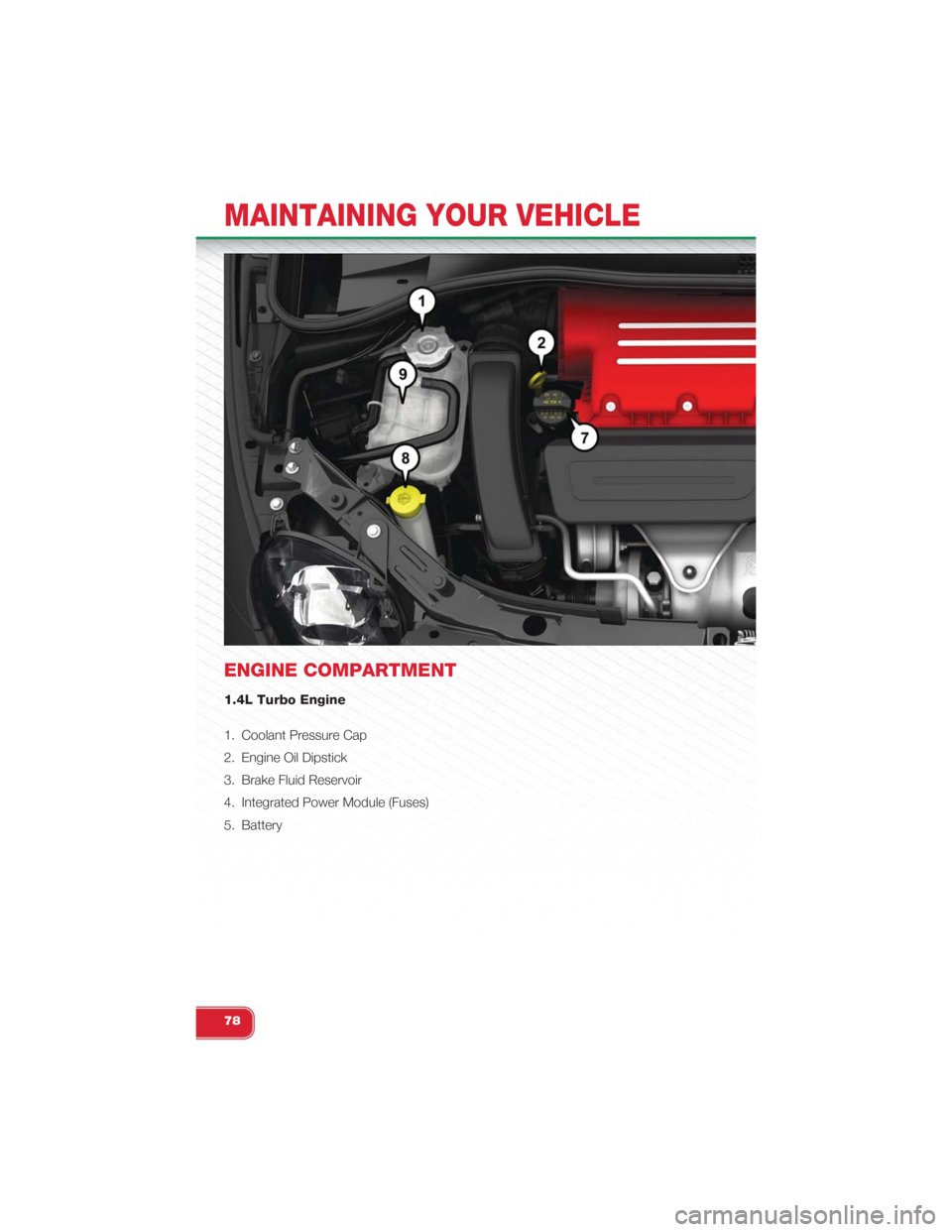
ENGINE COMPARTMENT
1.4L Turbo Engine
1. Coolant Pressure Cap
2. Engine Oil Dipstick
3. Brake Fluid Reservoir
4. Integrated Power Module (Fuses)
5. Battery
MAINTAINING YOUR VEHICLE
78
Page 84 of 108
MAINTENANCE SCHEDULE
Your vehicle is equipped with an automatic oil change indicator system. The oil
change indicator system will remind you that it is time to take your vehicle in for
scheduled maintenance.
Based on engine operation conditions, the oil change indicator message will illumi-
nate. This means that service is required for your vehicle. Operating conditions such
as frequent short-trips, trailer tow, extremely hot or cold ambient temperatures, and
E85 fuel usage will influence when the “Change Oil” message is displayed. Severe
operating conditions can cause the change oil message to illuminate as early as
3,500 miles (5,600 km) since last reset. Have your vehicle serviced as soon as pos-
sible, within the next 500 miles (805 km).
Your authorized dealer will reset the oil change indicator message after completing
the scheduled oil change. If a scheduled oil change is performed by someone other
than your authorized dealer, the message can be reset by referring to the steps de-
scribed under “Electronic Vehicle Information Center (EVIC)” in “Understanding Your
Instrument Panel” in your Owners Manual on the DVD for further information.
NOTE:Under no circumstances should oil change intervals exceed 10,000 miles (16,000 km) ortwelve months, whichever comes first.
Severe Duty All Models
Change Engine Oil at 4000 miles (6,500 km) if the vehicle is operated in a dusty and
off road environment. This type of vehicle use is considered Severe Duty.
Once A Month Or Before A Long Trip:
Check engine oil level
Check windshield washer fluid level
Check the tire inflation pressures and look for unusual wear or damage
Check the fluid levels of the coolant reservoir and brake master cylinder as needed
Check function of all interior and exterior lights
MAINTAINING YOUR VEHICLE
82
Page 98 of 108
FREQUENTLY ASKED QUESTIONS
GETTING STARTED
• How do I install my LATCH Equipped Child Seat? pg. 16
• How do I fold down my rear seat? pg. 22
ELECTRONICS
• What Sound System do I have? pg. 38
• How do I set the presets on my radio? pg. 41
• How do I connect my portable media player/iPod/MP3? pg. 49
• How do I pair my cell phone via Bluetooth® with the BLUE&ME™ Hands-Free
Communication System? pg. 46
WHAT TO DO IN EMERGENCIES
• What do I do if my TPMS warning light is blinking? pg. 56
• How do I Jump-Start my vehicle? pg. 69
MAINTAINING YOUR VEHICLE
• Where is my underhood fuse block located? pg. 88
• Where is my interior fuse block located? pg. 87
• What type of oil do I use? pg. 80
• How often should I change my engines oil? pg. 82
• What should my tire pressure be set at? pg. 89
FREQUENTLY ASKED QUESTIONS
96
Page 99 of 108
Adding Engine Coolant (Antifreeze) . . .81Adding Washer Fluid. . . . . . . . . . .81Air BagAdvanced Front Air Bag . . . . . . .12Advance Front Air Bag. . . . . . . .11Air Bags. . . . . . . . . . . . . . . .11Air Bag Warning Light. . . . . . . . .11Driver Knee Air Bag. . . . . . . . . .13Front Air Bag. . . . . . . . . . . . .11Passenger Knee Air Bag . . . . . . .13Rollover. . . . . . . . . . . . . . . . .11Side Impacts. . . . . . . . . . . . . .11Air bag Light. . . . . . . . . . . . . . . .55Air Cleaner, Engine (Engine Air CleanerFilter). . . . . . . . . . . . . . . . . . .81Air Conditioner Maintenance . .. . . . .81Air Conditioning Refrigerant. . . . . . . .81Air Conditioning System. . . . . . . . .81AlarmDisarm The System. . . . . . . . . .10Vehicle Security Alarm .. . . . . . .10Alarm (Security Alarm)........10, 60Antifreeze (Engine Coolant) . .. . . .80, 81Capacities. . . . . . . . . . . . . . .80Disposal. . . . . . . . . . . . . . . .81Anti-Lock Warning Light. . . . . . . . .55Appearance Care. . . . . . . . . . . . .81Automatic Temperature Control (ATC). . .31Automatic TransmissionFluid Type. . . . . . . . . . . . . . .81
Battery. . . . . . . . . . . . . . . . . . .81BLUE&ME™ Hands-FreeCommunication. . . . . . . . . . . .43Body Mechanism Lubrication. . . . . .81Brake Fluid...............80, 81Brakes. . . . . . . . . . . . . . . . . . .81Brake System. . . . . . . . . . . . . . .81Master Cylinder. . . . . . . . . . . .81Warning Light. . . . . . . . . . . . .58Break-In Recommendations, NewVehicle. . . . . . . . . . . . . . . . .24Bulb Replacement. . . . . . . . . . . . .92Bulbs, Light. . . . . . . . . . . . . . . .92
Capacities, Antifreeze (Engine Coolant). .80Capacities, Fluid. . . . . . . . . . . . . .80
Caps, FillerOil (Engine) . .. . . . . . . . . . . .81Car Washes . .. . . . . . . . . . . . . .81Charging System Light . .. . . . . . . .55Child Restraint . . .. . . . . . . . . . . .14Child RestraintsInstalling Child Restraints Using TheVehicle Seat Belt . .. . . . . . . . . .16Lower Anchors And Tethers ForChildren. . . . . . . . . . . . . . . .16Using The Top Tether Anchorage . .16CleaningWheels. . . . . . . . . . . . . . . . .81Windshield Wiper Blades. . . . . . .81Climate Control . .. . . . . . . . . . . .30Automatic. . . . . . . . . . . . . . .31Manual. . . . . . . . . . . . . . . . .30Cluster Warning/Indicator LightsAnti-Lock Brake (ABS) Light. . . . .55Brake Warning Light . .. . . . . . . .58Charging System Light . . .. . . . .55Electronic Speed Control SETIndicator . .. . . . . . . . . . . . . .60Electronic Throttle Control (ETC)Indicator Light. . . . . . . . . . . . .59Engine Temperature Warning Light. .57Front Fog Light Indicator. . . . . . .60High Beam Indicator. . . . . . . . .60Malfunction Indicator Light (MIL) . . .59Oil Pressure Warning Light. . . . . .55Park/Headlight ON Indicator. . . . .61Tire Pressure Monitoring System(TPMS) Light. . . . . . . . . . . . .56Turn Signal Indicator. . . . . . . . .60Vehicle Security Light . .. . . . . . .60Clutch.. . . . . . . . . . . . . . . . . . .81Clutch Fluid .. . . . . . . . . . . . . . .81Compact Spare Tire . . . . . . .. . . . .90Coolant (Antifreeze) . .. . . . . . . . . .80Cooling System . . .. . . . . . . . . . .81Adding Coolant (Antifreeze). . . . .81Coolant Level .. . . . . . . . . . . .81Disposal of Used Coolant. . . . . .81Drain, Flush, and Refill . . .. . . . .81Inspection. . . . . . . . . . . . . . .81Points to Remember . .. . . . . . .81Pressure Cap . .. . . . . . . . . . .81
INDEX
97