radio FIAT 500 ABARTH 2016 2.G Owner's Manual
[x] Cancel search | Manufacturer: FIAT, Model Year: 2016, Model line: 500 ABARTH, Model: FIAT 500 ABARTH 2016 2.GPages: 432, PDF Size: 3.32 MB
Page 298 of 432
A system fault can occur due to any of the following:
1. Signal interference due to electronic devices or drivingnext to facilities emitting the same radio frequencies as
the TPM sensors.
2. Installing aftermarket window tinting that contains materials that may block radio wave signals.
3. Accumulation of snow or ice around the wheels or wheel housings.
4. Using tire chains on the vehicle.
5. Using wheels/tires not equipped with TPM sensors.
NOTE:
• The TPMS will not monitor the pressure in a replace-
ment tire installed without a tire pressure sensor.
• If you install a replacement tire in place of a road tire
that has a pressure below the low-pressure warning limit, upon the next ignition switch cycle, the “Tire
Pressure Monitoring Telltale Light” will remain on and
a chime will sound. In addition, the graphic in the
EVIC will still display a low pressure message and a
tire highlighted in a different color.
• After driving the vehicle for up to 20 minutes above
15 mph (24 km/h), the “Tire Pressure Monitoring
Telltale Light” will flash on and off for 75 seconds and
then remain on solid. In addition, the EVIC will
display a “Service TPM System” message.
• For each subsequent ignition switch cycle, a chime will
sound, the “Tire Pressure Monitoring Telltale Light”
will flash on and off for 75 seconds and then remain on
solid, and the EVIC will display a “Service Tire Pres-
sure Monitoring System” message.
Once you repair or replace the original road tire and
reinstall it, the TPMS will update automatically. In addi-
tion, the “Tire Pressure Monitoring Telltale Light” will
296 STARTING AND OPERATING
Page 311 of 432
HAZARD WARNING FLASHERS
The Hazard Warning flasher switch is located on the
instrument panel below the radio.Push the switch to turn on the Hazard Warning
flashers. When the switch is activated, all direc-
tional turn signals will flash on and off to warn oncoming
traffic of an emergency. Push the switch a second time to
turn off the Hazard Warning flashers.
Do not use this emergency warning system when the
vehicle is in motion. Use it when your vehicle is disabled
and it is creating a safety hazard for other motorists.
If it is necessary to leave the vehicle to go for service, the
Hazard Warning flashers will continue to operate with
the ignition key removed and the vehicle locked.
NOTE: With extended use, the Hazard Warning flashers
may wear down your battery.
IF YOUR ENGINE OVERHEATS
In any of the following situations, you can reduce the
potential for overheating by taking the appropriate ac-
tion.
• On the highways — slow down.
• In city traffic — while stopped, place the transmission
in NEUTRAL, but do not increase engine idle speed.
NOTE: There are steps that you can take to slow down
an impending overheat condition:
• If your air conditioner (A/C) is on, turn it off. The A/C
system adds heat to the engine cooling system and
turning the A/C off can help remove this heat.
• You can also turn the temperature control to maximum
heat, the mode control to floor and the blower control
to high. This allows the heater core to act as a
6
WHAT TO DO IN EMERGENCIES 309
Page 335 of 432
WARNING!
•Take care to avoid the radiator cooling fan when-
ever the hood is raised. It can start anytime the
ignition switch is ON. You can be injured by
moving fan blades.
• Remove any metal jewelry such as rings, watch
bands and bracelets that could make an inadvertent
electrical contact. You could be seriously injured.
• Batteries contain sulfuric acid that can burn your
skin or eyes and generate hydrogen gas which is
flammable and explosive. Keep open flames or
sparks away from the battery.
1. Set the parking brake, shift the transmission into gear and turn the ignition to OFF/LOCK.
2. Turn off the heater, radio, and all unnecessary electri- cal accessories. 3. Remove the protective cover over the positive (+)
battery post. To remove the cover pull upward on the
cover.
4. If using another vehicle to jump-start the battery, park the vehicle within the jumper cables reach, set the
parking brake and make sure the ignition is OFF.
WARNING!
Do not allow vehicles to touch each other as this
could establish a ground connection and personal
injury could result.6
WHAT TO DO IN EMERGENCIES 333
Page 381 of 432
CAUTION!
Do not use Alcohol and Alcohol-based and/or Keton
based cleaning products to clean leather seats, as
damage to the seat may result.
Cleaning Headlights
Your vehicle has plastic headlights that are lighter and
less susceptible to stone breakage than glass headlights.
Plastic is not as scratch resistant as glass and therefore
different lens cleaning procedures must be followed.
To minimize the possibility of scratching the lenses and
reducing light output, avoid wiping with a dry cloth. To
remove road dirt, wash with a mild soap solution fol-
lowed by rinsing.
Do not use abrasive cleaning components, solvents, steel
wool or other aggressive material to clean the lenses.
Glass Surfaces
All glass surfaces should be cleaned on a regular basis
with MOPAR Glass Cleaner, or any commercial
household-type glass cleaner. Never use an abrasive type
cleaner. Use caution when cleaning the inside rear win-
dow equipped with electric defrosters or windows
equipped with radio antennas. Do not use scrapers or
other sharp instrument that may scratch the elements.
When cleaning the rear view mirror, spray cleaner on the
towel or cloth that you are using. Do not spray cleaner
directly on the mirror.
Instrument Panel Cover
The instrument panel cover has a low glare surface which
minimizes reflections on the windshield. Do not use
protectants or other products which may cause undesir-
able reflections. Use soap and warm water to restore the
low glare surface.
7
MAINTAINING YOUR VEHICLE 379
Page 385 of 432
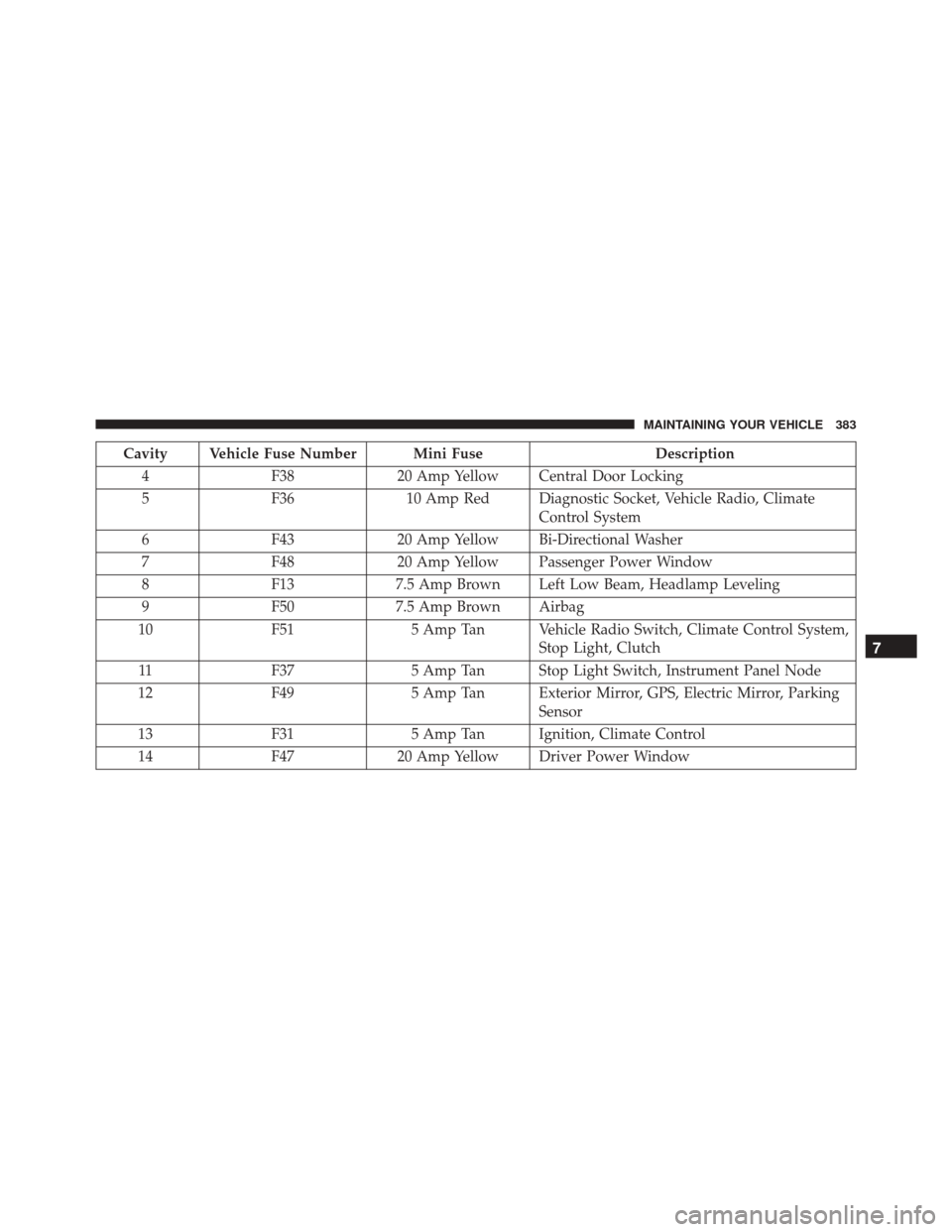
Cavity Vehicle Fuse Number Mini FuseDescription
4 F3820 Amp Yellow Central Door Locking
5 F36 10 Amp Red Diagnostic Socket, Vehicle Radio, Climate
Control System
6 F4320 Amp Yellow Bi-Directional Washer
7 F4820 Amp Yellow Passenger Power Window
8 F137.5 Amp Brown Left Low Beam, Headlamp Leveling
9 F507.5 Amp Brown Airbag
10 F51 5 Amp Tan Vehicle Radio Switch, Climate Control System,
Stop Light, Clutch
11 F37 5 Amp Tan Stop Light Switch, Instrument Panel Node
12 F49 5 Amp Tan Exterior Mirror, GPS, Electric Mirror, Parking
Sensor
13 F31 5 Amp Tan Ignition, Climate Control
14 F4720 Amp Yellow Driver Power Window
7
MAINTAINING YOUR VEHICLE 383
Page 417 of 432
Audio Systems (Radio).....................194
Automatic Dimming Mirror ...................88
Automatic Door Locks ......................23
Automatic Temperature Control (ATC) ..........216
Automatic Transaxle ........................11
Automatic Transmission ..............235, 371, 373
Adding Fluid ...................... .372, 373
Fluid And Filter Changes ..................373
Fluid Change ......................... .373
Fluid Level Check ...................... .372
Fluid Type ........................... .396
Gear Ranges .......................... .238
Special Additives ...................... .372
Autostick .............................. .243
Battery ............................ .155, 352
Charging System Light ...................155
Jump Starting ......................... .331
Keyless Transmitter Replacement (RKE) ........19Belts, Seat
...............................77
Body Mechanism Lubrication .................357
B-Pillar Location ......................... .269
Brake Assist System ...................... .255
Brake Fluid ......................... .394, 396
Brake, Parking .......................... .249
Brakes ................................ .368
Brake System ........................ .253, 368
Anti-Lock (ABS) ....................... .254
Master Cylinder ....................... .369
Parking ............................. .249
Warning Light ........................ .153
Brake/Transmission Interlock .................236
Bulb Replacement ..................... .388, 389
Bulbs, Light .......................... .79, 388
Capacities, Antifreeze (Engine Coolant) ..........393
Capacities, Fluid ......................... .393
10
INDEX 415
Page 425 of 432
Change Interval....................... .349
Checking ............................ .348
Disposal ............................. .350
Filter ............................... .350
Filter Disposal ........................ .350
Pressure Warning Light ...................157
Recommendation ....................349, 393
Viscosity ............................ .350
Oil Filter, Change ........................ .350
Oil Filter, Selection ....................... .350
Oil Pressure Light ........................ .157
Onboard Diagnostic System ..................344
Operating Precautions ..................... .344
Operator Manual (Owner’s Manual) .............5
Overheating, Engine ...................... .309
Owner’s Manual (Operator Manual) ..........5,408
Paint Care ............................. .373
Parking Brake ........................... .249Pets
....................................74
Placard, Tire And Loading Information ..........270
Power Door Locks ............................23
Mirrors ...............................89
Outlet (Auxiliary Electrical Outlet) ...........123
Steering ............................. .248
Sunroof ............................. .121
Windows ..............................24
Pregnant Women And Seat Belts ...............36
Preparation For Jacking .....................324
Pretensioners Seat Belts ..............................37
Radial Ply Tires ......................... .278
Radio Frequency General Information ...................15, 21
Radio Operation ......................... .213
Rear Liftgate (Sedan) .......................25
10
INDEX 423
Page 426 of 432
Rear Window Features.....................130
Recorder, Event Data .......................54
Recreational Towing ...................... .304
Reformulated Gasoline .....................298
Refrigerant ............................. .354
Release, Hood ............................98
Reminder, Seat Belt .........................29
Remote Keyless Entry (RKE) Disarm The Alarm .......................15
Power Convertible Top Function .............17
Remote Sound System (Radio) Controls ..........211
Replacement Bulbs ....................... .388
Replacement Keys .........................14
Replacement Parts ........................ .347
Replacement Tires ........................ .285
Reporting Safety Defects ....................407
Restraint, Head ...........................95
Restraints, Child ...........................55
Restraints, Occupant ........................27 Rotation, Tires
.......................... .287
Safety Checks Inside Vehicle ..................77
Safety Checks Outside Vehicle .................79
Safety Defects, Reporting ....................407
Safety, Exhaust Gas .........................76
Safety Information, Tire .....................263
Safety Tips ...............................75
Schedule, Maintenance .....................398
Seat Belt Energy Management Feature ................37
Lap/Shoulder Belt Operation ................33
Lap/Shoulder Belts .......................30
Lap/Shoulder Belt Untwisting ...............35
Pregnant Women ........................36
Seat Belt Extender .......................35
Seat Belt Pretensioner .....................37
Seat Belt Reminder .......................29
Seat Belt System .........................27
424 INDEX
Page 431 of 432

INSTALLATION OF RADIO TRANSMITTING
EQUIPMENTSpecial design considerations are incorporated into this
vehicle’s electronic system to provide immunity to radio
frequency signals. Mobile two-way radios and telephone
equipment must be installed properly by trained person-
nel. The following must be observed during installation.
The positive power connection should be made directly
to the battery and fused as close to the battery as possible.
The negative power connection should be made to body
sheet metal adjacent to the negative battery connection.
This connection should not be fused.
Antennas for two-way radios should be mounted on the
roof or the rear area of the vehicle. Care should be used
in mounting antennas with magnet bases. Magnets may
affect the accuracy or operation of the compass on
vehicles so equipped.The antenna cable should be as short as practical and
routed away from the vehicle wiring when possible. Use
only fully shielded coaxial cable.
Carefully match the antenna and cable to the radio to
ensure a low Standing Wave Ratio (SWR).
Mobile radio equipment with output power greater than
normal may require special precautions.
All installations should be checked for possible interfer-
ence between the communications equipment and the
vehicle’s electronic systems.