ESP FIAT 500 ABARTH 2016 2.G Owner's Guide
[x] Cancel search | Manufacturer: FIAT, Model Year: 2016, Model line: 500 ABARTH, Model: FIAT 500 ABARTH 2016 2.GPages: 432, PDF Size: 3.32 MB
Page 303 of 432
CAUTION!(Continued)
•The use of fuel additives, which are now being
sold as octane enhancers, is not recommended.
Most of these products contain high concentrations
of methanol. Fuel system damage or vehicle perfor-
mance problems resulting from the use of such
fuels or additives is not the responsibility of the
manufacturer and may void or not be covered
under the New Vehicle Limited Warranty.
NOTE: Intentional tampering with the emissions control
system can result in civil penalties being assessed against
you.
Carbon Monoxide Warnings
WARNING!
Carbon monoxide (CO) in exhaust gases is deadly.
Follow the precautions below to prevent carbon
monoxide poisoning:
• Do not inhale exhaust gases. They contain carbon
monoxide, a colorless and odorless gas, which can
kill. Never run the engine in a closed area, such as
a garage, and never sit in a parked vehicle with the
engine running for an extended period. If the
vehicle is stopped in an open area with the engine
running for more than a short period, adjust the
ventilation system to force fresh, outside air into
the vehicle.
• Guard against carbon monoxide with proper main-
tenance. Have the exhaust system inspected every
(Continued)
5
STARTING AND OPERATING 301
Page 316 of 432
WARNING!
•Do not attempt to seal a tire on the side of the
vehicle closest to traffic. Pull far enough off the
road to avoid the danger of being hit when using
the Tire Service Kit.
• Do not use Tire Service Kit or drive the vehicle
under the following circumstances:
– If the puncture in the tire tread is approximately 1/4 inch (6 mm) or larger.
– If the tire has any sidewall damage.
– If the tire has any damage from driving with extremely low tire pressure.
– If the tire has any damage from driving on a flat tire.
– If the wheel has any damage.
– If you are unsure of the condition of the tire or the wheel.
(Continued)
WARNING! (Continued)
•Keep Tire Service Kit away from open flames or
heat source.
• A loose Tire Service Kit thrown forward in a
collision or hard stop could endanger the occupants
of the vehicle. Always stow the Tire Service Kit in
the place provided. Failure to follow these warn-
ings can result in injuries that are serious or fatal to
you, your passengers, and others around you.
• Take care not to allow the contents of Tire Service
Kit to come in contact with hair, eyes, or clothing.
Tire Service Kit sealant is harmful if inhaled,
swallowed, or absorbed through the skin. It causes
skin, eye, and respiratory irritation. Flush immedi-
ately with plenty of water if there is any contact
with eyes or skin. Change clothing as soon as
possible, if there is any contact with clothing.
(Continued)
314 WHAT TO DO IN EMERGENCIES
Page 367 of 432
Adding Coolant
Your vehicle has been built with an improved engine
coolant (OAT coolant conforming to MS.90032) that al-
lows extended maintenance intervals. This engine cool-
ant (antifreeze) can be used up to ten years or 150,000
miles (240,000 km) before replacement. To prevent reduc-
ing this extended maintenance period, it is important that
you use the same engine coolant (OAT coolant conform-
ing to MS.90032) throughout the life of your vehicle.
Please review these recommendations for using Organic
Additive Technology (OAT) engine coolant (antifreeze)
that meets the requirements of FCA Material Standard
MS.90032. When adding engine coolant (antifreeze):
•We recommend using MOPAR Antifreeze/Coolant 10
Year/150,000 Mile Formula OAT (Organic Additive
Technology) that meets the requirements of FCA Ma-
terial Standard MS.90032. •
Mix a minimum solution of 50% OAT engine coolant
that meets the requirements of FCA Material Standard
MS.90032 and distilled water. Use higher concentra-
tions (not to exceed 70%) if temperatures below 34°F
(37°C) are anticipated. Please contact your authorized
dealer for assistance.
• Use only high purity water such as distilled or deion-
ized water when mixing the water/engine coolant
(antifreeze) solution. The use of lower quality water
will reduce the amount of corrosion protection in the
engine cooling system.
NOTE:
• It is the owner’s responsibility to maintain the proper
level of protection against freezing according to the
temperatures occurring in the area where the vehicle is
operated.
7
MAINTAINING YOUR VEHICLE 365
Page 377 of 432
Special Care
•If you drive on salted or dusty roads or if you drive
near the ocean, hose off the undercarriage at least once
a month.
• It is important that the drain holes in the lower edges
of the doors, rocker panels, and trunk be kept clear and
open.
• If you detect any stone chips or scratches in the paint,
touch them up immediately. The cost of such repairs is
considered the responsibility of the owner.
• If your vehicle is damaged due to a collision or similar
cause that destroys the paint and protective coating,
have your vehicle repaired as soon as possible. The
cost of such repairs is considered the responsibility of
the owner. •
If you carry special cargo such as chemicals, fertilizers,
de-icer salt, etc., be sure that such materials are well
packaged and sealed.
• If a lot of driving is done on gravel roads, consider
mud or stone shields behind each wheel.
• Use MOPAR Touch Up Paint on scratches as soon as
possible. Your authorized dealer has touch up paint to
match the color of your vehicle.
Wheel And Wheel Trim Care
All wheels and wheel trim, especially aluminum and
chrome plated wheels, should be cleaned regularly using
mild (neutral Ph) soap and water to maintain their luster
and to prevent corrosion. Wash wheels with the same
soap solution recommended for the body of the vehicle.
Your wheels are susceptible to deterioration caused by
salt, sodium chloride, magnesium chloride, calcium chlo-
ride, etc., and other road chemicals used to melt ice or7
MAINTAINING YOUR VEHICLE 375
Page 380 of 432
Interior Care
Use MOPAR Total Clean to clean fabric upholstery and
carpeting.
Use MOPAR Total Clean to clean vinyl upholstery.
MOPAR Total Clean is specifically recommended for
leather upholstery.
Your leather upholstery can be best preserved by regular
cleaning with a damp soft cloth. Small particles of dirt
can act as an abrasive and damage the leather upholstery
and should be removed promptly with a damp cloth.
Stubborn soils can be removed easily with a soft cloth
and MOPAR Total Clean. Care should be taken to avoid
soaking your leather upholstery with any liquid. Please
do not use polishes, oils, cleaning fluids, solvents, deter-
gents, or ammonia-based cleaners to clean your leather
upholstery. Application of a leather conditioner is not
required to maintain the original condition.
WARNING!
Do not use volatile solvents for cleaning purposes.
Many are potentially flammable, and if used in
closed areas they may cause respiratory harm.
CAUTION!
Direct contact of air fresheners, insect repellents,
suntan lotions, or hand sanitizers to the plastic,
painted, or decorated surfaces of the interior may
cause permanent damage. Wipe away immediately.
CAUTION!
Damage caused by these type of products may not be
covered by your New Vehicle Limited Warranty.
378 MAINTAINING YOUR VEHICLE
Page 386 of 432
Underhood Fuses
The Front Distribution Unit is located on the right side of
the engine compartment, next to the battery. To access the
fuses, press the release tabs and remove the cover.The ID number of the electrical component correspond-
ing to each fuse can be found on the back of the cover.
Front Distribution Unit
384 MAINTAINING YOUR VEHICLE
Page 408 of 432
has access to a TDD or a conventional teletypewriter
(TTY) in the United States, can communicate with the
manufacturer by dialing 1-800-380-CHRY.
Canadian residents with hearing difficulties that require
assistance can use the special needs relay service offered
by Bell Canada. For TTY teletypewriter users, dial 711
and for Voice callers, dial 1-800-855-0511 to connect with
a Bell Relay Service operator.
Service Contract
You may have purchased a service contract for a vehicle
to help protect you from the high cost of unexpected
repairs after the manufacturer’s New Vehicle Limited
Warranty expires. The manufacturer stands behind only
the manufacturer’s service contracts. If you purchased a
manufacturer’s service contract, you will receive Plan
Provisions and an Owner Identification Card in the mail
within three weeks of the vehicle delivery date. If you
have any questions about the service contract, call themanufacturer’s Service Contract National Customer
Hotline at 1-800-521-9922 (Canadian residents, call (800)
465-2001 English / (800) 387-9983 French).
The manufacturer will not stand behind any service
contract that is not the manufacturer’s service contract. It
is not responsible for any service contract other than the
manufacturer’s service contract. If you purchased a ser-
vice contract that is not a manufacturer’s service contract,
and you require service after the manufacturer’s New
Vehicle Limited Warranty expires, please refer to the
contract documents, and contact the person listed in
those documents.
We appreciate that you have made a major investment
when you purchased the vehicle. An authorized dealer
has also made a major investment in facilities, tools, and
training to assure that you are absolutely delighted with
the ownership experience. You will be pleased with their
406 IF YOU NEED CONSUMER ASSISTANCE
Page 412 of 432
significantly from the norm due to variations in driving
habits, service practices, and differences in road charac-
teristics and climate.
Traction Grades
The Traction grades, from highest to lowest, are AA, A, B,
and C. These grades represent the tire’s ability to stop on
wet pavement, as measured under controlled conditions
on specified government test surfaces of asphalt and
concrete. A tire marked C may have poor traction perfor-
mance.
WARNING!
The traction grade assigned to this tire is based on
straight-ahead braking traction tests, and does not
include acceleration, cornering, hydroplaning, or
peak traction characteristics.
Temperature Grades
The temperature grades are A (the highest), B, and C,
representing the tire’s resistance to the generation of heat
and its ability to dissipate heat, when tested under
controlled conditions on a specified indoor laboratory
test wheel. Sustained high temperature can cause the
material of the tire to degenerate and reduce tire life, and
excessive temperature can lead to sudden tire failure. The
grade C corresponds to a level of performance, which all
passenger vehicle tires must meet under the Federal
Motor Vehicle Safety Standard No. 109. Grades B and A
represent higher levels of performance on the laboratory
test wheel, than the minimum required by law.
410 IF YOU NEED CONSUMER ASSISTANCE
Page 416 of 432
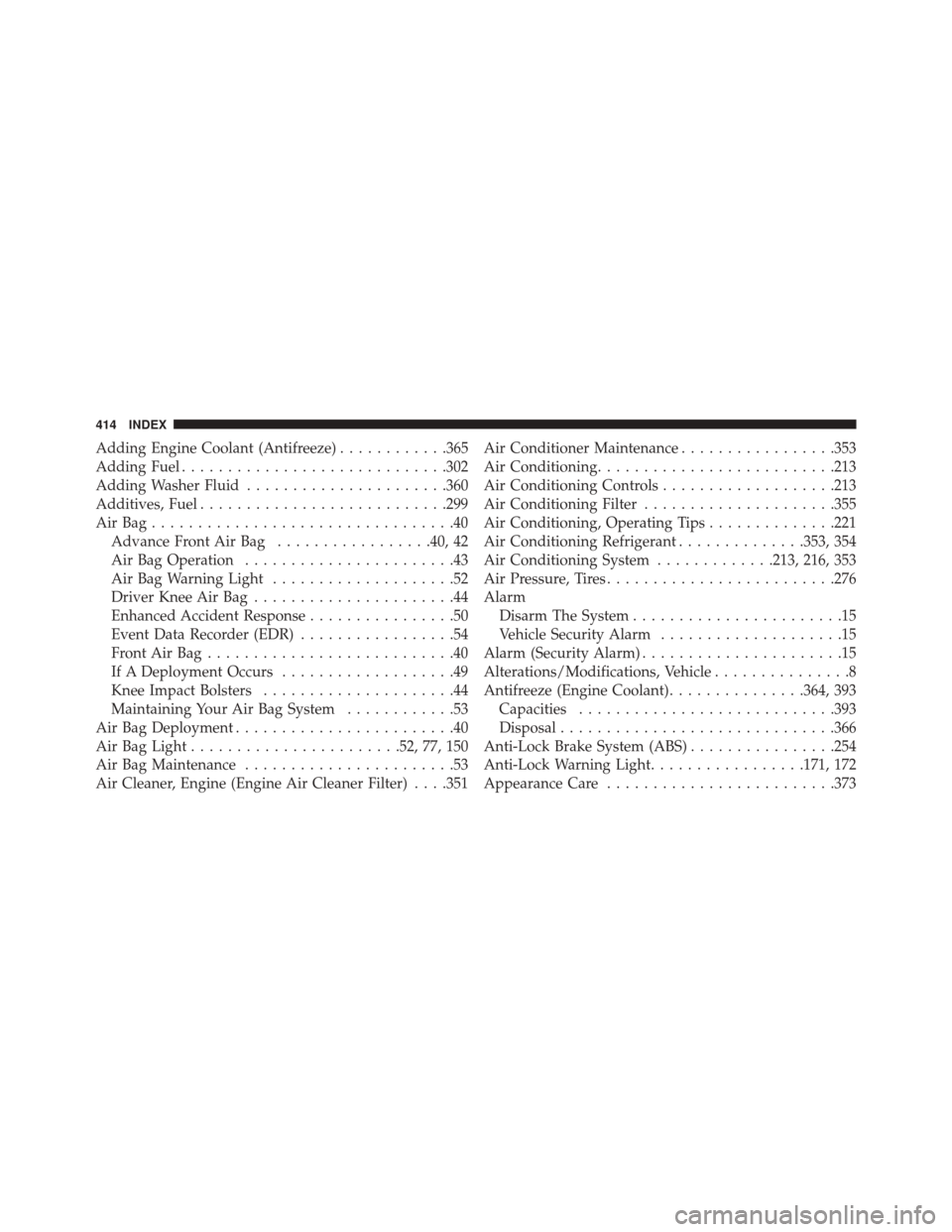
Adding Engine Coolant (Antifreeze)............365
Adding Fuel ............................ .302
Adding Washer Fluid ..................... .360
Additives, Fuel .......................... .299
AirBag.................................40 Advance Front Air Bag .................40, 42
Air Bag Operation .......................43
Air Bag Warning Light ....................52
Driver Knee Air Bag ......................44
Enhanced Accident Response ................50
Event Data Recorder (EDR) .................54
FrontAirBag...........................40
If A Deployment Occurs ...................49
Knee Impact Bolsters .....................44
Maintaining Your Air Bag System ............53
Air Bag Deployment ........................40
Air Bag Light ...................... .52, 77, 150
Air Bag Maintenance .......................53
Air Cleaner, Engine (Engine Air Cleaner Filter) . . . .351 Air Conditioner Maintenance
.................353
Air Conditioning ......................... .213
Air Conditioning Controls ...................213
Air Conditioning Filter .....................355
Air Conditioning, Operating Tips ..............221
Air Conditioning Refrigerant ..............353, 354
Air Conditioning System .............213, 216, 353
Air Pressure, Tires ........................ .276
Alarm Disarm The System .......................15
Vehicle Security Alarm ....................15
Alarm (Security Alarm) ......................15
Alterations/Modifications, Vehicle ...............8
Antifreeze (Engine Coolant) ...............364, 393
Capacities ........................... .393
Disposal ............................. .366
Anti-Lock Brake System (ABS) ................254
Anti-Lock Warning Light .................171, 172
Appearance Care ........................ .373
414 INDEX
Page 420 of 432
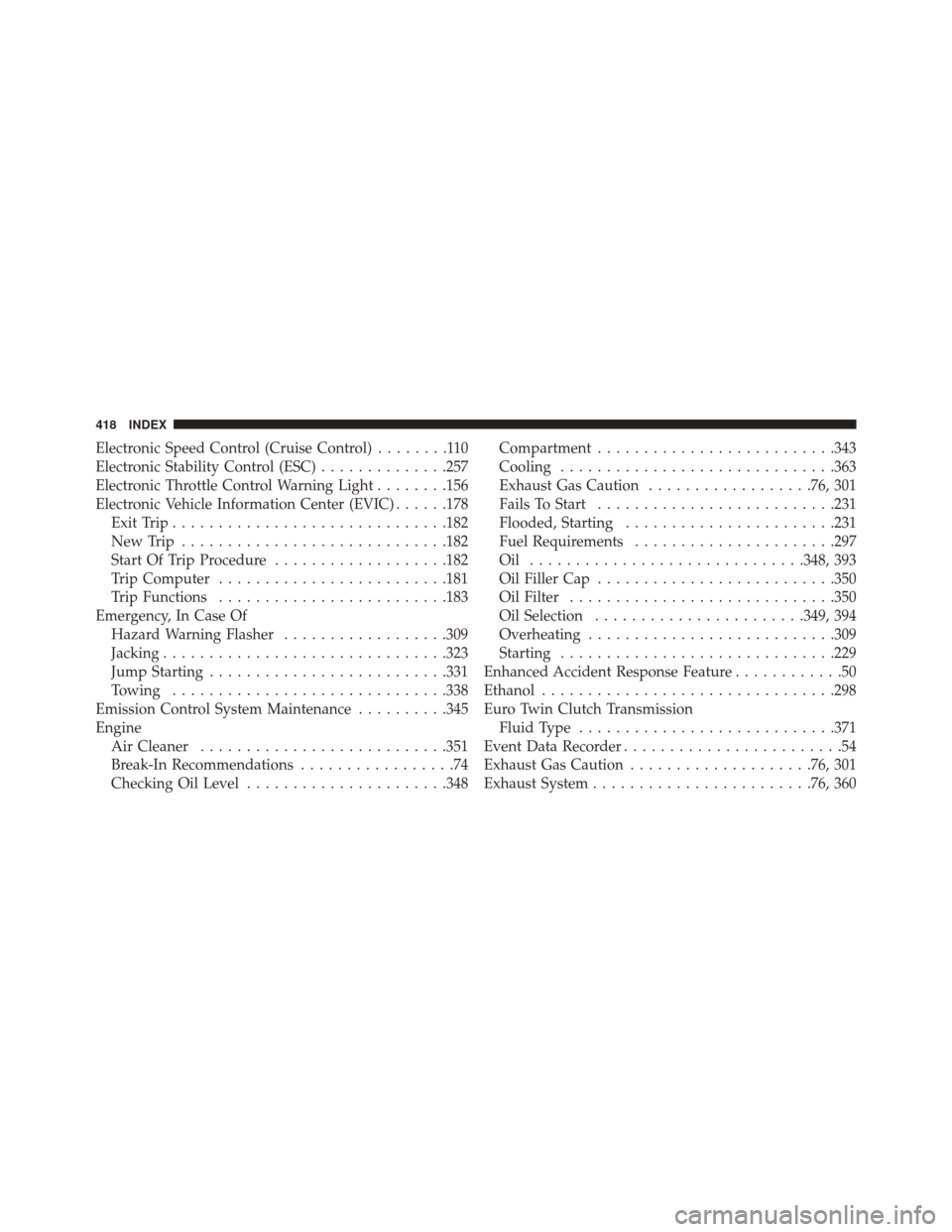
Electronic Speed Control (Cruise Control)........110
Electronic Stability Control (ESC) ..............257
Electronic Throttle Control Warning Light ........156
Electronic Vehicle Information Center (EVIC) ......178
Exit Trip ............................. .182
NewTrip ............................ .182
Start Of Trip Procedure ...................182
Trip Computer ........................ .181
Trip Functions ........................ .183
Emergency, In Case Of Hazard Warning Flasher ..................309
Jacking .............................. .323
Jump Starting ......................... .331
Towing ............................. .338
Emission Control System Maintenance ..........345
Engine Air Cleaner .......................... .351
Break-In Recommendations .................74
Checking Oil Level ..................... .348Compartment
......................... .343
Cooling ............................. .363
Exhaust Gas Caution ..................76, 301
Fails To Start ......................... .231
Flooded, Starting ...................... .231
Fuel Requirements ..................... .297
Oil ............................. .348, 393
Oil Filler Cap ......................... .350
Oil Filter ............................ .350
Oil Selection ...................... .349, 394
Overheating .......................... .309
Starting ............................. .229
Enhanced Accident Response Feature ............50
Ethanol ............................... .298
Euro Twin Clutch Transmission Fluid Type ........................... .371
Event Data Recorder ........................54
Exhaust Gas Caution ....................76, 301
Exhaust System ....................... .76, 360
418 INDEX