warning light FIAT 500 ABARTH 2016 2.G Workshop Manual
[x] Cancel search | Manufacturer: FIAT, Model Year: 2016, Model line: 500 ABARTH, Model: FIAT 500 ABARTH 2016 2.GPages: 432, PDF Size: 3.32 MB
Page 297 of 432

to be driven for up to 20 minutes above 15 mph
(24 km/h) in order for the TPMS to receive this informa-
tion.
TPMS Warning
When a system fault is detected, the “Tire Pressure
Monitoring Telltale Light” will flash on and off for 75
seconds and then remain on solid. The system fault will
sound a chime and also display a “Service Tire Pressure
Monitoring System” message in the EVIC for approxi-
mately 5 seconds.If the ignition switch is cycled, this sequence will repeat,
providing the system fault still exists. If the system fault
no longer exists, the “Tire Pressure Monitoring Telltale
Light” will no longer flash, and the “Service Tire Pressure
Monitoring System” message will no longer display.
Service TPM System Message
5
STARTING AND OPERATING 295
Page 298 of 432
A system fault can occur due to any of the following:
1. Signal interference due to electronic devices or drivingnext to facilities emitting the same radio frequencies as
the TPM sensors.
2. Installing aftermarket window tinting that contains materials that may block radio wave signals.
3. Accumulation of snow or ice around the wheels or wheel housings.
4. Using tire chains on the vehicle.
5. Using wheels/tires not equipped with TPM sensors.
NOTE:
• The TPMS will not monitor the pressure in a replace-
ment tire installed without a tire pressure sensor.
• If you install a replacement tire in place of a road tire
that has a pressure below the low-pressure warning limit, upon the next ignition switch cycle, the “Tire
Pressure Monitoring Telltale Light” will remain on and
a chime will sound. In addition, the graphic in the
EVIC will still display a low pressure message and a
tire highlighted in a different color.
• After driving the vehicle for up to 20 minutes above
15 mph (24 km/h), the “Tire Pressure Monitoring
Telltale Light” will flash on and off for 75 seconds and
then remain on solid. In addition, the EVIC will
display a “Service TPM System” message.
• For each subsequent ignition switch cycle, a chime will
sound, the “Tire Pressure Monitoring Telltale Light”
will flash on and off for 75 seconds and then remain on
solid, and the EVIC will display a “Service Tire Pres-
sure Monitoring System” message.
Once you repair or replace the original road tire and
reinstall it, the TPMS will update automatically. In addi-
tion, the “Tire Pressure Monitoring Telltale Light” will
296 STARTING AND OPERATING
Page 299 of 432
turn off as long as no tire pressure is below the low-
pressure warning limit in any of the four active road tires.
The vehicle may need to be driven for up to 20 minutes
above 15 mph (24 km/h) in order for the TPMS to receive
this information.
General Information
This device complies with Part 15 of the FCC rules and
RSS-210 of Industry Canada. Operation is subject to the
following two conditions:
(1) This device may not cause harmful interference.
(2) This device must accept any interference received,
including interference that may cause undesired opera-
tion.
NOTE:Changes or modifications not expressly approved
by the party responsible for compliance could void the
user ’s authority to operate the equipment.
FUEL REQUIREMENTS
This engine is designed to meet all emis-
sion regulations and provide satisfactory
fuel economy and performance when us-
ing high-quality unleaded “regular” gaso-
line with a minimum octane rating of 87.
For optimum performance and fuel economy the use of
91 octane or higher is recommended.
Light spark knock at low engine speeds is not harmful to
your engine. However, continued heavy spark knock at
high speeds can cause damage and immediate service is
required.
Poor quality gasoline can cause problems such as hard
starting, stalling and hesitations. If you experience these
symptoms, try another brand of gasoline (with the ap-
propriate octane rating for your engine) before consider-
ing service for the vehicle.
5
STARTING AND OPERATING 297
Page 305 of 432
CAUTION!(Continued)
into the fuel system. Also, a poorly fitting aftermar-
ket cap can cause the “Malfunction Indicator Light
(MIL)” to illuminate, due to fuel vapors escaping
from the system.
• To avoid fuel spillage and overfilling, do not “top
off” the fuel tank after filling.
WARNING!
• Never have any smoking materials lit in or near the
vehicle when the gas cap is removed or the tank is
being filled.
• Never add fuel when the engine is running. It may
cause the MIL to turn on and could cause a fire.
• A fire may result if gasoline is pumped into a
portable container that is inside of a vehicle. You
(Continued)
WARNING! (Continued)
could be burned. Always place gas containers on
the ground while filling.
NOTE:
• When the fuel nozzle “clicks” or shuts off, the fuel tank
is full.
• Tighten the gas cap about 1/4 turn until you hear one
click. This is an indication that the cap is properly
tightened.
• If the gas cap is not tightened properly, the MIL will
come on. Be sure the gas cap is tightened every time
the vehicle is refueled.
5
STARTING AND OPERATING 303
Page 332 of 432
5. Using the swivel wrench, raise the vehicle by turningthe jack screw to the right. Raise the vehicle only until
the tire just clears the surface and enough clearance is
obtained to install the spare tire. Minimum tire lift
provides maximum stability.
6. Remove the wheel bolts and pull the wheel off the hub. For vehicles equipped with aluminum wheels,
the center caps must be removed to remove the wheel
bolts. For vehicles equipped with steel wheels the
wheel covers must be removed to remove the wheel
bolts.
WARNING!
To avoid the risk of forcing the vehicle off the jack,
do not fully tighten the wheel bolts until the vehicle
has been lowered. Failure to follow this warning may
result in serious injury.
CAUTION!
Be sure to mount the spare tire with the valve stem
facing outward. The vehicle could be damaged if the
spare tire is mounted incorrectly.
WARNING!
To avoid possible personal injury, handle the wheel
covers with care to avoid contact with any sharp
edges.
7. Install the spare wheel and hand start the wheel bolts. Lightly tighten the bolts. To avoid the risk of forcing
the vehicle off the jack, do not tighten the bolts fully
until the vehicle has been lowered.
8. Lower the vehicle by turning the jack screw to the left.
9. Finish tightening the wheel bolts. Push down on the wrench while at the end of the handle for increased
330 WHAT TO DO IN EMERGENCIES
Page 347 of 432
access this information to assist with the diagnosis and
service of your vehicle and emissions system.
WARNING!
•ONLY an authorized service technician should con-
nect equipment to the OBD II connection port in
order to diagnose or service your vehicle.
• If unauthorized equipment is connected to the
OBD II connection port, such as a driver-behavior
tracking device, it may:
• Be possible that vehicle systems, including
safety related systems, could be impaired or a
loss of vehicle control could occur that may result
in an accident involving serious injury or death.
• Access, or allow others to access, information
stored in your vehicle systems, including per-
sonal information. For further information, refer to “Cybersecurity” in the
“Understanding Your Instrument Panel” section.
EMISSIONS INSPECTION AND MAINTENANCE
PROGRAMS
In some localities, it may be a legal requirement to pass
an inspection of your vehicle’s emissions control system.
Failure to pass could prevent vehicle registration.
For states that require an Inspection and Mainte-
nance (I/M), this check verifies the “Malfunction
Indicator Light (MIL)” is functioning and is not
on when the engine is running, and that the OBD II
system is ready for testing.
Normally, the OBD II system will be ready. The OBD II
system may notbe ready if your vehicle was recently
serviced, recently had a dead battery or a battery replace-
ment. If the OBD II system should be determined not
ready for the I/M test, your vehicle may fail the test.
7
MAINTAINING YOUR VEHICLE 345
Page 371 of 432
WARNING!(Continued)
high brake temperatures, excessive lining wear, and
possible brake damage. Riding the brakes may also
reduce braking capacity in an emergency.
Brake Master Cylinder
The fluid level in the master cylinder should be checked
when performing under hood services, or immediately if
the “Brake Warning Light” is on.
Be sure to clean the top of the master cylinder area before
removing the cap. If necessary, add fluid to bring the
fluid level up to the requirements described on the brake
fluid reservoir. Fluid level can be expected to fall as the
brake pads wear. The brake fluid level should be checked
when the pads are replaced. However, low fluid level
may be caused by a leak and a checkup may be needed. NOTE:
If your vehicle is equipped with a manual
transmission, the brake fluid reservoir supplies fluid to
both the brake system and the clutch release system. The
two systems are separated in the reservoir, and a leak in
one system will not affect the other system. The manual
transmission clutch release system should not require
fluid replacement during the life of the vehicle. If the
brake fluid reservoir is low and the brake system does
not indicate any leaks or other problems, it may be a
result of a leak in the hydraulic clutch release system. See
your local authorized dealer for service.
Use only manufacturer’s recommended brake fluid. Re-
fer to “Fluids, Lubricants, And Genuine Parts” in “Main-
taining Your Vehicle” for further information.
7
MAINTAINING YOUR VEHICLE 369
Page 416 of 432
Adding Engine Coolant (Antifreeze)............365
Adding Fuel ............................ .302
Adding Washer Fluid ..................... .360
Additives, Fuel .......................... .299
AirBag.................................40 Advance Front Air Bag .................40, 42
Air Bag Operation .......................43
Air Bag Warning Light ....................52
Driver Knee Air Bag ......................44
Enhanced Accident Response ................50
Event Data Recorder (EDR) .................54
FrontAirBag...........................40
If A Deployment Occurs ...................49
Knee Impact Bolsters .....................44
Maintaining Your Air Bag System ............53
Air Bag Deployment ........................40
Air Bag Light ...................... .52, 77, 150
Air Bag Maintenance .......................53
Air Cleaner, Engine (Engine Air Cleaner Filter) . . . .351 Air Conditioner Maintenance
.................353
Air Conditioning ......................... .213
Air Conditioning Controls ...................213
Air Conditioning Filter .....................355
Air Conditioning, Operating Tips ..............221
Air Conditioning Refrigerant ..............353, 354
Air Conditioning System .............213, 216, 353
Air Pressure, Tires ........................ .276
Alarm Disarm The System .......................15
Vehicle Security Alarm ....................15
Alarm (Security Alarm) ......................15
Alterations/Modifications, Vehicle ...............8
Antifreeze (Engine Coolant) ...............364, 393
Capacities ........................... .393
Disposal ............................. .366
Anti-Lock Brake System (ABS) ................254
Anti-Lock Warning Light .................171, 172
Appearance Care ........................ .373
414 INDEX
Page 417 of 432
Audio Systems (Radio).....................194
Automatic Dimming Mirror ...................88
Automatic Door Locks ......................23
Automatic Temperature Control (ATC) ..........216
Automatic Transaxle ........................11
Automatic Transmission ..............235, 371, 373
Adding Fluid ...................... .372, 373
Fluid And Filter Changes ..................373
Fluid Change ......................... .373
Fluid Level Check ...................... .372
Fluid Type ........................... .396
Gear Ranges .......................... .238
Special Additives ...................... .372
Autostick .............................. .243
Battery ............................ .155, 352
Charging System Light ...................155
Jump Starting ......................... .331
Keyless Transmitter Replacement (RKE) ........19Belts, Seat
...............................77
Body Mechanism Lubrication .................357
B-Pillar Location ......................... .269
Brake Assist System ...................... .255
Brake Fluid ......................... .394, 396
Brake, Parking .......................... .249
Brakes ................................ .368
Brake System ........................ .253, 368
Anti-Lock (ABS) ....................... .254
Master Cylinder ....................... .369
Parking ............................. .249
Warning Light ........................ .153
Brake/Transmission Interlock .................236
Bulb Replacement ..................... .388, 389
Bulbs, Light .......................... .79, 388
Capacities, Antifreeze (Engine Coolant) ..........393
Capacities, Fluid ......................... .393
10
INDEX 415
Page 418 of 432
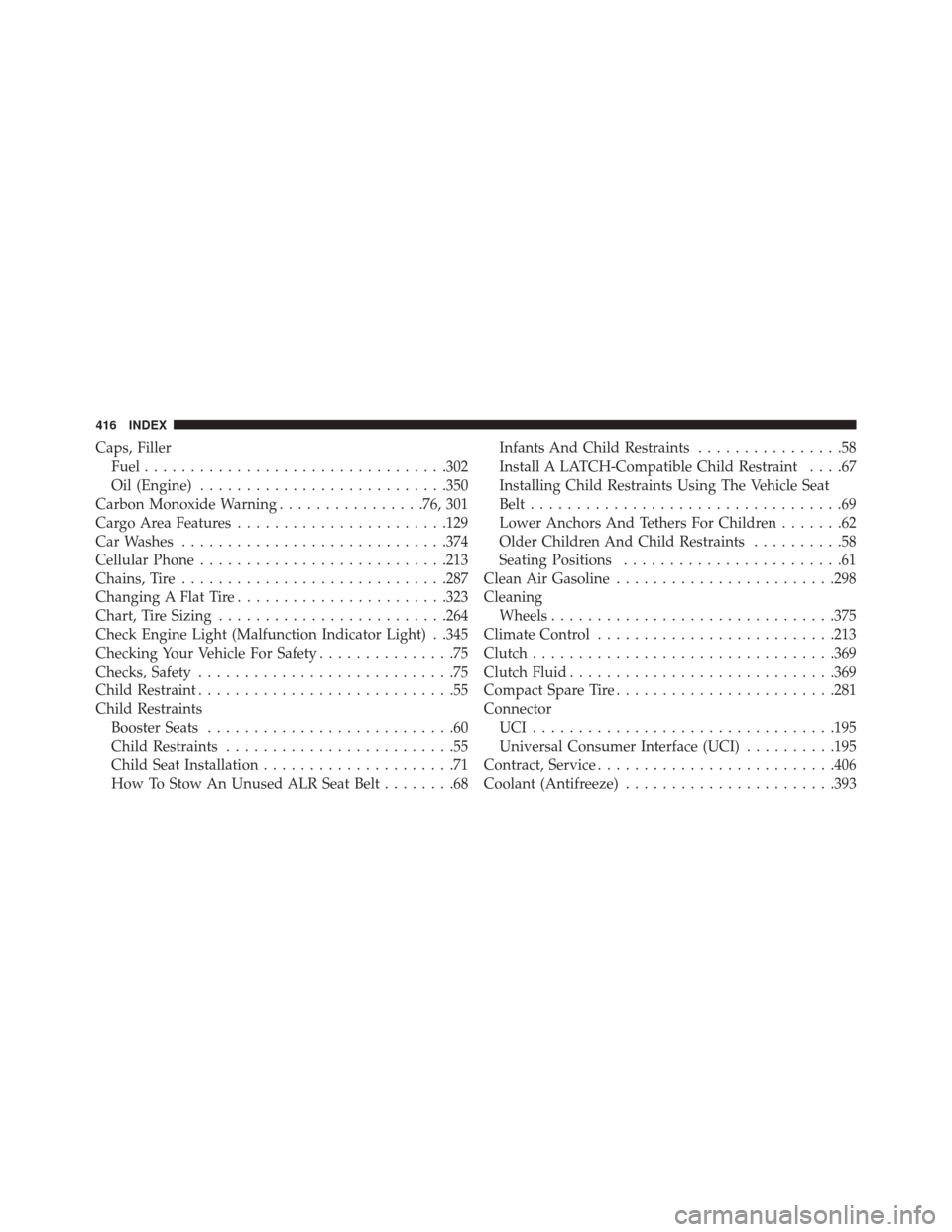
Caps, FillerFuel ................................ .302
Oil (Engine) .......................... .350
Carbon Monoxide Warning ................76, 301
Cargo Area Features ...................... .129
Car Washes ............................ .374
Cellular Phone .......................... .213
Chains, Tire ............................ .287
Changing A Flat Tire ...................... .323
Chart, Tire Sizing ........................ .264
Check Engine Light (Malfunction Indicator Light) . .345
Checking Your Vehicle For Safety ...............75
Checks, Safety ............................75
Child Restraint ............................55
Child Restraints Booster Seats ...........................60
Child Restraints .........................55
Child Seat Installation .....................71
How To Stow An Unused ALR Seat Belt ........68Infants And Child Restraints
................58
Install A LATCH-Compatible Child Restraint ....67
Installing Child Restraints Using The Vehicle Seat
Belt ..................................69
Lower Anchors And Tethers For Children .......62
Older Children And Child Restraints ..........58
Seating Positions ........................61
Clean Air Gasoline ....................... .298
Cleaning Wheels .............................. .375
Climate Control ......................... .213
Clutch ................................ .369
Clutch Fluid ............................ .369
Compact Spare Tire ....................... .281
Connector UCI................................ .195
Universal Consumer Interface (UCI) ..........195
Contract, Service ......................... .406
Coolant (Antifreeze) ...................... .393
416 INDEX