brake light FIAT 500 ABARTH CABRIO 2017 2.G User Guide
[x] Cancel search | Manufacturer: FIAT, Model Year: 2017, Model line: 500 ABARTH CABRIO, Model: FIAT 500 ABARTH CABRIO 2017 2.GPages: 338, PDF Size: 2.78 MB
Page 203 of 338
WARNING!(Continued)
•Be sure the parking brake is fully disengaged
before driving; failure to do so can lead to brake
failure and a collision.
• Always fully apply the parking brake when leav-
ing your vehicle, or it may roll and cause damage
or injury. Also be certain to leave a manual
transmission in FIRST gear or REVERSE gear.
Failure to do so may allow the vehicle to roll and
cause damage or injury.
CAUTION!
If the Brake Warning Light remains on with the
parking brake released, a brake system malfunction
is indicated. Have the brake system serviced by an
authorized dealer immediately.
SPORT MODE
Manual Transmission — If Equipped
In Sport mode, the engine is more responsive to the
throttle pedal, and provides more maximum torque by
increasing turbo boost pressure. Steering feedback is improved, and steering effort is slightly higher. This
driving mode is useful for spirited driving.
1. To activate the Sport mode, push the SPORT button.
Once activated, a SPORT message will be displayed in
the instrument cluster.
2. Momentarily release the accelerator pedal.
3. Press the accelerator pedal again to activate.
SPORT Button
5
STARTING AND OPERATING 201
Page 204 of 338
Automatic Transmission — If Equipped
The Sport mode increases steering feedback to the driver
with slight increase in effort and changes the transmission
shift schedules for more aggressive shifting. This driving
mode is useful while driving on twisty roads where more
steering precision is desired in spirited cornering.
1. To activate the Sport mode, push the SPORT button.Once activated, a SPORT message will be displayed in
the instrument cluster.
2. Push the SPORT button again to return to the stan-
dard driving mode.
BRAKE SYSTEM
Your vehicle is equipped with dual hydraulic brake
systems. If either of the two hydraulic systems loses
normal capability, the remaining system will still func-
tion. However, there will be some loss of overall brak-
ing effectiveness. You may notice increased pedal travel
during application, greater pedal force required to slow
or stop, and potential activation of the “Brake System
Warning Light”.
In the event power assist is lost for any reason (i.e.,
repeated brake applications with the engine off), the
brakes will still function. However, the effort required
to brake the vehicle will be much greater than that
required with the power system operating.
SPORT Button
202 STARTING AND OPERATING
Page 205 of 338
ELECTRONIC BRAKE CONTROL SYSTEM
Your vehicle is equipped with a advanced electronic
brake control system that includes the Anti-Lock Brake
System (ABS), Brake Assist System (BAS), Traction
Control System (TCS), Hill Start Assist (HSA), and
Electronic Stability Control (ESC). All systems work
together to enhance vehicle stability and control in
various driving conditions and are commonly referred
to as ESC.
Four-Wheel Anti-Lock Brake System (ABS)
The Four-Wheel ABS is designed to aid the driver in
maintaining vehicle control under adverse braking con-
ditions. The system operates with a separate computer
to modulate hydraulic pressure, to prevent wheel
lock-up and to help avoid skidding on slippery sur-
faces.
The system’s pump motor runs during an ABS stop to
provide regulated hydraulic pressure. The pump motor
makes a low humming noise during operation, which is
normal.
The ABS includes an amber ABS Warning Light. When
the light is illuminated, the ABS is not functioning. Thesystem reverts to standard non-anti-lock brakes. Turn-
ing the ignition Off and On again may reset the ABS if
the fault detected was only momentary.
WARNING!
•
Pumping the Anti-Lock Brakes will diminish
their effectiveness and may lead to a collision.
Pumping makes the stopping distance longer. Just
press firmly on your brake pedal when you need
to slow down or stop.
• The Anti-Lock Brake System (ABS) cannot pre-
vent the natural laws of physics from acting on
the vehicle, nor can it increase braking or steering
efficiency beyond that afforded by the condition
of the vehicle brakes and tires or the traction
afforded.
• The ABS cannot prevent collisions, including
those resulting from excessive speed in turns,
following another vehicle too closely, or hydro-
planing.
• The capabilities of an ABS-equipped vehicle
must never be exploited in a reckless or danger-
ous manner, which could jeopardize the user’s
safety or the safety of others.
5
STARTING AND OPERATING 203
Page 207 of 338
allow more engine torque to be applied to the wheel
that is not spinning. This feature remains active even if
TCS and ESC are in the Partial Off mode or Full Off
mode. Refer to “Electronic Stability Control (ESC)” in
this section for further information.
Hill Start Assist (HSA)
The HSA system is designed to assist the driver when
starting a vehicle from a stop on a hill. HSA will
maintain the level of brake pressure the driver applied
for a short period of time after the driver takes his foot
off the brake pedal. If the driver does not apply the
throttle during this short period of time, the system will
release brake pressure and the vehicle will roll down
the hill. The system will release brake pressure in
proportion to the amount of throttle applied as the
vehicle starts to move in the intended direction of
travel.
HSA Activation Criteria
The following criteria must be met in order for HSA to
activate:
•Vehicle must be stopped. •
Vehicle must be on a 2.5% (manual transmission) or
7% grade or greater (automatic transmission) grade
hill.
• Gear selection matches vehicle uphill direction (i.e.,
vehicle in NEUTRAL [manual transmission], vehicle
facing uphill is in forward gear; vehicle backing
uphill is in REVERSE gear).
WARNING!
There may be situations on minor hills with a
loaded vehicle, or while pulling a trailer, when the
system will not activate and slight rolling may
occur. This could cause a collision with another
vehicle or object. Always remember the driver is
responsible for braking the vehicle.
Disabling/Enabling HSA
If you wish to turn the HSA system on or off, it can be
done using the Customer Programmable Features in the
Uconnect Settings. Refer to “Uconnect Settings” in for
further information.
5
STARTING AND OPERATING 205
Page 292 of 338
Brake System
In order to assure brake system performance, all brake
system components should be inspected periodically.
Refer to the “Maintenance Schedule” for the proper
maintenance intervals.
WARNING!
Riding the brakes can lead to brake failure and possi-
bly a collision. Driving with your foot resting or riding
on the brake pedal can result in abnormally high brake
temperatures, excessive lining wear, and possible
brake damage. Riding the brakes may also reduce
braking capacity in an emergency.
Brake Master Cylinder
The fluid level in the master cylinder should be checked
when performing under hood services, or immediately
if the “Brake Warning Light” is on.
Be sure to clean the top of the master cylinder area
before removing the cap. If necessary, add fluid to bringthe fluid level up to the requirements described on the
brake fluid reservoir. Fluid level can be expected to fall
as the brake pads wear. The brake fluid level should be
checked when the pads are replaced. However, low
fluid level may be caused by a leak and a checkup may
be needed.
NOTE:
If your vehicle is equipped with a manual
transmission, the brake fluid reservoir supplies fluid to
both the brake system and the clutch release system.
The two systems are separated in the reservoir, and a
leak in one system will not affect the other system. The
manual transmission clutch release system should not
require fluid replacement during the life of the vehicle.
If the brake fluid reservoir is low and the brake system
does not indicate any leaks or other problems, it may be
a result of a leak in the hydraulic clutch release system.
See your local authorized dealer for service.
290 MAINTAINING YOUR VEHICLE
Page 304 of 338
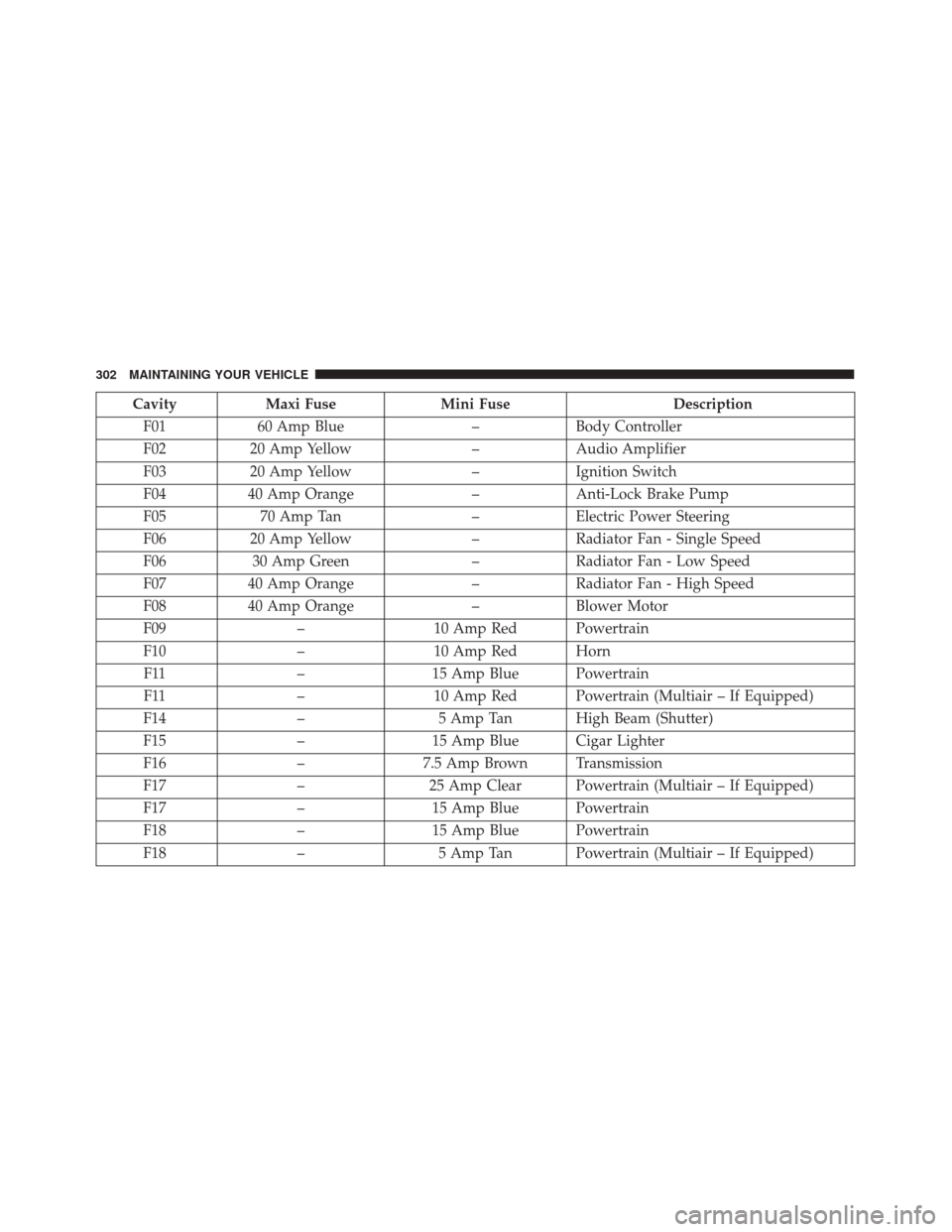
CavityMaxi Fuse Mini Fuse Description
F01 60 Amp Blue –Body Controller
F02 20 Amp Yellow –Audio Amplifier
F03 20 Amp Yellow –Ignition Switch
F04 40 Amp Orange –Anti-Lock Brake Pump
F05 70 Amp Tan –Electric Power Steering
F06 20 Amp Yellow –Radiator Fan - Single Speed
F06 30 Amp Green –Radiator Fan - Low Speed
F07 40 Amp Orange –Radiator Fan - High Speed
F08 40 Amp Orange –Blower Motor
F09 –10 Amp Red Powertrain
F10 –10 Amp Red Horn
F11 –15 Amp Blue Powertrain
F11 –10 Amp Red Powertrain (Multiair – If Equipped)
F14 –5 Amp Tan High Beam (Shutter)
F15 –15 Amp Blue Cigar Lighter
F16 –7.5 Amp Brown Transmission
F17 –25 Amp Clear Powertrain (Multiair – If Equipped)
F17 –15 Amp Blue Powertrain
F18 –15 Amp Blue Powertrain
F18 –5 Amp Tan Powertrain (Multiair – If Equipped)
302 MAINTAINING YOUR VEHICLE
Page 314 of 338
MAINTENANCE SCHEDULE
Your vehicle is equipped with an automatic oil change
indicator system. The oil change indicator system will
remind you that it is time to take your vehicle in for
scheduled maintenance.
Based on engine operation conditions, the oil change
indicator message will illuminate. This means that
service is required for your vehicle. Operating condi-
tions such as frequent short-trips, trailer tow, extremely
hot or cold ambient temperatures, and E85 fuel usage
will influence when the “Change Oil” message is dis-
played. Severe operating conditions can cause the
change oil message to illuminate as early as 3,500 miles
(5,600 km) since last reset. Have your vehicle serviced
as soon as possible, within the next 500 miles (805 km).
Your authorized dealer will reset the oil change indica-
tor message after completing the scheduled oil change.
If a scheduled oil change is performed by someone
other than your authorized dealer, the message can be
reset by referring to the steps described under “Instru-
ment Cluster Display” in “Understanding Your Instru-
ment Panel” for further information.NOTE:
Under no circumstances should oil change
intervals exceed 10,000 miles (16,000 km), twelve
months or 350 hours of engine run time, whichever
comes first. The 350 hours of engine run or idle time is
generally only a concern for fleet customers.
Severe Duty All Models
Change Engine Oil at 4,000 miles (6,500 km) if the
vehicle is operated in a dusty and off road environment
or is operated predominately at idle or only very low
engine RPM’s. This type of vehicle use is considered
Severe Duty.
Once A Month Or Before A Long Trip:
Check engine oil level.
Check windshield washer fluid level.
Check the tire inflation pressures and look for unusual
wear or damage.
Check the fluid levels of the coolant reservoir and brake
master cylinder as needed.
Check function of all interior and exterior lights.
312 MAINTENANCE SCHEDULES
Page 326 of 338
Adding Engine Coolant (Antifreeze)...........286
Adding Fuel ........................... .242
Adding Washer Fluid .....................283
Additives, Fuel ......................... .241
AirBag................................32 Advance Front Air Bag ...................32
Air Bag Operation ......................33
Driver Knee Air Bag .....................34
Enhanced Accident Response ..............266
Event Data Recorder (EDR) ...............266
FrontAirBag..........................32
If A Deployment Occurs ..................38
Knee Impact Bolsters ....................34
Maintaining Your Air Bag System ...........42
Transporting Pets .......................59
Air Bag Light ....................... .62, 120
Air Bag Maintenance ......................42
Air Cleaner, Engine (Engine Air Cleaner Filter) . . .275
Air Conditioner Maintenance ................277
Air Conditioning Filter .................179, 278
Air Conditioning, Operating Tips .............178
Air Conditioning Refrigerant .............277, 278
Air Conditioning System ................177, 277
Air Pressure, Tires ....................... .220Alarm
Disarm The System .....................12
Vehicle Security Alarm ...................12
Alarm (Security Alarm) .....................12
Alterations/Modifications, Vehicle ..............6
Antifreeze (Engine Coolant) ..............286, 308
Capacities .......................... .308
Disposal ............................ .288
Anti-Lock Brake System (ABS) ...............203
Anti-Lock Warning Light ...................135
Appearance Care ....................... .293
Audio Systems (Radio) ....................151
Automatic Dimming Mirror ..................71
Automatic Temperature Control (ATC) .........177
Automatic Transaxle ........................9
Automatic Transmission .............189, 292, 293
Adding Fluid ........................ .293
Fluid And Filter Changes .................293
Fluid
Change ........................ .293
Fluid Level Check ..................... .293
Fluid Type .......................... .310
Gear Ranges ......................... .191
Special Additives ..................... .292
Autostick ............................. .195
324 INDEX
Page 327 of 338
Battery........................... .123, 276
Charging System Light ..................123
Jump Starting ........................ .259
Keyless Key Fob Replacement ..............15
Belts, Seat ..............................61
Body Mechanism Lubrication ................281
B-Pillar Location ........................ .215
Brake Assist System ..................... .204
Brake Fluid ........................ .308, 310
Brake, Parking ......................... .200
Brakes ............................... .290
Brake System ....................... .202, 290
Anti-Lock (ABS) ...................... .203
Master Cylinder ...................... .290
Parking ............................ .200
Warning Light ....................... .121
Brake/Transmission Interlock ................190
Bulb Replacement .....................304, 305
Bulbs, Light ......................... .64, 304
Capacities, Antifreeze (Engine Coolant) .........308
Capacities, Fluid ........................ .308
Caps, Filler Fuel ............................... .242
Oil (Engine) ......................... .275Carbon Monoxide Warning
...............61, 242
Cargo Area Features ..................... .102
Car Washes ........................... .294
Cellular Phone ......................... .167
Chains, Tire ........................... .230
Chart, Tire Sizing ........................211
Check Engine Light (Malfunction Indicator Light) .271
Checking Your Vehicle For Safety ..............60
Checks, Safety ...........................60
Child Restraint ...........................44
Child Restraints Booster Seats ..........................48
Child Restraints ........................44
Child Seat Installation ....................57
How To Stow An Unused ALR Seat Belt .......54
Infants And Child Restraints ...............46
Lower
Anchors And Tethers For Children ......50
Older Children And Child Restraints .........46
Seating Positions .......................49
Clean Air Gasoline ...................... .239
Cleaning Wheels ............................ .295
Climate Control ........................ .167
Manual ............................ .167
Clutch ............................... .29010
INDEX 325
Page 328 of 338
Clutch Fluid........................... .290
Compact Spare Tire ...................... .224
Connector UCI............................... .151
Universal Consumer Interface (UCI) .........151
Contract, Service ........................ .320
Coolant (Antifreeze) ..................... .308
Cooling System ......................... .285
Adding Coolant (Antifreeze) ..............286
Coolant Level .....................285, 288
Disposal Of Used Coolant ................288
Drain, Flush, And Refill ..................285
Inspection .......................... .288
Points To Remember .................288, 289
Pressure Cap ........................ .288
Selection Of Coolant (Antifreeze) ........286, 308
Corrosion Protection ..................... .293
Cruise Light ........................... .138
Cupholders ........................... .101
Customer Assistance ..................... .318
Customer Programmable Features ............153
Daytime Running Lights ....................83
Dealer Service .......................... .272
Defroster, Windshield ......................62 Diagnostic System, Onboard
................270
Dipsticks Automatic Transmission .................293
Disarming, Security System ..................12
Disposal Antifreeze (Engine Coolant) ...............288
Door Ajar ............................. .125
Door Ajar Light ........................ .125
Door Locks .............................17
Door Locks, Automatic .....................19
Downshifting .......................... .188
Driving Through Flowing, Rising, Or Shallow Standing
Water .............................. .197
Electrical Power Outlets ....................99
Electric Remote Mirrors .....................72
Electronic Brake Control System ..............203
Brake
Assist System ....................204
Electronic Speed Control (Cruise Control) ........89
Electronic Stability Control (ESC) .............206
Electronic Throttle Control Warning Light .......123
Emergency, In Case Of Hazard Warning Flasher .................248
Jump Starting ........................ .259
326 INDEX