key FIAT 500 ABARTH CABRIO 2017 2.G Owner's Guide
[x] Cancel search | Manufacturer: FIAT, Model Year: 2017, Model line: 500 ABARTH CABRIO, Model: FIAT 500 ABARTH CABRIO 2017 2.GPages: 338, PDF Size: 2.78 MB
Page 193 of 338
Manual shifts can be made using the AutoStick shift
control (refer to “AutoStick” in this section for further
information). Toggling the gear selector forward (-) or
rearward (+) while in the AutoStick position (beside the
DRIVE position) will manually select the transmission
gear, and will display the current gear in the instrument
cluster as 1, 2, 3, etc.
NOTE:If the gear selector cannot be moved to the
PARK, REVERSE, or NEUTRAL position (when pushed
forward) it is probably in the AutoStick (+/-) position
(beside the DRIVE position). In AutoStick mode, the
transmission gear (1, 2, 3, etc.) is displayed in the
instrument cluster. Move the gear selector to the right
(into the DRIVE [D] position) for access to PARK,
REVERSE, and NEUTRAL.
Gear Ranges
DO NOT race the engine when shifting from PARK or
NEUTRAL into another gear range.
NOTE: After selecting any gear range, wait a moment
to allow the selected gear to engage before accelerating.
This is especially important when the engine is cold.
PARK (P)
This range supplements the parking brake by locking
the transmission. The engine can be started in this
range. Never attempt to use PARK while the vehicle is
in motion. Apply the parking brake when leaving the
vehicle in this range.
When parking on a level surface, you may shift the
transmission into PARK first, and then apply the park-
ing brake.
When parking on a hill, apply the parking brake before
shifting the transmission to PARK, otherwise the load
on the transmission locking mechanism may make it
difficult to move the gear selector out of PARK. As an
added precaution, turn the front wheels toward the
curb on a downhill grade and away from the curb on an
uphill grade.
When exiting the vehicle, always:
• Apply the parking brake.
• Shift the transmission into PARK.
• Turn the engine OFF.
• Remove the ignition key.
5
STARTING AND OPERATING 191
Page 194 of 338
WARNING!
•Never use the PARK position as a substitute for
the parking brake. Always apply the parking
brake fully when parked to guard against vehicle
movement and possible injury or damage.
• Your vehicle could move and injure you and
others if it is not in PARK. Check by trying to
move the gear selector out of PARK with the
brake pedal released. Make sure the transmission
is in PARK before leaving the vehicle.
• It is dangerous to shift out of PARK or NEUTRAL
if the engine speed is higher than idle speed. If
your foot is not firmly pressing the brake pedal,
the vehicle could accelerate quickly forward or in
reverse. You could lose control of the vehicle and
hit someone or something. Only shift into gear
when the engine is idling normally and your foot
is firmly pressing the brake pedal.
• Unintended movement of a vehicle could injure
those in or near the vehicle. As with all vehicles,
(Continued)
WARNING! (Continued)
you should never exit a vehicle while the engine
is running. Before exiting a vehicle always apply
the parking brake, shift the transmission into
PARK, turn the engine OFF, and remove the
ignition key. Once the key is removed, the trans-
mission is locked in PARK, securing the vehicle
against unwanted movement.
• When leaving the vehicle, always remove the
ignition key from the vehicle and lock the vehicle.
• Never leave children alone in a vehicle, or with
access to an unlocked vehicle. Allowing children
to be in a vehicle unattended is dangerous for a
number of reasons. A child or others could be
seriously or fatally injured. Children should be
warned not to touch the parking brake, brake
pedal or the transmission gear selector.
• Do not leave the ignition key in or near the
vehicle (or in a location accessible to children). A
child could operate power windows, other con-
trols, or move the vehicle.
192 STARTING AND OPERATING
Page 202 of 338
PARKING BRAKE
Before leaving the vehicle, make sure that the parking
brake is fully applied. Also, be certain to leave the
manual transmission in REVERSE or first gear.
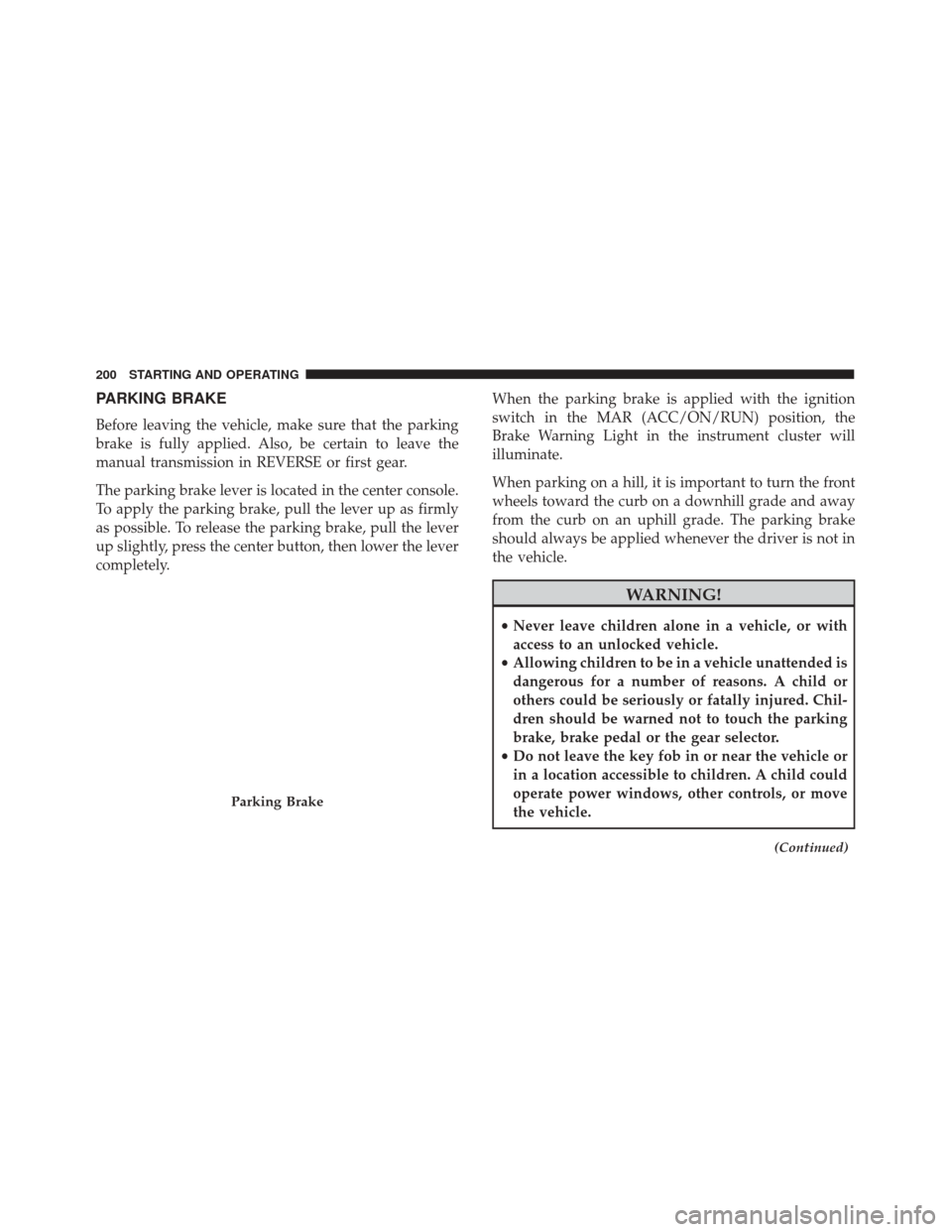
The parking brake lever is located in the center console.
To apply the parking brake, pull the lever up as firmly
as possible. To release the parking brake, pull the lever
up slightly, press the center button, then lower the lever
completely.When the parking brake is applied with the ignition
switch in the MAR (ACC/ON/RUN) position, the
Brake Warning Light in the instrument cluster will
illuminate.
When parking on a hill, it is important to turn the front
wheels toward the curb on a downhill grade and away
from the curb on an uphill grade. The parking brake
should always be applied whenever the driver is not in
the vehicle.
WARNING!
•
Never leave children alone in a vehicle, or with
access to an unlocked vehicle.
• Allowing children to be in a vehicle unattended is
dangerous for a number of reasons. A child or
others could be seriously or fatally injured. Chil-
dren should be warned not to touch the parking
brake, brake pedal or the gear selector.
• Do not leave the key fob in or near the vehicle or
in a location accessible to children. A child could
operate power windows, other controls, or move
the vehicle.
(Continued)
Parking Brake
200 STARTING AND OPERATING
Page 237 of 338
TPMS Warnings
The Tire Pressure Monitoring Telltale Light will flash on
and off for 75 seconds and remain on solid when a
system fault is detected, an audible chime will be
activated and the “Service Tire Pressure Monitoring
System” text message will display. If the ignition key is
cycled, this sequence will repeat providing the system
fault still exists. The Tire Pressure Monitoring Telltale
Light will turn off when the fault condition no longer
exists. A system fault can occur with any of the follow-
ing scenarios:
•Jamming due to electronic devices or driving next to
facilities emitting the same radio frequencies as the
TPM sensors.
• Installing some form of aftermarket window tinting
that affects radio wave signals.
• Snow or ice around the wheels or wheel housings.
• Using tire chains on the vehicle.
• Using wheels/tires not equipped with TPM sensors.
NOTE: Your vehicle may be equipped with a compact
spare wheel and tire assembly. •
The compact spare tire does not have a tire pressure
monitoring sensor. Therefore, the TPMS will not
monitor the tire pressure in the compact spare tire.
• If you install the compact spare tire in place of a road
tire that has a pressure below the low-pressure
warning limit, upon the next ignition key cycle, a
chime will sound, the Tire Pressure Monitoring Tell-
tale Light and the Low inflation pressure left or right
front / rear tire message will still turn ON due to the
low tire.
• However, after driving the vehicle for up to 20
minutes above 15 mph (24 km/h), the Tire Pressure
Monitoring Telltale Light will flash on and off for 75
seconds and then remain on solid and the “Service
Tire Pressure Monitoring System” message will be
displayed.
• This occurs for each subsequent ignition key cycle, a
chime will sound and the Tire Pressure Monitoring
Telltale Light will flash on and off for 75 seconds and
then remain on solid and the “Service Tire Pressure
Monitoring System” message will be displayed.
5
STARTING AND OPERATING 235
Page 250 of 338
HAZARD WARNING FLASHERS
The Hazard Warning flasher switch is located on the
instrument panel below the radio.Push the switch to turn on the Hazard Warning
flashers. When the switch is activated, all direc-
tional turn signals will flash on and off to warn oncom-
ing traffic of an emergency. Push the switch a second
time to turn off the Hazard Warning flashers.
Do not use this emergency warning system when the
vehicle is in motion. Use it when your vehicle is
disabled and it is creating a safety hazard for other
motorists.
If it is necessary to leave the vehicle to go for service, the
Hazard Warning flashers will continue to operate with
the ignition key removed and the vehicle locked.
NOTE: With extended use, the Hazard Warning flash-
ers may wear down your battery.
IF YOUR ENGINE OVERHEATS
In any of the following situations, you can reduce the
potential for overheating by taking the appropriate
action.
• On the highways — slow down.
• In city traffic — while stopped, place the transmis-
sion in NEUTRAL, but do not increase engine idle
speed.
NOTE: There are steps that you can take to slow down
an impending overheat condition:
• If your air conditioner (A/C) is on, turn it off. The
A/C system adds heat to the engine cooling system
and turning the A/C off can help remove this heat.
• You can also turn the temperature control to maxi-
mum heat, the mode control to floor and the blower
control to high. This allows the heater core to act as a
supplement to the radiator and aids in removing heat
from the engine cooling system.
248 WHAT TO DO IN EMERGENCIES
Page 263 of 338
Connecting The Jumper Cables
1. Connect the positive(+)end of the jumper cable to
the positive (+)post of the discharged vehicle.
2. Connect the opposite end of the positive (+)jumper
cable to the positive (+)post of the booster battery.
3. Connect the negative end (-)of the jumper cable to
the negative (-)post of the booster battery.
4. Connect the opposite end of the negative (-)jumper
cable to a good engine ground (exposed metal part of
the discharged vehicle underhood compartment)
away from the battery.
WARNING!
Do not connect the jumper cable to the negative (-)
post of the discharged battery. The resulting elec-
trical spark could cause the battery to explode and
could result in personal injury. Only use the spe-
cific ground point, do not use any other exposed
metal parts. 5. Start the engine in the vehicle that has the booster
battery, let the engine idle a few minutes, and then
turn the key to RUN position on the vehicle with the
discharged battery.
6. Once the vehicle is started, remove the jumper cables in the reverse sequence:
Disconnecting The Jumper Cables
1. Disconnect the negative (-)jumper cable from the
engine ground (-)of the vehicle with the discharged
battery.
2. Disconnect the negative end (-)of the jumper cable
from the negative (-)post of the booster battery.
3. Disconnect the opposite end of the positive (+)
jumper cable from the positive (+)post of the booster
battery.
4. Disconnect the positive (+)end of the jumper cable
from the positive (+)post of the discharged vehicle.
If frequent jump-starting is required to start your ve-
hicle, you should have the battery and charging system
inspected at your authorized dealer.
6
WHAT TO DO IN EMERGENCIES 261
Page 267 of 338
CAUTION!
•Do not use sling-type equipment when towing.
Vehicle damage may occur.
•
When securing the vehicle to a flatbed truck, do not
attach to front or rear suspension components. Dam-
age to your vehicle may result from improper towing.
Automatic Transmission
• Vehicle can be towed with the front wheels elevated.
• Vehicle can be towed on a flatbed truck (all wheels off
the ground).
If the ignition key is unavailable, or the vehicle’s battery
is discharged, refer to “Gear Selector Override” in this
section for instructions on shifting the transmission out
of PARK in order to move the vehicle.
CAUTION!
• DO NOT flat tow any vehicle equipped with an
automatic transmission. Damage to the drivetrain
will result. If these vehicles require towing, make
sure all drive wheels are OFF the ground.
(Continued)
CAUTION! (Continued)
•Towing this vehicle in violation of the above
requirements can cause severe transmission dam-
age. Damage from improper towing is not covered
under the New Vehicle Limited Warranty.
Manual Transmission
• Vehicle can be flat towed (all four wheels on the
ground) with the transmission in NEUTRAL.
• Vehicle can be towed with the front wheels elevated.
• Vehicle can be towed on a flatbed truck (all wheels off
the ground).
CAUTION!
Towing this vehicle in violation of the above require-
ments can cause severe engine and/or transmission
damage. Damage from improper towing is not cov-
ered under the New Vehicle Limited Warranty.
6
WHAT TO DO IN EMERGENCIES 265
Page 327 of 338
Battery........................... .123, 276
Charging System Light ..................123
Jump Starting ........................ .259
Keyless Key Fob Replacement ..............15
Belts, Seat ..............................61
Body Mechanism Lubrication ................281
B-Pillar Location ........................ .215
Brake Assist System ..................... .204
Brake Fluid ........................ .308, 310
Brake, Parking ......................... .200
Brakes ............................... .290
Brake System ....................... .202, 290
Anti-Lock (ABS) ...................... .203
Master Cylinder ...................... .290
Parking ............................ .200
Warning Light ....................... .121
Brake/Transmission Interlock ................190
Bulb Replacement .....................304, 305
Bulbs, Light ......................... .64, 304
Capacities, Antifreeze (Engine Coolant) .........308
Capacities, Fluid ........................ .308
Caps, Filler Fuel ............................... .242
Oil (Engine) ......................... .275Carbon Monoxide Warning
...............61, 242
Cargo Area Features ..................... .102
Car Washes ........................... .294
Cellular Phone ......................... .167
Chains, Tire ........................... .230
Chart, Tire Sizing ........................211
Check Engine Light (Malfunction Indicator Light) .271
Checking Your Vehicle For Safety ..............60
Checks, Safety ...........................60
Child Restraint ...........................44
Child Restraints Booster Seats ..........................48
Child Restraints ........................44
Child Seat Installation ....................57
How To Stow An Unused ALR Seat Belt .......54
Infants And Child Restraints ...............46
Lower
Anchors And Tethers For Children ......50
Older Children And Child Restraints .........46
Seating Positions .......................49
Clean Air Gasoline ...................... .239
Cleaning Wheels ............................ .295
Climate Control ........................ .167
Manual ............................ .167
Clutch ............................... .29010
INDEX 325
Page 330 of 338
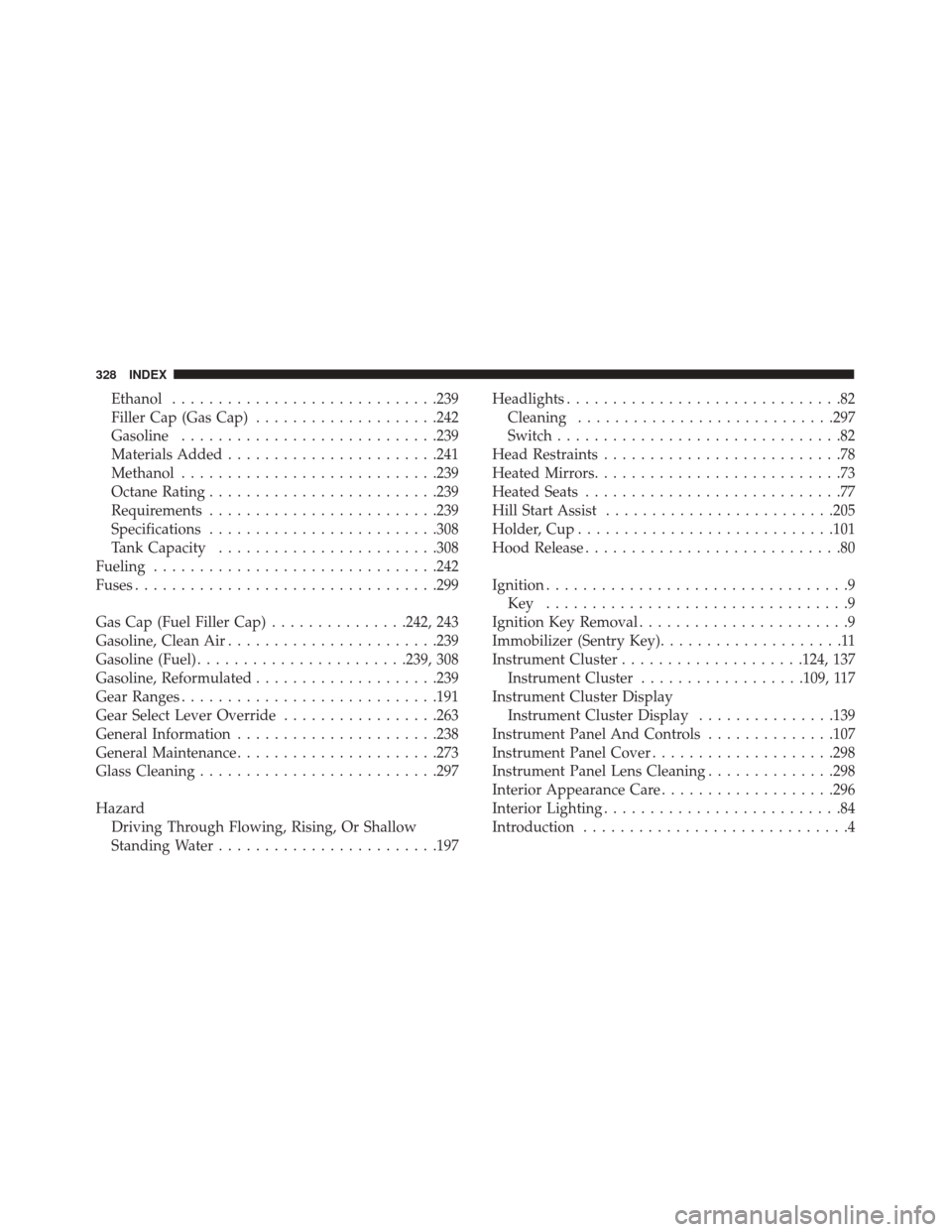
Ethanol............................ .239
Filler Cap (Gas Cap) ....................242
Gasoline ........................... .239
Materials Added ...................... .241
Methanol ........................... .239
Octane Rating ........................ .239
Requirements ........................ .239
Specifications ........................ .308
Tank Capacity ....................... .308
Fueling .............................. .242
Fuses ................................ .299
Gas Cap (Fuel Filler Cap) ...............242, 243
Gasoline, Clean Air ...................... .239
Gasoline (Fuel) ...................... .239, 308
Gasoline, Reformulated ....................239
Gear Ranges ........................... .191
Gear Select Lever Override .................263
General Information ..................... .238
General Maintenance ..................... .273
Glass Cleaning ......................... .297
Hazard Driving Through Flowing, Rising, Or Shallow
Standing Water ....................... .197Headlights
..............................82
Cleaning ........................... .297
Switch ...............................82
Head Restraints ..........................78
Heated Mirrors ...........................73
Heated Seats ............................77
Hill Start Assist ........................ .205
Holder, Cup ........................... .101
Hood Release ............................80
Ignition .................................9
Key .................................9
Ignition Key Removal .......................9
Immobilizer (Sentry Key) ....................11
Instrument Cluster ....................124, 137
Instrument Cluster ..................109, 117
Instrument Cluster Display Instrument Cluster Display ...............139
Instr
ument Panel And Controls ..............107
Instrument Panel Cover ....................298
Instrument Panel Lens Cleaning ..............298
Interior Appearance Care ...................296
Interior Lighting ..........................84
Introduction .............................4
328 INDEX
Page 331 of 338
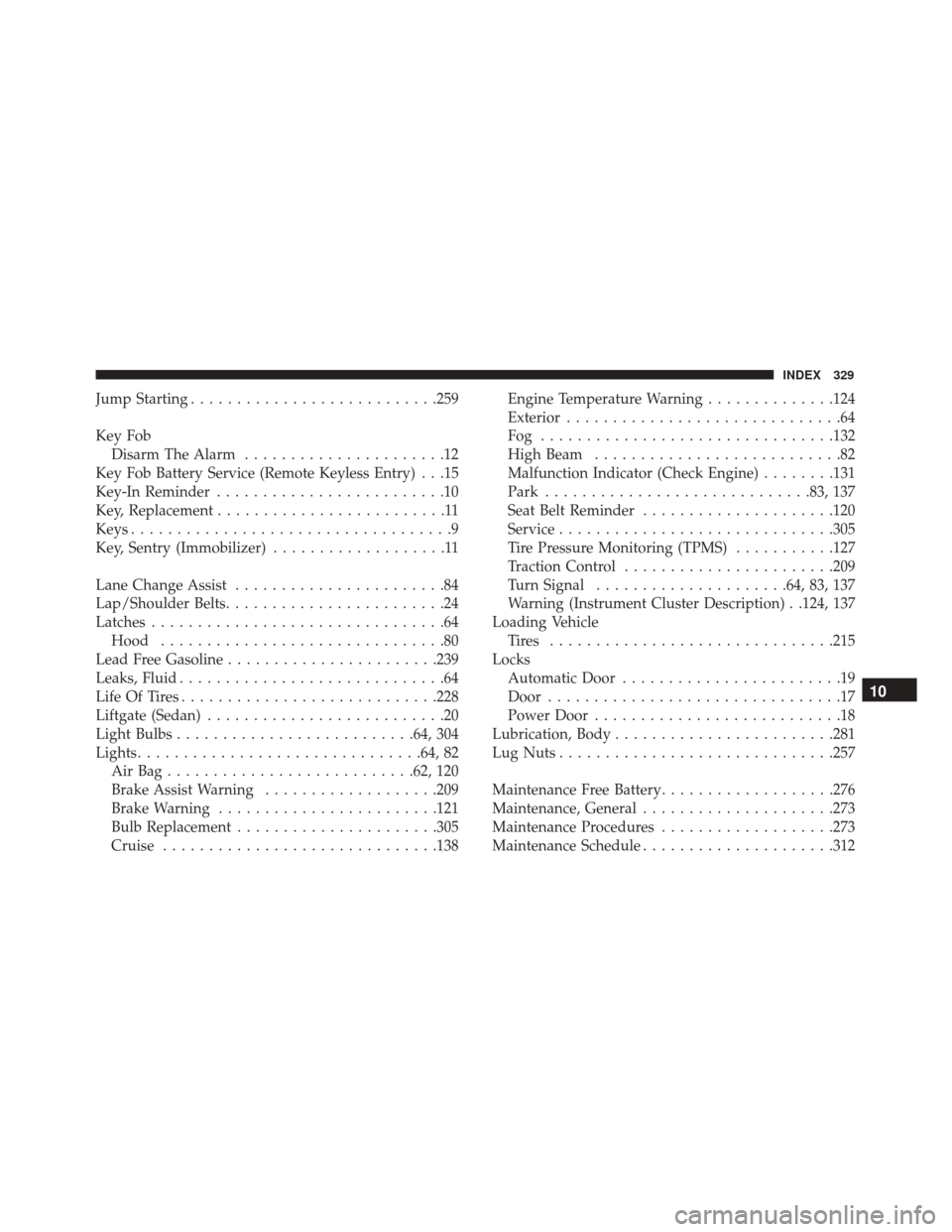
Jump Starting.......................... .259
Key Fob Disarm The Alarm ......................12
Key Fob Battery Service (Remote Keyless Entry) . . .15
Key-In Reminder .........................10
Key, Replacement .........................11
Keys ...................................9
Key, Sentry (Immobilizer) ...................11
Lane Change Assist .......................84
Lap/Shoulder Belts ........................24
Latches ................................64
Hood ...............................80
Lead Free Gasoline ...................... .239
Leaks, Fluid .............................64
Life Of Tires ........................... .228
Liftgate (Sedan) ..........................20
Light Bulbs ......................... .64, 304
Lights .............................. .64, 82
AirBag...........................62, 120
Brake Assist Warning ...................209
Brake Warning ....................... .121
Bulb Replacement ..................... .305
Cruise ............................. .138Engine Temperature Warning
..............124
Exterior ..............................64
Fog ............................... .132
High Beam ...........................82
Malfunction Indicator (Check Engine) ........131
Park ............................ .83, 137
Seat Belt Reminder .....................120
Service ............................. .305
Tire Pressure Monitoring (TPMS) ...........127
Traction Control ...................... .209
Turn Signal .....................64, 83, 137
Warning (Instrument Cluster Description) . .124, 137
Loading Vehicle Tires .............................. .215
Locks Automatic Door ........................19
Door ................................17
Power Door ...........................18
Lubrication, Body ....................... .281
Lug Nuts ............................. .257
Maintenance Free Battery ...................276
Maintenance,
General .....................273
Maintenance Procedures ...................273
Maintenance Schedule .....................312
10
INDEX 329