tire type FIAT 500 GUCCI 2012 2.G Owners Manual
[x] Cancel search | Manufacturer: FIAT, Model Year: 2012, Model line: 500 GUCCI, Model: FIAT 500 GUCCI 2012 2.GPages: 391, PDF Size: 2.2 MB
Page 64 of 391
NOTE:
•Ensure that the tether strap does not slip into the
opening between the seatbacks as you remove the
slack in the strap.
•When using the LATCH attaching system to install a
child restraint, please ensure that all seat belts not
being used for occupant restraints are stowed and out
of reach of children. It is recommended that before
installing the child restraint, buckle the seat belt so the
seat belt is tucked behind the child restraint. This
should stow the seat belt out of the reach of an
inquisitive child. Remind all children in the vehicle
that the seat belts are not toys and that they should not
play with them. In addition, never leave unattended
children in the vehicle.
WARNING!
Improper installation of a child restraint to the
LATCH anchorages can lead to failure of an infant or
child restraint. The child could be badly injured or
killed. Follow the manufacturer’s directions exactly
when installing an infant or child restraint.
Installing Child Restraints Using The Vehicle Seat
Belt
The seat belts in the passenger seating positions are
equipped with an Automatic Locking Retractor (ALR) to
secure a Child Restraint System (CRS). These types of
seat belts are designed to keep the lap portion of the seat
belt tight around the child restraint so that it is not
necessary to use a locking clip. The ALR will make a
ratcheting noise if you extract the entire belt from the
retractor and then allow the belt to retract into the
62 THINGS TO KNOW BEFORE STARTING YOUR VEHICLE
Page 136 of 391
CAUTION!
The TPMS has been optimized for the original
equipment tires and wheels. TPMS pressures and
warning have been established for the tire size
equipped on your vehicle. Undesirable system opera-
tion or sensor damage may result when using re-
placement equipment that is not of the same size,
type, and/or style. Aftermarket wheels can cause
sensor damage. Do not use tire sealant from a can or
balance beads if your vehicle is equipped with a
TPMS, as damage to the sensors may result.
16. Automatic Gearbox Failure This light will illuminate when there is an
automatic transmission fault. 17. Oil Pressure Warning Light
This light indicates low engine oil pressure. The
light should turn on momentarily when the engine
is started. If the light turns on while driving, stop the
vehicle and shut off the engine as soon as possible. A
chime will sound for four minutes when this light turns
on.
Do not operate the vehicle until the cause is corrected.
This light does not indicate how much oil is in the engine.
The engine oil level must be checked under the hood.
18. Malfunction Indicator Light (MIL) The Malfunction Indicator Light (MIL) is part of
an onboard diagnostic system, called OBDII, that
monitors engine and automatic transmission con-
trol systems. The light will illuminate when the key is in
the ON/RUN position before engine start. If the bulb
does not come on when turning the key from OFF/LOCK
to ON/RUN, have the condition checked promptly.
134 UNDERSTANDING YOUR INSTRUMENT PANEL
Page 150 of 391
NOTE:The range depends on several factors: driving
style, type of route (freeway, residential, mountain roads,
etc.), conditions of use of the car (load, tire pressure, etc.).
Trip planning must take into account the above notes.
Distance Travelled
This value shows the distance covered since the last reset.
Average Consumption
This value shows the approximate average consumption
since the last reset.
Instant Consumption
This indicates the fuel consumption. The value is con-
stantly updated. The message “----” will appear on the
display if the car is parked with the engine running.
Average Speed
This value shows the vehicle’s average speed as a func-
tion of the overall time elapsed since the last reset.
Travel Time
This value shows the time elapsed since the last reset.
Personal Settings (Customer-Programmable
Features)
Dimmer
The EVIC display is provided with a light sensor capable
of detecting environmental light conditions and adjust-
ing the brightness of the instruments accordingly.
NOTE: The brightness of the instrument panel may
change while travelling following an event that causes
switching from “day” to “night” conditions (or vice
versa) in the passenger compartment (e.g. in a tunnel, on
avenues in shadows, under bridges, etc.).
To adjust the brightness, proceed as follows:
1. Press the +or –button to set the required brightness
level.
148 UNDERSTANDING YOUR INSTRUMENT PANEL
Page 245 of 391
WARNING! (Continued)
•Unequal tire pressures from one side of the ve-
hicle to the other can cause the vehicle to drift to
the right or left.
•Always drive with each tire inflated to the recom-
mended cold tire inflation pressure.
Economy
Improper inflation pressures can cause uneven wear
patterns to develop across the tire tread. These abnormal
wear patterns will reduce tread life, resulting in a need
for earlier tire replacement. Under-inflation also increases
tire rolling resistance and results in higher fuel
consumption.
Ride Comfort And Vehicle Stability
Proper tire inflation contributes to a comfortable ride.
Over-inflation produces a jarring and uncomfortable
ride.
Tire Inflation Pressures
The proper cold tire inflation pressure is listed on the
driver’s side B-Pillar.
The pressure should be checked and adjusted as well as
inspected for signs of tire wear or visible damage, at least
once a month. Use a good quality pocket-type gauge to
check tire pressure. Do not make a visual judgement
when determining proper inflation. Radial tires may look
properly inflated even when they are under-inflated.
CAUTION!
After inspecting or adjusting the tire pressure, al-
ways reinstall the valve stem cap. This will prevent
moisture and dirt from entering the valve stem,
which could damage the valve stem.
5
STARTING AND OPERATING 243
Page 247 of 391
WARNING!
High speed driving with your vehicle under maxi-
mum load is dangerous. The added strain on your
tires could cause them to fail. You could have a
serious accident. Do not drive a vehicle loaded to the
maximum capacity at continuous speeds above
75 mph (120 km/h).
Radial-Ply Tires
WARNING!
Combining radial-ply tires with other types of tires
on your vehicle will cause your vehicle to handle
poorly. The instability could cause an accident. Al-
ways use radial-ply tires in sets of four. Never
combine them with other types of tires.Cuts and punctures in radial tires are repairable only in
the tread area because of sidewall flexing. Consult your
authorized tire dealer for radial tire repairs.
Compact Spare Tire
The compact spare is for temporary emergency use with
radial tires. It is engineered to be used on your style
vehicle only. Since this tire has limited tread life, the
original tire should be repaired (or replaced) and rein-
stalled at the first opportunity.
WARNING!
•Temporary use spare tires are for emergency use
only. With these tires, do not drive more than
50 mph (80 km/h).
(Continued)
5
STARTING AND OPERATING 245
Page 251 of 391
WARNING!
•Do not use a tire, wheel size or rating other than
that specified for your vehicle. Some combinations
of unapproved tires and wheels may change sus-
pension dimensions and performance characteris-
tics, resulting in changes to steering, handling, and
braking of your vehicle. This can cause unpredict-
able handling and stress to steering and suspen-
sion components. You could lose control and have
an accident resulting in serious injury or death.
Use only the tire and wheel sizes with load ratings
approved for your vehicle.
•Never use a tire with a smaller load index or
capacity other than what was originally equipped
on your vehicle. Using a tire with a smaller load
index could result in tire overloading and failure.
You could lose control and have an accident.(Continued)
WARNING! (Continued)
•Failure to equip your vehicle with tires having
adequate speed capability can result in sudden tire
failure and loss of vehicle control.
CAUTION!
Replacing original tires with tires of a different size
may result in false speedometer and odometer read-
ings.
TIRE CHAINS
Use only compact chains, or other traction aids that meet
SAE type “Class S” specifications. Chains must be the
proper size for the vehicle, as recommended by the chain
manufacturer.
NOTE:Do not use tire chains on a compact spare tire.
5
STARTING AND OPERATING 249
Page 253 of 391
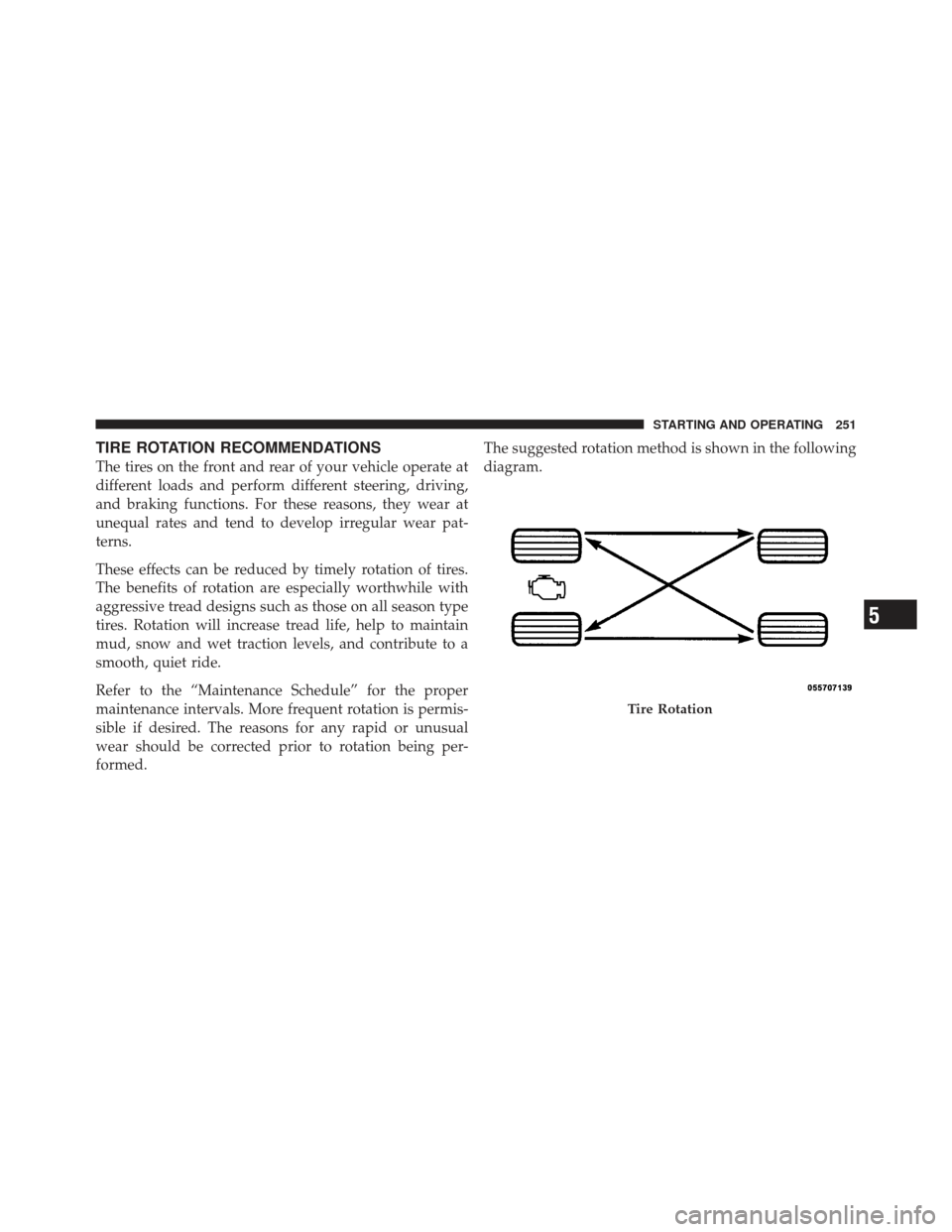
TIRE ROTATION RECOMMENDATIONS
The tires on the front and rear of your vehicle operate at
different loads and perform different steering, driving,
and braking functions. For these reasons, they wear at
unequal rates and tend to develop irregular wear pat-
terns.
These effects can be reduced by timely rotation of tires.
The benefits of rotation are especially worthwhile with
aggressive tread designs such as those on all season type
tires. Rotation will increase tread life, help to maintain
mud, snow and wet traction levels, and contribute to a
smooth, quiet ride.
Refer to the “Maintenance Schedule” for the proper
maintenance intervals. More frequent rotation is permis-
sible if desired. The reasons for any rapid or unusual
wear should be corrected prior to rotation being per-
formed.The suggested rotation method is shown in the following
diagram.
Tire Rotation
5
STARTING AND OPERATING 251
Page 255 of 391
For example, your vehicle may have a recommended
cold (parked for more than three hours) tire pressure of
30 psi (207 kPa). If the ambient temperature is 68° F (20°
C) and the measured tire pressure is 27 psi (186 kPa), a
temperature drop to 20° F (-7° C) will decrease the tire
pressure to approximately 26 psi (179 kPa). This tire
pressure is sufficiently low enough to turn on the Tire
Pressure Monitoring Telltale Light. Driving the vehicle
may cause the tire pressure to rise to approximately
27 psi (186 kPa), but the Tire Pressure Monitoring Telltale
Light will still be on. In this situation, the Tire Pressure
Monitoring Telltale Light will turn off only after the tires
are inflated to the vehicle’s recommended cold tire pres-
sure value.CAUTION!
•The TPMS has been optimized for the original
equipment tires and wheels. TPMS pressures and
warnings have been established for the tire size
equipped on your vehicle. Undesirable system
operation or sensor damage may result when us-
ing replacement equipment that is not of the same
size, type, and/or style. Aftermarket wheels can
cause sensor damage. Do not use aftermarket tire
sealants or balance beads if your vehicle is
equipped with a TPMS, as damage to the sensors
may result.
•After inspecting or adjusting the tire pressure,
always reinstall the valve stem cap. This will
prevent moisture and dirt from entering the valve
stem, which could damage the Tire Pressure Moni-
toring Sensor.
5
STARTING AND OPERATING 253
Page 335 of 391
Washing
Hand washing is highly recommended. Automatic car
washing equipment can damage the top material. If you
must use an automatic car wash, soft cloth systems are
preferred.
CAUTION!
Avoid high-pressure car washes, as they can damage
the top material. Also, increased water pressure may
force water past the weather strips.
General Cleaning
Careful vacuuming of the top before washing is helpful
in removing dust and other foreign particles. Wash in
partial shade instead of direct sun. Wet the entire vehicle
before washing the top. The top should be washed with
a soft, natural bristle scrub brush, and a mild soap
solution such as liquid dishwashing soap. Do not use
detergent.
CAUTION!
Never use an abrasive type cleaner or bleaches.
Cleaners should not contain silicones, organic sol-
vents, petroleum distillates, or plasticizers. Always
wait until the top is thoroughly dry before lowering
it into the storage area.
Scrub in all directions, covering an area of about two
square feet at a time. Avoid heavy scrubbing. Rinse the
entire vehicle with water to remove all soap and dirt from
the top fabric and to prevent streaking on painted and
chrome surfaces. Allow the top to dry before lowering.
Vacuuming the top with a wet/dry shop vacuum will
decrease the top’s drying time, ensure removal of all dirt,
and delete streaks in the material. Multiple cleanings
may be necessary to remove stubborn stains. If stains
persist, contact your local authorized dealer for further
suggestions.
7
MAINTAINING YOUR VEHICLE 333
Page 376 of 391
Adding Engine Coolant (Antifreeze).......... 319
Adding Fuel ........................... 262
Adding Washer Fluid ..................... 314
Additives, Fuel ......................... 259
Air Cleaner, Engine (Engine Air Cleaner Filter) . . . 308
Air Conditioner Maintenance ............... 311
Air Conditioning ........................ 186
Air Conditioning Controls ................. 186
Air Conditioning Refrigerant ................ 311
Air Conditioning System .............186,190,311
Air Conditioning, Operating Tips ............ 196
Air Pressure, Tires ....................... 243
Airbag .............................. 38,48
Airbag Deployment ....................... 50
Airbag Light ..................... 46,53,68,131
Airbag Maintenance ....................... 52
Airbag, Side ...................... 42,44,47,48
Airbag, Window (Side Curtain) ...........42,44,48
Alterations/Modifications, Vehicle ............. 7Anti-Lock Brake System (ABS)
.............. 224
Anti-Lock Warning Light .................. 137
Antifreeze (Engine Coolant) ...........318,343,344
Capacities .......................... 343
Disposal ........................... 320
Appearance Care ........................ 326
Automatic Dimming Mirror ................. 77
Automatic Door Locks ..................... 22
Automatic Temperature Control (ATC) ......... 190
Automatic Transaxle ...................... 12
Automatic Transmission ................207,325
Adding Fluid ....................... 326
Fluid and Filter Changes ............... 326
Fluid Level Check .................... 326
Fluid Type ......................... 325
Gear Ranges ........................ 209
Special Additives ..................... 326
Autostick ............................. 214
374 INDEX