light FIAT 500 GUCCI 2012 2.G Owner's Manual
[x] Cancel search | Manufacturer: FIAT, Model Year: 2012, Model line: 500 GUCCI, Model: FIAT 500 GUCCI 2012 2.GPages: 80, PDF Size: 1.87 MB
Page 42 of 80
- Electronic Throttle Control (ETC) Light
•This light informs you of a problem with the Electronic Throttle Control (ETC) system.
• If a problem is detected, the light will come on while the engine is running. Cycle the ignition
when the vehicle has completely stopped and the shift lever is placed in the PARK position; the
light should turn off.
• If the light remains lit with the engine running, your vehicle will usually be drivable; however, see
an authorized service center immediately. If the light is flashing when the engine is running,
immediate service is required and you may experience reduced performance, an elevated/rough
idle or engine stall and your vehicle may require towing.
- Electronic Stability Control (ESC) OFF Indicator Light
•This light indicates the Electronic Stability Control system (ESC) has been turned off by the
driver.
- Electronic Stability Control (ESC) Activation / Malfunction Indicator
Light
• The “ESC Activation/Malfunction Indicator Light” in the instrument cluster will come on for four
seconds when the ignition switch is turned to the ON/RUN position. If the “ESC
Activation/Malfunction Indicator Light” comes on continuously with the engine running, a
malfunction has been detected in the ESC system. If this light remains on, see your authorized
dealer as soon as possible to have the problem diagnosed and corrected.
NOTE:
• The “ESC Off Indicator Light” and the “ESC Activation/Malfunction Indicator Light” come on
momentarily each time the ignition switch is turned to ON/RUN.
• Each time the ignition is turned to ON/RUN, the ESC system will be ON even if it was turned
off previously.
- Tire Pressure Monitoring System (TPMS) Light
•Each tire, including the spare (if provided), should be checked monthly, when cold and inflated to
the inflation pressure recommended by the vehicle manufacturer on the vehicle placard or tire
inflation pressure label. (If your vehicle has tires of a different size than the size indicated on the
vehicle placard or tire inflation pressure label, you should determine the proper tire inflation
pressure for those tires.)
• As an added safety feature, your vehicle has been equipped with a Tire Pressure Monitoring
System (TPMS) that illuminates a low tire pressure telltale when one or more of your tires is
significantly under-inflated.Accordingly, when the low tire pressure telltale illuminates, you should
stop and check your tires as soon as possible, and inflate them to the proper pressure. Driving
on a significantly under-inflated tire causes the tire to overheat and can lead to tire failure.
Under-inflation also reduces fuel efficiency and tire tread life, and may affect the vehicle’s
handling and stopping ability.
• IF THE LIGHT STARTS FLASHING INDICATING A LOW TIRE PRESSURE, ADJUST THE
AIR PRESSURE IN THE LOW TIRE TO THE AIR PRESSURE SHOWN ON THE VEHICLE
PLACARD OR TIRE INFLATION PRESSURE LABEL LOCATED ON THE DRIVER'S
DOOR. NOTE: AFTER INFLATION, THE VEHICLE MAY NEED TO BE DRIVEN FOR 20
MINUTES BEFORE THE FLASHING LIGHT WILL TURN OFF.
WHAT TO DO IN EMERGENCIES
40
Page 43 of 80
•Please note that the TPMS is not a substitute for proper tire maintenance, and it is the driver’s
responsibility to maintain correct tire pressure, even if under-inflation has not reached the level
to trigger illumination of the TPMS low tire pressure telltale.
• Your vehicle has also been equipped with a TPMS malfunction indicator to indicate when the
system is not operating properly.The TPMS malfunction indicator is combined with the low tire
pressure telltale.When the system detects a malfunction, the telltale will flash for approximately
one minute and then remain continuously illuminated.This sequence will continue each time the
vehicle is restarted as long as the malfunction exists.
• When the malfunction indicator is illuminated, the system may not be able to detect or signal
low tire pressure as intended.TPMS malfunctions may occur for a variety of reasons, including
the installation of replacement or alternate tires or wheels on the vehicle that prevent the TPMS
from functioning properly.Always check the TPMS malfunction telltale after replacing one or
more tires or wheels on your vehicle, to ensure that the replacement or alternate tires and
wheels allow the TPMS to continue to function properly.
NOTE: Tire pressures change by approximately 1 psi (7 kPa) per 12° F (7° C) of air temperature
change. Keep this in mind when checking tire pressure inside a garage, especially in the Winter.
Example: If garage temperature is 68°F (20°C) and the outside temperature is 32°F (0°C), then
the cold tire inflation pressure should be increased by 3 psi (21 kPa), which equals 1 psi (7 kPa) for
every 12°F (7°C) for this outside temperature condition.
CAUTION!
The TPMS has been optimized for the original equipment tires and wheels.TPMS
pressures and warning have been established for the tire size equipped on your vehicle.
Undesirable system operation or sensor damage may result when using replacement
equipment that is not of the same size, type, and/or style.Aftermarket wheels can cause
sensor damage. Do not use tire sealant from a can, or balance beads if your vehicle is
equipped with a TPMS, as damage to the sensors may result.
BRAKE- Brake Warning Light
• The Brake Warning light illuminates when there is either a system malfunction or the parking
brake is applied. If the light is on and the parking brake is not applied, it indicates a possible brake
hydraulic malfunction, brake booster problem or an Anti-Lock Brake System problem.
• Please have your vehicle serviced immediately.
WARNING!
Driving a vehicle with the red brake light on is dangerous. Part of the brake system may
have failed. It will take longer to stop the vehicle.You could have a collision. Have the
vehicle checked immediately.
WHAT TO DO IN EMERGENCIES
41
Page 44 of 80
- Malfunction Indicator Light (MIL)
•Certain conditions, such as a loose or missing gas cap, poor fuel quality, etc., may illuminate the
MIL after engine start.The vehicle should be serviced if the light stays on through several typical
driving cycles. In most situations, the vehicle will drive normally and not require towing.
• If the MIL flashes when the engine is running, serious conditions may exist that could lead to
immediate loss of power or severe catalytic converter damage.We recommend you do not
operate the vehicle. Have the vehicle serviced immediately.
- Charging System Light
•This light shows the status of the electrical charging system. If the charging system light remains
on, it means that the vehicle is experiencing a problem with the charging system.
• We recommend you do not continue driving if the charging system light is on. Have the vehicle
serviced immediately.
- Oil Pressure Warning Light
•This light indicates low engine oil pressure. If the light turns on while driving, stop the vehicle and
shut off the engine as soon as possible.A chime will sound for four minutes when this light turns
on.
• We recommend you do not operate the vehicle or engine damage will occur. Have the vehicle
serviced immediately.
- Anti-Lock Brake (ABS) Light
•This light monitors the Anti-Lock Brake System (ABS).
• If the light is not on during starting, stays on, or turns on while driving, we recommend you drive
to the nearest service center and have the vehicle serviced immediately.
- Air Bag Warning Light
•If the light is not on during starting, stays on, or turns on while driving, have the vehicle serviced
by an authorized service center immediately.
IF YOUR ENGINE OVERHEATS
•In any of the following situations, you can reduce the potential for overheating by taking the
appropriate action.
•On the highways — slow down.
• In city traffic — while stopped, shift transmission into NEUTRAL, but do not increase engine
idle speed.
NOTE: There are steps that you can take to slow down an impending overheat condition:
• If your air conditioner (A/C) is on, turn it off.The A/C system adds heat to the engine cooling
system and turning the A/C off can help remove this heat.
• You can also turn the Temperature control to maximum heat, the Mode control to floor and the
Fan control to high.This allows the heater core to act as a supplement to the radiator and aids in
removing heat from the engine cooling system.
• If the temperature reading does not return to normal, turn the engine off immediately.
WHAT TO DO IN EMERGENCIES
42
Page 49 of 80
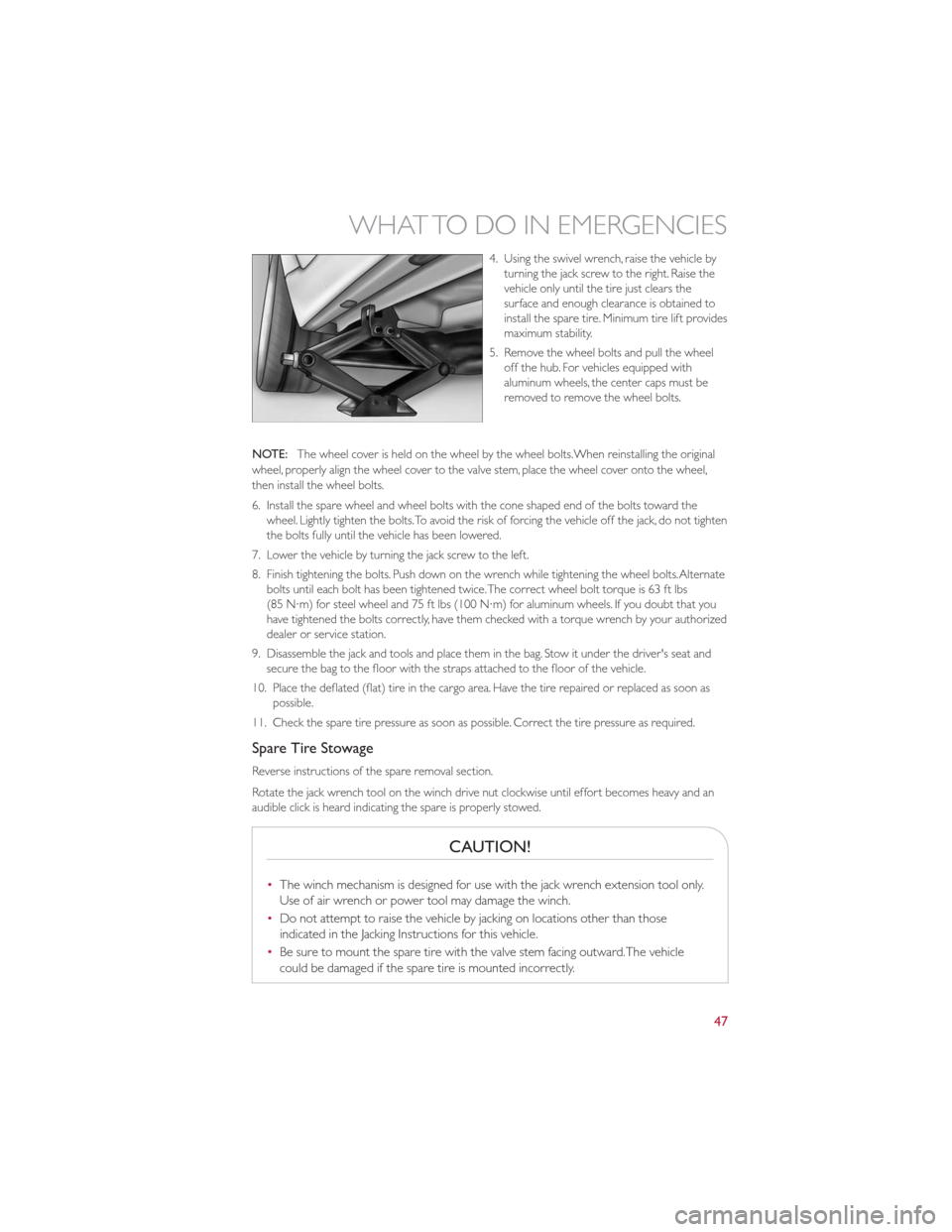
4. Using the swivel wrench, raise the vehicle byturning the jack screw to the right. Raise the
vehicle only until the tire just clears the
surface and enough clearance is obtained to
install the spare tire. Minimum tire lift provides
maximum stability.
5. Remove the wheel bolts and pull the wheel off the hub. For vehicles equipped with
aluminum wheels, the center caps must be
removed to remove the wheel bolts.
NOTE: The wheel cover is held on the wheel by the wheel bolts.When reinstalling the original
wheel, properly align the wheel cover to the valve stem, place the wheel cover onto the wheel,
then install the wheel bolts.
6. Install the spare wheel and wheel bolts with the cone shaped end of the bolts toward the wheel. Lightly tighten the bolts.To avoid the risk of forcing the vehicle off the jack, do not tighten
the bolts fully until the vehicle has been lowered.
7. Lower the vehicle by turning the jack screw to the left.
8. Finish tightening the bolts. Push down on the wrench while tightening the wheel bolts.Alternate bolts until each bolt has been tightened twice.The correct wheel bolt torque is 63 ft lbs
(85 N·m) for steel wheel and 75 ft lbs (100 N·m) for aluminum wheels. If you doubt that you
have tightened the bolts correctly, have them checked with a torque wrench by your authorized
dealer or service station.
9. Disassemble the jack and tools and place them in the bag. Stow it under the driver's seat and secure the bag to the floor with the straps attached to the floor of the vehicle.
10. Place the deflated (flat) tire in the cargo area. Have the tire repaired or replaced as soon as possible.
11. Check the spare tire pressure as soon as possible. Correct the tire pressure as required.
Spare Tire Stowage
Reverse instructions of the spare removal section.
Rotate the jack wrench tool on the winch drive nut clockwise until effort becomes heavy and an
audible click is heard indicating the spare is properly stowed.
CAUTION!
• The winch mechanism is designed for use with the jack wrench extension tool only.
Use of air wrench or power tool may damage the winch.
• Do not attempt to raise the vehicle by jacking on locations other than those
indicated in the Jacking Instructions for this vehicle.
• Be sure to mount the spare tire with the valve stem facing outward.The vehicle
could be damaged if the spare tire is mounted incorrectly.
WHAT TO DO IN EMERGENCIES
47
Page 59 of 80
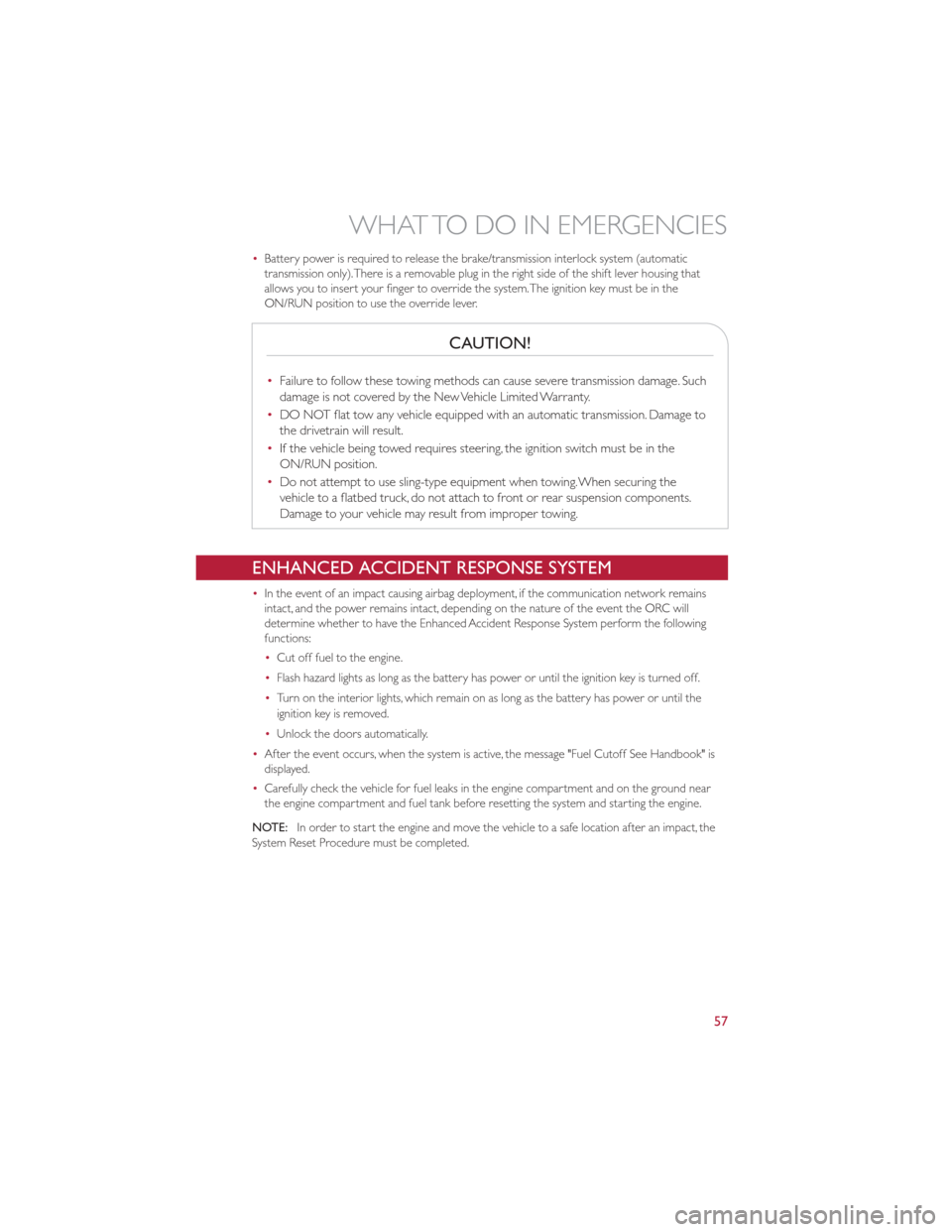
•Battery power is required to release the brake/transmission interlock system (automatic
transmission only).There is a removable plug in the right side of the shift lever housing that
allows you to insert your finger to override the system.The ignition key must be in the
ON/RUN position to use the override lever.
CAUTION!
•Failure to follow these towing methods can cause severe transmission damage. Such
damage is not covered by the New Vehicle Limited Warranty.
• DO NOT flat tow any vehicle equipped with an automatic transmission. Damage to
the drivetrain will result.
• If the vehicle being towed requires steering, the ignition switch must be in the
ON/RUN position.
• Do not attempt to use sling-type equipment when towing.When securing the
vehicle to a flatbed truck, do not attach to front or rear suspension components.
Damage to your vehicle may result from improper towing.
ENHANCED ACCIDENT RESPONSE SYSTEM
•In the event of an impact causing airbag deployment, if the communication network remains
intact, and the power remains intact, depending on the nature of the event the ORC will
determine whether to have the Enhanced Accident Response System perform the following
functions:
•Cut off fuel to the engine.
• Flash hazard lights as long as the battery has power or until the ignition key is turned off.
• Turn on the interior lights, which remain on as long as the battery has power or until the
ignition key is removed.
• Unlock the doors automatically.
• After the event occurs, when the system is active, the message "Fuel Cutoff See Handbook" is
displayed.
• Carefully check the vehicle for fuel leaks in the engine compartment and on the ground near
the engine compartment and fuel tank before resetting the system and starting the engine.
NOTE: In order to start the engine and move the vehicle to a safe location after an impact, the
System Reset Procedure must be completed.
WHAT TO DO IN EMERGENCIES
57
Page 60 of 80
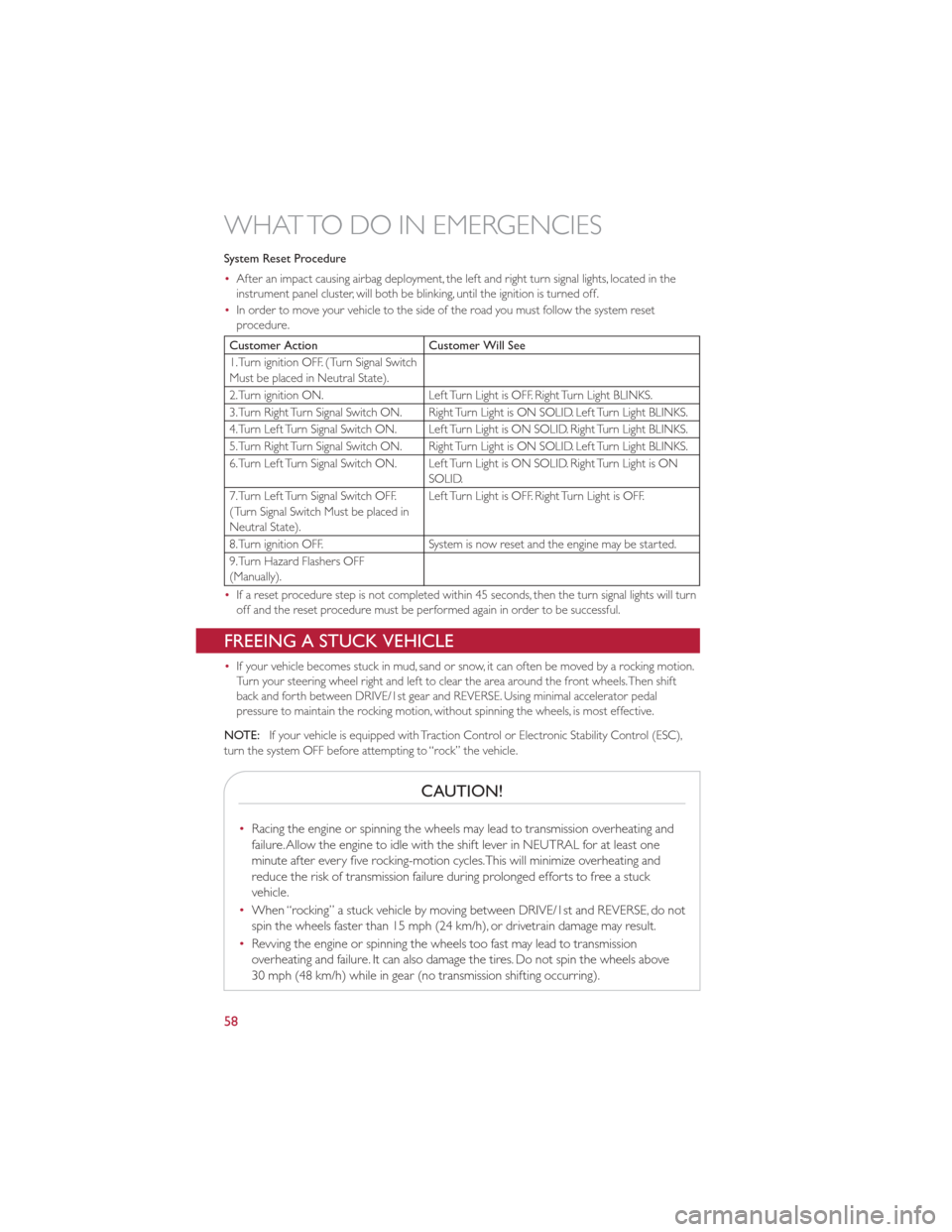
System Reset Procedure
•After an impact causing airbag deployment, the left and right turn signal lights, located in the
instrument panel cluster, will both be blinking, until the ignition is turned off.
• In order to move your vehicle to the side of the road you must follow the system reset
procedure.
Customer Action Customer Will See
1.Turn ignition OFF. (Turn Signal Switch
Must be placed in Neutral State).
2.Turn ignition ON. Left Turn Light is OFF. Right Turn Light BLINKS.
3.Turn Right Turn Signal Switch ON. Right Turn Light is ON SOLID. Left Turn Light BLINKS.
4.Turn Left Turn Signal Switch ON. Left Turn Light is ON SOLID. Right Turn Light BLINKS.
5.Turn Right Turn Signal Switch ON. Right Turn Light is ON SOLID. Left Turn Light BLINKS.
6.Turn Left Turn Signal Switch ON. Left Turn Light is ON SOLID. Right Turn Light is ON SOLID.
7.Turn Left Turn Signal Switch OFF.
(Turn Signal Switch Must be placed in
Neutral State). Left Turn Light is OFF. Right Turn Light is OFF.
8.Turn ignition OFF. System is now reset and the engine may be started.
9.Turn Hazard Flashers OFF
(Manually).
• If a reset procedure step is not completed within 45 seconds, then the turn signal lights will turn
off and the reset procedure must be performed again in order to be successful.
FREEING A STUCK VEHICLE
•If your vehicle becomes stuck in mud, sand or snow, it can often be moved by a rocking motion.
Turn your steering wheel right and left to clear the area around the front wheels.Then shift
back and forth between DRIVE/1st gear and REVERSE. Using minimal accelerator pedal
pressure to maintain the rocking motion, without spinning the wheels, is most effective.
NOTE: If your vehicle is equipped with Traction Control or Electronic Stability Control (ESC),
turn the system OFF before attempting to “rock” the vehicle.
CAUTION!
• Racing the engine or spinning the wheels may lead to transmission overheating and
failure.Allow the engine to idle with the shift lever in NEUTRAL for at least one
minute after every five rocking-motion cycles.This will minimize overheating and
reduce the risk of transmission failure during prolonged efforts to free a stuck
vehicle.
• When “rocking” a stuck vehicle by moving between DRIVE/1st and REVERSE, do not
spin the wheels faster than 15 mph (24 km/h), or drivetrain damage may result.
• Revving the engine or spinning the wheels too fast may lead to transmission
overheating and failure. It can also damage the tires. Do not spin the wheels above
30 mph (48 km/h) while in gear (no transmission shifting occurring).
WHAT TO DO IN EMERGENCIES
58
Page 67 of 80
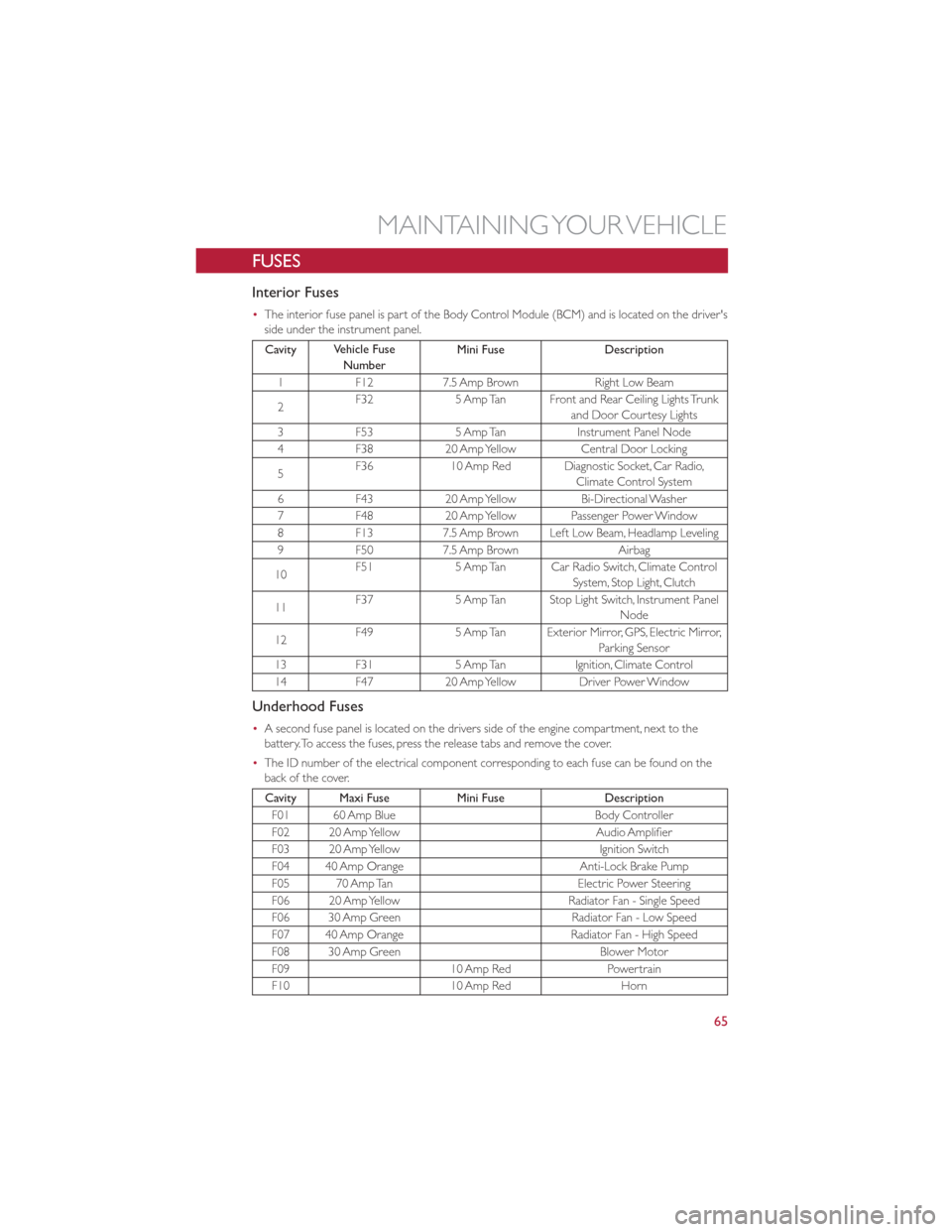
FUSES
Interior Fuses
•The interior fuse panel is part of the Body Control Module (BCM) and is located on the driver's
side under the instrument panel.
Cavity Vehicle Fuse
Number Mini Fuse
Description
1 F12 7.5 Amp Brown Right Low Beam
2 F32
5 Amp Tan Front and Rear Ceiling Lights Trunk
and Door Courtesy Lights
3 F53 5 Amp Tan Instrument Panel Node
4 F38 20 Amp Yellow Central Door Locking
5 F36
10 Amp Red Diagnostic Socket, Car Radio,
Climate Control System
6 F43 20 Amp Yellow Bi-Directional Washer
7 F48 20 Amp Yellow Passenger Power Window
8 F13 7.5 Amp Brown Left Low Beam, Headlamp Leveling
9 F50 7.5 Amp Brown Airbag
10 F51
5 Amp Tan Car Radio Switch, Climate Control
System, Stop Light, Clutch
11 F37
5 Amp Tan Stop Light Switch, Instrument Panel
Node
12 F49
5 Amp Tan Exterior Mirror, GPS, Electric Mirror,
Parking Sensor
13 F31 5 Amp Tan Ignition, Climate Control
14 F47 20 Amp Yellow Driver Power Window
Underhood Fuses
•A second fuse panel is located on the drivers side of the engine compartment, next to the
battery.To access the fuses, press the release tabs and remove the cover.
• The ID number of the electrical component corresponding to each fuse can be found on the
back of the cover.
Cavity Maxi Fuse Mini FuseDescription
F01 60 Amp Blue Body Controller
F02 20 Amp Yellow Audio Amplifier
F03 20 Amp Yellow Ignition Switch
F04 40 Amp Orange Anti-Lock Brake Pump
F05 70 Amp Tan Electric Power Steering
F06 20 Amp Yellow Radiator Fan - Single Speed
F06 30 Amp Green Radiator Fan - Low Speed
F07 40 Amp Orange Radiator Fan - High Speed
F08 30 Amp Green Blower Motor
F09 10 Amp RedPowertrain
F10 10 Amp RedHorn
MAINTAINING YOUR VEHICLE
65
Page 68 of 80
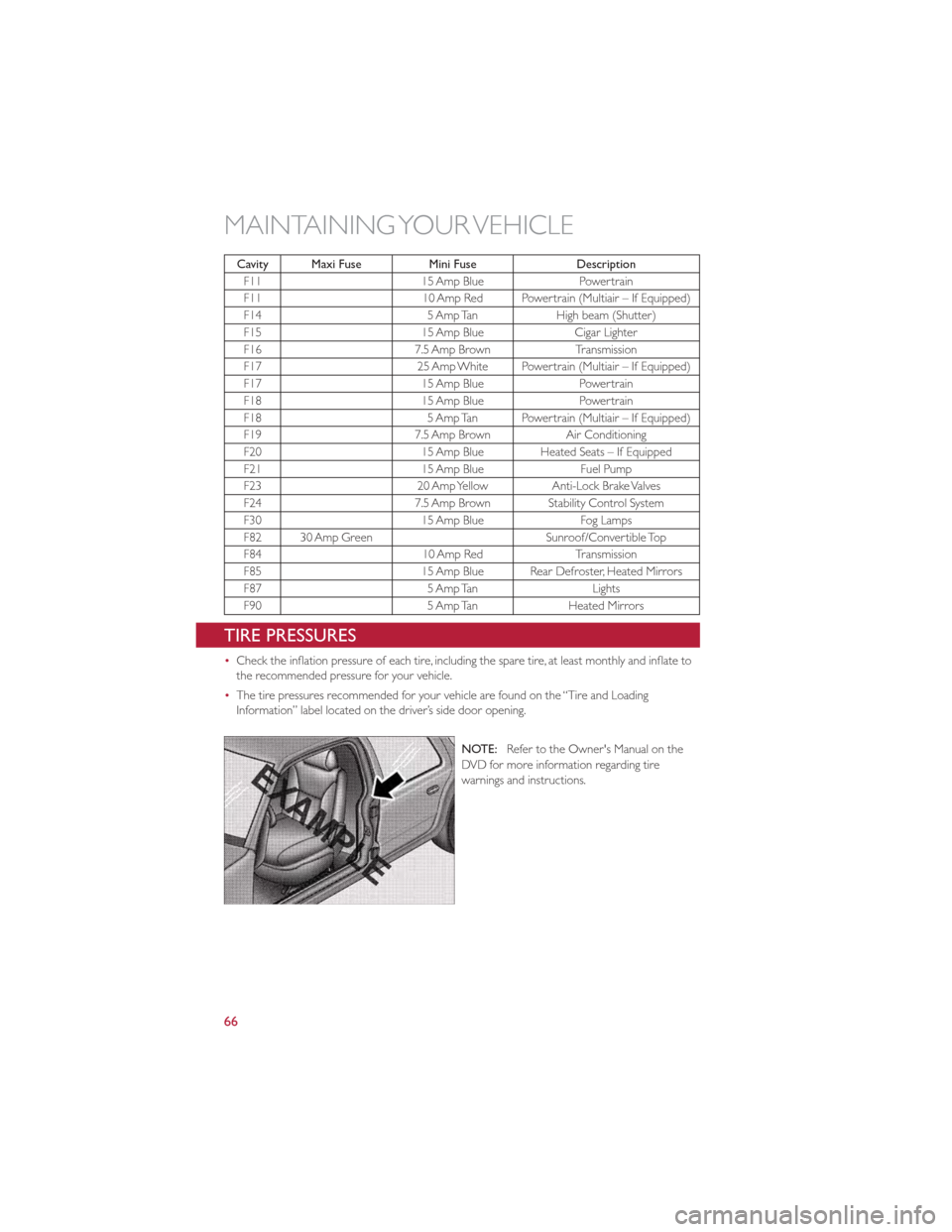
Cavity Maxi FuseMini FuseDescription
F11 15 Amp BluePowertrain
F11 10 Amp Red Powertrain (Multiair – If Equipped)
F14 5 Amp TanHigh beam (Shutter)
F15 15 Amp BlueCigar Lighter
F16 7.5 Amp BrownTransmission
F17 25 Amp White Powertrain (Multiair – If Equipped)
F17 15 Amp BluePowertrain
F18 15 Amp BluePowertrain
F18 5 Amp Tan Powertrain (Multiair – If Equipped)
F19 7.5 Amp BrownAir Conditioning
F20 15 Amp Blue Heated Seats – If Equipped
F21 15 Amp BlueFuel Pump
F23 20 Amp YellowAnti-Lock Brake Valves
F24 7.5 Amp Brown Stability Control System
F30 15 Amp BlueFog Lamps
F82 30 Amp Green Sunroof/Convertible Top
F84 10 Amp RedTransmission
F85 15 Amp Blue Rear Defroster, Heated Mirrors
F87 5 Amp TanLights
F90 5 Amp TanHeated Mirrors
TIRE PRESSURES
•Check the inflation pressure of each tire, including the spare tire, at least monthly and inflate to
the recommended pressure for your vehicle.
• The tire pressures recommended for your vehicle are found on the “Tire and Loading
Information” label located on the driver’s side door opening.
NOTE:Refer to the Owner's Manual on the
DVD for more information regarding tire
warnings and instructions.
MAINTAINING YOUR VEHICLE
66
Page 69 of 80
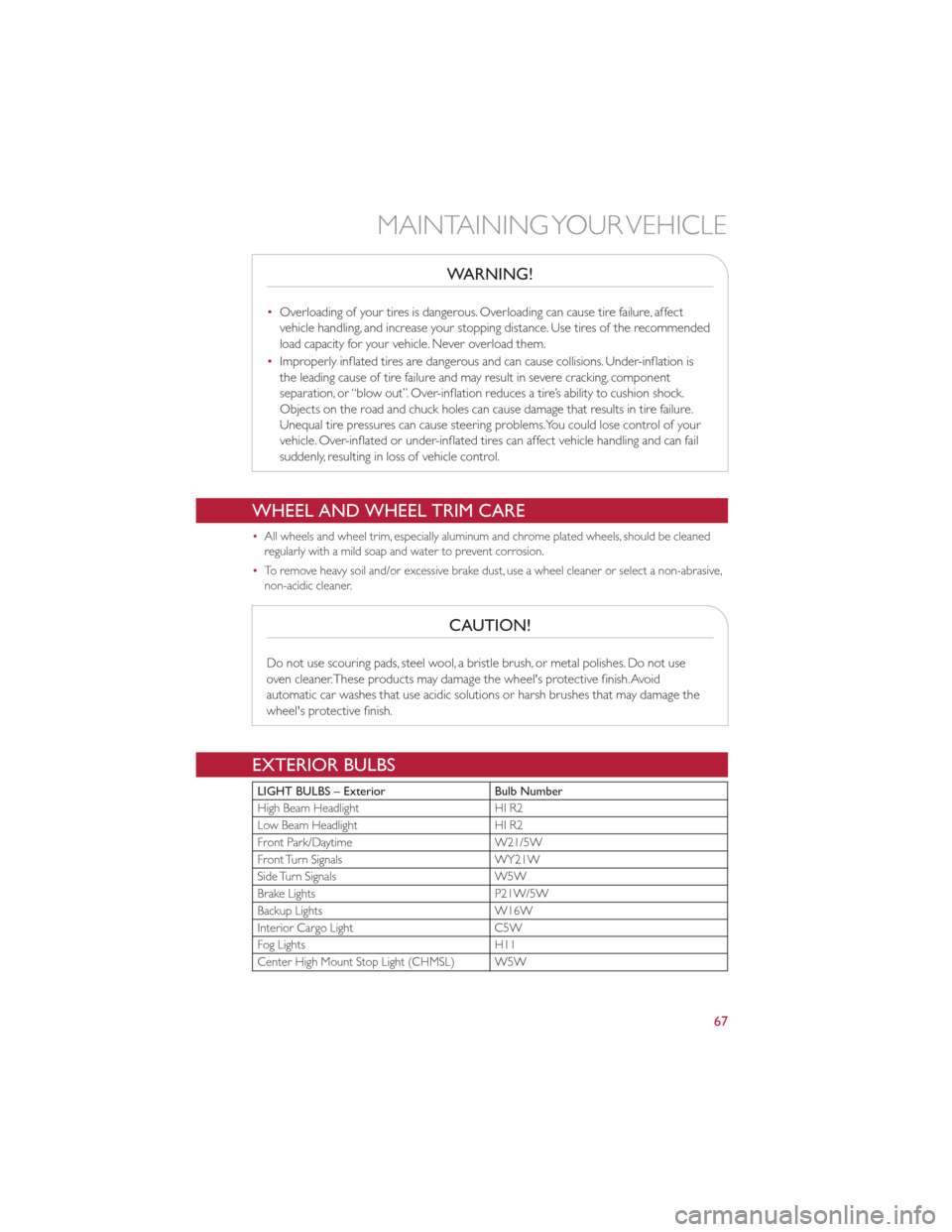
WARNING!
•Overloading of your tires is dangerous. Overloading can cause tire failure, affect
vehicle handling, and increase your stopping distance. Use tires of the recommended
load capacity for your vehicle. Never overload them.
• Improperly inflated tires are dangerous and can cause collisions. Under-inflation is
the leading cause of tire failure and may result in severe cracking, component
separation, or “blow out”. Over-inflation reduces a tire’s ability to cushion shock.
Objects on the road and chuck holes can cause damage that results in tire failure.
Unequal tire pressures can cause steering problems.You could lose control of your
vehicle. Over-inflated or under-inflated tires can affect vehicle handling and can fail
suddenly, resulting in loss of vehicle control.
WHEEL AND WHEEL TRIM CARE
•All wheels and wheel trim, especially aluminum and chrome plated wheels, should be cleaned
regularly with a mild soap and water to prevent corrosion.
• To remove heavy soil and/or excessive brake dust, use a wheel cleaner or select a non-abrasive,
non-acidic cleaner.
CAUTION!
Do not use scouring pads, steel wool, a bristle brush, or metal polishes. Do not use
oven cleaner.These products may damage the wheel's protective finish.Avoid
automatic car washes that use acidic solutions or harsh brushes that may damage the
wheel's protective finish.
EXTERIOR BULBS
LIGHT BULBS – Exterior Bulb Number
High Beam Headlight HI R2
Low Beam Headlight HI R2
Front Park/Daytime W21/5W
Front Turn Signals WY21W
Side Turn Signals W5W
Brake Lights P21W/5W
Backup Lights W16W
Interior Cargo Light C5W
Fog Lights H11
Center High Mount Stop Light (CHMSL) W5W
MAINTAINING YOUR VEHICLE
67
Page 72 of 80
AUTHENTIC ACCESSORIES BY MOPAR®
•The following highlights just some of the many Authentic FIAT Accessories by Mopar featuring a
fit, finish, and functionality specifically for your FIAT 500.
• In choosing Authentic Accessories you gain far more than expressive style, premium protection,
or extreme entertainment, you also benefit from enhancing your vehicle with accessories that
have been thoroughly tested and factory-approved.
• For the full line of Authentic FIAT Accessories by Mopar, visit your local FIAT dealership or
online at mopar.com.
EXTERIOR:
• Chrome Hood Spear •Chrome Exhaust Tip •Front End Cover
• Chrome Mirror Cover •Side Window Air Deflectors •Molded Splash Guards
• Chrome Lower Grill and
Fog Light Surrounds •
Body Side Molding •Vehicle Cover
• Chrome Fuel Door •Wheel Pocket Inserts •Locking Fuel Cap
INTERIOR:
• Door Sill Guards •Interior Appliques •Premium Carpet Floor Mats
• Chrome Shift Knob •Key Covers •Slush Mats
• Instrument Panel Graphics •Roadside Safety Kit •Cargo Organizer
ELECTRONICS:
• GPS Tracking System(s) •Remote Start •Sound System Upgrades
• Portable Navigation Systems •Wi-Fi •Interior/Ambient Lighting
• Rear Park Distance Sensors •iPod Connection Kit
CARRIERS:
• Roof Rack •Bike Carrier •Canoe Carrier
• Snowboard/Ski Carrier •Luggage Carrier •Hitch-mount Bike Carrier
MOPAR ACCESSORIES
70