lock FIAT 500 GUCCI 2012 2.G Owner's Manual
[x] Cancel search | Manufacturer: FIAT, Model Year: 2012, Model line: 500 GUCCI, Model: FIAT 500 GUCCI 2012 2.GPages: 80, PDF Size: 1.87 MB
Page 43 of 80
•Please note that the TPMS is not a substitute for proper tire maintenance, and it is the driver’s
responsibility to maintain correct tire pressure, even if under-inflation has not reached the level
to trigger illumination of the TPMS low tire pressure telltale.
• Your vehicle has also been equipped with a TPMS malfunction indicator to indicate when the
system is not operating properly.The TPMS malfunction indicator is combined with the low tire
pressure telltale.When the system detects a malfunction, the telltale will flash for approximately
one minute and then remain continuously illuminated.This sequence will continue each time the
vehicle is restarted as long as the malfunction exists.
• When the malfunction indicator is illuminated, the system may not be able to detect or signal
low tire pressure as intended.TPMS malfunctions may occur for a variety of reasons, including
the installation of replacement or alternate tires or wheels on the vehicle that prevent the TPMS
from functioning properly.Always check the TPMS malfunction telltale after replacing one or
more tires or wheels on your vehicle, to ensure that the replacement or alternate tires and
wheels allow the TPMS to continue to function properly.
NOTE: Tire pressures change by approximately 1 psi (7 kPa) per 12° F (7° C) of air temperature
change. Keep this in mind when checking tire pressure inside a garage, especially in the Winter.
Example: If garage temperature is 68°F (20°C) and the outside temperature is 32°F (0°C), then
the cold tire inflation pressure should be increased by 3 psi (21 kPa), which equals 1 psi (7 kPa) for
every 12°F (7°C) for this outside temperature condition.
CAUTION!
The TPMS has been optimized for the original equipment tires and wheels.TPMS
pressures and warning have been established for the tire size equipped on your vehicle.
Undesirable system operation or sensor damage may result when using replacement
equipment that is not of the same size, type, and/or style.Aftermarket wheels can cause
sensor damage. Do not use tire sealant from a can, or balance beads if your vehicle is
equipped with a TPMS, as damage to the sensors may result.
BRAKE- Brake Warning Light
• The Brake Warning light illuminates when there is either a system malfunction or the parking
brake is applied. If the light is on and the parking brake is not applied, it indicates a possible brake
hydraulic malfunction, brake booster problem or an Anti-Lock Brake System problem.
• Please have your vehicle serviced immediately.
WARNING!
Driving a vehicle with the red brake light on is dangerous. Part of the brake system may
have failed. It will take longer to stop the vehicle.You could have a collision. Have the
vehicle checked immediately.
WHAT TO DO IN EMERGENCIES
41
Page 44 of 80
- Malfunction Indicator Light (MIL)
•Certain conditions, such as a loose or missing gas cap, poor fuel quality, etc., may illuminate the
MIL after engine start.The vehicle should be serviced if the light stays on through several typical
driving cycles. In most situations, the vehicle will drive normally and not require towing.
• If the MIL flashes when the engine is running, serious conditions may exist that could lead to
immediate loss of power or severe catalytic converter damage.We recommend you do not
operate the vehicle. Have the vehicle serviced immediately.
- Charging System Light
•This light shows the status of the electrical charging system. If the charging system light remains
on, it means that the vehicle is experiencing a problem with the charging system.
• We recommend you do not continue driving if the charging system light is on. Have the vehicle
serviced immediately.
- Oil Pressure Warning Light
•This light indicates low engine oil pressure. If the light turns on while driving, stop the vehicle and
shut off the engine as soon as possible.A chime will sound for four minutes when this light turns
on.
• We recommend you do not operate the vehicle or engine damage will occur. Have the vehicle
serviced immediately.
- Anti-Lock Brake (ABS) Light
•This light monitors the Anti-Lock Brake System (ABS).
• If the light is not on during starting, stays on, or turns on while driving, we recommend you drive
to the nearest service center and have the vehicle serviced immediately.
- Air Bag Warning Light
•If the light is not on during starting, stays on, or turns on while driving, have the vehicle serviced
by an authorized service center immediately.
IF YOUR ENGINE OVERHEATS
•In any of the following situations, you can reduce the potential for overheating by taking the
appropriate action.
•On the highways — slow down.
• In city traffic — while stopped, shift transmission into NEUTRAL, but do not increase engine
idle speed.
NOTE: There are steps that you can take to slow down an impending overheat condition:
• If your air conditioner (A/C) is on, turn it off.The A/C system adds heat to the engine cooling
system and turning the A/C off can help remove this heat.
• You can also turn the Temperature control to maximum heat, the Mode control to floor and the
Fan control to high.This allows the heater core to act as a supplement to the radiator and aids in
removing heat from the engine cooling system.
• If the temperature reading does not return to normal, turn the engine off immediately.
WHAT TO DO IN EMERGENCIES
42
Page 46 of 80
Spare Tire Removal
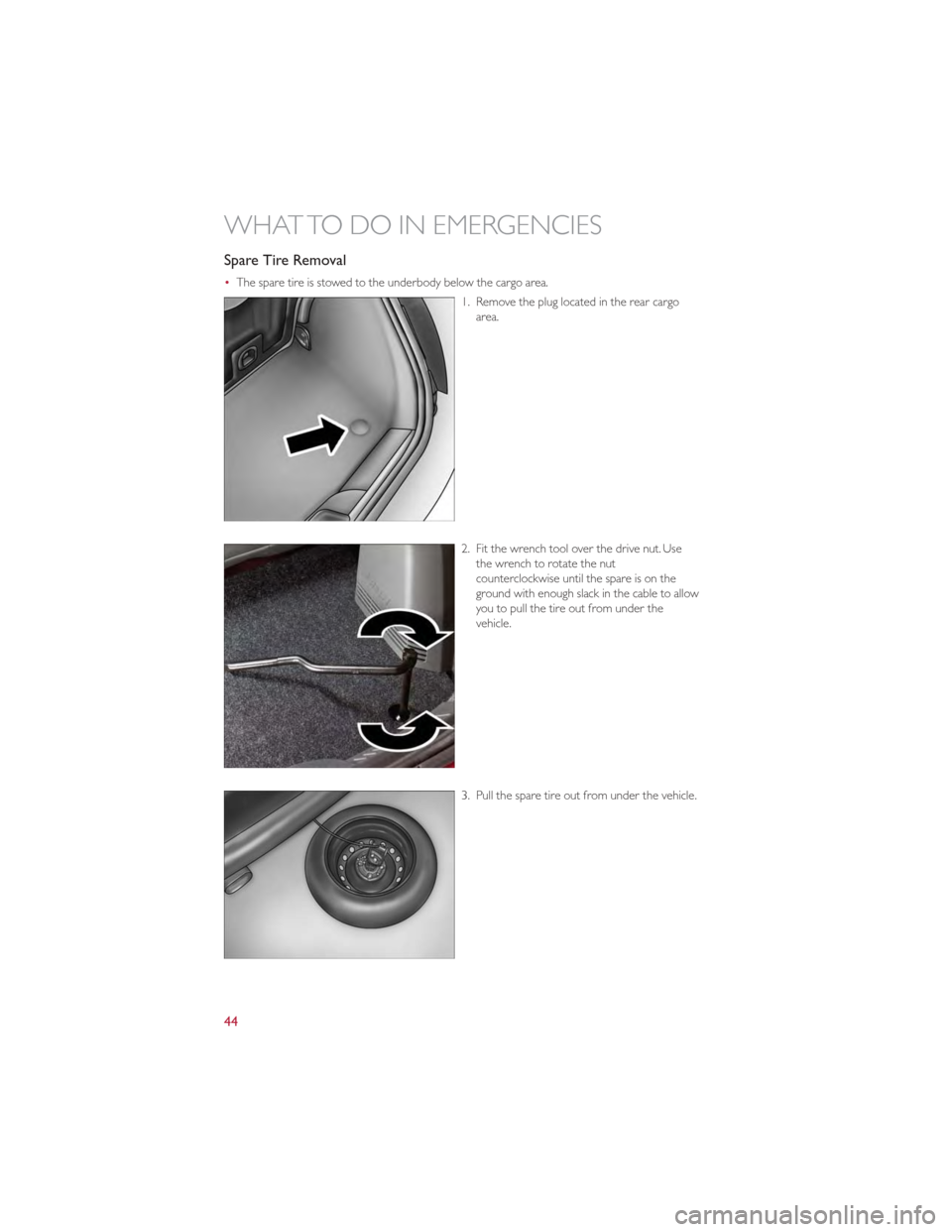
•The spare tire is stowed to the underbody below the cargo area.
1. Remove the plug located in the rear cargoarea.
2. Fit the wrench tool over the drive nut. Use the wrench to rotate the nut
counterclockwise until the spare is on the
ground with enough slack in the cable to allow
you to pull the tire out from under the
vehicle.
3. Pull the spare tire out from under the vehicle.
WHAT TO DO IN EMERGENCIES
44
Page 47 of 80
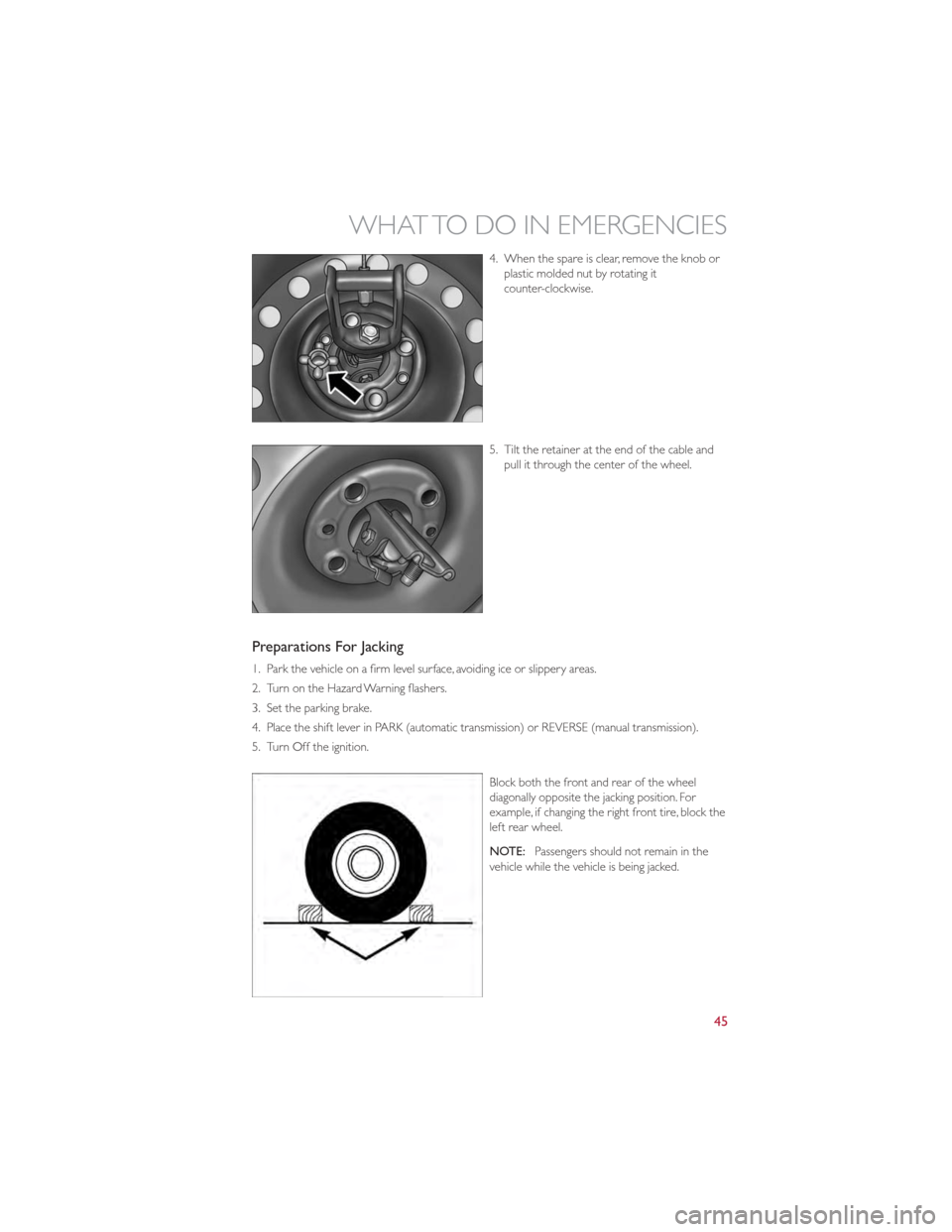
4. When the spare is clear, remove the knob orplastic molded nut by rotating it
counter-clockwise.
5. Tilt the retainer at the end of the cable and pull it through the center of the wheel.
Preparations For Jacking
1. Park the vehicle on a firm level surface, avoiding ice or slippery areas.
2. Turn on the Hazard Warning flashers.
3. Set the parking brake.
4. Place the shift lever in PARK (automatic transmission) or REVERSE (manual transmission).
5. Turn Off the ignition.
Block both the front and rear of the wheel
diagonally opposite the jacking position. For
example, if changing the right front tire, block the
left rear wheel.
NOTE:Passengers should not remain in the
vehicle while the vehicle is being jacked.
WHAT TO DO IN EMERGENCIES
45
Page 49 of 80
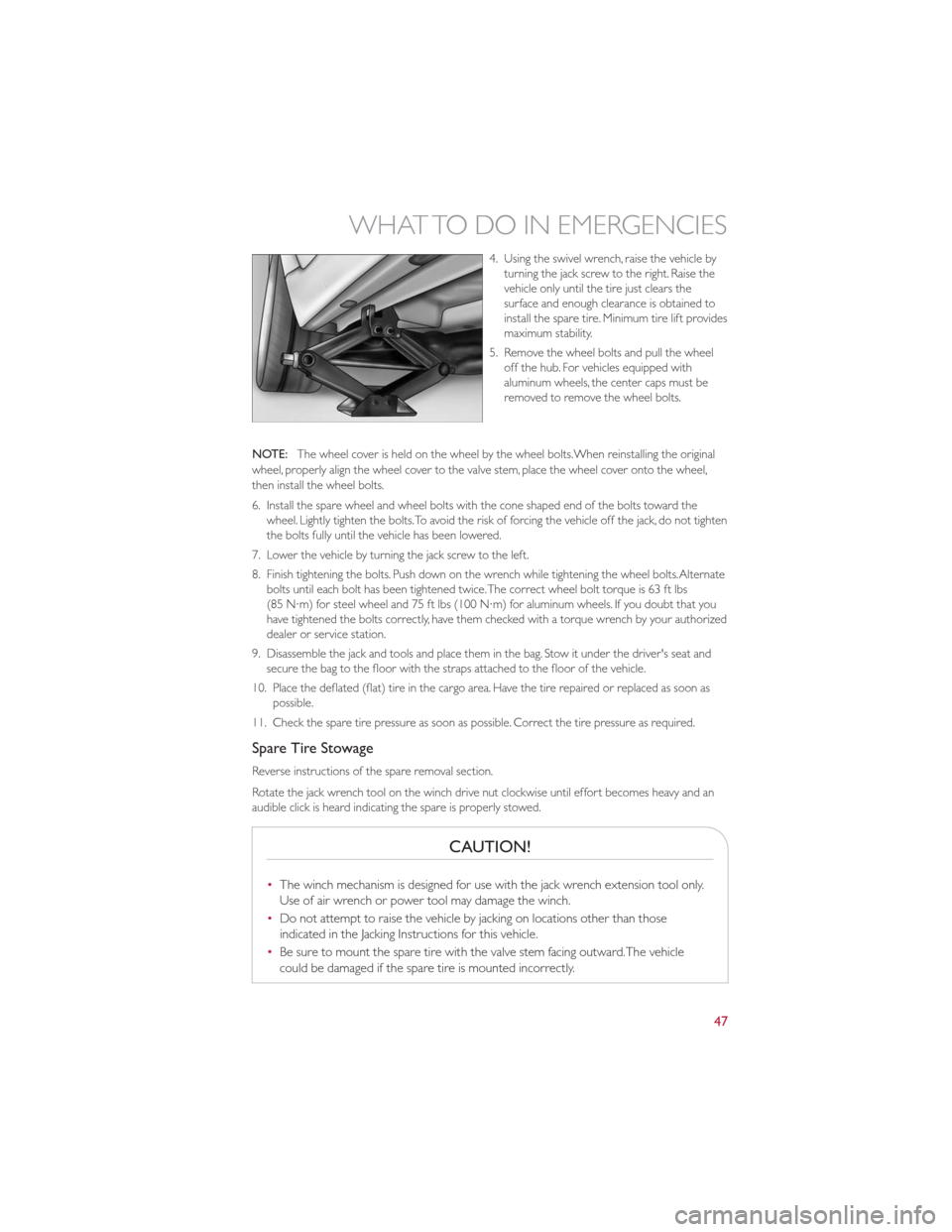
4. Using the swivel wrench, raise the vehicle byturning the jack screw to the right. Raise the
vehicle only until the tire just clears the
surface and enough clearance is obtained to
install the spare tire. Minimum tire lift provides
maximum stability.
5. Remove the wheel bolts and pull the wheel off the hub. For vehicles equipped with
aluminum wheels, the center caps must be
removed to remove the wheel bolts.
NOTE: The wheel cover is held on the wheel by the wheel bolts.When reinstalling the original
wheel, properly align the wheel cover to the valve stem, place the wheel cover onto the wheel,
then install the wheel bolts.
6. Install the spare wheel and wheel bolts with the cone shaped end of the bolts toward the wheel. Lightly tighten the bolts.To avoid the risk of forcing the vehicle off the jack, do not tighten
the bolts fully until the vehicle has been lowered.
7. Lower the vehicle by turning the jack screw to the left.
8. Finish tightening the bolts. Push down on the wrench while tightening the wheel bolts.Alternate bolts until each bolt has been tightened twice.The correct wheel bolt torque is 63 ft lbs
(85 N·m) for steel wheel and 75 ft lbs (100 N·m) for aluminum wheels. If you doubt that you
have tightened the bolts correctly, have them checked with a torque wrench by your authorized
dealer or service station.
9. Disassemble the jack and tools and place them in the bag. Stow it under the driver's seat and secure the bag to the floor with the straps attached to the floor of the vehicle.
10. Place the deflated (flat) tire in the cargo area. Have the tire repaired or replaced as soon as possible.
11. Check the spare tire pressure as soon as possible. Correct the tire pressure as required.
Spare Tire Stowage
Reverse instructions of the spare removal section.
Rotate the jack wrench tool on the winch drive nut clockwise until effort becomes heavy and an
audible click is heard indicating the spare is properly stowed.
CAUTION!
• The winch mechanism is designed for use with the jack wrench extension tool only.
Use of air wrench or power tool may damage the winch.
• Do not attempt to raise the vehicle by jacking on locations other than those
indicated in the Jacking Instructions for this vehicle.
• Be sure to mount the spare tire with the valve stem facing outward.The vehicle
could be damaged if the spare tire is mounted incorrectly.
WHAT TO DO IN EMERGENCIES
47
Page 50 of 80
WARNING!
•Do not attempt to change a tire on the side of the vehicle close to moving traffic.
Pull far enough off the road to avoid the danger of being hit when operating the jack
or changing the wheel.
• Being under a jacked-up vehicle is dangerous.The vehicle could slip off the jack and
fall on you.You could be crushed. Never put any part of your body under a vehicle
that is on a jack.
• Never start or run the engine while the vehicle is on a jack. If you need to get under
a raised vehicle, take it to a service center where it can be raised on a lift.
• The jack is designed to be used as a tool for changing tires only.The jack should not
be used to lift the vehicle for service purposes.The vehicle should be jacked on a
firm level surface only.Avoid ice or slippery areas.
• Carefully follow these tire changing warnings to help prevent personal injury or
damage to your vehicle:
• Always park on a firm, level surface as far from the edge of the roadway as possible
before raising the vehicle.
• Turn on the Hazard Warning flashers.
• Block the wheel diagonally opposite the wheel to be raised.
• Set the parking brake firmly and set an automatic transmission in PARK; a manual
transmission in REVERSE.
• Never start or run the engine with the vehicle on a jack.
• Do not let anyone sit in the vehicle when it is on a jack.
• Do not get under the vehicle when it is on a jack.
• Only use the jack in the positions indicated and for lifting this vehicle during a tire
change.
• If working on or near a roadway, be extremely careful of motor traffic.
• To assure that spare tires, flat or inflated, are securely stowed, spares must be stowed
with the valve stem facing the ground.
• Raising the vehicle higher than necessary can make the vehicle less stable. It could slip
off the jack and hurt someone near it. Raise the vehicle only enough to remove the
tire.
• To avoid the risk of forcing the vehicle off the jack, do not fully tighten the wheel
bolts until the vehicle has been lowered. Failure to follow this warning may result in
personal injury.
• To avoid possible personal injury, handle the wheel covers with care to avoid contact
with any sharp edges.
• A loose tire or jack thrown forward in a collision or hard stop could endanger the
occupants of the vehicle.Always stow the jack parts and the spare tire in the places
provided.
WHAT TO DO IN EMERGENCIES
48
Page 54 of 80
4. Check the pressure in the tire by reading the Pressure Gauge (3).
If tire pressure is less than 19 psi (1.3 Bar), the tire is too badly damaged. Do not attempt to
drive the vehicle further. Call for assistance.
If the tire pressure is 19 psi (1.3 bar) or higher:
1. Press the Power Button (4) to turn on TIREFIT and inflate the tire to the pressure indicated on the tire and loading information label on the driver-side door opening.
NOTE: If the tire becomes over-inflated, press the Deflation Button to reduce the tire pressure
to the recommended inflation pressure before continuing.
2. Disconnect the TIREFIT kit from the valve stem, reinstall the cap on the valve stem and unplug from 12 Volt outlet.
3. Place the TIREFIT kit in its proper storage area in the vehicle.
4. Have the tire inspected and repaired or replaced at the earliest opportunity at an authorized dealer or tire service center.
5. Replace the Sealant Bottle (1) and Sealant Hose (6) assembly at your authorized dealer as soon as possible. Refer to “(F) Sealant Bottle and Hose Replacement.”
NOTE: When having the tire serviced, advise the authorized dealer or service center that the
tire has been sealed using the TIREFIT service kit.
(F) Sealant Bottle And Hose Replacement:
1. Uncoil the Sealant Hose (6) (clear in color).
2. Locate the round Sealant Bottle release button in the recessed area under the sealant bottle.
3. Press the Sealant Bottle release button.The Sealant Bottle (1) will pop up. Remove the bottle and dispose of it accordingly.
4. Clean any remaining sealant from the TIREFIT housing.
5. Position the new Sealant Bottle (1) in the housing so that the Sealant Hose (6) aligns with the hose slot in the front of the housing. Press the bottle into the housing.An audible click will be
heard indicating the bottle is locked into place.
6. Verify that the cap is installed on the fitting at the end of the Sealant Hose (6) and return the hose to its storage area (located on the bottom of the air pump).
7. Return the TIREFIT kit to its storage location in the vehicle.
CAUTION!
• The metal end fitting from Power Plug (8) may get hot after use, so it should be
handled carefully.
• Failure to reinstall the cap on the fitting at the end of the Sealant Hose (6) can result
in sealant contacting your skin, clothing, and the vehicle’s interior. It can also result in
sealant contacting internal TIREFIT kit components which may cause permanent
damage to the kit.
WHAT TO DO IN EMERGENCIES
52
Page 56 of 80
Preparations For Jump-Start
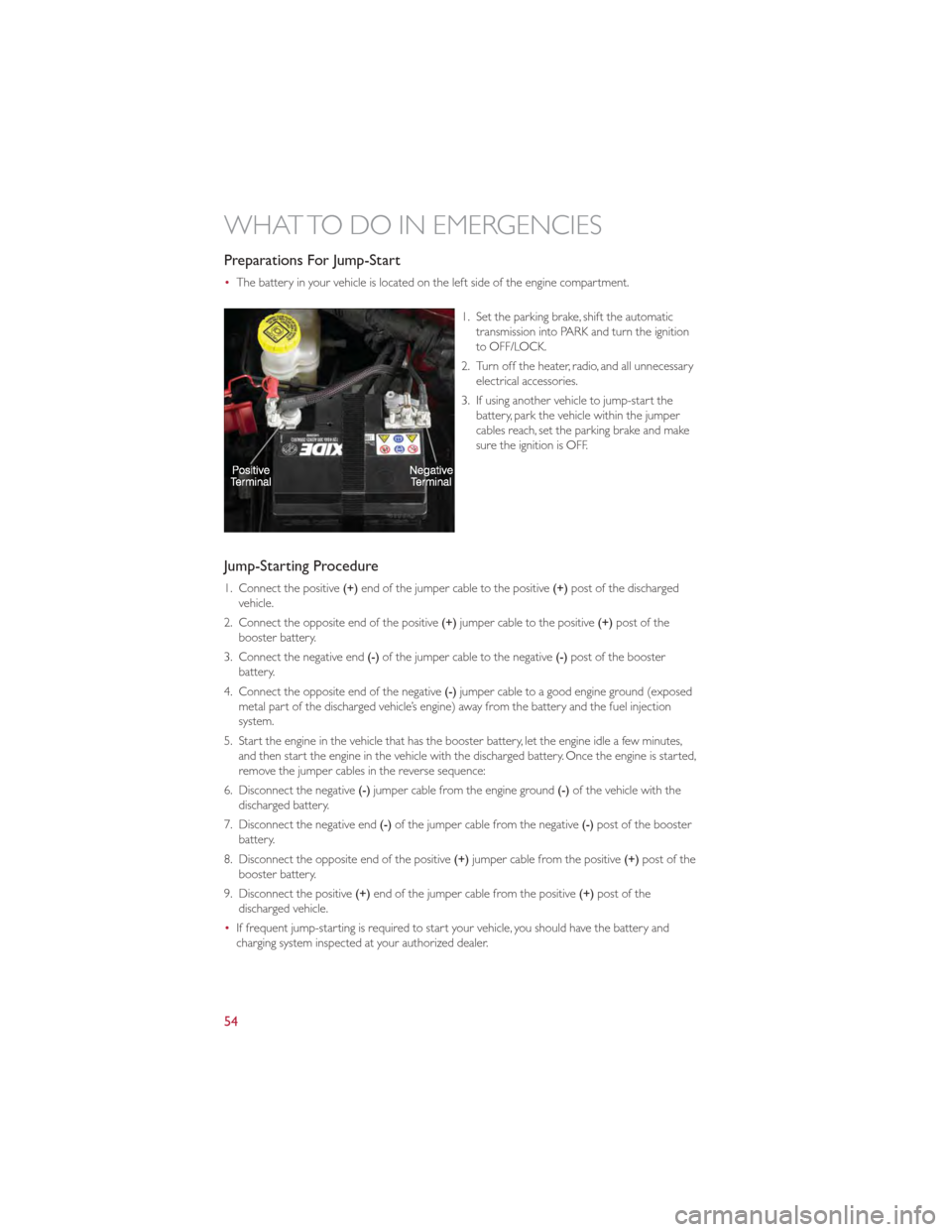
•The battery in your vehicle is located on the left side of the engine compartment.
1. Set the parking brake, shift the automatictransmission into PARK and turn the ignition
to OFF/LOCK.
2. Turn off the heater, radio, and all unnecessary electrical accessories.
3. If using another vehicle to jump-start the battery, park the vehicle within the jumper
cables reach, set the parking brake and make
sure the ignition is OFF.
Jump-Starting Procedure
1. Connect the positive (+)end of the jumper cable to the positive (+)post of the discharged
vehicle.
2. Connect the opposite end of the positive (+)jumper cable to the positive (+)postofthe
booster battery.
3. Connect the negative end (-)of the jumper cable to the negative (-)post of the booster
battery.
4. Connect the opposite end of the negative (-)jumper cable to a good engine ground (exposed
metal part of the discharged vehicle’s engine) away from the battery and the fuel injection
system.
5. Start the engine in the vehicle that has the booster battery, let the engine idle a few minutes, and then start the engine in the vehicle with the discharged battery. Once the engine is started,
remove the jumper cables in the reverse sequence:
6. Disconnect the negative (-)jumper cable from the engine ground (-)of the vehicle with the
discharged battery.
7. Disconnect the negative end (-)of the jumper cable from the negative (-)post of the booster
battery.
8. Disconnect the opposite end of the positive (+)jumper cable from the positive (+)postofthe
booster battery.
9. Disconnect the positive (+)end of the jumper cable from the positive (+)post of the
discharged vehicle.
• If frequent jump-starting is required to start your vehicle, you should have the battery and
charging system inspected at your authorized dealer.
WHAT TO DO IN EMERGENCIES
54
Page 58 of 80
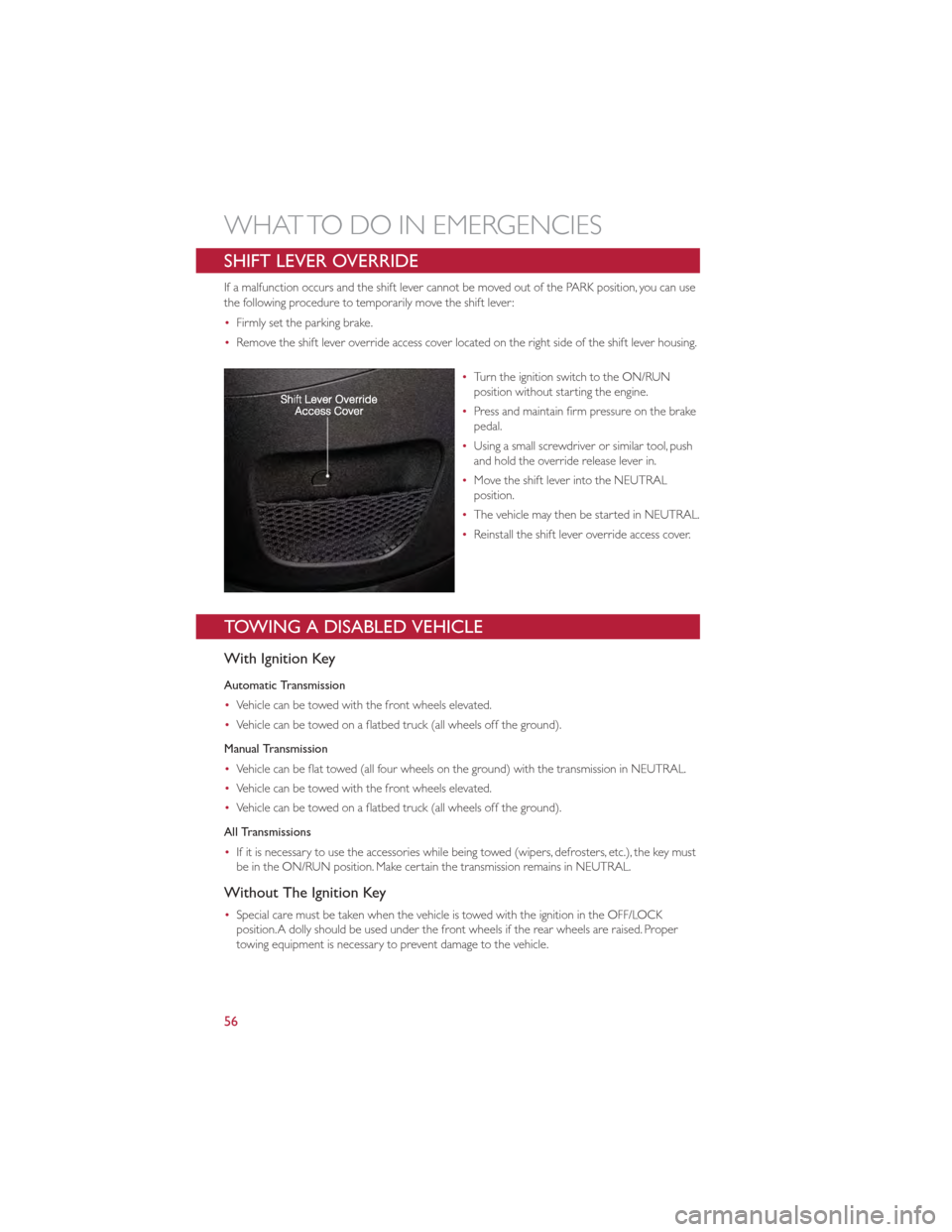
SHIFT LEVER OVERRIDE
If a malfunction occurs and the shift lever cannot be moved out of the PARK position, you can use
the following procedure to temporarily move the shift lever:
•Firmly set the parking brake.
• Remove the shift lever override access cover located on the right side of the shift lever housing.
•Turn the ignition switch to the ON/RUN
position without starting the engine.
• Press and maintain firm pressure on the brake
pedal.
• Using a small screwdriver or similar tool, push
and hold the override release lever in.
• Move the shift lever into the NEUTRAL
position.
• The vehicle may then be started in NEUTRAL.
• Reinstall the shift lever override access cover.
TOWING A DISABLED VEHICLE
With Ignition Key
Automatic Transmission
•Vehicle can be towed with the front wheels elevated.
• Vehicle can be towed on a flatbed truck (all wheels off the ground).
Manual Transmission
• Vehicle can be flat towed (all four wheels on the ground) with the transmission in NEUTRAL.
• Vehicle can be towed with the front wheels elevated.
• Vehicle can be towed on a flatbed truck (all wheels off the ground).
All Transmissions
• If it is necessary to use the accessories while being towed (wipers, defrosters, etc.), the key must
be in the ON/RUN position. Make certain the transmission remains in NEUTRAL.
Without The Ignition Key
•Special care must be taken when the vehicle is towed with the ignition in the OFF/LOCK
position.A dolly should be used under the front wheels if the rear wheels are raised. Proper
towing equipment is necessary to prevent damage to the vehicle.
WHAT TO DO IN EMERGENCIES
56
Page 59 of 80
•Battery power is required to release the brake/transmission interlock system (automatic
transmission only).There is a removable plug in the right side of the shift lever housing that
allows you to insert your finger to override the system.The ignition key must be in the
ON/RUN position to use the override lever.
CAUTION!
•Failure to follow these towing methods can cause severe transmission damage. Such
damage is not covered by the New Vehicle Limited Warranty.
• DO NOT flat tow any vehicle equipped with an automatic transmission. Damage to
the drivetrain will result.
• If the vehicle being towed requires steering, the ignition switch must be in the
ON/RUN position.
• Do not attempt to use sling-type equipment when towing.When securing the
vehicle to a flatbed truck, do not attach to front or rear suspension components.
Damage to your vehicle may result from improper towing.
ENHANCED ACCIDENT RESPONSE SYSTEM
•In the event of an impact causing airbag deployment, if the communication network remains
intact, and the power remains intact, depending on the nature of the event the ORC will
determine whether to have the Enhanced Accident Response System perform the following
functions:
•Cut off fuel to the engine.
• Flash hazard lights as long as the battery has power or until the ignition key is turned off.
• Turn on the interior lights, which remain on as long as the battery has power or until the
ignition key is removed.
• Unlock the doors automatically.
• After the event occurs, when the system is active, the message "Fuel Cutoff See Handbook" is
displayed.
• Carefully check the vehicle for fuel leaks in the engine compartment and on the ground near
the engine compartment and fuel tank before resetting the system and starting the engine.
NOTE: In order to start the engine and move the vehicle to a safe location after an impact, the
System Reset Procedure must be completed.
WHAT TO DO IN EMERGENCIES
57