cooling FIAT 500C 2013 2.G User Guide
[x] Cancel search | Manufacturer: FIAT, Model Year: 2013, Model line: 500C, Model: FIAT 500C 2013 2.GPages: 423, PDF Size: 9.86 MB
Page 359 of 423
Refer to the “Maintenance Schedule” for the proper
maintenance intervals.
Selection Of Coolant
Refer to “Fluids, Lubricants, and Genuine Parts” in
“Maintaining Your Vehicle” for further information.
CAUTION!
•Mixing of engine coolant (antifreeze) other than
specified Organic Additive Technology (OAT) en-
gine coolant (antifreeze), may result in engine
damage and may decrease corrosion protection.
Organic Additive Technology (OAT) engine cool-
ant is different and should not be mixed with
Hybrid Organic Additive Technology (HOAT) en-
gine coolant (antifreeze) or any “globally compat-
ible” coolant (antifreeze). If a non-OAT engine
coolant (antifreeze) is introduced into the cooling
system in an emergency, it should be flushed with
OAT coolant and replaced with the specified OAT
engine coolant (antifreeze) as soon as possible.
(Continued)
7
MAINTAINING YOUR VEHICLE 357
Page 361 of 423
•Use only high purity water such as distilled or deion-
ized water when mixing the water/engine coolant
(antifreeze) solution. The use of lower quality water
will reduce the amount of corrosion protection in the
engine cooling system.
Please note that it is the owner’s responsibility to main-
tain the proper level of protection against freezing ac-
cording to the temperatures occurring in the area where
the vehicle is operated.
NOTE:Mixing engine coolant (antifreeze) types is not
recommended and can result in cooling system damage.
Drain, flush, and refill as soon as possible to avoid
damage if coolant types are mixed in an emergency.
Cooling System Pressure Cap
The cap must be fully tightened to prevent loss of engine
coolant (antifreeze) and to ensure that engine coolant
(antifreeze) will return to the radiator from the coolant
recovery tank.
The cap should be inspected and cleaned if there is any
accumulation of foreign material on the sealing surfaces.
WARNING!
•The warning words “DO NOT OPEN HOT” on the
cooling system pressure cap are a safety precaution.
Never add engine coolant (antifreeze) when the
engine is overheated. Do not loosen or remove the
cap to cool an overheated engine. Heat causes pres-
sure to build up in the cooling system. To prevent
scalding or injury, do not remove the pressure cap
while the system is hot or under pressure.
(Continued)
7
MAINTAINING YOUR VEHICLE 359
Page 363 of 423
Points To Remember
NOTE:When the vehicle is stopped after a few miles/
kilometers of operation, you may observe vapor coming
from the front of the engine compartment. This is nor-
mally a result of moisture from rain, snow, or high
humidity accumulating on the radiator and being vapor-
ized when the thermostat opens, allowing hot engine
coolant (antifreeze) to enter the radiator.
If an examination of your engine compartment shows no
evidence of radiator or hose leaks, the vehicle may be
safely driven. The vapor will soon dissipate.
•Do not overfill the coolant expansion bottle.
•Check the coolant freeze point in the radiator and in the
coolant expansion bottle. If engine coolant (antifreeze)
needs to be added, the contents of the coolant expansion
bottle must also be protected against freezing.
•If frequent engine coolant (antifreeze) additions are
required, the cooling system should be pressure tested
for leaks.
•Maintain engine coolant (antifreeze) concentration at a
minimum of 50% OAT coolant (conforming to MS-12106)
and distilled water for proper corrosion protection of
your engine which contains aluminum components.
•Make sure that the coolant expansion bottle overflow
hoses are not kinked or obstructed.
•Keep the front of the radiator clean. If your vehicle is
equipped with air conditioning, keep the front of the
condenser clean.
•Do not change the thermostat for Summer or Winter
operation. If replacement is ever necessary, install ONLY
the correct type thermostat. Other designs may result in
unsatisfactory engine coolant (antifreeze) performance,
poor gas mileage, and increased emissions.
7
MAINTAINING YOUR VEHICLE 361
Page 387 of 423
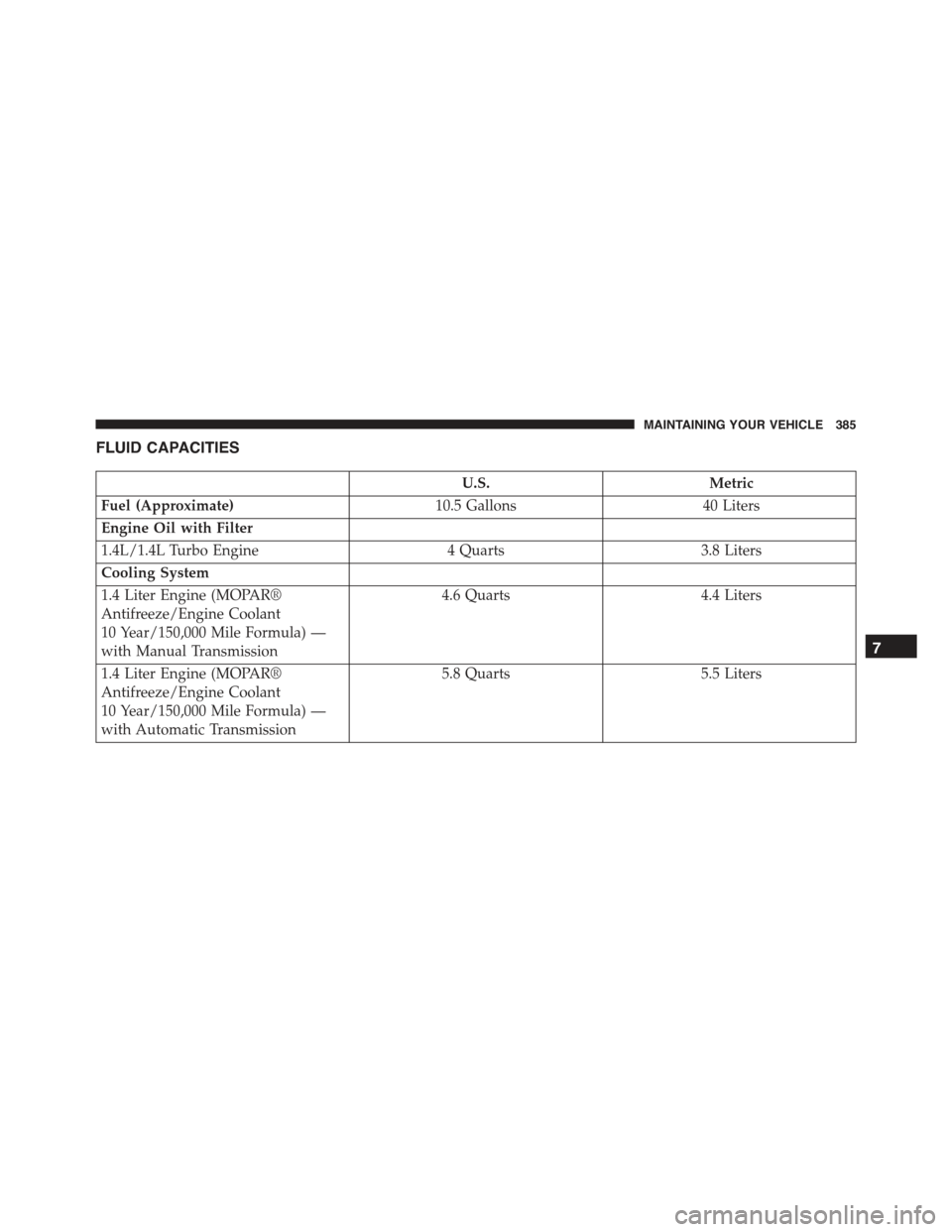
FLUID CAPACITIES
U.S.Metric
Fuel (Approximate)10.5 Gallons40 Liters
Engine Oil with Filter
1.4L/1.4L Turbo Engine4 Quarts3.8 Liters
Cooling System
1.4 Liter Engine (MOPAR®
Antifreeze/Engine Coolant
10 Year/150,000 Mile Formula) —
with Manual Transmission
4.6 Quarts4.4 Liters
1.4 Liter Engine (MOPAR®
Antifreeze/Engine Coolant
10 Year/150,000 Mile Formula) —
with Automatic Transmission
5.8 Quarts5.5 Liters
7
MAINTAINING YOUR VEHICLE 385
Page 393 of 423
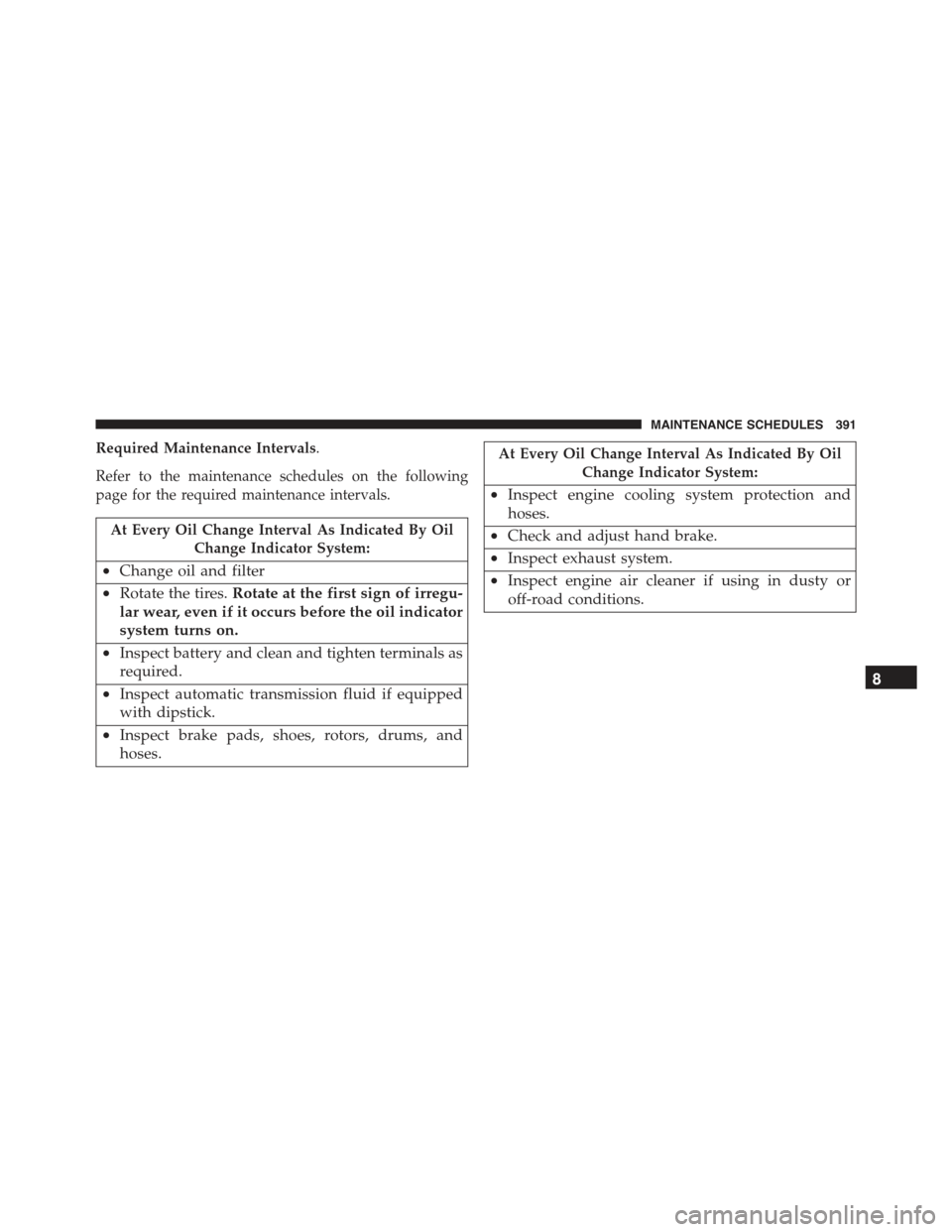
Required Maintenance Intervals.
Refer to the maintenance schedules on the following
page for the required maintenance intervals.
At Every Oil Change Interval As Indicated By Oil
Change Indicator System:
•Change oil and filter
•Rotate the tires.Rotate at the first sign of irregu-
lar wear, even if it occurs before the oil indicator
system turns on.
•Inspect battery and clean and tighten terminals as
required.
•Inspect automatic transmission fluid if equipped
with dipstick.
•Inspect brake pads, shoes, rotors, drums, and
hoses.
At Every Oil Change Interval As Indicated By Oil
Change Indicator System:
•Inspect engine cooling system protection and
hoses.
•Check and adjust hand brake.
•Inspect exhaust system.
•Inspect engine air cleaner if using in dusty or
off-road conditions.
8
MAINTENANCE SCHEDULES 391
Page 410 of 423
Cleaning
Wheels...............................369
Windshield Wiper Blades..................350
Climate Control..........................207
Clutch.................................362
Clutch Fluid.............................362
Compact Disc (CD) Maintenance..............206
Compact Spare Tire........................273
Connector
UCI . . . . . . . . . . . . . . . . . . . . . . . . . . . . . . . ..204
Universal Consumer Interface (UCI)..........204
Contract, Service..........................398
Convertible Top Maintenance.................373
Coolant (Antifreeze).......................385
Cooling System...........................356
Adding Coolant (Antifreeze)...............358
Coolant Level..........................356
Disposal of Used Coolant.................360
Drain, Flush, and Refill...................356
Inspection............................360
Points to Remember.....................359
Pressure Cap..........................359
Selection of Coolant (Antifreeze).............357
Corrosion Protection.......................367
Cruise Light.............................150
Cupholders.............................137
Customer Assistance.......................396
Data Recorder, Event.......................58
Daytime Running Lights....................114
Defroster, Windshield.......................81
Diagnostic System, Onboard.................337
Dipsticks
Automatic Transmission..................366
Disposal
Antifreeze (Engine Coolant)................360
Door Locks..............................23
Door Locks, Automatic......................26
408 INDEX
Page 411 of 423
Downshifting............................228
Driving
Through Flowing, Rising, or Shallow Standing
Water................................240
Electrical Power Outlets.....................134
Electric Remote Mirrors......................94
Electronic Brake Control System...............249
Brake Assist System.....................250
Electronic Speed Control (Cruise Control)........122
Electronic Stability Control (ESC)..............252
Electronic Vehicle Information Center (EVIC)......160
Emergency, In Case of
Hazard Warning Flasher..................297
Jacking...............................308
Jump Starting..........................320
Towing..............................327
Emission Control System Maintenance..........337
Engine
Air Cleaner...........................344
Break-In Recommendations.................78
Checking Oil Level......................340
Compartment..........................335
Cooling..............................356
Exhaust Gas Caution.....................80
Fails to Start...........................224
Flooded, Starting.......................224
Fuel Requirements......................285
Oil . . . . . . . . . . . . . . . . . . . . . . . . . . . . . . . . ..340
Oil Filler Cap..........................342
Oil Selection...........................342
Oil Synthetic..........................343
Overheating...........................297
Starting..............................223
Temperature Gauge......................157
Enhanced Accident Response Feature............53
Event Data Recorder........................58
10
INDEX 409