cooling FIAT 500C 2015 2.G User Guide
[x] Cancel search | Manufacturer: FIAT, Model Year: 2015, Model line: 500C, Model: FIAT 500C 2015 2.GPages: 438, PDF Size: 2.96 MB
Page 369 of 438
Refer to the “Maintenance Schedule” for the proper
maintenance intervals.
Selection Of Coolant
Refer to “Fluids, Lubricants, And Genuine Parts” in
“Maintaining Your Vehicle” for further information.
CAUTION!
•Mixing of engine coolant (antifreeze) other than
specified Organic Additive Technology (OAT) en-
gine coolant (antifreeze), may result in engine
damage and may decrease corrosion protection.
Organic Additive Technology (OAT) engine cool-
ant is different and should not be mixed with
Hybrid Organic Additive Technology (HOAT) en-
gine coolant (antifreeze) or any “globally compat-
ible” coolant (antifreeze). If a non-OAT engine
(Continued)
CAUTION! (Continued)
coolant (antifreeze) is introduced into the cooling
system in an emergency, the cooling system will
need to be drained, flushed, and refilled with fresh
OAT coolant (conforming to MS.90032), by an au-
thorized dealer as soon as possible.
• Do not use water alone or alcohol-based engine
coolant (antifreeze) products. Do not use additional
rust inhibitors or antirust products, as they may not
be compatible with the radiator engine coolant and
may plug the radiator.
• This vehicle has not been designed for use with
propylene glycol-based engine coolant (antifreeze).
Use of propylene glycol-based engine coolant (an-
tifreeze) is not recommended.
7
MAINTAINING YOUR VEHICLE 367
Page 370 of 438
Adding Coolant
Your vehicle has been built with an improved engine
coolant (OAT coolant conforming to MS.90032) that al-
lows extended maintenance intervals. This engine cool-
ant (antifreeze) can be used up to ten years or 150,000
miles (240,000 km) before replacement. To prevent reduc-
ing this extended maintenance period, it is important that
you use the same engine coolant (OAT coolant conform-
ing to MS.90032) throughout the life of your vehicle.
Please review these recommendations for using Organic
Additive Technology (OAT) engine coolant (antifreeze)
that meets the requirements of FCA Material Standard
MS.90032. When adding engine coolant (antifreeze):
•We recommend using MOPAR® Antifreeze/Coolant
10 Year/150,000 Mile Formula OAT (Organic Additive
Technology) that meets the requirements of FCA Ma-
terial Standard MS.90032. •
Mix a minimum solution of 50% OAT engine coolant
that meets the requirements of FCA Material Standard
MS.90032 and distilled water. Use higher concentra-
tions (not to exceed 70%) if temperatures below 34° F
(37° C) are anticipated.
• Use only high purity water such as distilled or deion-
ized water when mixing the water/engine coolant
(antifreeze) solution. The use of lower quality water
will reduce the amount of corrosion protection in the
engine cooling system.
Please note that it is the owner’s responsibility to main-
tain the proper level of protection against freezing ac-
cording to the temperatures occurring in the area where
the vehicle is operated.
368 MAINTAINING YOUR VEHICLE
Page 371 of 438
NOTE:
•Some vehicles require special tools to add coolant
properly. Failure to fill these systems properly could
lead to severe internal engine damage. If any coolant is
needed to be added to the system please contact your
local authorized dealer.
• Mixing engine coolant (antifreeze) types is not recom-
mended and can result in cooling system damage. If
HOAT and OAT coolant are mixed in an emergency,
have a authorized dealer drain, flush, and refill with
OAT coolant (conforming to MS.90032) as soon as
possible.
Cooling System Pressure Cap
The cap must be fully tightened to prevent loss of engine
coolant (antifreeze) and to ensure that engine coolant
(antifreeze) will return to the radiator from the coolant
recovery tank. The cap should be inspected and cleaned if there is any
accumulation of foreign material on the sealing surfaces.
WARNING!
•
Do not open hot engine cooling system. Never add
engine coolant (antifreeze) when the engine is
overheated. Do not loosen or remove the cap to cool
an overheated engine. Heat causes pressure to
build up in the cooling system. To prevent scalding
or injury, do not remove the pressure cap while the
system is hot or under pressure.
• Do not use a pressure cap other than the one
specified for your vehicle. Personal injury or en-
gine damage may result.
Disposal Of Used Engine Coolant
Used ethylene glycol-based engine coolant (antifreeze) is
a regulated substance requiring proper disposal. Check
7
MAINTAINING YOUR VEHICLE 369
Page 373 of 438
•Check the coolant freeze point in the radiator and in
the coolant expansion bottle. If engine coolant (anti-
freeze) needs to be added, the contents of the coolant
expansion bottle must also be protected against freez-
ing.
• If frequent engine coolant (antifreeze) additions are
required, the cooling system should be pressure tested
for leaks.
• Maintain engine coolant (antifreeze) concentration at a
minimum of 50% OAT coolant (conforming to
MS.90032) and distilled water for proper corrosion
protection of your engine which contains aluminum
components.
• Make sure that the coolant expansion bottle overflow
hoses are not kinked or obstructed.
• Keep the front of the radiator clean. If your vehicle is
equipped with air conditioning, keep the front of the
condenser clean. •
Do not change the thermostat for Summer or Winter
operation. If replacement is ever necessary, install
ONLY the correct type thermostat. Other designs may
result in unsatisfactory engine coolant (antifreeze)
performance, poor gas mileage, and increased emis-
sions.
Brake System
In order to assure brake system performance, all brake
system components should be inspected periodically.
Refer to the “Maintenance Schedule” for the proper
maintenance intervals.
WARNING!
Riding the brakes can lead to brake failure and
possibly a collision. Driving with your foot resting or
riding on the brake pedal can result in abnormally
(Continued)
7
MAINTAINING YOUR VEHICLE 371
Page 392 of 438
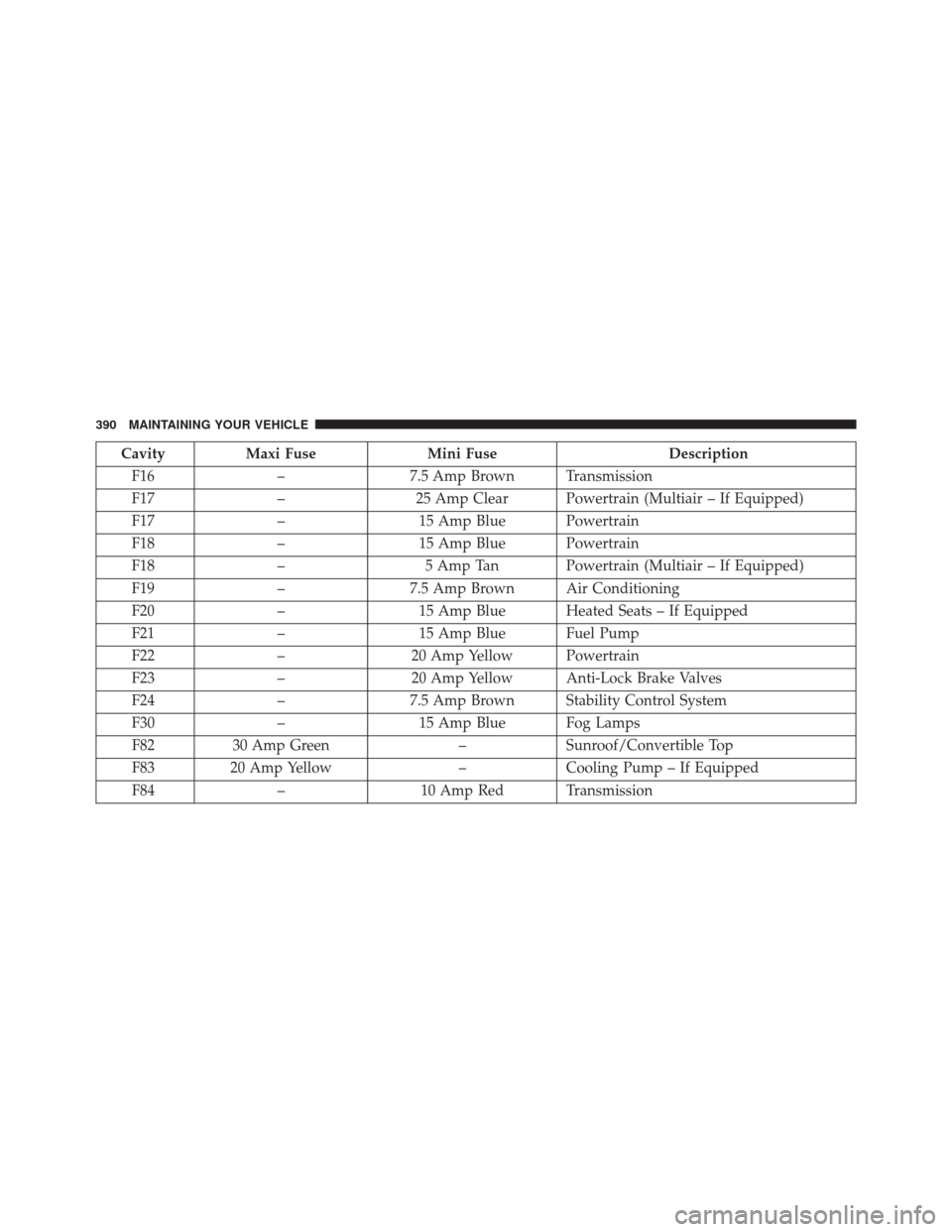
CavityMaxi Fuse Mini Fuse Description
F16 –7.5 Amp Brown Transmission
F17 –25 Amp Clear Powertrain (Multiair – If Equipped)
F17 –15 Amp Blue Powertrain
F18 –15 Amp Blue Powertrain
F18 – 5 Amp Tan Powertrain (Multiair – If Equipped)
F19 –7.5 Amp Brown Air Conditioning
F20 –15 Amp Blue Heated Seats – If Equipped
F21 –15 Amp Blue Fuel Pump
F22 –20 Amp Yellow Powertrain
F23 –20 Amp Yellow Anti-Lock Brake Valves
F24 –7.5 Amp Brown Stability Control System
F30 –15 Amp Blue Fog Lamps
F82 30 Amp Green –Sunroof/Convertible Top
F83 20 Amp Yellow –Cooling Pump – If Equipped
F84 –10 Amp Red Transmission
390 MAINTAINING YOUR VEHICLE
Page 399 of 438
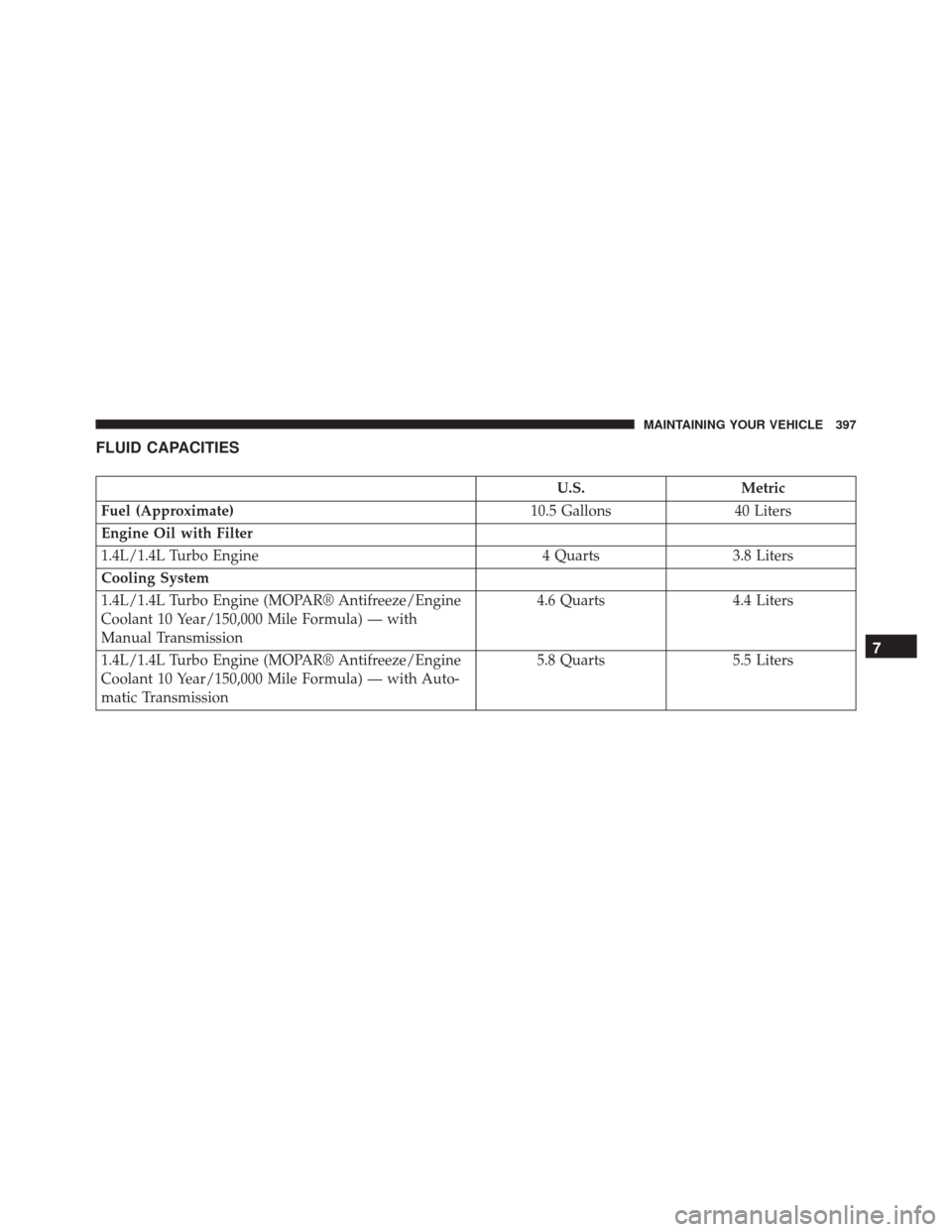
FLUID CAPACITIES
U.S.Metric
Fuel (Approximate) 10.5 Gallons40 Liters
Engine Oil with Filter
1.4L/1.4L Turbo Engine 4 Quarts3.8 Liters
Cooling System
1.4L/1.4L Turbo Engine (MOPAR® Antifreeze/Engine
Coolant 10 Year/150,000 Mile Formula) — with
Manual Transmission 4.6 Quarts
4.4 Liters
1.4L/1.4L Turbo Engine (MOPAR® Antifreeze/Engine
Coolant 10 Year/150,000 Mile Formula) — with Auto-
matic Transmission 5.8 Quarts
5.5 Liters
7
MAINTAINING YOUR VEHICLE 397
Page 401 of 438

CAUTION!
•Mixing of engine coolant (antifreeze) other than
specified Organic Additive Technology (OAT) en-
gine coolant (antifreeze), may result in engine
damage and may decrease corrosion protection.
Organic Additive Technology (OAT) engine cool-
ant is different and should not be mixed with
Hybrid Organic Additive Technology (HOAT) en-
gine coolant (antifreeze) or any “globally compat-
ible” coolant (antifreeze). If a non-OAT engine
coolant (antifreeze) is introduced into the cooling
system in an emergency, the cooling system will
need to be drained, flushed, and refilled with fresh
OAT coolant (conforming to MS.90032), by an au-
thorized dealer as soon as possible.
(Continued)
CAUTION! (Continued)
•Do not use water alone or alcohol-based engine
coolant (antifreeze) products. Do not use additional
rust inhibitors or antirust products, as they may not
be compatible with the radiator engine coolant and
may plug the radiator.
• This vehicle has not been designed for use with
propylene glycol-based engine coolant (antifreeze).
Use of propylene glycol-based engine coolant (an-
tifreeze) is not recommended.
7
MAINTAINING YOUR VEHICLE 399
Page 405 of 438
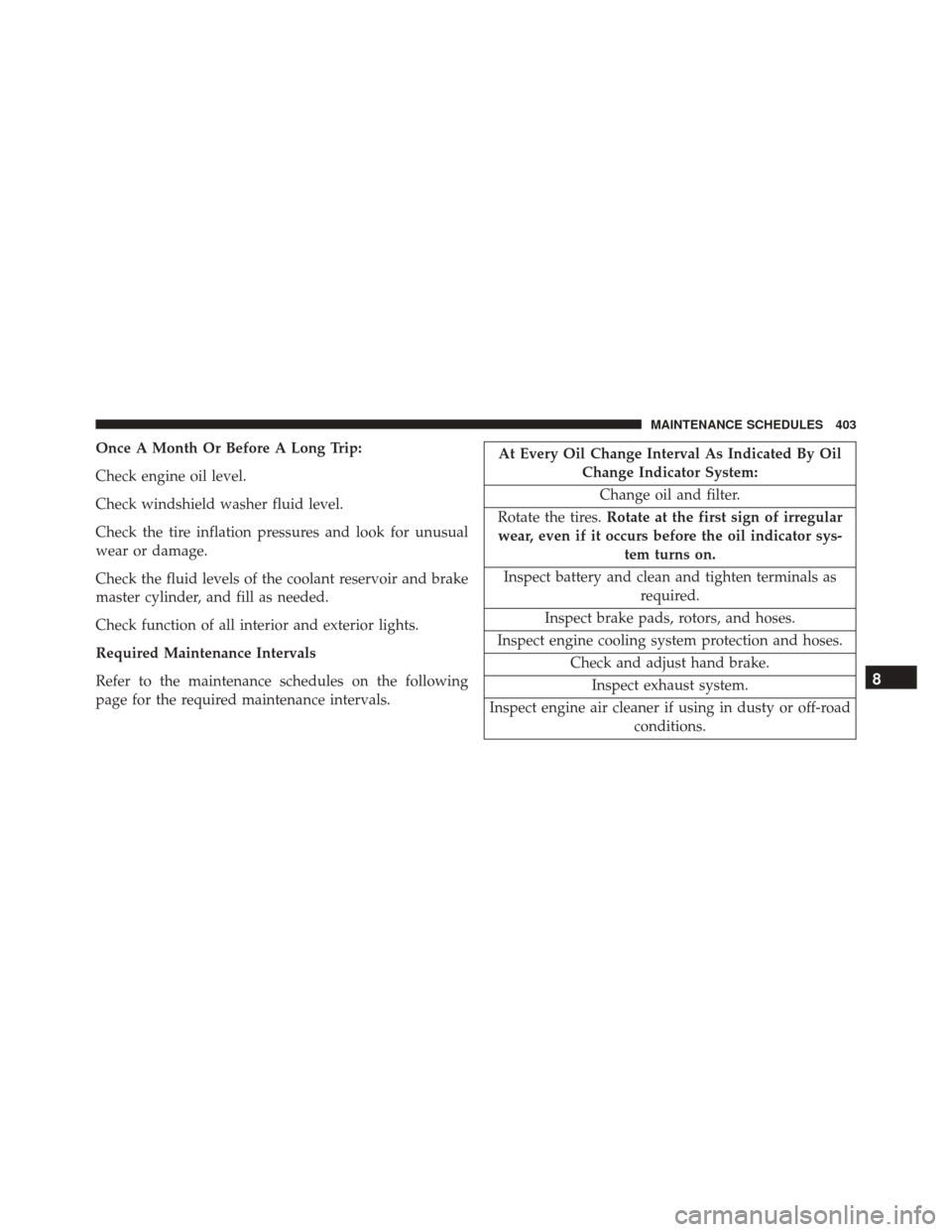
Once A Month Or Before A Long Trip:
Check engine oil level.
Check windshield washer fluid level.
Check the tire inflation pressures and look for unusual
wear or damage.
Check the fluid levels of the coolant reservoir and brake
master cylinder, and fill as needed.
Check function of all interior and exterior lights.
Required Maintenance Intervals
Refer to the maintenance schedules on the following
page for the required maintenance intervals.At Every Oil Change Interval As Indicated By OilChange Indicator System:
Change oil and filter.
Rotate the tires. Rotate at the first sign of irregular
wear, even if it occurs before the oil indicator sys- tem turns on.
Inspect battery and clean and tighten terminals as required.
Inspect brake pads, rotors, and hoses.
Inspect engine cooling system protection and hoses. Check and adjust hand brake.Inspect exhaust system.
Inspect engine air cleaner if using in dusty or off-road conditions.
8
MAINTENANCE SCHEDULES 403
Page 424 of 438
Chains, Tire............................ .280
Change Oil Indicator ...................... .402
Changing A Flat Tire ...................... .316
Chart, Tire Sizing ........................ .258
Check Engine Light (Malfunction Indicator Light) . .143,
347
Checking Your Vehicle For Safety ...............74
Checks, Safety ............................74
Child Restraint ............................54
Child Restraints Booster Seats ...........................59
Child Restraints .........................54
Child Seat Installation .....................70
How To Stow An Unused ALR Seat Belt ........67
Infants And Child Restraints ................57
Install A LATCH-Compatible Child Restraint ....65
Installing Child Restraints Using The Vehicle Seat
Belt ..................................68
Lower Anchors And Tethers For Children .......61Older Children And Child Restraints
..........57
Seating Positions ........................60
Clean Air Gasoline ....................... .293
Cleaning Wheels .............................. .379
Windshield Wiper Blades ..................360
Climate Control ......................... .206
Clutch ................................ .372
Clutch Fluid ............................ .372
Compact Disc (CD) Maintenance ..............205
Compact Spare Tire ....................... .275
Connector UCI................................ .203
Universal Consumer Interface (UCI) ..........203
Contract, Service ......................... .412
Convertible Top Maintenance .................383
Coolant (Antifreeze) ....................397, 398
Cooling System .......................... .366
Adding Coolant (Antifreeze) ...............368
422 INDEX
Page 426 of 438
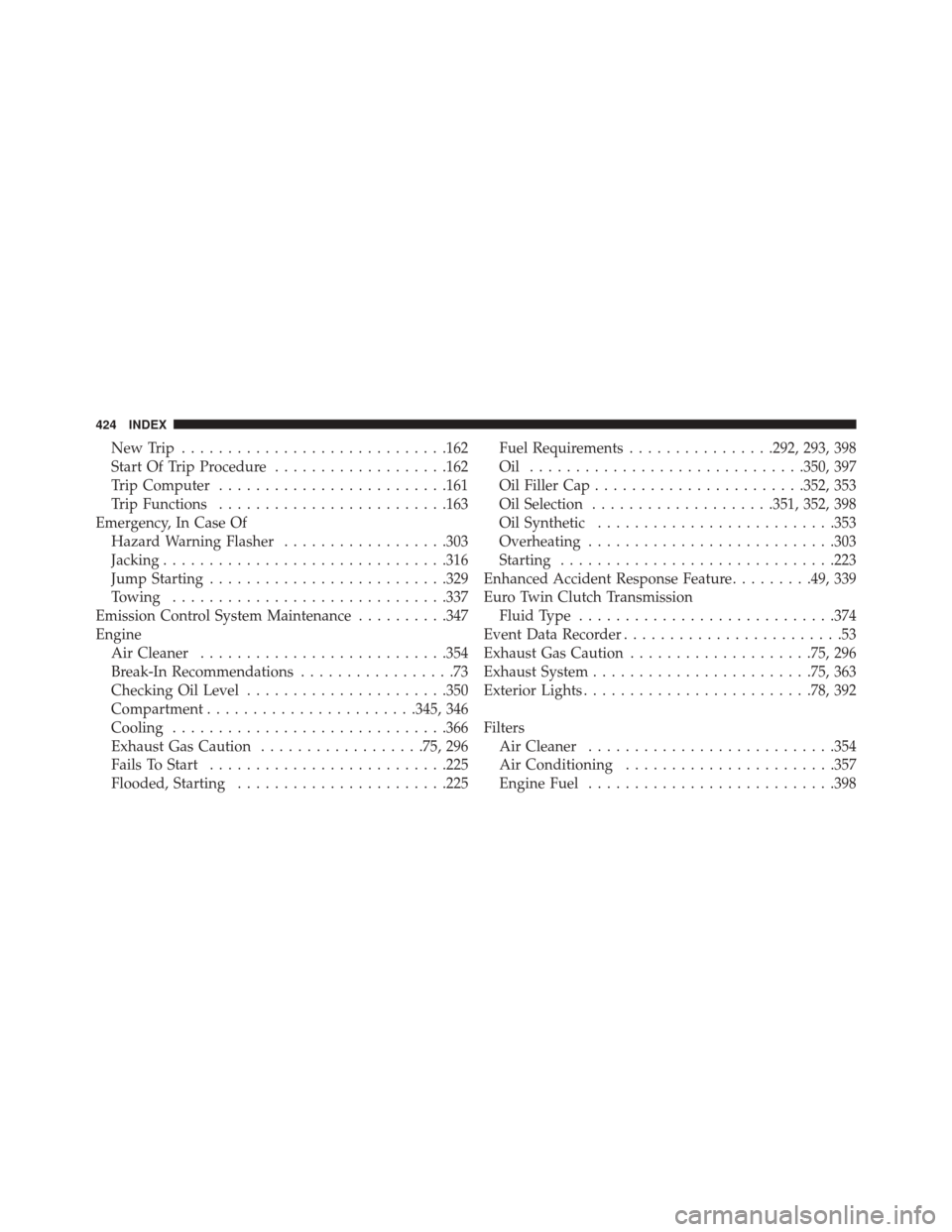
NewTrip .............................162
Start Of Trip Procedure ...................162
Trip Computer ........................ .161
Trip Functions ........................ .163
Emergency, In Case Of Hazard Warning Flasher ..................303
Jacking .............................. .316
Jump Starting ......................... .329
Towing ............................. .337
Emission Control System Maintenance ..........347
Engine Air Cleaner .......................... .354
Break-In Recommendations .................73
Checking Oil Level ..................... .350
Compartment ...................... .345, 346
Cooling ............................. .366
Exhaust Gas Caution ..................75, 296
Fails To Start ......................... .225
Flooded, Starting ...................... .225Fuel Requirements
................292, 293, 398
Oil ............................. .350, 397
Oil Filler Cap ...................... .352, 353
Oil Selection ....................351, 352, 398
Oil Synthetic ......................... .353
Overheating .......................... .303
Starting ............................. .223
Enhanced Accident Response Feature .........49, 339
Euro Twin Clutch Transmission Fluid Type ........................... .374
Event Data Recorder ........................53
Exhaust Gas Caution ....................75, 296
Exhaust System ....................... .75, 363
Exterior Lights ........................ .78, 392
Filters Air Cleaner .......................... .354
Air Conditioning ...................... .357
Engine Fuel .......................... .398
424 INDEX