ignition FIAT 500C 2019 Owner's Manual
[x] Cancel search | Manufacturer: FIAT, Model Year: 2019, Model line: 500C, Model: FIAT 500C 2019Pages: 332, PDF Size: 3.17 MB
Page 90 of 332
Steering” in “Starting And Operating” for further informa-
tion.
WARNING!
Continued operation with reduced assist could pose a
safety risk to yourself and others. Service should be
obtained as soon as possible.
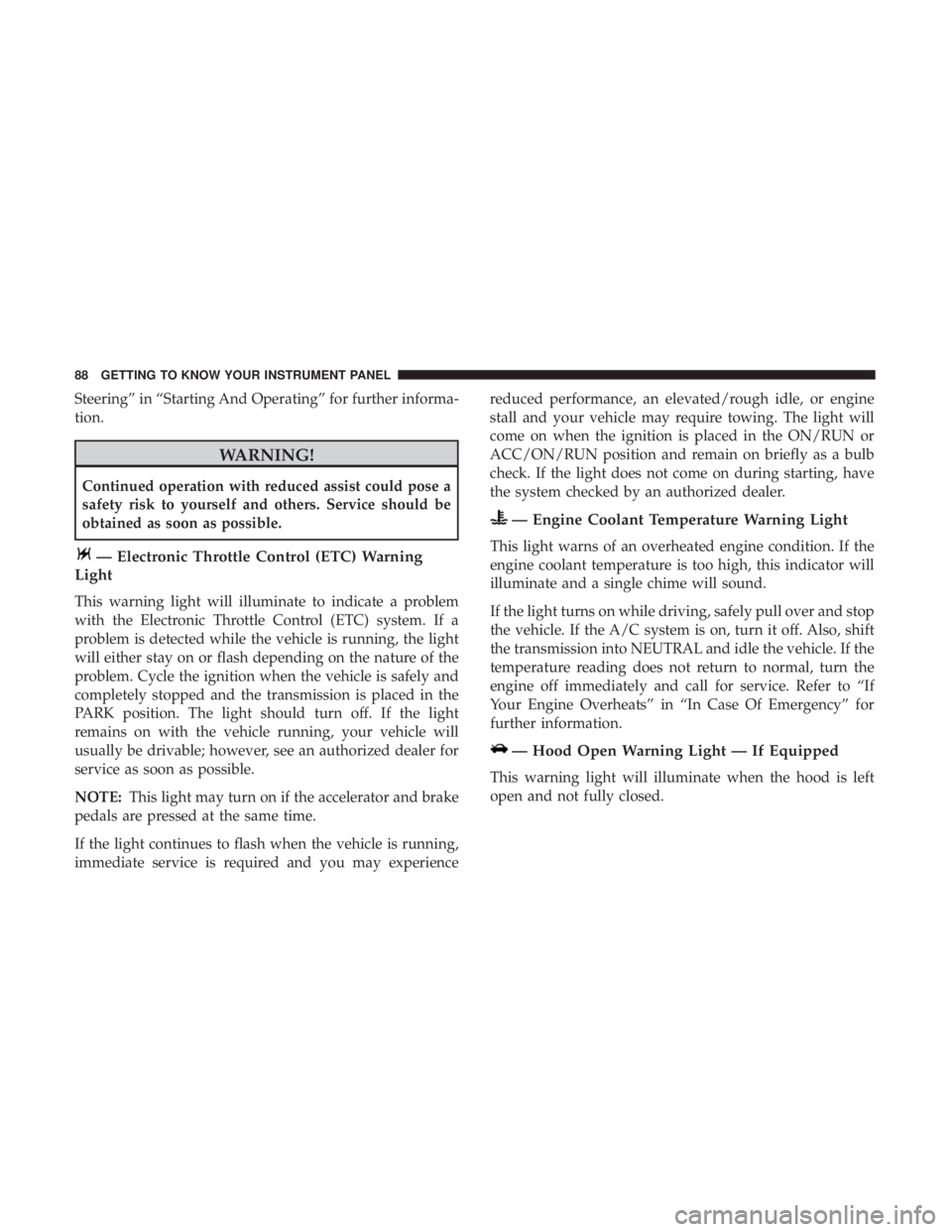
— Electronic Throttle Control (ETC) Warning
Light
This warning light will illuminate to indicate a problem
with the Electronic Throttle Control (ETC) system. If a
problem is detected while the vehicle is running, the light
will either stay on or flash depending on the nature of the
problem. Cycle the ignition when the vehicle is safely and
completely stopped and the transmission is placed in the
PARK position. The light should turn off. If the light
remains on with the vehicle running, your vehicle will
usually be drivable; however, see an authorized dealer for
service as soon as possible.
NOTE: This light may turn on if the accelerator and brake
pedals are pressed at the same time.
If the light continues to flash when the vehicle is running,
immediate service is required and you may experience reduced performance, an elevated/rough idle, or engine
stall and your vehicle may require towing. The light will
come on when the ignition is placed in the ON/RUN or
ACC/ON/RUN position and remain on briefly as a bulb
check. If the light does not come on during starting, have
the system checked by an authorized dealer.
— Engine Coolant Temperature Warning Light
This light warns of an overheated engine condition. If the
engine coolant temperature is too high, this indicator will
illuminate and a single chime will sound.
If the light turns on while driving, safely pull over and stop
the vehicle. If the A/C system is on, turn it off. Also, shift
the transmission into NEUTRAL and idle the vehicle. If the
temperature reading does not return to normal, turn the
engine off immediately and call for service. Refer to “If
Your Engine Overheats” in “In Case Of Emergency” for
further information.
— Hood Open Warning Light — If Equipped
This warning light will illuminate when the hood is left
open and not fully closed.
88 GETTING TO KNOW YOUR INSTRUMENT PANEL
Page 91 of 332
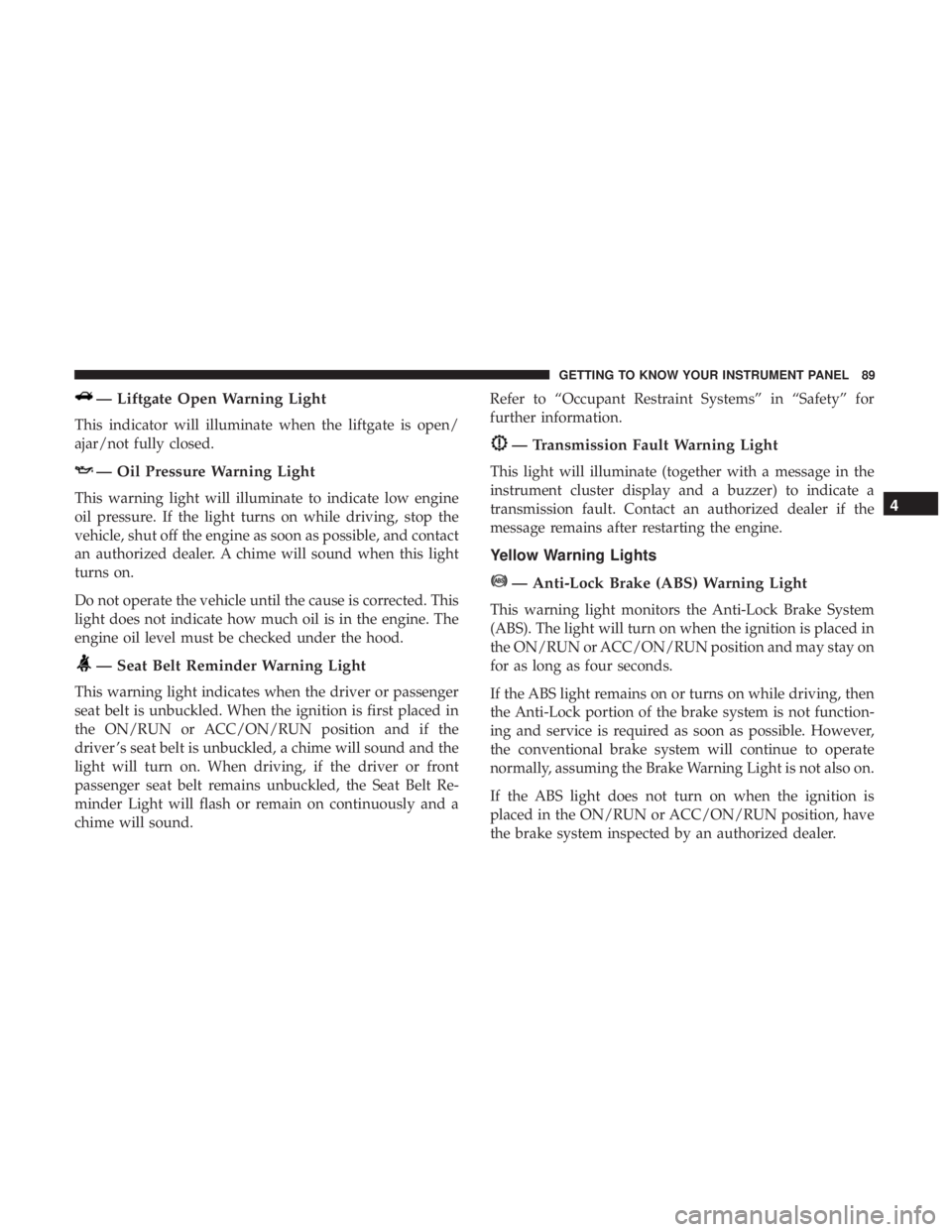
— Liftgate Open Warning Light
This indicator will illuminate when the liftgate is open/
ajar/not fully closed.
— Oil Pressure Warning Light
This warning light will illuminate to indicate low engine
oil pressure. If the light turns on while driving, stop the
vehicle, shut off the engine as soon as possible, and contact
an authorized dealer. A chime will sound when this light
turns on.
Do not operate the vehicle until the cause is corrected. This
light does not indicate how much oil is in the engine. The
engine oil level must be checked under the hood.
— Seat Belt Reminder Warning Light
This warning light indicates when the driver or passenger
seat belt is unbuckled. When the ignition is first placed in
the ON/RUN or ACC/ON/RUN position and if the
driver ’s seat belt is unbuckled, a chime will sound and the
light will turn on. When driving, if the driver or front
passenger seat belt remains unbuckled, the Seat Belt Re-
minder Light will flash or remain on continuously and a
chime will sound.Refer to “Occupant Restraint Systems” in “Safety” for
further information.
— Transmission Fault Warning Light
This light will illuminate (together with a message in the
instrument cluster display and a buzzer) to indicate a
transmission fault. Contact an authorized dealer if the
message remains after restarting the engine.
Yellow Warning Lights
— Anti-Lock Brake (ABS) Warning Light
This warning light monitors the Anti-Lock Brake System
(ABS). The light will turn on when the ignition is placed in
the ON/RUN or ACC/ON/RUN position and may stay on
for as long as four seconds.
If the ABS light remains on or turns on while driving, then
the Anti-Lock portion of the brake system is not function-
ing and service is required as soon as possible. However,
the conventional brake system will continue to operate
normally, assuming the Brake Warning Light is not also on.
If the ABS light does not turn on when the ignition is
placed in the ON/RUN or ACC/ON/RUN position, have
the brake system inspected by an authorized dealer.
4
GETTING TO KNOW YOUR INSTRUMENT PANEL 89
Page 92 of 332
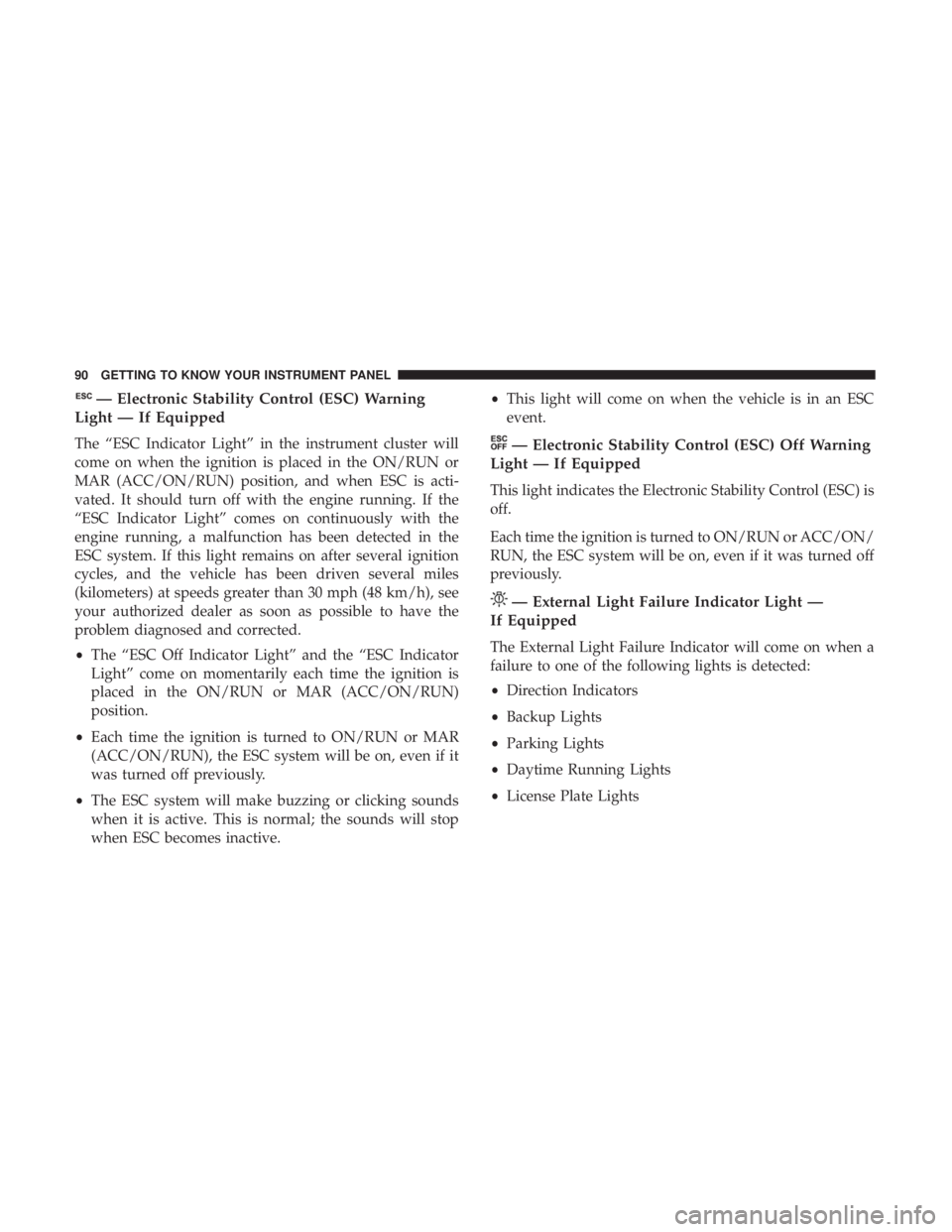
— Electronic Stability Control (ESC) Warning
Light — If Equipped
The “ESC Indicator Light” in the instrument cluster will
come on when the ignition is placed in the ON/RUN or
MAR (ACC/ON/RUN) position, and when ESC is acti-
vated. It should turn off with the engine running. If the
“ESC Indicator Light” comes on continuously with the
engine running, a malfunction has been detected in the
ESC system. If this light remains on after several ignition
cycles, and the vehicle has been driven several miles
(kilometers) at speeds greater than 30 mph (48 km/h), see
your authorized dealer as soon as possible to have the
problem diagnosed and corrected.
• The “ESC Off Indicator Light” and the “ESC Indicator
Light” come on momentarily each time the ignition is
placed in the ON/RUN or MAR (ACC/ON/RUN)
position.
• Each time the ignition is turned to ON/RUN or MAR
(ACC/ON/RUN), the ESC system will be on, even if it
was turned off previously.
• The ESC system will make buzzing or clicking sounds
when it is active. This is normal; the sounds will stop
when ESC becomes inactive. •
This light will come on when the vehicle is in an ESC
event.— Electronic Stability Control (ESC) Off Warning
Light — If Equipped
This light indicates the Electronic Stability Control (ESC) is
off.
Each time the ignition is turned to ON/RUN or ACC/ON/
RUN, the ESC system will be on, even if it was turned off
previously.
— External Light Failure Indicator Light —
If Equipped
The External Light Failure Indicator will come on when a
failure to one of the following lights is detected:
• Direction Indicators
• Backup Lights
• Parking Lights
• Daytime Running Lights
• License Plate Lights
90 GETTING TO KNOW YOUR INSTRUMENT PANEL
Page 93 of 332
The failure relating to these lights could be:
•One or more blown bulbs
• A blown protection fuse
• A break in the electrical connection
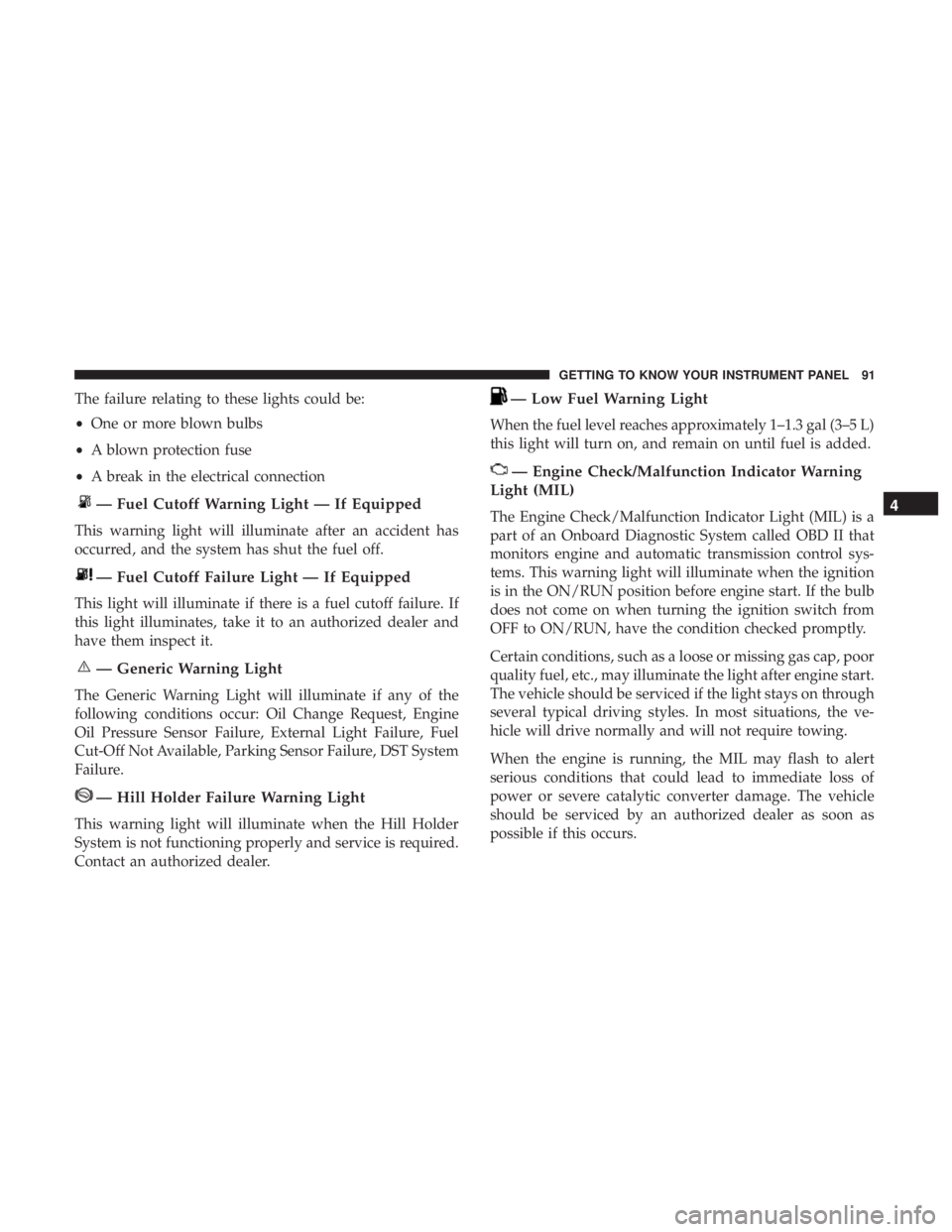
— Fuel Cutoff Warning Light — If Equipped
This warning light will illuminate after an accident has
occurred, and the system has shut the fuel off.
— Fuel Cutoff Failure Light — If Equipped
This light will illuminate if there is a fuel cutoff failure. If
this light illuminates, take it to an authorized dealer and
have them inspect it.
— Generic Warning Light
The Generic Warning Light will illuminate if any of the
following conditions occur: Oil Change Request, Engine
Oil Pressure Sensor Failure, External Light Failure, Fuel
Cut-Off Not Available, Parking Sensor Failure, DST System
Failure.
— Hill Holder Failure Warning Light
This warning light will illuminate when the Hill Holder
System is not functioning properly and service is required.
Contact an authorized dealer.
— Low Fuel Warning Light
When the fuel level reaches approximately 1–1.3 gal (3–5 L)
this light will turn on, and remain on until fuel is added.
— Engine Check/Malfunction Indicator Warning
Light (MIL)
The Engine Check/Malfunction Indicator Light (MIL) is a
part of an Onboard Diagnostic System called OBD II that
monitors engine and automatic transmission control sys-
tems. This warning light will illuminate when the ignition
is in the ON/RUN position before engine start. If the bulb
does not come on when turning the ignition switch from
OFF to ON/RUN, have the condition checked promptly.
Certain conditions, such as a loose or missing gas cap, poor
quality fuel, etc., may illuminate the light after engine start.
The vehicle should be serviced if the light stays on through
several typical driving styles. In most situations, the ve-
hicle will drive normally and will not require towing.
When the engine is running, the MIL may flash to alert
serious conditions that could lead to immediate loss of
power or severe catalytic converter damage. The vehicle
should be serviced by an authorized dealer as soon as
possible if this occurs.4
GETTING TO KNOW YOUR INSTRUMENT PANEL 91
Page 100 of 332
serviced, recently had a dead battery or a battery replace-
ment. If the OBD II system should be determined not ready
for the I/M test, your vehicle may fail the test.
Your vehicle has a simple ignition actuated test, which you
can use prior to going to the test station. To check if your
vehicle’s OBD II system is ready, you must do the follow-
ing:
1. Cycle the ignition switch to the ON position, but do notcrank or start the engine.
NOTE: If you crank or start the engine, you will have to
start this test over.
2. As soon as you cycle the ignition switch to the ON position, you will see the “Malfunction Indicator Light
(MIL)” symbol come on as part of a normal bulb check.
3. Approximately 15 seconds later, one of two things will happen:
• The MIL will flash for about ten seconds and then return
to being fully illuminated until you turn OFF the igni-
tion or start the engine. This means that your vehicle’s
OBD II system is not readyand you should notproceed
to the I/M station. •
The MIL will not flash at all and will remain fully
illuminated until you place the ignition in the off posi-
tion or start the engine. This means that your vehicle’s
OBD II system is readyand you can proceed to the I/M
station.
If your OBD II system is not ready,you should see an
authorized dealer or repair facility. If your vehicle was
recently serviced or had a battery failure or replacement,
you may need to do nothing more than drive your vehicle
as you normally would in order for your OBD II system to
update. A recheck with the above test routine may then
indicate that the system is now ready.
Regardless of whether your vehicle’s OBD II system is
ready or not, if the MIL is illuminated during normal
vehicle operation you should have your vehicle serviced
before going to the I/M station. The I/M station can fail
your vehicle because the MIL is on with the engine
running.
98 GETTING TO KNOW YOUR INSTRUMENT PANEL
Page 107 of 332
ESC Operating Modes
The ESC system has two available operating modes.
Full On
This is the normal operating mode for ESC. Whenever the
vehicle is started, the ESC system will be in On mode. This
mode should be used for most driving situations. ESC
should only be turned to Partial Off for specific reasons as
noted below.
Partial Off
This mode is entered by momentarily pushing the ESC Off
switch. This mode is intended to be used if the vehicle is in
deep snow, sand or gravel conditions and more wheel spin
than ESC would normally allow is required to gain trac-
tion.
To turn ESC on again, momentarily pushing the switch
again. This will restore the normal ESC On mode of
operation.NOTE:
To improve the vehicle’s traction when driving
with snow chains, or starting off in deep snow, sand or
gravel, it may be desirable to switch to the Partial Off mode
by pushing the switch. Once the situation requiring ESC to
be switched to the Partial Off mode is overcome, turn ESC
back on by momentarily pushing the switch. This may be
done while the vehicle is in motion.
WARNING!
When in “Partial Off” mode, the TCS functionality of
ESC (except for the limited slip feature described in
the TCS section) has been disabled and the “ESC Off
Indicator Light” will be illuminated. When in “Partial
Off” mode, the engine power reduction of TCS is
disabled, and the enhanced vehicle stability offered by
the ESC system is reduced.
ESC Activation/Malfunction Indicator Light And
ESC OFF Indicator Light
The ESC Activation/Malfunction Indicator Light
in the instrument cluster will come on when the
ignition switch is turned to the MAR (ACC/ON/
RUN) position for four seconds. If the ESC
5
SAFETY 105
Page 108 of 332
Activation/Malfunction Indicator Light comes on continu-
ously with the engine running, a malfunction has been
detected in the ESC system. If this light remains on after
several ignition cycles, and the vehicle has been driven
several miles (kilometers) at speeds greater than 30 mph
(48 km/h), see your authorized dealer as soon as possible
to have the problem diagnosed and corrected.
The ESC Activation/Malfunction Indicator Light (located
in the instrument cluster) starts to flash as soon as the tires
lose traction and the ESC system becomes active. The ESC
Activation/Malfunction Indicator Light also flashes when
TCS is active. If the ESC Activation/Malfunction Indicator
Light begins to flash during acceleration, ease up on the
accelerator and apply as little throttle as possible. Be sure to
adapt your speed and driving to the prevailing road
conditions.
NOTE:
•The ESC Activation/Malfunction Indicator Light and
the ESC OFF Indicator Light come on momentarily each
time the ignition switch is turned ON. •
Each time the ignition is turned ON, the ESC system will
be ON even if it was turned off previously.
The ESC OFF Indicator Light indicates the Elec-
tronic Stability Control (ESC) is partially off.
AUXILIARY DRIVING SYSTEMS
Tire Pressure Monitoring System (TPMS)
The Tire Pressure Monitor System (TPMS) will warn the
driver of a low tire pressure based on the vehicle recom-
mended cold tire pressure.
The tire pressure will vary with temperature by about 1 psi
(7 kPa) for every 12°F (6.5°C). This means that when the
outside temperature decreases, the tire pressure will de-
crease. Tire pressure should always be set based on cold
inflation tire pressure. This is defined as the tire pressure
after the vehicle has not been driven for at least three
hours, or driven less than 1 mile (1.6 km) after a three hour
period. The cold tire inflation pressure must not exceed the
maximum inflation pressure molded into the tire sidewall.
Refer to “Tires – General Information” in “Servicing And
Maintenace” for information on how to properly inflate the
106 SAFETY
Page 111 of 332
Tire Pressure Monitoring Low Pressure Warnings
The Tire Pressure Monitoring System Warning Light will
illuminate in the instrument cluster, an audible chime will
be activated, and the “Low inflation pressure left or right
front/rear tire” text message will display when one or
more of the four active road tire pressures are low. Should
this occur, you should stop as soon as possible, check the
inflation pressure of each tire on your vehicle, and inflate
each tire to the vehicle’s recommended cold placard pres-
sure value. The system will automatically update and the
Tire Pressure Monitoring Light will extinguish once the
updated tire pressures have been received. The vehicle
may need to be driven for up to 20 minutes above 15 mph
(24 km/h) to receive this information.
TPMS Warnings
The Tire Pressure Monitoring System Warning Light will
flash on and off for 75 seconds and remain on solid when
a system fault is detected, an audible chime will be
activated and the “Service Tire Pressure Monitoring Sys-
tem” text message will display. If the ignition key is cycled,
this sequence will repeat providing the system fault still
exists. The Tire Pressure Monitoring System Warning Light
will turn off when the fault condition no longer exists. A
system fault can occur with any of the following scenarios:•
Jamming due to electronic devices or driving next to
facilities emitting the same radio frequencies as the TPM
sensors.
• Installing some form of aftermarket window tinting that
affects radio wave signals.
• Snow or ice around the wheels or wheel housings.
• Using tire chains on the vehicle.
• Using wheels/tires not equipped with TPM sensors.
NOTE: Your vehicle may be equipped with a compact
spare wheel and tire assembly.
• The compact spare tire does not have a tire pressure
monitoring sensor. Therefore, the TPMS will not monitor
the tire pressure in the compact spare tire.
• If you install the compact spare tire in place of a road tire
that has a pressure below the low-pressure warning
limit, upon the next ignition key cycle, a chime will
sound, the Tire Pressure Monitoring System Warning
Light and the Low inflation pressure left or right front /
rear tire message will still turn ON due to the low tire.
• However, after driving the vehicle for up to 20 minutes
above 15 mph (24 km/h), the Tire Pressure Monitoring
System Warning Light will flash on and off for 75
5
SAFETY 109
Page 112 of 332
seconds and then remain on solid and the “Service Tire
Pressure Monitoring System” message will be dis-
played.
• This occurs for each subsequent ignition key cycle, a
chime will sound and the Tire Pressure Monitoring
System Warning Light will flash on and off for 75
seconds and then remain on solid and the “Service Tire
Pressure Monitoring System” message will be dis-
played.
• Once you repair or replace the original road tire and
reinstall it on the vehicle in place of the compact spare
tire, the TPMS will update automatically and the Tire
Pressure Monitoring System Warning Light will turn
OFF, as long as no tire pressure is below the low-
pressure warning limit in any of the four active road
tires. The vehicle may need to be driven for up to 20
minutes above 15 mph (24 km/h) in order for the TPMS
to receive this information.TPM System With (TFT) Tire Pressure Display
Screen
The Tire Pressure Monitor System (TPMS) uses wireless
technology with wheel rim mounted electronic sensors to
monitor tire pressure levels. Sensors, mounted to each
wheel as part of the valve stem, transmit tire pressure
readings to the receiver module.
The TPMS consists of the following components:
• Receiver module
• Four Tire Pressure Monitoring Sensors
• Various Tire Pressure Monitoring System messages,
which display in the instrument cluster
• Tire Pressure Monitoring System Warning Light
Tire Pressure Monitoring Low Pressure Warnings
The Tire Pressure Monitoring System Warning Light
will illuminate in the instrument cluster and a
chime will sound when tire pressure is low in one or more
of the four active road tires. In addition, the instrument
cluster will display a low pressure text message and a
graphic showing the low tire pressure tire highlighted in a
different color.
110 SAFETY
Page 113 of 332
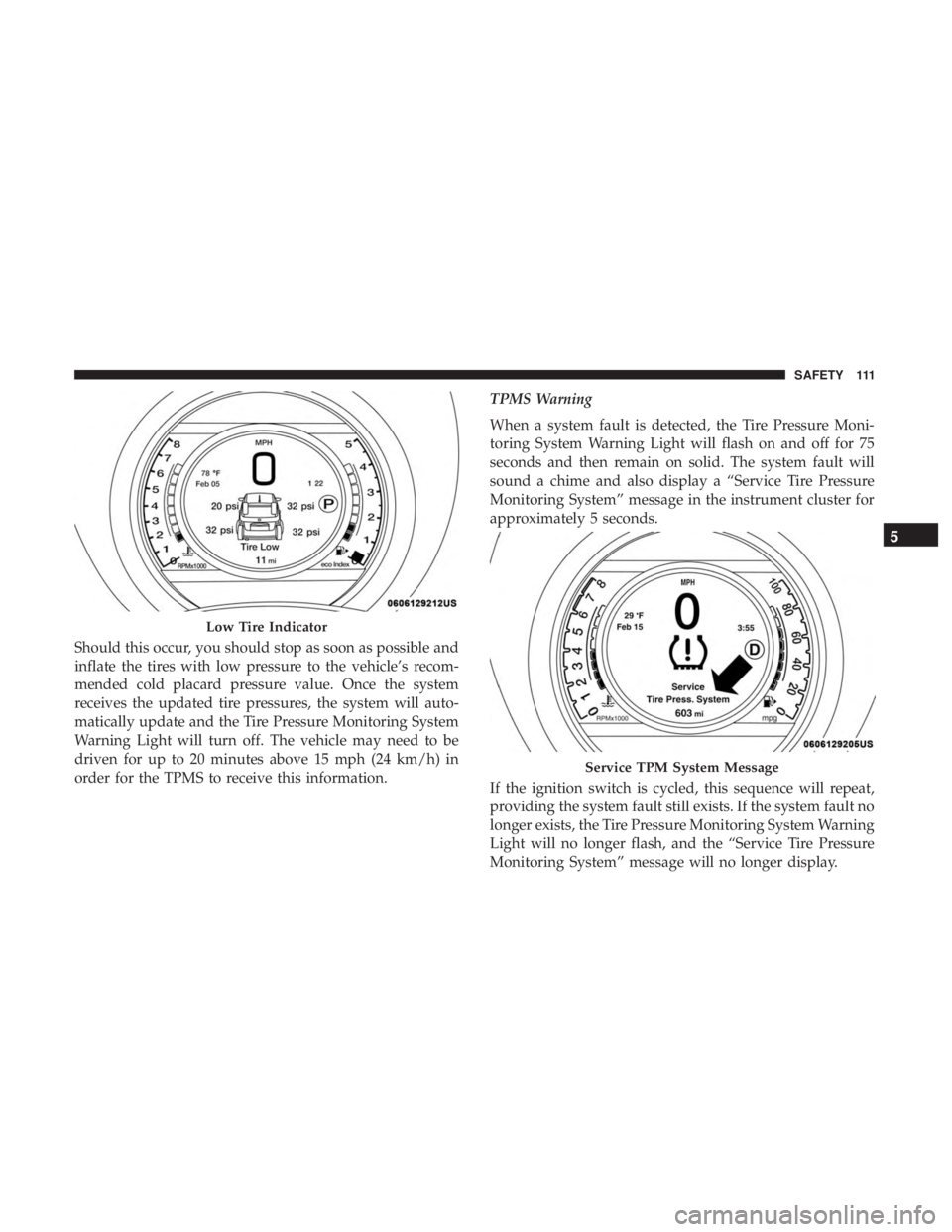
Should this occur, you should stop as soon as possible and
inflate the tires with low pressure to the vehicle’s recom-
mended cold placard pressure value. Once the system
receives the updated tire pressures, the system will auto-
matically update and the Tire Pressure Monitoring System
Warning Light will turn off. The vehicle may need to be
driven for up to 20 minutes above 15 mph (24 km/h) in
order for the TPMS to receive this information.TPMS Warning
When a system fault is detected, the Tire Pressure Moni-
toring System Warning Light will flash on and off for 75
seconds and then remain on solid. The system fault will
sound a chime and also display a “Service Tire Pressure
Monitoring System” message in the instrument cluster for
approximately 5 seconds.
If the ignition switch is cycled, this sequence will repeat,
providing the system fault still exists. If the system fault no
longer exists, the Tire Pressure Monitoring System Warning
Light will no longer flash, and the “Service Tire Pressure
Monitoring System” message will no longer display.
Low Tire Indicator
Service TPM System Message
5
SAFETY 111