warning FIAT 500C 2019 Service Manual
[x] Cancel search | Manufacturer: FIAT, Model Year: 2019, Model line: 500C, Model: FIAT 500C 2019Pages: 332, PDF Size: 3.17 MB
Page 104 of 332
TCS system, Brake Limited Differential (BLD), functions simi-
lar to a limited slip differential and controls the wheel spin
across a driven axle. If one wheel on a driven axle is spinning
faster than the other, the system will apply the brake of the
spinning wheel. This will allow more engine torque to be
applied to the wheel that is not spinning. This feature remains
active even if TCS and ESC are in the Partial Off mode. Refer
to “Electronic Stability Control (ESC)” in this section for
further information.
Hill Start Assist (HSA)
The HSA system is designed to assist the driver when
starting a vehicle from a stop on a hill. HSA will maintain
the level of brake pressure the driver applied for a short
period of time after the driver takes his foot off the brake
pedal. If the driver does not apply the throttle during this
short period of time, the system will release brake pressure
and the vehicle will roll down the hill. The system will
release brake pressure in proportion to the amount of
throttle applied as the vehicle starts to move in the
intended direction of travel.HSA Activation Criteria
The following criteria must be met in order for HSA to
activate:
•
Vehicle must be stopped.
• Vehicle must be on a 2.5% (manual transmission) or 7%
grade or greater (automatic transmission) hill.
• Gear selection matches vehicle uphill direction (i.e.,
vehicle in NEUTRAL (manual transmission), vehicle
facing uphill is in forward gear; vehicle backing uphill is
in REVERSE gear).
WARNING!
There may be situations on minor hills with a loaded
vehicle, or while pulling a trailer, when the system will
not activate and slight rolling may occur. This could
cause a collision with another vehicle or object. Always
remember the driver is responsible for braking the
vehicle.
102 SAFETY
Page 106 of 332
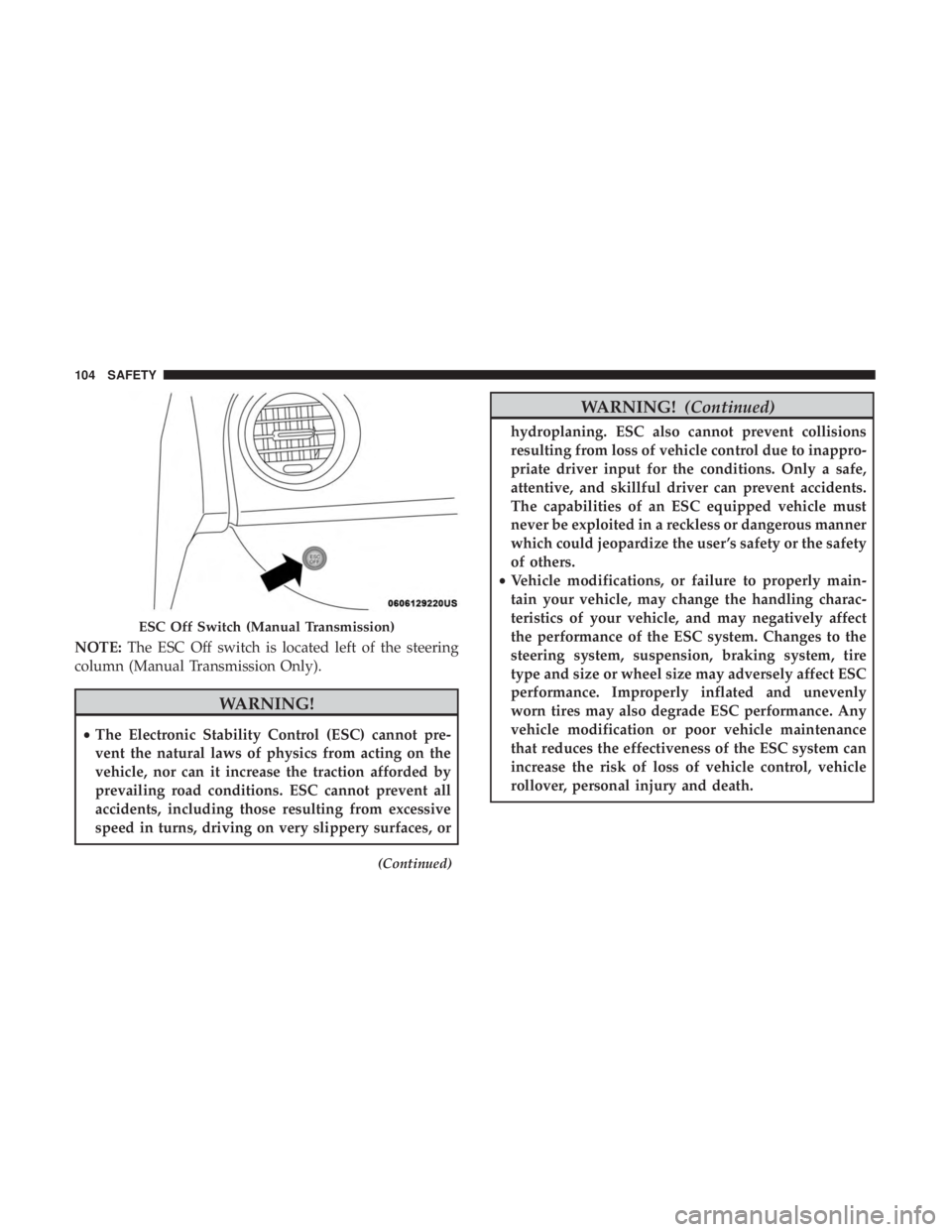
NOTE:The ESC Off switch is located left of the steering
column (Manual Transmission Only).
WARNING!
• The Electronic Stability Control (ESC) cannot pre-
vent the natural laws of physics from acting on the
vehicle, nor can it increase the traction afforded by
prevailing road conditions. ESC cannot prevent all
accidents, including those resulting from excessive
speed in turns, driving on very slippery surfaces, or
(Continued)
WARNING! (Continued)
hydroplaning. ESC also cannot prevent collisions
resulting from loss of vehicle control due to inappro-
priate driver input for the conditions. Only a safe,
attentive, and skillful driver can prevent accidents.
The capabilities of an ESC equipped vehicle must
never be exploited in a reckless or dangerous manner
which could jeopardize the user ’s safety or the safety
of others.
• Vehicle modifications, or failure to properly main-
tain your vehicle, may change the handling charac-
teristics of your vehicle, and may negatively affect
the performance of the ESC system. Changes to the
steering system, suspension, braking system, tire
type and size or wheel size may adversely affect ESC
performance. Improperly inflated and unevenly
worn tires may also degrade ESC performance. Any
vehicle modification or poor vehicle maintenance
that reduces the effectiveness of the ESC system can
increase the risk of loss of vehicle control, vehicle
rollover, personal injury and death.
ESC Off Switch (Manual Transmission)
104 SAFETY
Page 107 of 332
ESC Operating Modes
The ESC system has two available operating modes.
Full On
This is the normal operating mode for ESC. Whenever the
vehicle is started, the ESC system will be in On mode. This
mode should be used for most driving situations. ESC
should only be turned to Partial Off for specific reasons as
noted below.
Partial Off
This mode is entered by momentarily pushing the ESC Off
switch. This mode is intended to be used if the vehicle is in
deep snow, sand or gravel conditions and more wheel spin
than ESC would normally allow is required to gain trac-
tion.
To turn ESC on again, momentarily pushing the switch
again. This will restore the normal ESC On mode of
operation.NOTE:
To improve the vehicle’s traction when driving
with snow chains, or starting off in deep snow, sand or
gravel, it may be desirable to switch to the Partial Off mode
by pushing the switch. Once the situation requiring ESC to
be switched to the Partial Off mode is overcome, turn ESC
back on by momentarily pushing the switch. This may be
done while the vehicle is in motion.
WARNING!
When in “Partial Off” mode, the TCS functionality of
ESC (except for the limited slip feature described in
the TCS section) has been disabled and the “ESC Off
Indicator Light” will be illuminated. When in “Partial
Off” mode, the engine power reduction of TCS is
disabled, and the enhanced vehicle stability offered by
the ESC system is reduced.
ESC Activation/Malfunction Indicator Light And
ESC OFF Indicator Light
The ESC Activation/Malfunction Indicator Light
in the instrument cluster will come on when the
ignition switch is turned to the MAR (ACC/ON/
RUN) position for four seconds. If the ESC
5
SAFETY 105
Page 109 of 332
vehicle’s tires. The tire pressure will also increase as the
vehicle is driven, this is normal and there should be no
adjustment for this increased pressure.
The TPMS will warn the driver of a low tire pressure if the
tire pressure falls below the low pressure warning limit for
any reason, including low temperature effects, or natural
pressure loss through the tire.
The TPMS will continue to warn the driver of low tire
pressure as long as the condition exists, and will not turn off
until the tire pressure is at or above the recommended cold
tire pressure on the placard. Once the low tire pressure
warning (Tire Pressure Monitoring System Warning Light)
illuminates, you must increase the tire pressure to the
recommended cold tire pressure in order for the Tire Pressure
Monitoring System Warning Light to turn off. The system
will automatically update and the Tire Pressure Monitoring
System Warning Light will turn off once the system receives
the updated tire pressures. The vehicle may need to be
driven for up to 20 minutes above 15 mph (24 km/h) in order
for the TPMS to receive this information.
For example, your vehicle may have a recommended cold
(parked for more than three hours) tire pressure of 30 psi
(207 kPa). If the ambient temperature is 68°F (20°C) and the
measured tire pressure is 27 psi (186 kPa), a temperaturedrop to 20°F (-7°C) will decrease the tire pressure to
approximately 23 psi (159 kPa). This tire pressure is suffi-
ciently low enough to turn on the Tire Pressure Monitoring
System Warning Light. Driving the vehicle may cause the
tire pressure to rise to approximately 27 psi (186 kPa), but
the Tire Pressure Monitoring System Warning Light will
still be on. In this situation, the Tire Pressure Monitoring
System Warning Light will turn off only after the tires are
inflated to the vehicle’s recommended cold tire pressure
value.
CAUTION!
•
The TPMS has been optimized for the original
equipment tires and wheels. TPMS pressures and
warnings have been established for the tire size
equipped on your vehicle. Undesirable system op-
eration or sensor damage may result when using
replacement equipment that is not of the same size,
type, and/or style. Aftermarket wheels can cause
sensor damage. Using aftermarket tire sealants may
cause the Tire Pressure Monitoring System (TPMS)
sensor to become inoperable. After using an after-
market tire sealant it is recommended that you take
(Continued)
5
SAFETY 107
Page 110 of 332
CAUTION!(Continued)
your vehicle to an authorized dealership to have your
sensor function checked.
• After inspecting or adjusting the tire pressure, al-
ways reinstall the valve stem cap. This will prevent
moisture and dirt from entering the valve stem,
which could damage the Tire Pressure Monitoring
Sensor.
NOTE:
• The TPMS is not intended to replace normal tire care and
maintenance, or to provide warning of a tire failure or
condition.
• The TPMS should not be used as a tire pressure gauge
while adjusting your tire pressure.
• Driving on a significantly under-inflated tire causes the
tire to overheat and can lead to tire failure. Under-
inflation also reduces fuel efficiency and tire tread life,
and may affect the vehicle’s handling and stopping
ability.
• The TPMS is not a substitute for proper tire mainte-
nance, and it is the driver ’s responsibility to maintain
correct tire pressure using an accurate tire gauge, even if under-inflation has not reached the level to trigger
illumination of the Tire Pressure Monitoring System
Warning Light.
•
Seasonal temperature changes will affect tire pressure, and
the TPMS will monitor the actual tire pressure in the tire.
TPM System With Comfort Cluster
This is the TPMS warning indicator located in the
instrument cluster.
The TPMS uses wireless technology with wheel rim
mounted electronic sensors to monitor tire pressure levels.
Sensors, mounted to each wheel as part of the valve stem,
transmit tire pressure readings to the Receiver Module.
NOTE: It is particularly important for you to check the tire
pressure in all of the tires on your vehicle regularly and to
maintain the proper pressure.
The TPMS consists of the following components:
• Receiver Module
• Four Tire Pressure Monitoring Sensors
• Tire Pressure Monitoring System Warning Light
• Text Message Display
108 SAFETY
Page 111 of 332
Tire Pressure Monitoring Low Pressure Warnings
The Tire Pressure Monitoring System Warning Light will
illuminate in the instrument cluster, an audible chime will
be activated, and the “Low inflation pressure left or right
front/rear tire” text message will display when one or
more of the four active road tire pressures are low. Should
this occur, you should stop as soon as possible, check the
inflation pressure of each tire on your vehicle, and inflate
each tire to the vehicle’s recommended cold placard pres-
sure value. The system will automatically update and the
Tire Pressure Monitoring Light will extinguish once the
updated tire pressures have been received. The vehicle
may need to be driven for up to 20 minutes above 15 mph
(24 km/h) to receive this information.
TPMS Warnings
The Tire Pressure Monitoring System Warning Light will
flash on and off for 75 seconds and remain on solid when
a system fault is detected, an audible chime will be
activated and the “Service Tire Pressure Monitoring Sys-
tem” text message will display. If the ignition key is cycled,
this sequence will repeat providing the system fault still
exists. The Tire Pressure Monitoring System Warning Light
will turn off when the fault condition no longer exists. A
system fault can occur with any of the following scenarios:•
Jamming due to electronic devices or driving next to
facilities emitting the same radio frequencies as the TPM
sensors.
• Installing some form of aftermarket window tinting that
affects radio wave signals.
• Snow or ice around the wheels or wheel housings.
• Using tire chains on the vehicle.
• Using wheels/tires not equipped with TPM sensors.
NOTE: Your vehicle may be equipped with a compact
spare wheel and tire assembly.
• The compact spare tire does not have a tire pressure
monitoring sensor. Therefore, the TPMS will not monitor
the tire pressure in the compact spare tire.
• If you install the compact spare tire in place of a road tire
that has a pressure below the low-pressure warning
limit, upon the next ignition key cycle, a chime will
sound, the Tire Pressure Monitoring System Warning
Light and the Low inflation pressure left or right front /
rear tire message will still turn ON due to the low tire.
• However, after driving the vehicle for up to 20 minutes
above 15 mph (24 km/h), the Tire Pressure Monitoring
System Warning Light will flash on and off for 75
5
SAFETY 109
Page 112 of 332
seconds and then remain on solid and the “Service Tire
Pressure Monitoring System” message will be dis-
played.
• This occurs for each subsequent ignition key cycle, a
chime will sound and the Tire Pressure Monitoring
System Warning Light will flash on and off for 75
seconds and then remain on solid and the “Service Tire
Pressure Monitoring System” message will be dis-
played.
• Once you repair or replace the original road tire and
reinstall it on the vehicle in place of the compact spare
tire, the TPMS will update automatically and the Tire
Pressure Monitoring System Warning Light will turn
OFF, as long as no tire pressure is below the low-
pressure warning limit in any of the four active road
tires. The vehicle may need to be driven for up to 20
minutes above 15 mph (24 km/h) in order for the TPMS
to receive this information.TPM System With (TFT) Tire Pressure Display
Screen
The Tire Pressure Monitor System (TPMS) uses wireless
technology with wheel rim mounted electronic sensors to
monitor tire pressure levels. Sensors, mounted to each
wheel as part of the valve stem, transmit tire pressure
readings to the receiver module.
The TPMS consists of the following components:
• Receiver module
• Four Tire Pressure Monitoring Sensors
• Various Tire Pressure Monitoring System messages,
which display in the instrument cluster
• Tire Pressure Monitoring System Warning Light
Tire Pressure Monitoring Low Pressure Warnings
The Tire Pressure Monitoring System Warning Light
will illuminate in the instrument cluster and a
chime will sound when tire pressure is low in one or more
of the four active road tires. In addition, the instrument
cluster will display a low pressure text message and a
graphic showing the low tire pressure tire highlighted in a
different color.
110 SAFETY
Page 113 of 332
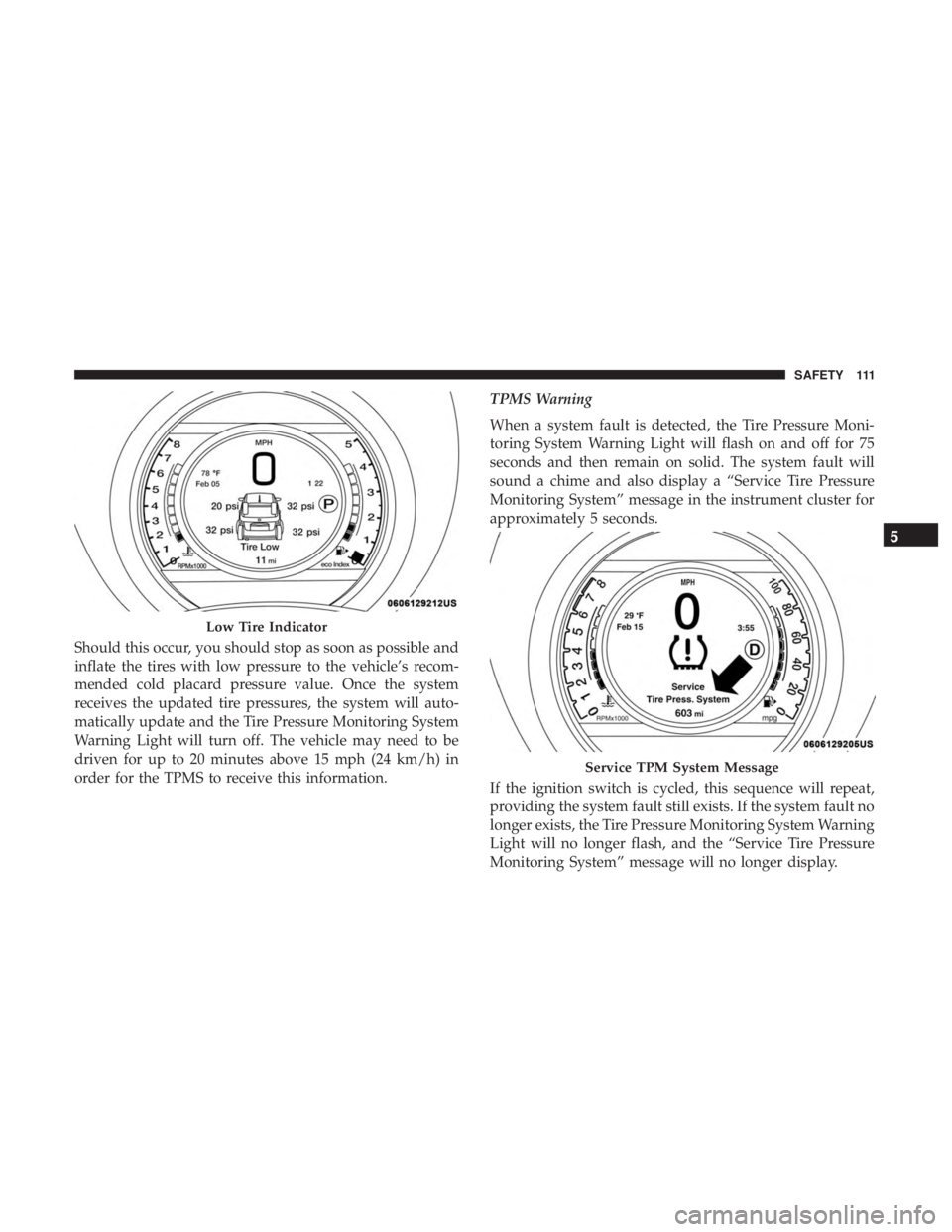
Should this occur, you should stop as soon as possible and
inflate the tires with low pressure to the vehicle’s recom-
mended cold placard pressure value. Once the system
receives the updated tire pressures, the system will auto-
matically update and the Tire Pressure Monitoring System
Warning Light will turn off. The vehicle may need to be
driven for up to 20 minutes above 15 mph (24 km/h) in
order for the TPMS to receive this information.TPMS Warning
When a system fault is detected, the Tire Pressure Moni-
toring System Warning Light will flash on and off for 75
seconds and then remain on solid. The system fault will
sound a chime and also display a “Service Tire Pressure
Monitoring System” message in the instrument cluster for
approximately 5 seconds.
If the ignition switch is cycled, this sequence will repeat,
providing the system fault still exists. If the system fault no
longer exists, the Tire Pressure Monitoring System Warning
Light will no longer flash, and the “Service Tire Pressure
Monitoring System” message will no longer display.
Low Tire Indicator
Service TPM System Message
5
SAFETY 111
Page 114 of 332
A system fault can occur due to any of the following:
1. Signal interference due to electronic devices or drivingnext to facilities emitting the same radio frequencies as
the TPM sensors.
2. Installing aftermarket window tinting that contains ma- terials that may block radio wave signals.
3. Accumulation of snow or ice around the wheels or wheel housings.
4. Using tire chains on the vehicle.
5. Using wheels/tires not equipped with TPM sensors.
NOTE:
• The TPMS will not monitor the pressure in a replace-
ment tire installed without a tire pressure sensor.
• If you install a replacement tire in place of a road tire
that has a pressure below the low-pressure warning
limit, upon the next ignition switch cycle, the Tire
Pressure Monitoring System Warning Light will remain
on and a chime will sound. In addition, the graphic in
the instrument cluster will still display a low pressure
message and a tire highlighted in a different color. •
After driving the vehicle for up to 20 minutes above
15 mph (24 km/h), the Tire Pressure Monitoring System
Warning Light will flash on and off for 75 seconds and
then remain on solid. In addition, the instrument cluster
will display a “Service TPM System” message.
• For each subsequent ignition switch cycle, a chime will
sound, the Tire Pressure Monitoring System Warning
Light will flash on and off for 75 seconds and then
remain on solid, and the instrument cluster will display
a “Service Tire Pressure Monitoring System” message.
Once you repair or replace the original road tire and
reinstall it, the TPMS will update automatically. In addi-
tion, the Tire Pressure Monitoring System Warning Light
will turn off as long as no tire pressure is below the
low-pressure warning limit in any of the four active road
tires. The vehicle may need to be driven for up to 20
minutes above 15 mph (24 km/h) in order for the TPMS to
receive this information.
General Information
This device complies with Part 15 of the FCC rules and RSS
210 of Industry Canada. Operation is subject to the follow-
ing conditions:
1. This device may not cause harmful interference.
112 SAFETY
Page 116 of 332
7. The driver and front passenger seats should be movedback as far as practical to allow the front air bags room
to inflate.
8. Do not lean against the door or window. If your vehicle has side air bags, and deployment occurs, the side air
bags will inflate forcefully into the space between occu-
pants and the door and occupants could be injured.
9. If the air bag system in this vehicle needs to be modified to accommodate a disabled person, refer to the “Cus-
tomer Assistance” section for customer service contact
information.
WARNING!
•Never place a rear-facing child restraint in front of an
air bag. A deploying passenger front air bag can
cause death or serious injury to a child 12 years or
younger, including a child in a rear-facing child
restraint.
• Never install a rear-facing child restraint in the front
seat of a vehicle. Only use a rear-facing child re-
straint in the rear seat. If the vehicle does not have a
rear seat, do not transport a rear-facing child restraint
in that vehicle.
Seat Belt Systems
Buckle up even though you are an excellent driver, even on
short trips. Someone on the road may be a poor driver and
could cause a collision that includes you. This can happen
far away from home or on your own street.
Research has shown that seat belts save lives, and they can
reduce the seriousness of injuries in a collision. Some of the
worst injuries happen when people are thrown from the
vehicle. Seat belts reduce the possibility of ejection and the
risk of injury caused by striking the inside of the vehicle.
Everyone in a motor vehicle should be belted at all times.
Enhanced Seat Belt Use Reminder System (BeltAlert)
Driver and Passenger BeltAlert (if equipped)
BeltAlert is a feature intended to remind the driver
and outboard front seat passenger (if equipped with
outboard front passenger seat BeltAlert) to buckle their
seat belts. The Belt Alert feature is active whenever the
ignition switch is in the START or ON/RUN position.
Initial Indication
If the driver is unbuckled when the ignition switch is first
in the START or ON/RUN position, a chime will signal for
114 SAFETY