battery FIAT 500E 2013 2.G User Guide
[x] Cancel search | Manufacturer: FIAT, Model Year: 2013, Model line: 500E, Model: FIAT 500E 2013 2.GPages: 350, PDF Size: 2.49 MB
Page 27 of 350
Charging The High Voltage Battery
1. Put the vehicle in PARK.
2. Turn the ignition to the OFF position.
3. Remove the Level 1 EVSE from its storage bin bylifting the rear cargo cover. 4. Uncoil the entire length of the EVSE (charge cord).
5. Plug the EVSE into a standard 120V AC outlet that is
properly grounded. It is recommended that the EVSE
is connected to an AC outlet on a circuit which is not
electrically loaded by other devices. Extension cords
may not be used.
NOTE: All of the EVSE LED’s illuminate green.
6. Open the charge receptacle door.
NOTE: The charge receptacle door is locked whenever
the vehicle is locked. Unlock the doors to unlock the
charge receptacle door for charging.
EVSE Location
2
THINGS TO KNOW BEFORE STARTING YOUR VEHICLE 25
Page 30 of 350
Vehicle Charge Indicators
Instrument Cluster Battery Gauge
There is a battery gauge indicator located on the instru-
ment cluster. The battery gauge will display, with pro-
gressive color indication, the current state of charge for
the high voltage battery; with the percentage value
located at the bottom of the gauge.Charge Low and Limited Power Messages
The state of charge is monitored during normal opera-
tion. If the state of charge reaches certain thresholds the
following messages will also be displayed on the cluster:
Battery Gauge
28 THINGS TO KNOW BEFORE STARTING YOUR VEHICLE
Page 31 of 350
•charge low — displayed at 17% (warning displayed for
five seconds).
• charge low — displayed at 11% (remains on until the
condition changes).
• charge low limited power mode — turtle displayed at
5% and remains on. •
charge low limited power mode — turtle flashes at 0%
until condition changes.
NOTE: The limited power mode can also be activated if
the high voltage battery temperature is to high or to low.
Charge Low Message
Charge Low Limited Power Mode
2
THINGS TO KNOW BEFORE STARTING YOUR VEHICLE 29
Page 32 of 350
NOTE:At 0% state of charge or below the following
features will be disabled if in use:
• Heated Seats
• Electronic Speed Control
• Climate Controls
Instrument Panel State Of Charge Indicator
In addition to the battery gauge your vehicle is equipped
with a visual state of charge indicator. The state of charge
indicator is made up of five lights that are mounted to the
center of the instrument panel. The state of charge indicator represents the current state
of charge for the high voltage battery. The state of charge
indicator lights quickly to identify the battery state of
charge while the vehicle is being charged. Each light
represents the percent of charge that the battery is
currently at.
State Of Charge Indicator
30 THINGS TO KNOW BEFORE STARTING YOUR VEHICLE
Page 33 of 350
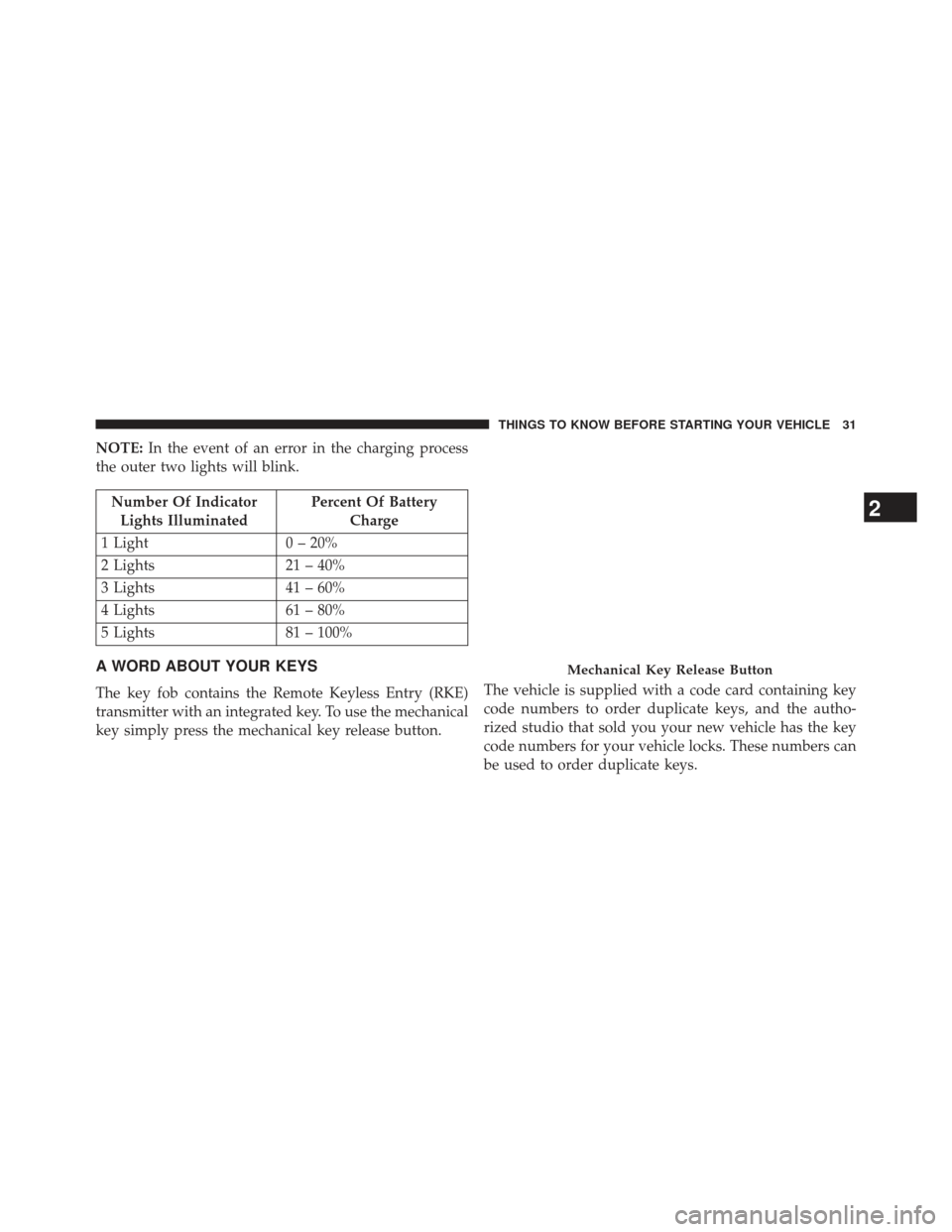
NOTE:In the event of an error in the charging process
the outer two lights will blink.
Number Of Indicator Lights Illuminated Percent Of Battery
Charge
1 Light 0 – 20%
2 Lights 21 – 40%
3 Lights 41 – 60%
4 Lights 61 – 80%
5 Lights 81 – 100%
A WORD ABOUT YOUR KEYS
The key fob contains the Remote Keyless Entry (RKE)
transmitter with an integrated key. To use the mechanical
key simply press the mechanical key release button. The vehicle is supplied with a code card containing key
code numbers to order duplicate keys, and the autho-
rized studio that sold you your new vehicle has the key
code numbers for your vehicle locks. These numbers can
be used to order duplicate keys.
Mechanical Key Release Button
2
THINGS TO KNOW BEFORE STARTING YOUR VEHICLE 31
Page 39 of 350
To Lock The Doors And Liftgate
Press and release the LOCK button on the RKE transmit-
ter to lock all doors and the liftgate. The turn signal lights
will flash and the horn will chirp to acknowledge the
signal. If a door is ajar the turn signal lights will flash at
an increased rate and there will be no horn chirp, this is
to indicate that a door is still ajar.
Programming Additional Transmitters
Refer to Sentry Key® “Customer Key Programming.”
If you do not have a programmed RKE transmitter,
contact your authorized studio for details.
General Information
This device complies with Part 15 of FCC rules and with
RS-210 of Industry Canada. Operation is subject to the
following conditions:
1. This device may not cause harmful interference.2. This device must accept any interference that may be
received including interference that may cause unde-
sired operation.
NOTE: Changes or modifications not expressly ap-
proved by the party responsible for compliance could
void the user’s authority to operate the equipment.
If your RKE transmitter fails to operate from a normal
distance, check for these two conditions:
1. Weak battery in RKE transmitter. The expected life of the battery is from one to two years.
2. Closeness to a radio transmitter such as a radio station tower, airport transmitter, and some mobile or CB
radios.Transmitter Battery Replacement
NOTE: Perchlorate Material – special handling may ap-
ply. See www.dtsc.ca.gov/hazardouswaste/perchlorate
2
THINGS TO KNOW BEFORE STARTING YOUR VEHICLE 37
Page 40 of 350

The recommended replacement battery is CR2032.
1. Press the mechanical key release button and releasethe mechanical key to access the battery case screw
located on the side of the Key Fob. 2. Rotate the screw located on the side of the Key Fob
using a small screwdriver.
Mechanical Key Release Button
Key Fob Screw Location
38 THINGS TO KNOW BEFORE STARTING YOUR VEHICLE
Page 41 of 350
3. Take out the battery case. Remove and replace thebattery observing its polarity.
4. Refit the battery case inside the Key Fob and turn the screw to lock it into place.DOOR LOCKS
The door locks can be manually locked or unlocked from
inside the vehicle by using the door handle. If the door
handle is pushed a red lock indicator will show on the
door handle (indicating locked) when the door is closed,
the door will lock.
Battery Case Removed
Door Lock Handle
2
THINGS TO KNOW BEFORE STARTING YOUR VEHICLE 39
Page 66 of 350
hand, depending on the type and location of impact,
Advanced Front Air Bags may deploy in crashes with
little vehicle front-end damage but that produce a severe
initial deceleration.
The side air bags will not deploy in all side collisions.
Side air bag deployment will depend on the severity and
type of collision.
Because air bag sensors measure vehicle deceleration
over time, vehicle speed and damage by themselves are
not good indicators of whether or not an air bag should
have deployed.
Seat belts are necessary for your protection in all colli-
sions, and also are needed to help keep you in position,
away from an inflating air bag.
The ORC monitors the readiness of the electronic parts of
the air bag system whenever the ignition switch is in theON/RUN or START position. If the key is in the OFF/
LOCK position, or not in the ignition, the air bag system
is not on and the air bags will not inflate.
The ORC contains a backup power supply system that
may deploy the air bags even if the battery loses power or
it becomes disconnected prior to deployment.
Also, the ORC turns on the Air Bag Warning
Light in the instrument panel for approxi-
mately four to eight seconds for a self-check
when the ignition is first turned on. After the
self-check, the Air Bag Warning Light will turn off. If the
ORC detects a malfunction in any part of the system, it
turns on the Air Bag Warning Light, either momentarily
or continuously. A single chime will sound if the light
comes on again after initial startup.
It also includes diagnostics that will illuminate the instru-
ment cluster Air Bag Warning Light if a malfunction is
64 THINGS TO KNOW BEFORE STARTING YOUR VEHICLE
Page 69 of 350
covers the window. The air bag inflates in about 30
milliseconds (about one-quarter of the time that it takes
to blink your eyes) with enough force to injure you if you
are not belted and seated properly, or if items are
positioned in the area where the side curtain air bag
inflates. This especially applies to children. The side
curtain air bag is about 3-1/2 in (9 cm) thick when it is
inflated.
Because air bag sensors estimate deceleration over time,
vehicle speed and damage are not good indicators of
whether or not an air bag should have deployed.
Front And Side Impact Sensors
In front and side impacts, impact sensors can aid the
ORC in determining appropriate response to impact
events.
Enhanced Accident Response System
In the event of an impact causing air bag deployment, if
the communication network and power remains intact,
depending on the nature of the event, the ORC will
determine whether to have the Enhanced Accident Re-
sponse System perform the following functions:
•Disable the high voltage battery.
• Place the transmission into PARK.
• Flash hazard lights as long as the 12 Volt battery has
power or until the ignition key is turned off.
• Turn on the interior lights, which remain on as long as
the 12 Volt battery has power or until the ignition key
is removed.
• Unlock the doors automatically.
2
THINGS TO KNOW BEFORE STARTING YOUR VEHICLE 67