Light FIAT 500E 2013 2.G Repair Manual
[x] Cancel search | Manufacturer: FIAT, Model Year: 2013, Model line: 500E, Model: FIAT 500E 2013 2.GPages: 350, PDF Size: 2.49 MB
Page 259 of 350
NOTE:
•The TPMS will not monitor the pressure in a replace-
ment tire installed without a tire pressure sensor.
• If you install a replacement tire in place of a road tire
that has a pressure below the low-pressure warning
limit, upon the next ignition switch cycle, the “Tire
Pressure Monitoring Telltale Light” will remain on and
a chime will sound. In addition, the graphic in the
EVIC will still display a pressure value in a different
color.
• After driving the vehicle for up to 20 minutes above
15 mph (24 km/h), the “Tire Pressure Monitoring
Telltale Light” will flash on and off for 75 seconds and
then remain on solid. In addition, the EVIC will
display a “Service TPM System” message for a mini-
mum of five seconds and then display dashes (- -) in
place of the pressure value. •
For each subsequent ignition switch cycle, a chime will
sound, the “Tire Pressure Monitoring Telltale Light”
will flash on and off for 75 seconds and then remain on
solid, and the EVIC will display a “Service TPM
System” message for a minimum of five seconds and
then display dashes (- -) in place of the pressure value.
Once you repair or replace the original road tire and
reinstall it, the TPMS will update automatically. In addi-
tion, the “Tire Pressure Monitoring Telltale Light” will
turn off and the graphic in the EVIC will display a new
pressure value instead of dashes (- -), as long as no tire
pressure is below the low-pressure warning limit in any
of the four active road tires. The vehicle may need to be
driven for up to 20 minutes above 15 mph (24 km/h) in
order for the TPMS to receive this information.
5
STARTING AND OPERATING 257
Page 263 of 350

Range Projection
This area of the cluster is used to display the projected
range of the high voltage battery. The two arrows to the
left of the mileage are used to forecast the effect of recent
driving.
•When both arrows are grey, expect the range to drop
approximately one mile for each mile driven.
• When the up arrow is highlighted, expect the range
number to hold steady or increase while driving.
• When the down arrow is highlighted, expect the range
number to decrease more than one mile for each mile
driven.
Range Projection Indicators
5
STARTING AND OPERATING 261
Page 301 of 350
WARNING!
Commercially available windshield washer solvents
are flammable. They could ignite and burn you. Care
must be exercised when filling or working around
the washer solution.
Brake System
In order to assure brake system performance, all brake
system components should be inspected periodically.
Refer to the “Maintenance Schedule” for the proper
maintenance intervals.
WARNING!
Riding the brakes can lead to brake failure and
possibly a collision. Driving with your foot resting or
riding on the brake pedal can result in abnormally
(Continued)
WARNING!(Continued)
high brake temperatures, excessive lining wear, and
possible brake damage. Riding the brakes may also
reduce braking capacity in an emergency.
Brake Master Cylinder
The fluid level in the master cylinder should be checked
when performing under hood services, or immediately if
the “Brake Warning Light” is on and the parking brake is
not applied.
Be sure to clean the top of the master cylinder area before
removing the cap. If necessary, add fluid to bring the
fluid level up to the requirements described on the brake
fluid reservoir. Fluid level can be expected to fall as the
brake pads wear. The brake fluid level should be checked
when the pads are replaced. However, low fluid level
may be caused by a leak and a checkup may be needed.
7
MAINTAINING YOUR VEHICLE 299
Page 307 of 350
WARNING!
Do not use volatile solvents for cleaning purposes.
Many are potentially flammable, and if used in
closed areas they may cause respiratory harm.
CAUTION!
Do not use Alcohol and Alcohol-based and/or Keton
based cleaning products to clean leather seats, as
damage to the seat may result.
Cleaning Headlights
Your vehicle has plastic headlights that are lighter and
less susceptible to stone breakage than glass headlights.
Plastic is not as scratch resistant as glass and therefore
different lens cleaning procedures must be followed.To minimize the possibility of scratching the lenses and
reducing light output, avoid wiping with a dry cloth. To
remove road dirt, wash with a mild soap solution fol-
lowed by rinsing.
Do not use abrasive cleaning components, solvents, steel
wool or other aggressive material to clean the lenses.
Glass Surfaces
All glass surfaces should be cleaned on a regular basis
with MOPAR® Glass Cleaner, or any commercial
household-type glass cleaner. Never use an abrasive type
cleaner. Use caution when cleaning the inside rear win-
dow equipped with electric defrosters or the right rear
quarter window equipped with the radio antenna. Do
not use scrapers or other sharp instrument that may
scratch the elements.
7
MAINTAINING YOUR VEHICLE 305
Page 310 of 350
Interior Fuses
The interior fuse panel is part of the Body Control
Module (BCM) and is located on the driver’s side under
the instrument panel.CavityVehicle
Fuse
Number Mini
Fuse Description
1 F12 7.5 Amp
Brown Right Low Beam
2 F32 5 Amp Ta nFront and Rear
Ceiling Lights
Trunk and Door
Courtesy Lights
3 F53 5 Amp Ta nInstrument Panel
Node
4 F38 20 Amp YellowCentral Door Lock-
ing
Fuse Panel
308 MAINTAINING YOUR VEHICLE
Page 311 of 350
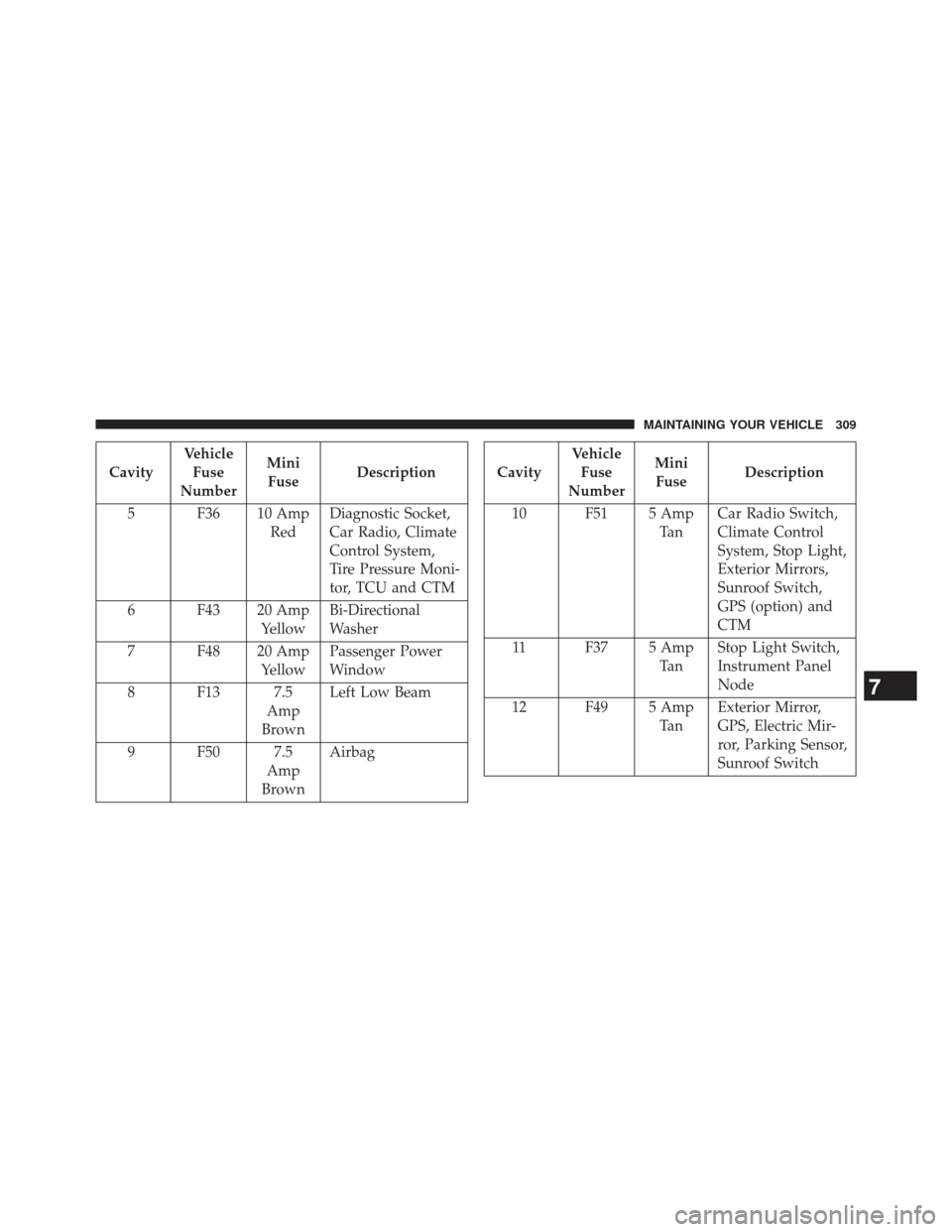
CavityVehicle
Fuse
Number Mini
Fuse Description
5 F36 10 Amp RedDiagnostic Socket,
Car Radio, Climate
Control System,
Tire Pressure Moni-
tor, TCU and CTM
6 F43 20 Amp YellowBi-Directional
Washer
7 F48 20 Amp YellowPassenger Power
Window
8 F13 7.5 Amp
Brown Left Low Beam
9 F50 7.5 Amp
Brown AirbagCavity
Vehicle
Fuse
Number Mini
Fuse Description
10 F51 5 Amp Ta nCar Radio Switch,
Climate Control
System, Stop Light,
Exterior Mirrors,
Sunroof Switch,
GPS (option) and
CTM
11 F37 5 Amp Ta nStop Light Switch,
Instrument Panel
Node
12 F49 5 Amp Ta nExterior Mirror,
GPS, Electric Mir-
ror, Parking Sensor,
Sunroof Switch
7
MAINTAINING YOUR VEHICLE 309
Page 313 of 350
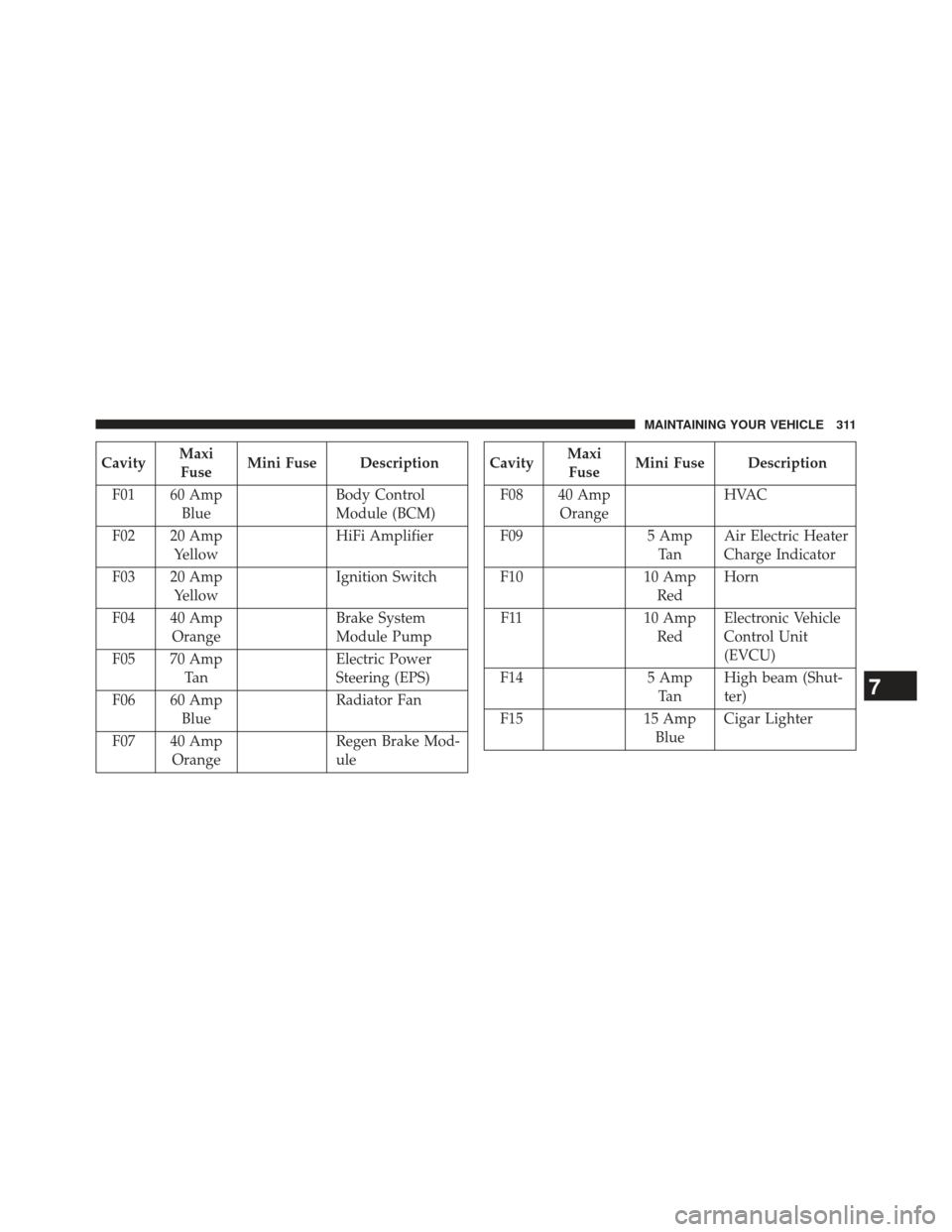
CavityMaxi
Fuse Mini Fuse Description
F01 60 Amp Blue Body Control
Module (BCM)
F02 20 Amp Yellow HiFi Amplifier
F03 20 Amp Yellow Ignition Switch
F04 40 Amp Orange Brake System
Module Pump
F05 70 Amp Ta n Electric Power
Steering (EPS)
F06 60 Amp Blue Radiator Fan
F07 40 Amp Orange Regen Brake Mod-
uleCavity
Maxi
Fuse Mini Fuse Description
F08 40 Amp Orange HVAC
F09 5 Amp
Ta n Air Electric Heater
Charge Indicator
F10 10 Amp
Red Horn
F11 10 Amp
Red Electronic Vehicle
Control Unit
(EVCU)
F14 5 Amp
Ta n High beam (Shut-
ter)
F15 15 Amp
Blue Cigar Lighter
7
MAINTAINING YOUR VEHICLE 311
Page 319 of 350
7. Reinstall the plastic cap.
Front Fog Lamps
To replace the front fog lights, see your authorized
studio.
Front/Rear Side Marker Lamps
1. Remove portion of the wheel liner to allow handaccess to side marker lamp.
2. Rotate the bulb socket counterclockwise, and remove the bulb and socket assembly from the housing.
3. Pull the bulb from the socket and insert the replace- ment bulb.
4. Install the bulb and socket assembly into the housing, and rotate the socket clockwise to lock it in place.
5. Reinstall the wheel liner.
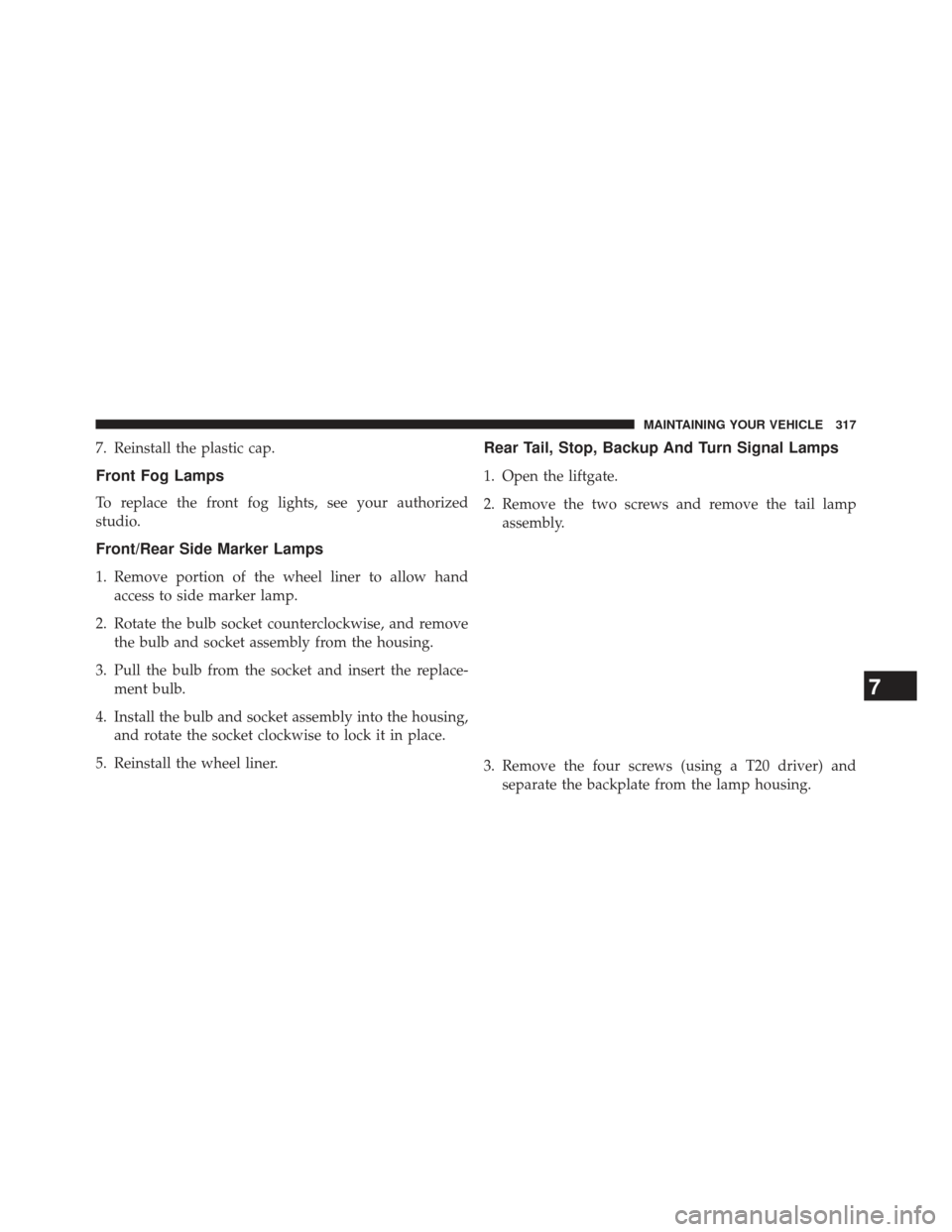
Rear Tail, Stop, Backup And Turn Signal Lamps
1. Open the liftgate.
2. Remove the two screws and remove the tail lamp assembly.
3. Remove the four screws (using a T20 driver) and separate the backplate from the lamp housing.
7
MAINTAINING YOUR VEHICLE 317
Page 320 of 350
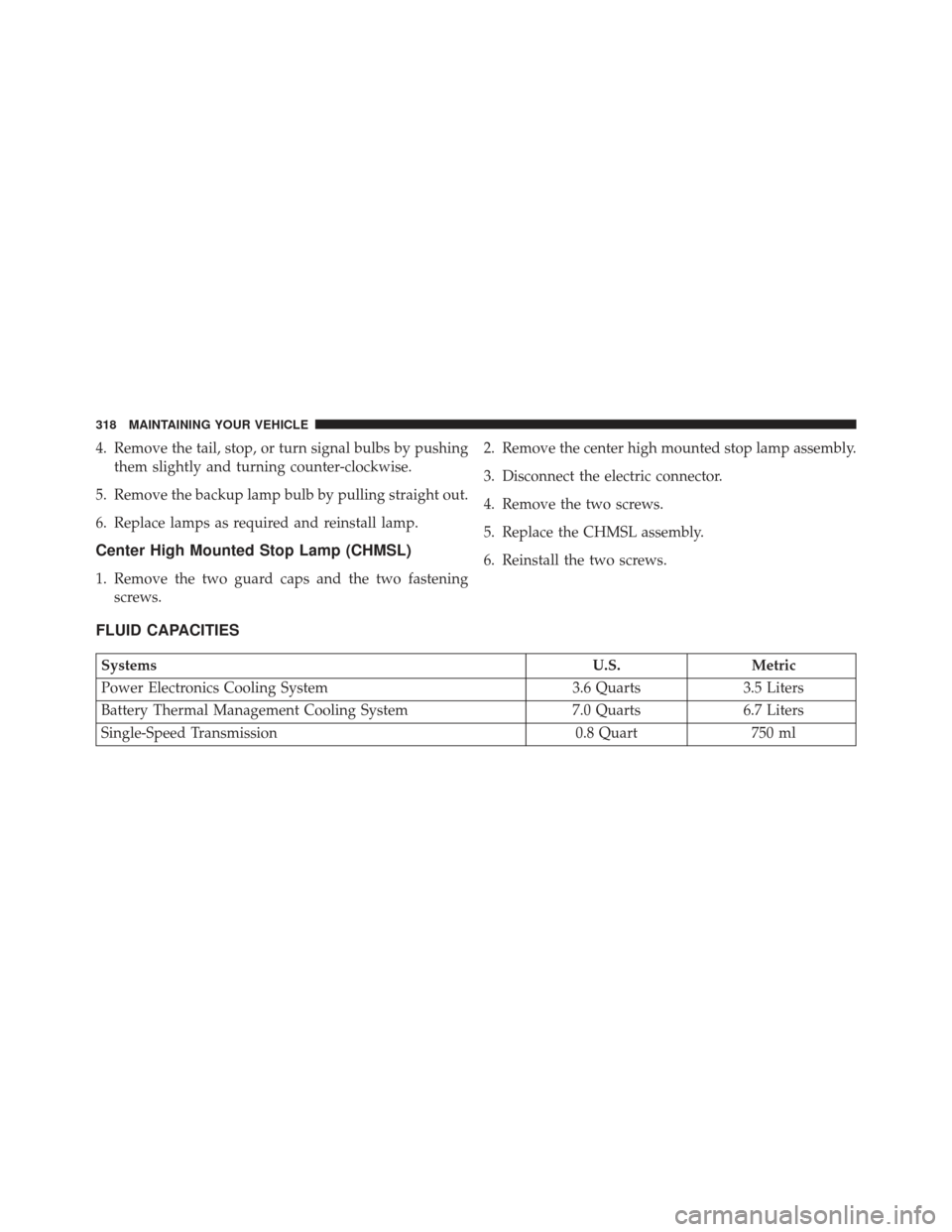
4. Remove the tail, stop, or turn signal bulbs by pushingthem slightly and turning counter-clockwise.
5. Remove the backup lamp bulb by pulling straight out.
6. Replace lamps as required and reinstall lamp.
Center High Mounted Stop Lamp (CHMSL)
1. Remove the two guard caps and the two fastening screws. 2. Remove the center high mounted stop lamp assembly.
3. Disconnect the electric connector.
4. Remove the two screws.
5. Replace the CHMSL assembly.
6. Reinstall the two screws.
FLUID CAPACITIES
Systems
U.S.Metric
Power Electronics Cooling System 3.6 Quarts3.5 Liters
Battery Thermal Management Cooling System 7.0 Quarts6.7 Liters
Single-Speed Transmission 0.8 Quart750 ml
318 MAINTAINING YOUR VEHICLE
Page 324 of 350
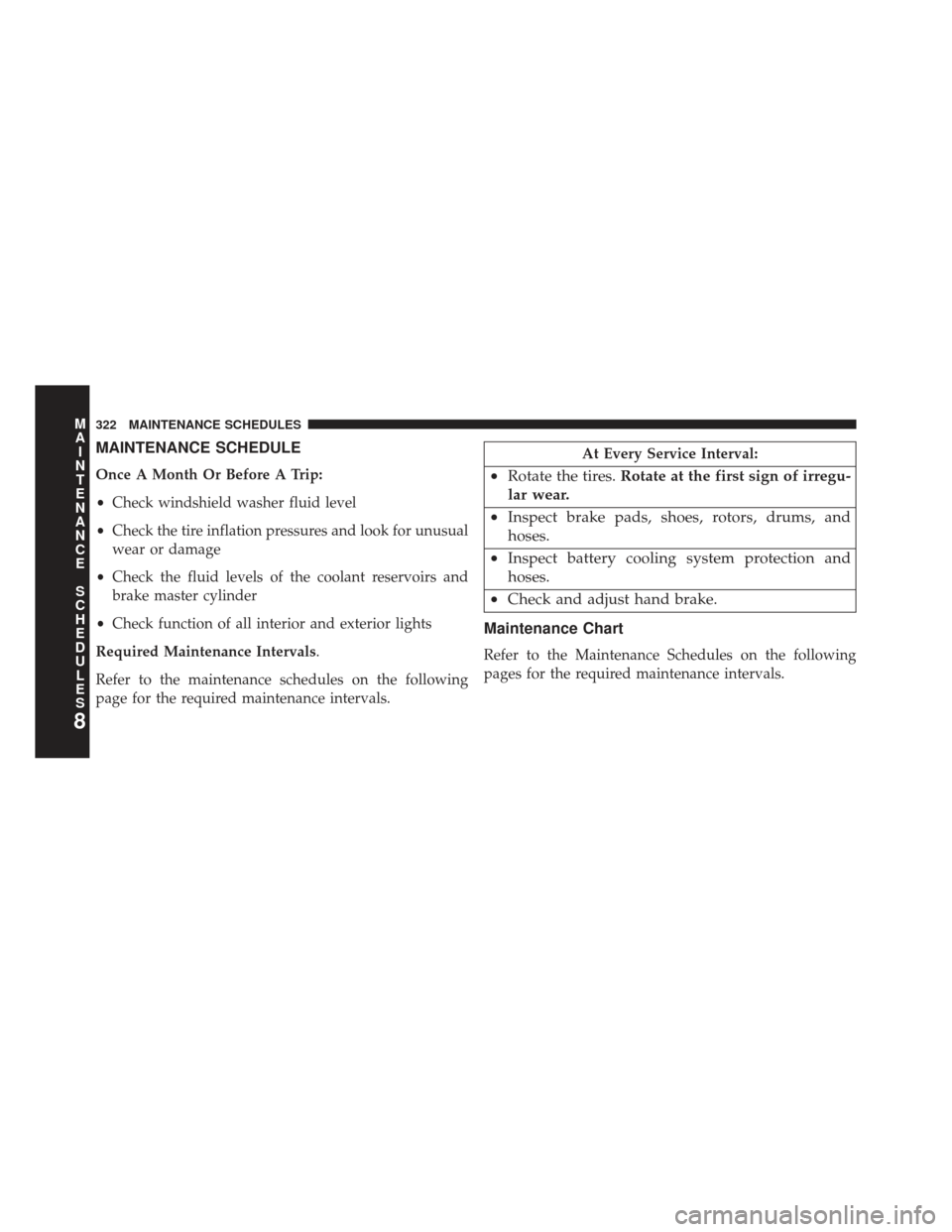
MAINTENANCE SCHEDULE
Once A Month Or Before A Trip:
•Check windshield washer fluid level
• Check the tire inflation pressures and look for unusual
wear or damage
• Check the fluid levels of the coolant reservoirs and
brake master cylinder
• Check function of all interior and exterior lights
Required Maintenance Intervals.
Refer to the maintenance schedules on the following
page for the required maintenance intervals.
At Every Service Interval:
• Rotate the tires. Rotate at the first sign of irregu-
lar wear.
• Inspect brake pads, shoes, rotors, drums, and
hoses.
• Inspect battery cooling system protection and
hoses.
• Check and adjust hand brake.
Maintenance Chart
Refer to the Maintenance Schedules on the following
pages for the required maintenance intervals.
8
M A I
N T
E
N
A
N
C E
S
C
H E
D
U L
E
S322 MAINTENANCE SCHEDULES