brake FIAT 500E 2013 2.G Owner's Manual
[x] Cancel search | Manufacturer: FIAT, Model Year: 2013, Model line: 500E, Model: FIAT 500E 2013 2.GPages: 84, PDF Size: 1.56 MB
Page 64 of 84
MANUAL PARK RELEASE
WARNING!
Always secure your vehicle by fully applying the parking brake, before activating the
Manual Park Release.Activating the Manual Park Release will allow your vehicle to roll
away if it is not secured by the parking brake or other means. Activating the Manual Park
Release on an unsecured vehicle could lead to serious injury or death for those in or
around the vehicle .
• In order to move the vehicle in cases where the transmission will not shift out of PARK
(such as a dead battery), a Manual Park Release is available .Ifadead12voltbatteryis
the cause of the condition refer to “Jump Start Procedure — 12 Volt Battery” before
performing the Manual Park Release .
• To perform the Manual Park Release follow these steps:
1. To prevent the vehicle from rolling unintentionally, firmly apply the parking brake .
2.
If possible, raise the front driver's side of the vehicle to provide access to the transmission .
3.Working from underneath the vehicle, remove the black rubber plug from the front of
the Park module (a black canister mounted on the front of the transmission).
4. Using a T25 driver bit, rotate the Manual Park Release shaft (located just behind the
rubber plug) clockwise, at least 20 turns, to release the Park mechanism. The vehicle is
now out of PARK and can be moved.
5. Reinstall the rubber plug.
6. Release the parking brake only when a
driver is in the vehicle, or the vehicle is
secured by other means. The Manual Park
Release will be reset automatically once
the vehicle is restarted.
WHAT TO DO IN EMERGENCIES
62
Page 66 of 84
ENHANCED ACCIDENT RESPONSE SYSTEM
•In the event of an impact causing air bag deployment, if the communication network andpower remains intact, depending on the nature of the event, the ORC will determine
whether to have the Enhanced Accident Response System perform the following functions:
• Disable the high voltage battery .
• Place the transmission into PARK.
• Flash hazard lights as long as the 12 Volt battery has power or until the ignition key is
turned off.
• Turn on the interior lights, which remain on as long as the 12 Volt battery has power or
until the ignition key is removed.
• Unlock the doors automatically .
•
In order to move your vehicle to the side of the road the transmission must be in NEUTRAL and the 12 Volt system must be functional .To place the transmission into NEUTRAL you must
turn the ignition OFF and then back to the RUN position (cycle the ignition) then press the
NEUTRAL button .
NOTE:
The high voltage battery will remain disabled after an Enhanced Accident Response Event
and must be reset by your authorized studio .
FREEING A STUCK VEHICLE
•If your vehicle becomes stuck in mud, sand or snow, it can often be moved using a
rocking motion. Turn the steering wheel right and left to clear the area around the front
wheels. Then shift back and forth between DRIVE and REVERSE while gently pressing
the accelerator .Use the least amount of accelerator pedal pressure that will maintain the
rocking motion, without spinning the wheels.
NOTE:
Press the “ESC Off ” switch, to place the Electronic Stability Control (ESC) system in “Partial
Off ” mode, before rocking the vehicle .Refer to “Electronic Brake Control” in “Starting And
Operating” for further information. Once the vehicle has been freed, press the “ESC Off ”
switch again to restore “ESC On” mode .
CAUTION!
•When “rocking” a stuck vehicle by shifting between DRIVE and REVERSE, do not
spin the wheels faster than 15 mph (24 km/h), or drivetrain damage may result.
• Spinning the wheels too fast may lead to transmission overheating and failure .It can
also damage the tires. Do not spin the wheels above 30 mph (48 km/h) while in gear .
WHAT TO DO IN EMERGENCIES
64
Page 67 of 84
WARNING!
Fast spinning tires can be dangerous.Forces generated by excessive wheel speeds may
cause damage, or even failure, of the axle and tires .A tire could explode and injure some-
one .Do not spin your vehicle's wheels faster than 30 mph (48 km/h) or for longer than
30 seconds continuously without stopping when you are stuck and do not let anyone near
a spinning wheel, no matter what the speed .
EVENT DATA RECORDER (EDR)
•This vehicle is equipped with an Event Data Recorder (EDR) .The main purpose of an EDR
is to record, in certain crash or near crash-like situations, such as an air bag deployment or
hitting a road obstacle, data that assists in understanding how a vehicle’s systems performed .
The EDR is designed to record data related to vehicle dynamics and safety systems for a
short period of time, typically 30 seconds or less .The EDR in this vehicle is designed to
record such data as:
• How various systems in your vehicle were operating.
• Whether or not the driver and passenger safety belts were buckled/fastened .
• How far (if at all) the driver was depressing the accelerator and/or brake pedal.
• How fast the vehicle was traveling.
• These data can help provide a better understanding of the circumstances in which
crashes and injuries occur .
NOTE:
EDR data are recorded by your vehicle only if a non-trivial crash situation occurs; no data
are recorded by the EDR under normal driving conditions and no personal data (e .g.name,
gender, age, and crash location) are recorded. However, other parties, such as law enforce-
ment, could combine the EDR data with the type of personally identifying data routinely
acquired during a crash investigation.
• To read data recorded by an EDR, special equipment is required, and access to the vehicle
or the EDR is needed. In addition to the vehicle manufacturer, other parties such as law
enforcement, that have the special equipment, can read the information if they have
access to the vehicle or the EDR.
WHAT TO DO IN EMERGENCIES
65
Page 70 of 84
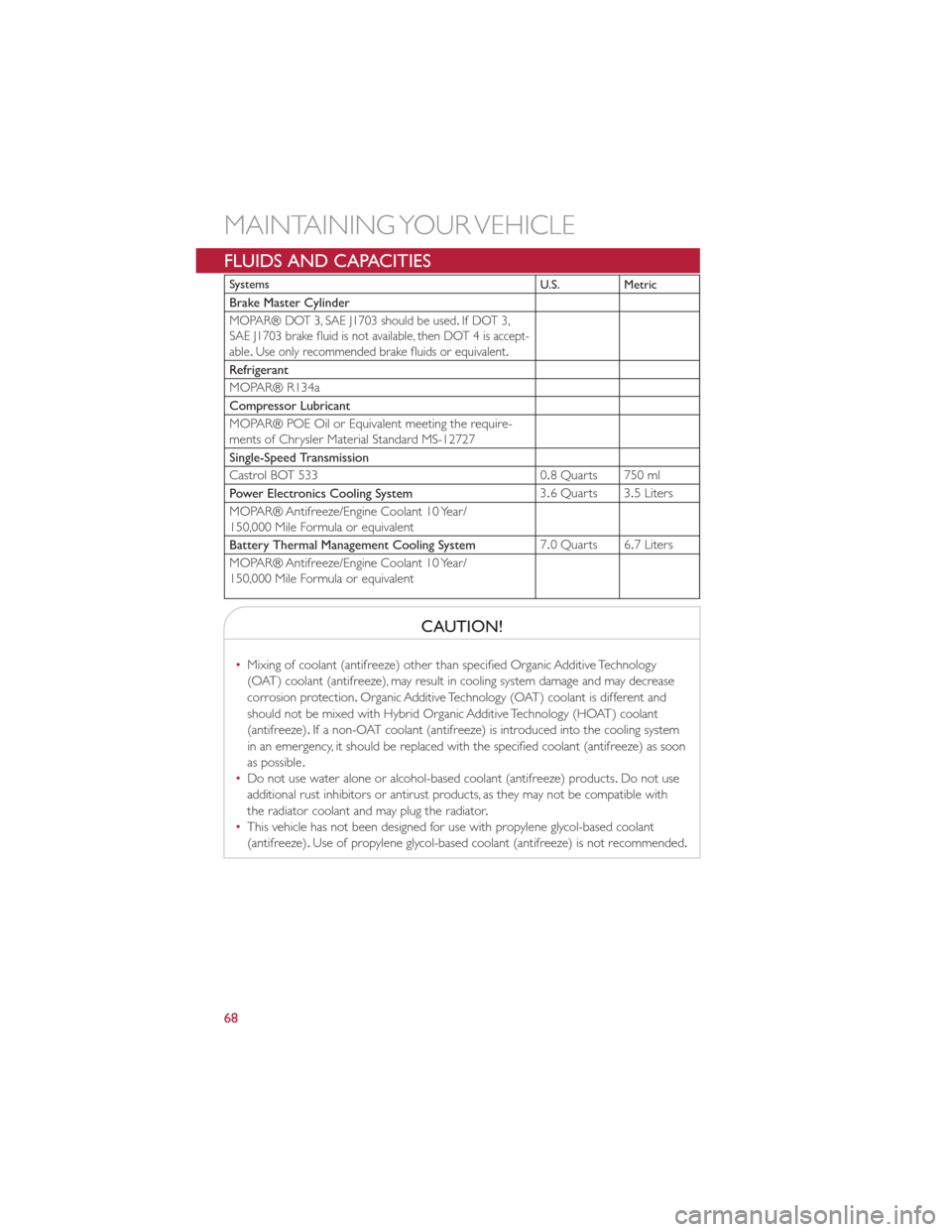
FLUIDS AND CAPACITIES
SystemsU.S. Metric
Brake Master Cylinder
MOPAR® DOT 3, SAE J1703 should be used.If DOT 3,
SAE J1703 brake fluid is not available, then DOT 4 is accept-
able .Use only recommended brake fluids or equivalent .
Refrigerant
MOPAR® R134a
Compressor Lubricant
MOPAR® POE Oil or Equivalent meeting the require-
ments of Chrysler Material Standard MS-12727
Single-Speed Transmission
Castrol BOT 533 0.8 Quarts 750 ml
Power Electronics Cooling System 3.6 Quarts 3
.5 Liters
MOPAR® Antifreeze/Engine Coolant 10 Year/
150,000 Mile Formula or equivalent
Battery Thermal Management Cooling System 7.0 Quarts 6
.7 Liters
MOPAR® Antifreeze/Engine Coolant 10 Year/
150,000 Mile Formula or equivalent
CAUTION!
• Mixing of coolant (antifreeze) other than specified Organic Additive Technology
(OAT) coolant (antifreeze), may result in cooling system damage and may decrease
corrosion protection. Organic Additive Technology (OAT) coolant is different and
should not be mixed with Hybrid Organic Additive Technology (HOAT) coolant
(antifreeze). If a non-OAT coolant (antifreeze) is introduced into the cooling system
in an emergency, it should be replaced with the specified coolant (antifreeze) as soon
as possible .
• Do not use water alone or alcohol-based coolant (antifreeze) products .Do not use
additional rust inhibitors or antirust products, as they may not be compatible with
the radiator coolant and may plug the radiator .
• This vehicle has not been designed for use with propylene glycol-based coolant
(antifreeze). Use of propylene glycol-based coolant (antifreeze) is not recommended.
MAINTAINING YOUR VEHICLE
68
Page 71 of 84
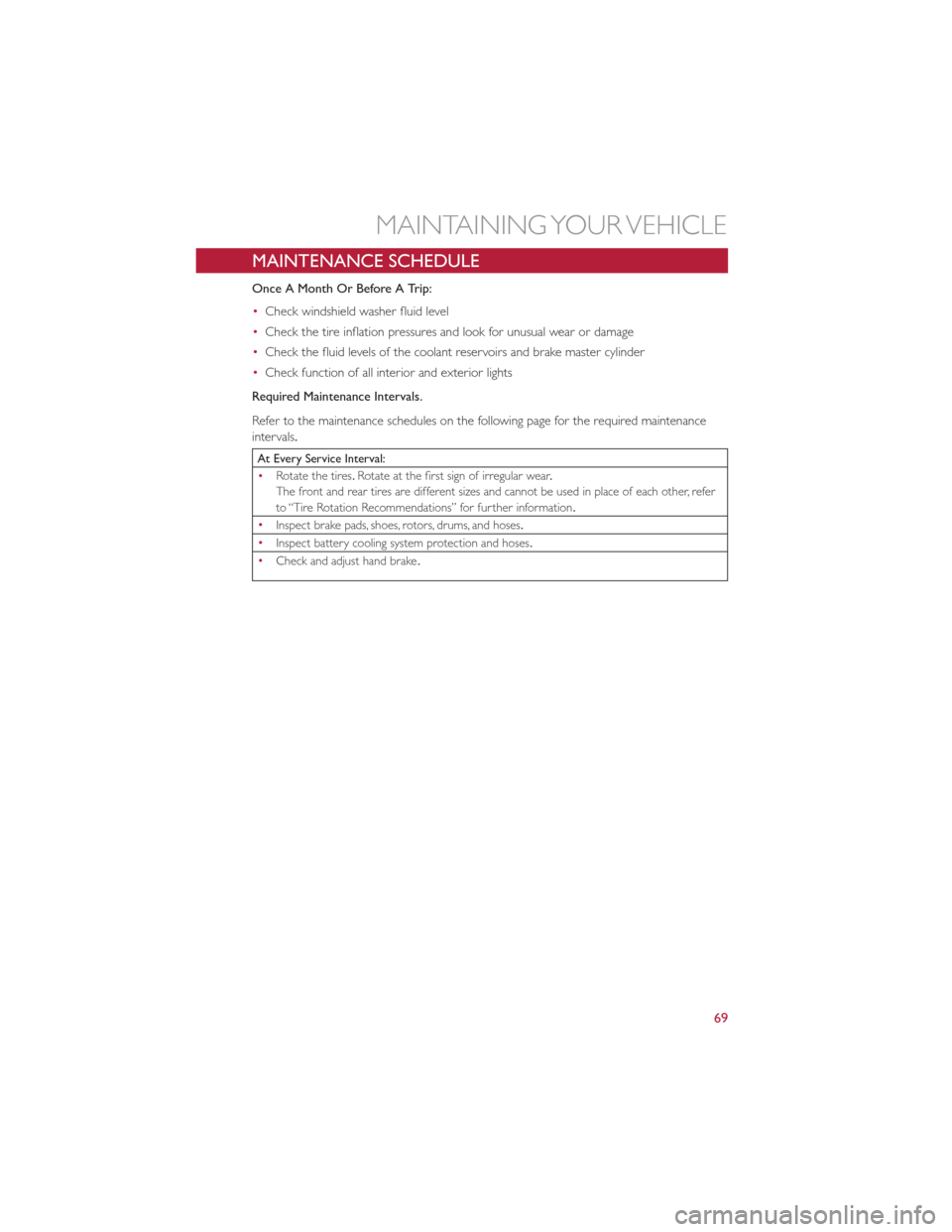
MAINTENANCE SCHEDULE
Once A Month Or Before A Trip:
•Check windshield washer fluid level
• Check the tire inflation pressures and look for unusual wear or damage
• Check the fluid levels of the coolant reservoirs and brake master cylinder
• Check function of all interior and exterior lights
Required Maintenance Intervals.
Refer to the maintenance schedules on the following page for the required maintenance
intervals.
At Every Service Interval:
• Rotate the tires. Rotate at the first sign of irregular wear .
The front and rear tires are different sizes and cannot be used in place of each other, refer
to “Tire Rotation Recommendations” for further information .
• Inspect brake pads, shoes, rotors, drums, and hoses .
• Inspect battery cooling system protection and hoses .
• Check and adjust hand brake .
MAINTAINING YOUR VEHICLE
69
Page 72 of 84
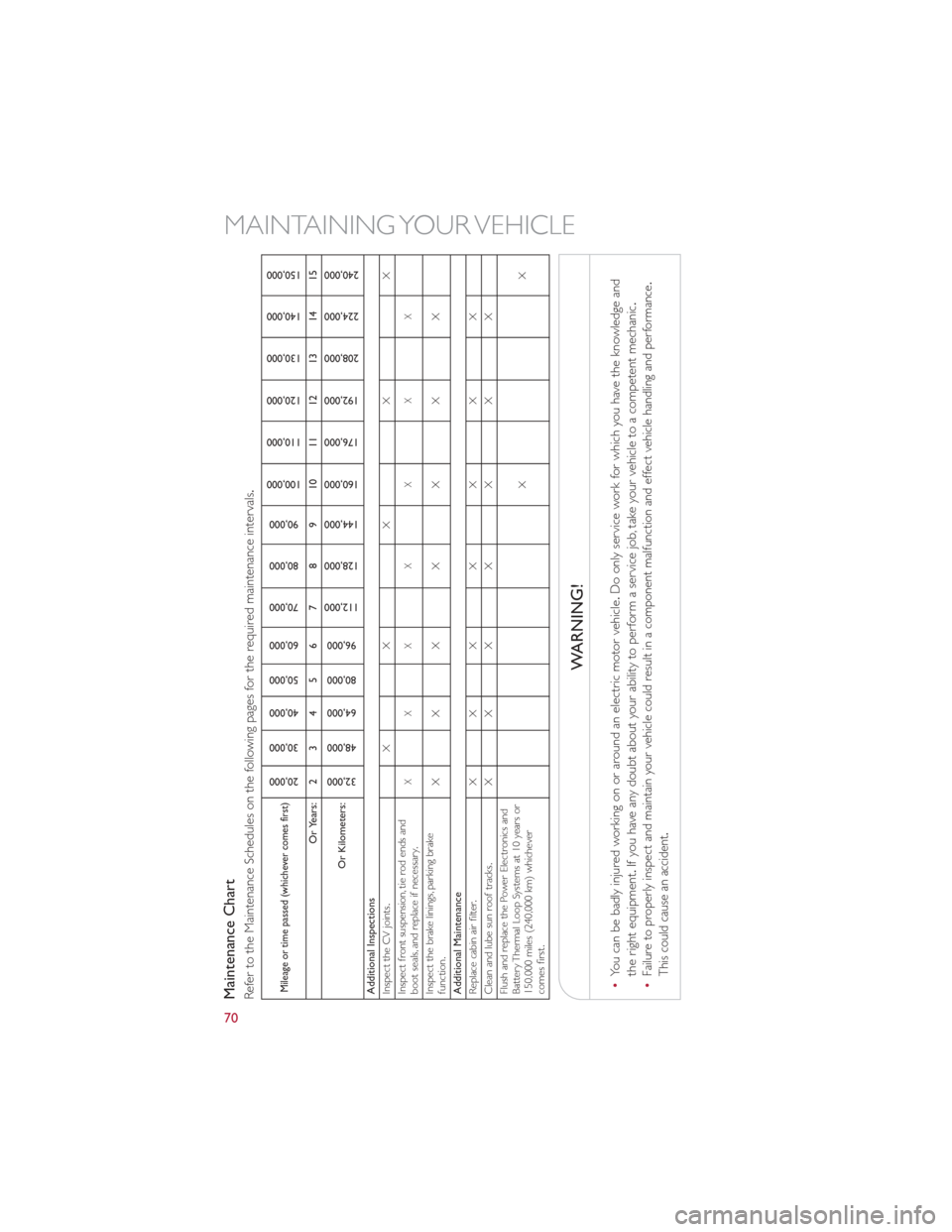
Maintenance ChartRefer to the Maintenance Schedules on the following pages for the required maintenance intervals.Mileage or time passed (whichever comes first)
20,000
30,000
40,000
50,000
60,000
70,000
80,000
90,000
100,000
110,000
120,000
130,000
140,000
150,000
Or Years: 2 3 4 5 6 7 8 9 10 11 12 13 14 15
Or Kilometers:
32,000
48,000
64,000
80,000
96,000
112,000
128,000
144,000
160,000
176,000
192,000
208,000
224,000
240,000
Additional Inspections
Inspect the CV joints. XX X X X
Inspect front suspension, tie rod ends and
boot seals, and replace if necessary .
XXXXXXX
Inspect the brake linings, parking brake
function. XXXXXXX
Additional Maintenance
Replace cabin air filter . XXXXXXX
Clean and lube sun roof tracks .XXXXXXX
Flush and replace the Power Electronics and
Battery Thermal Loop Systems at 10 years or
150,000 miles (240,000 km) whichever
comes first. XX
WARNING!
•
You can be badly injured working on or around an electric motor vehicle .Do only service work for which you have the knowledge and
the right equipment. If you have any doubt about your ability to perform a service job, take your vehicle to a competent mechanic .
•Failure to properly inspect and maintain your vehicle could result in a component malfunction and effect vehicle handling and performance .
This could cause an accident .
MAINTAINING YOUR VEHICLE
70
Page 74 of 84
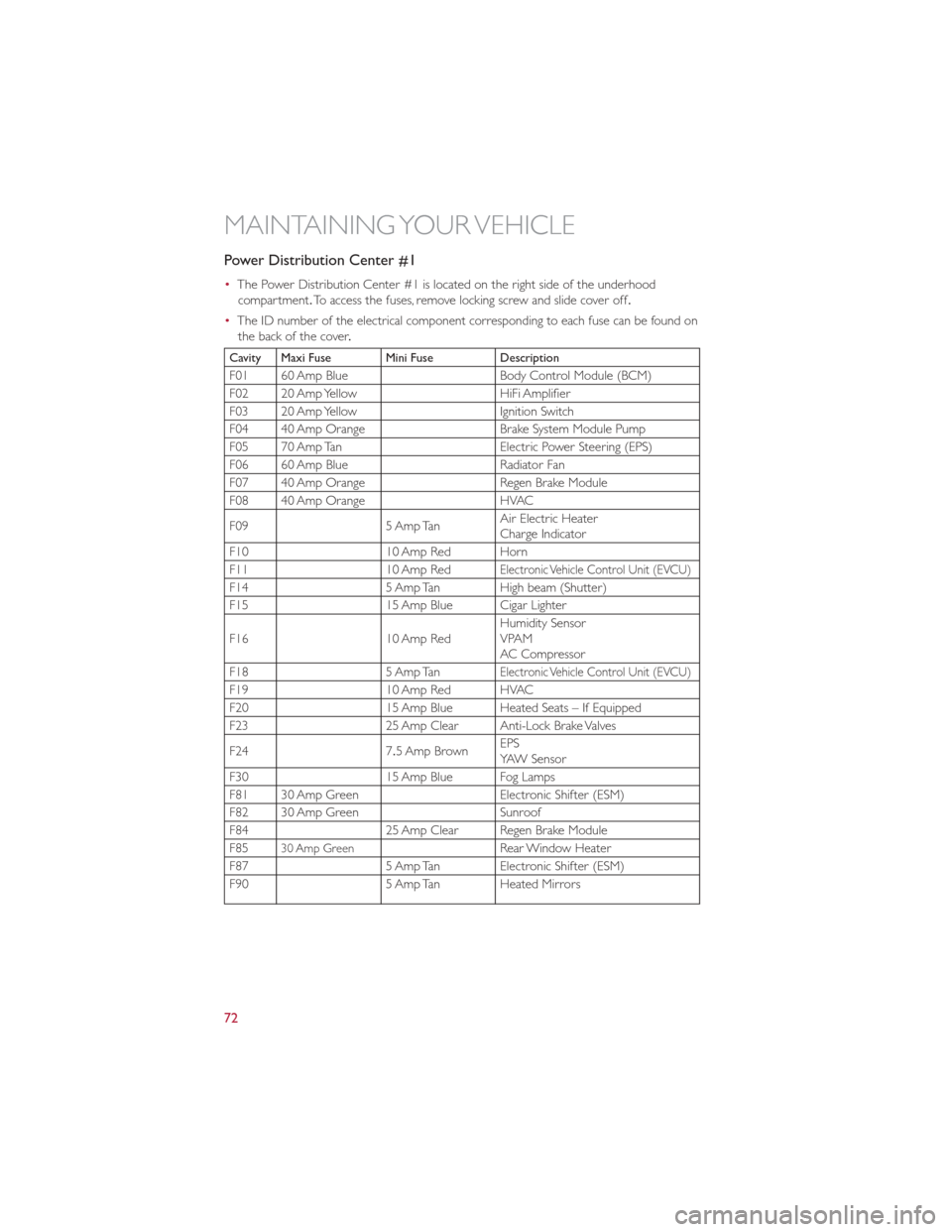
Power Distribution Center #1
•The Power Distribution Center #1 is located on the right side of the underhood
compartment. To access the fuses, remove locking screw and slide cover off.
• The ID number of the electrical component corresponding to each fuse can be found on
thebackofthecover .
Cavity Maxi Fuse Mini Fuse Description
F01 60 Amp BlueBody Control Module (BCM)
F02 20 Amp Yellow HiFi Amplifier
F03 20 Amp Yellow Ignition Switch
F04 40 Amp Orange Brake System Module Pump
F05 70 Amp Tan Electric Power Steering (EPS)
F06 60 Amp Blue Radiator Fan
F07 40 Amp Orange Regen Brake Module
F08 40 Amp Orange HVAC
F09 5 Amp TanAir Electric Heater
Charge Indicator
F10 10 Amp Red Horn
F11 10 Amp Red
Electronic Vehicle Control Unit (EVCU)
F145 Amp Tan High beam (Shutter)
F15 15 Amp Blue Cigar Lighter
F16 10 Amp RedHumidity Sensor
VPAM
AC Compressor
F18 5 Amp Tan
Electronic Vehicle Control Unit (EVCU)
F1910 Amp Red HVAC
F20 15 Amp Blue Heated Seats – If Equipped
F23 25 Amp Clear Anti-Lock Brake Valves
F24 7.5 Amp BrownEPS
YAW Sensor
F30 15 Amp Blue Fog Lamps
F81 30 Amp Green Electronic Shifter (ESM)
F82 30 Amp Green Sunroof
F84 25 Amp Clear Regen Brake Module
F85
30 Amp GreenRear Window Heater
F87 5 Amp Tan Electronic Shifter (ESM)
F90 5 Amp Tan Heated Mirrors
MAINTAINING YOUR VEHICLE
72
Page 77 of 84
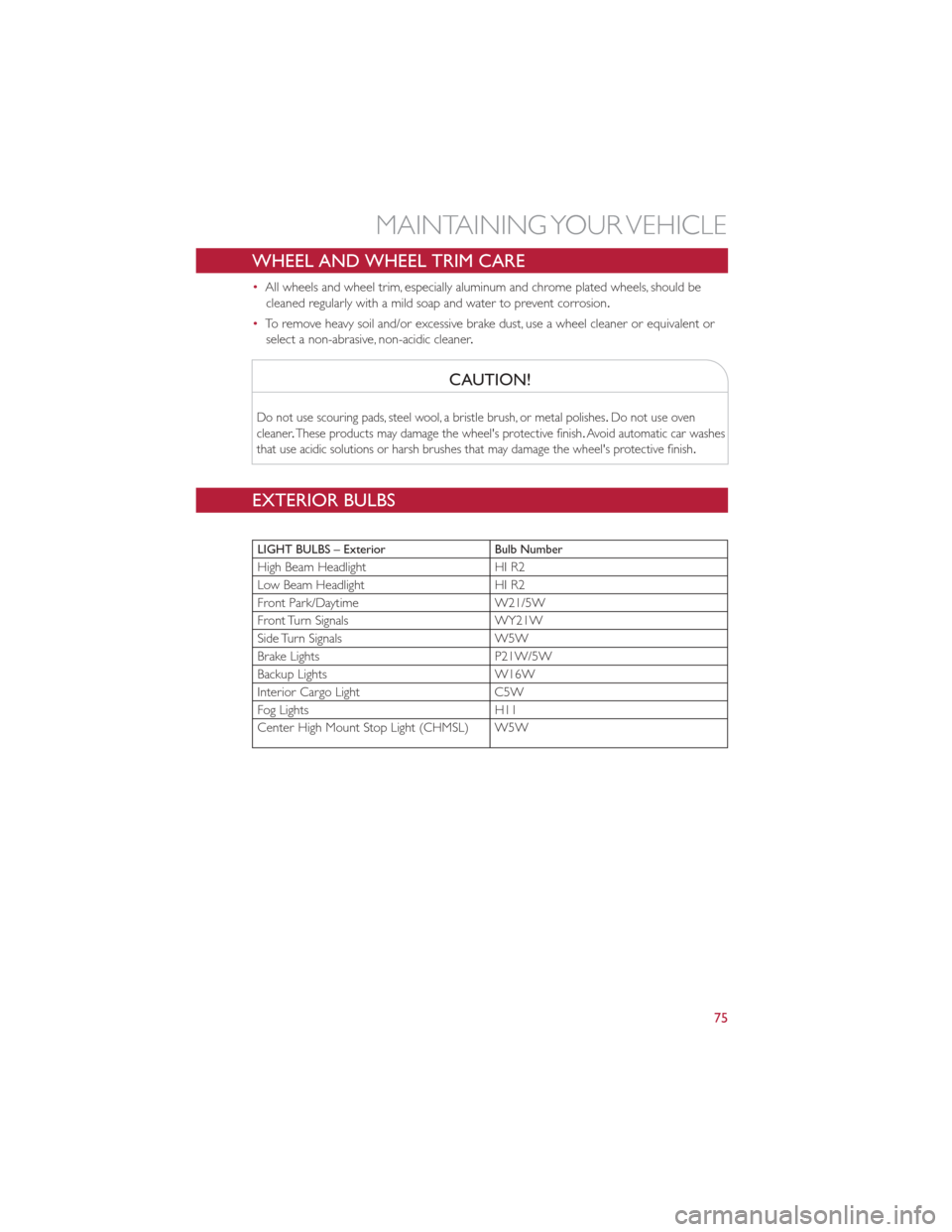
WHEEL AND WHEEL TRIM CARE
•All wheels and wheel trim, especially aluminum and chrome plated wheels, should be
cleaned regularly with a mild soap and water to prevent corrosion.
• To remove heavy soil and/or excessive brake dust, use a wheel cleaner or equivalent or
select a non-abrasive, non-acidic cleaner .
CAUTION!
Do not use scouring pads, steel wool, a bristle brush, or metal polishes .Do not use oven
cleaner .These products may damage the wheel's protective finish .Avoid automatic car washes
that use acidic solutions or harsh brushes that may damage the wheel's protective finish .
EXTERIOR BULBS
LIGHT BULBS – ExteriorBulb Number
High Beam HeadlightHI R2
Low Beam Headlight HI R2
Front Park/Daytime W21/5W
Front Turn Signals WY21W
Side Turn Signals W5W
Brake Lights P21W/5W
Backup Lights W16W
Interior Cargo Light C5W
Fog Lights H11
Center High Mount Stop Light (CHMSL) W5W
MAINTAINING YOUR VEHICLE
75
Page 81 of 84
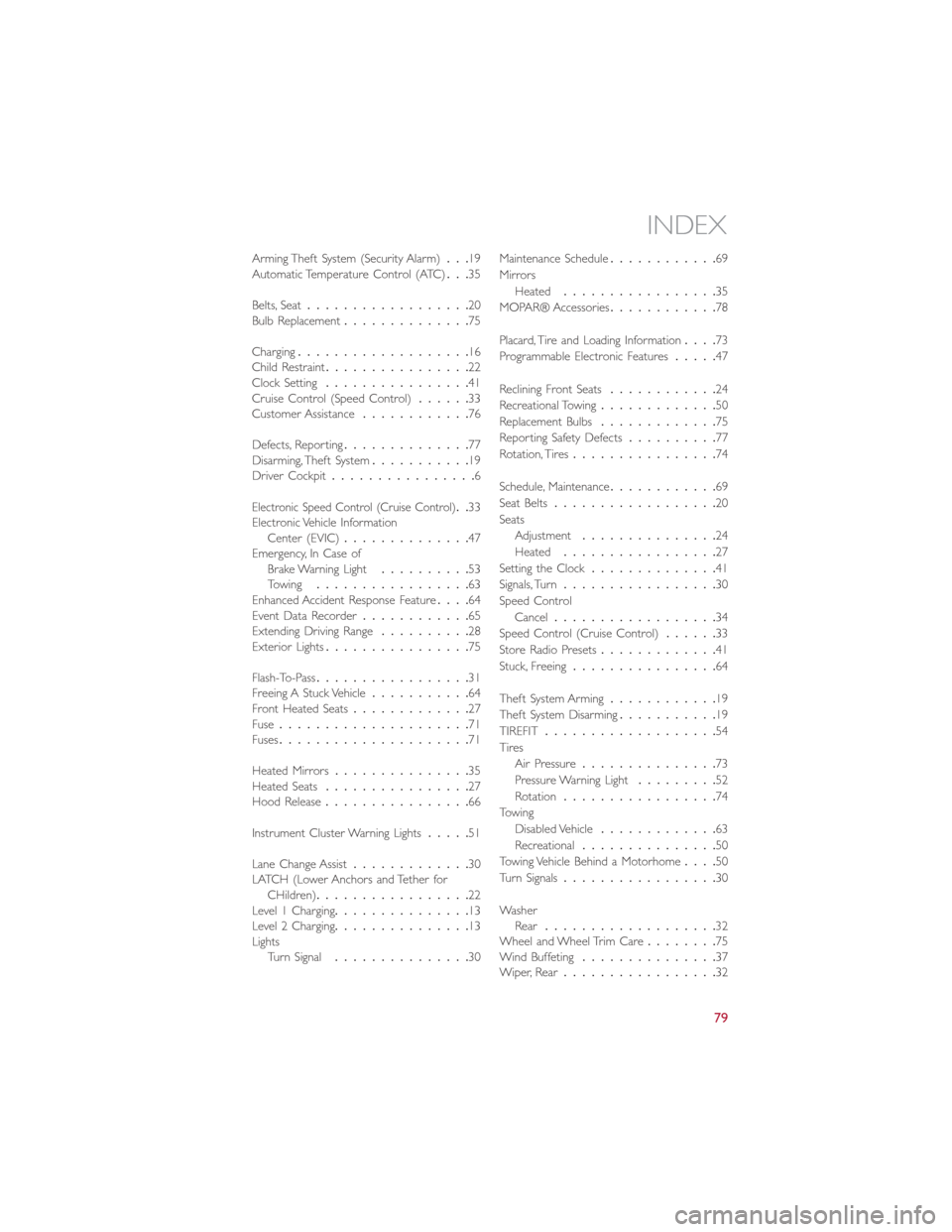
Arming Theft System (Security Alarm)...19
Automatic Temperature Control (ATC) ...35
Belts, Seat .................. 20
Bulb Replacement .............. 75
Charging ................... 16
Child Restraint ................ 22
Clock Setting ................ 41
Cruise Control (Speed Control) ......33
Customer Assistance ............76
Defects, Reporting .............. 77
Disarming, Theft System ...........19
Driver Cockpit ................ 6
Electronic Speed Control (Cruise Control)..33
Electronic Vehicle Information Center (EVIC) .............. 47
Emergency, In Case of Brake Warning Light ..........53
Towing ................. 63
Enhanced Accident Response Feature ....64
Event Data Recorder ............65
Extending Driving Range ..........28
Exterior Lights ................ 75
Flash-To-Pass ................. 31
Freeing A Stuck Vehicle ...........64
Front Heated Seats ............. 27
Fuse ..................... 71
Fuses ..................... 71
Heated Mirrors ............... 35
Heated Seats ................ 27
Hood Release ................ 66
Instrument Cluster Warning Lights .....51
Lane Change Assist ............. 30
LATCH (Lower Anchors and Tether for CHildren) ................. 22
Level 1 Charging ............... 13
Level 2 Charging ............... 13
Lights Turn Signal ............... 30Maintenance Schedule
............69
Mirrors Heated ................. 35
MOPAR® Accessories ............78
Placard, Tire and Loading Information ....73
Programmable Electronic Features .....47
Reclining Front Seats ............24
Recreational Towing ............. 50
Replacement Bulbs ............. 75
Reporting Safety Defects ..........77
Rotation, Tires ................ 74
Schedule, Maintenance ............69
Sea
t Belts .................. 20
Seats Adjustment ............... 24
Heated ................. 27
Setting the Clock .............. 41
Signals, Turn ................. 30
Speed Control Cancel .................. 34
Speed Control (Cruise Control) ......33
Store Radio Presets ............. 41
Stuck, Freeing ................ 64
Theft System Arming ............19
Theft System Disarming ...........19
TIREFIT ................... 54
Tires Air Pressure ............... 73
Pressure Warning Light .........52
Rotation ................. 74
Towing Disabled Vehicle ............. 63
Recreational ............... 50
Towing Vehicle Behind a Motorhome ....50
Turn Signals ................. 30
Washer Rear ................... 32
Wheel and Wheel Trim Care ........75
Wind Buffeting ............... 37
Wiper, Rear ................. 32
INDEX
79