transmission FIAT 500E 2014 2.G Owner's Manual
[x] Cancel search | Manufacturer: FIAT, Model Year: 2014, Model line: 500E, Model: FIAT 500E 2014 2.GPages: 363, PDF Size: 2.66 MB
Page 224 of 363
CAUTION!
•Always check the depth of the standing water
before driving through it. Never drive through
standing water that is deeper than the bottom of
the tire rims mounted on the vehicle.
• Determine the condition of the road or the path
that is under water and if there are any obstacles in
the way before driving through the standing water.
• Do not exceed 5 mph (8 km/h) when driving
through standing water. This will minimize wave
effects.
(Continued)
CAUTION! (Continued)
•Driving through standing water may cause damage
to your vehicle’s drivetrain components. Always
inspect your vehicle’s fluids (i.e., transmission,
coolant, etc.) for signs of contamination (i.e., fluid
that is milky or foamy in appearance) after driving
through standing water. Do not continue to operate
the vehicle if any fluid appears contaminated, as
this may result in further damage. Such damage is
not covered by the New Vehicle Limited Warranty.
• Driving through standing water limits your vehi-
cle’s traction capabilities. Do not exceed 5 mph
(8 km/h) when driving through standing water.
(Continued)
222 STARTING AND OPERATING
Page 227 of 363
When the parking brake is applied with the ignition
switch in the MAR (ACC/ON/RUN) position, the Brake
Warning Light in the instrument cluster will illuminate.
When parking on a hill, it is important to turn the front
wheels toward the curb on a downhill grade and away
from the curb on an uphill grade. The parking brakeshould always be applied whenever the driver is not in
the vehicle.
WARNING!
•
Never leave children alone in a vehicle, or with
access to an unlocked vehicle.
• Allowing children to be in a vehicle unattended is
dangerous for a number of reasons. A child or
others could be seriously or fatally injured. Chil-
dren should be warned not to touch the parking
brake, brake pedal or the transmission push but-
tons.
• Do not leave the key fob in or near the vehicle (or
in a location accessible to children), and do not
leave the ignition in the MAR (ACC/ON/RUN)
position. A child could operate power windows,
other controls, or move the vehicle.
(Continued)
Parking Brake
5
STARTING AND OPERATING 225
Page 268 of 363
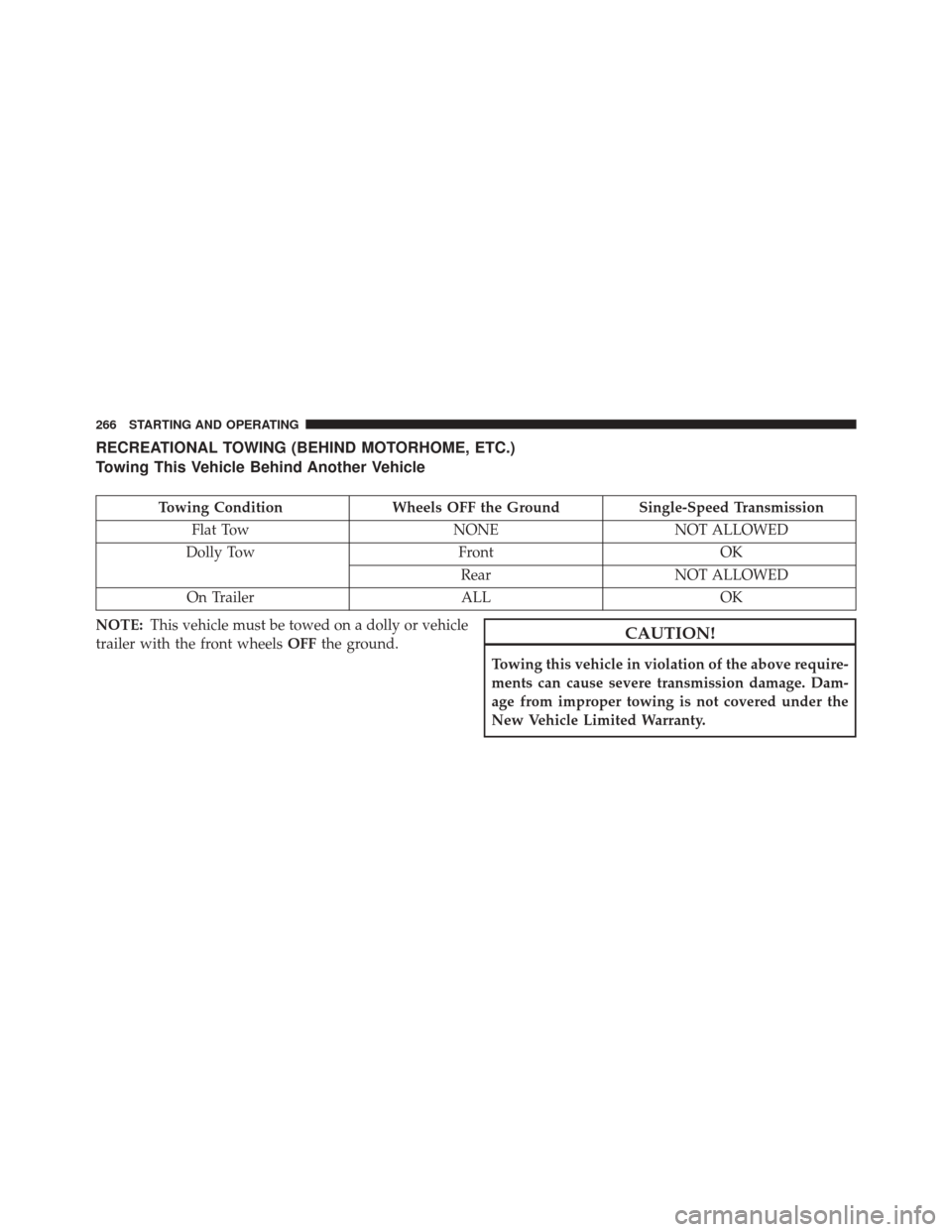
RECREATIONAL TOWING (BEHIND MOTORHOME, ETC.)
Towing This Vehicle Behind Another Vehicle
Towing ConditionWheels OFF the Ground Single-Speed Transmission
Flat Tow NONENOT ALLOWED
Dolly Tow FrontOK
Rear NOT ALLOWED
On Trailer ALLOK
NOTE: This vehicle must be towed on a dolly or vehicle
trailer with the front wheels OFFthe ground.
CAUTION!
Towing this vehicle in violation of the above require-
ments can cause severe transmission damage. Dam-
age from improper towing is not covered under the
New Vehicle Limited Warranty.
266 STARTING AND OPERATING
Page 281 of 363
kit when injecting the sealant into the deflated tire and
running the air pump. Move the vehicle as necessary
to place the valve stem in this position before proceed-
ing.
3. Place the transmission in PARK (auto transmission) or in Gear (manual transmission) and turn Off the igni-
tion.
4. Set the parking brake.
(B) Setting Up To Use TIREFIT:
1. Push in the Mode Select Knob (5) and turn to the Sealant Mode position.
2. Uncoil the Sealant Hose (6) and then remove the cap from the fitting at the end of the hose.
3. Place the TIREFIT kit flat on the ground next to the deflated tire. 4. Remove the cap from the valve stem and then screw
the fitting at the end of the Sealant Hose (6) onto the
valve stem.
5. Uncoil the Power Plug (8) and insert the plug into the vehicle’s 12 Volt power outlet.
NOTE: Do not remove foreign objects (e.g., screws or
nails) from the tire.
(C) Injecting TIREFIT Sealant Into The Deflated
Tire:
• Always start the engine before turning ON the TIRE-
FIT kit.
NOTE: Manual transmission vehicles must have the
parking brake engaged and the shift lever in NEUTRAL.
• After pressing the Power Button (4), the sealant (white
fluid) will flow from the Sealant Bottle (1) through the
Sealant Hose (6) and into the tire.6
WHAT TO DO IN EMERGENCIES 279
Page 287 of 363
WARNING!
•Take care to avoid the radiator cooling fan when-
ever the hood is raised. It can start anytime the
ignition switch is ON. You can be injured by
moving fan blades.
• Remove any metal jewelry such as rings, watch
bands and bracelets that could make an inadvertent
electrical contact. You could be seriously injured.
• Batteries contain sulfuric acid that can burn your
skin or eyes and generate hydrogen gas which is
flammable and explosive. Keep open flames or
sparks away from the battery.
1. Set the parking brake, place the transmission into PARK and turn the ignition to LOCK.
2. Turn off the heater, radio, and all unnecessary electri- cal accessories.
Battery Posts
1 — Positive (+) Post (Covered With Protective Cap)
2 — Negative (-) Post
6
WHAT TO DO IN EMERGENCIES 285
Page 291 of 363
MANUAL PARK RELEASE
WARNING!
Always secure your vehicle by fully applying the
parking brake, before activating the Manual Park
Release. Activating the Manual Park Release will
allow your vehicle to roll away if it is not secured by
the parking brake or other means. Activating the
Manual Park Release on an unsecured vehicle could
lead to serious injury or death for those in or around
the vehicle.In order to move the vehicle in cases where the transmis-
sion will not shift out of PARK (such as a dead battery),
a Manual Park Release is available. If a dead 12 volt
battery is the cause of the condition refer to “Jump Start
Procedure — 12 Volt Battery” before performing the
Manual Park Release.
To perform the Manual Park Release follow these steps:
•
To prevent the vehicle from rolling unintentionally,
firmly apply the parking brake.
• If possible, raise the front driver’s side of the vehicle to
provide access to the transmission.
• Working from underneath the vehicle, remove the
black rubber plug from the front of the Park module
(a black canister mounted on the front of the transmis-
sion).
6
WHAT TO DO IN EMERGENCIES 289
Page 293 of 363
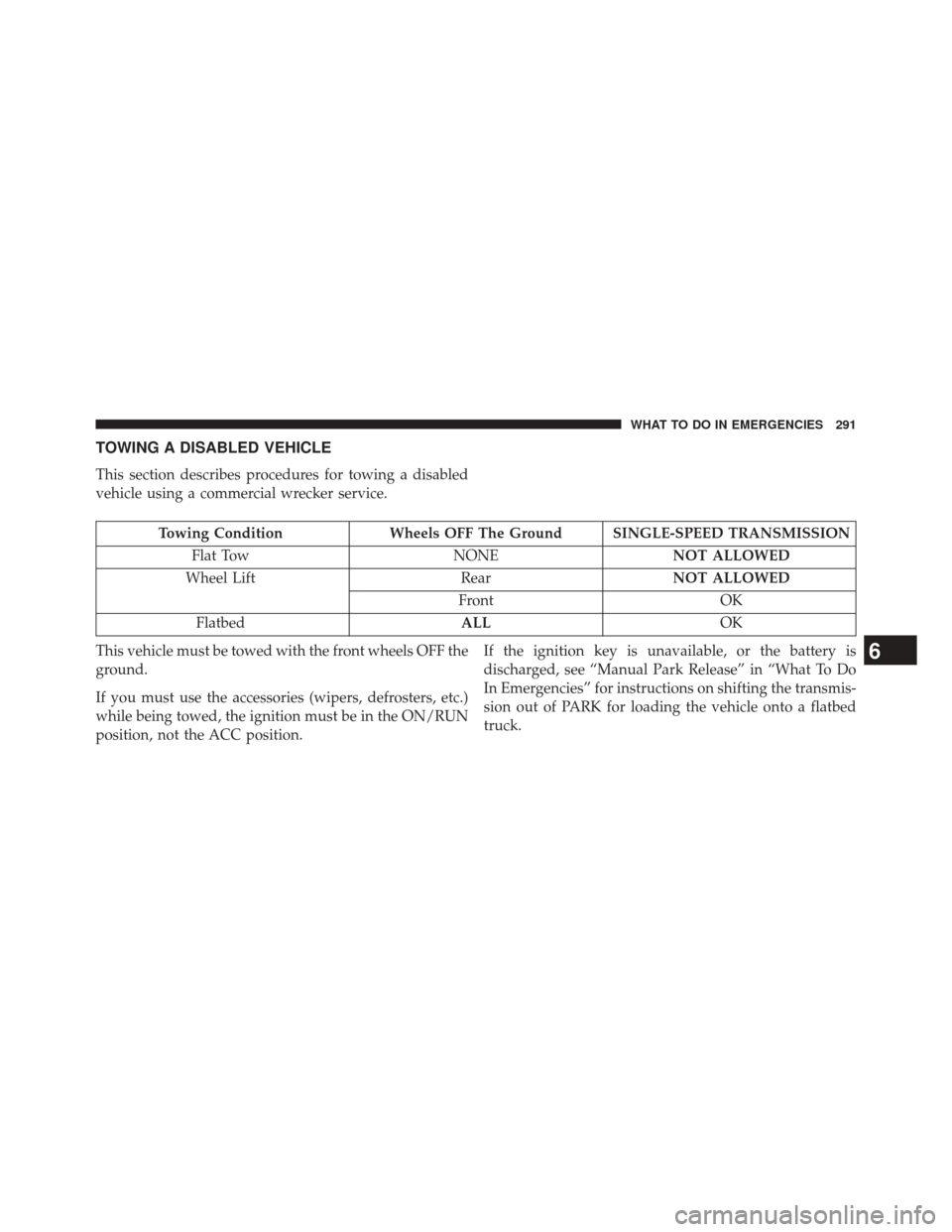
TOWING A DISABLED VEHICLE
This section describes procedures for towing a disabled
vehicle using a commercial wrecker service.
Towing ConditionWheels OFF The Ground SINGLE-SPEED TRANSMISSION
Flat Tow NONENOT ALLOWED
Wheel Lift RearNOT ALLOWED
Front OK
Flatbed ALLOK
This vehicle must be towed with the front wheels OFF the
ground.
If you must use the accessories (wipers, defrosters, etc.)
while being towed, the ignition must be in the ON/RUN
position, not the ACC position. If the ignition key is unavailable, or the battery is
discharged, see “Manual Park Release” in “What To Do
In Emergencies” for instructions on shifting the transmis-
sion out of PARK for loading the vehicle onto a flatbed
truck.
6
WHAT TO DO IN EMERGENCIES 291
Page 333 of 363
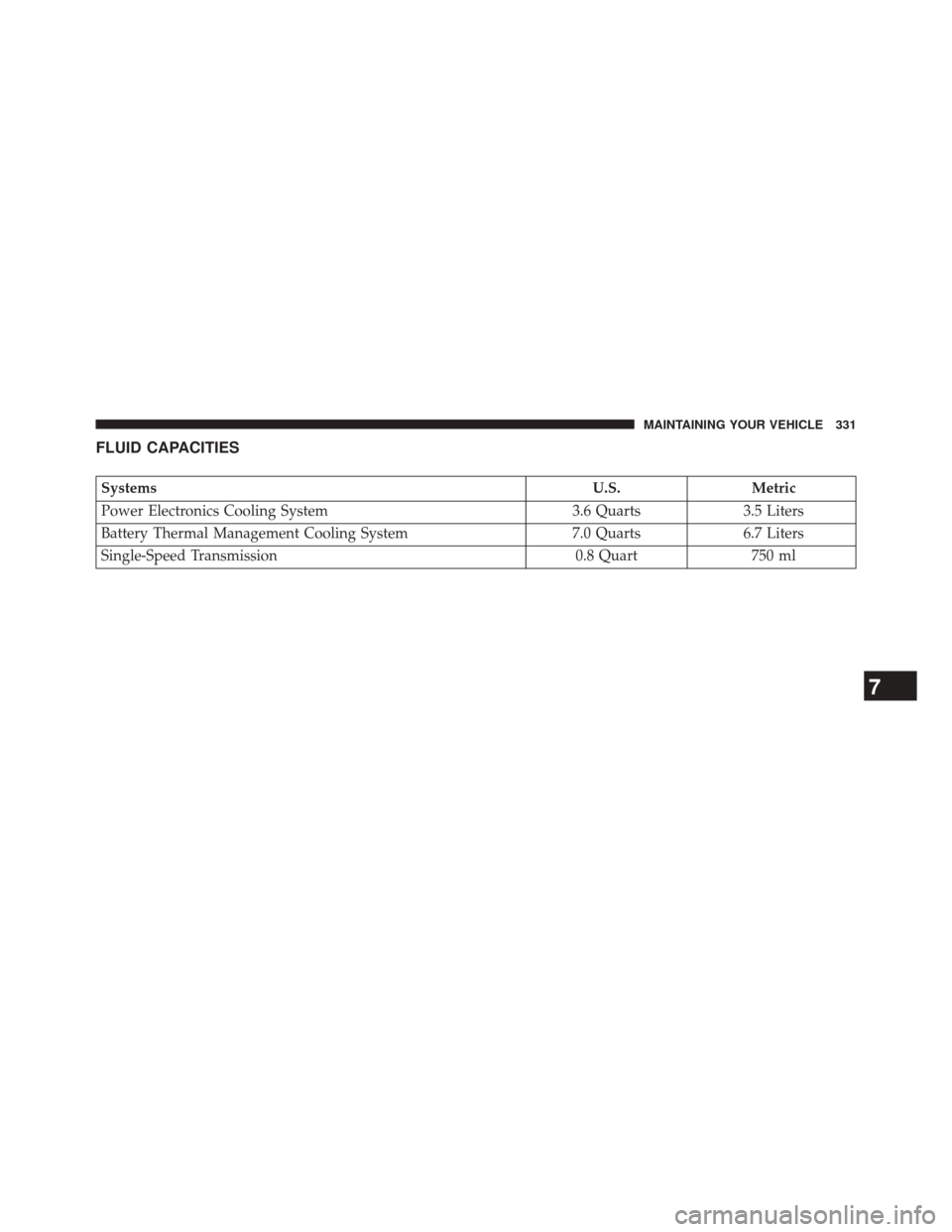
FLUID CAPACITIES
SystemsU.S.Metric
Power Electronics Cooling System 3.6 Quarts3.5 Liters
Battery Thermal Management Cooling System 7.0 Quarts6.7 Liters
Single-Speed Transmission 0.8 Quart750 ml
7
MAINTAINING YOUR VEHICLE 331
Page 334 of 363
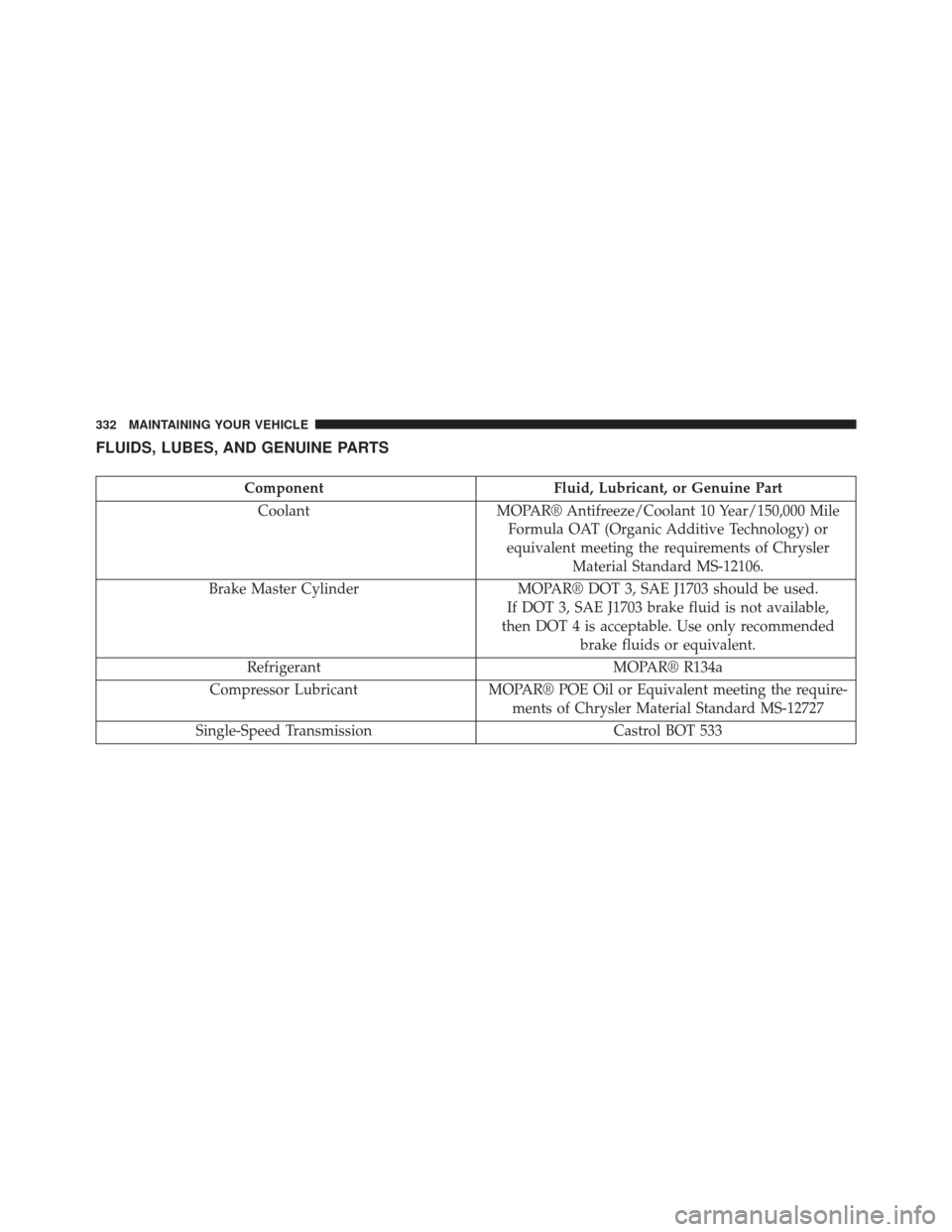
FLUIDS, LUBES, AND GENUINE PARTS
ComponentFluid, Lubricant, or Genuine Part
Coolant MOPAR® Antifreeze/Coolant 10 Year/150,000 Mile
Formula OAT (Organic Additive Technology) or
equivalent meeting the requirements of Chrysler Material Standard MS-12106.
Brake Master Cylinder MOPAR® DOT 3, SAE J1703 should be used.
If DOT 3, SAE J1703 brake fluid is not available,
then DOT 4 is acceptable. Use only recommended brake fluids or equivalent.
Refrigerant MOPAR® R134a
Compressor Lubricant MOPAR® POE Oil or Equivalent meeting the require-
ments of Chrysler Material Standard MS-12727
Single-Speed Transmission Castrol BOT 533
332 MAINTAINING YOUR VEHICLE
Page 352 of 363
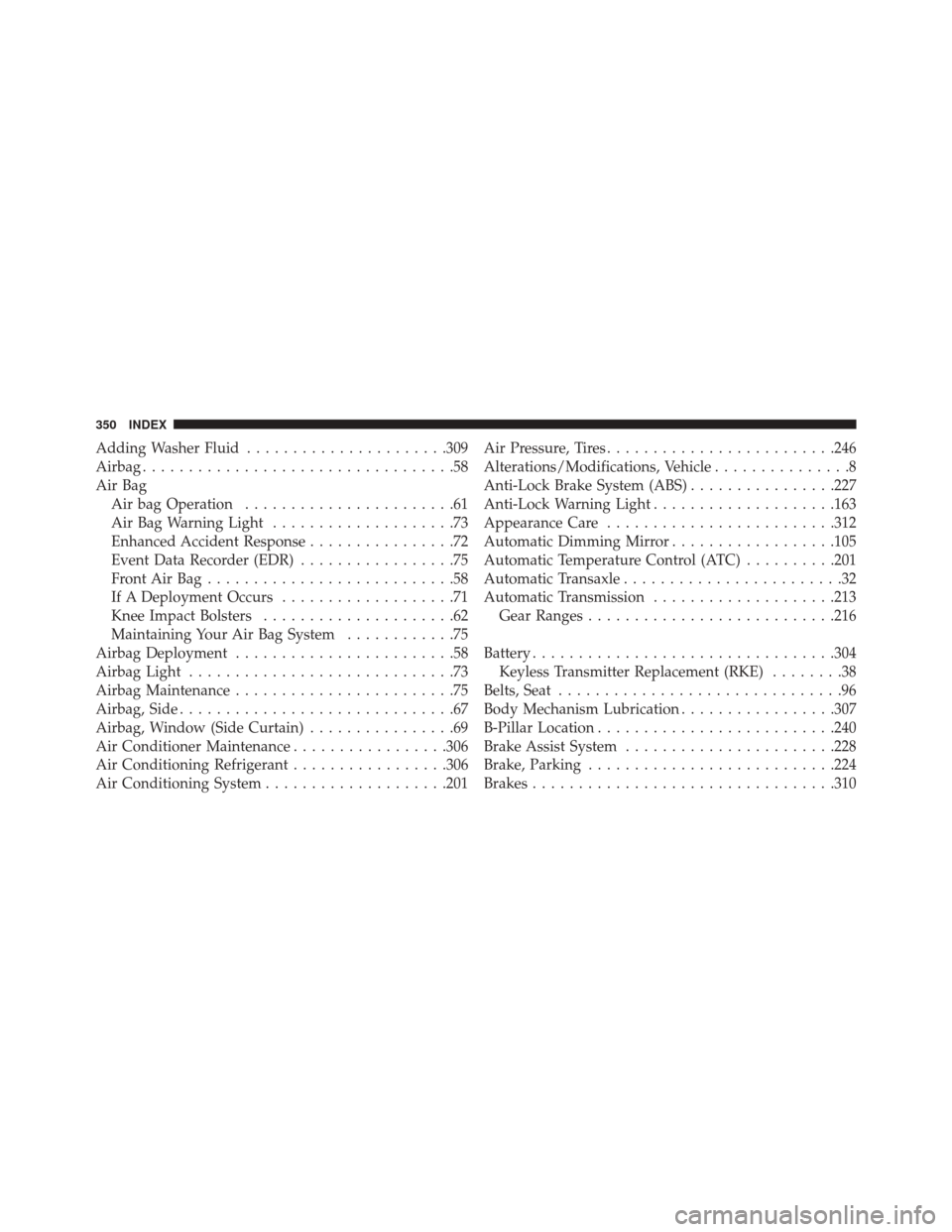
Adding Washer Fluid..................... .309
Airbag ..................................58
Air Bag Air bag Operation .......................61
Air Bag Warning Light ....................73
Enhanced Accident Response ................72
Event Data Recorder (EDR) .................75
FrontAirBag...........................58
If A Deployment Occurs ...................71
Knee Impact Bolsters .....................62
Maintaining Your Air Bag System ............75
Airbag Deployment ........................58
Airbag Light .............................73
Airbag Maintenance ........................75
Airbag, Side ..............................67
Airbag, Window (Side Curtain) ................69
Air Conditioner Maintenance .................306
Air Conditioning Refrigerant .................306
Air Conditioning System ....................201 Air Pressure, Tires
........................ .246
Alterations/Modifications, Vehicle ...............8
Anti-Lock Brake System (ABS) ................227
Anti-Lock Warning Light ....................163
Appearance Care ........................ .312
Automatic Dimming Mirror ..................105
Automatic Temperature Control (ATC) ..........201
Automatic Transaxle ........................32
Automatic Transmission ....................213
Gear Ranges .......................... .216
Battery ................................ .304
Keyless Transmitter Replacement (RKE) ........38
Belts, Seat ...............................96
Body Mechanism Lubrication .................307
B-Pillar Location ......................... .240
Brake Assist System ...................... .228
Brake, Parking .......................... .224
Brakes ................................ .310
350 INDEX