high voltage FIAT 500E 2015 2.G User Guide
[x] Cancel search | Manufacturer: FIAT, Model Year: 2015, Model line: 500E, Model: FIAT 500E 2015 2.GPages: 367, PDF Size: 9.42 MB
Page 32 of 367
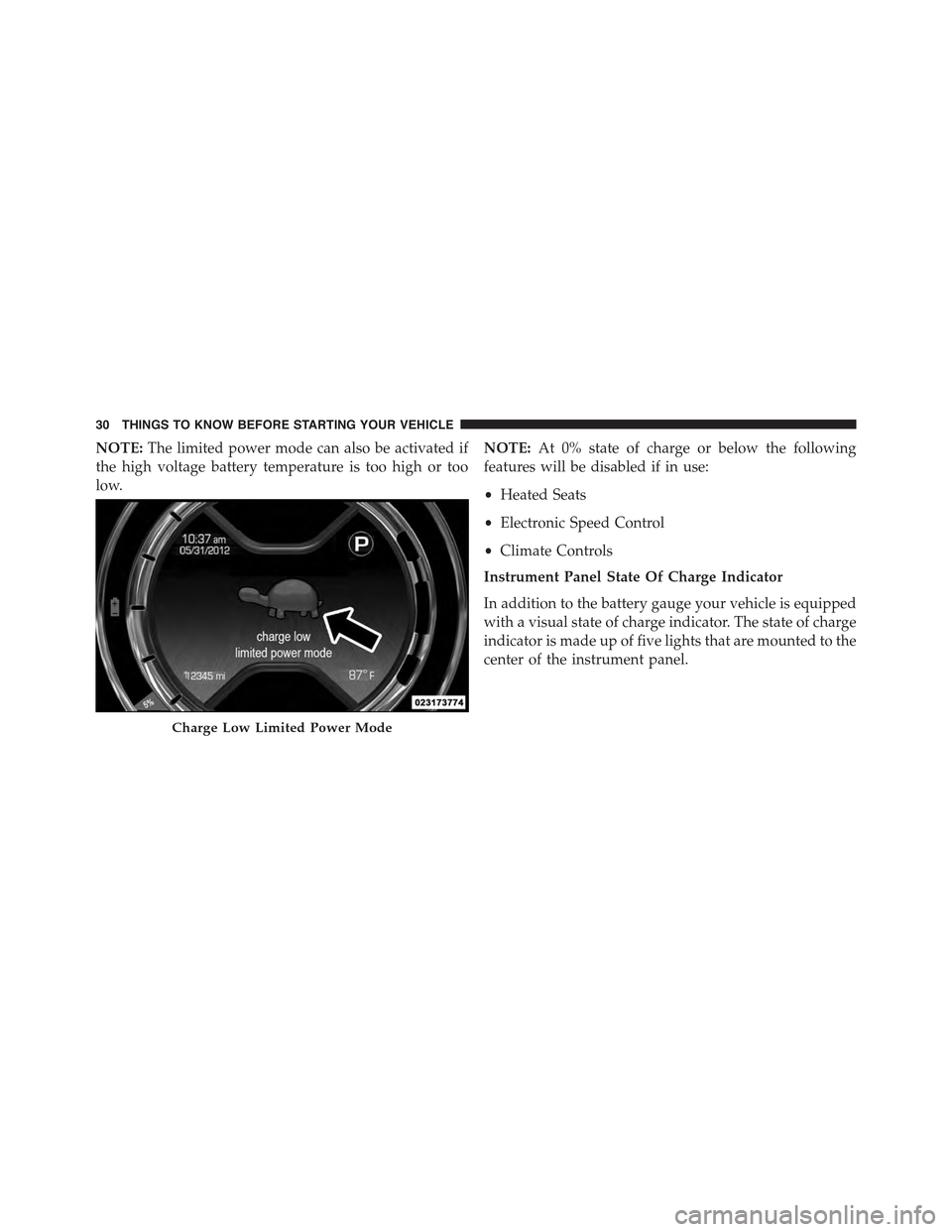
NOTE:The limited power mode can also be activated if
the high voltage battery temperature is too high or too
low.
NOTE:At 0% state of charge or below the following
features will be disabled if in use:
•Heated Seats
•Electronic Speed Control
•Climate Controls
Instrument Panel State Of Charge Indicator
In addition to the battery gauge your vehicle is equipped
with a visual state of charge indicator. The state of charge
indicator is made up of five lights that are mounted to the
center of the instrument panel.
Charge Low Limited Power Mode
30 THINGS TO KNOW BEFORE STARTING YOUR VEHICLE
Page 33 of 367
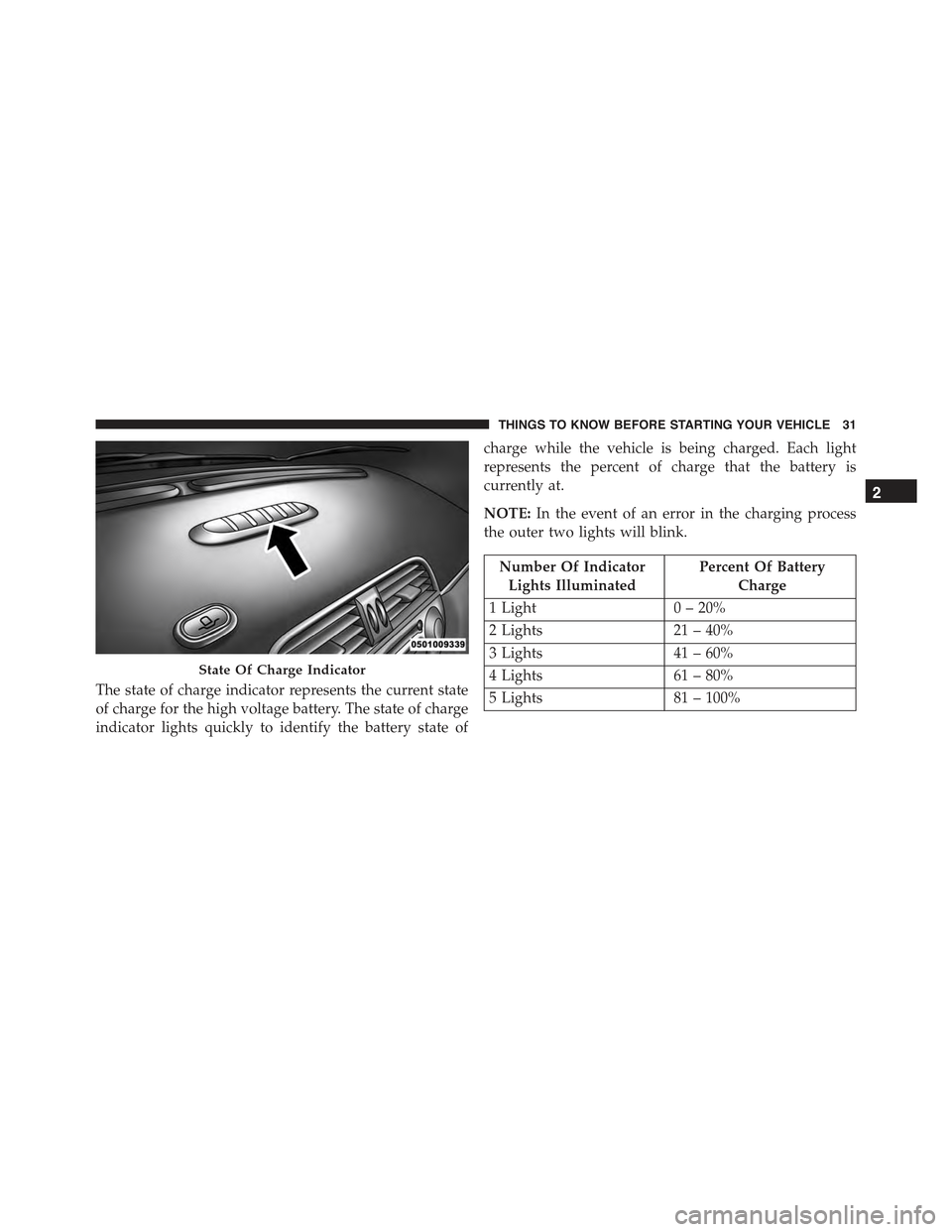
The state of charge indicator represents the current state
of charge for the high voltage battery. The state of charge
indicator lights quickly to identify the battery state of
charge while the vehicle is being charged. Each light
represents the percent of charge that the battery is
currently at.
NOTE:In the event of an error in the charging process
the outer two lights will blink.
Number Of Indicator
Lights Illuminated
Percent Of Battery
Charge
1 Light0 – 20%
2 Lights21 – 40%
3 Lights41 – 60%
4 Lights61 – 80%
5 Lights81 – 100%
State Of Charge Indicator
2
THINGS TO KNOW BEFORE STARTING YOUR VEHICLE 31
Page 207 of 367
NOTE:The center instrument panel outlets can be aimed
so that they are directed toward the rear seat passengers
for maximum airflow to the rear.
9. Bi-Level
Air is directed through the panel and floor outlets.
Press and release the Panel mode button and Floor
mode button to enter Bi-Level mode, the indicators
illuminate when ON. Performing this function will cause
the ATC to switch into manual mode.
10. Temperature Control Down Button
Provides temperature down control. Push the button for
cooler temperature settings.
NOTE:If the temperature is lowered until#Lo#is dis-
played, all high voltage Heating, Ventilation, and Air
Conditioning (HVAC) systems are deactivated and am-
bient air is circulated according to the Heating, Ventila-
tion, and Air Conditioning (HVAC) control settings.
11. Climate Control ON/OFF Button
Push and release to turn the Climate Control ON or OFF.
12. Recirculation Control Button
Push and release to change the current setting. The
indicator illuminates when ON.
NOTE:When in Defrost mode, the Recirculation button
will flash if pushed. This indicates that you can not
proceed to this mode due to fogging risk.
Climate Control Functions
Air Conditioning (A/C)
The Air Conditioning (A/C) button allows the operator to
manually activate or deactivate the air conditioning system.
When in A/C mode with the ATC set to a cool temperature,
dehumidified air flows through the air outlets. If Economy
mode is desired, push the A/C button to turn off the A/C
mode in the ATC display and deactivate the A/C system.
4
UNDERSTANDING YOUR INSTRUMENT PANEL 205
Page 223 of 367
CAUTION!
Towing the vehicle, coasting, or driving for any other
reason with the transmission in NEUTRAL can cause
severe transmission damage. Refer to “Recreational
Towing” in “Starting And Operating” and “Towing A
Disabled Vehicle” in “What To Do In Emergencies”
for further information.
DRIVE (D)
Use this gear for all city and highway driving.
Auto Park
The Auto Park feature automatically places the transmis-
sion into PARK if there is any indication that the driver
may leave the vehicle while the transmission is in D
(DRIVE), N (NEUTRAL) or R (REVERSE).
Auto Park is enabled under the following conditions:
•Key On (12 Volt ON and High Voltage OFF) or READY
mode (12 Volt ON and High Voltage ON).
•Vehicle speed is below 2 mph (3 km/h)
NOTE:
•Auto Park is enabled (only once) at the beginning of
each key cycle and is re-enabled each time the vehicle
speed exceeds 8 mph (13 km/h).
•Auto Park is disabled above 2 mph (3 km/h) and
transmission range will be maintained.
The instrument cluster will display an Auto Shift To Park
message and chime once when Auto Park is activated.
5
STARTING AND OPERATING 221
Page 236 of 367
The ESC Activation/Malfunction Indicator Light also
flashes when TCS is active. If the ESC Activation/
Malfunction Indicator Light begins to flash during accel-
eration, ease up on the accelerator and apply as little
throttle as possible. Be sure to adapt your speed and
driving to the prevailing road conditions.
NOTE:
•The ESC Activation/Malfunction Indicator Light and
the ESC OFF Indicator Light come on momentarily
each time the ignition switch is turned ON.
•Each time the ignition is turned ON, the ESC system
will be ON even if it was turned off previously.
The ESC OFF Indicator Light indicates the
Electronic Stability Control (ESC) is partially
off.
Regenerative Braking System (RBS)
Your 500e has a Regenerative Braking System
(RBS). The RBS increases the fuel economy of the
vehicle, particularly in stop-and-go city traffic.
The electric motors which propel the vehicle
forward can operate as generators when braking. The RBS
recharges the high voltage battery under certain braking
conditions by recapturing energy that would otherwise be
lost while braking. The electric power that is generated goes
back into the high voltage battery for later use, for example
when acceleration is desired.
The RBS uses conventional hydraulic friction brakes, regen-
erative braking, or a combination to slow the vehicle. If the
system detects slippery conditions while braking, ONLY
friction is used to slow the vehicle. The RBS can result in
extended life of the hydraulic service brakes; however, all
inspection, scheduled maintenance, and service intervals for
the vehicle service brakes must be followed.
234 STARTING AND OPERATING
Page 272 of 367
RECREATIONAL TOWING (BEHIND MOTORHOME, ETC.)
Towing This Vehicle Behind Another Vehicle
Towing ConditionWheels OFF the GroundSingle-Speed Transmission
Flat TowNONENOT ALLOWED
Dolly TowFrontOK
RearNOT ALLOWED
On TrailerALLOK
NOTE:This vehicle must be towed on a dolly or vehicle
trailer with the front wheelsOFFthe ground.
CAUTION!
Towing this vehicle in violation of the above require-
ments can cause severe transmission damage. Dam-
age from improper towing is not covered under the
New Vehicle Limited Warranty.
EXTENDING YOUR DRIVING RANGE PER
CHARGE
The drive system and cabin temperature management
features use the most energy from the high voltage
battery. Reducing energy draw from these features are
the easiest and most effective way to extend driving
range.
270 STARTING AND OPERATING
Page 273 of 367
The 500e uses high voltage components to heat and cool
the cabin, so when using automatic climate control,
consider setting temperatures a few degrees higher or
lower during hot and cold days. If your 500e has been
soaking in hot or cold temperatures for an extended
period, it is recommended that the car be preconditioned
using the FIAT Access smartphone app while still
plugged into a charging source. This will allow 500e to
use external power to establish a comfortable cabin
temperature before the drive and allow the battery to
maintain the temperature at significantly lower energy
levels.
Additional tips:
•Keep tires properly inflated
•When practical, choose surface streets over the high-
way, and work to maintain a steady speed
•Avoid carrying nonessential cargo
•Be mindful of adding external accessories that may
increase aerodynamic drag
•Perform all scheduled maintenance at recommended
intervals
Driver Behavior Gauge
To help the driver extend the driving range of the high
voltage battery your vehicle is equipped with a Driver
Behavior Gauge. The Driver Behavior Gauge is located
on the right side of the instrument cluster and contains
three driving ranges:
•Power
The needle will move into the Power range when under
acceleration.
•ECO
The needle will move into the ECO range when you are
maximizing the driving range of the high voltage battery.
5
STARTING AND OPERATING 271
Page 301 of 367
MAINTENANCE PROCEDURES
WARNING!
Your vehicle has both a high voltage DC and AC
system as well as a 12 Volt system. DC and AC high
voltage are both extremely dangerous and can cause
severe burns, electric shock, serious injury or even
death. In order to avoid personal injuries:
•DO NOT TOUCH THE HIGH VOLTAGE CABLES
(ORANGE COLORED) AND/OR THE CONNEC-
TORS.
•Follow all Caution and Warning labels attached to
the High Voltage components.
•Do not remove or replace any of the 500e System
components. All replacement or repairs of 500e
System components should be performed by a
factory-trained technician at an authorized dealer.
The pages that follow contain therequiredmaintenance
services determined by the engineers who designed your
vehicle.
Besides those maintenance items specified in the fixed
maintenance schedule, there are other components which
may require servicing or replacement in the future.
CAUTION!
•Failure to properly maintain your vehicle or per-
form repairs and service when necessary could
result in more costly repairs, damage to other
components or negatively impact vehicle perfor-
mance. Immediately have potential malfunctions
examined by an authorized dealer or qualified
repair center.
(Continued)
7
MAINTAINING YOUR VEHICLE 299
Page 302 of 367
CAUTION!(Continued)
•Your vehicle has been built with improved fluids
that protect the performance and durability of your
vehicle and also allow extended maintenance inter-
vals. Do not use chemical flushes in these compo-
nents as the chemicals can damage them. Such
damage is not covered by the New Vehicle Limited
Warranty. If a flush is needed because of compo-
nent malfunction, use only the specified fluid for
the flushing procedure.
Power Electronics And Battery Thermal
Management Systems
The Power Electronics and Battery Thermal Management
Systems are completely separate and designed to regu-
late temperature for the high voltage battery and the
electric components.
Power Electronics and Battery Thermal
Management Systems — Coolant Level Check
The coolant expansion bottles provides a quick visual
method for determining that the coolant level is ad-
equate. With the vehicle off and coolant at ambient
temperature, the level of the coolant (antifreeze) in the
bottles should be between the bottom and top lines
marked “MIN-MAX FILL RANGE”.
300 MAINTAINING YOUR VEHICLE
Page 331 of 367
VEHICLE STORAGE
The preferred way of storing your vehicle for a long
period of time is to leave it attached to a Level 1 or Level
2 charger. The vehicle has a wake-up feature that will
wake the system every 3 weeks and do a maintenance
charge on the 12 Volt battery and also top off the high
voltage battery if necessary.
Anytime you store your vehicle, or keep it out of service
(e.g., vacation) for two weeks or more, run the air
conditioning system at idle for about five minutes in the
fresh air and high blower setting. This will ensure
adequate system lubrication to minimize the possibility
of compressor damage when the air conditioning system
is started again.
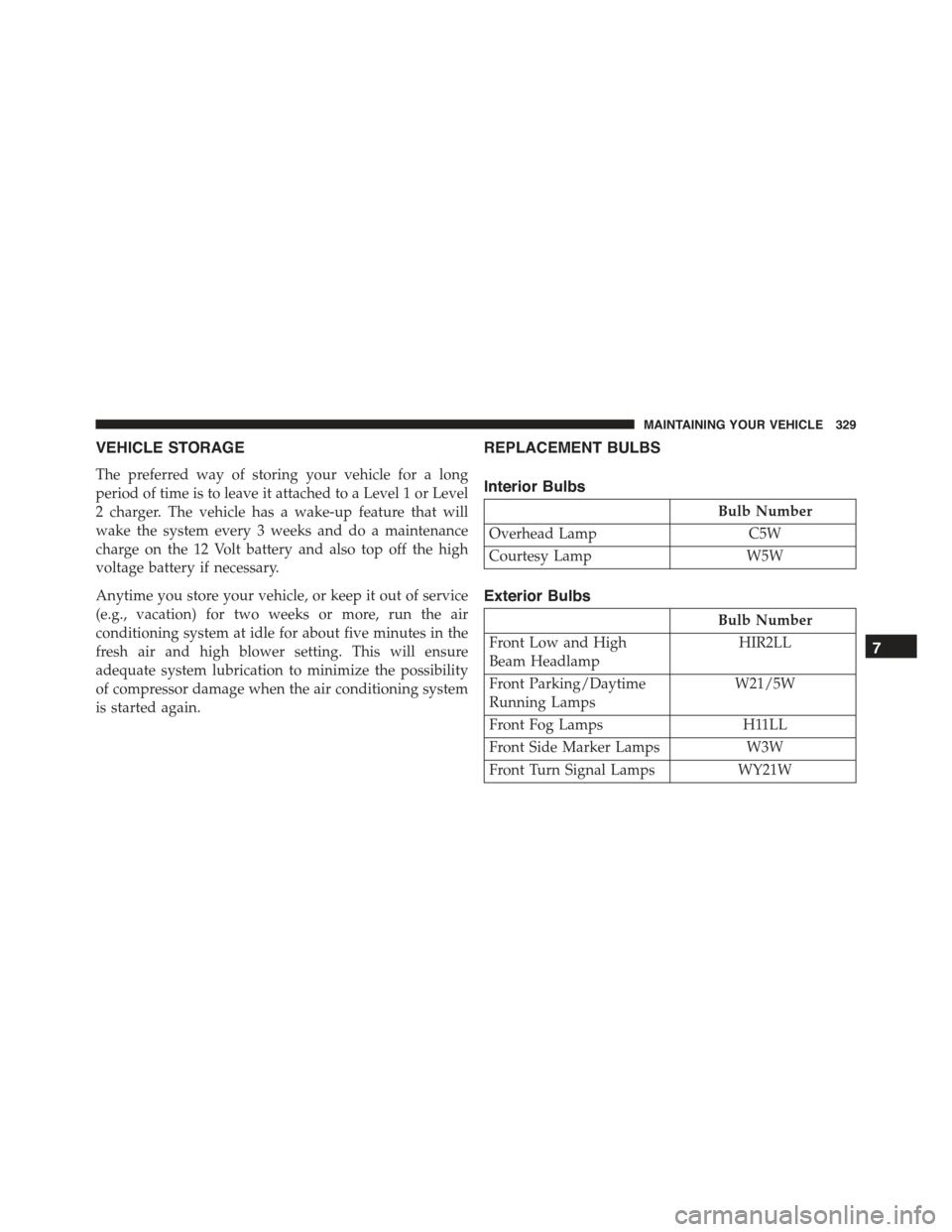
REPLACEMENT BULBS
Interior Bulbs
Bulb Number
Overhead LampC5W
Courtesy LampW5W
Exterior Bulbs
Bulb Number
Front Low and High
Beam Headlamp
HIR2LL
Front Parking/Daytime
Running Lamps
W21/5W
Front Fog Lamps H11LL
Front Side Marker Lamps W3W
Front Turn Signal Lamps WY21W
7
MAINTAINING YOUR VEHICLE 329