climate control FIAT 500E 2016 2.G User Guide
[x] Cancel search | Manufacturer: FIAT, Model Year: 2016, Model line: 500E, Model: FIAT 500E 2016 2.GPages: 362, PDF Size: 2.58 MB
Page 201 of 362
this button is selected. Push the button a second time to
turn off the Recirculation mode LED and allow outside
air into the vehicle.
NOTE:In cold weather, use of Recirculation mode may
lead to excessive window fogging. The recirculation
feature may be unavailable (indicator light shall blink) if
conditions exist that could create fogging on the inside of
the windshield. On systems with Manual Climate Con-
trols, the Recirculation mode is not allowed in Defrost
mode to improve window clearing operation. Recircula-
tion will be disabled automatically if this mode is se-
lected. Attempting to use Recirculation while in this
mode will cause the LED in the control button to blink
and then turn off.
Automatic Operation
1. Push the AUTO button on the Automatic Temperature Control (ATC) Panel, the indicator will illuminate
when on. 2. Next, adjust the temperature you would like the
system to maintain by adjusting the temperature con-
trol buttons. Once the desired temperature is dis-
played, the system will achieve and automatically
maintain that comfort level.
3. When the system is set up for your comfort level, it is not necessary to change the settings. You will experi-
ence the greatest efficiency by simply allowing the
system to function automatically.
NOTE:
• It is not necessary to move the temperature settings for
cold or hot vehicles. The system automatically adjusts
the temperature, mode and fan speed to provide
comfort as quickly as possible.
• The temperature can be displayed in U.S. or Metric
units by selecting the US/M customer-programmable
4
UNDERSTANDING YOUR INSTRUMENT PANEL 199
Page 203 of 362
Regular cleaning of the inside of the windows with a
non-filming cleaning solution (vinegar and water works
very well) will help prevent contaminates (cigarette
smoke, perfumes, etc.) from sticking to the windows.
Contaminates increase the rate of window fogging.
NOTE:Automatic Temperature Controls (ATC) will au-
tomatically adjust the climate control settings to reduce
or eliminate window fogging on the front windshield.
When this occurs, recirculation will be unavailable.
Summer Operation
Your air conditioning system is also equipped with an
automatic recirculation system. When the system senses
a heavy load or high heat conditions, it may use Recir-
culation A/C mode to provide additional comfort while
in automatic mode.
Winter Operation
When operating the system during the winter months,
make sure the air intake, located directly in front of the
windshield, is free of ice, slush, snow, or other obstruc-
tions.
Vacation Storage
Anytime you store your vehicle, or keep it out of service
(i.e., vacation) for two weeks or more, run the air
conditioning system at idle for about five minutes in the
fresh air using the high blower setting. This will ensure
adequate system lubrication to minimize the possibility
of compressor damage when the air conditioning system
is started again.
4
UNDERSTANDING YOUR INSTRUMENT PANEL 201
Page 264 of 362
CAUTION!
Towing this vehicle in violation of the above require-
ments can cause severe transmission damage. Dam-
age from improper towing is not covered under the
New Vehicle Limited Warranty.
EXTENDING YOUR DRIVING RANGE PER
CHARGE
The drive system and cabin temperature management
features use the most energy from the high voltage
battery. Reducing energy draw from these features are
the easiest and most effective way to extend driving
range.
The 500e uses high voltage components to heat and cool
the cabin, so when using automatic climate control, con-
sider setting temperatures a few degrees higher or lower
during hot and cold days. If your 500e has been soaking inhot or cold temperatures for an extended period, it is
recommended that the car be preconditioned using the
Uconnect Access smartphone app while still plugged into a
charging source. This will allow 500e to use external power
to establish a comfortable cabin temperature before the
drive and allow the battery to maintain the temperature at
significantly lower energy levels.
Additional tips:
•
Keep tires properly inflated
• When practical, choose surface streets over the high-
way, and work to maintain a steady speed
• Avoid carrying nonessential cargo
• Be mindful of adding external accessories that may
increase aerodynamic drag
• Perform all scheduled maintenance at recommended
intervals
262 STARTING AND OPERATING
Page 317 of 362
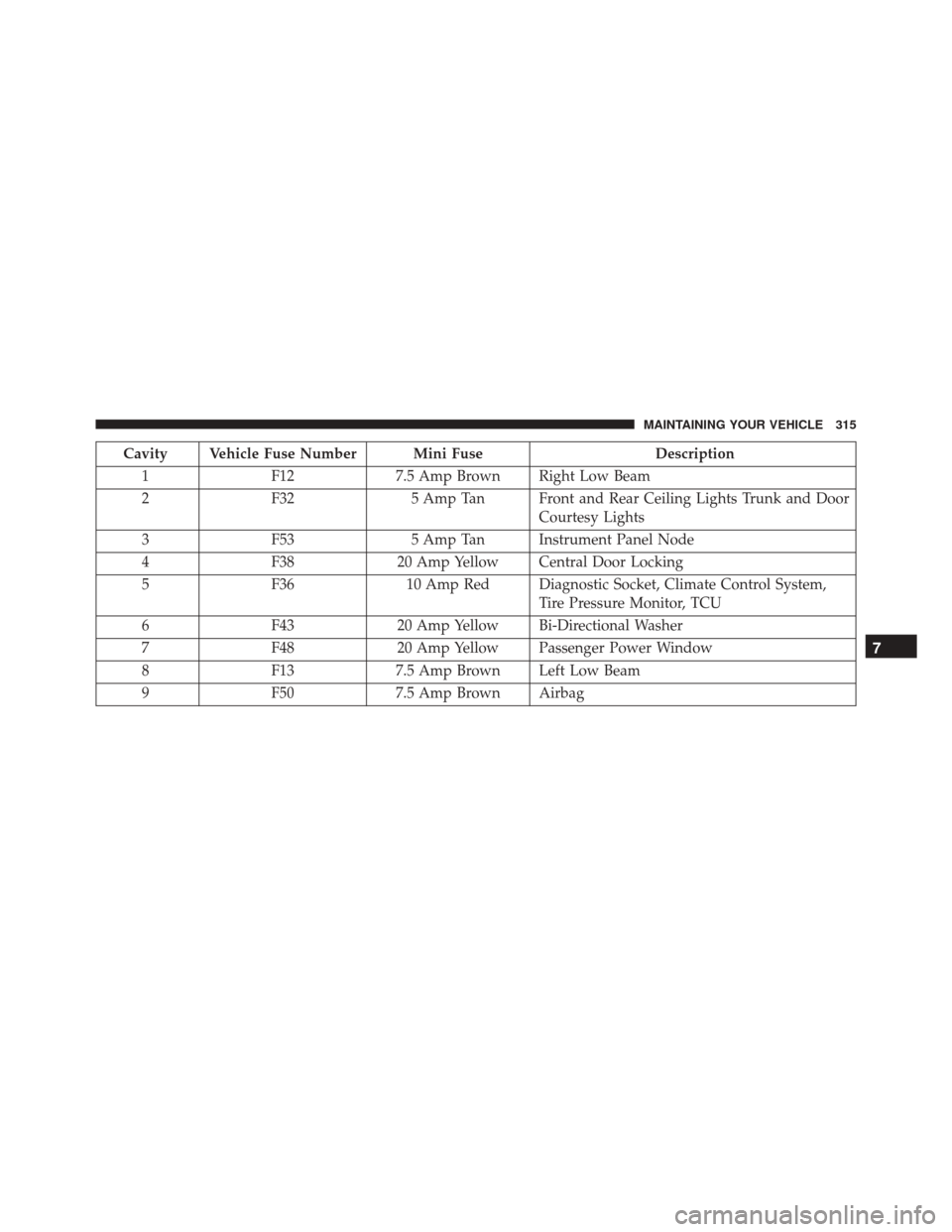
Cavity Vehicle Fuse Number Mini FuseDescription
1 F127.5 Amp Brown Right Low Beam
2 F32 5 Amp Tan Front and Rear Ceiling Lights Trunk and Door
Courtesy Lights
3 F53 5 Amp Tan Instrument Panel Node
4 F3820 Amp Yellow Central Door Locking
5 F36 10 Amp Red Diagnostic Socket, Climate Control System,
Tire Pressure Monitor, TCU
6 F4320 Amp Yellow Bi-Directional Washer
7 F4820 Amp Yellow Passenger Power Window
8 F137.5 Amp Brown Left Low Beam
9 F507.5 Amp Brown Airbag
7
MAINTAINING YOUR VEHICLE 315
Page 318 of 362
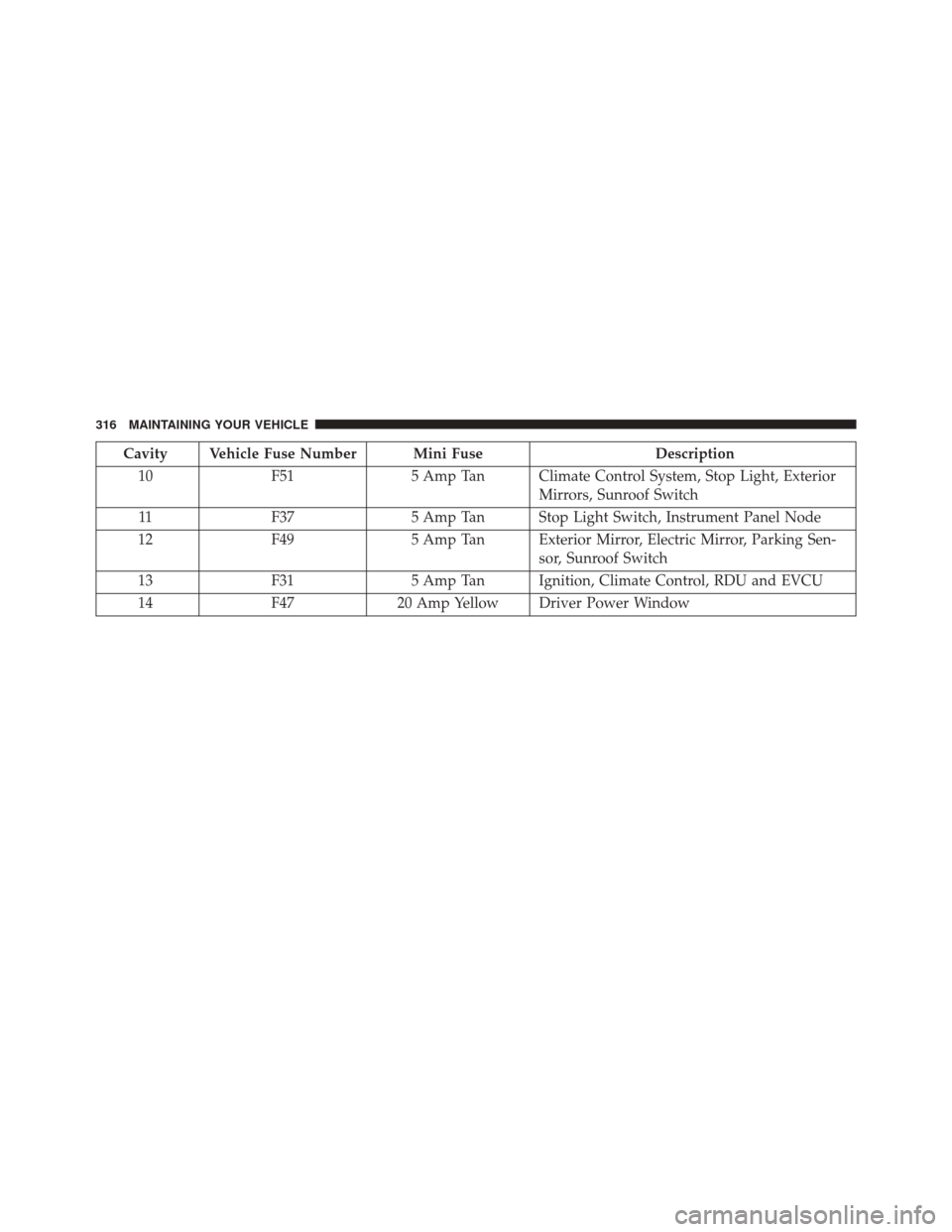
Cavity Vehicle Fuse Number Mini FuseDescription
10 F51 5 Amp Tan Climate Control System, Stop Light, Exterior
Mirrors, Sunroof Switch
11 F37 5 Amp Tan Stop Light Switch, Instrument Panel Node
12 F49 5 Amp Tan Exterior Mirror, Electric Mirror, Parking Sen-
sor, Sunroof Switch
13 F31 5 Amp Tan Ignition, Climate Control, RDU and EVCU
14 F4720 Amp Yellow Driver Power Window
316 MAINTAINING YOUR VEHICLE
Page 347 of 362
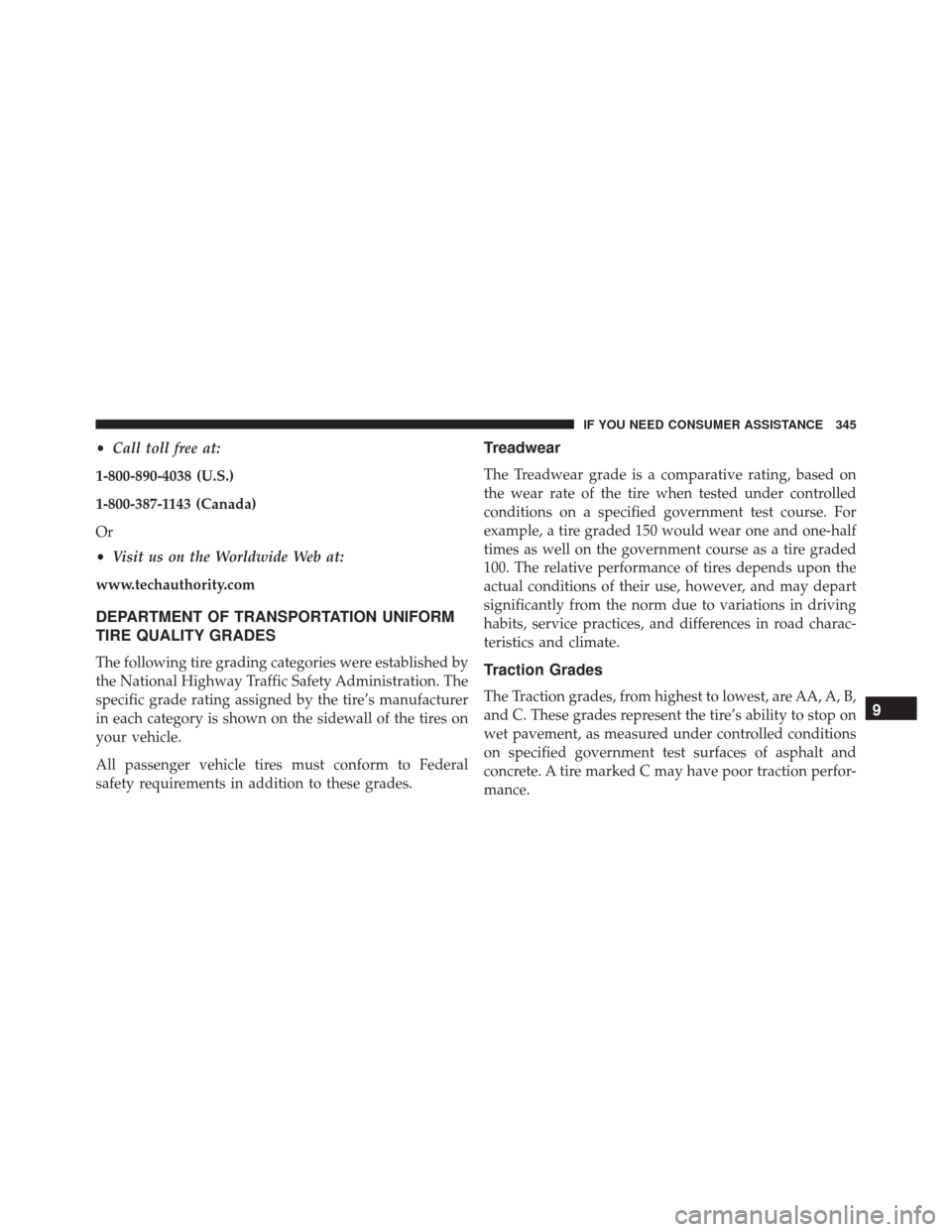
•Call toll free at:
1-800-890-4038 (U.S.)
1-800-387-1143 (Canada)
Or
• Visit us on the Worldwide Web at:
www.techauthority.com
DEPARTMENT OF TRANSPORTATION UNIFORM
TIRE QUALITY GRADES
The following tire grading categories were established by
the National Highway Traffic Safety Administration. The
specific grade rating assigned by the tire’s manufacturer
in each category is shown on the sidewall of the tires on
your vehicle.
All passenger vehicle tires must conform to Federal
safety requirements in addition to these grades.
Treadwear
The Treadwear grade is a comparative rating, based on
the wear rate of the tire when tested under controlled
conditions on a specified government test course. For
example, a tire graded 150 would wear one and one-half
times as well on the government course as a tire graded
100. The relative performance of tires depends upon the
actual conditions of their use, however, and may depart
significantly from the norm due to variations in driving
habits, service practices, and differences in road charac-
teristics and climate.
Traction Grades
The Traction grades, from highest to lowest, are AA, A, B,
and C. These grades represent the tire’s ability to stop on
wet pavement, as measured under controlled conditions
on specified government test surfaces of asphalt and
concrete. A tire marked C may have poor traction perfor-
mance.9
IF YOU NEED CONSUMER ASSISTANCE 345
Page 351 of 362
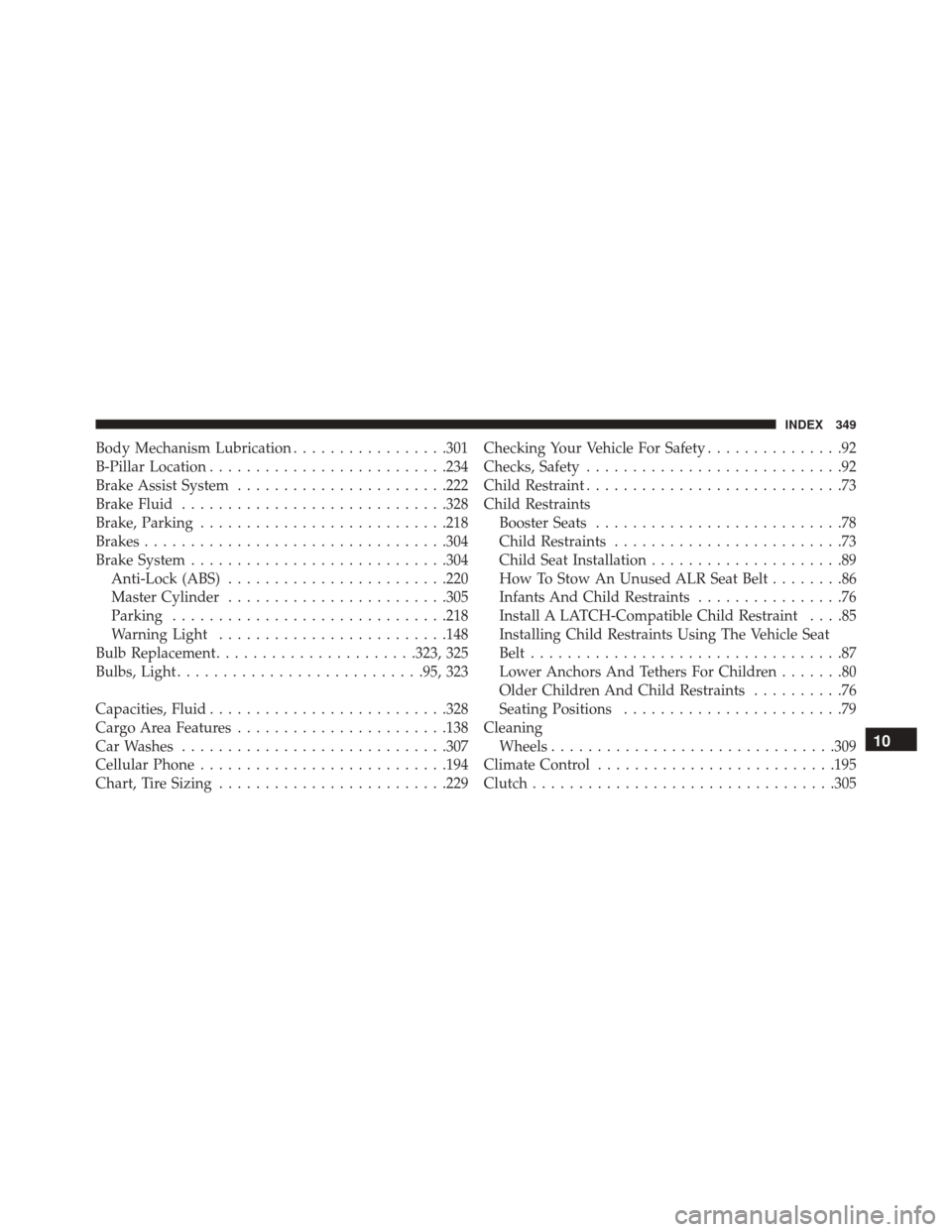
Body Mechanism Lubrication.................301
B-Pillar Location ......................... .234
Brake Assist System ...................... .222
Brake Fluid ............................ .328
Brake, Parking .......................... .218
Brakes ................................ .304
Brake System ........................... .304
Anti-Lock (ABS) ....................... .220
Master Cylinder ....................... .305
Parking ............................. .218
Warning Light ........................ .148
Bulb Replacement ..................... .323, 325
Bulbs, Light .......................... .95, 323
Capacities, Fluid ......................... .328
Cargo Area Features ...................... .138
Car Washes ............................ .307
Cellular Phone .......................... .194
Chart, Tire Sizing ........................ .229Checking Your Vehicle For Safety
...............92
Checks, Safety ............................92
Child Restraint ............................73
Child Restraints Booster Seats ...........................78
Child Restraints .........................73
Child Seat Installation .....................89
How To Stow An Unused ALR Seat Belt ........86
Infants And Child Restraints ................76
Install A LATCH-Compatible Child Restraint ....85
Installing Child Restraints Using The Vehicle Seat
Belt ..................................87
Lower Anchors And Tethers For Children .......80
Older Children And Child Restraints ..........76
Seating Positions ........................79
Cleaning Wheels .............................. .309
Climate Control ......................... .195
Clutch ................................ .305
10
INDEX 349