instrument cluster FIAT 500E 2016 2.G User Guide
[x] Cancel search | Manufacturer: FIAT, Model Year: 2016, Model line: 500E, Model: FIAT 500E 2016 2.GPages: 362, PDF Size: 2.58 MB
Page 146 of 362
INSTRUMENT CLUSTER
Instrument Cluster
144 UNDERSTANDING YOUR INSTRUMENT PANEL
Page 157 of 362
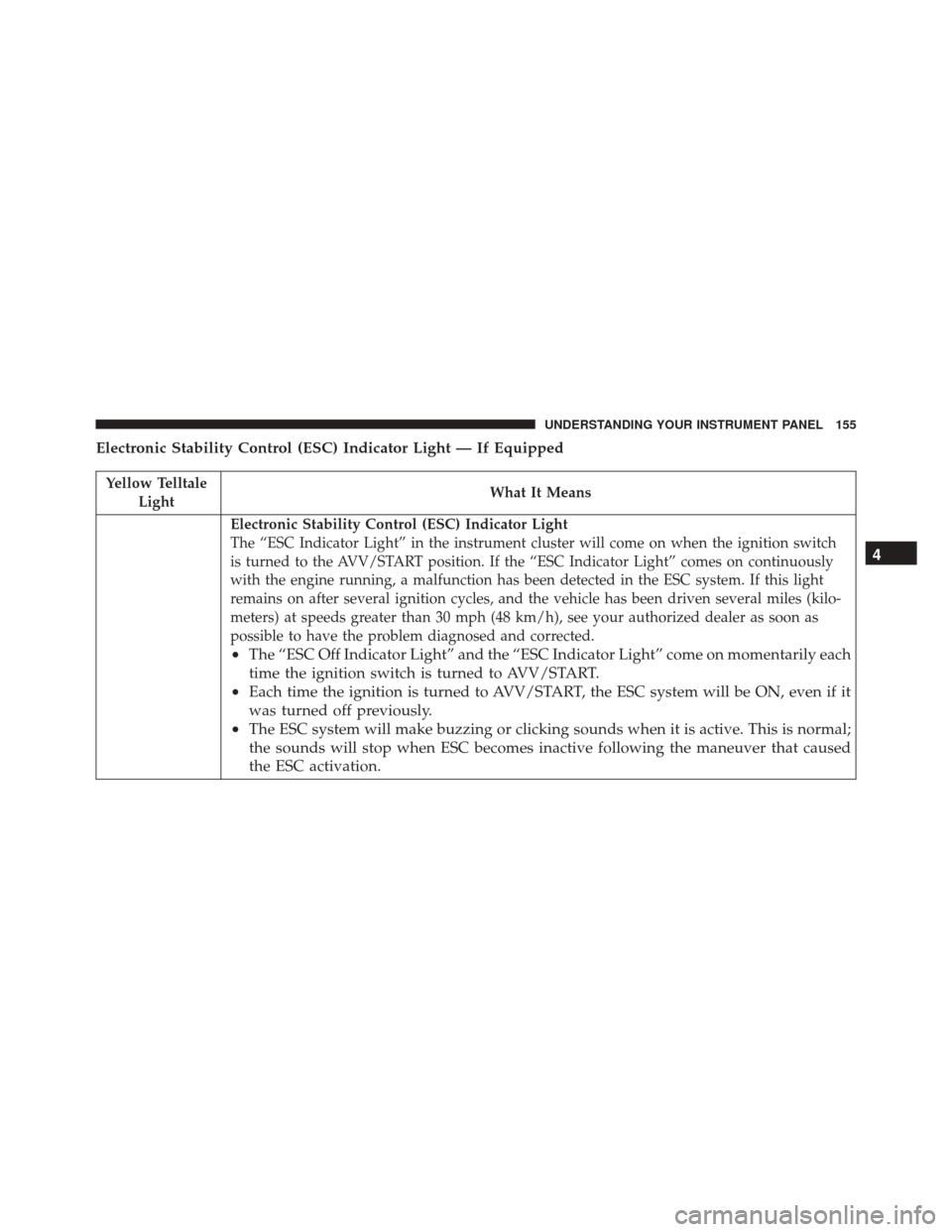
Electronic Stability Control (ESC) Indicator Light — If Equipped
Yellow TelltaleLight What It Means
Electronic Stability Control (ESC) Indicator Light
The “ESC Indicator Light” in the instrument cluster will come on when the ignition switch
is turned to the AVV/START position. If the “ESC Indicator Light” comes on continuously
with the engine running, a malfunction has been detected in the ESC system. If this light
remains on after several ignition cycles, and the vehicle has been driven several miles (kilo-
meters) at speeds greater than 30 mph (48 km/h), see your authorized dealer as soon as
possible to have the problem diagnosed and corrected.
•
The “ESC Off Indicator Light” and the “ESC Indicator Light” come on momentarily each
time the ignition switch is turned to AVV/START.
• Each time the ignition is turned to AVV/START, the ESC system will be ON, even if it
was turned off previously.
• The ESC system will make buzzing or clicking sounds when it is active. This is normal;
the sounds will stop when ESC becomes inactive following the maneuver that caused
the ESC activation. 4
UNDERSTANDING YOUR INSTRUMENT PANEL 155
Page 166 of 362
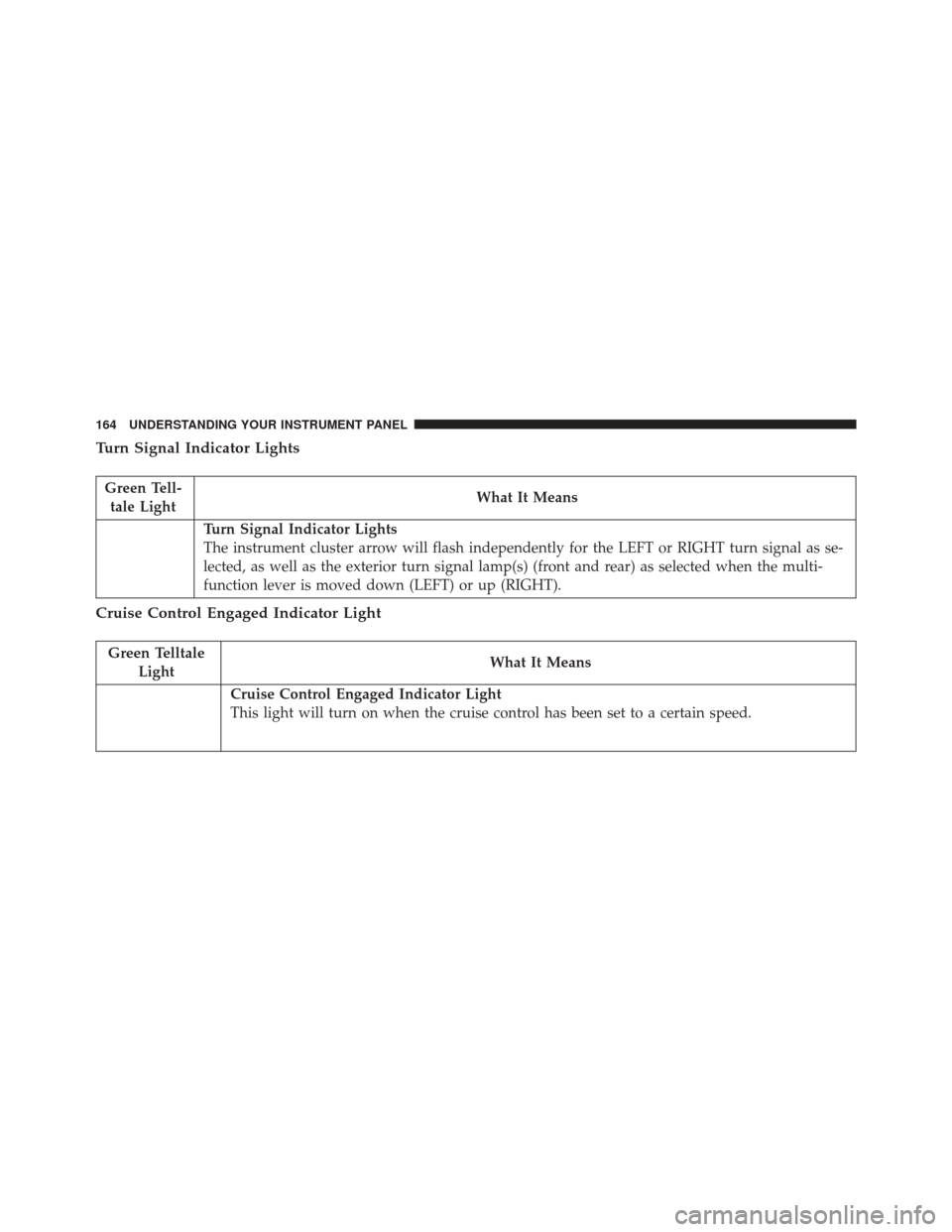
Turn Signal Indicator Lights
Green Tell-tale Light What It Means
Turn Signal Indicator Lights
The instrument cluster arrow will flash independently for the LEFT or RIGHT turn signal as se-
lected, as well as the exterior turn signal lamp(s) (front and rear) as selected when the multi-
function lever is moved down (LEFT) or up (RIGHT).
Cruise Control Engaged Indicator Light
Green Telltale
Light What It Means
Cruise Control Engaged Indicator Light
This light will turn on when the cruise control has been set to a certain speed.
164 UNDERSTANDING YOUR INSTRUMENT PANEL
Page 168 of 362
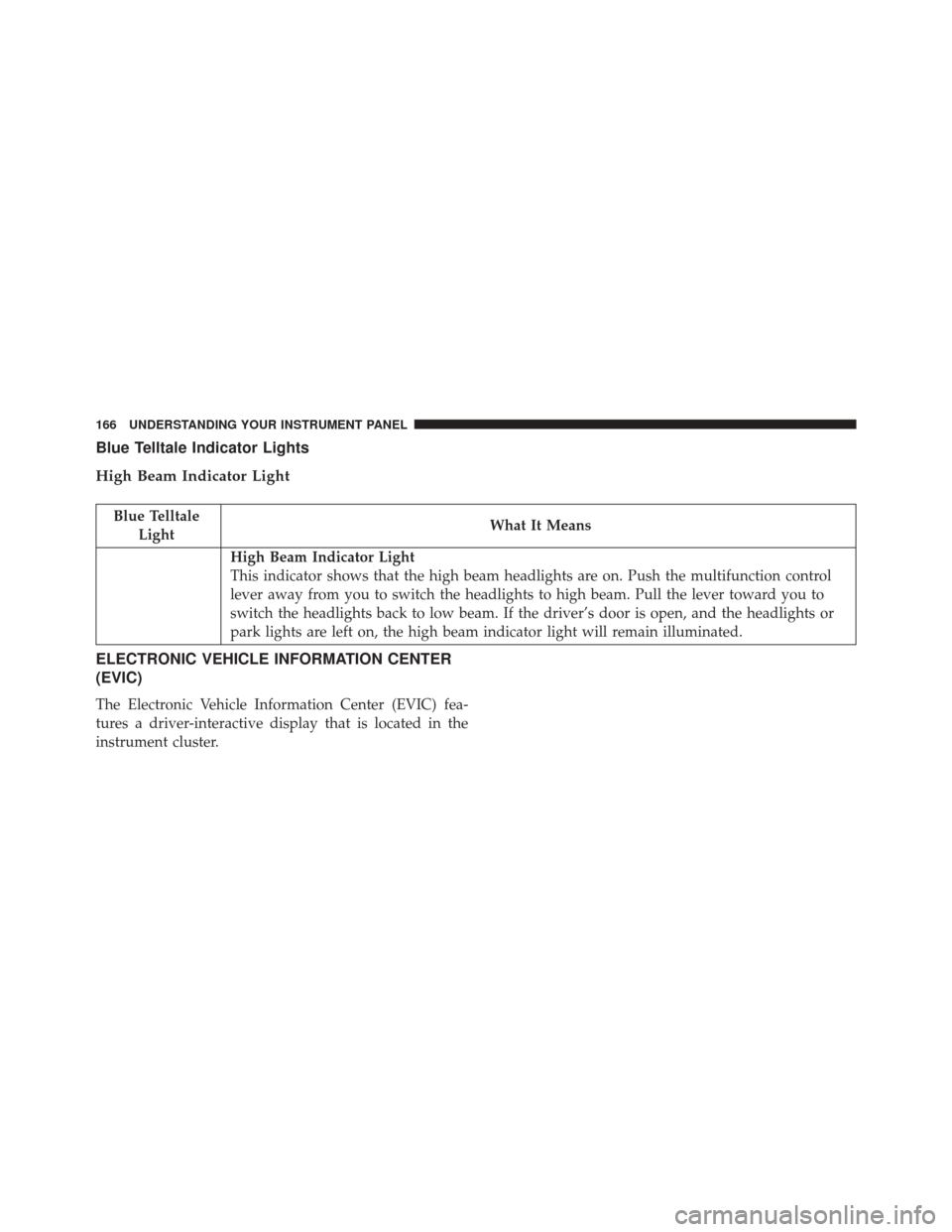
Blue Telltale Indicator Lights
High Beam Indicator Light
Blue TelltaleLight What It Means
High Beam Indicator Light
This indicator shows that the high beam headlights are on. Push the multifunction control
lever away from you to switch the headlights to high beam. Pull the lever toward you to
switch the headlights back to low beam. If the driver’s door is open, and the headlights or
park lights are left on, the high beam indicator light will remain illuminated.
ELECTRONIC VEHICLE INFORMATION CENTER
(EVIC)
The Electronic Vehicle Information Center (EVIC) fea-
tures a driver-interactive display that is located in the
instrument cluster.
166 UNDERSTANDING YOUR INSTRUMENT PANEL
Page 169 of 362
The EVIC consists of the following:
•System Status
• Vehicle Information Warning Message Displays
• Outside Temperature Display •
Trip Computer Functions
• Tire Pressure Monitoring Display
• Range
EVIC Control Buttons
The EVIC control buttons are located on the right side of
the Instrument Cluster. There are three control buttons
that are used to navigate through the EVIC functions:
•+ button
• – button
• MENU ESC button
Electronic Vehicle Information Center (EVIC) Display
4
UNDERSTANDING YOUR INSTRUMENT PANEL 167
Page 172 of 362
5. Briefly push and release the MENU ESC button tostore the new setting and go back to the previously
selected submenu option.
6. Push and hold the MENU ESC button to return to the main menu (short hold) or the main screen (longer
hold).
Trip Computer
The Trip Computer is located in the instrument cluster.
The Trip Computer displays trip information such as:
average speed, distance traveled, average energy, time
traveled, motor power, and tire pressure.
Trip Button
The TRIP button is located on the right steering column
stalk. •
A short button push scrolls through the user-selectable
information.
• A long button push resets.
The User-Selectable options are:
• Motor Power (Kilowatts)
Trip Button
170 UNDERSTANDING YOUR INSTRUMENT PANEL
Page 215 of 362
CAUTION!
Towing the vehicle, coasting, or driving for any other
reason with the transmission in NEUTRAL can cause
severe transmission damage. Refer to “Recreational
Towing” in “Starting And Operating” and “Towing A
Disabled Vehicle” in “What To Do In Emergencies”
for further information.
DRIVE (D)
Use this gear for all city and highway driving.
Auto Park
The Auto Park feature automatically places the transmis-
sion into PARK if there is any indication that the driver
may leave the vehicle while the transmission is in D
(DRIVE), N (NEUTRAL) or R (REVERSE).Auto Park is enabled under the following conditions:
•
Key On (12 Volt ON and High Voltage OFF) or READY
mode (12 Volt ON and High Voltage ON).
• Vehicle speed is below 2 mph (3 km/h).
NOTE:
• Auto Park is enabled (only once) at the beginning of
each key cycle and is re-enabled each time the vehicle
speed exceeds 8 mph (13 km/h).
• Auto Park is disabled above 2 mph (3 km/h) and
transmission range will be maintained.
The instrument cluster will display an Auto Shift To Park
message and chime once when Auto Park is activated.
5
STARTING AND OPERATING 213
Page 221 of 362
When the parking brake is applied with the ignition
switch in the MAR (ACC/ON/RUN) position, the Brake
Warning Light in the instrument cluster will illuminate.
When parking on a hill, it is important to turn the front
wheels toward the curb on a downhill grade and away
from the curb on an uphill grade. The parking brake should
always be applied whenever the driver is not in the vehicle.
WARNING!
•Never leave children alone in a vehicle, or with
access to an unlocked vehicle.
• Allowing children to be in a vehicle unattended is
dangerous for a number of reasons. A child or
others could be seriously or fatally injured. Chil-
dren should be warned not to touch the parking
brake, brake pedal or the transmission push but-
tons.
(Continued)
WARNING! (Continued)
•Do not leave the key fob in or near the vehicle (or
in a location accessible to children). A child could
operate power windows, other controls, or move
the vehicle.
• Be sure the parking brake is fully disengaged
before driving; failure to do so can lead to brake
failure and a collision.
• Always fully apply the parking brake when leav-
ing your vehicle, or it may roll and cause damage or
injury.
5
STARTING AND OPERATING 219
Page 227 of 362
Partial Off
This mode is entered by momentarily pushing the ESC
Off switch. This mode is intended to be used if the vehicle
is in deep snow, sand or gravel conditions and more
wheel spin than ESC would normally allow is required to
gain traction.
To turn ESC on again, momentarily pushing the switch
again. This will restore the normal ESC On mode of
operation.
NOTE:To improve the vehicle’s traction when driving
with snow chains, or starting off in deep snow, sand or
gravel, it may be desirable to switch to the Partial Off
mode by pushing the switch. Once the situation requiring
ESC to be switched to the Partial Off mode is overcome,
turn ESC back on by momentarily pushing the switch.
This may be done while the vehicle is in motion.WARNING!
• When in “Partial Off” mode, the TCS functionality
of ESC, (except for the limited slip feature de-
scribed in the TCS section), has been disabled and
the “ESC Off Indicator Light” will be illuminated.
When in “Partial Off” mode, the engine power
reduction feature of TCS is disabled, and the
enhanced vehicle stability offered by the ESC sys-
tem is reduced.
ESC Activation/Malfunction Indicator Light And
ESC OFF Indicator Light
The ESC Activation/Malfunction Indicator
Light in the instrument cluster will come on
when the ignition switch is turned to the MAR
(ACC/ON/RUN) position for four seconds. If
the ESC Activation/Malfunction Indicator Light comes
5
STARTING AND OPERATING 225
Page 228 of 362
on continuously with the vehicle operating running, a
malfunction has been detected in the ESC system. If this
light remains on after several ignition cycles, and the
vehicle has been driven several miles (kilometers) at
speeds greater than 30 mph (48 km/h), see your autho-
rized dealer as soon as possible to have the problem
diagnosed and corrected.
The ESC Activation/Malfunction Indicator Light (located
in the instrument cluster) starts to flash as soon as the
tires lose traction and the ESC system becomes active.
The ESC Activation/Malfunction Indicator Light also
flashes when TCS is active. If the ESC Activation/
Malfunction Indicator Light begins to flash during accel-
eration, ease up on the accelerator and apply as little
throttle as possible. Be sure to adapt your speed and
driving to the prevailing road conditions.NOTE:
•
The ESC Activation/Malfunction Indicator Light and
the ESC OFF Indicator Light come on momentarily
each time the ignition switch is turned ON.
• Each time the ignition is turned ON, the ESC system
will be ON even if it was turned off previously.
The ESC OFF Indicator Light indicates the
Electronic Stability Control (ESC) is partially
off.
Regenerative Braking System (RBS)
Your 500e has a Regenerative Braking System
(RBS). The RBS reduces the high voltage bat-
tery consumption of the vehicle, particularly in
stop-and-go city traffic. The electric motors
226 STARTING AND OPERATING