transmission FIAT 500E 2016 2.G Owner's Manual
[x] Cancel search | Manufacturer: FIAT, Model Year: 2016, Model line: 500E, Model: FIAT 500E 2016 2.GPages: 362, PDF Size: 2.58 MB
Page 221 of 362
When the parking brake is applied with the ignition
switch in the MAR (ACC/ON/RUN) position, the Brake
Warning Light in the instrument cluster will illuminate.
When parking on a hill, it is important to turn the front
wheels toward the curb on a downhill grade and away
from the curb on an uphill grade. The parking brake should
always be applied whenever the driver is not in the vehicle.
WARNING!
•Never leave children alone in a vehicle, or with
access to an unlocked vehicle.
• Allowing children to be in a vehicle unattended is
dangerous for a number of reasons. A child or
others could be seriously or fatally injured. Chil-
dren should be warned not to touch the parking
brake, brake pedal or the transmission push but-
tons.
(Continued)
WARNING! (Continued)
•Do not leave the key fob in or near the vehicle (or
in a location accessible to children). A child could
operate power windows, other controls, or move
the vehicle.
• Be sure the parking brake is fully disengaged
before driving; failure to do so can lead to brake
failure and a collision.
• Always fully apply the parking brake when leav-
ing your vehicle, or it may roll and cause damage or
injury.
5
STARTING AND OPERATING 219
Page 263 of 362
NOTE:Changes or modifications not expressly approved
by the party responsible for compliance could void the
user ’s authority to operate the equipment.TRAILER TOWING
Trailer towing with this vehicle is not recommended.
RECREATIONAL TOWING (BEHIND MOTORHOME, ETC.)
Towing This Vehicle Behind Another Vehicle
Towing Condition Wheels OFF the Ground Single-Speed Transmission
Flat Tow NONENOT ALLOWED
Dolly Tow FrontOK
Rear NOT ALLOWED
On Trailer ALLOK
NOTE:
• When recreational towing your vehicle, always follow
applicable state and provincial laws. Contact state and
provincial Highway Safety offices for additional de-
tails. •
This vehicle must be towed on a dolly or vehicle trailer
with the front wheels OFFthe ground.
5
STARTING AND OPERATING 261
Page 264 of 362
CAUTION!
Towing this vehicle in violation of the above require-
ments can cause severe transmission damage. Dam-
age from improper towing is not covered under the
New Vehicle Limited Warranty.
EXTENDING YOUR DRIVING RANGE PER
CHARGE
The drive system and cabin temperature management
features use the most energy from the high voltage
battery. Reducing energy draw from these features are
the easiest and most effective way to extend driving
range.
The 500e uses high voltage components to heat and cool
the cabin, so when using automatic climate control, con-
sider setting temperatures a few degrees higher or lower
during hot and cold days. If your 500e has been soaking inhot or cold temperatures for an extended period, it is
recommended that the car be preconditioned using the
Uconnect Access smartphone app while still plugged into a
charging source. This will allow 500e to use external power
to establish a comfortable cabin temperature before the
drive and allow the battery to maintain the temperature at
significantly lower energy levels.
Additional tips:
•
Keep tires properly inflated
• When practical, choose surface streets over the high-
way, and work to maintain a steady speed
• Avoid carrying nonessential cargo
• Be mindful of adding external accessories that may
increase aerodynamic drag
• Perform all scheduled maintenance at recommended
intervals
262 STARTING AND OPERATING
Page 275 of 362
on the ground. This will provide the best positioning
of the kit when injecting the sealant into the deflated
tire and running the air pump. Move the vehicle as
necessary to place the valve stem in this position
before proceeding.
3. Place the transmission in PARK (auto transmission) or in Gear (manual transmission) and place the ignition
in the OFF position.
4. Set the parking brake.
(B) Setting Up To Use Tire Service Kit:
1. Push in the Mode Select Knob (5) and turn to the Sealant Mode position.
2. Uncoil the Sealant Hose (6) and then remove the cap from the fitting at the end of the hose.
3. Place the Tire Service Kit flat on the ground next to the deflated tire. 4. Remove the cap from the valve stem and then screw
the fitting at the end of the Sealant Hose (6) onto the
valve stem.
5. Uncoil the Power Plug (8) and insert the plug into the vehicle’s 12 Volt power outlet.
NOTE: Do not remove foreign objects (e.g., screws or
nails) from the tire.
(C) Injecting Tire Service Kit Sealant Into The
Deflated Tire:
• Always start the engine before turning ON the Tire
Service Kit.
NOTE: Manual transmission vehicles must have the
parking brake engaged and the gear selector in NEU-
TRAL.
6
WHAT TO DO IN EMERGENCIES 273
Page 282 of 362
WARNING!
•Take care to avoid the radiator cooling fan when-
ever the hood is raised. It can start anytime the
ignition switch is ON. You can be injured by
moving fan blades.
• Remove any metal jewelry such as rings, watch
bands and bracelets that could make an inadvertent
electrical contact. You could be seriously injured.
• Batteries contain sulfuric acid that can burn your
skin or eyes and generate hydrogen gas which is
flammable and explosive. Keep open flames or
sparks away from the battery.
1. Set the parking brake, place the transmission into PARK and turn the ignition to LOCK.
2. Turn off the heater, radio, and all unnecessary electri- cal accessories. 3. Remove the protective cover over the positive
(+)
battery post.
4. If using another vehicle to jump-start the battery, park the vehicle within the jumper cables reach, set the
parking brake and make sure the ignition is OFF.
WARNING!
Do not allow vehicles to touch each other as this
could establish a ground connection and personal
injury could result.
Jump-Starting Procedure
WARNING!
Failure to follow this jump-starting procedure could
result in personal injury or property damage due to
battery explosion.
280 WHAT TO DO IN EMERGENCIES
Page 286 of 362
In order to move the vehicle in cases where the transmis-
sion will not shift out of PARK (such as a dead battery),
a Manual Park Release is available. If a dead 12 volt
battery is the cause of the condition refer to “Jump Start
Procedure — 12 Volt Battery” before performing the
Manual Park Release.
To perform the Manual Park Release follow these steps:
1. To prevent the vehicle from rolling unintentionally,firmly apply the parking brake.
2. If possible, raise the front driver’s side of the vehicle to provide access to the transmission.
3.
Working from underneath the vehicle, remove the black
rubber plug from the front of the Park module (a black
canister mounted on the front of the transmission).
4. Using a T25 driver bit, rotate the Manual Park Release shaft (located just behind the rubber plug) clockwise,
at least 20 turns, to release the Park mechanism. The
vehicle is now out of PARK and can be moved. 5. Reinstall the rubber plug.
6. Release the parking brake only when a driver is in the
vehicle, or the vehicle is secured by other means. The
Manual Park Release will be reset automatically once
the vehicle is restarted.
Manual Park Release Location
284 WHAT TO DO IN EMERGENCIES
Page 287 of 362
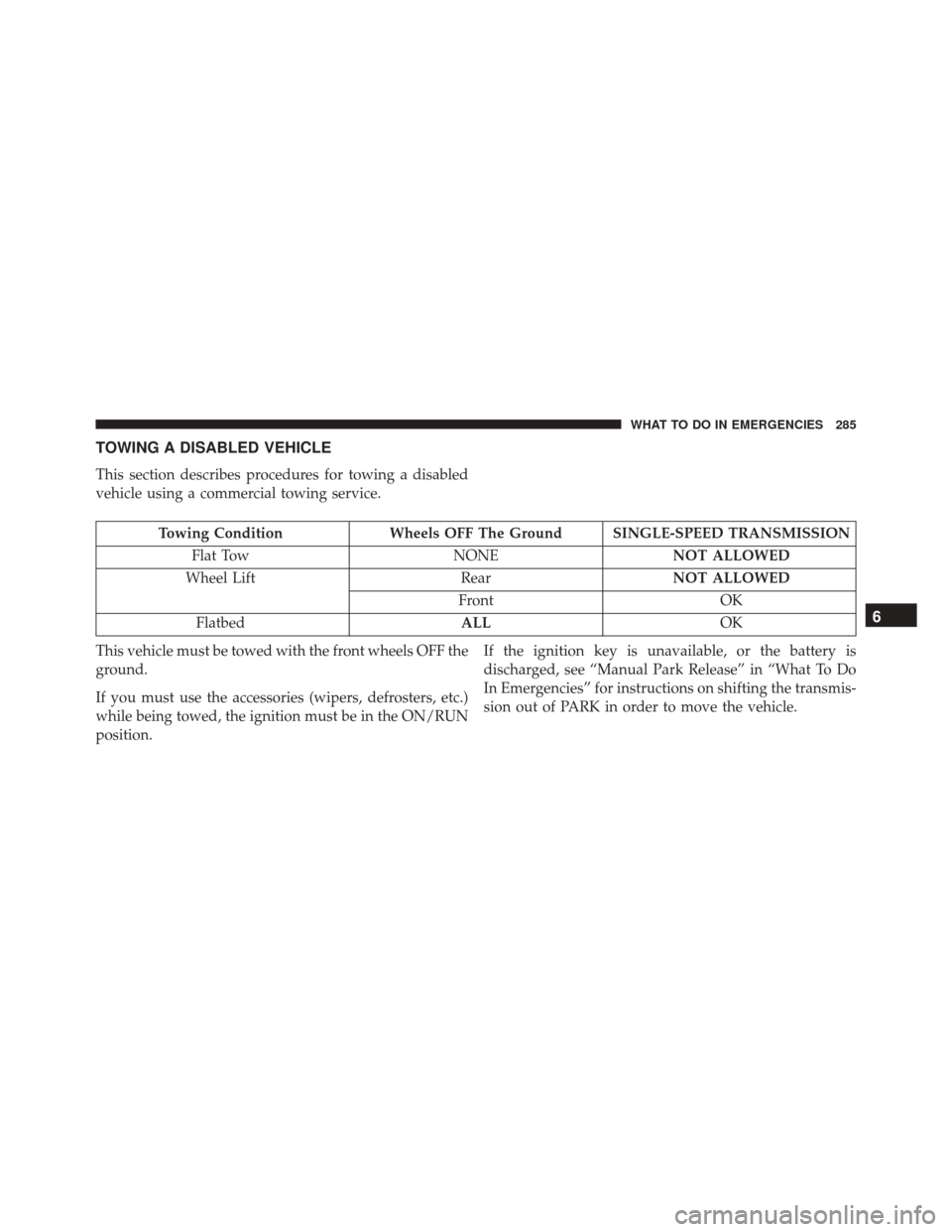
TOWING A DISABLED VEHICLE
This section describes procedures for towing a disabled
vehicle using a commercial towing service.
Towing ConditionWheels OFF The Ground SINGLE-SPEED TRANSMISSION
Flat Tow NONENOT ALLOWED
Wheel Lift RearNOT ALLOWED
Front OK
Flatbed ALLOK
This vehicle must be towed with the front wheels OFF the
ground.
If you must use the accessories (wipers, defrosters, etc.)
while being towed, the ignition must be in the ON/RUN
position. If the ignition key is unavailable, or the battery is
discharged, see “Manual Park Release” in “What To Do
In Emergencies” for instructions on shifting the transmis-
sion out of PARK in order to move the vehicle.
6
WHAT TO DO IN EMERGENCIES 285
Page 330 of 362
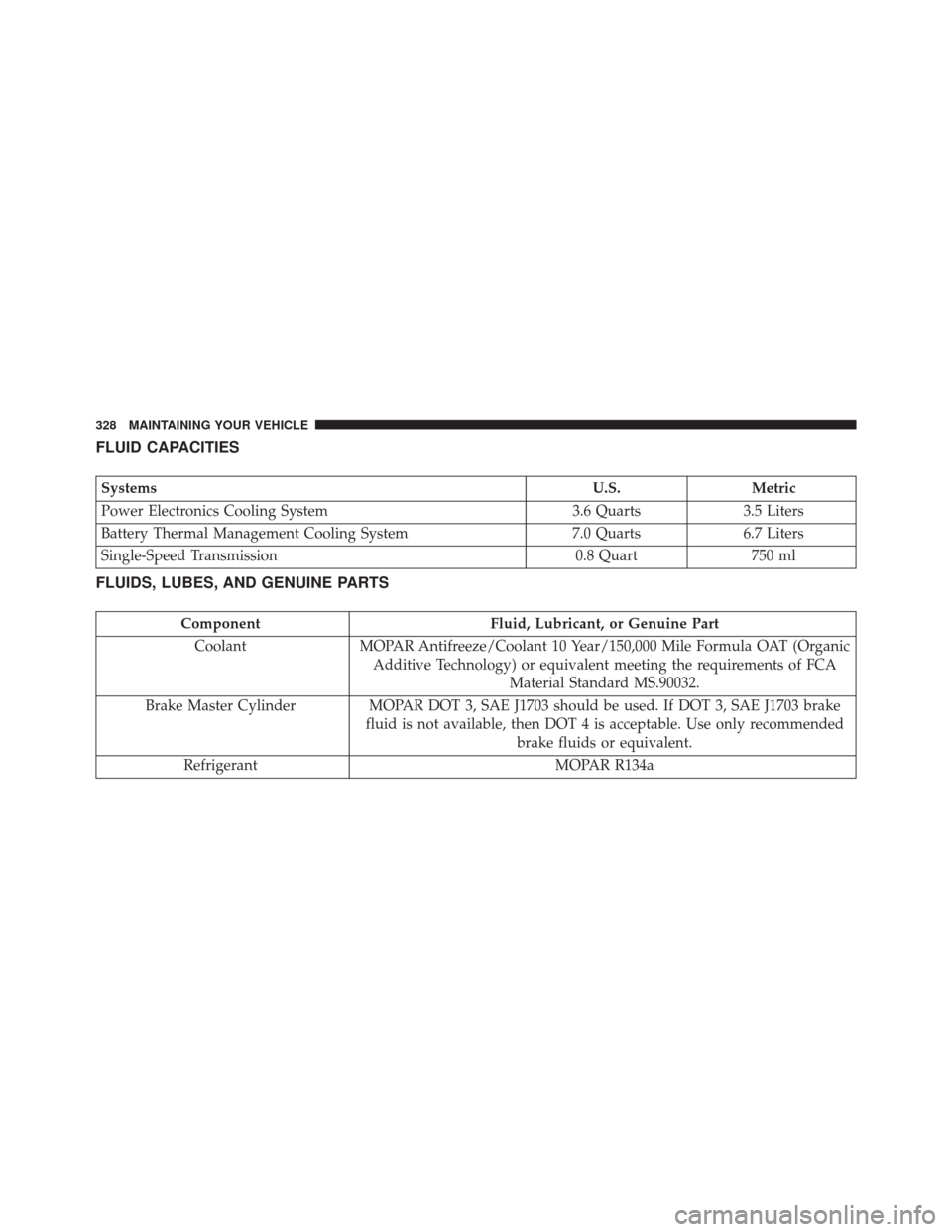
FLUID CAPACITIES
SystemsU.S.Metric
Power Electronics Cooling System 3.6 Quarts3.5 Liters
Battery Thermal Management Cooling System 7.0 Quarts6.7 Liters
Single-Speed Transmission 0.8 Quart750 ml
FLUIDS, LUBES, AND GENUINE PARTS
Component Fluid, Lubricant, or Genuine Part
Coolant MOPAR Antifreeze/Coolant 10 Year/150,000 Mile Formula OAT (Organic
Additive Technology) or equivalent meeting the requirements of FCA Material Standard MS.90032.
Brake Master Cylinder MOPAR DOT 3, SAE J1703 should be used. If DOT 3, SAE J1703 brake fluid is not available, then DOT 4 is acceptable. Use only recommendedbrake fluids or equivalent.
Refrigerant MOPAR R134a
328 MAINTAINING YOUR VEHICLE
Page 331 of 362
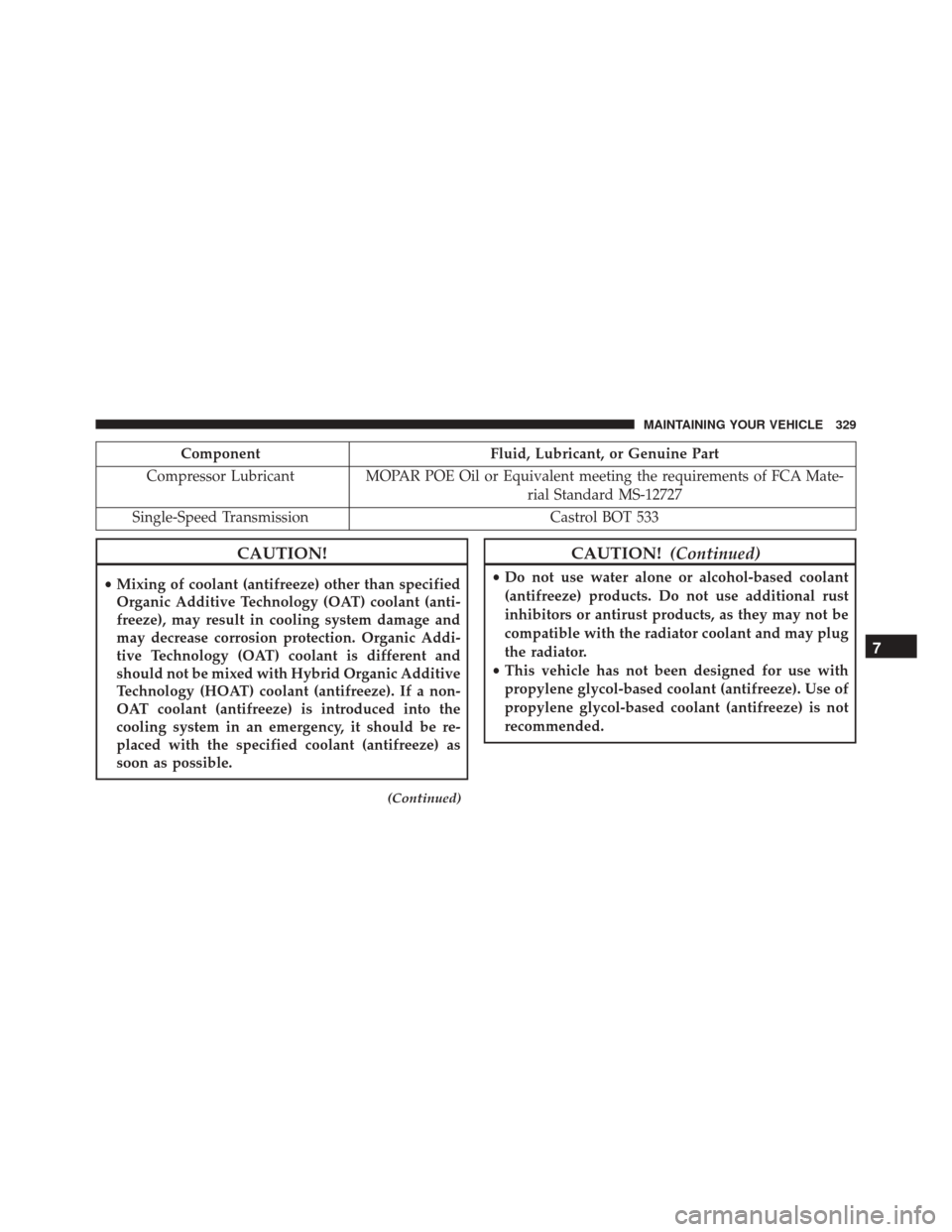
ComponentFluid, Lubricant, or Genuine Part
Compressor Lubricant MOPAR POE Oil or Equivalent meeting the requirements of FCA Mate- rial Standard MS-12727
Single-Speed Transmission Castrol BOT 533
CAUTION!
•Mixing of coolant (antifreeze) other than specified
Organic Additive Technology (OAT) coolant (anti-
freeze), may result in cooling system damage and
may decrease corrosion protection. Organic Addi-
tive Technology (OAT) coolant is different and
should not be mixed with Hybrid Organic Additive
Technology (HOAT) coolant (antifreeze). If a non-
OAT coolant (antifreeze) is introduced into the
cooling system in an emergency, it should be re-
placed with the specified coolant (antifreeze) as
soon as possible.
(Continued)
CAUTION! (Continued)
•Do not use water alone or alcohol-based coolant
(antifreeze) products. Do not use additional rust
inhibitors or antirust products, as they may not be
compatible with the radiator coolant and may plug
the radiator.
• This vehicle has not been designed for use with
propylene glycol-based coolant (antifreeze). Use of
propylene glycol-based coolant (antifreeze) is not
recommended.
7
MAINTAINING YOUR VEHICLE 329
Page 350 of 362
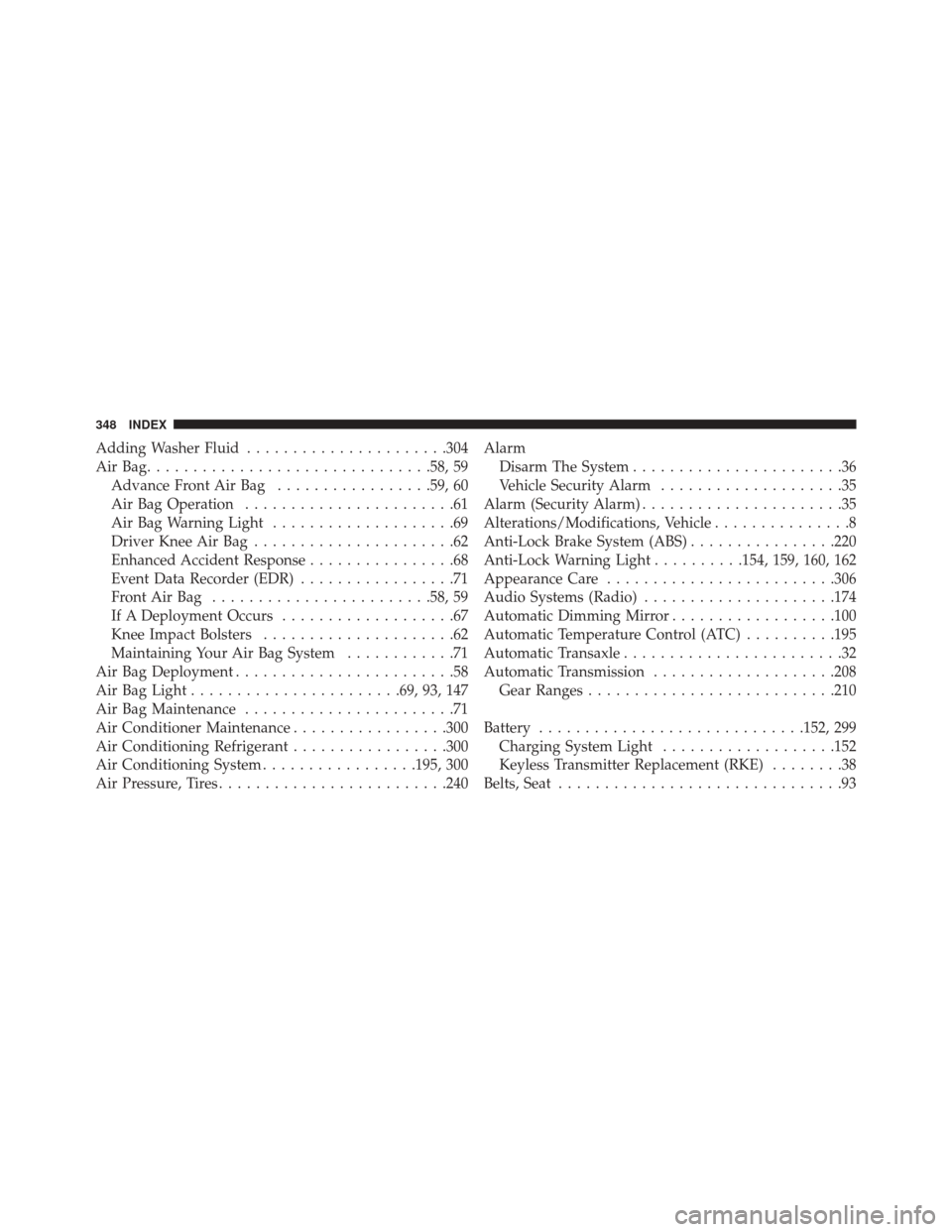
Adding Washer Fluid..................... .304
AirBag.............................. .58, 59
Advance Front Air Bag .................59, 60
Air Bag Operation .......................61
Air Bag Warning Light ....................69
Driver Knee Air Bag ......................62
Enhanced Accident Response ................68
Event Data Recorder (EDR) .................71
FrontAirBag ........................58, 59
If A Deployment Occurs ...................67
Knee Impact Bolsters .....................62
Maintaining Your Air Bag System ............71
Air Bag Deployment ........................58
Air Bag Light ...................... .69, 93, 147
Air Bag Maintenance .......................71
Air Conditioner Maintenance .................300
Air Conditioning Refrigerant .................300
Air Conditioning System .................195, 300
Air Pressure, Tires ........................ .240Alarm
Disarm The System .......................36
Vehicle Security Alarm ....................35
Alarm (Security Alarm) ......................35
Alterations/Modifications, Vehicle ...............8
Anti-Lock Brake System (ABS) ................220
Anti-Lock Warning Light ..........154, 159, 160, 162
Appearance Care ........................ .306
Audio Systems (Radio) .....................174
Automatic Dimming Mirror ..................100
Automatic Temperature Control (ATC) ..........195
Automatic Transaxle ........................32
Automatic Transmission ....................208
Gear Ranges .......................... .210
Battery ............................ .152, 299
Charging System Light ...................152
Keyless Transmitter Replacement (RKE) ........38
Belts, Seat ...............................93
348 INDEX