child lock FIAT 500E 2017 2.G User Guide
[x] Cancel search | Manufacturer: FIAT, Model Year: 2017, Model line: 500E, Model: FIAT 500E 2017 2.GPages: 300, PDF Size: 2.58 MB
Page 73 of 300
Installing Child Restraints Using The Vehicle
Seat Belt
Child restraint systems are designed to be secured in
vehicle seats by lap belts or the lap belt portion of a
lap/shoulder belt.
WARNING!
•Improper installation or failure to properly secure
a child restraint can lead to failure of the restraint.
The child could be badly injured or killed.
• Follow the child restraint manufacturer ’s direc-
tions exactly when installing an infant or child
restraint.
The seat belts in the passenger seating positions are
equipped with a Switchable Automatic Locking Retrac-
tor (ALR) that is designed to keep the lap portion of the
seat belt tight around the child restraint so that it is not
necessary to use a locking clip. The ALR retractor can be
“switched” into a locked mode by pulling all of the
webbing out of the retractor and then letting the web-
bing retract back into the retractor. If it is locked, the
ALR will make a clicking noise while the webbing is
pulled back into the retractor. Refer to the “Automatic
Locking Mode” description in “Switchable Automatic Locking Retractors (ALR)” under “Occupant Restraint
Systems” for additional information on ALR.
Please see the table below and the following sections for
more information.
Lap/Shoulder Belt Systems For Installing Child
Restraints In This Vehicle
Automatic Locking Retractor (ALR) Locations
•
ALR = Switchable Automatic Locking Retractor
•
Top Tether Anchorage Symbol 2
THINGS TO KNOW BEFORE STARTING YOUR VEHICLE 71
Page 74 of 300
Frequently Asked Questions About Installing Child Restraints With Seat Belts
What is the weight limit (child’s weight
+ weight of the child restraint) for using the Tether Anchor with the seat belt to
attach a forward facing child restraint? Weight limit of the
Child Restraint Always use the tether anchor when us-
ing the seat belt to install a forward fac- ing child restraint, up to the recom-mended weight limit of the child restraint.
Can the rear-facing child restraint touch the back of the front passenger seat? Yes
Contact between the front passenger seat
and the child restraint is allowed, if the
child restraint manufacturer also allows contact.
Can the head restraints be removed? YesYes, all may be removed.
Can the buckle stalk be twisted to
tighten the seat belt against the belt path of the child restraint? No
Do not twist the buckle stalk in a seating
position with an ALR retractor.
Installing A Child Restraint With A Switchable
Automatic Locking Retractor (ALR)
Child restraint systems are designed to be secured in
vehicle seats by lap belts or the lap belt portion of a
lap/shoulder belt.
WARNING!
•Improper installation or failure to properly secure
a child restraint can lead to failure of the restraint.
The child could be badly injured or killed.
• Follow the child restraint manufacturer ’s direc-
tions exactly when installing an infant or child
restraint.
72 THINGS TO KNOW BEFORE STARTING YOUR VEHICLE
Page 75 of 300
1. Place the child seat in the center of the seatingposition. Move the vehicle seat as far rearward as
possible to keep the child as far from the advanced
passenger air bag as possible.
2. Pull enough of the seat belt webbing from the retractor to pass it through the belt path of the child
restraint. Do not twist the belt webbing in the belt
path.
3. Slide the latch plate into the buckle until you hear a “click.”
4. Pull on the webbing to make the lap portion tight against the child seat.
5. To lock the seat belt, pull down on the shoulder part of the belt until you have pulled all the seat belt
webbing out of the retractor. Then, allow the web-
bing to retract back into the retractor. As the webbing
retracts, you will hear a clicking sound. This means
the seat belt is now in the Automatic Locking mode.
6. Try to pull the webbing out of the retractor. If it is locked, you should not be able to pull out any
webbing. If the retractor is not locked, repeat step 5. 7. Finally, pull up on any excess webbing to tighten the
lap portion around the child restraint while you push
the child restraint rearward and downward into the
vehicle seat.
8. If the child restraint has a top tether strap and the seating position has a top tether anchorage, connect
the tether strap to the anchorage and tighten the
tether strap. See the section “Installing Child Re-
straints Using the Top Tether Anchorage” for direc-
tions to attach a tether anchor.
9. Test that the child restraint is installed tightly by pulling back and forth on the child seat at the belt
path. It should not move more than 1 inch (25.4 mm)
in any direction.
Any seat belt system will loosen with time, so check the
belt occasionally, and pull it tight if necessary.
2
THINGS TO KNOW BEFORE STARTING YOUR VEHICLE 73
Page 110 of 300
CAUTION!
•Rear Park Assist is only a parking aid and it is
unable to recognize every obstacle, including
small obstacles. Parking curbs might be tempo-
rarily detected or not detected at all. Obstacles
located above or below the sensors will not be
detected when they are in close proximity.
• The vehicle must be driven slowly when using
Rear Park Assist in order to be able to stop in time
when an obstacle is detected. It is recommended
that the driver looks over his/her shoulder when
using Rear Park Assist.
POWER SUNROOF — IF EQUIPPED
The power sunroof switch is located in the overhead
console.
WARNING!
• Never leave children alone in a vehicle, or with
access to an unlocked vehicle. Never leave the key
fob in or near the vehicle, or in a location acces-
sible to children. Occupants, particularly unat-
tended children, can become entrapped by the
power sunroof while operating the power sunroof
switch. Such entrapment may result in serious
injury or death.
(Continued)
Power Sunroof Switch
108 UNDERSTANDING THE FEATURES OF YOUR VEHICLE
Page 175 of 300
STARTING PROCEDURES
Before starting your vehicle, adjust your seat, adjust
both inside and outside mirrors, and fasten your seat
belts.
WARNING!
•Never leave children alone in a vehicle, or with
access to an unlocked vehicle.
• Allowing children to be in a vehicle unattended is
dangerous for a number of reasons. A child or
others could be seriously or fatally injured. Chil-
dren should be warned not to touch the parking
brake, brake pedal or the gear selector.
• Do not leave the key fob in or near the vehicle (or
in a location accessible to children). A child could
operate power windows, other controls, or move
the vehicle.
Single-Speed Transmission
The transmission must be in the PARK or NEUTRAL
position before you can start the vehicle. Apply the
brakes when selecting a transmission gear from Park.
NOTE: You must press the brake pedal before selecting
a transmission gear.
Normal Starting
Turn the key to the START position while your vehicle
is in PARK. When the ignition key is turned to the
START and then released to the RUN position, a chime
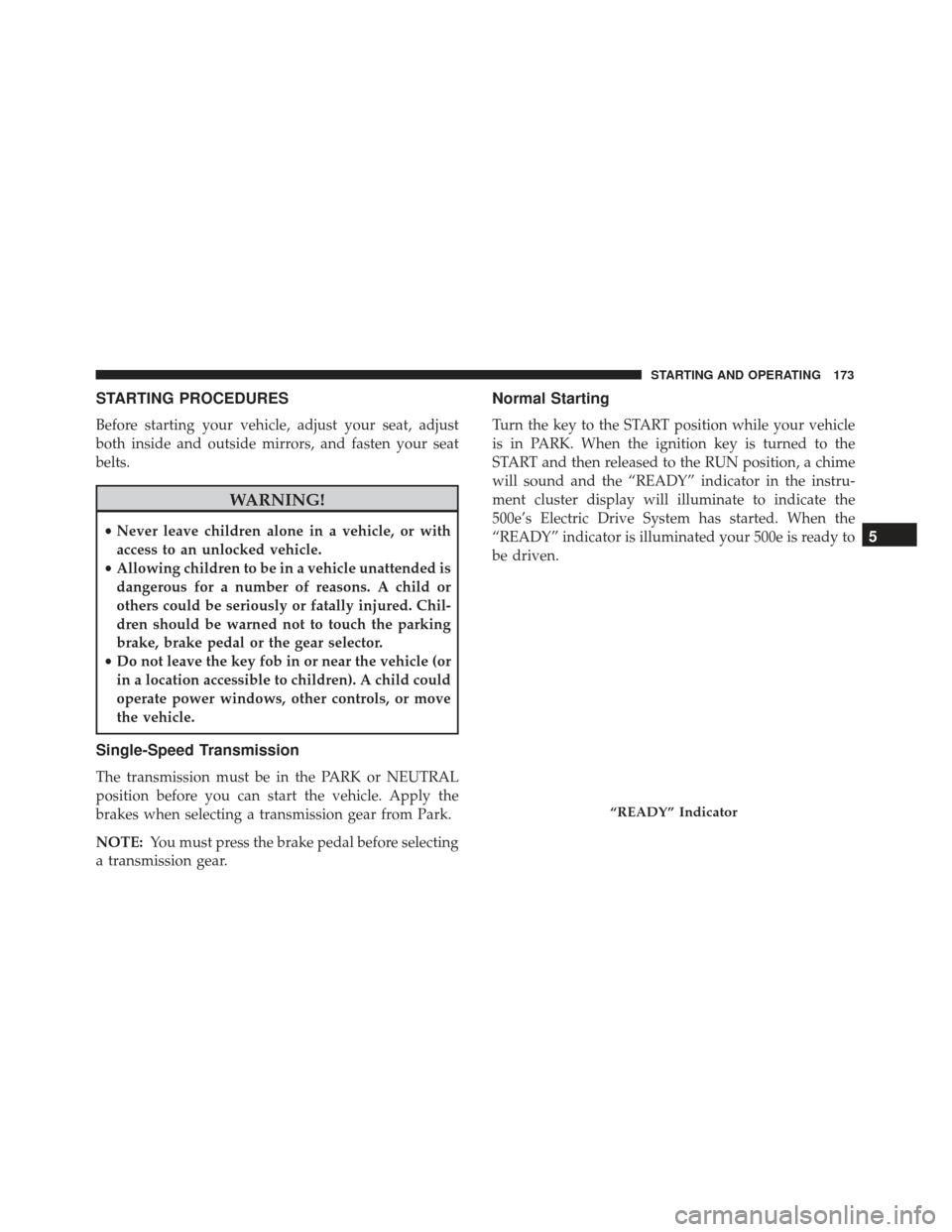
will sound and the “READY” indicator in the instru-
ment cluster display will illuminate to indicate the
500e’s Electric Drive System has started. When the
“READY” indicator is illuminated your 500e is ready to
be driven.
“READY” Indicator
5
STARTING AND OPERATING 173
Page 177 of 300
NOTE:
•You must press and hold the brake pedal while
shifting in or out of PARK.
• If all push-button LEDs are on when the key is ON,
see your authorized dealer.
WARNING!
• Only place the transmission into gear when your
foot is firmly pressing the brake pedal.
• Unintended movement of a vehicle could injure
those in or near the vehicle. As with all vehicles,
you should never exit a vehicle while the vehicle
is in “READY” mode. Before exiting a vehicle,
always apply the parking brake, shift the trans-
mission into PARK, and remove the ignition key.
Once the key is removed, the transmission is
locked in PARK, securing the vehicle against
unwanted movement.
• When leaving the vehicle, always remove the
ignition key and lock your vehicle.
• Never leave children alone in a vehicle, or with
access to an unlocked vehicle. Allowing children
(Continued)
WARNING! (Continued)
to be in a vehicle unattended is dangerous for a
number of reasons. A child or others could be
seriously or fatally injured. Children should be
warned not to touch the parking brake, brake
pedal or the transmission range buttons.
• Do not leave the ignition key in or near the
vehicle (or in a location accessible to children). A
child could operate power windows, other con-
trols, or move the vehicle.
Key Ignition Park Interlock
This vehicle is equipped with a Key Ignition Park
Interlock which requires the transmission to be in PARK
before the ignition can be turned to the OFF position.
The key can only be removed from the ignition when
the ignition is in the OFF position, and once removed,
the transmission is locked in PARK.
5
STARTING AND OPERATING 175
Page 179 of 300
WARNING!(Continued)
always apply the parking brake, shift the trans-
mission into PARK, and remove the ignition key.
Once the key is removed, the transmission is
locked in PARK, securing the vehicle against
unwanted movement.
• When leaving the vehicle, always remove the
ignition key and lock your vehicle.
• Never leave children alone in a vehicle, or with
access to an unlocked vehicle. Allowing children
to be in a vehicle unattended is dangerous for a
number of reasons. A child or others could be
seriously or fatally injured. Children should be
warned not to touch the parking brake, brake
pedal or the transmission range buttons.
• Do not leave the ignition key in or near the
vehicle (or in a location accessible to children). A
child could operate power windows, other con-
trols, or move the vehicle.
REVERSE (R)
This gear is for moving the vehicle backward. Shift into
REVERSE only after the vehicle has come to a complete
stop.
NEUTRAL (N)
The vehicle may be started in this gear. Apply the
parking brake and place the transmission into PARK if
you must leave the vehicle.
WARNING!
Do not coast in NEUTRAL and never turn off the
ignition to coast down a hill. These are unsafe
practices that limit your response to changing traf-
fic or road conditions. You might lose control of the
vehicle and have a collision.
CAUTION!
Towing the vehicle, coasting, or driving for any
other reason with the transmission in NEUTRAL
can cause severe transmission damage. Refer to
“Recreational Towing” in “Starting And Operating”
and “Towing A Disabled Vehicle” in “What To Do
In Emergencies” for further information.
DRIVE (D)
Use this gear for all city and highway driving.
5
STARTING AND OPERATING 177
Page 184 of 300
When the parking brake is applied with the ignition
switch in the MAR (ACC/ON/RUN) position, the
Brake Warning Light in the instrument cluster will
illuminate.
When parking on a hill, it is important to turn the front
wheels toward the curb on a downhill grade and away
from the curb on an uphill grade. The parking brake
should always be applied whenever the driver is not in
the vehicle.
WARNING!
•Never leave children alone in a vehicle, or with
access to an unlocked vehicle.
• Allowing children to be in a vehicle unattended is
dangerous for a number of reasons. A child or
others could be seriously or fatally injured. Chil-
dren should be warned not to touch the parking
brake, brake pedal or the transmission push but-
tons.
• Do not leave the key fob in or near the vehicle (or
in a location accessible to children). A child could
operate power windows, other controls, or move
the vehicle.
• Be sure the parking brake is fully disengaged
before driving; failure to do so can lead to brake
failure and a collision.
• Always fully apply the parking brake when leav-
ing your vehicle, or it may roll and cause damage
or injury.
Parking Brake
182 STARTING AND OPERATING
Page 287 of 300
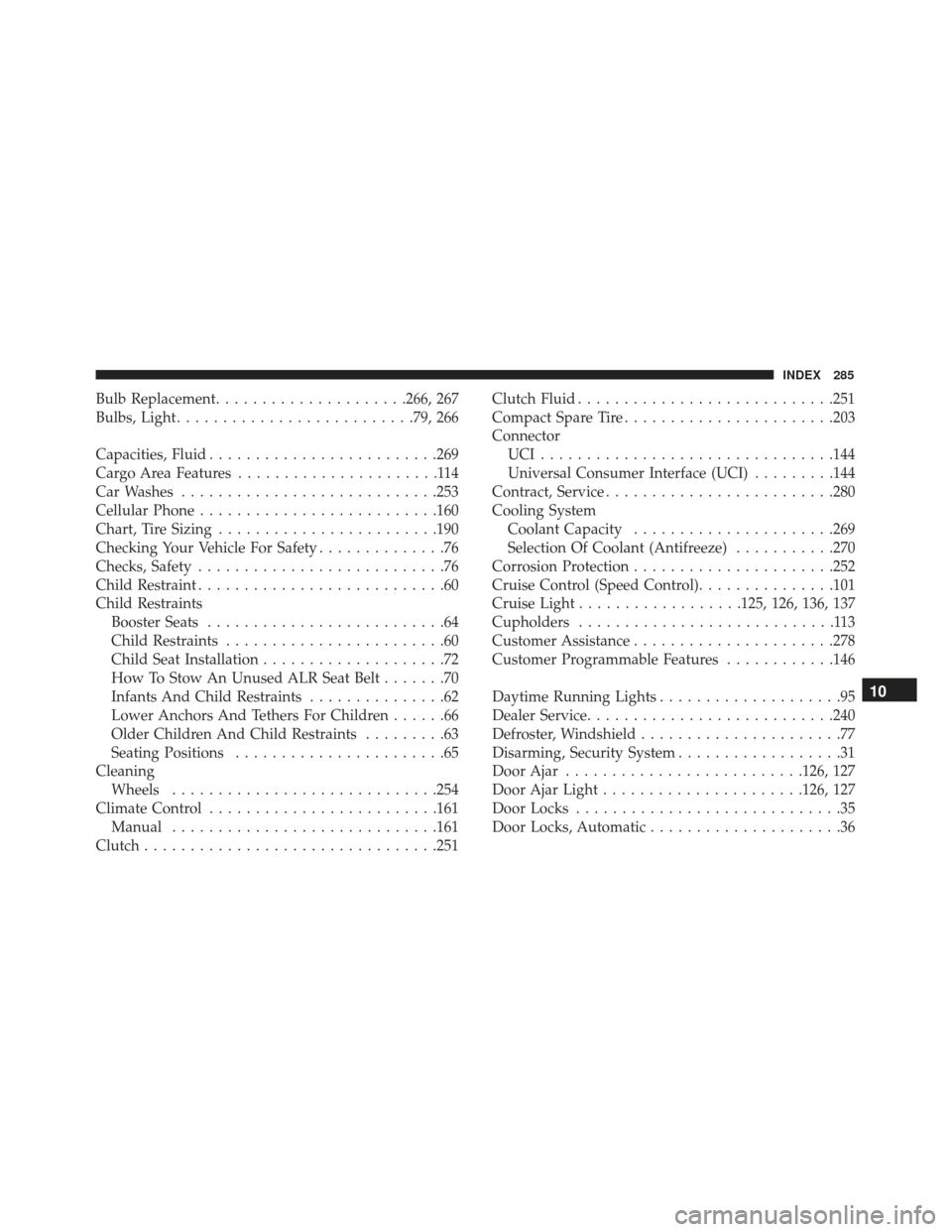
Bulb Replacement.....................266, 267
Bulbs, Light ......................... .79, 266
Capacities, Fluid ........................ .269
Cargo Area Features ......................114
Car Washes ........................... .253
Cellular Phone ......................... .160
Chart, Tire Sizing ....................... .190
Checking Your Vehicle For Safety ..............76
Checks, Safety ...........................76
Child Restraint ...........................60
Child Restraints Booster Seats ..........................64
Child Restraints ........................60
Child Seat Installation ....................72
How To Stow An Unused ALR Seat Belt .......70
Infants And Child Restraints ...............62
Lower Anchors And Tethers For Children ......66
Older Children And Child Restraints .........63
Seating Positions .......................65
Cleaning Wheels ............................ .254
Climate Control ........................ .161
Manual ............................ .161
Clutch ............................... .251Clutch Fluid
........................... .251
Compact Spare Tire ...................... .203
Connector UCI............................... .144
Universal Consumer Interface (UCI) .........144
Contract, Service ........................ .280
Cooling System Coolant Capacity ..................... .269
Selection Of Coolant (Antifreeze) ...........270
Corrosion Protection ..................... .252
Cruise Control (Speed Control) ...............101
Cruise Light ..................125, 126, 136, 137
Cupholders ............................113
Customer Assistance ..................... .278
Customer Programmable Features ............146
Daytime Running Lights ....................95
Dealer Service .......................... .240
Defroster, Windshield ......................77
Disarming,
Security System ..................31
Door Ajar ......................... .126, 127
Door Ajar Light ..................... .126, 127
Door Locks .............................35
Door Locks, Automatic .....................36
10
INDEX 285