coolant FIAT 500E 2017 2.G User Guide
[x] Cancel search | Manufacturer: FIAT, Model Year: 2017, Model line: 500E, Model: FIAT 500E 2017 2.GPages: 300, PDF Size: 2.58 MB
Page 248 of 300
Power Electronics And Battery Thermal
Management Systems — Drain, Flush And Refill
Refer to “Maintenance Schedules” for the proper main-
tenance intervals.
If the coolant (antifreeze) is dirty or contains a consid-
erable amount of sediment, clean and flush with a
reliable cooling system cleaner. Follow with a thorough
rinsing to remove all deposits and chemicals. Properly
dispose of old coolant (antifreeze) solution.
CAUTION!
It is recommended to have the cooling systems
serviced at your authorized dealer. Failure to do so
could result in poor cooling system performance
and/or vehicle damage.
Disposal Of Used Power Electronics And
Battery Thermal Management Systems Coolant
Used antifreeze is a regulated substance requiring
proper disposal. Check with your local authorities to
determine the disposal rules for your community. To
prevent ingestion by animals or children, do not store
antifreeze in open containers or allow it to remain inpuddles on the ground. If ingested by a child, contact a
physician immediately. Clean up any ground spills
immediately.
Points To Remember
WARNING!
•
Turn vehicle OFF and disconnect the fan motor
lead before working near the radiator cooling fan.
• You or others can be badly burned by hot engine
coolant (antifreeze) or steam from your radiator. If
you see or hear steam coming from under the
hood, do not open the hood until the radiator has
had time to cool. Never open a cooling system
pressure cap when the radiator or coolant bottle is
hot.
• Keep hands, tools, clothing, and jewelry away
from the radiator cooling fan when the hood is
raised. The fan may start without warning,
whether the ignition is on or off.
If an examination of your underhood compartment
shows no evidence of cooler or hose leaks, the vehicle
may be safely driven.
• Do not overfill the coolant recovery bottles.
246 MAINTAINING YOUR VEHICLE
Page 249 of 300
•Check coolant (antifreeze) freeze point in the coolant
recovery bottles. If coolant (antifreeze) needs to be
added, contents of coolant recovery bottles must also
be protected against freezing.
• If frequent coolant (antifreeze) additions are re-
quired, or if the level in the coolant recovery bottles
does not drop when the engine cools, the cooling
system should be pressure tested for leaks.
• Maintain coolant (antifreeze) concentration at 50%
OAT coolant (antifreeze) (minimum) and distilled/
deionized water for proper corrosion protection of
your engine which contains aluminum components.
• Make sure that the coolant control systems recovery
bottles overflow hoses are not kinked or obstructed.
• Keep the front of the coolant control systems clean. If
your vehicle is equipped with air conditioning, keep
the front of the condenser clean.
Maintenance-Free Battery 12 Volt
Your vehicle is equipped with a maintenance-free 12
Volt battery. You will never have to add water, nor is
periodic maintenance required.
WARNING!
• Battery fluid is a corrosive acid solution and can
burn or even blind you. Do not allow battery
fluid to contact your eyes, skin, or clothing. Do
not lean over a battery when attaching clamps. If
acid splashes in eyes or on skin, flush the area
immediately with large amounts of water. Refer
to “Jump-Starting Procedures” in “What To Do In
Emergencies” for further information.
• Battery gas is flammable and explosive. Keep
flame or sparks away from the battery. Do not use
a booster battery or any other booster source with
an output greater than 12 Volts. Do not allow
cable clamps to touch each other.
• Battery posts, terminals, and related accessories
contain lead and lead compounds. Wash hands
after handling.
• The battery in this vehicle has a vent hose that
should not be disconnected and should only be
replaced with a battery of the same type (vented).
7
MAINTAINING YOUR VEHICLE 247
Page 253 of 300
Adding Washer Fluid
The windshield washer fluid reservoir is located in the
underhood compartment, and the fluid level should be
checked at regular intervals. Fill the reservoir with
windshield washer solvent (not coolant/antifreeze).
Refer to “Underhood Compartment” in “Maintaining
Your Vehicle” for further information.
WARNING!
Commercially available windshield washer sol-
vents are flammable. They could ignite and burn
you. Care must be exercised when filling or work-
ing around the washer solution.
Brake System
In order to assure brake system performance, all brake
system components should be inspected periodically.
Refer to the “Maintenance Schedule” for the proper
maintenance intervals.
WARNING!
Riding the brakes can lead to brake failure and
possibly a collision. Driving with your foot resting
or riding on the brake pedal can result in abnor-
mally high brake temperatures, excessive lining
wear, and possible brake damage. Riding the
brakes may also reduce braking capacity in an
emergency.
Brake Master Cylinder
The fluid level in the master cylinder should be checked
when performing under hood services, or immediately
if the “Brake Warning Light” is on and the parking
brake is not applied.
Be sure to clean the top of the master cylinder area
before removing the cap. If necessary, add fluid to bring
the fluid level up to the requirements described on the
brake fluid reservoir. Fluid level can be expected to fall
as the brake pads wear. The brake fluid level should be
checked when the pads are replaced. However, low
fluid level may be caused by a leak and a checkup may
be needed.7
MAINTAINING YOUR VEHICLE 251
Page 267 of 300
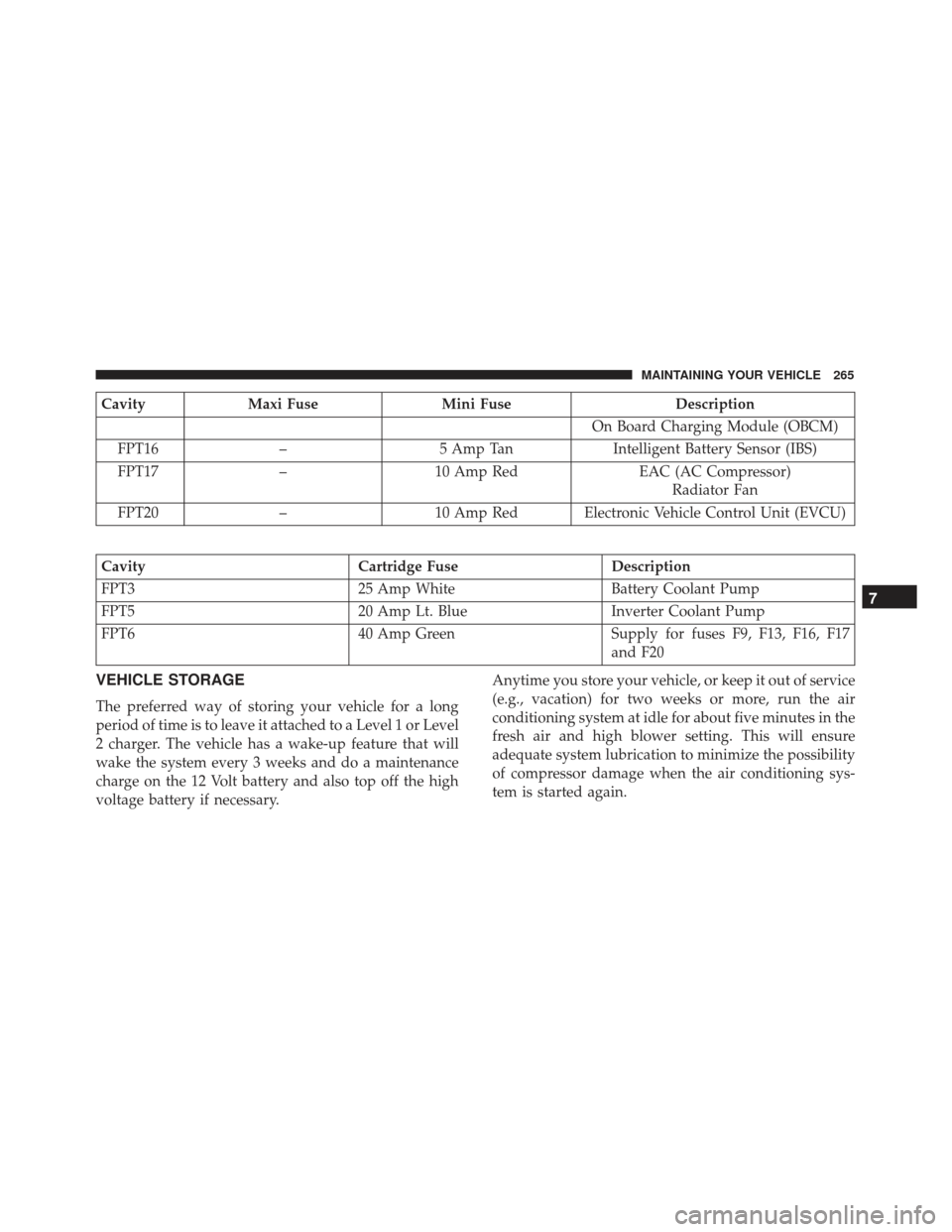
CavityMaxi Fuse Mini Fuse Description
On Board Charging Module (OBCM)
FPT16 –5 Amp Tan Intelligent Battery Sensor (IBS)
FPT17 –10 Amp Red EAC (AC Compressor)
Radiator Fan
FPT20 –10 Amp Red Electronic Vehicle Control Unit (EVCU)
Cavity Cartridge FuseDescription
FPT3 25 Amp WhiteBattery Coolant Pump
FPT5 20 Amp Lt. BlueInverter Coolant Pump
FPT6 40 Amp GreenSupply for fuses F9, F13, F16, F17
and F20
VEHICLE STORAGE
The preferred way of storing your vehicle for a long
period of time is to leave it attached to a Level 1 or Level
2 charger. The vehicle has a wake-up feature that will
wake the system every 3 weeks and do a maintenance
charge on the 12 Volt battery and also top off the high
voltage battery if necessary. Anytime you store your vehicle, or keep it out of service
(e.g., vacation) for two weeks or more, run the air
conditioning system at idle for about five minutes in the
fresh air and high blower setting. This will ensure
adequate system lubrication to minimize the possibility
of compressor damage when the air conditioning sys-
tem is started again.
7
MAINTAINING YOUR VEHICLE 265
Page 272 of 300
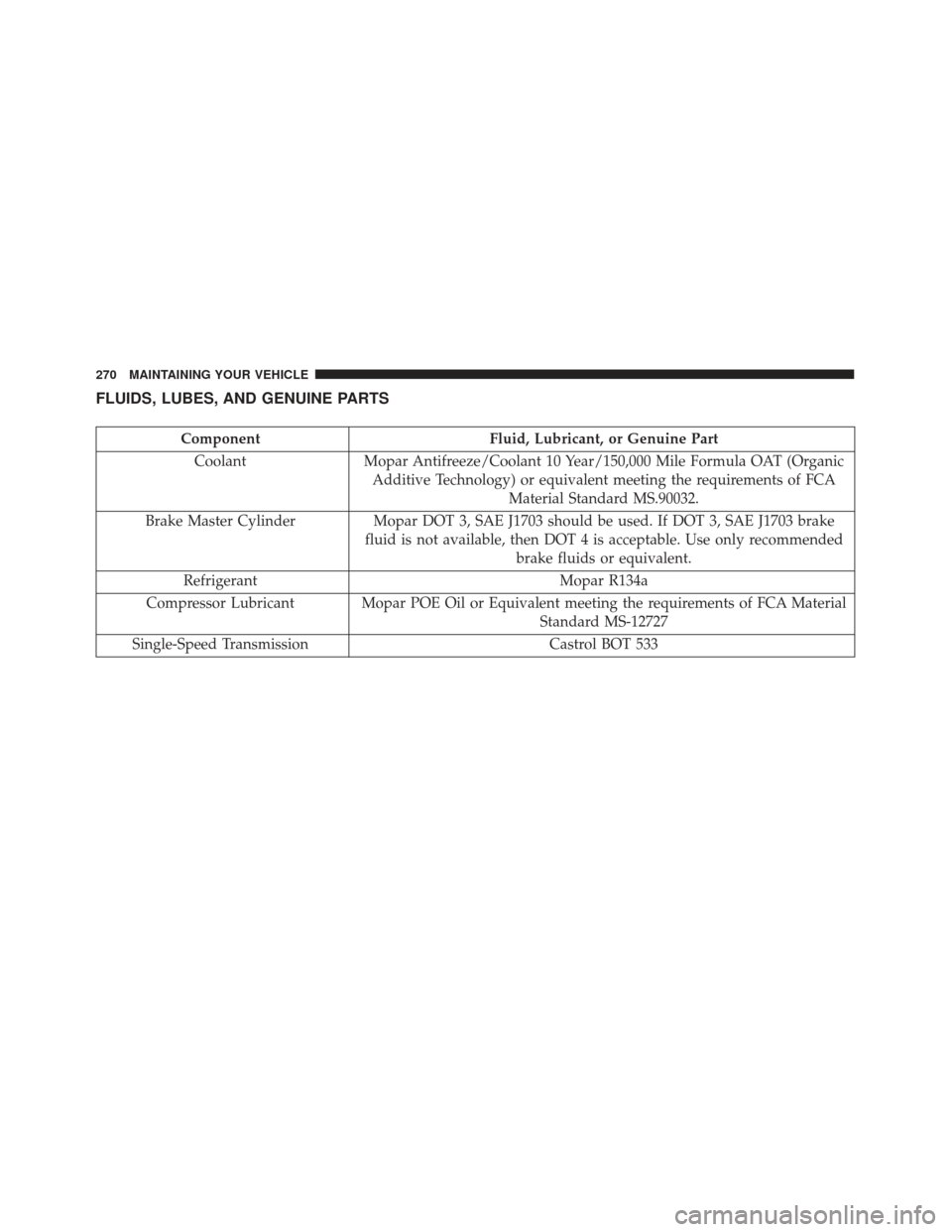
FLUIDS, LUBES, AND GENUINE PARTS
ComponentFluid, Lubricant, or Genuine Part
Coolant Mopar Antifreeze/Coolant 10 Year/150,000 Mile Formula OAT (Organic
Additive Technology) or equivalent meeting the requirements of FCA Material Standard MS.90032.
Brake Master Cylinder Mopar DOT 3, SAE J1703 should be used. If DOT 3, SAE J1703 brake
fluid is not available, then DOT 4 is acceptable. Use only recommended brake fluids or equivalent.
Refrigerant Mopar R134a
Compressor Lubricant Mopar POE Oil or Equivalent meeting the requirements of FCA Material Standard MS-12727
Single-Speed Transmission Castrol BOT 533
270 MAINTAINING YOUR VEHICLE
Page 273 of 300
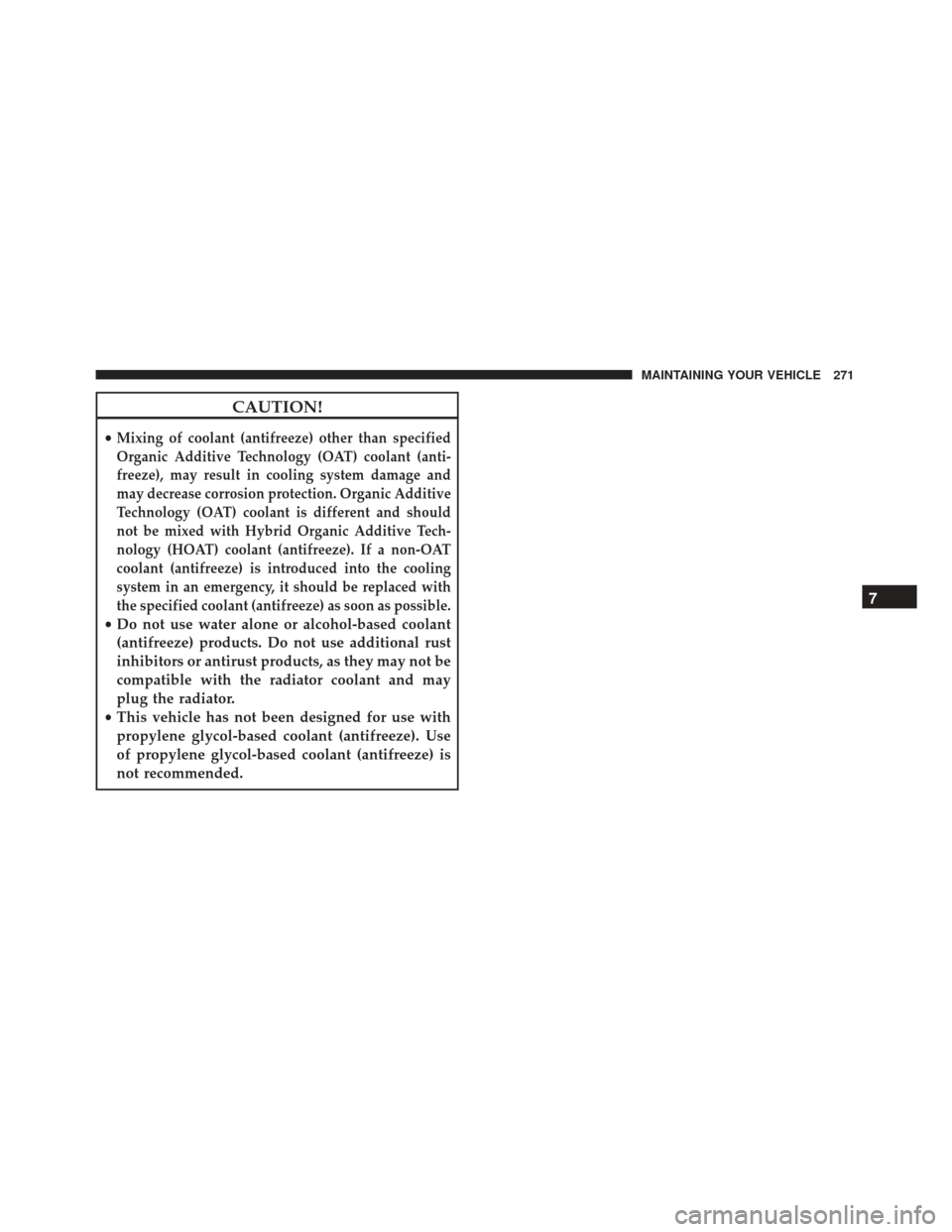
CAUTION!
•Mixing of coolant (antifreeze) other than specified
Organic Additive Technology (OAT) coolant (anti-
freeze), may result in cooling system damage and
may decrease corrosion protection. Organic Additive
Technology (OAT) coolant is different and should
not be mixed with Hybrid Organic Additive Tech-
nology (HOAT) coolant (antifreeze). If a non-OAT
coolant (antifreeze) is introduced into the cooling
system in an emergency, it should be replaced with
the specified coolant (antifreeze) as soon as possible.
• Do not use water alone or alcohol-based coolant
(antifreeze) products. Do not use additional rust
inhibitors or antirust products, as they may not be
compatible with the radiator coolant and may
plug the radiator.
• This vehicle has not been designed for use with
propylene glycol-based coolant (antifreeze). Use
of propylene glycol-based coolant (antifreeze) is
not recommended.
7
MAINTAINING YOUR VEHICLE 271
Page 276 of 300
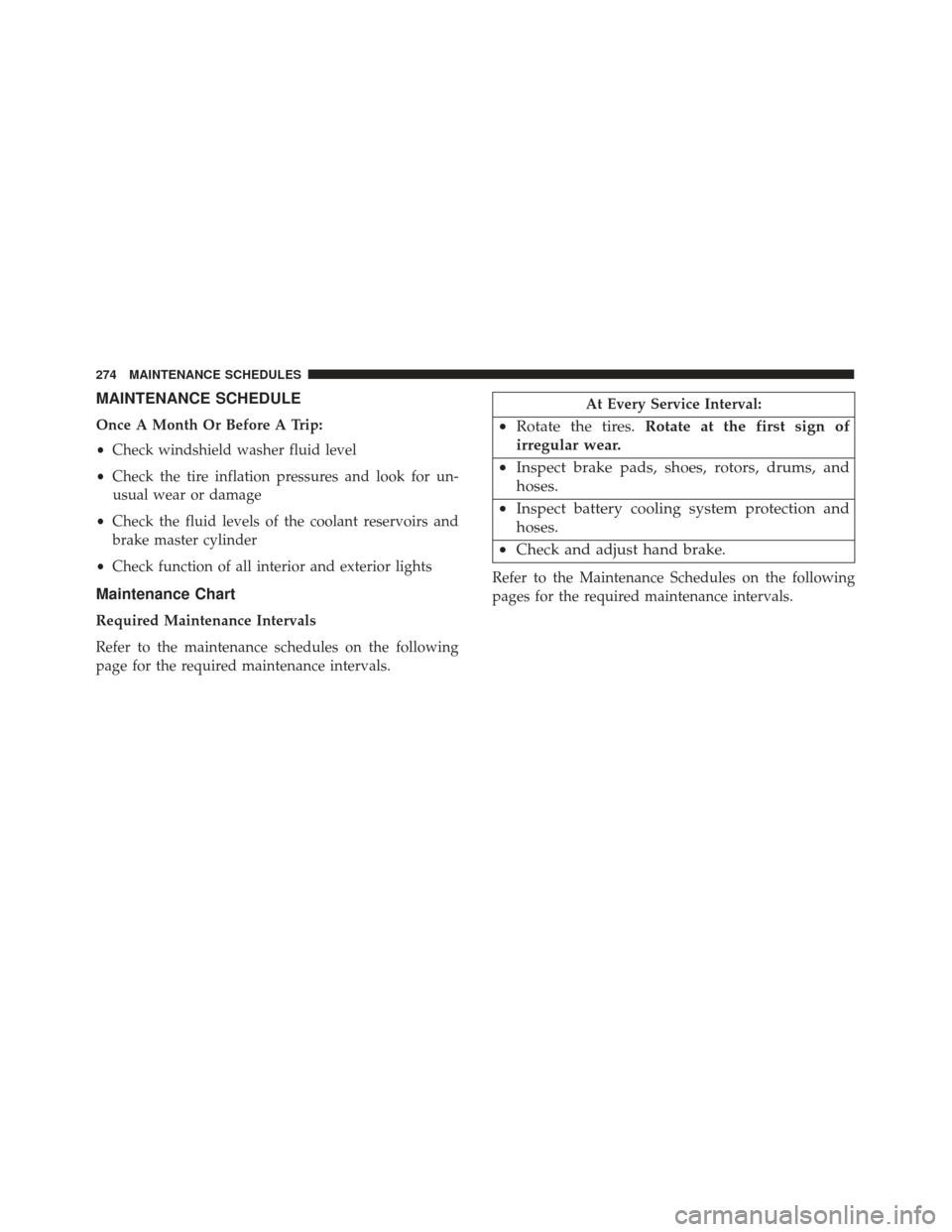
MAINTENANCE SCHEDULE
Once A Month Or Before A Trip:
•Check windshield washer fluid level
• Check the tire inflation pressures and look for un-
usual wear or damage
• Check the fluid levels of the coolant reservoirs and
brake master cylinder
• Check function of all interior and exterior lights
Maintenance Chart
Required Maintenance Intervals
Refer to the maintenance schedules on the following
page for the required maintenance intervals.
At Every Service Interval:
• Rotate the tires. Rotate at the first sign of
irregular wear.
• Inspect brake pads, shoes, rotors, drums, and
hoses.
• Inspect battery cooling system protection and
hoses.
• Check and adjust hand brake.
Refer to the Maintenance Schedules on the following
pages for the required maintenance intervals.
274 MAINTENANCE SCHEDULES
Page 277 of 300
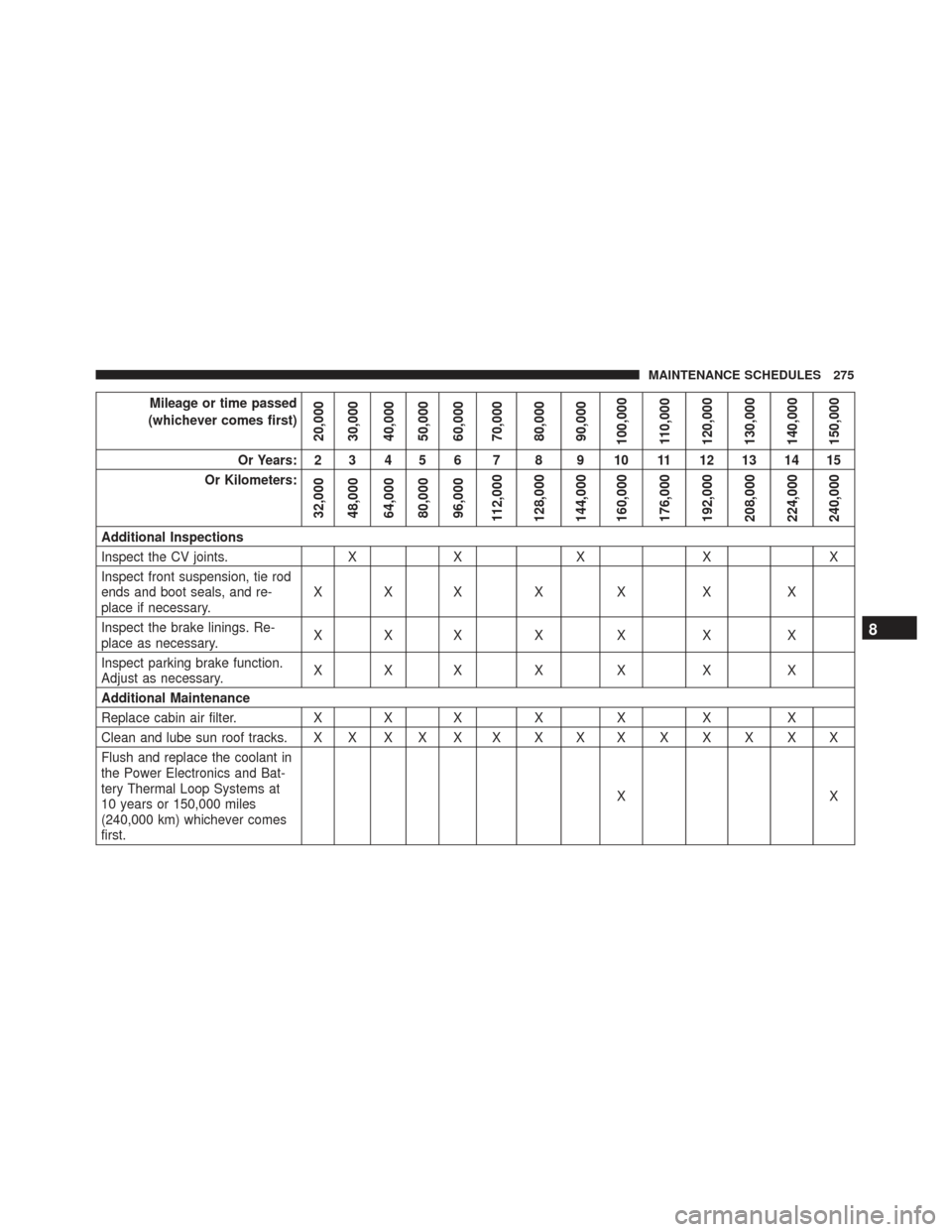
Mileage or time passed
(whichever comes first)
20,000
30,000
40,000
50,000
60,000
70,000
80,000
90,000
100,000
110,000
120,000
130,000
140,000
150,000
Or Years: 2 3 4 5 6 7 8 9 10 11 12 13 14 15
Or Kilometers:
32,000
48,000
64,000
80,000
96,000
112,000
128,000
144,000
160,000
176,000
192,000
208,000
224,000
240,000
Additional Inspections
Inspect the CV joints. XX X X X
Inspect front suspension, tie rod
ends and boot seals, and re-
place if necessary. XXX X X X X
Inspect the brake linings. Re-
place as necessary. XXX X X X X
Inspect parking brake function.
Adjust as necessary. XXX X X X X
Additional Maintenance
Replace cabin air filter. X X X XX XX
Clean and lube sun roof tracks. X X X X X X X X X X X X X X
Flush and replace the coolant in
the Power Electronics and Bat-
tery Thermal Loop Systems at
10 years or 150,000 miles
(240,000 km) whichever comes
first. XX
8
MAINTENANCE SCHEDULES 275
Page 287 of 300
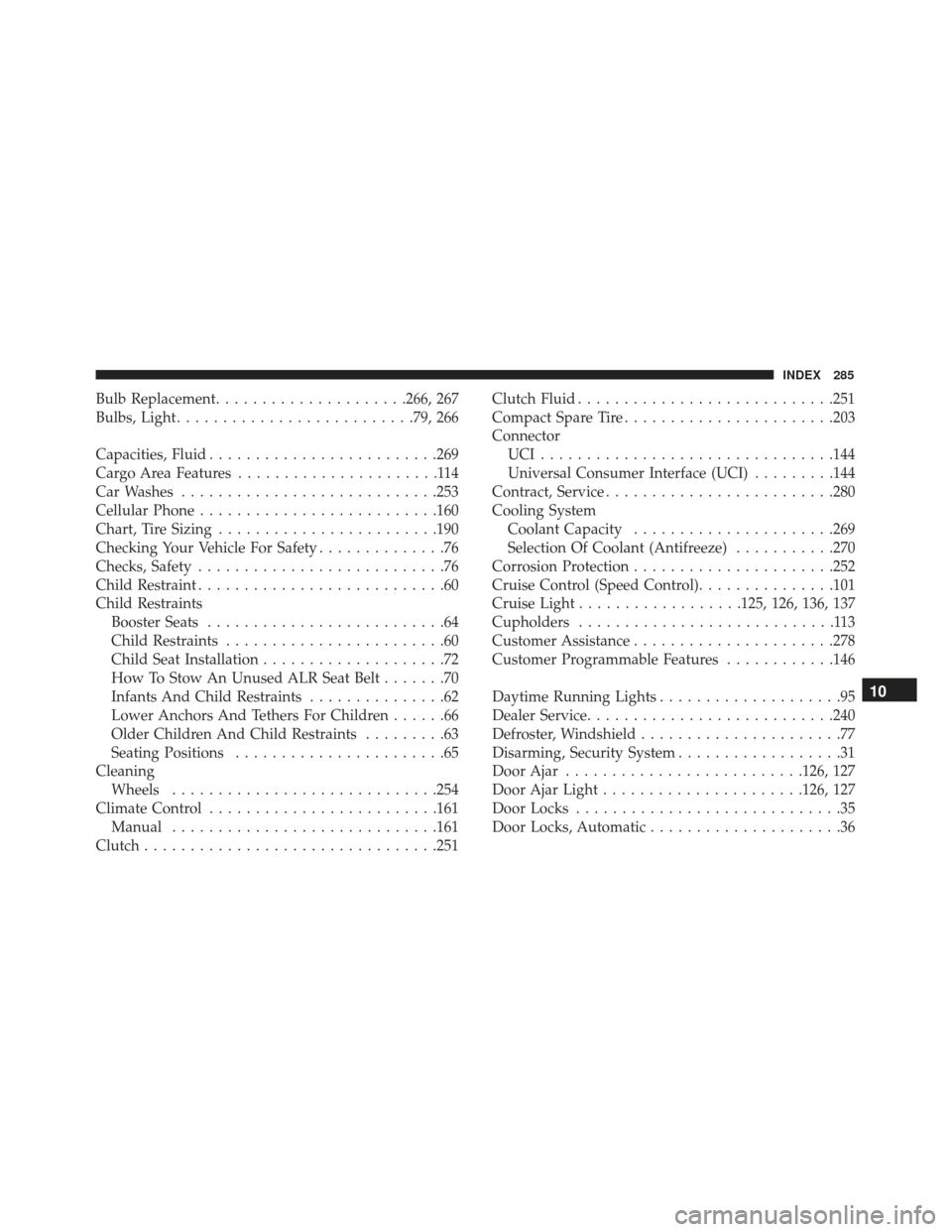
Bulb Replacement.....................266, 267
Bulbs, Light ......................... .79, 266
Capacities, Fluid ........................ .269
Cargo Area Features ......................114
Car Washes ........................... .253
Cellular Phone ......................... .160
Chart, Tire Sizing ....................... .190
Checking Your Vehicle For Safety ..............76
Checks, Safety ...........................76
Child Restraint ...........................60
Child Restraints Booster Seats ..........................64
Child Restraints ........................60
Child Seat Installation ....................72
How To Stow An Unused ALR Seat Belt .......70
Infants And Child Restraints ...............62
Lower Anchors And Tethers For Children ......66
Older Children And Child Restraints .........63
Seating Positions .......................65
Cleaning Wheels ............................ .254
Climate Control ........................ .161
Manual ............................ .161
Clutch ............................... .251Clutch Fluid
........................... .251
Compact Spare Tire ...................... .203
Connector UCI............................... .144
Universal Consumer Interface (UCI) .........144
Contract, Service ........................ .280
Cooling System Coolant Capacity ..................... .269
Selection Of Coolant (Antifreeze) ...........270
Corrosion Protection ..................... .252
Cruise Control (Speed Control) ...............101
Cruise Light ..................125, 126, 136, 137
Cupholders ............................113
Customer Assistance ..................... .278
Customer Programmable Features ............146
Daytime Running Lights ....................95
Dealer Service .......................... .240
Defroster, Windshield ......................77
Disarming,
Security System ..................31
Door Ajar ......................... .126, 127
Door Ajar Light ..................... .126, 127
Door Locks .............................35
Door Locks, Automatic .....................36
10
INDEX 285
Page 291 of 300
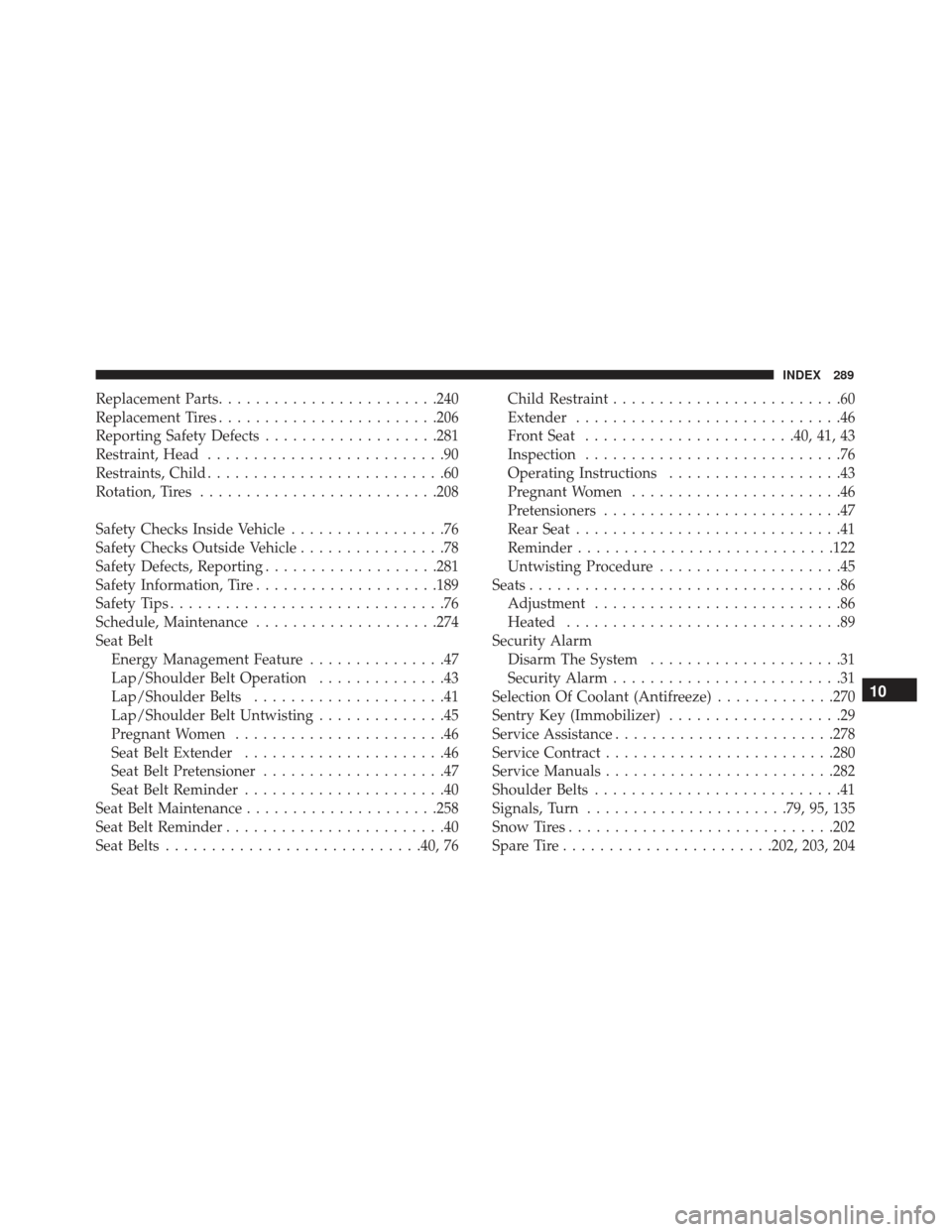
Replacement Parts....................... .240
Replacement Tires ....................... .206
Reporting Safety Defects ...................281
Restraint, Head ..........................90
Restraints, Child ..........................60
Rotation, Tires ......................... .208
Safety Checks Inside Vehicle .................76
Safety Checks Outside Vehicle ................78
Safety Defects, Reporting ...................281
Safety Information, Tire ....................189
Safety Tips ..............................76
Schedule, Maintenance ....................274
Seat Belt Energy Management Feature ...............47
Lap/Shoulder Belt Operation ..............43
Lap/Shoulder Belts .....................41
Lap/Shoulder Belt Untwisting ..............45
Pregnant Women .......................46
Seat Belt Extender ......................46
Seat Belt Pretensioner ....................47
Seat Belt Reminder ......................40
Seat Belt Maintenance .....................258
Seat Belt Reminder ........................40
Seat Belts ........................... .40, 76Child Restraint
.........................60
Extender .............................46
Front Seat ...................... .40, 41, 43
Inspection ............................76
Operating Instructions ...................43
Pregnant Women .......................46
Pretensioners ..........................47
Rear Seat .............................41
Reminder ........................... .122
Untwisting Procedure ....................45
Seats ..................................86
Adjustment ...........................86
Heated ..............................89
Security Alarm Disarm The System .....................31
Security Alarm .........................31
Selection Of Coolant (Antifreeze) .............270
Sentry Key (Immobilizer) ...................29
Service Assistance ....................... .278
Service Contract ........................ .280
Service Manuals ........................ .282
Shoulder
Belts ...........................41
Signals, Turn ..................... .79, 95, 135
Snow Tires ............................ .202
Spare Tire ...................... .202, 203, 204
10
INDEX 289