radio FIAT 500E 2017 2.G Owner's Manual
[x] Cancel search | Manufacturer: FIAT, Model Year: 2017, Model line: 500E, Model: FIAT 500E 2017 2.GPages: 300, PDF Size: 2.58 MB
Page 161 of 300
TIP:Your mobile phone must have the full implemen-
tation of the Message Access Profile (MAP) to take
advantage of this feature. For details about MAP, visit
UconnectPhone.com. Apple iPhone iOS6 or later sup-
ports reading incomingtext messages only.
Radio Operation And Mobile Phones
Under certain conditions, the mobile phone being on in
your vehicle can cause erratic or noisy performance
from your radio. This condition may be lessened or
eliminated by relocating the mobile phone antenna.
This condition is not harmful to the radio. If your radio
performance does not satisfactorily “clear” by the repo-
sitioning of the antenna, it is recommended that the
radio volume be turned down or off during mobile
phone operation.
Harmful Interference Statement
This device complies with Part 15 of the FCC rules and
RSS 210 of Industry Canada. Operation is subject to the
following conditions:
•This device may not cause harmful interference.
• This device must accept any interference received,
including interference that may cause undesired op-
eration. NOTE:
Changes or modifications not expressly ap-
proved by the party responsible for compliance could
void the user ’s authority to operate the equipment.
Additional Information
© 2016 FCA US LLC. All rights reserved. Mopar and
Uconnect are registered trademarks and Mopar Owner
Connect is a trademark of FCA US LLC. Android is a
trademark of Google Inc. SiriusXM and all related
marks and logos are trademarks of SiriusXM Radio Inc.
For Uconnect system support, call 1-877-855-8400
(24 hours a day 7 days a week) or visit
DriveUconnect.com.
STEERING WHEEL AUDIO CONTROLS
The remote sound system controls are located on the
rear surface of the steering wheel. Reach behind the
wheel to access the switches.
4
UNDERSTANDING YOUR INSTRUMENT PANEL 159
Page 162 of 300
The right-hand control is a rocker-type switch with a
pushbutton in the center and controls the volume and
mode of the sound system. Pushing the top of the
rocker switch will increase the volume, and pushing the
bottom of the rocker switch will decrease the volume.
Pushing the center button will make the radio switch
between the various modes available (AM/FM/SAT/
AUX/Media Player, etc.) and can also be used to
select/enter an item while scrolling through menu.
The left-hand control is a rocker-type switch with a
push-button in the center. The function of the left-hand
control is different depending on which mode you are in.
The following describes the left-hand control operation
in each mode.
Radio Operation
Pushing the top of the switch will “Seek” up for the next
listenable station and pushing the bottom of the switch
will “Seek” down for the next listenable station.
The button located in the center of the left-hand control
will tune to the next preset station that you have
programmed in the radio preset button.
RADIO OPERATION AND MOBILE PHONES
Under certain conditions, the mobile phone being on in
your vehicle can cause erratic or noisy performance
from your radio. This condition may be lessened or
eliminated by relocating the mobile phone antenna.
This condition is not harmful to the radio. If your radio
performance does not satisfactorily “clear” by the repo-
sitioning of the antenna, it is recommended that the
radio volume be turned down or off during mobile
phone operation.
Remote Sound System Controls (Back View OfSteering Wheel)
160 UNDERSTANDING YOUR INSTRUMENT PANEL
Page 216 of 300
TPMS Warning
When a system fault is detected, the “Tire Pressure
Monitoring Telltale Light” will flash on and off for 75
seconds and then remain on solid. The system fault will
sound a chime and also display a “Service Tire Pressure
Monitoring System” message in the instrument cluster
for approximately 5 seconds.
If the ignition switch is cycled, this sequence will repeat,
providing the system fault still exists. If the system fault
no longer exists, the “Tire Pressure Monitoring Telltale
Light” will no longer flash, and the “Service TPM
System” message will no longer display.A system fault can occur due to any of the following:
1. Signal interference due to electronic devices or driv-
ing next to facilities emitting the same radio frequen-
cies as the TPM sensors.
2. Installing aftermarket window tinting that contains materials that may block radio wave signals.
3. Accumulation of snow or ice around the wheels or wheel housings.
4. Using tire chains on the vehicle.
5. Using wheels/tires not equipped with TPM sensors.
NOTE:
• The TPMS will not monitor the pressure in a replace-
ment tire installed without a tire pressure sensor.
• If you install a replacement tire in place of a road tire
that has a pressure below the low-pressure warning
limit, upon the next ignition switch cycle, the “Tire
Pressure Monitoring Telltale Light” will remain on
and a chime will sound. In addition, the highlighted
graphic in the instrument cluster will still display a
low pressure text message and a pressure value in a
different color.
Service TPM System Message
214 STARTING AND OPERATING
Page 222 of 300
HAZARD WARNING FLASHERS
The Hazard Warning flasher switch is located on the
instrument panel below the radio.Push the switch to turn on the Hazard Warning
flashers. When the switch is activated, all direc-
tional turn signals will flash on and off to warn oncom-
ing traffic of an emergency. Push the switch a second
time to turn off the Hazard Warning flashers.
Do not use this emergency warning system when the
vehicle is in motion. Use it when your vehicle is
disabled and it is creating a safety hazard for other
motorists.
If it is necessary to leave the vehicle to go for service, the
Hazard Warning flashers will continue to operate with
the ignition key removed and the vehicle locked.
NOTE: With extended use, the Hazard Warning flash-
ers may wear down your battery.
WHEEL AND TIRE TORQUE SPECIFICATIONS
Proper lug nut/bolt torque is very important to ensure
that the wheel is properly mounted to the vehicle. Any
time a wheel has been removed and reinstalled on the
vehicle, the lug nuts/bolts should be torqued using a
properly calibrated torque wrench.
Torque Specifications
Lug Nut/Bolt Torque **Lug Nut/ Bolt SizeLug Nut/
Bolt
Socket Size
66 Ft-Lbs (90 N·m)
Steel Wheels Only
74 Ft-Lbs (100 N·m) Aluminum Wheels Only M12 x 1.25 17 mm
**Use only your authorized dealer recommended lug
nuts/bolts and clean or remove any dirt or oil before
tightening.
Inspect the wheel mounting surface prior to mounting
the tire and remove any corrosion or loose particles.
220 WHAT TO DO IN EMERGENCIES
Page 233 of 300
WARNING!
•Take care to avoid the radiator cooling fan when-
ever the hood is raised. It can start anytime the
ignition switch is ON. You can be injured by
moving fan blades.
•
Remove any metal jewelry such as rings, watch
bands and bracelets that could make an inadvertent
electrical contact. You could be seriously injured.
• Batteries contain sulfuric acid that can burn your
skin or eyes and generate hydrogen gas which is
flammable and explosive. Keep open flames or
sparks away from the battery.
1. Set the parking brake, place the transmission into PARK and turn the ignition to LOCK.
2. Turn off the heater, radio, and all unnecessary elec- trical accessories.
3. Remove the protective cover over the positive (+)
battery post.
4. If using another vehicle to jump-start the battery, park the vehicle within the jumper cables reach, set
the parking brake and make sure the ignition is OFF.
WARNING!
Do not allow vehicles to touch each other as this
could establish a ground connection and personal
injury could result.
Jump-Starting Procedure
WARNING!
Failure to follow this jump-starting procedure
could result in personal injury or property damage
due to battery explosion.
CAUTION!
Failure to follow these procedures could result in
damage to the charging system of the booster ve-
hicle or the discharged vehicle.
Connecting The Jumper Cables
1. Connect the positive (+)end of the jumper cable to
the positive (+)post of the discharged vehicle.
2. Connect the opposite end of the positive (+)jumper
cable to the positive (+)post of the booster battery.
6
WHAT TO DO IN EMERGENCIES 231
Page 259 of 300
WARNING!
Do not use volatile solvents for cleaning purposes.
Many are potentially flammable, and if used in
closed areas they may cause respiratory harm.
CAUTION!
•Direct contact of air fresheners, insect repellents,
suntan lotions, or hand sanitizers to the plastic,
painted, or decorated surfaces of the interior may
cause permanent damage. Wipe away immedi-
ately.
• Damage caused by these type of products may not
be covered by your New Vehicle Limited War-
ranty.
• Do not use Alcohol and Alcohol-based and/or
Keton based cleaning products to clean leather
seats, as damage to the seat may result.
Cleaning Headlights
Your vehicle has plastic headlights that are lighter and
less susceptible to stone breakage than glass headlights. Plastic is not as scratch resistant as glass and therefore
different lens cleaning procedures must be followed.
To minimize the possibility of scratching the lenses and
reducing light output, avoid wiping with a dry cloth. To
remove road dirt, wash with a mild soap solution
followed by rinsing.
Do not use abrasive cleaning components, solvents,
steel wool or other aggressive material to clean the
lenses.
Glass Surfaces
All glass surfaces should be cleaned on a regular basis
with Mopar Glass Cleaner, or any commercial
household-type glass cleaner. Never use an abrasive
type cleaner. Use caution when cleaning the inside rear
window equipped with electric defrosters or windows
equipped with radio antennas. Do not use scrapers or
other sharp instrument that may scratch the elements.
When cleaning the rear view mirror, spray cleaner on
the towel or cloth that you are using. Do not spray
cleaner directly on the mirror.
7
MAINTAINING YOUR VEHICLE 257
Page 265 of 300
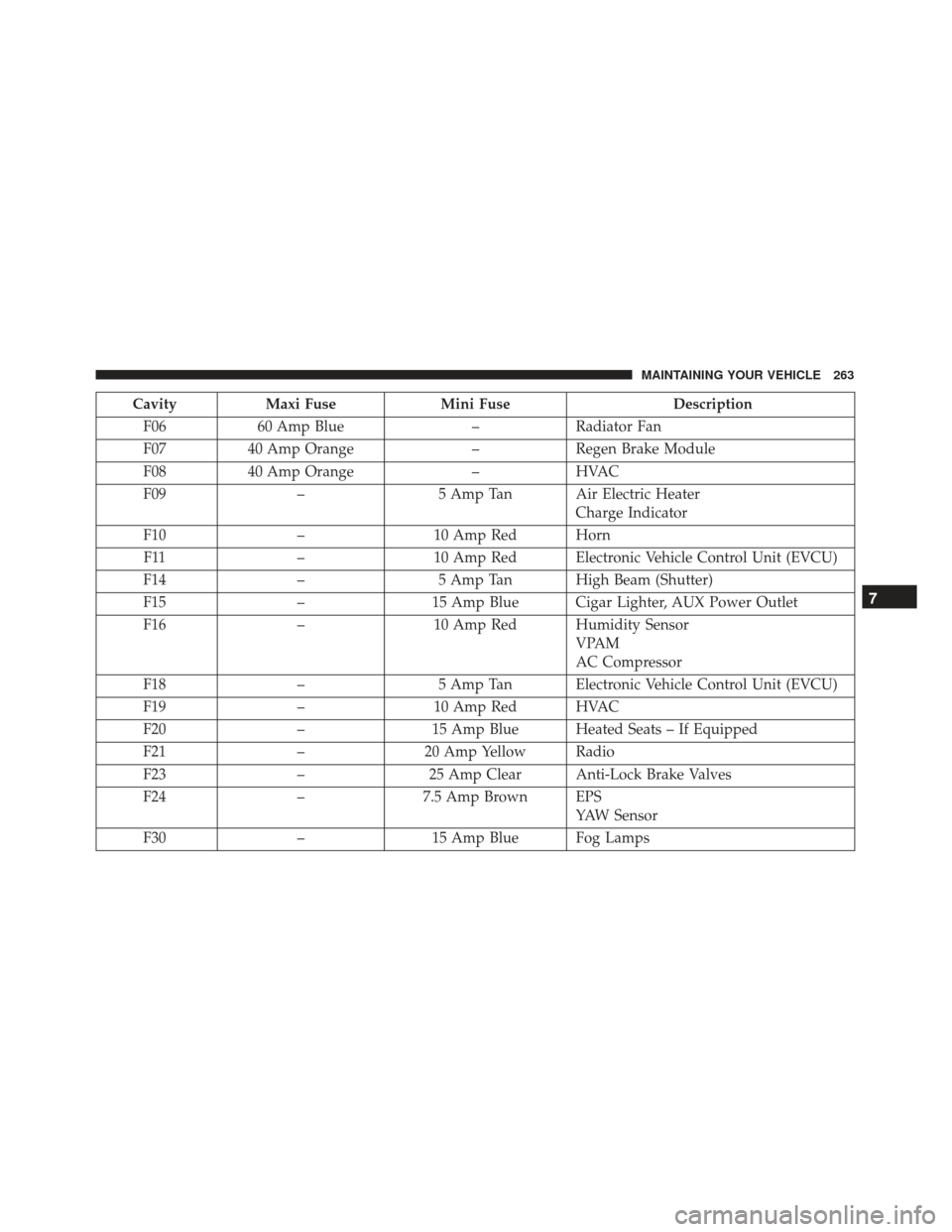
CavityMaxi Fuse Mini Fuse Description
F06 60 Amp Blue –Radiator Fan
F07 40 Amp Orange –Regen Brake Module
F08 40 Amp Orange –HVAC
F09 –5 Amp Tan Air Electric Heater
Charge Indicator
F10 –10 Amp Red Horn
F11 –10 Amp Red Electronic Vehicle Control Unit (EVCU)
F14 –5 Amp Tan High Beam (Shutter)
F15 –15 Amp Blue Cigar Lighter, AUX Power Outlet
F16 –10 Amp Red Humidity Sensor
VPAM
AC Compressor
F18 –5 Amp Tan Electronic Vehicle Control Unit (EVCU)
F19 –10 Amp Red HVAC
F20 –15 Amp Blue Heated Seats – If Equipped
F21 –20 Amp Yellow Radio
F23 –25 Amp Clear Anti-Lock Brake Valves
F24 –7.5 Amp Brown EPS
YAW Sensor
F30 –15 Amp Blue Fog Lamps
7
MAINTAINING YOUR VEHICLE 263
Page 286 of 300
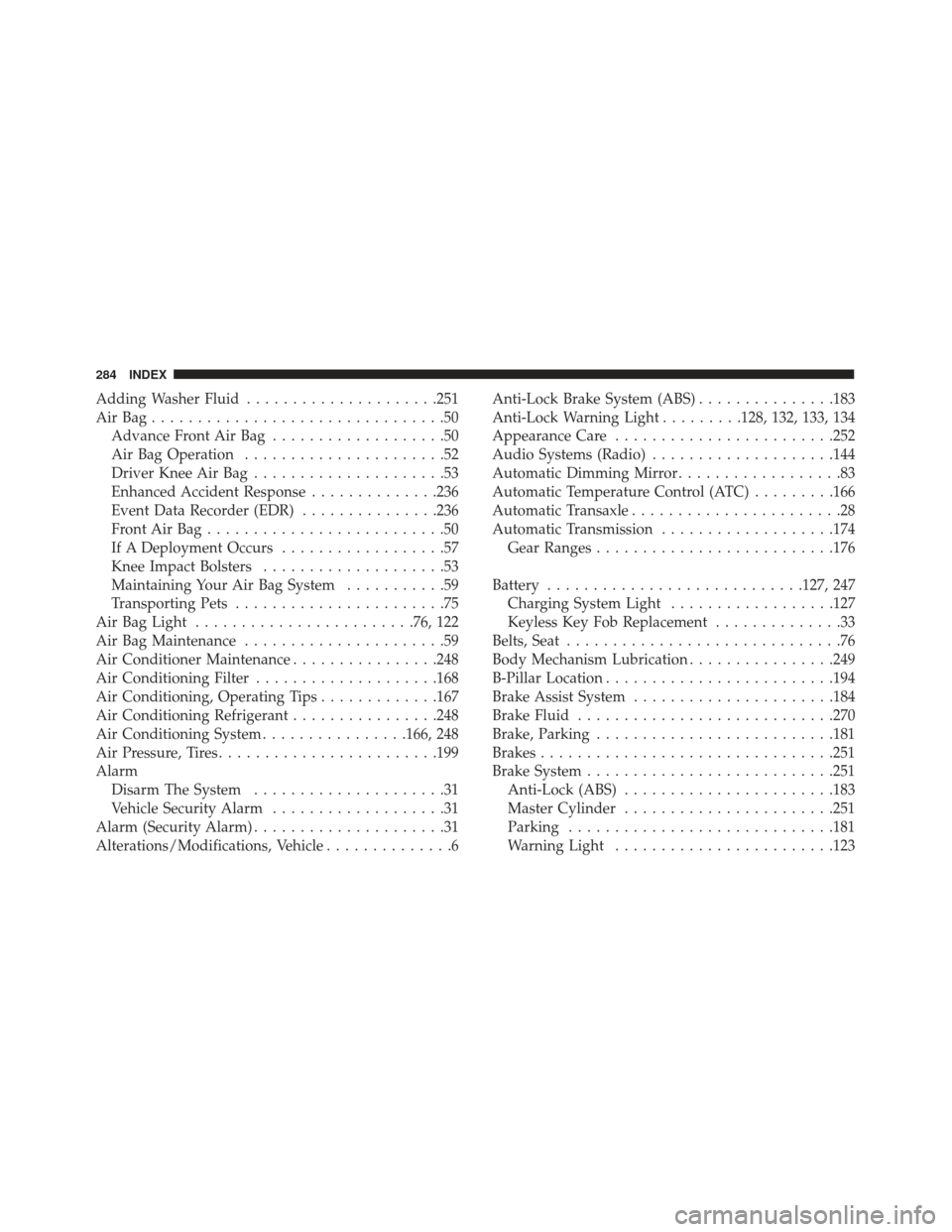
Adding Washer Fluid.....................251
AirBag................................50 Advance Front Air Bag ...................50
Air Bag Operation ......................52
Driver Knee Air Bag .....................53
Enhanced Accident Response ..............236
Event Data Recorder (EDR) ...............236
FrontAirBag..........................50
If A Deployment Occurs ..................57
Knee Impact Bolsters ....................53
Maintaining Your Air Bag System ...........59
Transporting Pets .......................75
Air Bag Light ....................... .76, 122
Air Bag Maintenance ......................59
Air Conditioner Maintenance ................248
Air Conditioning Filter ....................168
Air Conditioning, Operating Tips .............167
Air Conditioning Refrigerant ................248
Air Conditioning System ................166, 248
Air Pressure, Tires ....................... .199
Alarm Disarm The System .....................31
Vehicle Security Alarm ...................31
Alarm (Security Alarm) .....................31
Alterations/Modifications, Vehicle ..............6Anti-Lock Brake System (ABS)
...............183
Anti-Lock Warning Light .........128, 132, 133, 134
Appearance Care ....................... .252
Audio Systems (Radio) ....................144
Automatic Dimming Mirror ..................83
Automatic Temperature Control (ATC) .........166
Automatic Transaxle .......................28
Automatic Transmission ...................174
Gear Ranges ......................... .176
Battery ........................... .127, 247
Charging System Light ..................127
Keyless Key Fob Replacement ..............33
Belts, Seat ..............................76
Body Mechanism Lubrication ................249
B-Pillar Location ........................ .194
Brake Assist System ..................... .184
Brake Fluid ........................... .270
Brake,
Parking ......................... .181
Brakes ............................... .251
Brake System .......................... .251
Anti-Lock (ABS) ...................... .183
Master Cylinder ...................... .251
Parking ............................ .181
Warning Light ....................... .123
284 INDEX
Page 290 of 300
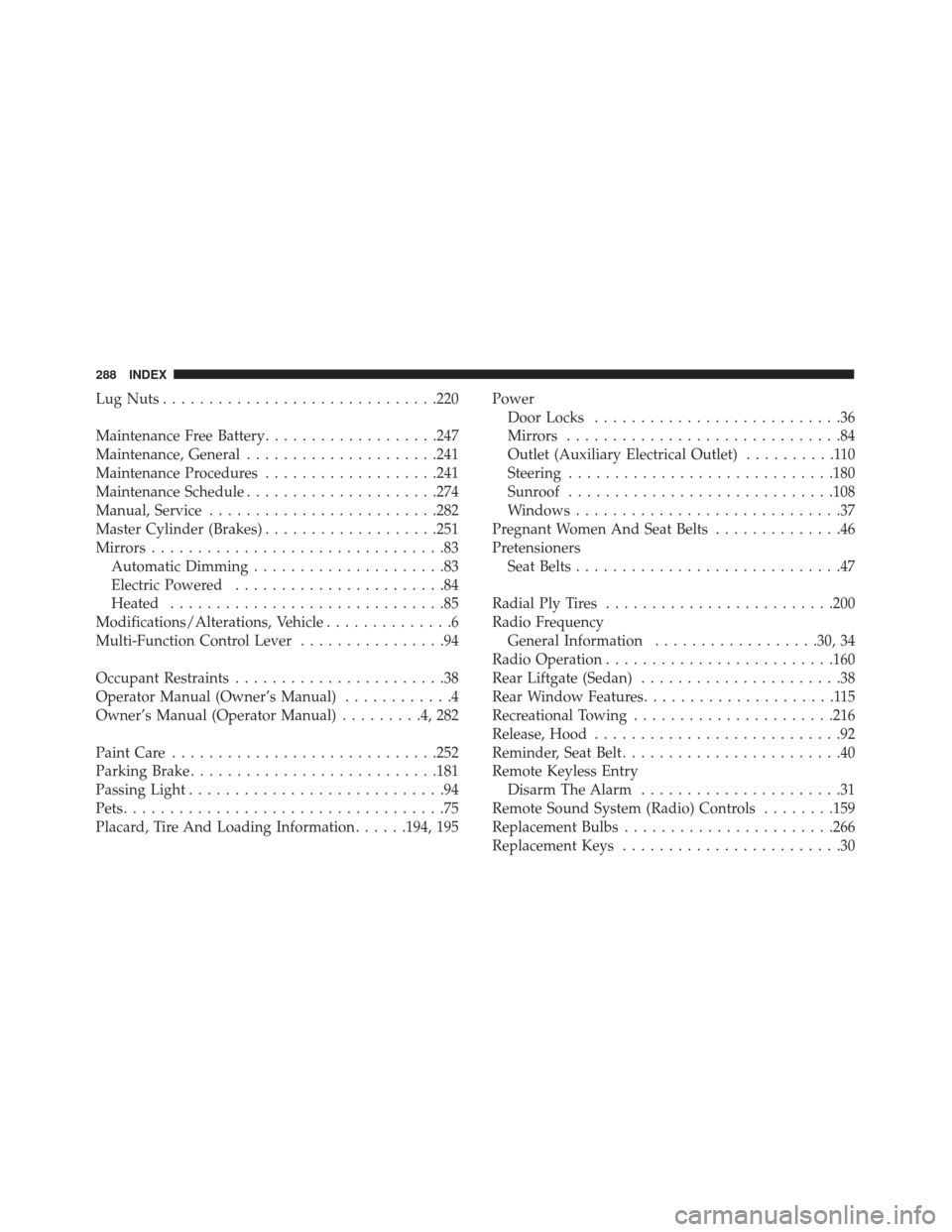
Lug Nuts............................. .220
Maintenance Free Battery ...................247
Maintenance, General .....................241
Maintenance Procedures ...................241
Maintenance Schedule .....................274
Manual, Service ........................ .282
Master Cylinder (Brakes) ...................251
Mirrors ................................83
Automatic Dimming .....................83
Electric Powered .......................84
Heated ..............................85
Modifications/Alterations, Vehicle ..............6
Multi-Function Control Lever ................94
Occupant Restraints .......................38
Operator Manual (Owner’s Manual) ............4
Owner’s Manual (Operator Manual) .........4,282
Paint Care ............................ .252
Parking Brake .......................... .181
Passing Light ............................94
Pets ...................................75
Placard, Tire And Loading Information ......194, 195Power
Door Locks ...........................36
Mirrors ..............................84
Outlet (Auxiliary Electrical Outlet) ..........110
Steering ............................ .180
Sunroof ............................ .108
Windows .............................37
Pregnant Women And Seat Belts ..............46
Pretensioners Seat Belts .............................47
Radial Ply Tires ........................ .200
Radio Frequency General Information ..................30, 34
Radio Operation ........................ .160
Rear Liftgate (Sedan) ......................38
Rear Window Features .....................115
Recreational Towing ..................... .216
Release, Hood ...........................92
Reminder, Seat Belt ........................40
Remote Keyless Entry Disarm The Alarm ......................31
Remote Sound System (Radio) Controls ........159
Replacement Bulbs ...................... .266
Replacement
Keys ........................30
288 INDEX
Page 299 of 300
VEHICLES SOLD IN CANADA
With respect to any Vehicles Sold in Canada, the name FCA
US LLC shall be deemed to be deleted and the name FCA
Canada Inc. used in substitution therefore.
DRIVING AND ALCOHOL
Drunken driving is one of the most frequent causes of
accidents.
Your driving ability can be seriously impaired with blood
alcohol levels far below the legal minimum. If you are
drinking, don’t drive. Ride with a designated non-
drinking driver, call a cab, a friend, or use public trans-
portation.
WARNING!
Driving after drinking can lead to an accident.
Your perceptions are less sharp, your reflexes are
slower, and your judgment is impaired when you
have been drinking. Never drink and then drive.
This manual illustrates and describes the operation of
features and equipment that are either standard or op-
tional on this vehicle. This manual may also include a
description of features and equipment that are no longer
available or were not ordered on this vehicle. Please
disregard any features and equipment described in this
manual that are not on this vehicle.
FCA US LLC reserves the right to make changes in design
and specifications, and/or make additions to or improve-
ments to its products without imposing any obligation
upon itself to install them on products previously manu-
factured.
Copyright © 2016 FCA US LLC
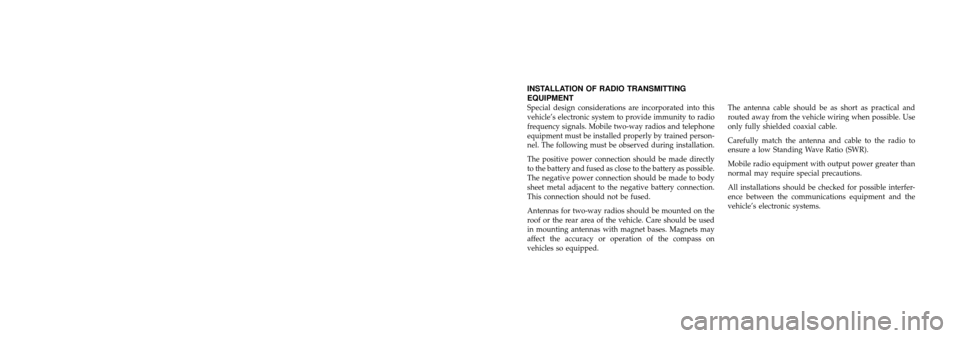
INSTALLATION OF RADIO TRANSMITTING
EQUIPMENT
Special design considerations are incorporated into this
vehicle’s electronic system to provide immunity to radio
frequency signals. Mobile two-way radios and telephone
equipment must be installed properly by trained person-
nel. The following must be observed during installation.
The positive power connection should be made directly
to the battery and fused as close to the battery as possible.
The negative power connection should be made to body
sheet metal adjacent to the negative battery connection.
This connection should not be fused.
Antennas for two-way radios should be mounted on the
roof or the rear area of the vehicle. Care should be used
in mounting antennas with magnet bases. Magnets may
affect the accuracy or operation of the compass on
vehicles so equipped.The antenna cable should be as short as practical and
routed away from the vehicle wiring when possible. Use
only fully shielded coaxial cable.
Carefully match the antenna and cable to the radio to
ensure a low Standing Wave Ratio (SWR).
Mobile radio equipment with output power greater than
normal may require special precautions.
All installations should be checked for possible interfer-
ence between the communications equipment and the
vehicle’s electronic systems.