fuse FIAT 500E 2019 User Guide
[x] Cancel search | Manufacturer: FIAT, Model Year: 2019, Model line: 500E, Model: FIAT 500E 2019Pages: 300, PDF Size: 3.03 MB
Page 194 of 300
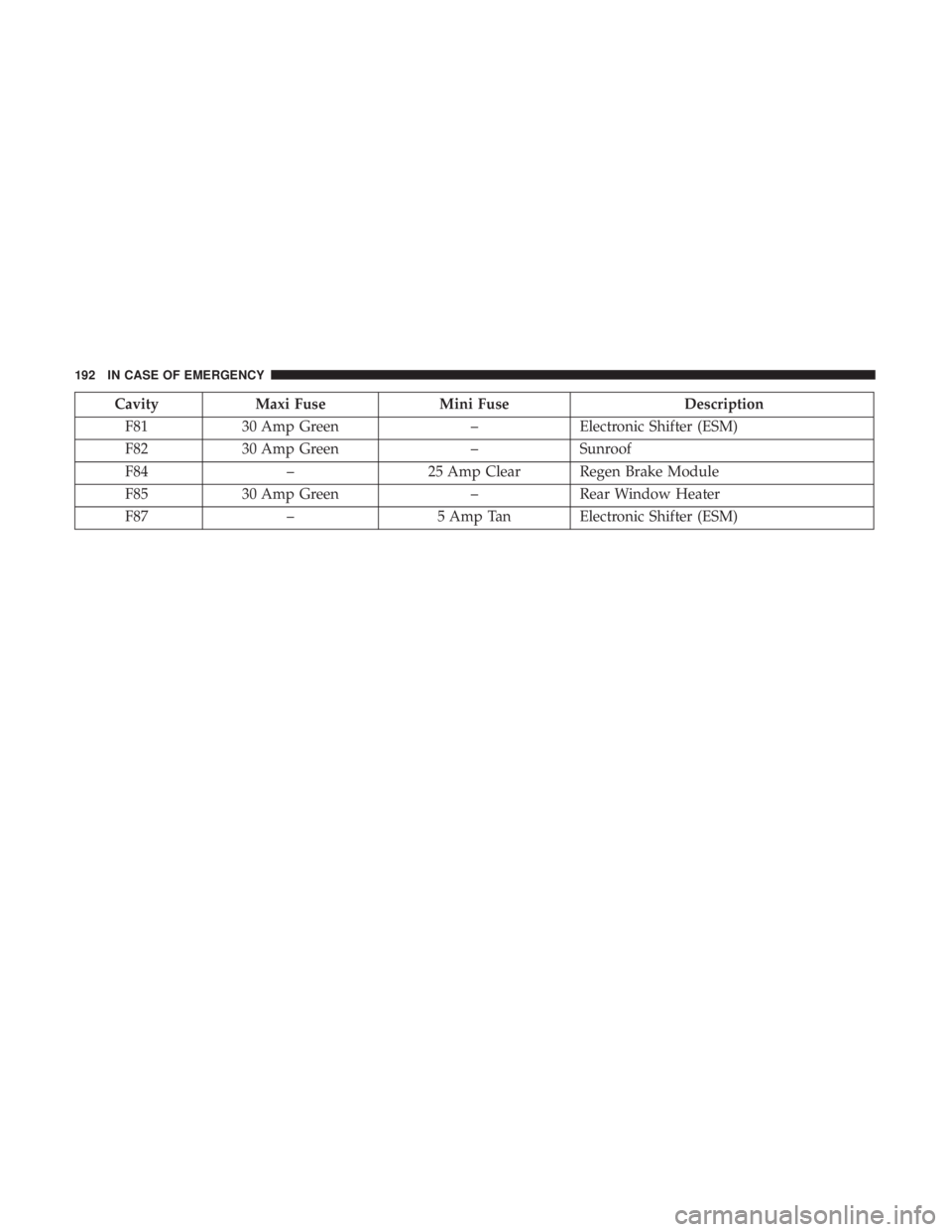
CavityMaxi Fuse Mini Fuse Description
F81 30 Amp Green –Electronic Shifter (ESM)
F82 30 Amp Green –Sunroof
F84 –25 Amp Clear Regen Brake Module
F85 30 Amp Green –Rear Window Heater
F87 –5 Amp Tan Electronic Shifter (ESM)
192 IN CASE OF EMERGENCY
Page 195 of 300
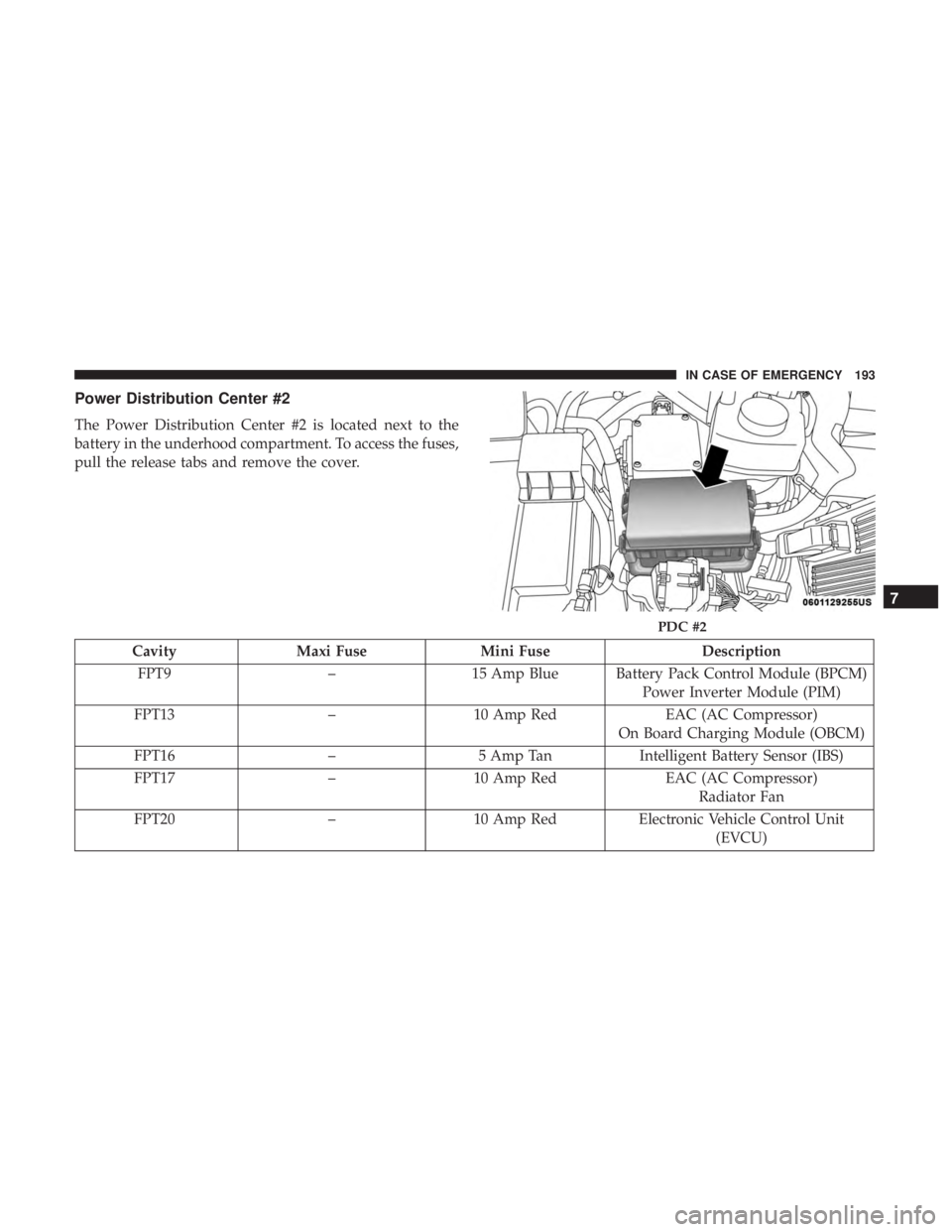
Power Distribution Center #2
The Power Distribution Center #2 is located next to the
battery in the underhood compartment. To access the fuses,
pull the release tabs and remove the cover.
CavityMaxi Fuse Mini Fuse Description
FPT9 –15 Amp Blue Battery Pack Control Module (BPCM)
Power Inverter Module (PIM)
FPT13 –10 Amp Red EAC (AC Compressor)
On Board Charging Module (OBCM)
FPT16 –5 Amp Tan Intelligent Battery Sensor (IBS)
FPT17 –10 Amp Red EAC (AC Compressor)
Radiator Fan
FPT20 –10 Amp Red Electronic Vehicle Control Unit
(EVCU)
PDC #2
7
IN CASE OF EMERGENCY 193
Page 196 of 300
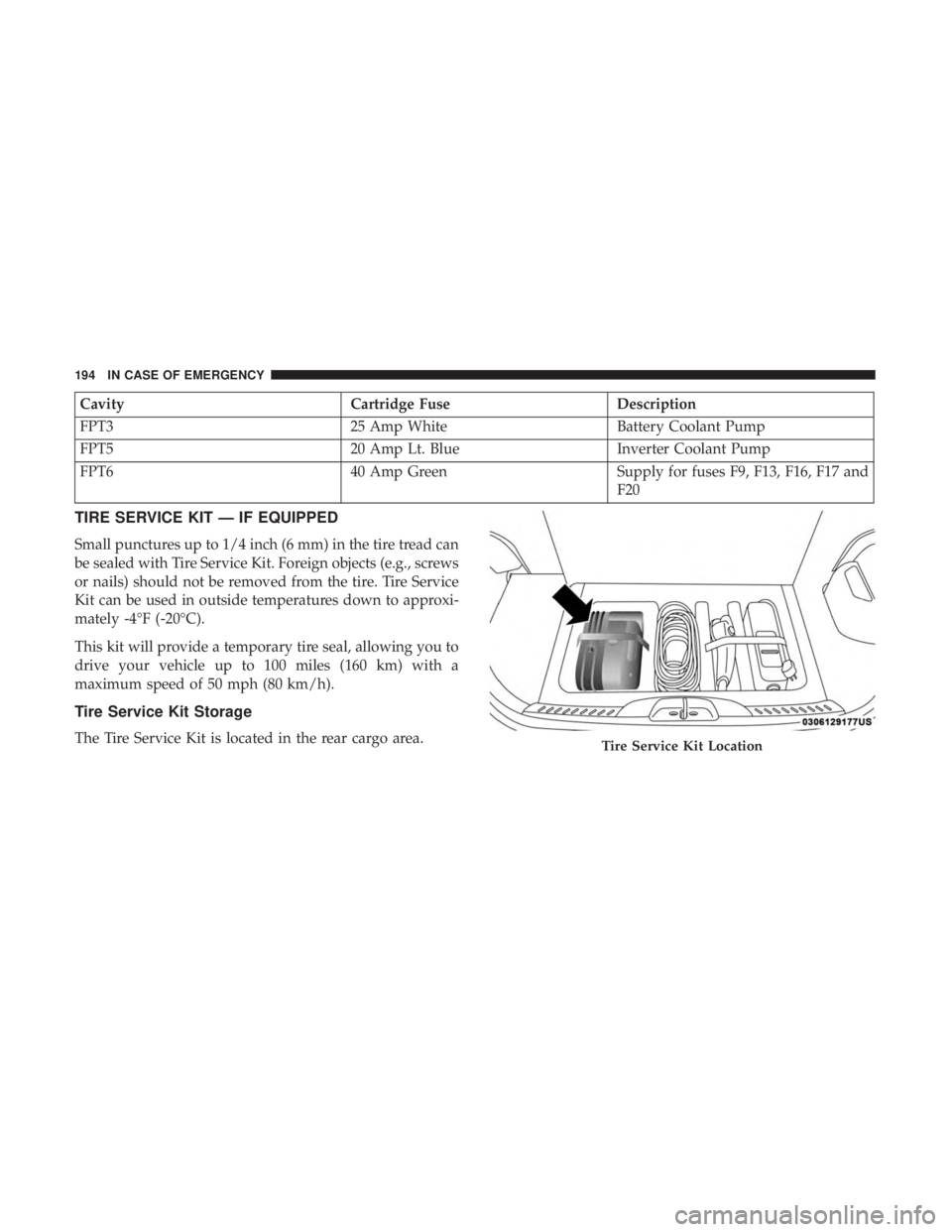
CavityCartridge FuseDescription
FPT3 25 Amp WhiteBattery Coolant Pump
FPT5 20 Amp Lt. BlueInverter Coolant Pump
FPT6 40 Amp GreenSupply for fuses F9, F13, F16, F17 and
F20
TIRE SERVICE KIT — IF EQUIPPED
Small punctures up to 1/4 inch (6 mm) in the tire tread can
be sealed with Tire Service Kit. Foreign objects (e.g., screws
or nails) should not be removed from the tire. Tire Service
Kit can be used in outside temperatures down to approxi-
mately -4°F (-20°C).
This kit will provide a temporary tire seal, allowing you to
drive your vehicle up to 100 miles (160 km) with a
maximum speed of 50 mph (80 km/h).
Tire Service Kit Storage
The Tire Service Kit is located in the rear cargo area.Tire Service Kit Location
194 IN CASE OF EMERGENCY
Page 216 of 300
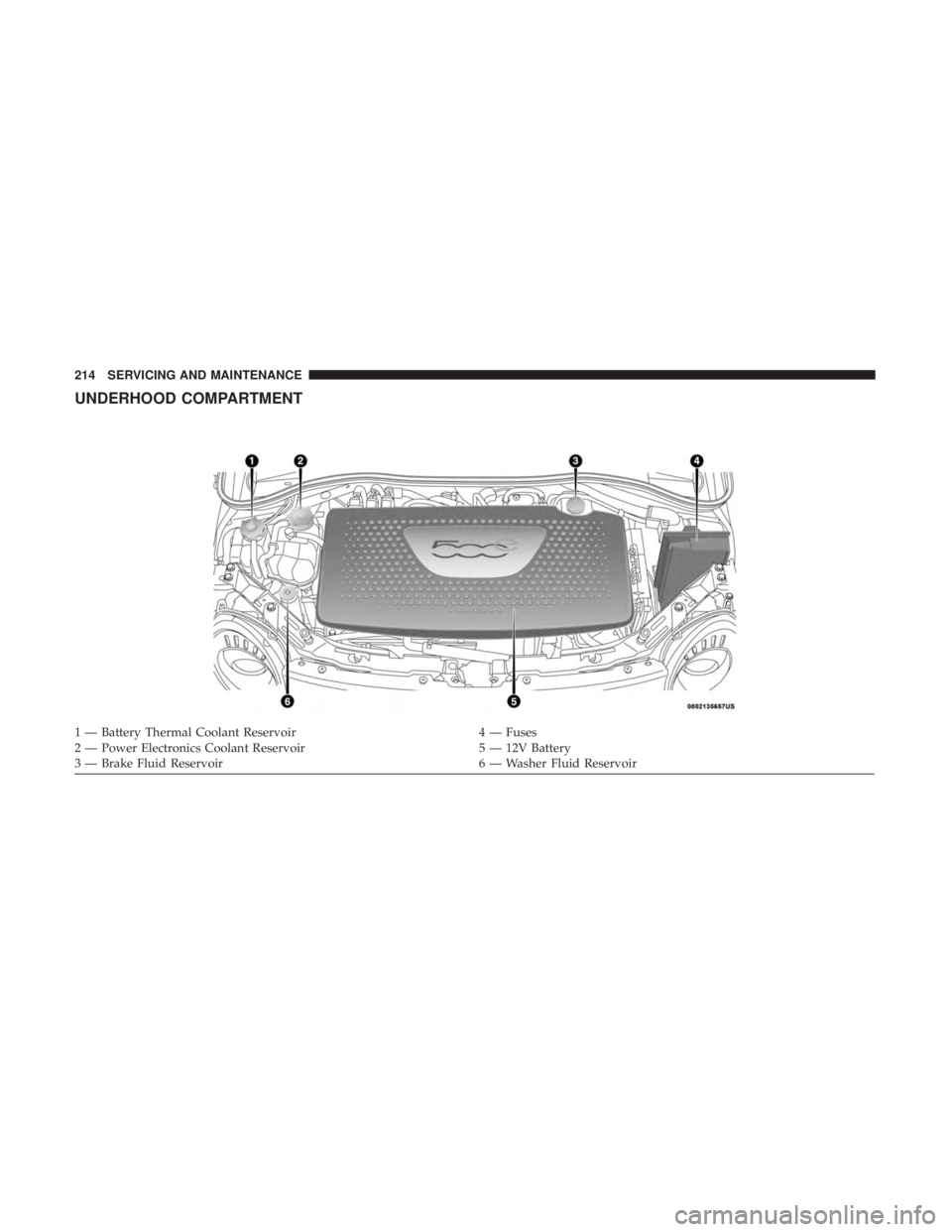
UNDERHOOD COMPARTMENT
1 — Battery Thermal Coolant Reservoir4 — Fuses
2 — Power Electronics Coolant Reservoir 5 — 12V Battery
3 — Brake Fluid Reservoir 6 — Washer Fluid Reservoir
214 SERVICING AND MAINTENANCE
Page 292 of 300
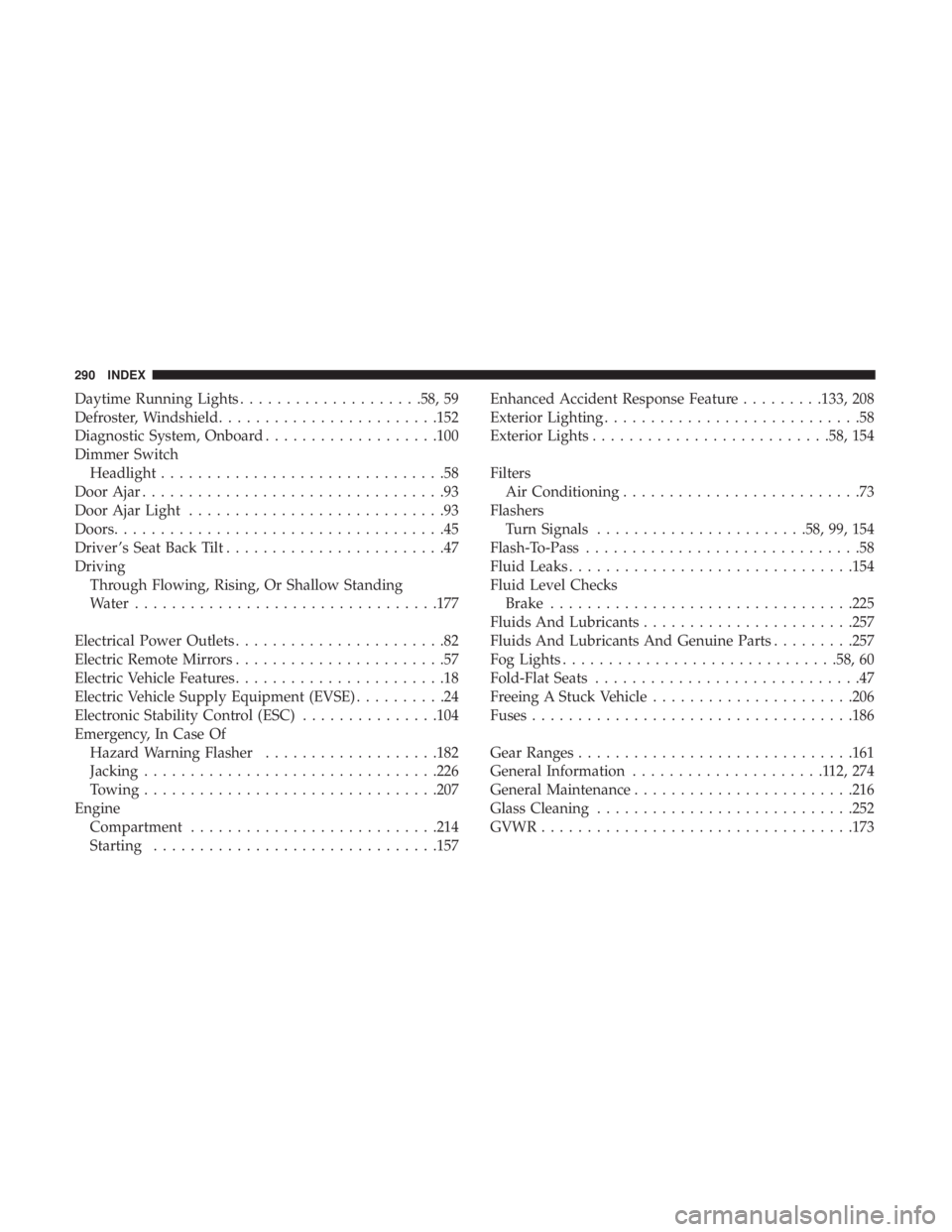
Daytime Running Lights....................58, 59
Defroster, Windshield ....................... .152
Diagnostic System, Onboard ...................100
Dimmer Switch Headlight ...............................58
Door Ajar .................................93
Door Ajar Light ............................93
Doors ....................................45
Driver ’s Seat Back Tilt ........................47
Driving Through Flowing, Rising, Or Shallow Standing
Water ................................ .177
Electrical Power Outlets .......................82
Electric Remote Mirrors .......................57
Electric Vehicle Features .......................18
Electric Vehicle Supply Equipment (EVSE) ..........24
Electronic Stability Control (ESC) ...............104
Emergency, In Case Of Hazard Warning Flasher ...................182
Jacking ............................... .226
Towing ............................... .207
Engine Compartment .......................... .214
Starting .............................. .157Enhanced Accident Response Feature
.........133, 208
Exterior Lighting ............................58
Exterior Lights ......................... .58, 154
Filters Air Conditioning ..........................73
Flashers Turn Signals ...................... .58, 99, 154
Flash-To-Pass ..............................58
Fluid Leaks .............................. .154
Fluid Level Checks Brake ................................ .225
Fluids And Lubricants ...................... .257
Fluids And Lubricants And Genuine Parts .........257
Fog Lights ............................. .58, 60
Fold-Flat Seats .............................47
Freeing A Stuck Vehicle ..................... .206
Fuses .................................. .186
Gear Ranges ............................. .161
General Information .....................112,274
General Maintenance ....................... .216
Glass Cleaning ........................... .252
GVWR ................................. .173
290 INDEX
Page 299 of 300

INSTALLATION OF RADIO TRANSMITTING
EQUIPMENT
Special design considerations are incorporated into this
vehicle’s electronic system to provide immunity to radio
frequency signals. Mobile two-way radios and telephone
equipment must be installed properly by trained person-
nel. The following must be observed during installation.
The positive power connection should be made directly
to the battery and fused as close to the battery as possible.
The negative power connection should be made to body
sheet metal adjacent to the negative battery connection.
This connection should not be fused.
Antennas for two-way radios should be mounted on the
roof or the rear area of the vehicle. Care should be used
in mounting antennas with magnet bases. Magnets may
affect the accuracy or operation of the compass on
vehicles so equipped.
The antenna cable should be as short as practical and
routed away from the vehicle wiring when possible. Use
only fully shielded coaxial cable.
Carefully match the antenna and cable to the radio to
ensure a low Standing Wave Ratio (SWR).Mobile radio equipment with output power greater than
normal may require special precautions.
All installations should be checked for possible interfer-
ence between the communications equipment and the
vehicle’s electronic systems.
WARNING:
Operating, servicing and maintaining a
passenger vehicle or off-road highway
motor vehicle can expose you to chemicals
including engine exhaust, carbon monoxide,
phthalates, and lead, which are known to
the State of California to cause cancer and
birth defects or other reproductive harm.
To minimize exposure, avoid breathing
exhaust, do not idle the engine except as
necessary, service your vehicle in a
well-ventilated area and wear gloves or
wash your hands frequently when servicing
your vehicle. For more information go to
www.P65Warnings.ca.gov/passenger-vehicle.