warning FIAT 500E 2019 User Guide
[x] Cancel search | Manufacturer: FIAT, Model Year: 2019, Model line: 500E, Model: FIAT 500E 2019Pages: 300, PDF Size: 3.03 MB
Page 34 of 300
FCC Notice:
This unit has systems that operate on a radio frequency
that comply with Part 15 of the Federal Communications
Commission (FCC) rules.
Operation is subject to the following two conditions:
1. The device may not cause interference.
2. The device must accept any interference received, in-cluding interference that may cause undesired operation
of the device.
Changes or modifications to any of these systems by other
than an authorized service facility could void authorization
to use this equipment.
This unit complies with ICES-003E of Industry Canada,
and EMC Directive 2004/108/EC.
Guidelines for preventing fire and electric shock:
• Ensure the charging cable is positioned so it will not be
stepped on, tripped over, or otherwise subjected to
damage or stress.
• There are no user serviceable parts inside.
• Do not use the charging cordset if it is visibly damaged.
Contact an authorized dealer for service. •
Do not place fingers, or any other objects inside the
charge connector.
• Do not allow children to operate this device. Adult
supervision is mandatory when children are in proxim-
ity when the charging cordset is in use.
NOTE: During normal operation, the charge connector or
AC plug may feel warm. If either one feels hot during
charging, unplug the charging cordset and have a qualified
electrician inspect the wall receptacle before you continue
charging.
WARNING!
Do not use the charging cordset with a receptacle that
is worn or damaged. Using the charging cordset with a
worn or damaged receptacle may cause burns or start a
fire.
Vehicle Charge Indicators
Instrument Cluster High Voltage Battery Gauge
There is a battery gauge indicator located on the instru-
ment cluster. The battery gauge displays, with progressive
32 GETTING TO KNOW YOUR VEHICLE
Page 35 of 300
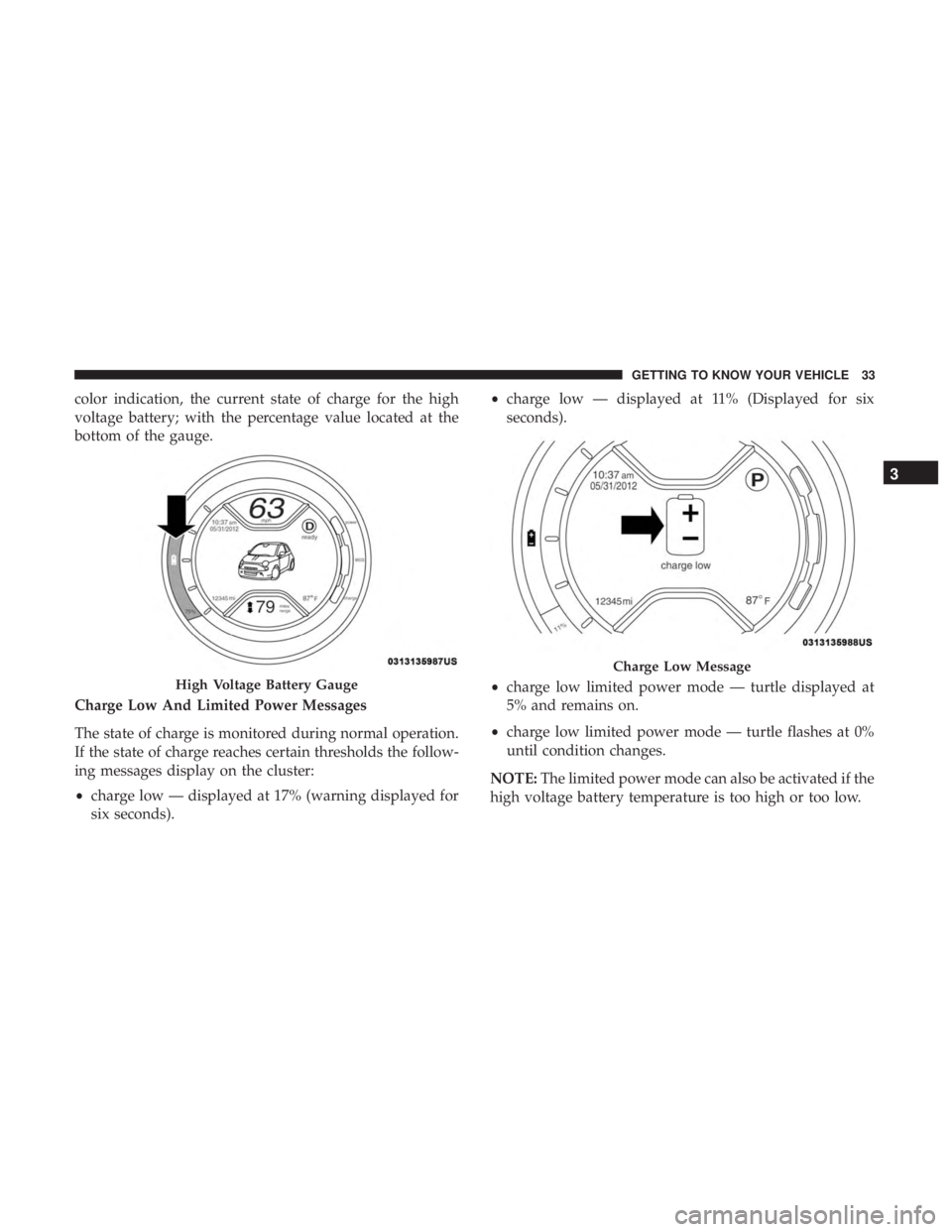
color indication, the current state of charge for the high
voltage battery; with the percentage value located at the
bottom of the gauge.
Charge Low And Limited Power Messages
The state of charge is monitored during normal operation.
If the state of charge reaches certain thresholds the follow-
ing messages display on the cluster:
•charge low — displayed at 17% (warning displayed for
six seconds). •
charge low — displayed at 11% (Displayed for six
seconds).
• charge low limited power mode — turtle displayed at
5% and remains on.
• charge low limited power mode — turtle flashes at 0%
until condition changes.
NOTE: The limited power mode can also be activated if the
high voltage battery temperature is too high or too low.
High Voltage Battery Gauge
Charge Low Message
3
GETTING TO KNOW YOUR VEHICLE 33
Page 42 of 300
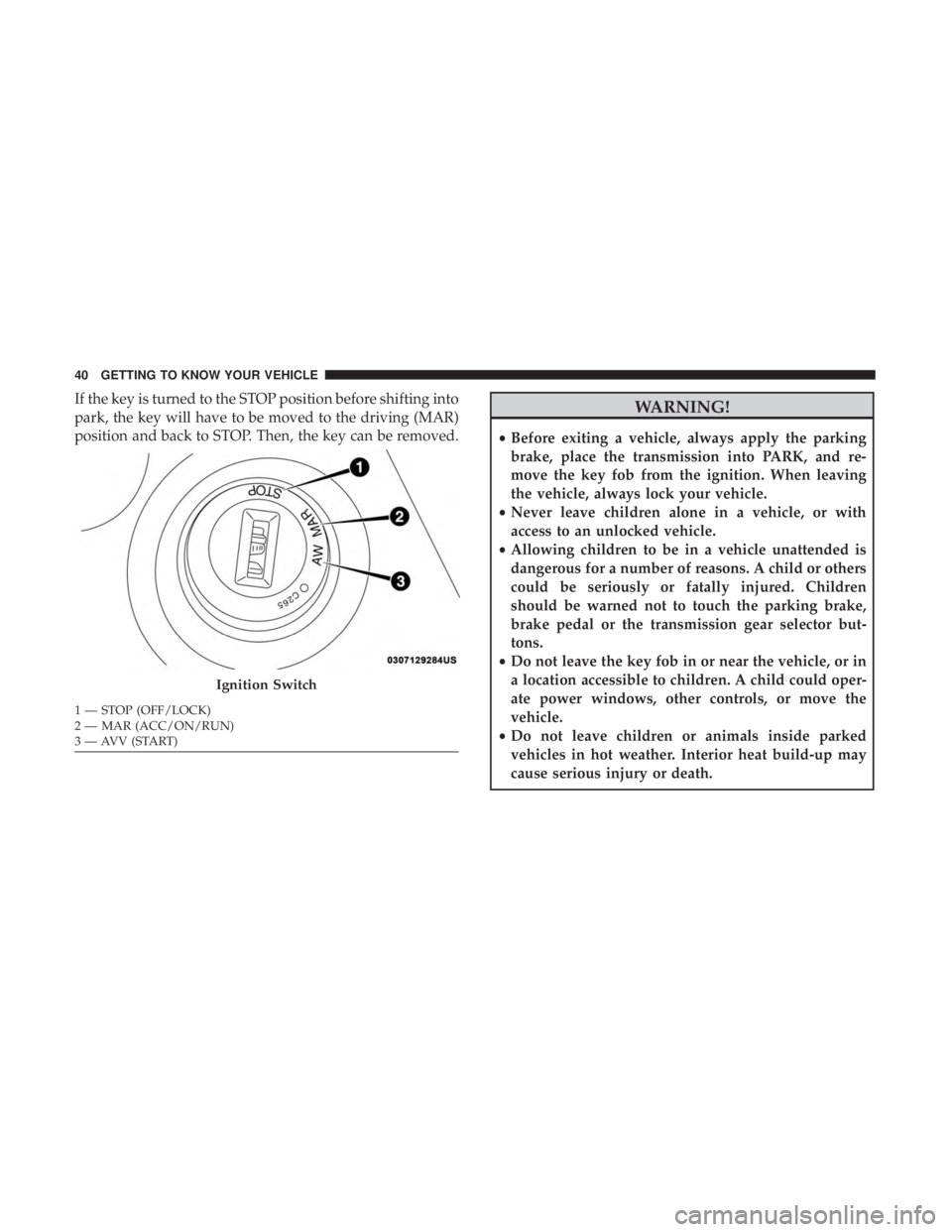
If the key is turned to the STOP position before shifting into
park, the key will have to be moved to the driving (MAR)
position and back to STOP. Then, the key can be removed.WARNING!
•Before exiting a vehicle, always apply the parking
brake, place the transmission into PARK, and re-
move the key fob from the ignition. When leaving
the vehicle, always lock your vehicle.
• Never leave children alone in a vehicle, or with
access to an unlocked vehicle.
• Allowing children to be in a vehicle unattended is
dangerous for a number of reasons. A child or others
could be seriously or fatally injured. Children
should be warned not to touch the parking brake,
brake pedal or the transmission gear selector but-
tons.
• Do not leave the key fob in or near the vehicle, or in
a location accessible to children. A child could oper-
ate power windows, other controls, or move the
vehicle.
• Do not leave children or animals inside parked
vehicles in hot weather. Interior heat build-up may
cause serious injury or death.
Ignition Switch
1 — STOP (OFF/LOCK)
2 — MAR (ACC/ON/RUN)
3 — AVV (START) 40 GETTING TO KNOW YOUR VEHICLE
Page 47 of 300
DOORS
Manual Lock
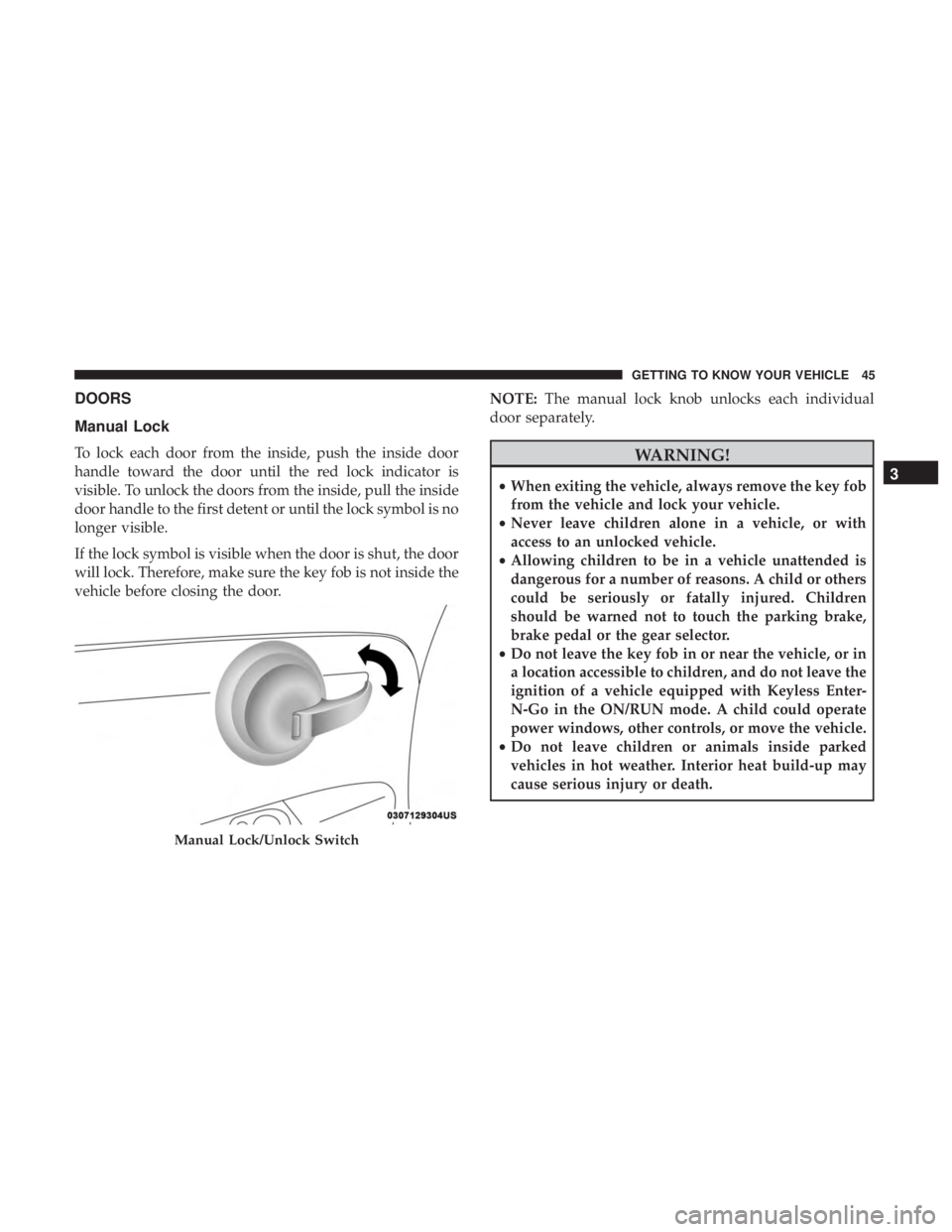
To lock each door from the inside, push the inside door
handle toward the door until the red lock indicator is
visible. To unlock the doors from the inside, pull the inside
door handle to the first detent or until the lock symbol is no
longer visible.
If the lock symbol is visible when the door is shut, the door
will lock. Therefore, make sure the key fob is not inside the
vehicle before closing the door.NOTE:
The manual lock knob unlocks each individual
door separately.WARNING!
• When exiting the vehicle, always remove the key fob
from the vehicle and lock your vehicle.
• Never leave children alone in a vehicle, or with
access to an unlocked vehicle.
• Allowing children to be in a vehicle unattended is
dangerous for a number of reasons. A child or others
could be seriously or fatally injured. Children
should be warned not to touch the parking brake,
brake pedal or the gear selector.
• Do not leave the key fob in or near the vehicle, or in
a location accessible to children, and do not leave the
ignition of a vehicle equipped with Keyless Enter-
N-Go in the ON/RUN mode. A child could operate
power windows, other controls, or move the vehicle.
• Do not leave children or animals inside parked
vehicles in hot weather. Interior heat build-up may
cause serious injury or death.
Manual Lock/Unlock Switch
3
GETTING TO KNOW YOUR VEHICLE 45
Page 49 of 300
SEATS
Seats are a part of the Occupant Restraint System of the
vehicle.
WARNING!
•It is dangerous to ride in a cargo area, inside or
outside of a vehicle. In a collision, people riding in
these areas are more likely to be seriously injured or
killed.
• Do not allow people to ride in any area of your
vehicle that is not equipped with seats and seat belts.
In a collision, people riding in these areas are more
likely to be seriously injured or killed.
• Be sure everyone in your vehicle is in a seat and
using a seat belt properly.
Manual Adjustment Front Seats
Forward/Rearward Adjustment
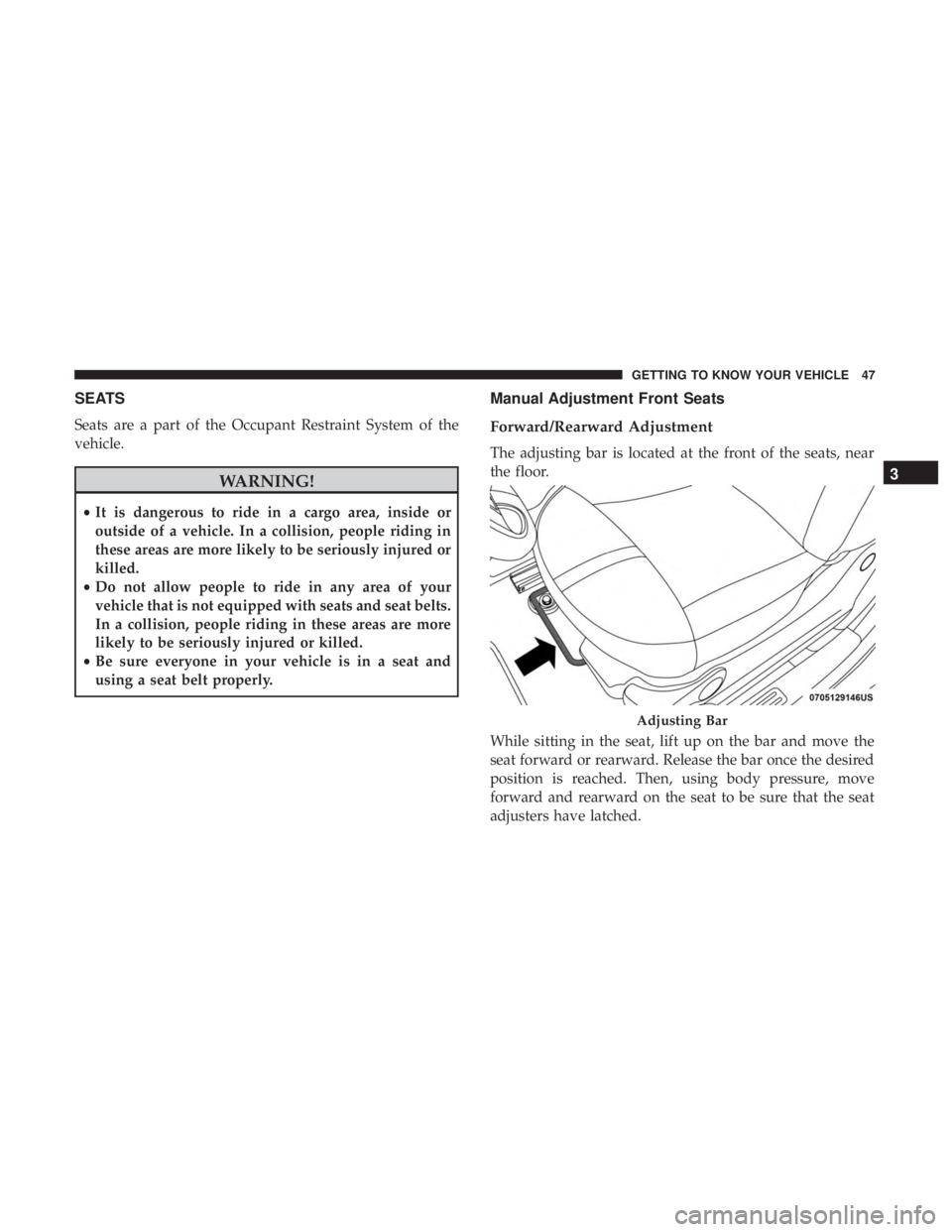
The adjusting bar is located at the front of the seats, near
the floor.
While sitting in the seat, lift up on the bar and move the
seat forward or rearward. Release the bar once the desired
position is reached. Then, using body pressure, move
forward and rearward on the seat to be sure that the seat
adjusters have latched.
Adjusting Bar
3
GETTING TO KNOW YOUR VEHICLE 47
Page 50 of 300
WARNING!
•Adjusting a seat while driving may be dangerous.
Moving a seat while driving could result in loss of
control which could cause a collision and serious
injury or death.
•
Seats should be adjusted before fastening the seat
belts and while the vehicle is parked. Serious injury or
death could result from a poorly adjusted seat belt.
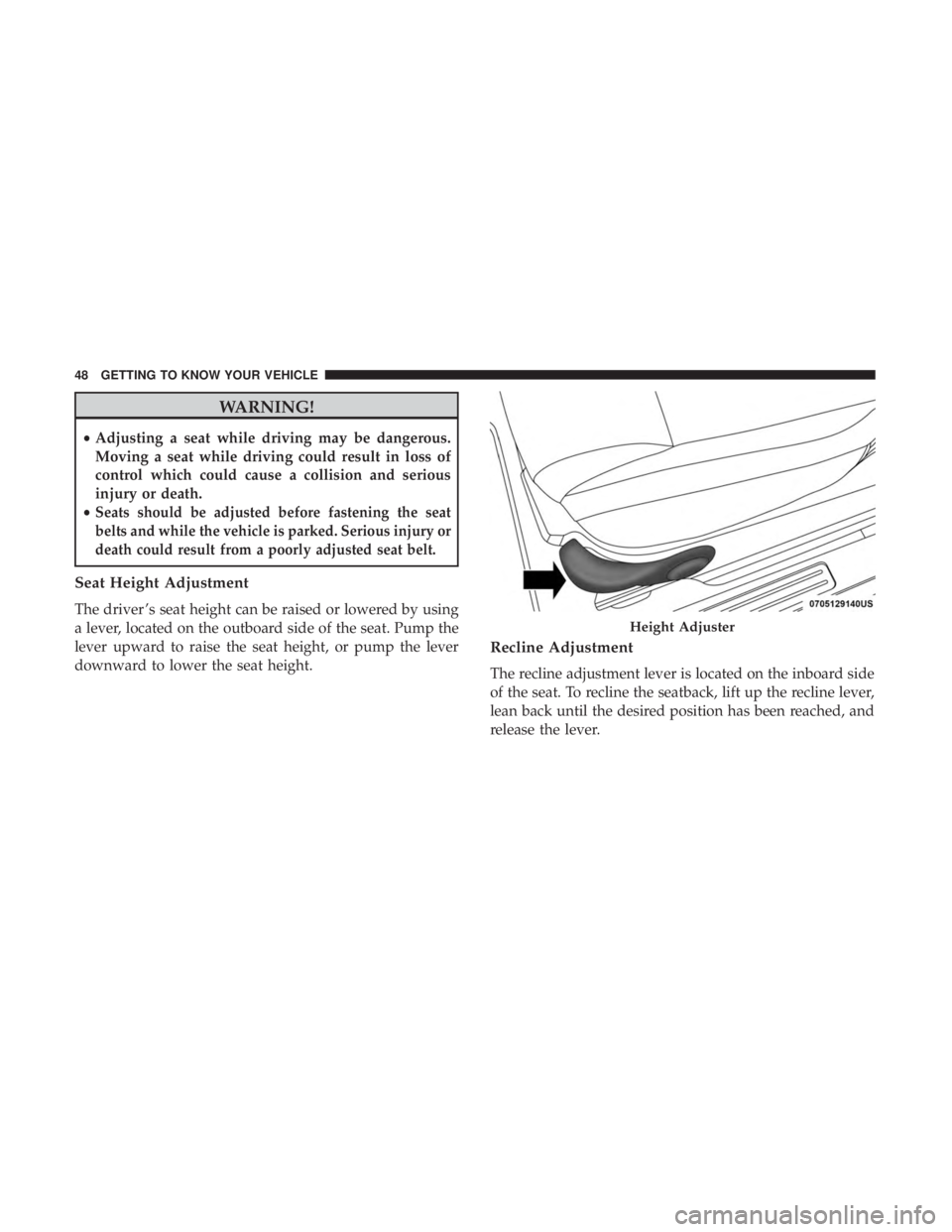
Seat Height Adjustment
The driver ’s seat height can be raised or lowered by using
a lever, located on the outboard side of the seat. Pump the
lever upward to raise the seat height, or pump the lever
downward to lower the seat height.
Recline Adjustment
The recline adjustment lever is located on the inboard side
of the seat. To recline the seatback, lift up the recline lever,
lean back until the desired position has been reached, and
release the lever.
Height Adjuster
48 GETTING TO KNOW YOUR VEHICLE
Page 51 of 300
WARNING!
Do not ride with the seatback reclined so that the
shoulder belt is no longer resting against your chest. In
a collision you could slide under the seat belt, which
could result in serious injury or death.
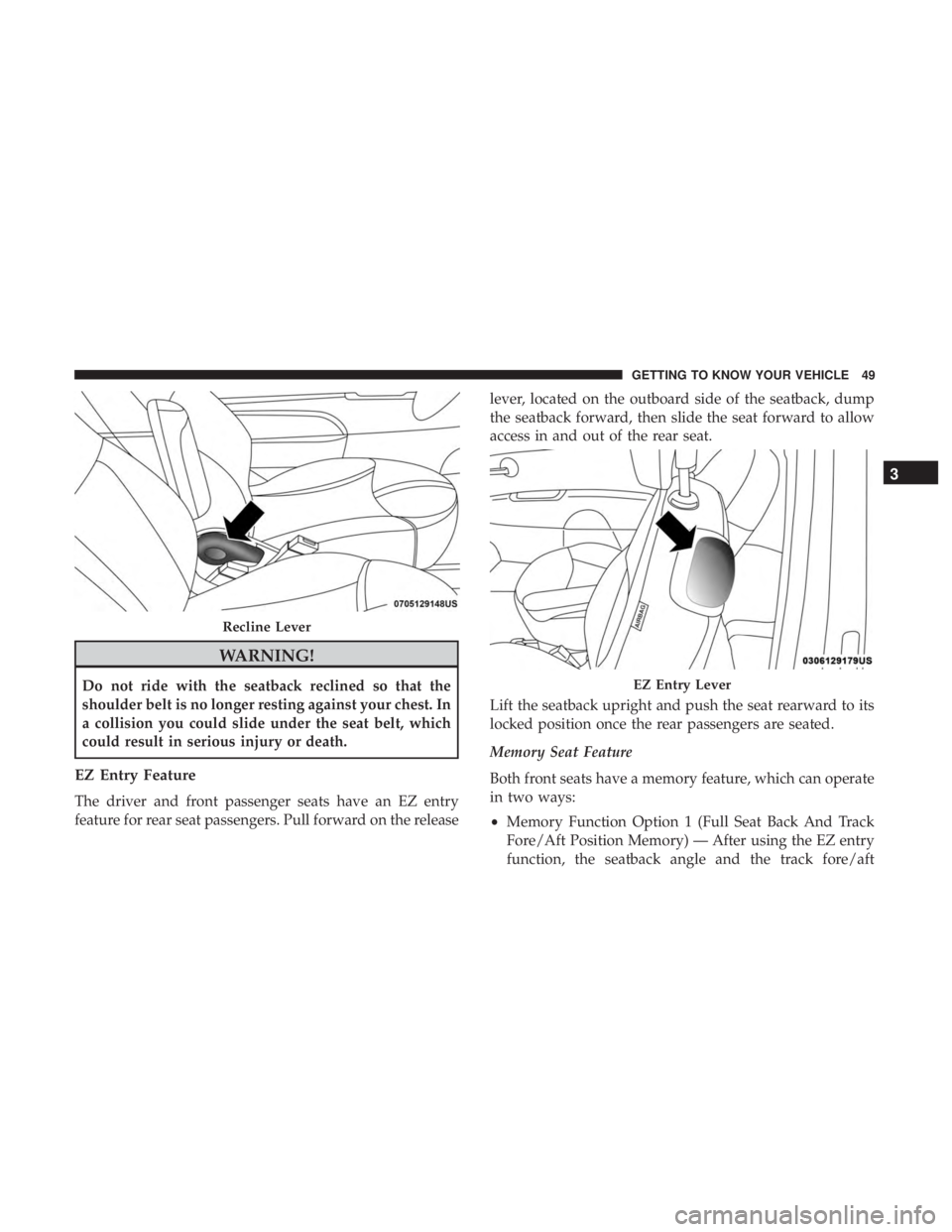
EZ Entry Feature
The driver and front passenger seats have an EZ entry
feature for rear seat passengers. Pull forward on the releaselever, located on the outboard side of the seatback, dump
the seatback forward, then slide the seat forward to allow
access in and out of the rear seat.
Lift the seatback upright and push the seat rearward to its
locked position once the rear passengers are seated.
Memory Seat Feature
Both front seats have a memory feature, which can operate
in two ways:
•
Memory Function Option 1 (Full Seat Back And Track
Fore/Aft Position Memory) — After using the EZ entry
function, the seatback angle and the track fore/aft
Recline Lever
EZ Entry Lever
3
GETTING TO KNOW YOUR VEHICLE 49
Page 52 of 300
adjuster can both re-lock into the position they were
most recently adjusted to. This is accomplished if the
seat is moved fully rearward to its last fore/aft position
on the tracks before the seat back is returned upright.
•
Memory Function Option 2 (Seat Back Only Memory) —
After using the EZ entry function, the seat back may first
be returned upright prior to going back to the last fore/aft
(memory) position on the tracks. This results in the seat
back memory being set only – The track will then be
locked forward of its last set fore/aft memory position. To
then reset the fore/aft track memory feature (to reestab-
lish Memory Function Option 1), the seat has to be
returned fully rearward to its last fore/aft memory track
position as described in Memory Function Option 1.
Heated Seats — If Equipped
On some models, the front driver and passenger seats may
be equipped with heaters in both the seat cushions and
seatbacks. The controls for the front heated seats are
located on the center instrument panel area.
Push the switch once to turn on the heated seats.
Push the switch a second time to shut the heating
elements off. NOTE:
Once a heat setting is selected, heat will be felt
within two to five minutes.
WARNING!
• Persons who are unable to feel pain to the skin
because of advanced age, chronic illness, diabetes,
spinal cord injury, medication, alcohol use, exhaus-
tion or other physical condition must exercise care
when using the seat heater. It may cause burns even
at low temperatures, especially if used for long
periods of time.
• Do not place anything on the seat or seatback that
insulates against heat, such as a blanket or cushion.
This may cause the seat heater to overheat. Sitting in
a seat that has been overheated could cause serious
burns due to the increased surface temperature of the
seat.
50 GETTING TO KNOW YOUR VEHICLE
Page 53 of 300
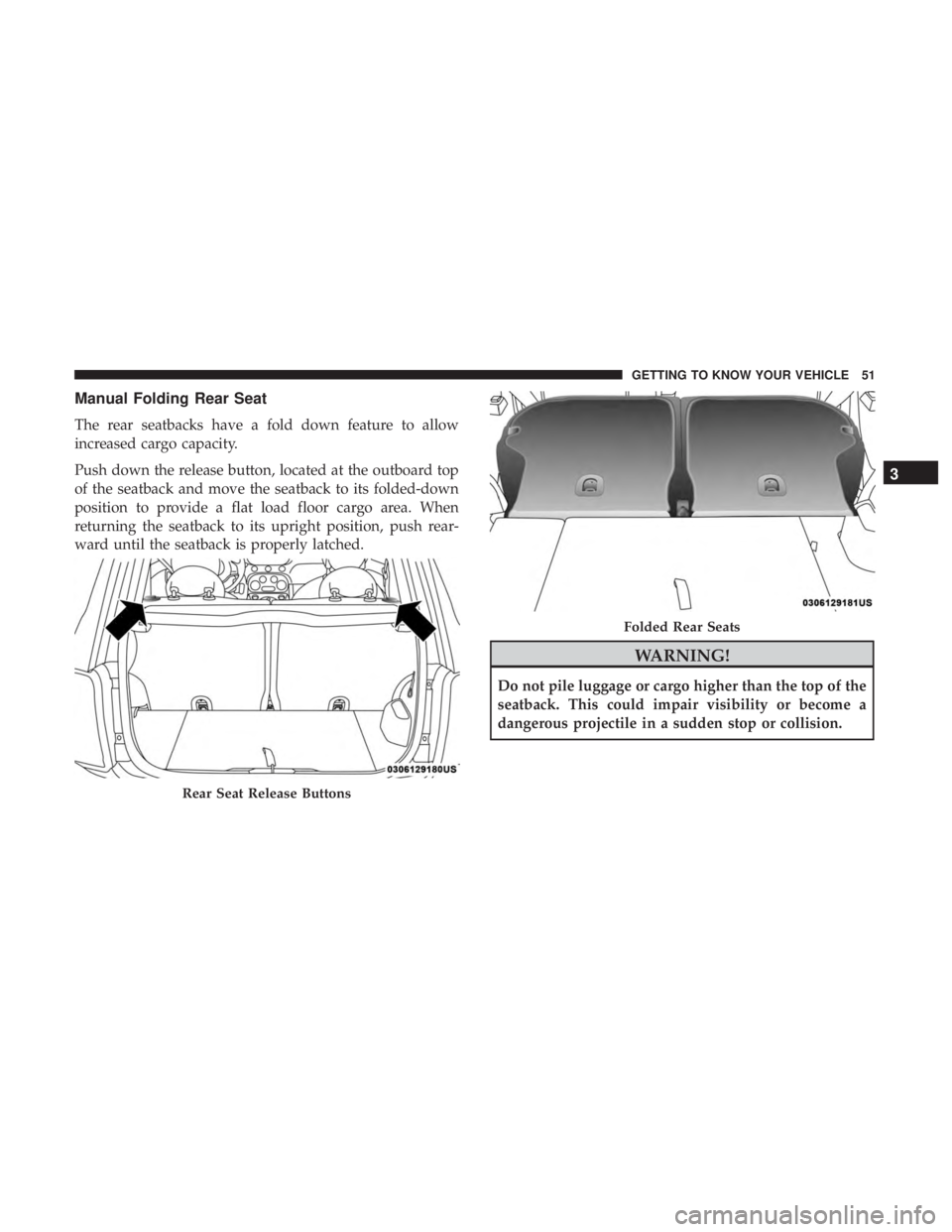
Manual Folding Rear Seat
The rear seatbacks have a fold down feature to allow
increased cargo capacity.
Push down the release button, located at the outboard top
of the seatback and move the seatback to its folded-down
position to provide a flat load floor cargo area. When
returning the seatback to its upright position, push rear-
ward until the seatback is properly latched.
WARNING!
Do not pile luggage or cargo higher than the top of the
seatback. This could impair visibility or become a
dangerous projectile in a sudden stop or collision.
Rear Seat Release Buttons
Folded Rear Seats
3
GETTING TO KNOW YOUR VEHICLE 51
Page 54 of 300
HEAD RESTRAINTS
Head restraints are designed to reduce the risk of injury by
restricting head movement in the event of a rear impact.
Head restraints should be adjusted so that the top of the
head restraint is located above the top of your ear.
WARNING!
•All occupants, including the driver, should not oper-
ate a vehicle or sit in a vehicle’s seat until the head
restraints are placed in their proper positions in
order to minimize the risk of neck injury in the event
of a crash.
• Head restraints should never be adjusted while the
vehicle is in motion. Driving a vehicle with the head
restraints improperly adjusted or removed could
cause serious injury or death in the event of a
collision.
Reactive Head Restraints — Front Seats
The driver and front passenger seats are equipped with
Reactive Head Restraints. In the event of a rear impact, the
Reactive Head Restraints will automatically extend for-
ward minimizing the gap between the back of the occu-
pant’s head and the Reactive Head Restraint.
To raise the head restraint, pull upward on the head
restraint. To lower the head restraint, push the adjustment
button, located at the base of the head restraint, and push
downward on the head restraint.
52 GETTING TO KNOW YOUR VEHICLE