brakes FIAT 500E 2019 Owners Manual
[x] Cancel search | Manufacturer: FIAT, Model Year: 2019, Model line: 500E, Model: FIAT 500E 2019Pages: 300, PDF Size: 3.03 MB
Page 104 of 300
SAFETY FEATURES
Four-Wheel Anti-Lock Brake System (ABS)
The Four-Wheel ABS is designed to aid the driver in
maintaining vehicle control under adverse braking condi-
tions. The system operates with a separate computer to
modulate hydraulic pressure, to prevent wheel lock-up
and to help avoid skidding on slippery surfaces.
The system’s pump motor runs during an ABS stop to
provide regulated hydraulic pressure. The pump motor
makes a low humming noise during operation, which is
normal.
The ABS includes an amber ABS Warning Light. When the
light is illuminated, the ABS is not functioning. The system
reverts to standard non-anti-lock brakes. Turning the igni-
tion OFF and ON again may reset the ABS if the fault
detected was only momentary.
WARNING!
•The ABS contains sophisticated electronic equip-
ment that may be susceptible to interference caused
(Continued)
WARNING! (Continued)
by improperly installed or high output radio trans-
mitting equipment. This interference can cause pos-
sible loss of anti-lock braking capability. Installation
of such equipment should be performed by qualified
professionals.
• Pumping of the Anti-Lock Brakes will diminish their
effectiveness and may lead to a collision. Pumping
makes the stopping distance longer. Just press firmly
on your brake pedal when you need to slow down or
stop.
• The ABS cannot prevent the natural laws of physics
from acting on the vehicle, nor can it increase brak-
ing or steering efficiency beyond that afforded by the
condition of the vehicle brakes and tires or the
traction afforded.
• The ABS cannot prevent collisions, including those
resulting from excessive speed in turns, following
another vehicle too closely, or hydroplaning.
• The capabilities of an ABS equipped vehicle must
never be exploited in a reckless or dangerous manner
that could jeopardize the user ’s safety or the safety of
others.
102 SAFETY
Page 105 of 300
When you are in a severe braking condition involving the
use of the ABS, you will experience some pedal drop as the
vehicle comes to a stop. This is the result of the system
reverting to the base brake system.
Engagement of the ABS may be accompanied by a pulsing
sensation. You may also hear a clicking noise. These
occurrences are normal and indicate that the system is
functioning properly.
Electronic Brake Control System
Your vehicle is equipped with a advanced electronic brake
control system that includes the Brake Assist System (BAS),
Traction Control System (TCS), and Electronic Stability
Control (ESC). All systems work together to enhance
vehicle stability and control in various driving conditions
and are commonly referred to as ESC.
Brake Assist System (BAS)
The BAS is designed to optimize the vehicle’s braking
capability during emergency braking maneuvers. The sys-
tem detects an emergency braking situation by sensing the
rate and amount of brake application and then applies
optimum pressure to the brakes. This can help reduce
braking distances. The BAS complements the anti-lock
brake system (ABS). Applying the brakes very quicklyresults in the best BAS assistance. To receive the benefit of
the system, you must apply continuous braking pressure
during the stopping sequence, (do not “pump” the brakes).
Do not reduce brake pedal pressure unless braking is no
longer desired. Once the brake pedal is released, the BAS is
deactivated.
WARNING!
The Brake Assist System (BAS) cannot prevent the
natural laws of physics from acting on the vehicle, nor
can it increase the traction afforded by prevailing road
conditions. BAS cannot prevent collisions, including
those resulting from excessive speed in turns, driving
on very slippery surfaces, or hydroplaning. The capa-
bilities of a BAS-equipped vehicle must never be
exploited in a reckless or dangerous manner, which
could jeopardize the user’s safety or the safety of
others.
Traction Control System (TCS)
This system monitors the amount of wheel spin of each of
the driven wheels. If wheel spin is detected, brake pressure
is applied to the slipping wheel(s) and vehicle power is
reduced to provide enhanced acceleration and stability. A
feature of the TCS system, Brake Limited Differential
5
SAFETY 103
Page 109 of 300
The RBS uses conventional hydraulic friction brakes, re-
generative braking, or a combination to slow the vehicle. If
the system detects slippery conditions while braking,
ONLY friction is used to slow the vehicle. The RBS can
result in extended life of the hydraulic service brakes;
however, all inspection, scheduled maintenance, and ser-
vice intervals for the vehicle service brakes must be fol-
lowed.
AUXILIARY DRIVING SYSTEMS
Tire Pressure Monitor System
The Tire Pressure Monitor System (TPMS) will warn the
driver of a low tire pressure based on the vehicle recom-
mended cold placard pressure.
The tire pressure will vary with temperature by about 1psi
(7 kPa) for every 12°F (6.5°C). This means that when the
outside temperature decreases, the tire pressure will de-
crease. Tire pressure should always be set based on cold
inflation tire pressure. This is defined as the tire pressure
after the vehicle has not been driven for at least three
hours, or driven less than 1 mile (1.6 km) after a three hour
period. The cold tire inflation pressure must not exceed the
maximum inflation pressure molded into the tire sidewall.
Refer to “Tires – General Information” in “Servicing AndMaintenance” for information on how to properly inflate
the vehicle’s tires. The tire pressure will also increase as the
vehicle is driven. This is normal and there should be no
adjustment for this increased pressure.
The TPMS will warn the driver of a low tire pressure if the
tire pressure falls below the low-pressure warning limit for
any reason, including low temperature effects and natural
pressure loss through the tire.
The TPMS will continue to warn the driver of low tire
pressure as long as the condition exists, and will not turn
off until the tire pressure is at or above the recommended
cold placard pressure. Once the low tire pressure warning
(Tire Pressure Monitoring System Warning Light) illumi-
nates, you must increase the tire pressure to the recom-
mended cold placard pressure in order for the Tire Pressure
Monitoring System Warning Light to turn off. The system
will automatically update and the Tire Pressure Monitoring
System Warning Light will turn off once the system re-
ceives the updated tire pressures. The vehicle may need to
be driven for up to 20 minutes above 15 mph (24 km/h) in
order for the TPMS to receive this information.
For example, your vehicle may have a recommended cold
(parked for more than three hours) placard pressure of 33
psi (227 kPa). If the ambient temperature is 68°F (20°C) and
5
SAFETY 107
Page 159 of 300
STARTING PROCEDURES
Before starting your vehicle, adjust your seat, adjust both
inside and outside mirrors, and fasten your seat belts.
WARNING!
•Never leave children alone in a vehicle, or with
access to an unlocked vehicle.
• Allowing children to be in a vehicle unattended is
dangerous for a number of reasons. A child or others
could be seriously or fatally injured. Children
should be warned not to touch the parking brake,
brake pedal or the transmission gear selector.
• Do not leave the key fob in or near the vehicle (or in
a location accessible to children). A child could
operate power windows, other controls, or move the
vehicle.
Single-Speed Transmission
The transmission must be in the PARK or NEUTRAL
position before you can start the vehicle. Apply the brakes
when selecting a transmission gear from Park.
NOTE: You must press the brake pedal before selecting a
transmission gear.
Normal Starting
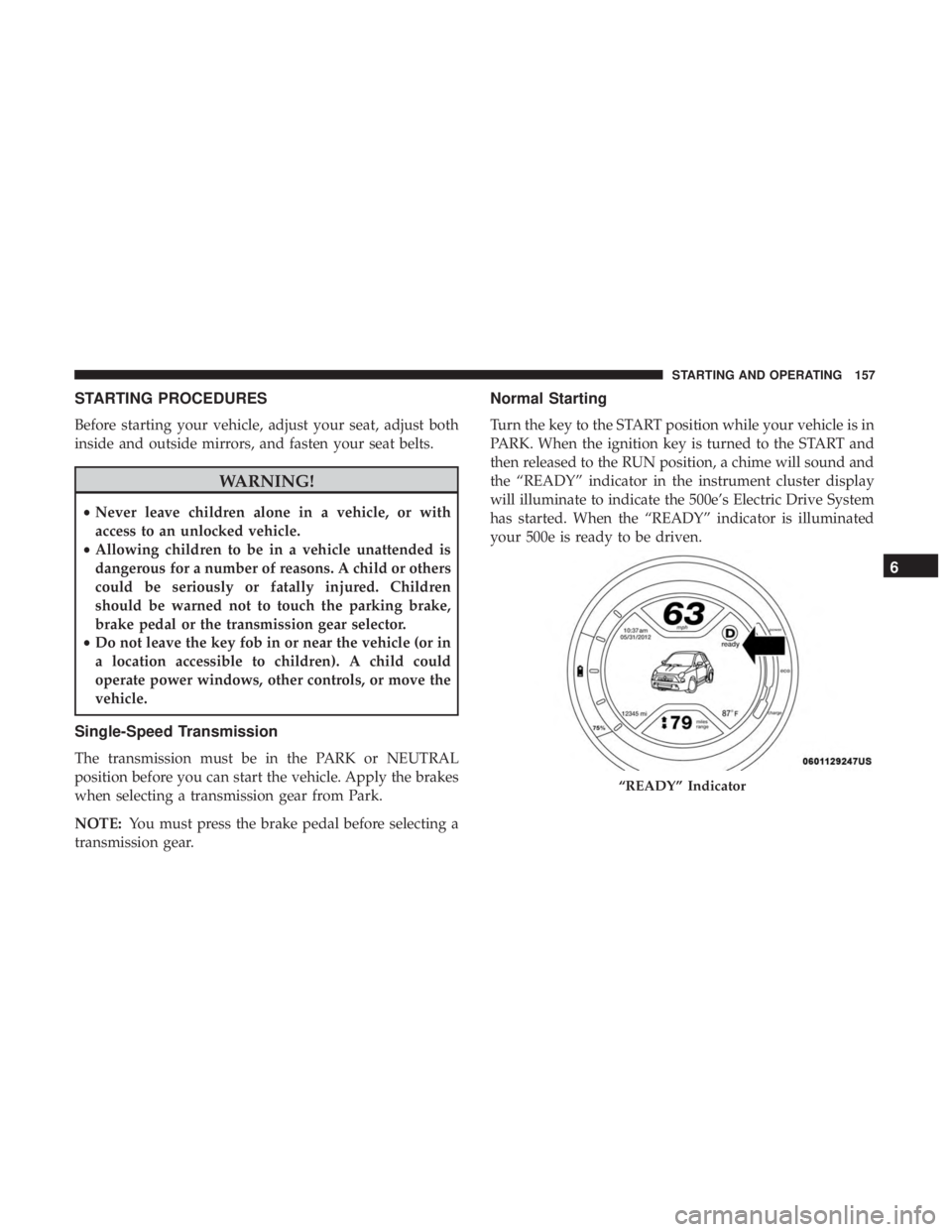
Turn the key to the START position while your vehicle is in
PARK. When the ignition key is turned to the START and
then released to the RUN position, a chime will sound and
the “READY” indicator in the instrument cluster display
will illuminate to indicate the 500e’s Electric Drive System
has started. When the “READY” indicator is illuminated
your 500e is ready to be driven.
“READY” Indicator
6
STARTING AND OPERATING 157
Page 177 of 300
Improper weight distributions can have an adverse effect
on the way your vehicle steers and handles and the way
the brakes operate.
CAUTION!
Do not load your vehicle any heavier than the GVWR
or the maximum front and rear GAWR. If you do, parts
on your vehicle can break, or it can change the way
your vehicle handles. This could cause you to lose
control. Also overloading can shorten the life of your
vehicle.
TRAILER TOWING
Trailer towing with this vehicle is not recommended.
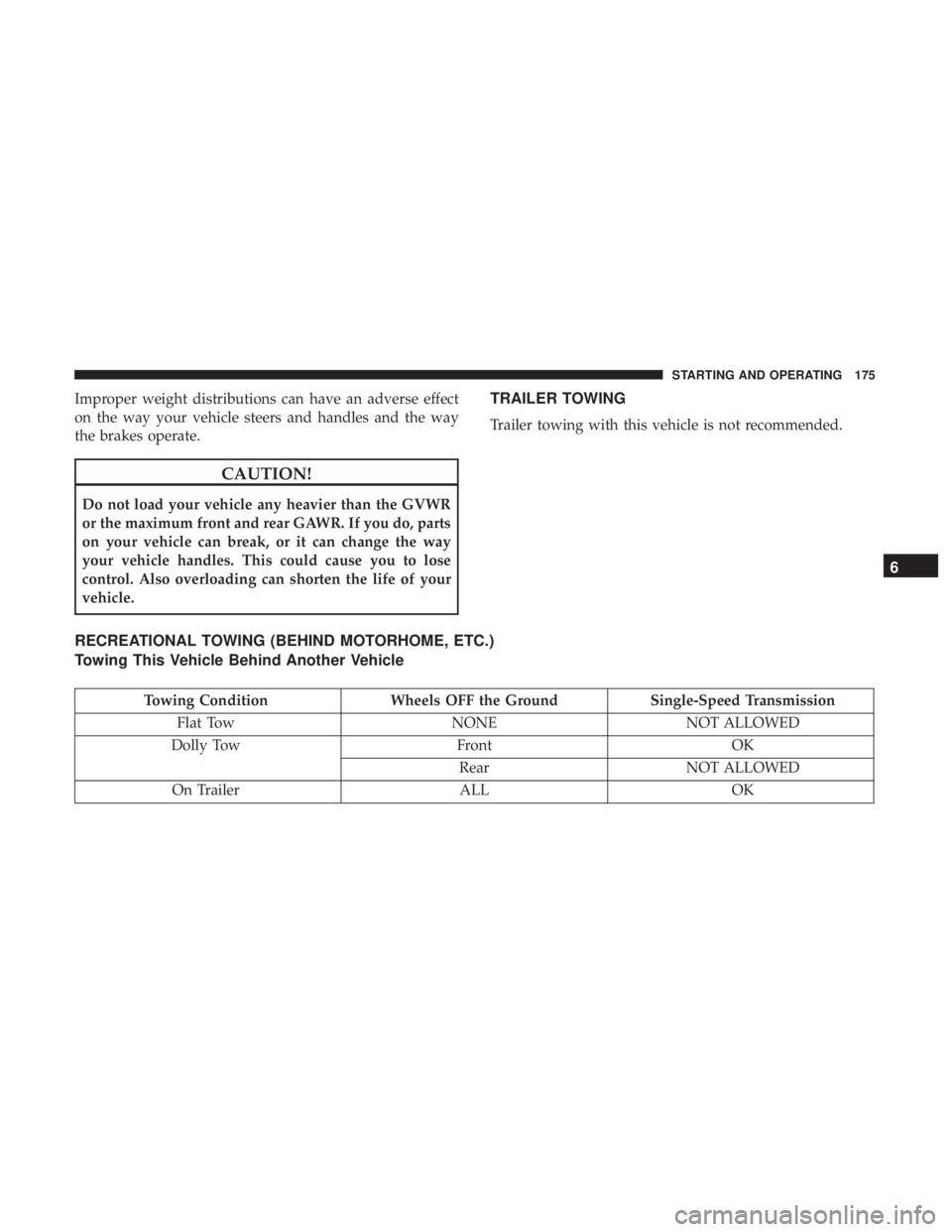
RECREATIONAL TOWING (BEHIND MOTORHOME, ETC.)
Towing This Vehicle Behind Another Vehicle
Towing ConditionWheels OFF the Ground Single-Speed Transmission
Flat Tow NONENOT ALLOWED
Dolly Tow FrontOK
Rear NOT ALLOWED
On Trailer ALLOK
6
STARTING AND OPERATING 175
Page 180 of 300
CAUTION!(Continued)
result in further damage. Such damage is not covered
by the New Vehicle Limited Warranty.
• Driving through standing water limits your vehicle’s
traction capabilities. Do not exceed 5 mph (8 km/h)
when driving through standing water.
• Driving through standing water limits your vehicle’s
braking capabilities, which increases stopping dis-
tances. Therefore, after driving through standing
water, drive slowly and lightly press on the brake
pedal several times to dry the brakes.
• Failure to follow these warnings may result in inju-
ries that are serious or fatal to you, your passengers,
and others around you.
EXTENDING YOUR DRIVING RANGE PER CHARGE
The drive system and cabin temperature management
features use the most energy from the high voltage battery.
Reducing energy draw from these features are the easiest
and most effective way to extend driving range. The 500e uses high voltage components to heat and cool
the cabin, so when using automatic climate control, con-
sider setting temperatures a few degrees higher or lower
during hot and cold days. If your 500e has been soaking in
hot or cold temperatures for an extended period, it is
recommended that the car be preconditioned using the
Uconnect smartphone app (not available in Canada) while
still plugged into a charging source. This will allow 500e to
use external power to establish a comfortable cabin tem-
perature before the drive and allow the battery to maintain
the temperature at significantly lower energy levels.
Additional tips:
•
Keep tires properly inflated.
• When practical, choose surface streets over the highway,
and work to maintain a steady speed.
• Avoid carrying nonessential cargo.
• Be mindful of adding external accessories that may
increase aerodynamic drag.
• Perform all scheduled maintenance at recommended
intervals.
178 STARTING AND OPERATING
Page 227 of 300
4. Install the wiper blade pivot pin into the wiper bladeholder at the end of the wiper arm, and firmly press the
wiper blade until it snaps into place.
5. Lower the wiper blade and snap the pivot cap into place.
Brake System
In order to assure brake system performance, all brake
system components should be inspected periodically. Refer
to the “Maintenance Plan” in this section for the proper
maintenance intervals.
WARNING!
Riding the brakes can lead to brake failure and possi-
bly a collision. Driving with your foot resting or riding
on the brake pedal can result in abnormally high brake
temperatures, excessive lining wear, and possible
brake damage. You would not have your full braking
capacity in an emergency.
Brake Master Cylinder
The fluid in the master cylinder should be checked when
performing under hood services or immediately if the
“Brake Warning Light” is illuminated. Be sure to clean the top of the master cylinder area before
removing the cap. If necessary, add fluid to bring the fluid
level up to the requirements described on the brake fluid
reservoir. With disc brakes, fluid level can be expected to
fall as the brake pads wear. Brake fluid level should be
checked when pads are replaced. However, low fluid level
may be caused by a leak and a checkup may be needed.
Use only manufacturer’s recommended brake fluid. Refer
to “Fluids And Lubricants” in “Technical Specifications”
for further information.
WARNING!
•
Use only manufacturer’s recommended brake fluid.
Refer to “Fluids And Lubricants” in “Technical
Specifications” for further information. Using the
wrong type of brake fluid can severely damage your
brake system and/or impair its performance. The
proper type of brake fluid for your vehicle is also
identified on the original factory installed hydraulic
master cylinder reservoir.
• To avoid contamination from foreign matter or mois-
ture, use only new brake fluid or fluid that has been
(Continued)
8
SERVICING AND MAINTENANCE 225
Page 247 of 300
NOTE:If you intend parking or storing your vehicle for an
extended period after cleaning the wheels with wheel
cleaner, drive your vehicle and apply the brakes to remove
the water droplets from the brake components. This activ-
ity will remove the red rust on the brake rotors and prevent
vehicle vibration when braking.
Dark Vapor Chrome, Black Satin Chrome, or Low Gloss
Clear Coat Wheels
CAUTION!
If your vehicle is equipped with these specialty
wheels, DO NOT USE wheel cleaners, abrasives, or
polishing compounds. They will permanently damage
this finish and such damage is not covered by the New
Vehicle Limited Warranty. HAND WASH ONLY US-
ING MILD SOAP AND WATER WITH A SOFT
CLOTH. Used on a regular basis; this is all that is
required to maintain this finish.
Tire Chains (Traction Devices)
Use of traction devices require sufficient tire-to-body clear-
ance. Follow these recommendations to guard against
damage:
• Traction device must be of proper size for the tire, as
recommended by the traction device manufacturer.
• Install on Front Tires.
• Due to limited clearance, a 185/55R15 tire on a 15 x 6.0
x 35mm wheel with a Peerless Super Z6 low profile
traction device or equivalent is recommended.
WARNING!
Using tires of different size and type (M+S, Snow)
between front and rear axles can cause unpredictable
handling. You could lose control and have a collision.
8
SERVICING AND MAINTENANCE 245
Page 256 of 300
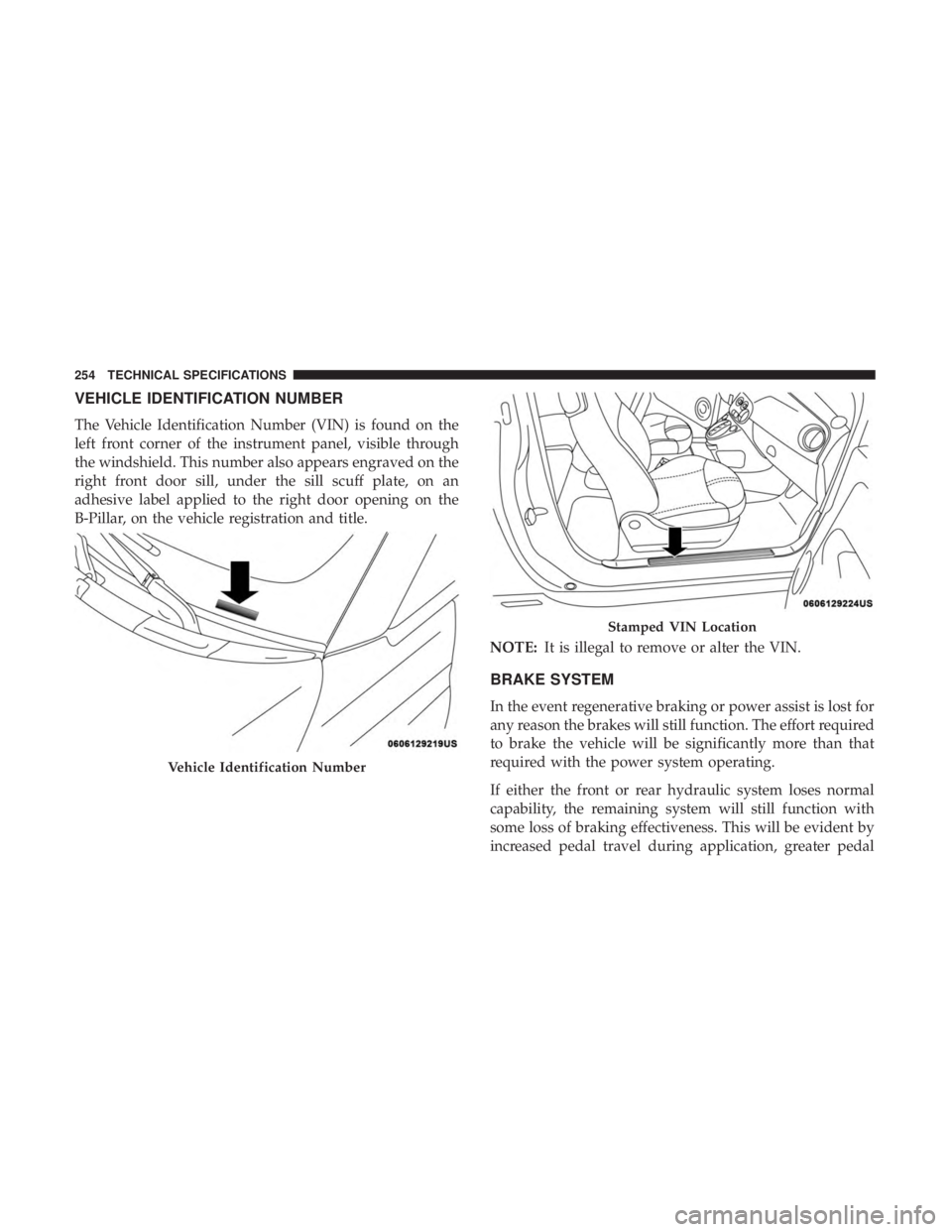
VEHICLE IDENTIFICATION NUMBER
The Vehicle Identification Number (VIN) is found on the
left front corner of the instrument panel, visible through
the windshield. This number also appears engraved on the
right front door sill, under the sill scuff plate, on an
adhesive label applied to the right door opening on the
B-Pillar, on the vehicle registration and title.NOTE:It is illegal to remove or alter the VIN.
BRAKE SYSTEM
In the event regenerative braking or power assist is lost for
any reason the brakes will still function. The effort required
to brake the vehicle will be significantly more than that
required with the power system operating.
If either the front or rear hydraulic system loses normal
capability, the remaining system will still function with
some loss of braking effectiveness. This will be evident by
increased pedal travel during application, greater pedal
Vehicle Identification Number
Stamped VIN Location
254 TECHNICAL SPECIFICATIONS
Page 294 of 300
Lights............................... .58, 154
AirBag......................... .92, 123, 152
Brake Assist Warning ..................... .106
Brake Warning ...........................92
Bulb Replacement ....................... .182
Cruise .................................99
Daytime Running .........................58
Dimmer Switch, Headlight ...................58
Exterior .............................. .154
Headlights ..............................58
High Beam ..............................59
High Beam/Low Beam Select .................58
Instrument Cluster ........................58
Lights On Reminder .......................58
Park ............................... .59, 99
Passing ............................. .58, 59
Seat Belt Reminder ........................94
Security Alarm ...........................42
Service ............................... .182
Traction Control ........................ .106
Turn Signals .....................58, 60, 99, 154
Warning Instrument Cluster Descriptions ........99
Loading Vehicle ........................... .173
Tires................................. .230Locks
Power Door .............................46
Lubrication, Body ......................... .223
Lug Nuts/Bolts ........................... .255
Maintenance Free Battery .....................215
Maintenance, General ...................... .216
Maintenance Procedures ..................... .216
Maintenance Schedule .......................211
Manual Service ............................... .286
Master Cylinder Brakes ............................... .225
Memory Seat ..............................49
Mirrors ..................................56
Automatic Dimming .......................56
Electric Powered ..........................57
Heated ............................. .56, 58
Outside ................................56
Rearview ...............................56
Modifications/Alterations V
ehicle .................................5
Mopar Parts ............................. .285
MP3 Control ............................. .273
292 INDEX