coolant reservoir FIAT 500E 2019 Owners Manual
[x] Cancel search | Manufacturer: FIAT, Model Year: 2019, Model line: 500E, Model: FIAT 500E 2019Pages: 300, PDF Size: 3.03 MB
Page 213 of 300
SCHEDULED SERVICING
Once A Month Or Before A Trip:
•Check windshield washer fluid level
• Check the tire inflation pressures and look for unusual
wear or damage
• Check the fluid levels of the coolant reservoirs and brake
master cylinder
• Check function of all interior and exterior lights
Maintenance Plan
Required Maintenance Intervals
Refer to the maintenance schedules on the following page
for the required maintenance intervals.
At Every Service Interval:
• Rotate the tires. Rotate at the first sign of irregular
wear.
• Inspect brake pads, shoes, rotors, drums, and hoses.
• Inspect battery cooling system protection and
hoses.
• Check and adjust hand brake.
Refer to the Maintenance Plan on the following pages for
the required maintenance intervals.
8
SERVICING AND MAINTENANCE 211
Page 216 of 300
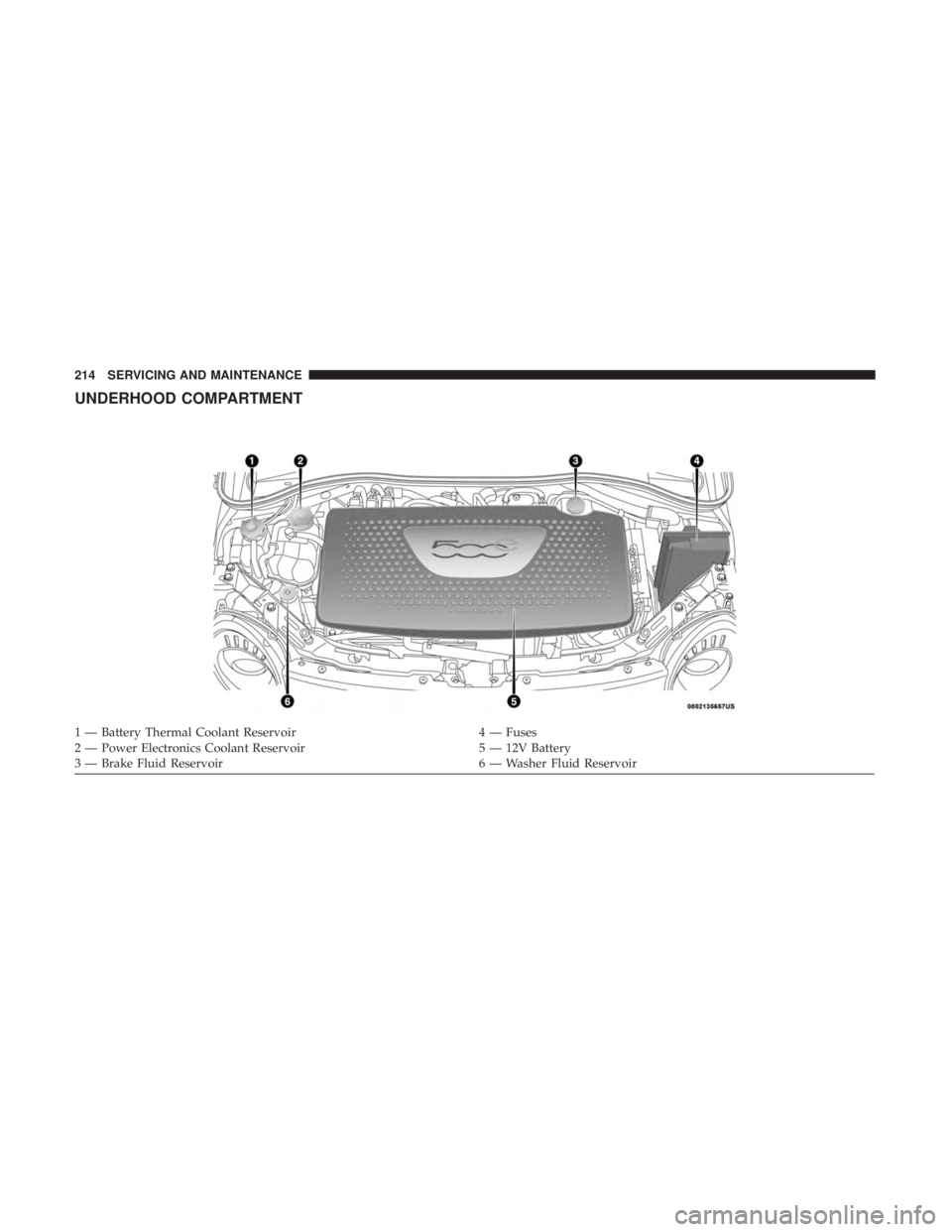
UNDERHOOD COMPARTMENT
1 — Battery Thermal Coolant Reservoir4 — Fuses
2 — Power Electronics Coolant Reservoir 5 — 12V Battery
3 — Brake Fluid Reservoir 6 — Washer Fluid Reservoir
214 SERVICING AND MAINTENANCE
Page 217 of 300
Adding Washer Fluid
The windshield washer fluid reservoir is located in the
underhood compartment, and the fluid level should be
checked at regular intervals. Fill the reservoir with wind-
shield washer solvent (not coolant/ antifreeze). Refer to
“Underhood Compartment” in this section for further
information.
WARNING!
Commercially available windshield washer solvents
are flammable. They could ignite and burn you. Care
must be exercised when filling or working around the
washer solution.
Maintenance-Free Battery 12 Volt
Your vehicle is equipped with a maintenance-free 12 Volt
battery. You will never have to add water, nor is periodic
maintenance required.
WARNING!
•Battery fluid is a corrosive acid solution and can
burn or even blind you. Do not allow battery fluid to
(Continued)
WARNING! (Continued)
contact your eyes, skin, or clothing. Do not lean over
a battery when attaching clamps. If acid splashes in
eyes or on skin, flush the area immediately with
large amounts of water. Refer to “Jump Starting
Procedure” in “In Case Of Emergency” for further
information.
• Battery gas is flammable and explosive. Keep flame
or sparks away from the battery. Do not use a booster
battery or any other booster source with an output
greater than 12 Volts. Do not allow cable clamps to
touch each other.
• Battery posts, terminals, and related accessories con-
tain lead and lead compounds. Wash hands after
handling.
• The battery in this vehicle has a vent hose that
should not be disconnected and should only be
replaced with a battery of the same type (vented).
CAUTION!
• It is essential when replacing the cables on the
battery that the positive cable is attached to the
(Continued)
8
SERVICING AND MAINTENANCE 215
Page 221 of 300
Power Electronics And Battery Thermal
Management Systems — Cooling Pressure Caps
The caps must be fully tightened to prevent loss of coolant
(antifreeze).
The caps should be inspected and cleaned if there is any
accumulation of foreign material on the sealing surfaces.
NOTE:
•The pressure caps on the reservoirs are unique and rated
at 5 PSI (34.5 kPa).
• Use only Mopar replacement parts.
WARNING!
•The warning words “DO NOT OPEN HOT” on the
cooling system pressure cap are a safety precaution.
Never add coolant (antifreeze) when the cooling
system is overheated. Do not loosen or remove the
cap to cool an overheated cooling system. Heat
causes pressure to build up in the cooling system. To
prevent scalding or injury, do not remove the pres-
sure cap while the system is hot or under pressure.
• Do not use a pressure cap other than the one speci-
fied for your vehicle. Personal injury or vehicle
damage may result.
Selection Of Coolant
Refer to “Fluids And Lubricants” in “Technical Specifica-
tions” for further information.
CAUTION!
• Mixing of coolant (antifreeze) other than specified
Organic Additive Technology (OAT) coolant (anti-
freeze), may result in cooling system damage and
may decrease corrosion protection. Organic Additive
Technology (OAT) coolant is different and should
not be mixed with Hybrid Organic Additive Tech-
nology (HOAT) coolant (antifreeze). If a non-OAT
coolant (antifreeze) is introduced into the cooling
system in an emergency, it should be replaced with
the specified coolant (antifreeze) as soon as possible.
• Do not use water alone or alcohol-based coolant
(antifreeze) products. Do not use additional rust
inhibitors or antirust products, as they may not be
compatible with the radiator coolant and may plug
the radiator.
• This vehicle has not been designed for use with
propylene glycol-based coolant (antifreeze). Use of
propylene glycol-based coolant (antifreeze) is not
recommended.
8
SERVICING AND MAINTENANCE 219