warning FIAT 500L 2014 2.G Owners Manual
[x] Cancel search | Manufacturer: FIAT, Model Year: 2014, Model line: 500L, Model: FIAT 500L 2014 2.GPages: 409, PDF Size: 3.2 MB
Page 355 of 409
Your leather upholstery can be best preserved by regular
cleaning with a damp soft cloth. Small particles of dirt
can act as an abrasive and damage the leather upholstery
and should be removed promptly with a damp cloth.
Stubborn soils can be removed easily with a soft cloth
and MOPAR® Total Clean. Care should be taken to avoid
soaking your leather upholstery with any liquid. Please
do not use polishes, oils, cleaning fluids, solvents, deter-
gents, or ammonia-based cleaners to clean your leather
upholstery. Application of a leather conditioner is not
required to maintain the original condition.
WARNING!
Do not use volatile solvents for cleaning purposes.
Many are potentially flammable, and if used in
closed areas they may cause respiratory harm.
CAUTION!
Do not use Alcohol and Alcohol-based and/or Keton
based cleaning products to clean leather seats, as
damage to the seat may result.
Cleaning Headlights
Your vehicle has plastic headlights that are lighter and
less susceptible to stone breakage than glass headlights.
Plastic is not as scratch resistant as glass and therefore
different lens cleaning procedures must be followed.
To minimize the possibility of scratching the lenses and
reducing light output, avoid wiping with a dry cloth. To
remove road dirt, wash with a mild soap solution fol-
lowed by rinsing.
Do not use abrasive cleaning components, solvents, steel
wool or other aggressive material to clean the lenses.
7
MAINTAINING YOUR VEHICLE 353
Page 357 of 409
Seat Belt Maintenance
Do not bleach, dye or clean the belts with chemical
solvents or abrasive cleaners. This will weaken the fabric.
Sun damage can also weaken the fabric.
If the belts need cleaning, use a mild soap solution or
lukewarm water. Do not remove the belts from the car to
wash them. Dry with a soft cloth.
Replace the belts if they appear frayed or worn or if the
buckles do not work properly.
WARNING!
A frayed or torn belt could rip apart in a collision and
leave you with no protection. Inspect the belt system
periodically, checking for cuts, frays, or loose parts.
Damaged parts must be replaced immediately. Do
not disassemble or modify the system. Seat belt
(Continued)
WARNING!(Continued)
assemblies must be replaced after a collision if they
have been damaged (i.e., bent retractor, torn web-
bing, etc.).
FUSES
WARNING!
•When replacing a blown fuse, always use an ap-
propriate replacement fuse with the same amp
rating as the original fuse. Never replace a fuse
with another fuse of higher amp rating. Never
replace a blown fuse with metal wires or any other
material. Failure to use proper fuses may result in
serious personal injury, fire and/or property dam-
age.
(Continued)
7
MAINTAINING YOUR VEHICLE 355
Page 358 of 409
WARNING!(Continued)
•Before replacing a fuse, make sure that the ignition
is off and that all the other services are switched off
and/or disengaged.
• If the replaced fuse blows again, contact an autho-
rized dealer.
• If a general protection fuse for safety systems (air
bag system, braking system), power unit systems
(engine system, gearbox system) or steering system
blows, contact an authorized dealer.
Underhood Fuses
The Front Distribution Unit is located on the right side of
the engine compartment, next to the battery. To access the
fuses, press the release tabs and remove the cover. The ID number of the electrical component correspond-
ing to each fuse can be found on the back of the cover.
Front Distribution Unit
356 MAINTAINING YOUR VEHICLE
Page 381 of 409
WARNING!
•You can be badly injured working on or around a
motor vehicle. Do only service work for which you
have the knowledge and the right equipment. If
you have any doubt about your ability to perform a
service job, take your vehicle to a competent me-
chanic.
• Failure to properly inspect and maintain your ve-
hicle could result in a component malfunction and
effect vehicle handling and performance. This
could cause an accident.
8
M A I
N T
E
N
A
N
C E
S
C
H E
D
U L
E
SMAINTENANCE SCHEDULES 379
Page 387 of 409
WARNING!
Engine exhaust, some of its constituents, and certain
vehicle components contain, or emit, chemicals
known to the State of California to cause cancer and
birth defects, or other reproductive harm. In addi-
tion, certain fluids contained in vehicles and certain
products of component wear contain, or emit, chemi-
cals known to the State of California to cause cancer
and birth defects, or other reproductive harm.
WARRANTY INFORMATION
See the Warranty Information Booklet, located on the
DVD, for the terms and provisions of FIAT Group
Automobiles warranties applicable to this vehicle and
market.
REPORTING SAFETY DEFECTS
In The 50 United States And Washington, D.C.
If you believe that your vehicle has a defect that could
cause a crash or cause injury or death, you should
immediately inform the National Highway Traffic Safety
Administration (NHTSA) in addition to notifying the
manufacturer.
If NHTSA receives similar complaints, it may open an
investigation, and if it finds that a safety defect exists in
a group of vehicles, it may order a recall and remedy
campaign. However, NHTSA cannot become involved in
individual problems between you, your authorized
dealer, and the manufacturer.
To contact NHTSA, you may either call the Auto Safety
Hotline toll free at 1–888–327–4236 (TTY: 1–800–424– 9153),
or go to http://www.safercar.gov; or write to: Administra-
tor, NHTSA, 1200 New Jersey Avenue, SE., West Building,
9
IF YOU NEED CONSUMER ASSISTANCE 385
Page 390 of 409
Treadwear
The Treadwear grade is a comparative rating, based on
the wear rate of the tire when tested under controlled
conditions on a specified government test course. For
example, a tire graded 150 would wear one and one-half
times as well on the government course as a tire graded
100. The relative performance of tires depends upon the
actual conditions of their use, however, and may depart
significantly from the norm due to variations in driving
habits, service practices, and differences in road charac-
teristics and climate.
Traction Grades
The Traction grades, from highest to lowest, are AA, A, B,
and C. These grades represent the tire’s ability to stop on
wet pavement, as measured under controlled conditions
on specified government test surfaces of asphalt and
concrete. A tire marked C may have poor traction perfor-
mance.
WARNING!
The traction grade assigned to this tire is based on
straight-ahead braking traction tests, and does not
include acceleration, cornering, hydroplaning, or
peak traction characteristics.
388 IF YOU NEED CONSUMER ASSISTANCE
Page 391 of 409
Temperature Grades
The temperature grades are A (the highest), B, and C,
representing the tire’s resistance to the generation of heat
and its ability to dissipate heat, when tested under
controlled conditions on a specified indoor laboratory
test wheel. Sustained high temperature can cause the
material of the tire to degenerate and reduce tire life, and
excessive temperature can lead to sudden tire failure. The
grade C corresponds to a level of performance, which all
passenger car tires must meet under the Federal Motor
Vehicle Safety Standard No. 109. Grades B and A repre-
sent higher levels of performance on the laboratory test
wheel, than the minimum required by law.
WARNING!
The temperature grade for this tire is established for
a tire that is properly inflated and not overloaded.
Excessive speed, under-inflation, or excessive load-
ing, either separately or in combination, can cause
heat buildup and possible tire failure.
9
IF YOU NEED CONSUMER ASSISTANCE 389
Page 394 of 409
Adding Engine Coolant (Antifreeze)............340
Adding Fuel ............................ .280
Adding Washer Fluid ..................... .335
Additives, Fuel .......................... .279
Airbag ..................................42
Airbag Deployment ........................56
Airbag Light .............................51
Airbag Maintenance ........................58
Airbag, Side ..............................46
Airbag, Window (Side Curtain) ................47
Air Cleaner, Engine (Engine Air Cleaner Filter) . . . .326
Air Conditioner Maintenance .................328
Air Conditioning Filter .....................330
Air Conditioning Refrigerant .................328
Air Conditioning System ....................328
Air Pressure, Tires ........................ .259
Alarm (Security Alarm) ......................15
Alarm System (Security Alarm) ................15
Alterations/Modifications, Vehicle ...............8Antifreeze (Engine Coolant)
..................339
Capacities ........................... .369
Disposal ............................. .342
Anti-Lock Brake System (ABS) ................237
Anti-Lock Warning Light ....................167
Appearance Care ........................ .349
Arming System (Security Alarm) ...............15
Automatic Dimming Mirror ...................91
Automatic Transmission ....................216
Fluid Type ........................... .371
Autostick .............................. .230
Auto Up Power Windows ....................26
Battery ................................ .327
Jump Starting ......................... .308
Belts, Seat ...............................83
Body Mechanism Lubrication .................332
B-Pillar Location ......................... .253
Brake Assist System ...................... .239
392 INDEX
Page 395 of 409
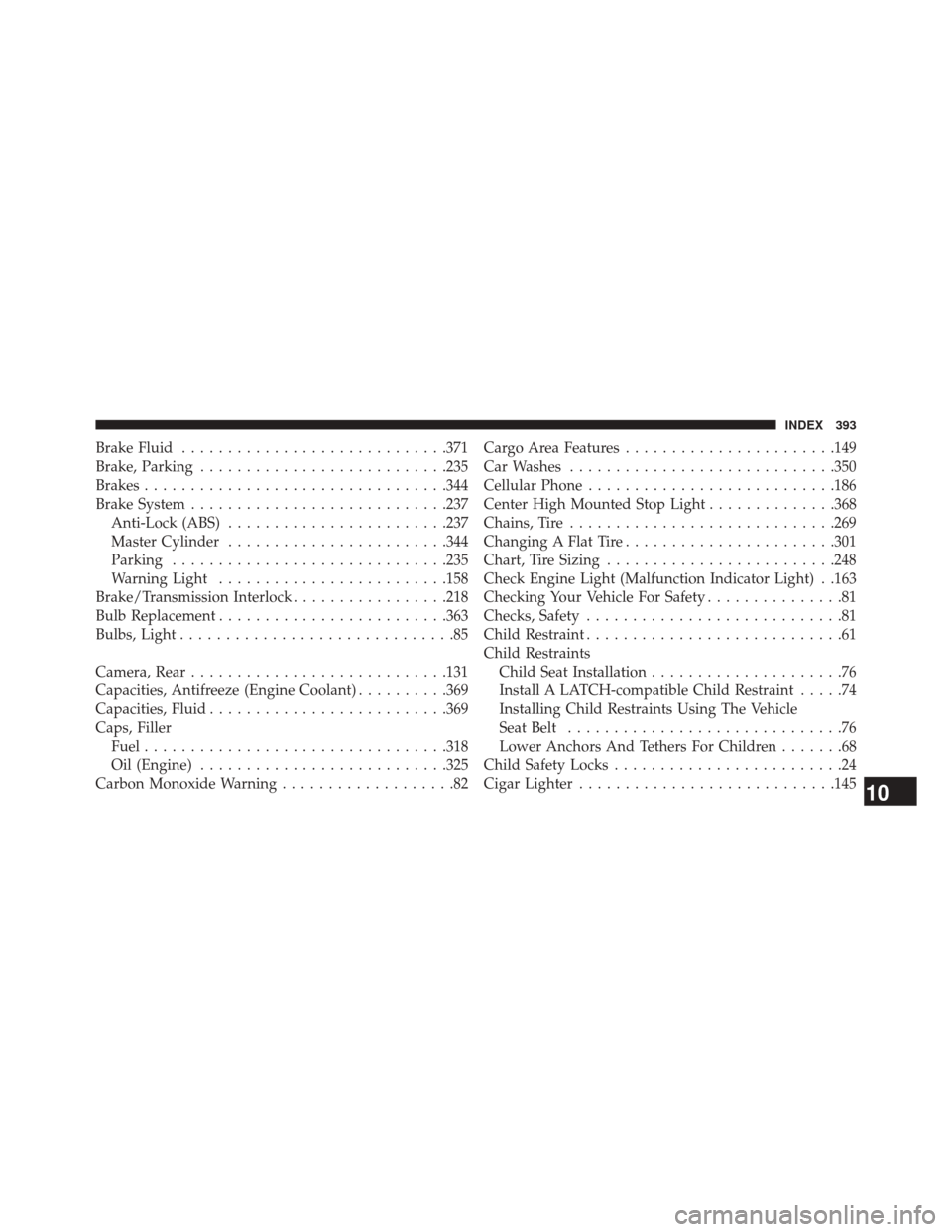
Brake Fluid............................ .371
Brake, Parking .......................... .235
Brakes ................................ .344
Brake System ........................... .237
Anti-Lock (ABS) ....................... .237
Master Cylinder ....................... .344
Parking ............................. .235
Warning Light ........................ .158
Brake/Transmission Interlock .................218
Bulb Replacement ........................ .363
Bulbs, Light ..............................85
Camera, Rear ........................... .131
Capacities, Antifreeze (Engine Coolant) ..........369
Capacities, Fluid ......................... .369
Caps, Filler Fuel ................................ .318
Oil (Engine) .......................... .325
Carbon Monoxide Warning ...................82 Cargo Area Features
...................... .149
Car Washes ............................ .350
Cellular Phone .......................... .186
Center High Mounted Stop Light ..............368
Chains, Tire ............................ .269
Changing A Flat Tire ...................... .301
Chart, Tire Sizing ........................ .248
Check Engine Light (Malfunction Indicator Light) . .163
Checking Your Vehicle For Safety ...............81
Checks, Safety ............................81
Child Restraint ............................61
Child Restraints Child Seat Installation .....................76
Install A LATCH-compatible Child Restraint .....74
Installing Child Restraints Using The Vehicle
Seat Belt ..............................76
Lower Anchors And Tethers For Children .......68
Child Safety Locks .........................24
Cigar Lighter ........................... .145
10
INDEX 393
Page 397 of 409
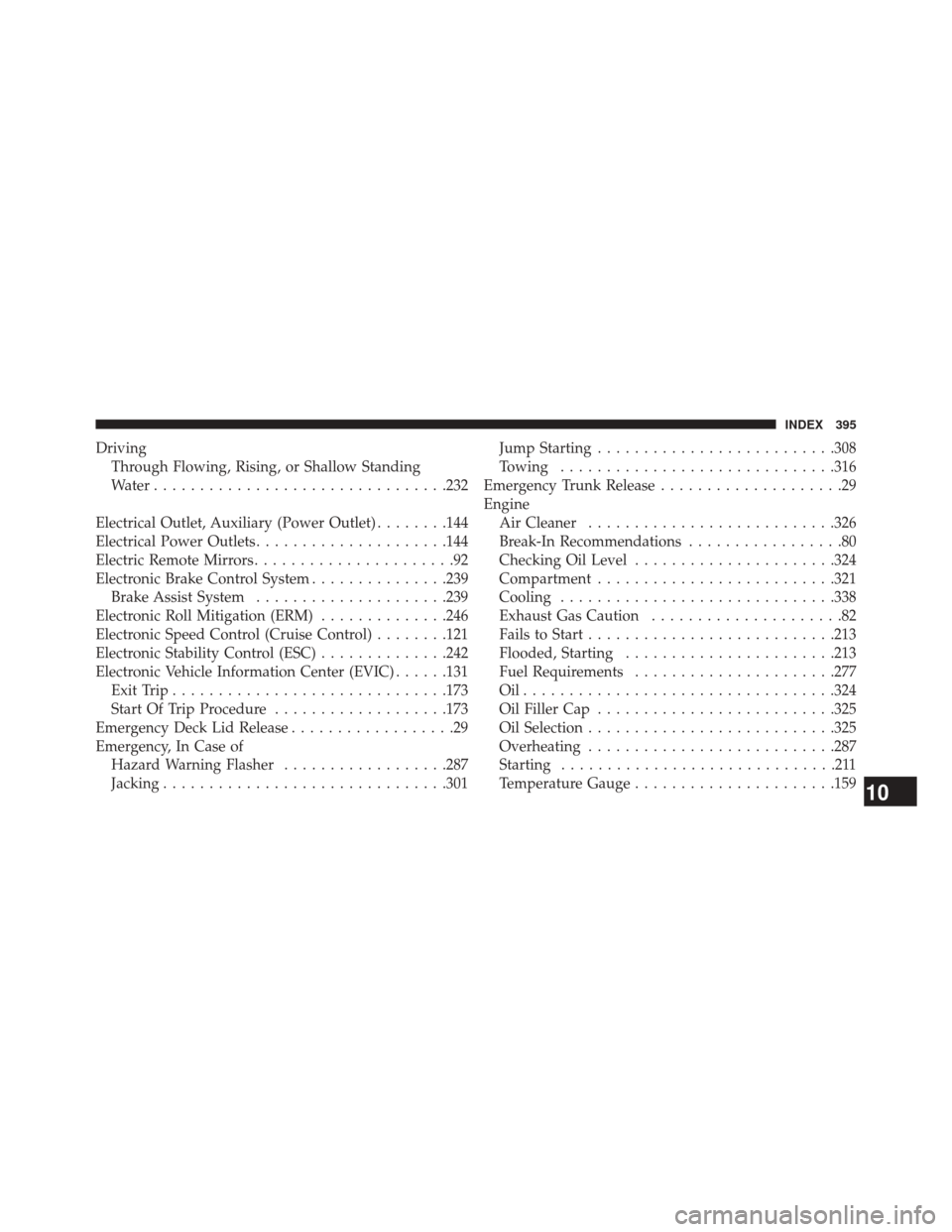
DrivingThrough Flowing, Rising, or Shallow Standing
Water ............................... .232
Electrical Outlet, Auxiliary (Power Outlet) ........144
Electrical Power Outlets .....................144
Electric Remote Mirrors ......................92
Electronic Brake Control System ...............239
Brake Assist System .....................239
Electronic Roll Mitigation (ERM) ..............246
Electronic Speed Control (Cruise Control) ........121
Electronic Stability Control (ESC) ..............242
Electronic Vehicle Information Center (EVIC) ......131
Exit Trip ............................. .173
Start Of Trip Procedure ...................173
Emergency Deck Lid Release ..................29
Emergency, In Case of Hazard Warning Flasher ..................287
Jacking .............................. .301Jump Starting
......................... .308
Towing ............................. .316
Emergency Trunk Release ....................29
Engine Air Cleaner .......................... .326
Break-In Recommendations .................80
Checking Oil Level ..................... .324
Compartment ......................... .321
Cooling ............................. .338
Exhaust Gas Caution .....................82
Fails to Start .......................... .213
Flooded, Starting ...................... .213
Fuel Requirements ..................... .277
Oil................................. .324
Oil Filler Cap ......................... .325
Oil Selection .......................... .325
Overheating .......................... .287
Starting ..............................211
Temperature Gauge ..................... .159
10
INDEX 395