belt FIAT 500L 2014 2.G User Guide
[x] Cancel search | Manufacturer: FIAT, Model Year: 2014, Model line: 500L, Model: FIAT 500L 2014 2.GPages: 409, PDF Size: 3.2 MB
Page 41 of 409
position that has a belt with this feature. Children 12
years old and under should always be properly re-
strained in a vehicle with a rear seat.
How To Engage The Automatic Locking Mode
1. Buckle the combination lap and shoulder belt.
2. Grasp the shoulder portion and pull downward untilthe entire belt is extracted.
3. Allow the belt to retract. As the belt retracts, you will hear a clicking sound. This indicates the safety belt is
now in the Automatic Locking Mode.
How To Disengage The Automatic Locking Mode
Unbuckle the combination lap/shoulder belt and allow it
to retract completely to disengage the Automatic Locking
Mode and activate the vehicle sensitive (emergency)
locking mode.
WARNING!
•The belt and retractor assembly must be replaced if
the seat belt assembly Automatic Locking Retractor
(ALR) feature or any other seat belt function is not
working properly when checked according to the
procedures in the Service Manual.
• Failure to replace the belt and retractor assembly
could increase the risk of injury in collisions.
Energy Management Feature
This vehicle has a safety belt system with an Energy
Management feature in the front and rear outer seating
positions to help further reduce the risk of injury in the
event of a head-on collision.
This safety belt system has a retractor assembly that is
designed to release webbing in a controlled manner. This
feature is designed to help reduce the belt force acting on
the occupant’s chest.
2
THINGS TO KNOW BEFORE STARTING YOUR VEHICLE 39
Page 42 of 409
Seat Belt Pretensioners
The seat belts for both front seating positions are
equipped with dual pretensioning devices that are de-
signed to remove slack from the seat belt in the event of
a collision. The dual pretensioning devices are located on
the lower B-pillars and in the kick plate area. These
devices may improve the performance of the seat belt by
assuring that the belt is tight about the occupant early in
a collision. Pretensioners work for all size occupants,
including those in child restraints.
NOTE:These devices are not a substitute for proper seat
belt placement by the occupant. The seat belt still must be
worn snugly and positioned properly.
The pretensioners are triggered by the Occupant Re-
straint Controller (ORC). Like the air bags, the preten-
sioners are single use items. A deployed pretensioner or
a deployed air bag must be replaced immediately.
Enhanced Seat Belt Use Reminder System
(BeltAlert®)
BeltAlert® is a feature intended to remind the driver and
front passenger (if equipped with front passenger
BeltAlert®) to fasten their seat belts. The feature is active
whenever the ignition is on. If the driver or front seat
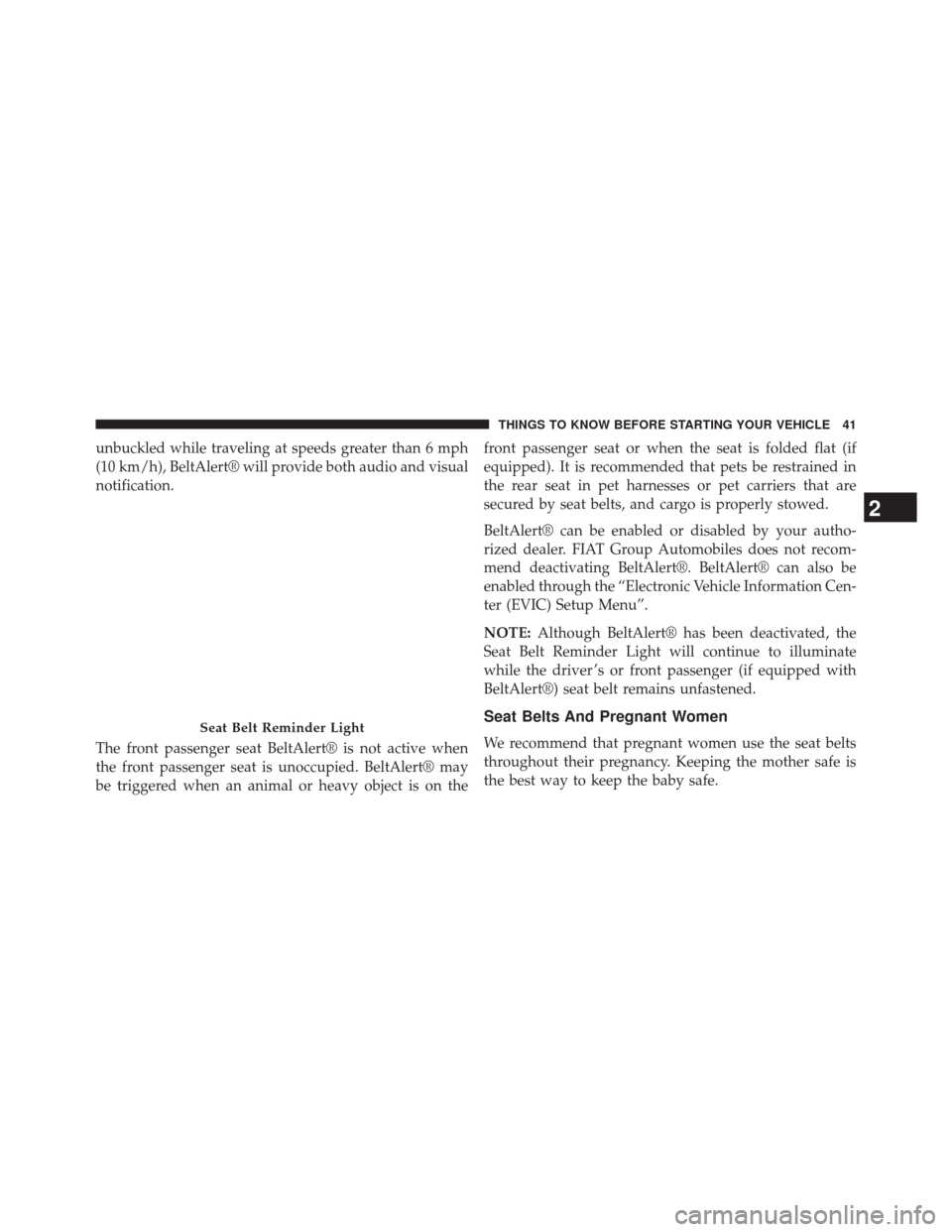
passenger is unbelted, the Seat Belt Reminder Light will
turn on and remain on until both front seat belts are
fastened.
The BeltAlert® warning sequence begins after the vehicle
speed is over 6 mph (10 km/h), by blinking the Seat Belt
Reminder Light and sounding an intermittent chime.
Once the sequence starts, it will continue for the entire
duration or until the respective seatbelts are fastened.
After the sequence completes, the Seat Belt Reminder
Light remains illuminated until the respective seat belts
are fastened. The driver should instruct all other occu-
pants to fasten their seat belts. If a front seat belt is
40 THINGS TO KNOW BEFORE STARTING YOUR VEHICLE
Page 43 of 409
unbuckled while traveling at speeds greater than 6 mph
(10 km/h), BeltAlert® will provide both audio and visual
notification.
The front passenger seat BeltAlert® is not active when
the front passenger seat is unoccupied. BeltAlert® may
be triggered when an animal or heavy object is on thefront passenger seat or when the seat is folded flat (if
equipped). It is recommended that pets be restrained in
the rear seat in pet harnesses or pet carriers that are
secured by seat belts, and cargo is properly stowed.
BeltAlert® can be enabled or disabled by your autho-
rized dealer. FIAT Group Automobiles does not recom-
mend deactivating BeltAlert®. BeltAlert® can also be
enabled through the “Electronic Vehicle Information Cen-
ter (EVIC) Setup Menu”.
NOTE:
Although BeltAlert® has been deactivated, the
Seat Belt Reminder Light will continue to illuminate
while the driver ’s or front passenger (if equipped with
BeltAlert®) seat belt remains unfastened.
Seat Belts And Pregnant Women
We recommend that pregnant women use the seat belts
throughout their pregnancy. Keeping the mother safe is
the best way to keep the baby safe.
Seat Belt Reminder Light
2
THINGS TO KNOW BEFORE STARTING YOUR VEHICLE 41
Page 44 of 409
Pregnant women should wear the lap part of the belt
across the thighs and as snug across the hips as possible.
Keep the belt low so that it does not come across the
abdomen. That way the strong bones of the hips will take
the force if there is a collision.
Supplemental Restraint System (SRS) — Air Bags
This vehicle has Advanced Front Air Bags for both the
driver and front passenger as a supplement to the seat
belt restraint systems. The driver’s Advanced Front Air
Bag is mounted in the center of the steering wheel. The
passenger’s Advanced Front Air Bag is mounted in the
instrument panel, above the glove compartment. The
word AIRBAG is embossed on the air bag covers. In
addition, the vehicle is equipped with a Supplemental
Driver Side Knee Air Bag mounted under the instrument
panel below the steering column.NOTE:
The Driver and Passenger Advanced Front Air
Bags are certified to new Federal regulations for Ad-
vanced Air Bags.
The Advanced Front Air Bags are designed to allow the
air bags to have different inflation levels based on several
factors, including the severity and type of collision.
This vehicle may be equipped with driver and/or front
passenger seat track position sensors that may adjust the
inflation level of the Advanced Front Air Bags based
upon seat position.
This vehicle may be equipped with a driver and/or front
passenger seat belt buckle switch that detects whether
the driver or front passenger seat belt is fastened. The
seat belt buckle switch may adjust the inflation level of
the Advanced Front Air Bags.
42 THINGS TO KNOW BEFORE STARTING YOUR VEHICLE
Page 47 of 409
•Passenger Advanced Front Air Bag
• Supplemental Seat-Mounted Side Air Bags (SAB)
• Supplemental Side Air Bag Inflatable Curtains (SABIC)
• Front and Side Impact Sensors
• Front Seat Belt Pretensioners, Seat Belt Buckle Switch,
and Seat Track Position Sensors
Advanced Front Air Bag Features
The Advanced Front Air Bag system provides output
appropriate to the severity and type of collision as
determined by the Occupant Restraint Controller (ORC),
which may receive information from the front impact
sensors.
WARNING!
• No objects should be placed over or near the air
bag on the instrument panel, because any such
objects could cause harm if the vehicle is in a
collision severe enough to cause the air bag to
inflate.
• Do not put anything on or around the air bag
covers or attempt to open them manually. You may
damage the air bags and you could be injured
because the air bags may no longer be functional.
The protective covers for the air bag cushions are
designed to open only when the air bags are
inflating.
• Do not drill, cut or tamper with the knee bolster in
any way.
• Do not mount any accessories to the knee bolster
such as alarm lights, stereos, citizen band radios,
etc.
2
THINGS TO KNOW BEFORE STARTING YOUR VEHICLE 45
Page 51 of 409
Knee Impact Bolsters
The Knee Impact Bolsters help protect the knees of the
driver and front passenger, and position the front occu-
pants for the best interaction with the Advanced Front
Air Bags.Along with seat belts and pretensioners, Advanced Front
Air Bags and the Supplemental Driver Side Knee Air Bag
work with the knee impact bolsters to provide improved
protection for the driver and front passenger.
Air Bag Deployment Sensors And Controls
Occupant Restraint Controller (ORC)
The ORC is part of a Federally regulated safety system
required for this vehicle.
The ORC determines if deployment of the front and/or
side air bags in a frontal or side collision is required.
Based on the impact sensor’s signals, a central electronic
ORC deploys the Advanced Front Air Bags, Supplemen-
tal Driver Side Knee Air Bag, Supplemental Side Air Bag
Inflatable Curtain (SABIC), Supplemental Seat-Mounted
Side Air Bags (SAB), and front seat belt pretensioners, as
required, depending on several factors, including the
severity and type of impact.
Supplemental Driver Side Knee Air Bag
2
THINGS TO KNOW BEFORE STARTING YOUR VEHICLE 49
Page 52 of 409
Advanced Front Air Bags and Supplemental Driver Side
Knee Air Bag are designed to provide additional protec-
tion by supplementing the seat belts in certain frontal
collisions depending on several factors, including the
severity and type of collision. Advanced Front Air Bags
are not expected to reduce the risk of injury in rear or side
collisions.
The Advanced Front Air Bags and Supplemental Driver
Side Knee Air Bag will not deploy in all frontal collisions,
including some that may produce substantial vehicle
damage — for example, some pole collisions, truck
underrides, and angle offset collisions. On the other
hand, depending on the type and location of impact,
Advanced Front Air Bags may deploy in crashes with
little vehicle front-end damage but that produce a severe
initial deceleration.The side air bags will not deploy in all side collisions.
Side air bag deployment will depend on the severity and
type of collision.
Because air bag sensors measure vehicle deceleration
over time, vehicle speed and damage by themselves are
not good indicators of whether or not an air bag should
have deployed.
Seat belts are necessary for your protection in all colli-
sions, and also are needed to help keep you in position,
away from an inflating air bag.
The ORC monitors the readiness of the electronic parts of
the air bag system whenever the ignition switch is in the
ON/RUN or START position. If the key is in the OFF/
LOCK position, or not in the ignition, the air bag system
is not on and the air bags will not inflate.
50 THINGS TO KNOW BEFORE STARTING YOUR VEHICLE
Page 55 of 409
inflating SAB exits through the seat seam into the space
between the occupant and the door. The SAB fully
inflates in about 10 milliseconds. The side air bag moves
at a very high speed and with such a high force that it
could injure you if you are not seated properly, or if items
are positioned in the area where the side air bag inflates.
This especially applies to children.
Supplemental Side Air Bag Inflatable Curtain
(SABIC) Inflator Units
During collisions where the impact is confined to a
particular area of the side of the vehicle, the ORC may
deploy the Supplemental Side Air Bag Inflatable Curtain
(SABIC), depending on the severity and type of collision.
In these events, the ORC will deploy the SABIC only on
the impact side of the vehicle.A quantity of non-toxic gas is generated to inflate the side
curtain air bag. The inflating side curtain air bag pushes
the outside edge of the headliner out of the way and
covers the window. The air bag inflates in about 30
milliseconds (about one-quarter of the time that it takes
to blink your eyes) with enough force to injure you if you
are not belted and seated properly, or if items are
positioned in the area where the side curtain air bag
inflates. This especially applies to children. The side
curtain air bag is about 3-1/2 in (9 cm) thick when it is
inflated.
Because air bag sensors estimate deceleration over time,
vehicle speed and damage are not good indicators of
whether or not an air bag should have deployed.
2
THINGS TO KNOW BEFORE STARTING YOUR VEHICLE 53
Page 59 of 409
•As the air bags deflate, you may see some smoke-like
particles. The particles are a normal by-product of the
process that generates the non-toxic gas used for air
bag inflation. These airborne particles may irritate the
skin, eyes, nose, or throat. If you have skin or eye
irritation, rinse the area with cool water. For nose or
throat irritation, move to fresh air. If the irritation
continues, see your doctor. If these particles settle on
your clothing, follow the garment manufacturer’s in-
structions for cleaning.
Do not drive your vehicle after the air bags have de-
ployed. If you are involved in another collision, the air
bags will not be in place to protect you.WARNING!
Deployed air bags and seat belt pretensioners cannot
protect you in another collision. Have the air bags,
seat belt pretensioners, and the front seat belt retrac-
tor assemblies replaced by an authorized dealer im-
mediately. Also, have the Occupant Restraint Con-
troller (ORC) system serviced as well.
2
THINGS TO KNOW BEFORE STARTING YOUR VEHICLE 57
Page 62 of 409
The EDR in this vehicle is designed to record such data
as:
•How various systems in your vehicle were operating;
• Whether or not the driver and passenger safety belts
were buckled/fastened;
• How far (if at all) the driver was depressing the
accelerator and/or brake pedal; and,
• How fast the vehicle was traveling.
These data can help provide a better understanding of
the circumstances in which crashes and injuries occur. NOTE:
EDR data are recorded by your vehicle only if a
non-trivial crash situation occurs; no data are recorded by
the EDR under normal driving conditions and no per-
sonal data (e.g., name, gender, age, and crash location)
are recorded. However, other parties, such as law en-
forcement, could combine the EDR data with the type of
personally identifying data routinely acquired during a
crash investigation.
To read data recorded by an EDR, special equipment is
required, and access to the vehicle or the EDR is needed.
In addition to the vehicle manufacturer, other parties,
such as law enforcement, that have the special equip-
ment, can read the information if they have access to the
vehicle or the EDR.
60 THINGS TO KNOW BEFORE STARTING YOUR VEHICLE