radio FIAT 500L 2014 2.G User Guide
[x] Cancel search | Manufacturer: FIAT, Model Year: 2014, Model line: 500L, Model: FIAT 500L 2014 2.GPages: 409, PDF Size: 3.2 MB
Page 185 of 409
Exit Menu
This function closes the initial menu screen.
Briefly press theMENUbutton to go back to the main
screen.
Press the
button to return to the first menu option
(Speed Beep).
Press thebutton to return to the last menu option
(Daylights).
Uconnect® RADIOS
For detailed information about your Uconnect® radio,
refer to your Uconnect® supplement Manual.
iPod®/USB/SD CARD/MEDIA PLAYER CONTROL
This feature allows an iPod® or external USB device to be
plugged into the USB port or an SD Card (6.5 Only) to be
plugged into the SD Card slot Refer to the Uconnect® 5.0/6.5 User’s Manual for iPod®,
external USB or SD Card device support capability.
1 — SD Card Slot (6.5 Only)
2 — USB Connector
3 — AUX/Cable Jack
4
UNDERSTANDING YOUR INSTRUMENT PANEL 183
Page 186 of 409
STEERING WHEEL AUDIO CONTROLS
The remote sound system controls are located on the rear
surface of the steering wheel. Reach behind the wheel to
access the switches.The right-hand control is a rocker-type switch with a
pushbutton in the center and controls the volume and
mode of the sound system. Pressing the top of the rocker
switch will increase the volume, and pressing the bottom
of the rocker switch will decrease the volume.
Pressing the center button will make the radio switch
between the various modes available (AM/FM/SAT/
AUX/Media Player, etc.) and can also be used to select/
enter an item while scrolling through menu.
The left-hand control is a rocker-type switch with a
pushbutton in the center. The function of the left-hand
control is different depending on which mode you are in.
The following describes the left-hand control operation in
each mode.
Remote Sound System Controls (Back View Of Steering
Wheel)
184 UNDERSTANDING YOUR INSTRUMENT PANEL
Page 187 of 409
Radio Operation
Pressing the top of the switch will “Seek” up for the next
listenable station and pressing the bottom of the switch
will “Seek” down for the next listenable station.
The button located in the center of the left-hand control
will tune to the next preset station that you have pro-
grammed in the radio preset pushbutton.
Player Operation
Pressing the top of the switch once will go to the next
track on the Player. Pressing the bottom of the switch
once will go to the beginning of the current track, or to
the beginning of the previous track if it is within one
second after the current track begins to play.
If you press the switch up or down twice, it plays the
second track; three times, it will play the third, etc.
CD/DVD DISC MAINTENANCE
To keep a CD/DVD in good condition, take the following
precautions:
1. Handle the disc by its edge; avoid touching thesurface.
2. If the disc is stained, clean the surface with a soft cloth, wiping from center to edge.
3. Do not apply paper or tape to the disc; avoid scratch- ing the disc.
4. Do not use solvents such as benzene, thinner, cleaners, or anti-static sprays.
5. Store the disc in its case after playing.
6. Do not expose the disc to direct sunlight.
7. Do not store the disc where temperatures may become too high.
4
UNDERSTANDING YOUR INSTRUMENT PANEL 185
Page 188 of 409
NOTE:If you experience difficulty in playing a particular
disc, it may be damaged (i.e., scratched, reflective coating
removed, a hair, moisture or dew on the disc) oversized,
or have protection encoding. Try a known good disc
before considering disc player service.
RADIO OPERATION AND MOBILE PHONES
Under certain conditions, the mobile phone being on in
your vehicle can cause erratic or noisy performance from
your radio. This condition may be lessened or eliminated
by relocating the mobile phone antenna. This condition is
not harmful to the radio. If your radio performance does
not satisfactorily “clear” by the repositioning of the
antenna, it is recommended that the radio volume be
turned down or off during mobile phone operation.
CLIMATE CONTROLS
Manual Climate Control System
Controls
The Manual Climate controls consist of a series of rotary
dials, an inner push knob and two push buttons.
Manual Temperature Control (MTC)
186 UNDERSTANDING YOUR INSTRUMENT PANEL
Page 277 of 409
text message will display when one or more of the four
active road tire pressures are low. Should this occur, you
should stop as soon as possible, check the inflation
pressure of each tire on your vehicle, and inflate each tire
to the vehicle’s recommended cold placard pressure
value. The system will automatically update and the Tire
Pressure Monitoring Light will extinguish once the up-
dated tire pressures have been received. The vehicle may
need to be driven for up to 20 minutes above 15 mph
(24 km/h) to receive this information.
Check TPMS Warnings
The Tire Pressure Monitoring Telltale Light will flash on
and off for 75 seconds and remain on solid when a system
fault is detected, an audible chime will be activated and
the “Tire Pressure Monitoring Unavailable” text message
will display. If the ignition key is cycled, this sequence
will repeat providing the system fault still exists. The TirePressure Monitoring Telltale Light will turn off when the
fault condition no longer exists. A system fault can occur
with any of the following scenarios:
1. Jamming due to electronic devices or driving next to
facilities emitting the same radio frequencies as the
TPM sensors.
2. Installing some form of aftermarket window tinting that affects radio wave signals.
3. Snow or ice around the wheels or wheel housings.
4. Using tire chains on the vehicle.
5. Using wheels/tires not equipped with TPM sensors.
NOTE: Your vehicle may be equipped with a compact
spare wheel and tire assembly.
1. The compact spare tire does not have a tire pressure monitoring sensor. Therefore, the TPMS will not moni-
tor the tire pressure in the compact spare tire.
5
STARTING AND OPERATING 275
Page 289 of 409
HAZARD WARNING FLASHERS
The Hazard Warning flasher switch is located on the
instrument panel below the radio.Press the switch to turn on the Hazard Warning
flashers. When the switch is activated, all direc-
tional turn signals will flash on and off to warn oncoming
traffic of an emergency. Press the switch a second time to
turn off the Hazard Warning flashers.
Do not use this emergency warning system when the
vehicle is in motion. Use it when your vehicle is disabled
and it is creating a safety hazard for other motorists.
If it is necessary to leave the vehicle to go for service, the
Hazard Warning flashers will continue to operate with
the ignition key removed and the vehicle locked.
NOTE: With extended use, the Hazard Warning flashers
may wear down your battery.
IF YOUR ENGINE OVERHEATS
In any of the following situations, you can reduce the
potential for overheating by taking the appropriate ac-
tion.
• On the highways — slow down.
• In city traffic — while stopped, place the transmission
in NEUTRAL, but do not increase engine idle speed.
NOTE: There are steps that you can take to slow down
an impending overheat condition:
• If your air conditioner (A/C) is on, turn it off. The A/C
system adds heat to the engine cooling system and
turning the A/C off can help remove this heat.
• You can also turn the temperature control to maximum
heat, the mode control to floor and the blower control
to high. This allows the heater core to act as a
supplement to the radiator and aids in removing heat
from the engine cooling system.
6
WHAT TO DO IN EMERGENCIES 287
Page 312 of 409
WARNING!
•Take care to avoid the radiator cooling fan when-
ever the hood is raised. It can start anytime the
ignition switch is ON. You can be injured by
moving fan blades.
• Remove any metal jewelry such as rings, watch
bands and bracelets that could make an inadvertent
electrical contact. You could be seriously injured.
• Batteries contain sulfuric acid that can burn your
skin or eyes and generate hydrogen gas which is
flammable and explosive. Keep open flames or
sparks away from the battery.
1. Set the parking brake, shift the Euro Twin Clutch Transmission into PARK and turn the ignition to OFF. 2. Turn off the heater, radio, and all unnecessary electri-
cal accessories.
3. Remove the protective cover over the remote positive (+) battery post. To remove the cover, pull upward on
the cover.
4. If using another vehicle to jump-start the battery, park the vehicle within the jumper cables reach, set the
parking brake and make sure the ignition is OFF.
WARNING!
Do not allow vehicles to touch each other as this
could establish a ground connection and personal
injury could result.
310 WHAT TO DO IN EMERGENCIES
Page 356 of 409
Glass Surfaces
All glass surfaces should be cleaned on a regular basis
with MOPAR® Glass Cleaner, or any commercial
household-type glass cleaner. Never use an abrasive type
cleaner. Use caution when cleaning the inside rear win-
dow equipped with electric defrosters or the right rear
quarter window equipped with the radio antenna. Do
not use scrapers or other sharp instrument that may
scratch the elements.
When cleaning the rear view mirror, spray cleaner on the
towel or rag that you are using. Do not spray cleaner
directly on the mirror.
Instrument Panel Cover
The instrument panel cover has a low glare surface which
minimizes reflections on the windshield. Do not use
protectants or other products which may cause undesir-
able reflections. Use soap and warm water to restore the
low glare surface.
Instrument Panel Bezels
CAUTION!
When installing hanging air fresheners in your ve-
hicle, read the installation instructions carefully.
Some air fresheners will damage the finish of
painted or decorated parts if allowed to directly
contact any surface.
Cleaning Plastic Instrument Cluster Lenses
The lenses in front of the instruments in this vehicle are
molded in clear plastic. When cleaning the lenses, care
must be taken to avoid scratching the plastic.
1. Clean with a wet soft rag. A mild soap solution may beused, but do not use high alcohol content or abrasive
cleaners. If soap is used, wipe clean with a clean damp
rag.
2. Dry with a soft cloth.
354 MAINTAINING YOUR VEHICLE
Page 362 of 409
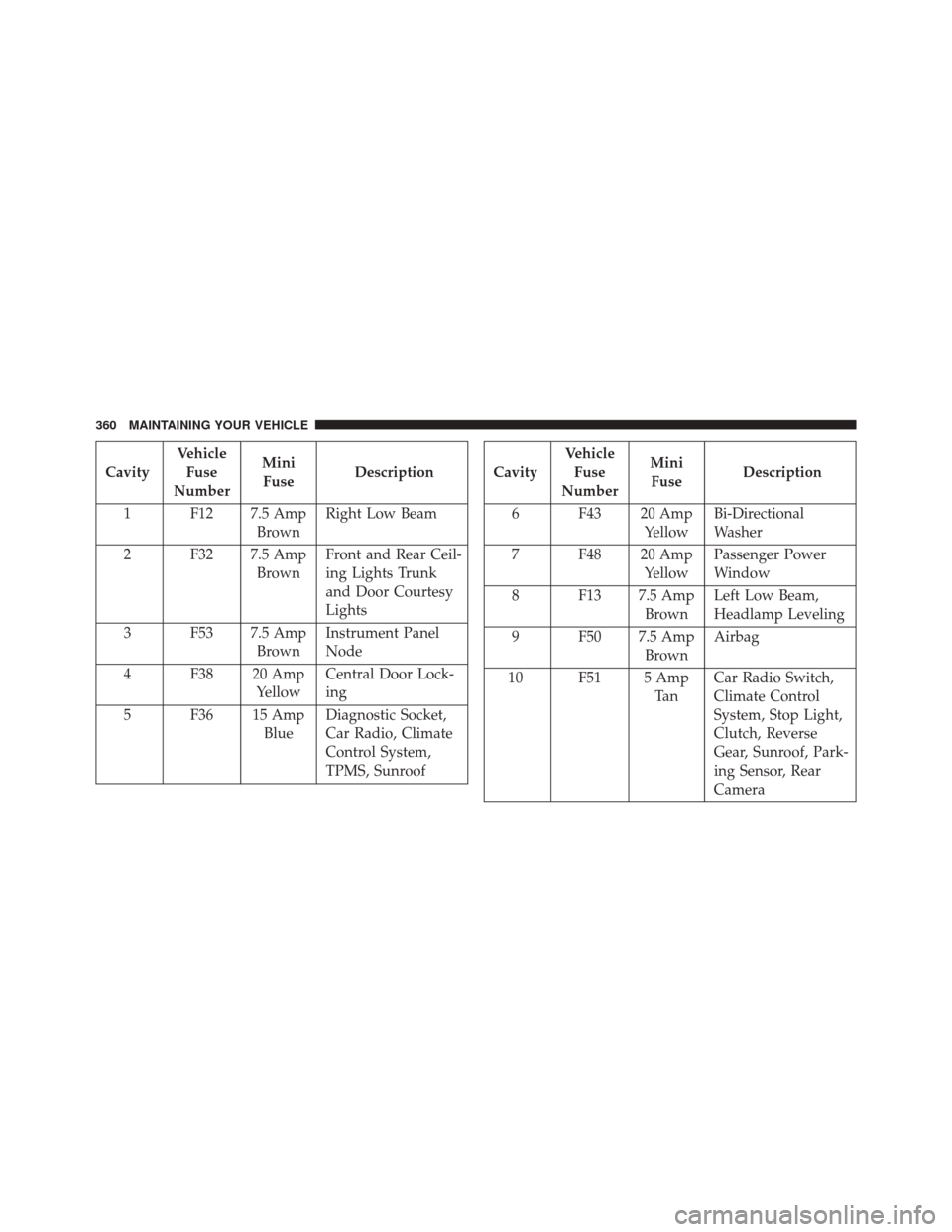
CavityVehicle
Fuse
Number Mini
Fuse Description
1 F12 7.5 Amp BrownRight Low Beam
2 F32 7.5 Amp BrownFront and Rear Ceil-
ing Lights Trunk
and Door Courtesy
Lights
3 F53 7.5 Amp BrownInstrument Panel
Node
4 F38 20 Amp YellowCentral Door Lock-
ing
5 F36 15 Amp BlueDiagnostic Socket,
Car Radio, Climate
Control System,
TPMS, SunroofCavity Vehicle
Fuse
Number Mini
Fuse Description
6 F43 20 Amp YellowBi-Directional
Washer
7 F48 20 Amp YellowPassenger Power
Window
8 F13 7.5 Amp BrownLeft Low Beam,
Headlamp Leveling
9 F50 7.5 Amp BrownAirbag
10 F51 5 Amp Ta nCar Radio Switch,
Climate Control
System, Stop Light,
Clutch, Reverse
Gear, Sunroof, Park-
ing Sensor, Rear
Camera
360 MAINTAINING YOUR VEHICLE
Page 403 of 409
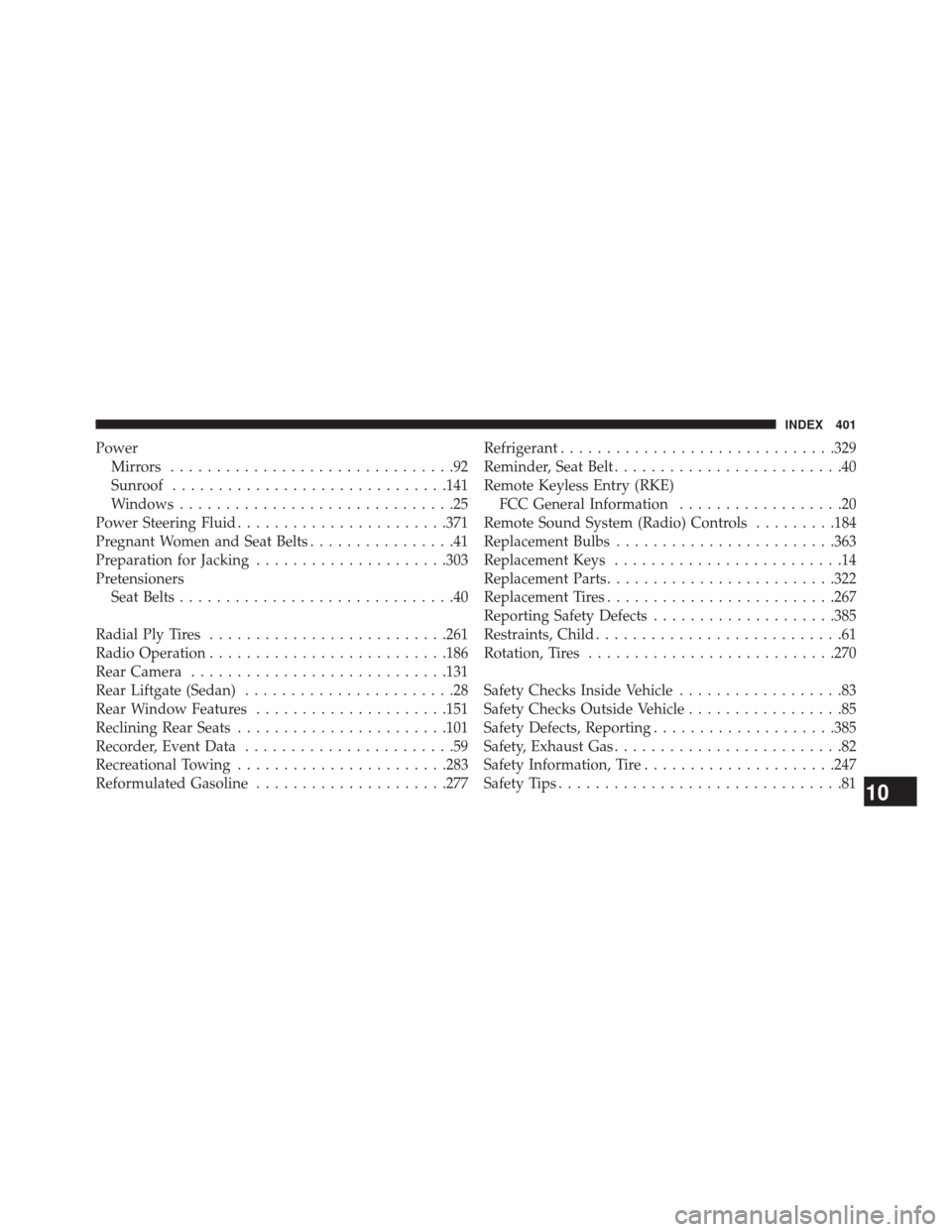
PowerMirrors ...............................92
Sunroof ............................. .141
Windows ..............................25
Power Steering Fluid ...................... .371
Pregnant Women and Seat Belts ................41
Preparation for Jacking .....................303
Pretensioners Seat Belts ..............................40
Radial Ply Tires ......................... .261
Radio Operation ......................... .186
Rear Camera ........................... .131
Rear Liftgate (Sedan) .......................28
Rear Window Features .....................151
Reclining Rear Seats ...................... .101
Recorder, Event Data .......................59
Recreational Towing ...................... .283
Reformulated Gasoline .....................277 Refrigerant
............................. .329
Reminder, Seat Belt .........................40
Remote Keyless Entry (RKE) FCC General Information ..................20
Remote Sound System (Radio) Controls .........184
Replacement Bulbs ....................... .363
Replacement Keys .........................14
Replacement Parts ........................ .322
Replacement Tires ........................ .267
Reporting Safety Defects ....................385
Restraints, Child ...........................61
Rotation, Tires .......................... .270
Safety Checks Inside Vehicle ..................83
Safety Checks Outside Vehicle .................85
Safety Defects, Reporting ....................385
Safety, Exhaust Gas .........................82
Safety Information, Tire .....................247
Safety Tips ...............................81
10
INDEX 401