stop start FIAT 500L 2015 2.G User Guide
[x] Cancel search | Manufacturer: FIAT, Model Year: 2015, Model line: 500L, Model: FIAT 500L 2015 2.GPages: 438, PDF Size: 12.64 MB
Page 210 of 438
Selecting the footwell/windshield or only windshield dis-
tribution activates the climate control system compressor
(LED on A/C button on) and the air recirculation is set to
#outside air#intake (LED on the recirculation button off ).
This logic guarantees optimum visibility at the windows.
It is, however, always possible to manage air recirculation
and the climate control system compressor manually.
Rear Window Defrosting
Push the Rear Defrost button to activate heated rear
window defrosting.
The effective activation of the function is indicated by the
rear defrost warning light on the instrument panel
switching ON.
This function switches OFF automatically after about 20
minutes or when the engine is turned OFF. It is not
switched on automatically the next time the engine is
started.
If equipped, push the rear defrost button to activate
defrosting of door mirrors and heated rear window.
NOTE:Do not affix stickers to the inside of the heated
rear window over the heating filaments, to avoid damage
that might cause them to stop working properly.
Switching Off The Climate Control System
Push the On/Off button.
With climate control system off:
•air recirculation is on, thus isolating the passenger
compartment from the outside;
•the compressor is off;
•the fan is off;
•the heated rear window can be activated / deacti-
vated.
208 UNDERSTANDING YOUR INSTRUMENT PANEL
Page 227 of 438
Turn the ignition switch to the AVV/ACC (START)
position and release it when the engine starts. If the
engine fails to start within 10 seconds, turn the ignition
switch to the STOP (OFF/LOCK) position, wait 10 to 15
seconds, then repeat the “Normal Starting” procedure.
Cold Weather Operation
To prevent possible engine damage while starting at low
temperatures, this vehicle will inhibit engine cranking
when the ambient temperature is less than –22° F (–30° C)
and the oil temperature sensor reading indicates an
engine block heater has not been used. An externally
powered electric engine block heater is available as a
factory installed option.
The message “plug in engine heater” will be displayed in
the instrument cluster when the ambient temperature is
below 5° F (–15° C) at the time the engine is shut off as a
reminder to avoid possible crank delays at the next cold
start.
NOTE:Use of the recommended SAE 5W-40 Synthetic oil
and adhering to the prescribed oil change intervals is
important to prevent engine damage and ensure satisfac-
tory starting in cold conditions.
Extended Park Starting
NOTE:Extended Park condition occurs when the vehicle
has not been started or driven for at least 35 days.
1. Install a battery charger or jumper cables to the battery
to ensure a full battery charge during the crank cycle.
2. Cycle the ignition in the START position and release it
when the engine starts.
3. If the engine fails to start within ten seconds, cycle the
ignition to the STOP (OFF/LOCK) position, wait five
seconds to allow the starter to cool, then repeat the
Extended Park Starting procedure.
5
STARTING AND OPERATING 225
Page 230 of 438
For most city driving you will find it easier to use only
the lower gears. For steady highway driving with light
accelerations, sixth gear is recommended.
Never drive with your foot resting on the clutch pedal, or
try to hold the vehicle on a hill with the clutch pedal
partially engaged. This will cause abnormal wear on the
clutch.
To shift into REVERSE, pull up on the ring just below the
gear shift knob and then move into the REVERSE (R)
position.
Never shift into REVERSE until the vehicle has come to a
complete stop.
NOTE:During cold weather, until the transmission lu-
bricant is warm, you may experience slightly higher shift
efforts. This is normal and not harmful to the transmis-
sion.
Downshifting
Proper downshifting will improve fuel economy and
prolong engine life.
CAUTION!
If you skip a gear while downshifting or downshift
at too high of a vehicle speed, these conditions may
cause the engine to overspeed if too low of a gear is
selected and the clutch pedal is released. Damage to
the clutch and the transmission can result from
skipping a gear while downshifting or downshifting
at too high of a vehicle speed even if the clutch pedal
is held pressed (i.e., not released).
To maintain a safe speed and prolong brake life, shift
down to second or first when descending a steep grade.
228 STARTING AND OPERATING
Page 231 of 438
When turning a corner, or driving up a steep grade,
downshift early so that the engine will not be overbur-
dened.
AUTOMATIC TRANSMISSION — IF EQUIPPED
CAUTION!
Damage to the transmission may occur if the follow-
ing precautions are not observed:
•Shift into or out of PARK or REVERSE only after
the vehicle has come to a complete stop.
•Do not shift between PARK, REVERSE, NEU-
TRAL, or DRIVE when the engine is above idle
speed.
•Before shifting into any gear, make sure your foot
is firmly pressing the brake pedal.
NOTE:You must press and hold the brake pedal while
shifting out of PARK.
WARNING!
•It is dangerous to shift out of PARK or NEUTRAL
if the engine speed is higher than idle speed. If
your foot is not firmly pressing the brake pedal, the
vehicle could accelerate quickly forward or in re-
verse. You could lose control of the vehicle and hit
someone or something. Only shift into gear when
the engine is idling normally and your foot is
firmly pressing the brake pedal.
(Continued)
5
STARTING AND OPERATING 229
Page 234 of 438
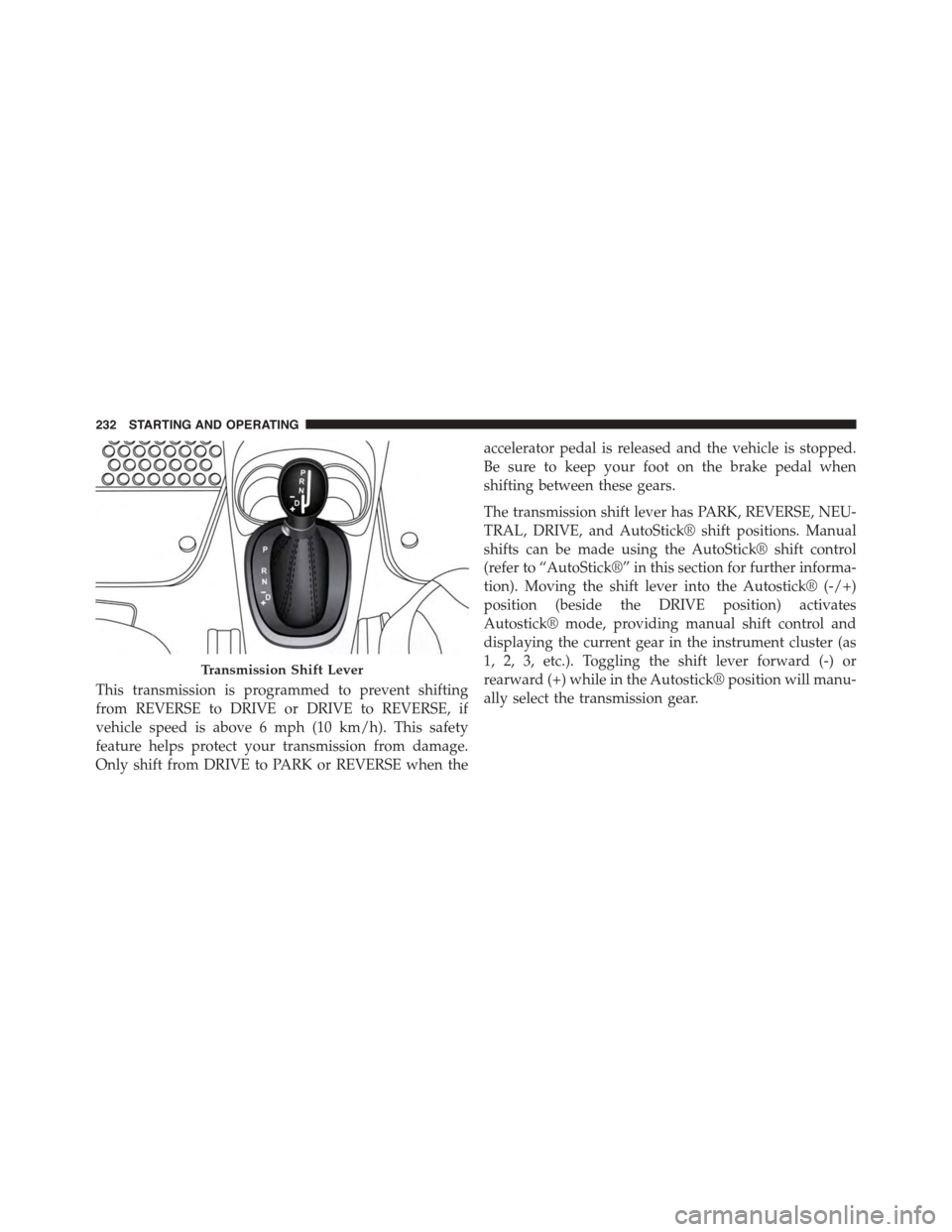
This transmission is programmed to prevent shifting
from REVERSE to DRIVE or DRIVE to REVERSE, if
vehicle speed is above 6 mph (10 km/h). This safety
feature helps protect your transmission from damage.
Only shift from DRIVE to PARK or REVERSE when the
accelerator pedal is released and the vehicle is stopped.
Be sure to keep your foot on the brake pedal when
shifting between these gears.
The transmission shift lever has PARK, REVERSE, NEU-
TRAL, DRIVE, and AutoStick® shift positions. Manual
shifts can be made using the AutoStick® shift control
(refer to “AutoStick®” in this section for further informa-
tion). Moving the shift lever into the Autostick® (-/+)
position (beside the DRIVE position) activates
Autostick® mode, providing manual shift control and
displaying the current gear in the instrument cluster (as
1, 2, 3, etc.). Toggling the shift lever forward (-) or
rearward (+) while in the Autostick® position will manu-
ally select the transmission gear.
Transmission Shift Lever
232 STARTING AND OPERATING
Page 238 of 438
CAUTION!
•Before moving the shift lever out of PARK, you
must turn the ignition switch from the LOCK/OFF
position to the ON/RUN position, and also press
the brake pedal. Otherwise, damage to the shift
lever could result.
•DO NOT race the engine when shifting from
PARK or NEUTRAL into another gear range, as this
can damage the drivetrain.
The following indicators should be used to ensure that
you have engaged the transmission into the PARK posi-
tion:
•When shifting into PARK, press the lock button on the
shift lever and firmly move the lever all the way
forward until it stops and is fully seated.
•Look at the transmission gear position display and
verify that it indicates the PARK position.
•With brake pedal released, verify that the shift lever
will not move out of PARK.
REVERSE (R)
This range is for moving the vehicle backward. Shift into
REVERSE only after the vehicle has come to a complete
stop.
NEUTRAL (N)
Use this range when the vehicle is standing for prolonged
periods with the engine running. The engine may be
started in this range. Apply the parking brake and shift
the transmission into PARK if you must leave the vehicle.
236 STARTING AND OPERATING
Page 240 of 438
•At low speeds you may hear mechanical noises similar
to a manual transmission as the transmission changes
gears. These noises are normal and will not damage
the transmission.
•Very aggressive driving may result in some clutch
odor similar to a manual transmission. An active
warning message will display in the Instrument Clus-
ter if cool down actions are needed.
•When stopped on an incline, always use the brakes to
hold the vehicle in place. On steep inclines, Hill Start
Assist (HSA) will temporarily hold the car in position
when the brake pedal is released. If the accelerator
pedal is not applied after a short time, the car will roll
back. Either reapply the brake (to hold the vehicle) or
press the accelerator to climb the hill.
•Before and after the engine is started, you may hear a
hydraulic pump for a short period of time. This noise
is normal and will not damage the transmission.
•When frequent transmission shifting occurs (such as
when operating the vehicle under heavy loading con-
ditions, in hilly terrain, or traveling into strong head
winds), use the AutoStick shift control (refer to
“AutoStick” in this section for further information) to
select a lower gear. Under these conditions, using a
lower gear will improve performance and extend
transmission life by reducing excessive shifting and
heat buildup.
•During extremely cold temperatures, the transmission
will not operate if the oil temperature is -22° F (-30° C)
or below. Allow the engine to idle briefly with the
transmission in PARK in order to warm the fluid.
Normal operation will resume once the transmission
temperature has risen to a suitable level.
238 STARTING AND OPERATING
Page 241 of 438
Instrument Cluster Messages
Messages will be displayed in the instrument cluster to
alert the driver when certain unusual conditions occur.
These messages are described below.
MESSAGEDESCRIPTION
GEAR UNAVAILABLEIn AutoStick mode, the gear selected by the driver is not
available due to a fault condition. See your authorized
dealer for diagnosis and service.
SHIFT NOT ALLOWEDThe gear position requested by the driver is currently
blocked. This occurs if REVERSE is requested while mov-
ing (at 6 mph [10 km/h] or faster), or if DRIVE is re-
quested while moving backwards (at 6 mph [10 km/h] or
faster). Make sure the vehicle is stopped before engaging
DRIVE or REVERSE.
5
STARTING AND OPERATING 239
Page 242 of 438
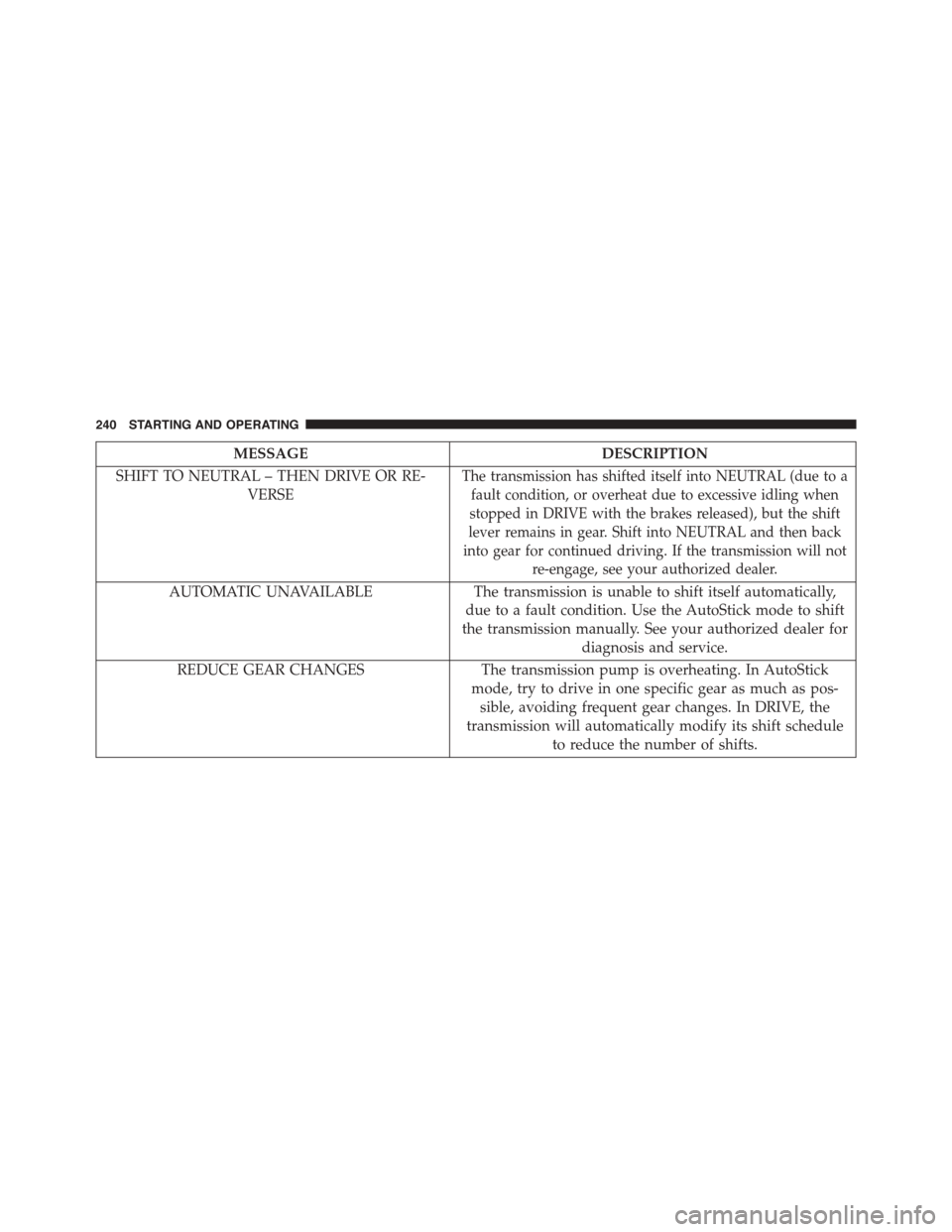
MESSAGEDESCRIPTION
SHIFT TO NEUTRAL – THEN DRIVE OR RE-
VERSE
The transmission has shifted itself into NEUTRAL (due to a
fault condition, or overheat due to excessive idling when
stopped in DRIVE with the brakes released), but the shift
lever remains in gear. Shift into NEUTRAL and then back
into gear for continued driving. If the transmission will not
re-engage, see your authorized dealer.
AUTOMATIC UNAVAILABLEThe transmission is unable to shift itself automatically,
due to a fault condition. Use the AutoStick mode to shift
the transmission manually. See your authorized dealer for
diagnosis and service.
REDUCE GEAR CHANGESThe transmission pump is overheating. In AutoStick
mode, try to drive in one specific gear as much as pos-
sible, avoiding frequent gear changes. In DRIVE, the
transmission will automatically modify its shift schedule
to reduce the number of shifts.
240 STARTING AND OPERATING
Page 243 of 438
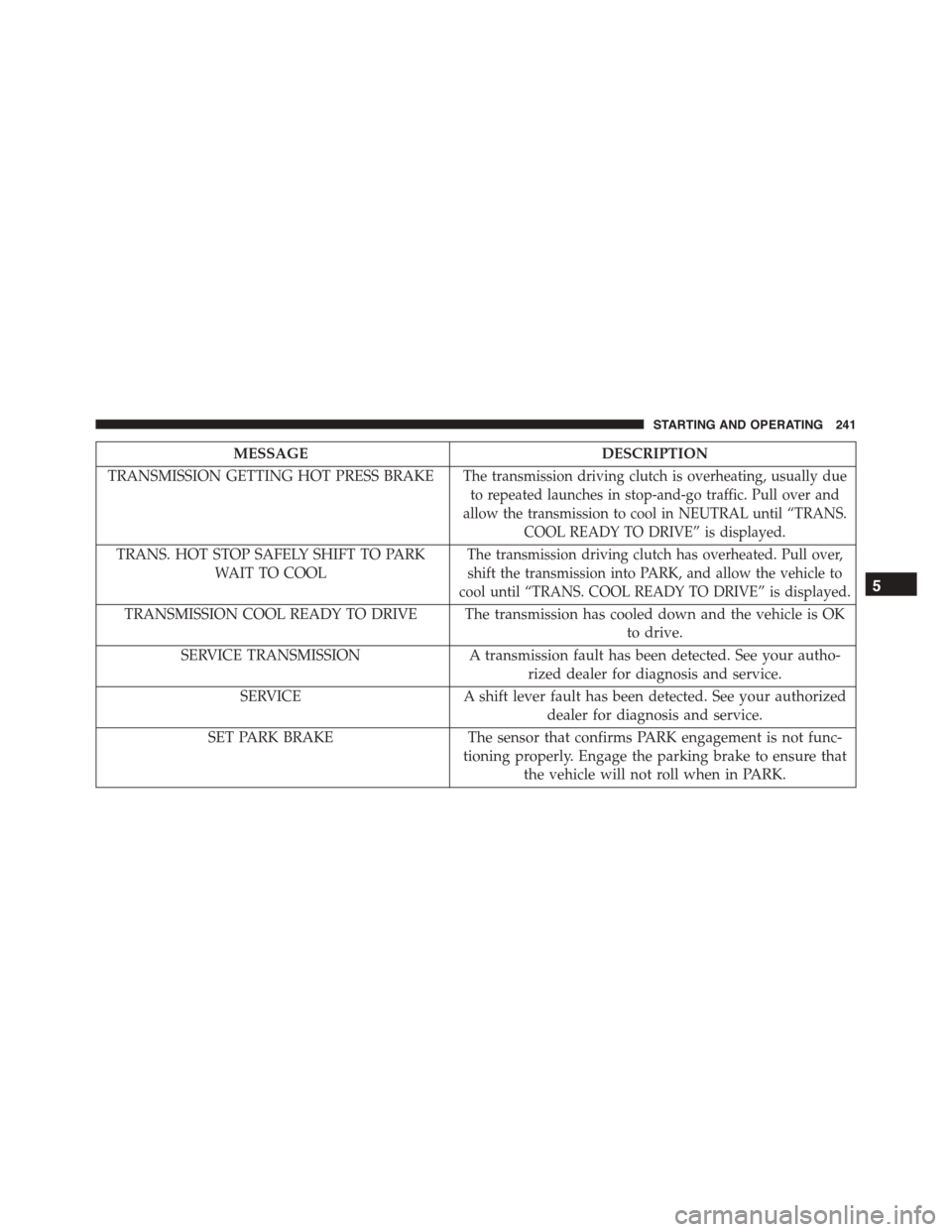
MESSAGEDESCRIPTION
TRANSMISSION GETTING HOT PRESS BRAKEThe transmission driving clutch is overheating, usually due
to repeated launches in stop-and-go traffic. Pull over and
allow the transmission to cool in NEUTRAL until “TRANS.
COOL READY TO DRIVE” is displayed.
TRANS. HOT STOP SAFELY SHIFT TO PARK
WAIT TO COOL
The transmission driving clutch has overheated. Pull over,
shift the transmission into PARK, and allow the vehicle to
cool until “TRANS. COOL READY TO DRIVE” is displayed.
TRANSMISSION COOL READY TO DRIVE The transmission has cooled down and the vehicle is OK
to drive.
SERVICE TRANSMISSIONA transmission fault has been detected. See your autho-
rized dealer for diagnosis and service.
SERVICEA shift lever fault has been detected. See your authorized
dealer for diagnosis and service.
SET PARK BRAKEThe sensor that confirms PARK engagement is not func-
tioning properly. Engage the parking brake to ensure that
the vehicle will not roll when in PARK.
5
STARTING AND OPERATING 241