ECU FIAT 500L 2015 2.G Owners Manual
[x] Cancel search | Manufacturer: FIAT, Model Year: 2015, Model line: 500L, Model: FIAT 500L 2015 2.GPages: 438, PDF Size: 12.64 MB
Page 11 of 438
THINGS TO KNOW BEFORE STARTING YOUR VEHICLE
CONTENTS
!A WORD ABOUT YOUR KEYS.............11
▫Ignition Switch........................11
▫Locking Doors With A Key................13
▫Key-In-Ignition Reminder................14
!SENTRY KEY®.........................14
▫Replacement Keys.....................15
▫General Information....................15
!VEHICLE SECURITY ALARM..............15
▫To Arm The System....................15
▫To Disarm The System...................16
▫Central Lock/Unlock (Switch Safe Lock Device) —
If Equipped..........................17
!REMOTE KEYLESS ENTRY (RKE)............18
▫To Unlock The Doors And Liftgate..........19
▫To Lock The Doors And Liftgate............19
▫Programming Additional Transmitters........20
▫Request For Additional Remote Controls......20
▫Replacing The Battery In The Key With Remote
Control..............................20
▫General Information....................21
2
Page 16 of 438
Key-In-Ignition Reminder
Opening the driver’s door when the key is in the ignition
and the ignition switch position is OFF/LOCK sounds a
signal to remove the key.
SENTRY KEY®
The Sentry Key® Immobilizer System prevents unau-
thorized vehicle operation by disabling the engine. The
system does not need to be armed or activated. Operation
is automatic, regardless of whether the vehicle is locked
or unlocked.
The system uses ignition keys which have an embedded
electronic chip (transponder) to prevent unauthorized
vehicle operation. Therefore, only keys that are pro-
grammed to the vehicle can be used to start and operate
the vehicle.
NOTE:A key which has not been programmed is also
considered an invalid key, even if it is cut to fit the
ignition switch lock cylinder for that vehicle.
If the Vehicle Security Light is on after the key is turned
to the ON/RUN position, it indicates that there is a
problem with the electronics.
CAUTION!
•Always remove the Sentry Key® from the vehicle
and lock all doors when leaving the vehicle unat-
tended.
•The Sentry Key® Immobilizer system is not com-
patible with some aftermarket remote starting sys-
tems. Use of these systems may result in vehicle
starting problems and loss of security protection.
All of the keys provided with your new vehicle have
been programmed to the vehicle electronics.
14 THINGS TO KNOW BEFORE STARTING YOUR VEHICLE
Page 17 of 438
Replacement Keys
NOTE:Only keys that have been programmed to the
vehicle electronics can be used to start the vehicle. Once
a Sentry Key® has been programmed to a vehicle, it
cannot be programmed to any other vehicle.
NOTE: When having the Sentry Key® Immobilizer
System serviced, bring all vehicle keys with you to an
authorized dealer.
General Information
The Sentry Key® system complies with FCC rules part 15
and with RSS-210 of Industry Canada. Operation is
subject to the following conditions:
•This device may not cause harmful interference.
•This device must accept any interference that may be
received, including interference that may cause unde-
sired operation.
NOTE:Changes or modifications not expressly approved
by the party responsible for compliance could void the
user’s authority to operate the equipment.
VEHICLE SECURITY ALARM
The Vehicle Security Alarm monitors the vehicle doors
for unauthorized entry and the ignition switch for unau-
thorized operation. While the Vehicle Security Alarm is
armed, interior switches for door locks and liftgate
release are disabled. If something triggers the alarm, the
Vehicle Security Alarm will provide the following au-
dible and visible signals: the horn will pulse, the park
lamps and/or turn signals will flash, and the Vehicle
Security Light on the instrument panel will flash.
To Arm The System
1. Remove the key from the ignition switch and get out
of the vehicle.
2
THINGS TO KNOW BEFORE STARTING YOUR VEHICLE 15
Page 18 of 438
2. Lock the door using either the Central Lock/Unlock
switch or the Remote Keyless Entry (RKE) transmitter
and close all doors.
3. The horn will sound and the Vehicle Security Light in
the instrument cluster will switch on for approxi-
mately 3 seconds. This shows that the Vehicle Security
Alarm is arming. During this period, if a door is
opened, the ignition switch is turned to ON/RUN, or
the power door locks are unlocked in any manner, the
Vehicle Security Alarm will automatically disarm.
After approximately 3 seconds, the Vehicle Security
Light will flash. This shows that the Vehicle Security
Alarm is fully armed.
The activation of the Vehicle Security Alarm is followed
by a self-diagnosis stage. If a fault is detected during the
self-diagnosis stage, the horn will sound a second time.
If the horn sounds a second time, check that all doors, hood
and liftgate are closed correctly, then rearm the system.
If the Vehicle Security Alarm sounds the horn a second
time even when all doors, hood and liftgate are correctly
closed, a fault has occurred in the operation of the
system. Contact your authorized dealer.
To Disarm The System
Push UNLOCK on the RKE transmitter, or insert the key
into the ignition switch and turn the ignition switch to
the ON/RUN position.
NOTE:The Vehicle Security Alarm will not disarm when
the metal insert of the key is used on a single door lock
cylinder.
The Vehicle Security Alarm is designed to protect your
vehicle; however, you can create conditions where the
Vehicle Security Alarm will arm unexpectedly. If you
remain in the vehicle and lock the doors with the RKE
transmitter, once the Vehicle Security Alarm is armed,
when you pull the door handle to exit, the alarm will
16 THINGS TO KNOW BEFORE STARTING YOUR VEHICLE
Page 19 of 438
sound. If this occurs, push the UNLOCK button on the
RKE transmitter to disarm the Vehicle Security Alarm.
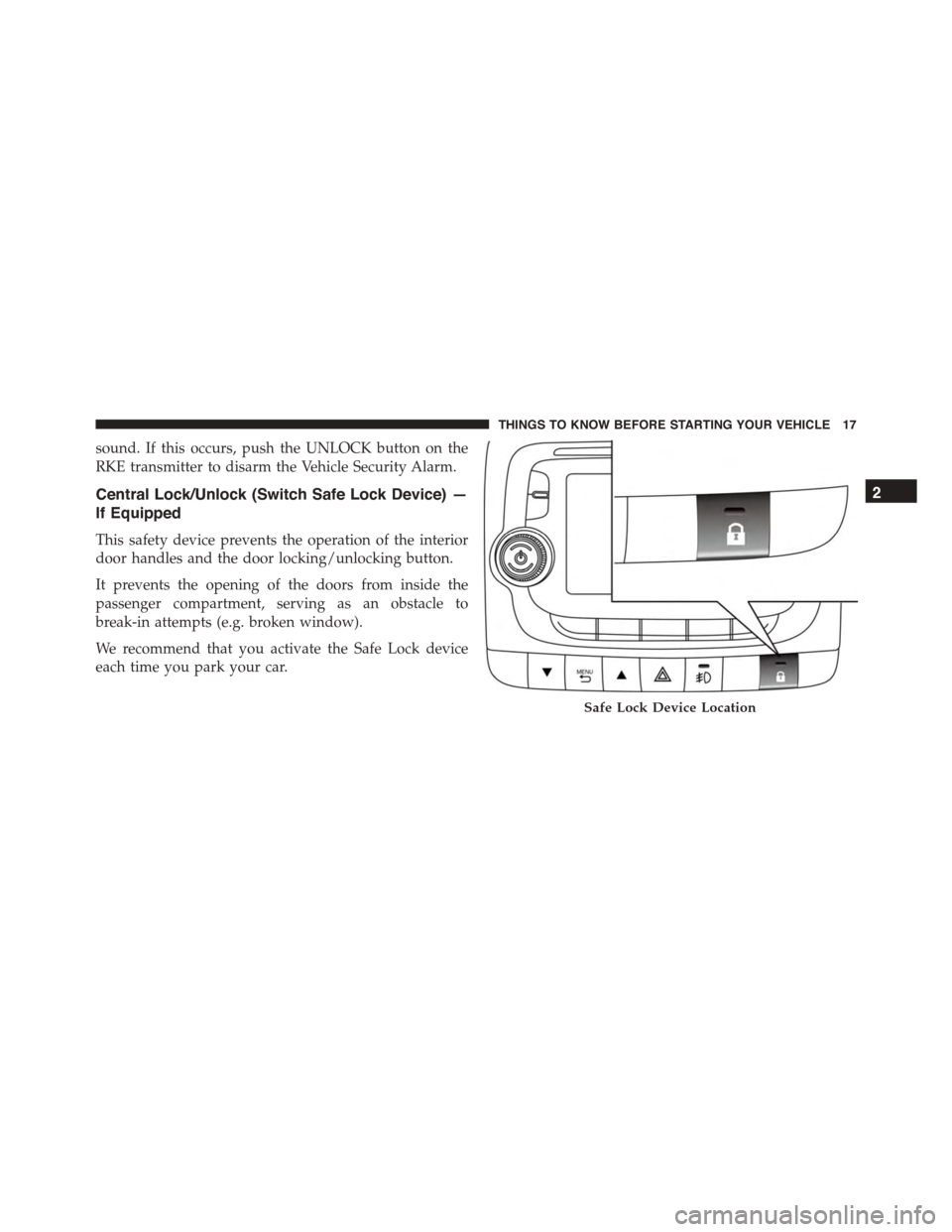
Central Lock/Unlock (Switch Safe Lock Device) —
If Equipped
This safety device prevents the operation of the interior
door handles and the door locking/unlocking button.
It prevents the opening of the doors from inside the
passenger compartment, serving as an obstacle to
break-in attempts (e.g. broken window).
We recommend that you activate the Safe Lock device
each time you park your car.
Safe Lock Device Location
2
THINGS TO KNOW BEFORE STARTING YOUR VEHICLE 17
Page 25 of 438
NOTE:With central locking active (LED ON), opening
one of the front doors, it is possible to perform a central
unlocking (LED OFF). With central locking active (LED
ON), in order to open one of the rear passenger doors, it
is necessary pulling the internal door handle twice. With
one of the rear door open (LED OFF), the unlocking is
performed only for that door, not for all the vehicle.
To unlock the front doors, pull the inside door handle to
the first detent. If the rear doors are locked, you must pull
the door handle once to unlock the door and pull the
door handle a second time to open the door.
WARNING!
•Do not leave children or animals inside parked
vehicles in hot weather. Interior heat build-up may
cause serious injury or death.
(Continued)
WARNING!(Continued)
•For personal security and safety in the event of a
collision, lock the vehicle doors as you drive as
well as when you park and leave the vehicle.
•Before exiting a vehicle, always turn the vehicle
OFF, apply the parking brake, shift the automatic
transmission into PARK or the manual transmis-
sion into REVERSE, and remove the Key Fob from
the ignition. When leaving the vehicle, always lock
your vehicle.
•Never leave children alone in a vehicle, or with
access to an unlocked vehicle.
(Continued)
2
THINGS TO KNOW BEFORE STARTING YOUR VEHICLE 23
Page 32 of 438
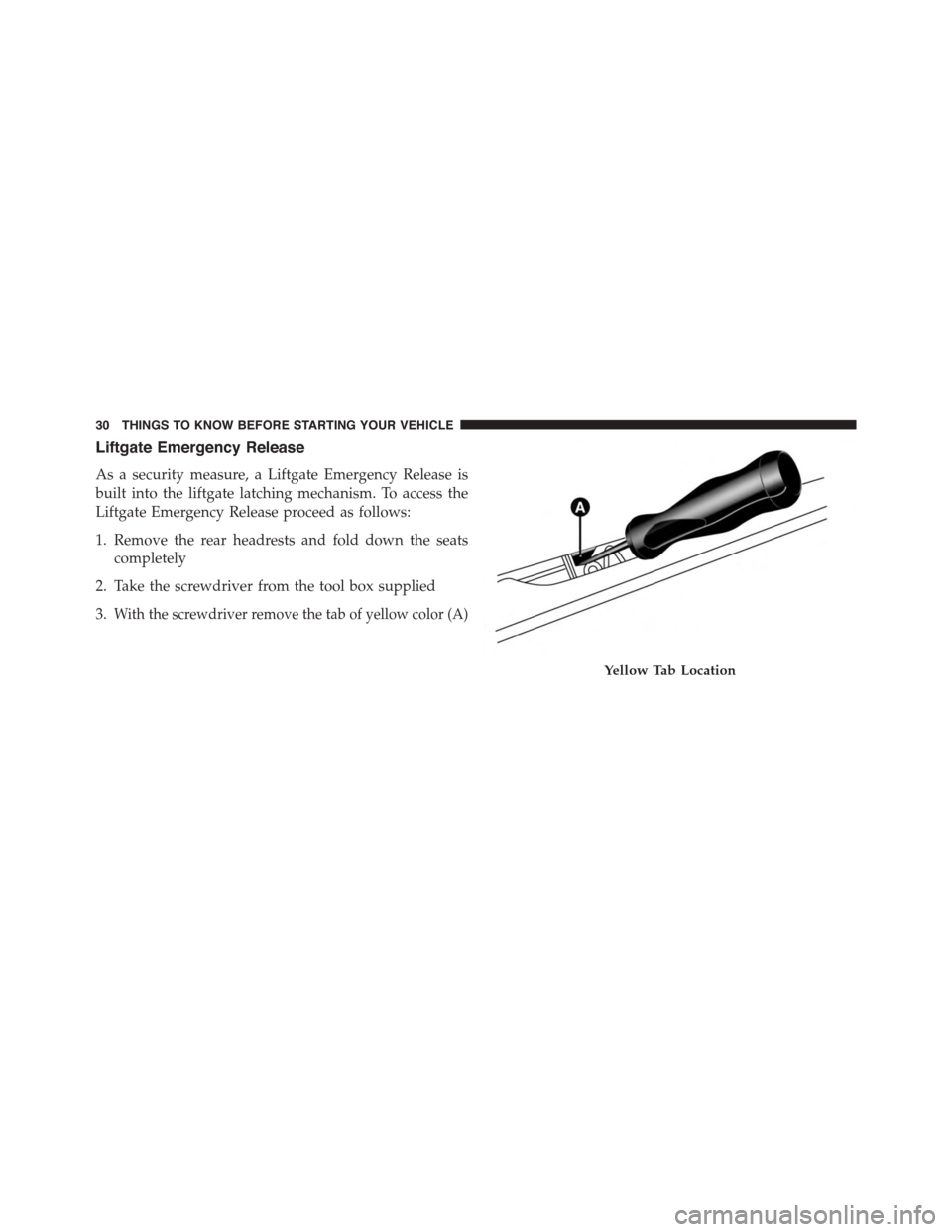
Liftgate Emergency Release
As a security measure, a Liftgate Emergency Release is
built into the liftgate latching mechanism. To access the
Liftgate Emergency Release proceed as follows:
1. Remove the rear headrests and fold down the seats
completely
2. Take the screwdriver from the tool box supplied
3.With the screwdriver remove the tab of yellow color (A)
Yellow Tab Location
30 THINGS TO KNOW BEFORE STARTING YOUR VEHICLE
Page 34 of 438
2. If a child from 2 to 12 years old (not in a rear-facing
child restraint) must ride in the front passenger seat,
move the seat as far back as possible and use the
proper child restraint. (Refer to “Child Restraints”)
3. Children that are not big enough to wear the vehicle
seat belt properly (Refer to#Child Restraints#) should
be secured in a vehicle with a rear seat in child
restraints or belt-positioning booster seats. Older chil-
dren who do not use child restraints or belt-
positioning booster seats should ride properly buckled
up in a vehicle with a rear seat.
4. Never allow children to slide the shoulder belt behind
them or under their arm.
5. You should read the instructions provided with your
child restraint to make sure that you are using it
properly.
6. All occupants should always wear their lap and
shoulder belts properly.
7. The driver and front passenger seats should be moved
back as far as practical to allow the Advanced Front
Air Bags room to inflate.
8. Do not lean against the door or window. If your
vehicle has side air bags, and deployment occurs, the
side air bags will inflate forcefully into the space
between you and the door and you could be injured.
9. If the air bag system in this vehicle needs to be
modified to accommodate a disabled person, contact
the Customer Center. Phone numbers are provided
under#If You Need Assistance.#
32 THINGS TO KNOW BEFORE STARTING YOUR VEHICLE
Page 36 of 438
Light remains illuminated until the respective seat belts
are buckled. The driver should instruct all other occu-
pants to buckle their seat belts. If an outboard front seat
belt is unbuckled while traveling at speeds greater than 5
MPH (8 km/h), BeltAlert will provide both audio and
visual notification.
The outboard front passenger seat BeltAlert is not active
when the outboard front passenger seat is unoccupied.
BeltAlert may be triggered when an animal or heavy
object is on the outboard front passenger seat or when the
seat is folded flat (if equipped). It is recommended that
pets be restrained in the rear seat (if equipped) in pet
harnesses or pet carriers that are secured by seat belts,
and cargo is properly stowed.
BeltAlert can be activated or deactivated by your autho-
rized dealer. Chrysler Group LLC does not recommend
deactivating BeltAlert.
NOTE:If BeltAlert has been deactivated, the Seat Belt
Reminder Light will continue to illuminate while the
driver ’s or outboard front passenger ’s (if equipped with
BeltAlert) seat belt remains unbuckled.
Lap/Shoulder Belts
All seating positions in your vehicle are equipped with
lap/shoulder belts.
The seat belt webbing retractor will lock only during very
sudden stops or collisions. This feature allows the shoul-
der part of the seat belt to move freely with you under
normal conditions. However, in a collision the seat belt
will lock and reduce your risk of striking the inside of the
vehicle or being thrown out of the vehicle.
34 THINGS TO KNOW BEFORE STARTING YOUR VEHICLE
Page 43 of 438
NOTE:These devices are not a substitute for proper seat
belt placement by the occupant. The seat belt still must be
worn snugly and positioned properly.
The pretensioners are triggered by the Occupant Re-
straint Controller (ORC). Like the air bags, the preten-
sioners are single use items. A deployed pretensioner or
a deployed air bag must be replaced immediately.
Energy Management Feature
This vehicle has a seat belt system with an Energy
Management feature in the outboard front and rear
seating positions that may help further reduce the risk of
injury in the event of a collision. This seat belt system has
a retractor assembly that is designed to release webbing
in a controlled manner.
Switchable Automatic Locking Retractor (ALR) —
If Equipped
The seat belts in the passenger seating positions may be
equipped with a Switchable Automatic Locking Retractor
(ALR) which is used to secure a child restraint system.
For additional information, refer to “Installing Child
Restraints Using The Vehicle Seat Belt” under the “Child
Restraints” section of this manual. The table below
defines the type of feature for each seating position.
2
THINGS TO KNOW BEFORE STARTING YOUR VEHICLE 41