manual transmission FIAT 500L 2015 2.G Owner's Manual
[x] Cancel search | Manufacturer: FIAT, Model Year: 2015, Model line: 500L, Model: FIAT 500L 2015 2.GPages: 148, PDF Size: 3.77 MB
Page 110 of 148
Tire Service Kit Usage Precautions
•Replace the Tire Service Kit Sealant Bottle (1) and Sealant Hose (6) prior to the expi-
ration date (printed on the bottle label) to assure optimum operation of the system.
Refer to “Sealing A Tire With Tire Service Kit” section (F) “Sealant Bottle and Hose
Replacement.”
•The Sealant Bottle (1) and Sealant Hose (6) are a one tire application use.After each
use, always replace these components immediately at an authorized dealer.
•When the Tire Service Kit sealant is in a liquid form, clean water, and a damp cloth will
remove the material from the vehicle or tire and wheel components.Once the sealant
dries, it can easily be peeled off and properly discarded.
•For optimum performance, make sure the valve stem on the wheel is free of debris
before connecting the Tire Service Kit.
•You can use the Tire Service Kit air pump to inflate bicycle tires.The kit also comes
with two needles, located in the Accessory Storage Compartment (on the bottom of
the air pump) for inflating sport balls, rafts, or similar inflatable items.However, use
only the Air Pump Hose (7) and make sure the Mode Select Knob (5) is in the Air
Mode when inflating such items to avoid injecting sealant into them.The Tire Service
Kit Sealant is only intended to seal punctures less than 1/4 inch (6 mm) diameter in
the tread of your vehicle.
•Do not lift or carry the Tire Service Kit by the hoses.
Sealing A Tire With Tire Service Kit
(A) Whenever You Stop To Use Tire Service Kit:
1.Pull over to a safe location and turn on the vehicle’s Hazard Warning flashers.
2.Verify that the valve stem (on the wheel with the deflated tire) is in a position that is
near to the ground.This will allow the Tire Service Kit Hoses (6) and (7) to reach the
valve stem and keep the Tire Service Kit flat on the ground.This will provide the best
positioning of the kit when injecting the sealant into the deflated tire and running the
air pump.Move the vehicle as necessary to place the valve stem in this position be-
fore proceeding.
3.Place the transmission in PARK (auto transmission) or in Gear (manual transmission)
and cycle the ignition to the OFF position.
4.Set the parking brake.
(B) Setting Up To Use Tire Service Kit:
1.Turn the Mode Select Knob (5) to the Sealant Mode position.
2.Uncoil the Sealant Hose (6) and then remove the cap from the fitting at the end of
the hose.
3.Place the Tire Service Kit flat on the ground next to the deflated tire.
4.Remove the cap from the valve stem and then screw the fitting at the end of the
Sealant Hose (6) onto the valve stem.
WHAT TO DO IN EMERGENCIES
108
Page 111 of 148
5.Uncoil the Power Plug (8) and insert the plug into the vehicle’s 12 Volt power outlet.
6.Do not remove foreign objects (e.g., screws or nails) from the tire.
(C) Injecting Tire Service Kit Sealant Into The Deflated Tire:
Always start the engine before turning ON the Tire Service Kit.
NOTE:
Manual transmission vehicles must have the parking brake engaged and the shift lever in
NEUTRAL.
After pushing the Power Button (4), the sealant (white fluid) will flow from the Sealant
Bottle (1) through the Sealant Hose (6) and into the tire.
NOTE:
Sealant may leak out through the puncture in the tire.
If the sealant (white fluid) does not flow within 0 – 10seconds through the Sealant Hose
(6):
1.Push the Power Button (4) to turn Off the Tire Service Kit.Disconnect the Sealant
Hose (6) from the valve stem.Make sure the valve stem is free of debris.Reconnect
the Sealant Hose (6) to the valve stem.Check that the Mode Select Knob (5) is in
the Sealant Mode position and not Air Mode.Push the Power Button (4) to turn On
the Tire Service Kit.
2.Connect the Power Plug (8) to a different 12 Volt power outlet in your vehicle or
another vehicle, if available.Make sure the engine is running before turning ON the
Tire Service Kit.
3.The Sealant Bottle (1) may be empty due to previous use.Call for assistance.
NOTE:
If the Mode Select Knob (5) is on Air Mode and the pump is operating, air will dispense
from the Air Pump Hose (7) only, not the Sealant Hose (6).
If the sealant (white fluid) does flow through the Sealant Hose (6):
1.Continue to operate the pump until sealant is no longer flowing through the hose
(typically takes 30 - 70 seconds).As the sealant flows through the Sealant Hose (6),
the Pressure Gauge (3) can read as high as 70 psi (4.8 Bar).The Pressure Gauge (3)
will decrease quickly from approximately 70 psi (4.8 Bar) to the actual tire pressure
when the Sealant Bottle (1) is empty.
2.The pump will start to inject air into the tire immediately after the Sealant Bottle (1)
is empty.Continue to operate the pump and inflate the tire to the pressure indicated
on the tire pressure label on the driver-side latch pillar (recommended pressure).
Check the tire pressure by looking at the Pressure Gauge (3).
WHAT TO DO IN EMERGENCIES
109
Page 119 of 148
CAUTION!
•Do not use sling-type equipment when towing.Vehicle damage may occur.
•When securing the vehicle to a flatbed truck, do not attach to front or rear sus-
pension components.Damage to your vehicle may result from improper towing.
If you must use the accessories (wipers, defroster, etc.) while being towed, the key must
be in the ON/RUN position.
Manual Transmission
•Vehicle can be flat towed (all four wheels on the ground) with the transmission in
NEUTRAL.
•Vehicle can be towed with the front wheels elevated.
•Vehicle can be towed on a flatbed truck (all wheels off the ground).
CAUTION!
Towing this vehicle in violation of the above requirements can cause severe engine
and/or transmission damage.Damage from improper towing is not covered under the
New Vehicle Limited Warranty.
Euro Twin Clutch Transmission
•Vehicle can be flat towed (all four wheels on the ground) with the transmission in
NEUTRAL.
•Vehicle can be towed with the front wheels elevated.
•Vehicle can be towed on a flatbed truck (all wheels off the ground).
If the ignition key is unavailable, or the vehicle's battery is discharged, refer to "Shift Lever
Override" in this section for instructions on shifting the transmission out of PARK for
towing.
CAUTION!
•Towing this vehicle in violation of the above requirements can cause severe trans-
mission damage.Damage from improper towing is not covered under the New
Vehicle Limited Warranty.
WHAT TO DO IN EMERGENCIES
117
Page 127 of 148
CAUTION!
•Mixing of engine coolant (antifreeze) other than specified Organic Additive Tech-
nology (OAT) engine coolant (antifreeze), may result in engine damage and may
decrease corrosion protection.Organic Additive Technology (OAT) engine coolant
is different and should not be mixed with Hybrid Organic Additive Technology
(HOAT) engine coolant (antifreeze) or any “globally compatible” coolant (anti-
freeze).If a non-OAT engine coolant (antifreeze) is introduced into the cooling
system in an emergency, the cooling system will need to be drained, flushed, and
refilled with fresh OAT coolant (conforming to MS.90032), by an authorized
dealer as soon as possible.
•Do not use water alone or alcohol-based engine coolant (antifreeze) products.Do
not use additional rust inhibitors or antirust products, as they may not be compat-
ible with the radiator engine coolant and may plug the radiator.
•This vehicle has not been designed for use with propylene glycol-based engine
coolant (antifreeze).Use of propylene glycol-based engine coolant (antifreeze) is
not recommended.
Chassis
Component Fluid, Lubricant, or Genuine Part
Manual Transmission – If Equipped We recommend you use MOPAR® CSeries Manual & Dual Dry Clutch Trans-mission Fluid
Euro Twin Clutch Transmission – IfEquippedGear Oil:Use only MOPAR® C Series
Manual & Dual Dry Clutch Transmission
Fluid or equivalent.
Control system:Use only MOPAR® C
Series DDCT SAE 75W Hydraulic Fluid or
equivalent.Failure to use the correct fluid
may affect the function or performance of
your transmission.
Automatic Transmission – Aisin F21-250HD Transmission – If EquippedUse only MOPAR® AW-1 AutomaticTransmission Fluid or equivalent.Failure touse the correct fluid may affect the func-tion or performance of your transmission.
Brake Master Cylinder We recommend you use MOPAR® DOT4.If DOT 4 brake fluid is not available,then DOT 3 is acceptable.
MAINTAINING YOUR VEHICLE
125
Page 130 of 148
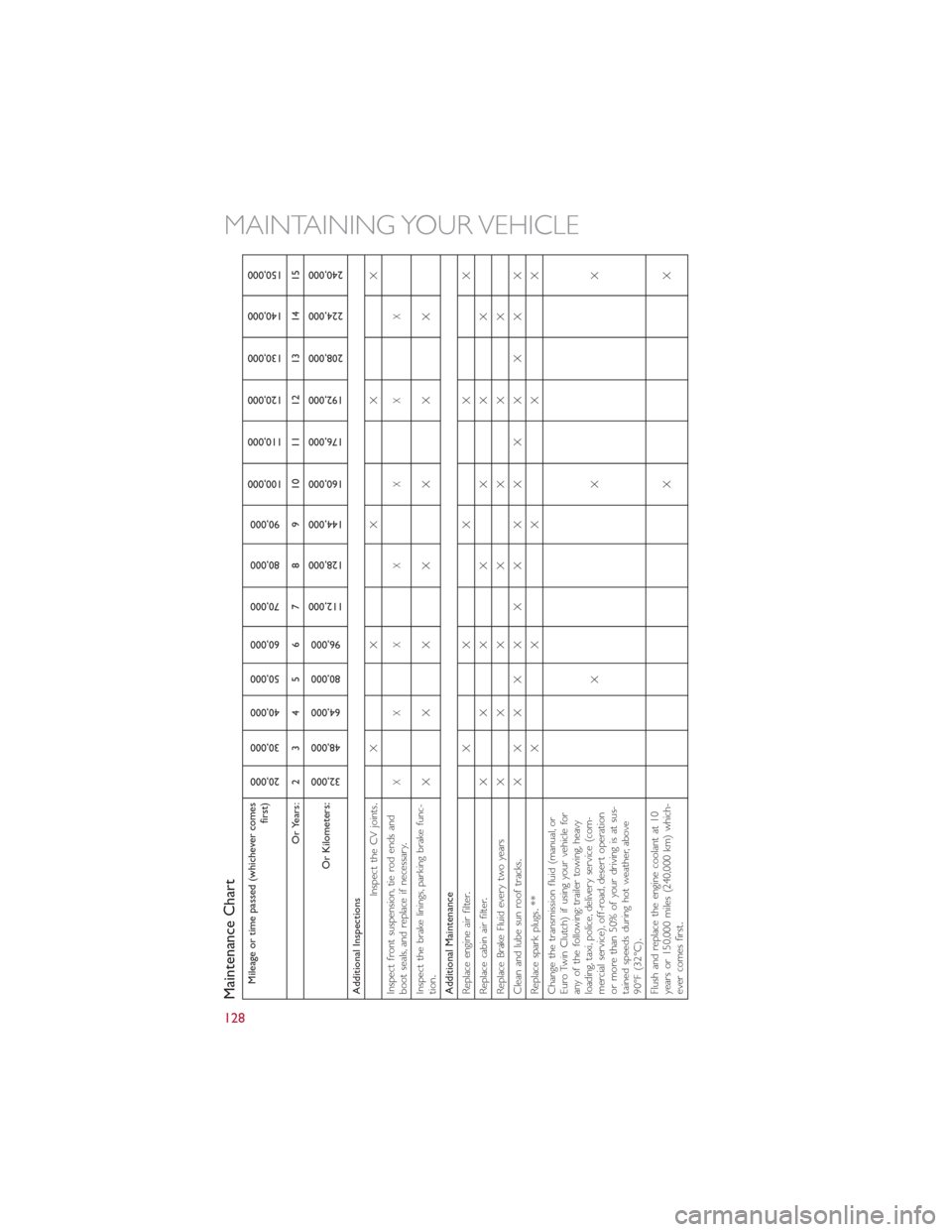
Maintenance ChartMileage or time passed (whichever comes
first)
20,000
30,000
40,000
50,000
60,000
70,000
80,000
90,000
100,000
110,000
120,000
130,000
140,000
150,000
Or Years: 2 3 4 5 6 7 8 9 10 11 12 13 14 15
Or Kilometers:
32,000
48,000
64,000
80,000
96,000
112,000
128,000
144,000
160,000
176,000
192,000
208,000
224,000
240,000
Additional Inspections
Inspect the CV joints
.
XX X X X
Inspect front suspension, tie rod ends andboot seals, and replace if necessary
.
XXX X X X X
Inspect the brake linings, parking brake func-tion
.
XXX X X X X
Additional MaintenanceReplace engine air filter
.
XX X X X
Replace cabin air filter
.
XXX X X X X
Replace Brake Fluid every two years X X X X X X XClean and lube sun roof tracks
.
XX XX X X X X X X X X X X
Replace spark plugs
.** X X X X X
Change the transmission fluid (manual, orEuro Twin Clutch) if using your vehicle forany of the following: trailer towing, heavyloading, taxi, police, delivery service (com-mercial service), off-road, desert operationor more than 50% of your driving is at sus-tained speeds during hot weather, above90°F (32°C)
.
XX X
Flush and replace the engine coolant at 10years or 150,000 miles (240,000 km) which-ever comes first
.
XX
MAINTAINING YOUR VEHICLE
128
Page 143 of 148
Adding Engine Coolant (Antifreeze)....126
Adding Fuel.................37
Adding Washer Fluid............126
Air Bag
Advanced Front Air Bag.........12
Advance Front Air Bag.........12
Air Bags.................12
Air Bag Warning Light..........12
Driver Knee Air Bag...........13
Front Air Bag..............12Passenger Knee Air Bag.........13Rollover.................12Side Impacts...............12Air Bag Light.................92Air Bag, Side.................12Air Cleaner, Engine (Engine AirCleaner Filter).............126Air Conditioner Maintenance.......126Air Conditioning Refrigerant........126Air Conditioning System..........126AlarmDisarm The System............9Vehicle Security Alarm..........9Alarm (Security Alarm)..........9, 97Antifreeze (Engine Coolant).....124, 126Capacities...............124Disposal................126Anti-Lock Warning Light...........92Appearance Care.............126Audio Systems (Radio).........41, 45Automatic TransmissionFluid Type...............125
Battery...................126Body Mechanism Lubrication........126Brake Fluid.................125Brakes...................126Brake System................126Master Cylinder............126Warning Light..............94Break-In Recommendations, New Vehicle..26Bulb Replacement.............136Bulbs, Light.................136
Capacities, Antifreeze (Engine Coolant)..124Capacities, Fluid...............124Caps, FillerFuel..................120
Oil (Engine)..............126
Car Washes................126
Changing A Flat Tire.............99
Charging System Light............92
Child Restraint................15
Child Restraints
Center Seat LATCH...........16
Installing Child Restraints Using The
Vehicle Seat Belt.............17
Lower Anchors And Tethers ForChildren.................17Using The Top Tether Anchorage....17CleaningWheels................126Windshield Wiper Blades.......126Climate ControlAutomatic................32Manual..................31Clock....................43Clock Setting................43Cluster Warning/Indicator LightsAnti-Lock Brake (ABS) Light......92Brake Warning Light...........94Charging System Light.........92Electronic Speed Control SETIndicator.................97Electronic Throttle Control (ETC)Indicator Light..............96Engine Temperature Warning Light...94Front Fog Light Indicator........97High Beam Indicator..........96Malfunction Indicator Light (MIL)....95Oil Pressure Warning Light.......92Park/Headlight ON Indicator......97Tire Pressure Monitoring System(TPMS) Light..............93Turn Signal Indicator..........96Vehicle Security Light..........97Clutch...................126Clutch Fluid................126Compact Spare Tire............134Coolant (Antifreeze)............124Cooling System...............126Adding Coolant (Antifreeze).....126Coolant Level.............126Disposal Of Used Coolant......126Drain, Flush, And Refill.........126Inspection...............126
INDEX
141
Page 145 of 148
Disarm The Alarm.............9
Lane Change Assist.............26
Lap/Shoulder Belts..............11
LATCH (Lower Anchors And Tether
For CHildren)............16, 18
Liftgate....................8
Light Bulbs.................136
Lights
Fog...................97High Beam Indicator..........96Low Fuel................92Seat Belt Reminder...........94Security Alarm.............97Tire Pressure Monitoring (TPMS)...93Turn Signal...............26LocksKeys...................8Liftgate, Tailgate..............8Lower Anchors And Tether For CHildren(LATCH).................16Lubrication, Body..............126
Maintenance Free Battery.........126Maintenance, General...........126Maintenance Procedures..........126Maintenance Schedule...........126Malfunction Indicator Light (CheckEngine)..................95Manual TransmissionLubricant Selection..........125Master Cylinder (Brakes)..........126MirrorsHeated...............31, 33
Navigation..................63New Vehicle Break-In Period........26
Occupant Restraints.............15Oil Change Indicator............98Oil Change Indicator, Reset.........98Oil, Engine...............124, 126Capacity................124Change Interval............126Checking................126Disposal................126Filter..................126Filter Disposal.............126
Materials Added To..........126
Recommendation.........124, 126
Viscosity................126
Oil Filter, Selection.............126
Oil Pressure Light..............92
Outlet
Power..................89
Overheating, Engine.............98
Paint Care.................126Phone, Hands-Free (Uconnect®)......74Phone (Uconnect®).............74Placard, Tire And Loading Information...133PowerDoor Locks...............9Inverter.................88Outlet (Auxiliary Electrical Outlet)...89Steering.................97Sunroof.................33Power Steering Fluid............125Programmable Electronic Features.....85
Radio Operation...............45Radio (Sound Systems)...........45Rear Seat, Folding..............23Reclining Front Seats............22Recreational Towing.............90Refrigerant.................126Remote Keyless Entry (RKE)Disarm The Alarm.............9Replacement Bulbs.............136Reporting Safety Defects..........138
Schedule, Maintenance...........126Seat BeltEngage The Automatic Locking Mode..17Seat Belt Maintenance...........126Seat Belts..................11Adjustable Shoulder Belt........11Pretensioners..............11Reminder................94Seat Belt Warning............11SeatsAdjustment...............22Heated.................24Rear Folding...............23Security Alarm................97Disarm The System............9
INDEX
143