brake light FIAT 500L 2017 2.G User Guide
[x] Cancel search | Manufacturer: FIAT, Model Year: 2017, Model line: 500L, Model: FIAT 500L 2017 2.GPages: 370, PDF Size: 3.56 MB
Page 231 of 370
DRIVING THROUGH WATER
Driving through water more than a few inches/
centimeters deep will require extra caution to ensure
safety and prevent damage to your vehicle.
Flowing/Rising Water
WARNING!
Do not drive on or across a road or path where water
is flowing and/or rising (as in storm run-off). Flow-
ing water can wear away the road or path’s surface
and cause your vehicle to sink into deeper water.
Furthermore, flowing and/or rising water can carry
your vehicle away swiftly. Failure to follow this
warning may result in injuries that are serious or
fatal to you, your passengers, and others around
you.
Shallow Standing Water
Although your vehicle is capable of driving through
shallow standing water, consider the following Cau-
tions and Warnings before doing so.
WARNING!
•Driving through standing water limits your vehi-
cle’s traction capabilities. Do not exceed 5 mph
(8 km/h) when driving through standing water.
• Driving through standing water limits your vehi-
cle’s braking capabilities, which increases stop-
ping distances. Therefore, after driving through
standing water, drive slowly and lightly press on
the brake pedal several times to dry the brakes.
• Failure to follow these warnings may result in
injuries that are serious or fatal to you, your
passengers, and others around you.
CAUTION!
•Always check the depth of the standing water
before driving through it. Never drive through
standing water that is deeper than the bottom of
the tire rims mounted on the vehicle.
• Determine the condition of the road or the path
that is under water and if there are any obstacles
in the way before driving through the standing
water.
(Continued)
5
STARTING AND OPERATING 229
Page 232 of 370
CAUTION!(Continued)
•Do not exceed 5 mph (8 km/h) when driving
through standing water. This will minimize wave
effects.
• Driving through standing water may cause dam-
age to your vehicle’s drivetrain components. Al-
ways inspect your vehicle’s fluids (i.e., engine oil,
transmission, axle, etc.) for signs of contamination
(i.e., fluid that is milky or foamy in appearance)
after driving through standing water. Do not
continue to operate the vehicle if any fluid ap-
pears contaminated, as this may result in further
damage. Such damage is not covered by the New
Vehicle Limited Warranty.
• Getting water inside your vehicle’s engine can
cause it to lock up and stall out, and cause serious
internal damage to the engine. Such damage is
not covered by the New Vehicle Limited War-
ranty.
ELECTRIC POWER STEERING
This only operates with the key turned to MAR/ON
and the engine started. The steering allows the force
required at the steering wheel to be adjusted to suit
driving conditions.
NOTE: When turning the ignition key quickly, full
power steering functionality can be achieved after a few
seconds.
PARKING BRAKE
Before leaving the vehicle, make sure that the parking
brake is fully applied.
The parking brake lever is located in the center console.
To apply the parking brake, pull the lever up as firmly
as possible. To release the parking brake, pull the lever
up slightly, push the side button with your thumb, then
lower the lever completely.
230 STARTING AND OPERATING
Page 233 of 370
When the parking brake is applied with the ignition
switch in the MAR (ACC/ON/RUN) position, the
Brake Warning Light in the instrument cluster will
illuminate.
When parking on a hill, it is important to turn the front
wheels toward the curb on a downhill grade and away
from the curb on an uphill grade. The parking brake
should always be applied whenever the driver is not in
the vehicle.
WARNING!
•Never leave children alone in a vehicle, or with
access to an unlocked vehicle.
• Allowing children to be in a vehicle unattended is
dangerous for a number of reasons. A child or
others could be seriously or fatally injured. Chil-
dren should be warned not to touch the parking
brake, brake pedal or the gear selector.
• Do not leave the key fob in or near the vehicle or
in a location accessible to children. A child could
operate power windows, other controls, or move
the vehicle.
• Be sure the parking brake is fully disengaged
before driving; failure to do so can lead to brake
failure and a collision.
• Always fully apply the parking brake when leav-
ing your vehicle, or it may roll and cause damage
or injury.
CAUTION!
If the Brake Warning Light remains on with the
parking brake released, a brake system malfunction
(Continued)
1 — Parking Brake Release Button
2 — Parking Brake Lever
5
STARTING AND OPERATING 231
Page 234 of 370
CAUTION!(Continued)
is indicated. Have the brake system serviced by an
authorized dealer immediately.
BRAKE SYSTEM
Your vehicle is equipped with dual hydraulic brake
systems. If either of the two hydraulic systems loses
normal capability, the remaining system will still func-
tion. However, there will be some loss of overall brak-
ing effectiveness. You may notice increased pedal travel
during application, greater pedal force required to slow
or stop, and potential activation of the “Brake System
Warning Light”.
In the event power assist is lost for any reason (i.e.,
repeated brake applications with the engine off), the
brakes will still function. However, the effort required
to brake the vehicle will be much greater than that
required with the power system operating.
ELECTRONIC BRAKE CONTROL SYSTEM
Your vehicle is equipped with a advanced electronic
brake control system that includes the Anti-Lock Brake
System (ABS), Brake Assist System (BAS), Traction
Control System (TCS), Hill Start Assist (HSA), Dynamic Steering Torque (DST), and Electronic Stability Control
(ESC). All systems work together to enhance vehicle
stability and control in various driving conditions and
are commonly referred to as ESC.
Four-Wheel Anti-Lock Brake System (ABS)
The Four-Wheel ABS is designed to aid the driver in
maintaining vehicle control under adverse braking con-
ditions. The system operates with a separate computer
to modulate hydraulic pressure, to prevent wheel
lock-up and to help avoid skidding on slippery sur-
faces.
The system’s pump motor runs during an ABS stop to
provide regulated hydraulic pressure. The pump motor
makes a low humming noise during operation, which is
normal.
The ABS includes an amber ABS Warning Light. When
the light is illuminated, the ABS is not functioning. The
system reverts to standard non-anti-lock brakes. Turn-
ing the ignition Off and On again may reset the ABS if
the fault detected was only momentary.
232 STARTING AND OPERATING
Page 237 of 370
•Gear selection matches vehicle uphill direction (i.e.,
vehicle in NEUTRAL (manual transmission), vehicle
facing uphill is in forward gear; vehicle backing
uphill is in REVERSE gear).
WARNING!
There may be situations on minor hills with a
loaded vehicle, or while pulling a trailer, when the
system will not activate and slight rolling may
occur. This could cause a collision with another
vehicle or object. Always remember the driver is
responsible for braking the vehicle.
Disabling/Enabling HSA
If you wish to turn the HSA system on or off, it can be
done using the Customer Programmable Features in the
Uconnect Settings. Refer to “Uconnect Settings” in for
further information.
Dynamic Steering Torque (DST)
The DST function uses the integration of the ESC
system with the electric power steering to increase the
safety level of the whole vehicle. In critical situations (braking with different grip condi-
tions), through the DST function the ESC system con-
trols the steering to implement an additional torque
contribution on the steering wheel, to suggest the most
correct manoeuvre to the driver.
The coordinated action of brakes and steering increases
the safety and vehicle control feeling.
NOTE:
The DST is a driving aid system and does not
replace the driver’s actions while driving the vehicle.
Electronic Stability Control (ESC)
This system enhances directional control and stability of
the vehicle under various driving conditions. ESC cor-
rects for oversteering or understeering of the vehicle by
applying the brake of the appropriate wheel to assist in
counteracting the oversteering or understeering condi-
tion. Engine power may also be reduced to help the
vehicle maintain the desired path. ESC uses sensors in
the vehicle to determine the vehicle path intended by
the driver and compares it to the actual path of the
vehicle. When the actual path does not match the
intended path, ESC applies the brake of the appropriate
wheel to assist in counteracting the oversteer or under-
steer condition.
5
STARTING AND OPERATING 235
Page 240 of 370
NOTE:To improve the vehicle’s traction when driving
with snow chains, or when starting off in deep snow,
sand, or gravel, it may be desirable to switch to the
“Partial Off” mode by momentarily pushing the “ESC
OFF” button. Once the situation requiring “Partial Off”
mode is overcome, turn ESC back on by momentarily
pushing the “ESC OFF” button. This may be done while
the vehicle is in motion.
WARNING!
When in “Partial Off” mode, the TCS functionality
of ESC (except for the limited slip feature described
in the TCS section) has been disabled and the “ESC
Off Indicator Light” will be illuminated. When in
“Partial Off” mode, the engine power reduction of
TCS is disabled, and the enhanced vehicle stability
offered by the ESC system is reduced.
Electronic Roll Mitigation (ERM)
This system anticipates the potential for wheel lift by
monitoring the driver ’s steering wheel input and the
speed of the vehicle. When ERM determines that the
rate of change of the steering wheel angle and vehicle’s
speed are sufficient to potentially cause wheel lift, it
then applies the appropriate brake and may also reduce
engine power to lessen the chance that wheel lift will
occur. ERM will only intervene during very severe or
evasive driving maneuvers.ESC Off Switch
238 STARTING AND OPERATING
Page 320 of 370
If an examination of your engine compartment shows
no evidence of radiator or hose leaks, the vehicle may
be safely driven. The vapor will soon dissipate.
•Do not overfill the coolant expansion bottle.
• Check the coolant freeze point in the radiator and in
the coolant expansion bottle. If engine coolant (anti-
freeze) needs to be added, the contents of the coolant
expansion bottle must also be protected against freez-
ing.
• If frequent engine coolant (antifreeze) additions are
required, the cooling system should be pressure
tested for leaks.
• Maintain engine coolant (antifreeze) concentration at
a minimum of 50% OAT coolant (conforming to
MS.90032) and distilled water for proper corrosion
protection of your engine which contains aluminum
components.
• Keep the front of the radiator clean. If your vehicle is
equipped with air conditioning, keep the front of the
condenser clean.
• Do not change the thermostat for Summer or Winter
operation. If replacement is ever necessary, install
ONLY the correct type thermostat. Other designs may result in unsatisfactory engine coolant (anti-
freeze) performance, poor gas mileage, and increased
emissions.
Brake System
In order to assure brake system performance, all brake
system components should be inspected periodically.
Refer to the “Maintenance Schedule” for the proper
maintenance intervals.
WARNING!
Riding the brakes can lead to brake failure and
possibly a collision. Driving with your foot resting
or riding on the brake pedal can result in abnor-
mally high brake temperatures, excessive lining
wear, and possible brake damage. Riding the
brakes may also reduce braking capacity in an
emergency.
Brake Master Cylinder
The fluid level in the master cylinder should be checked
when performing under hood services, or immediately
if the “Brake Warning Light” is on.
318 MAINTAINING YOUR VEHICLE
Page 346 of 370
MAINTENANCE SCHEDULE
Your vehicle is equipped with an automatic oil change
indicator system. The oil change indicator system will
remind you that it is time to take your vehicle in for
scheduled maintenance.
Based on engine operation conditions, the oil change
indicator message will illuminate in the instrument
cluster. This means that service is required for your
vehicle. Operating conditions such as frequent short-
trips, trailer tow and extremely hot or cold ambient
temperatures will influence when the “Change Oil” or
“Oil Change Required” message is displayed. Severe
Operating Conditions can cause the change oil message
to illuminate as early as 3,500 miles (5,600 km) since last
reset. Have your vehicle serviced as soon as possible,
within the next 500 miles (805 km).
Your authorized dealer will reset the oil change indica-
tor message after completing the scheduled oil change.
If a scheduled oil change is performed by someone
other than your authorized dealer, the message can be
reset by referring to the steps described under “Instru-
ment Cluster Display” in “Understanding Your Instru-
ment Panel” for further information.NOTE:
Under no circumstances should oil change
intervals exceed 10,000 miles (16,000 km), twelve
months or 350 hours of engine run time, whichever
comes first. The 350 hours of engine run or idle time is
generally only a concern for fleet customers.
Severe Duty All Models
Change Engine Oil at 4,000 miles (6,500 km) if the
vehicle is operated in a dusty and off road environment
or is operated predominately at idle or only very low
engine RPM’s. This type of vehicle use is considered
Severe Duty.
Once A Month Or Before A Long Trip:
• Check engine oil level.
• Check windshield washer fluid level.
• Check the tire inflation pressures and look for un-
usual wear or damage.
• Check the fluid levels of the coolant reservoir, and
brake master cylinder reservoir, and fill as needed.
• Check function of all interior and exterior lights.
344 MAINTENANCE SCHEDULES
Page 358 of 370
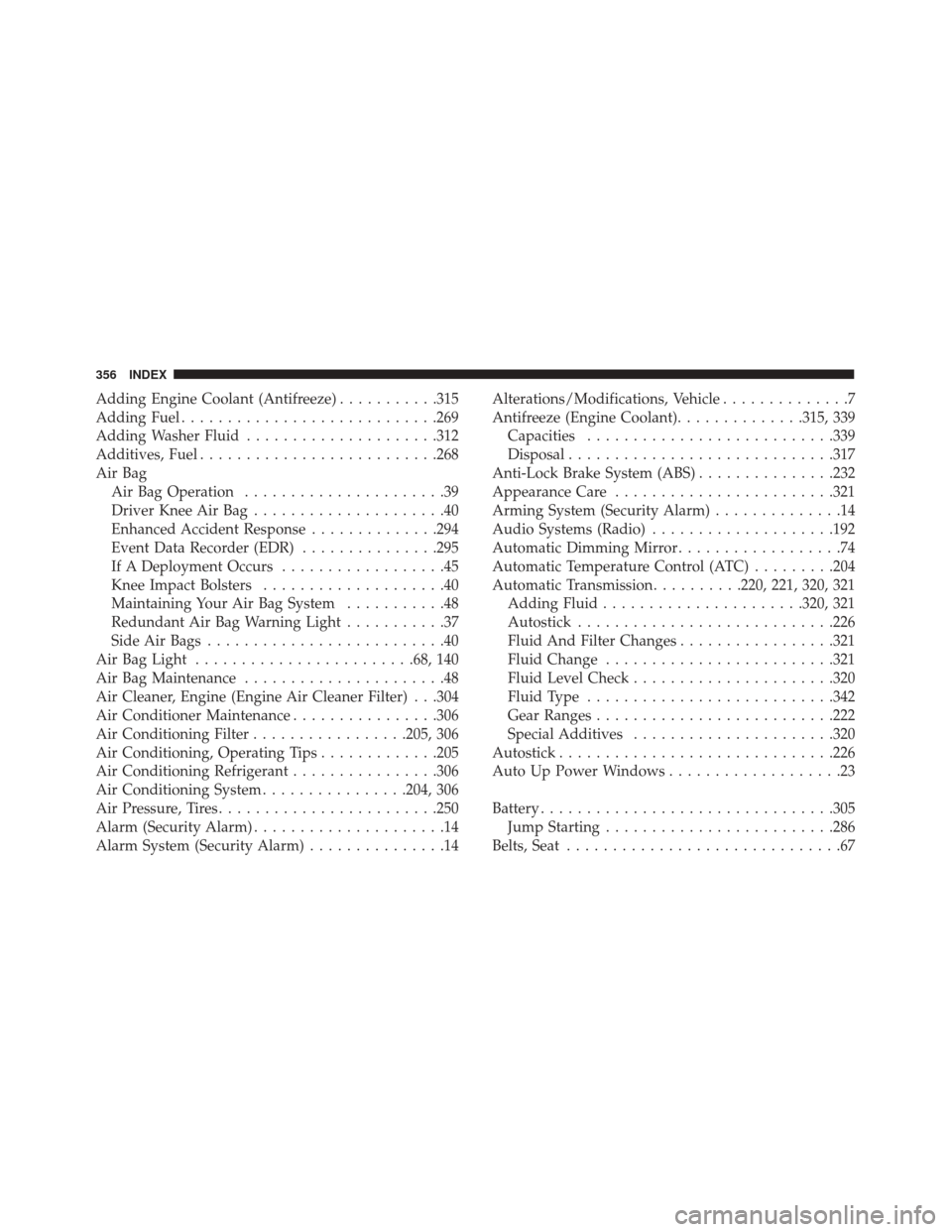
Adding Engine Coolant (Antifreeze)...........315
Adding Fuel ............................269
Adding Washer Fluid .....................312
Additives, Fuel ..........................268
Air Bag Air Bag Operation ......................39
Driver Knee Air Bag .....................40
Enhanced Accident Response ..............294
Event Data Recorder (EDR) ...............295
If A Deployment Occurs ..................45
Knee Impact Bolsters ....................40
Maintaining Your Air Bag System ...........48
Redundant Air Bag Warning Light ...........37
Side Air Bags ..........................40
Air Bag Light ........................68, 140
Air Bag Maintenance ......................48
Air Cleaner, Engine (Engine Air Cleaner Filter) . . .304
Air Conditioner Maintenance ................306
Air Conditioning Filter .................205, 306
Air Conditioning, Operating Tips .............205
Air Conditioning Refrigerant ................306
Air Conditioning System ................204, 306
Air Pressure, Tires ........................250
Alarm (Security Alarm) .....................14
Alarm System (Security Alarm) ...............14Alterations/Modifications, Vehicle
..............7
Antifreeze (Engine Coolant) ..............315, 339
Capacities .......................... .339
Disposal ............................ .317
Anti-Lock Brake System (ABS) ...............232
Appearance Care ........................321
Arming System (Security Alarm) ..............14
Audio Systems (Radio) ....................192
Automatic Dimming Mirror ..................74
Automatic Temperature Control (ATC) .........204
Automatic Transmission ..........220, 221, 320, 321
Adding Fluid ..................... .320, 321
Autostick ............................226
Fluid And Filter Changes .................321
Fluid Change ........................ .321
Fluid Level
Check ..................... .320
Fluid Type .......................... .342
Gear Ranges ..........................222
Special Additives ..................... .320
Autostick ............................. .226
Auto Up Power Windows ...................23
Battery ............................... .305
Jump Starting ........................ .286
Belts, Seat ..............................67
356 INDEX
Page 359 of 370
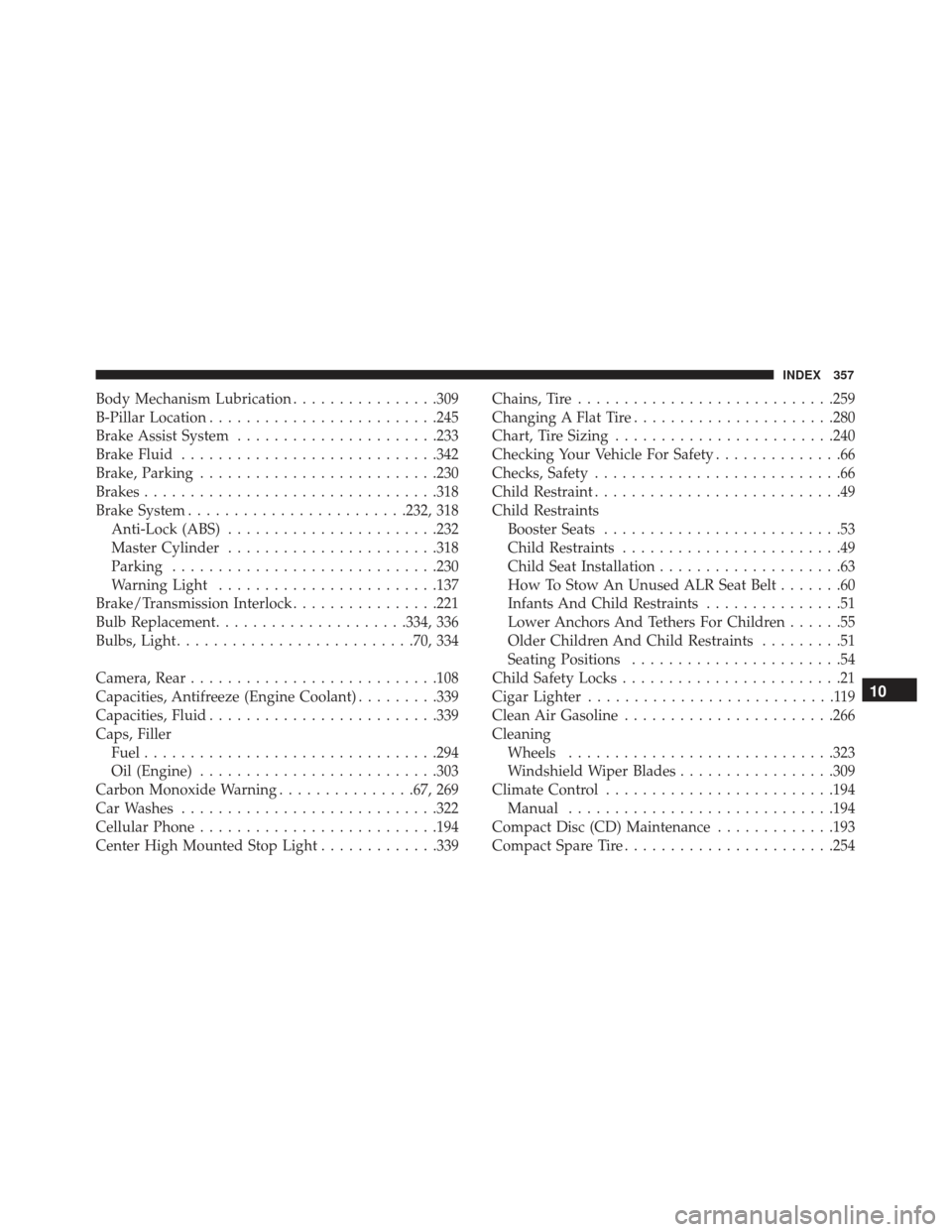
Body Mechanism Lubrication................309
B-Pillar Location ........................ .245
Brake Assist System ..................... .233
Brake Fluid ............................342
Brake, Parking ..........................230
Brakes ............................... .318
Brake System ........................232, 318
Anti-Lock (ABS) .......................232
Master Cylinder .......................318
Parking ............................ .230
Warning Light ........................137
Brake/Transmission Interlock ................221
Bulb Replacement .....................334, 336
Bulbs, Light ..........................70, 334
Camera, Rear .......................... .108
Capacities, Antifreeze (Engine Coolant) .........339
Capacities, Fluid ........................ .339
Caps, Filler Fuel ............................... .294
Oil (Engine) ..........................303
Carbon Monoxide Warning ...............67, 269
Car Washes ............................322
Cellular Phone ..........................194
Center High Mounted Stop Light .............339Chains, Tire
............................259
Changing A Flat Tire ..................... .280
Chart, Tire Sizing ........................240
Checking Your Vehicle For Safety ..............66
Checks, Safety ...........................66
Child Restraint ...........................49
Child Restraints Booster Seats ..........................53
Child Restraints ........................49
Child Seat Installation ....................63
How To Stow An Unused ALR Seat Belt .......60
Infants And Child Restraints ...............51
Lower Anchors And Tethers For Children ......55
Older Children And Child Restraints .........51
Seating Positions .......................54
Child Safety
Locks ........................21
Cigar Lighter ...........................119
Clean Air Gasoline .......................266
Cleaning Wheels ............................ .323
Windshield Wiper Blades .................309
Climate Control ........................ .194
Manual ............................ .194
Compact Disc (CD) Maintenance .............193
Compact Spare Tire .......................254
10
INDEX 357