check engine FIAT 500L 2017 2.G Owner's Manual
[x] Cancel search | Manufacturer: FIAT, Model Year: 2017, Model line: 500L, Model: FIAT 500L 2017 2.GPages: 370, PDF Size: 3.56 MB
Page 319 of 370
The cap should be inspected and cleaned if there is any
accumulation of foreign material on the sealing sur-
faces.
WARNING!
•Do not open hot engine cooling system. Never
add engine coolant (antifreeze) when the engine
is overheated. Do not loosen or remove the cap to
cool an overheated engine. Heat causes pressure
to build up in the cooling system. To prevent
scalding or injury, do not remove the pressure cap
while the system is hot or under pressure.
• Do not use a pressure cap other than the one
specified for your vehicle. Personal injury or
engine damage may result.
Disposal Of Used Engine Coolant
Used ethylene glycol-based engine coolant (antifreeze)
is a regulated substance requiring proper disposal.
Check with your local authorities to determine the
disposal rules for your community. To prevent ingestion
by animals or children, do not store ethylene glycol-
based engine coolant in open containers or allow it to remain in puddles on the ground. If ingested by a child
or pet, seek emergency assistance immediately. Clean
up any ground spills immediately.
Coolant Level
The coolant expansion bottle provides a quick visual
method for determining that the coolant level is ad-
equate. With the engine off and cold, the level of the
engine coolant (antifreeze) in the bottle should be
between the “MIN” and “MAX” marks.
As long as the engine operating temperature is satisfac-
tory, the coolant bottle need only be checked once a
month.
When additional engine coolant (antifreeze) is needed
to maintain the proper level, it should be added to the
coolant bottle. Do not overfill.
Points To Remember
NOTE:
When the vehicle is stopped after a few miles/
kilometers of operation, you may observe vapor coming
from the front of the engine compartment. This is
normally a result of moisture from rain, snow, or high
humidity accumulating on the radiator and being va-
porized when the thermostat opens, allowing hot en-
gine coolant (antifreeze) to enter the radiator.
7
MAINTAINING YOUR VEHICLE 317
Page 320 of 370
If an examination of your engine compartment shows
no evidence of radiator or hose leaks, the vehicle may
be safely driven. The vapor will soon dissipate.
•Do not overfill the coolant expansion bottle.
• Check the coolant freeze point in the radiator and in
the coolant expansion bottle. If engine coolant (anti-
freeze) needs to be added, the contents of the coolant
expansion bottle must also be protected against freez-
ing.
• If frequent engine coolant (antifreeze) additions are
required, the cooling system should be pressure
tested for leaks.
• Maintain engine coolant (antifreeze) concentration at
a minimum of 50% OAT coolant (conforming to
MS.90032) and distilled water for proper corrosion
protection of your engine which contains aluminum
components.
• Keep the front of the radiator clean. If your vehicle is
equipped with air conditioning, keep the front of the
condenser clean.
• Do not change the thermostat for Summer or Winter
operation. If replacement is ever necessary, install
ONLY the correct type thermostat. Other designs may result in unsatisfactory engine coolant (anti-
freeze) performance, poor gas mileage, and increased
emissions.
Brake System
In order to assure brake system performance, all brake
system components should be inspected periodically.
Refer to the “Maintenance Schedule” for the proper
maintenance intervals.
WARNING!
Riding the brakes can lead to brake failure and
possibly a collision. Driving with your foot resting
or riding on the brake pedal can result in abnor-
mally high brake temperatures, excessive lining
wear, and possible brake damage. Riding the
brakes may also reduce braking capacity in an
emergency.
Brake Master Cylinder
The fluid level in the master cylinder should be checked
when performing under hood services, or immediately
if the “Brake Warning Light” is on.
318 MAINTAINING YOUR VEHICLE
Page 321 of 370
Be sure to clean the top of the master cylinder area
before removing the cap. If necessary, add fluid to bring
the fluid level up to the requirements described on the
brake fluid reservoir. Fluid level can be expected to fall
as the brake pads wear. The brake fluid level should be
checked when the pads are replaced. However, low
fluid level may be caused by a leak and a checkup may
be needed.
Use only manufacturer’s recommended brake fluid.
Refer to “Fluids, Lubricants, And Genuine Parts” in
“Maintaining Your Vehicle” for further information.
WARNING!
•Use only manufacturer’s recommended brake
fluid. Refer to “Fluids, Lubricants, And Genuine
Parts” in “Maintaining Your Vehicle” for further
information. Using the wrong type of brake fluid
can severely damage your brake system and/or
impair its performance. The proper type of brake
fluid for your vehicle is also identified on the
original factory installed hydraulic master cylin-
der reservoir.
(Continued)
WARNING! (Continued)
•To avoid contamination from foreign matter or
moisture, use only new brake fluid or fluid that
has been in a tightly closed container. Keep the
master cylinder reservoir cap secured at all times.
Brake fluid in a open container absorbs moisture
from the air resulting in a lower boiling point.
This may cause it to boil unexpectedly during
hard or prolonged braking, resulting in sudden
brake failure. This could result in a collision.
• Overfilling the brake fluid reservoir can result in
spilling brake fluid on hot engine parts, causing
the brake fluid to catch fire. Brake fluid can also
damage painted and vinyl surfaces, care should
be taken to avoid its contact with these surfaces.
• Do not allow petroleum-based fluid to contami-
nate the brake fluid. Brake seal components could
be damaged, causing partial or complete brake
failure. This could result in a collision.
7
MAINTAINING YOUR VEHICLE 319
Page 322 of 370
Automatic Transmission
Selection Of Lubricant
It is important to use the proper transmission fluid to
ensure optimum transmission performance and life.
Use only the manufacturer ’s specified transmission
fluid. Refer to “Fluids, Lubricants, And Genuine Parts”
in this section for fluid specifications. It is important to
maintain the transmission fluid at the correct level
using the recommended fluid. No chemical flushes
should be used in any transmission; only the approved
lubricant should be used.
CAUTION!
Using a transmission fluid other than the manufac-
turer ’s recommended fluid may cause deterioration
in transmission shift quality and/or torque con-
verter shudder. Refer to “Fluids, Lubricants, And
Genuine Parts” in this section for fluid specifica-
tions.
Special Additives
The manufacturer strongly recommends against using
any special additives in the transmission.Automatic Transmission Fluid (ATF) is an engineered
product and its performance may be impaired by
supplemental additives. Therefore, do not add any fluid
additives to the transmission. The only exception to this
policy is the use of special dyes for diagnosing fluid
leaks. Avoid using transmission sealers as they may
adversely affect seals.
CAUTION!
Do not use chemical flushes in your transmission as
the chemicals can damage your transmission com-
ponents. Such damage is not covered by the New
Vehicle Limited Warranty.
Fluid Level Check
The fluid level is preset at the factory and does not
require adjustment under normal operating conditions.
Routine fluid level checks are not required, therefore the
transmission has no dipstick. Your authorized dealer
can check your transmission fluid level using special
service tools. If you notice fluid leakage or transmission
malfunction, visit your authorized dealer immediately
to have the transmission fluid level checked. Operating
320 MAINTAINING YOUR VEHICLE
Page 329 of 370
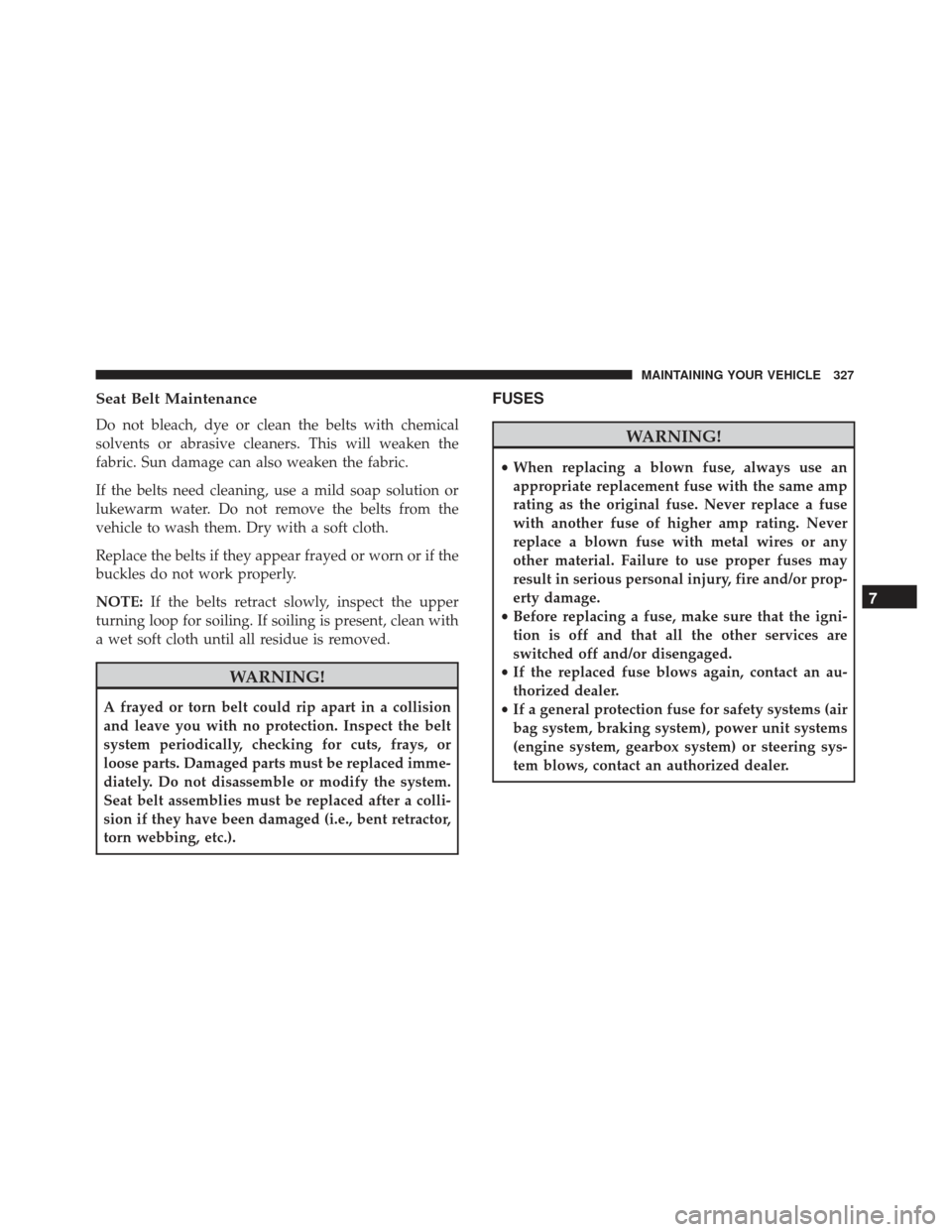
Seat Belt Maintenance
Do not bleach, dye or clean the belts with chemical
solvents or abrasive cleaners. This will weaken the
fabric. Sun damage can also weaken the fabric.
If the belts need cleaning, use a mild soap solution or
lukewarm water. Do not remove the belts from the
vehicle to wash them. Dry with a soft cloth.
Replace the belts if they appear frayed or worn or if the
buckles do not work properly.
NOTE:If the belts retract slowly, inspect the upper
turning loop for soiling. If soiling is present, clean with
a wet soft cloth until all residue is removed.
WARNING!
A frayed or torn belt could rip apart in a collision
and leave you with no protection. Inspect the belt
system periodically, checking for cuts, frays, or
loose parts. Damaged parts must be replaced imme-
diately. Do not disassemble or modify the system.
Seat belt assemblies must be replaced after a colli-
sion if they have been damaged (i.e., bent retractor,
torn webbing, etc.).
FUSES
WARNING!
• When replacing a blown fuse, always use an
appropriate replacement fuse with the same amp
rating as the original fuse. Never replace a fuse
with another fuse of higher amp rating. Never
replace a blown fuse with metal wires or any
other material. Failure to use proper fuses may
result in serious personal injury, fire and/or prop-
erty damage.
• Before replacing a fuse, make sure that the igni-
tion is off and that all the other services are
switched off and/or disengaged.
• If the replaced fuse blows again, contact an au-
thorized dealer.
• If a general protection fuse for safety systems (air
bag system, braking system), power unit systems
(engine system, gearbox system) or steering sys-
tem blows, contact an authorized dealer.
7
MAINTAINING YOUR VEHICLE 327
Page 346 of 370
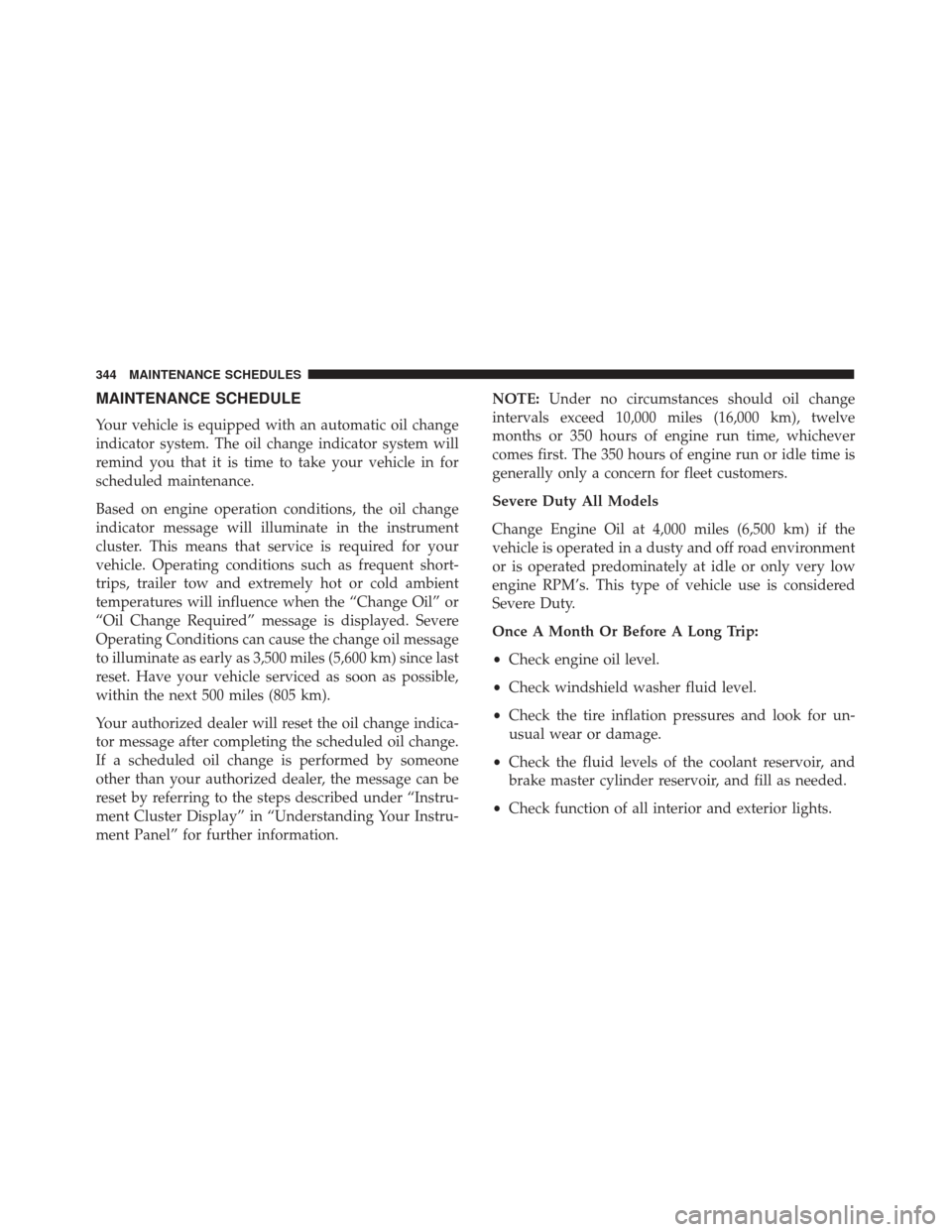
MAINTENANCE SCHEDULE
Your vehicle is equipped with an automatic oil change
indicator system. The oil change indicator system will
remind you that it is time to take your vehicle in for
scheduled maintenance.
Based on engine operation conditions, the oil change
indicator message will illuminate in the instrument
cluster. This means that service is required for your
vehicle. Operating conditions such as frequent short-
trips, trailer tow and extremely hot or cold ambient
temperatures will influence when the “Change Oil” or
“Oil Change Required” message is displayed. Severe
Operating Conditions can cause the change oil message
to illuminate as early as 3,500 miles (5,600 km) since last
reset. Have your vehicle serviced as soon as possible,
within the next 500 miles (805 km).
Your authorized dealer will reset the oil change indica-
tor message after completing the scheduled oil change.
If a scheduled oil change is performed by someone
other than your authorized dealer, the message can be
reset by referring to the steps described under “Instru-
ment Cluster Display” in “Understanding Your Instru-
ment Panel” for further information.NOTE:
Under no circumstances should oil change
intervals exceed 10,000 miles (16,000 km), twelve
months or 350 hours of engine run time, whichever
comes first. The 350 hours of engine run or idle time is
generally only a concern for fleet customers.
Severe Duty All Models
Change Engine Oil at 4,000 miles (6,500 km) if the
vehicle is operated in a dusty and off road environment
or is operated predominately at idle or only very low
engine RPM’s. This type of vehicle use is considered
Severe Duty.
Once A Month Or Before A Long Trip:
• Check engine oil level.
• Check windshield washer fluid level.
• Check the tire inflation pressures and look for un-
usual wear or damage.
• Check the fluid levels of the coolant reservoir, and
brake master cylinder reservoir, and fill as needed.
• Check function of all interior and exterior lights.
344 MAINTENANCE SCHEDULES
Page 347 of 370
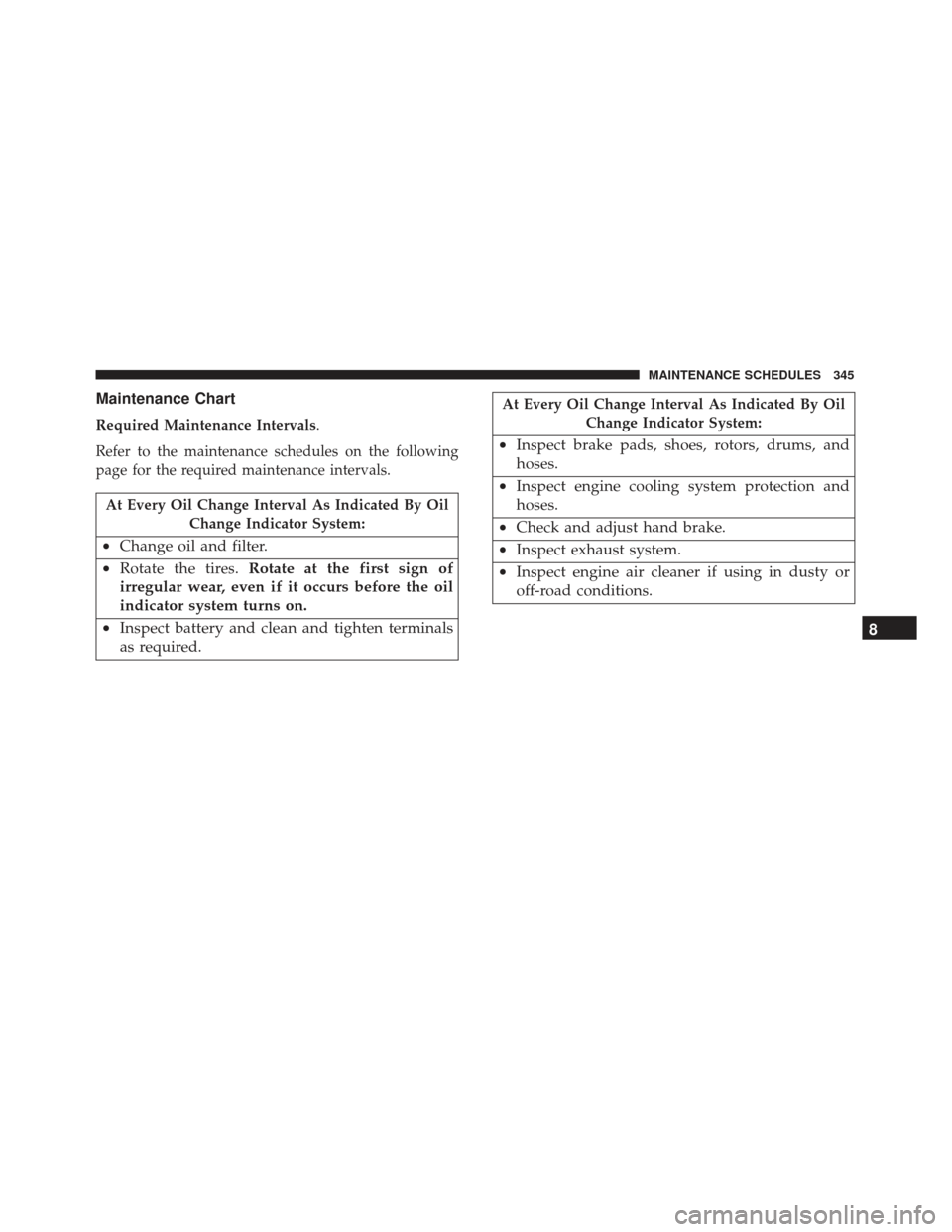
Maintenance Chart
Required Maintenance Intervals.
Refer to the maintenance schedules on the following
page for the required maintenance intervals.
At Every Oil Change Interval As Indicated By OilChange Indicator System:
•Change oil and filter.
• Rotate the tires. Rotate at the first sign of
irregular wear, even if it occurs before the oil
indicator system turns on.
• Inspect battery and clean and tighten terminals
as required.
At Every Oil Change Interval As Indicated By Oil
Change Indicator System:
•Inspect brake pads, shoes, rotors, drums, and
hoses.
• Inspect engine cooling system protection and
hoses.
• Check and adjust hand brake.
• Inspect exhaust system.
• Inspect engine air cleaner if using in dusty or
off-road conditions.
8
MAINTENANCE SCHEDULES 345
Page 358 of 370
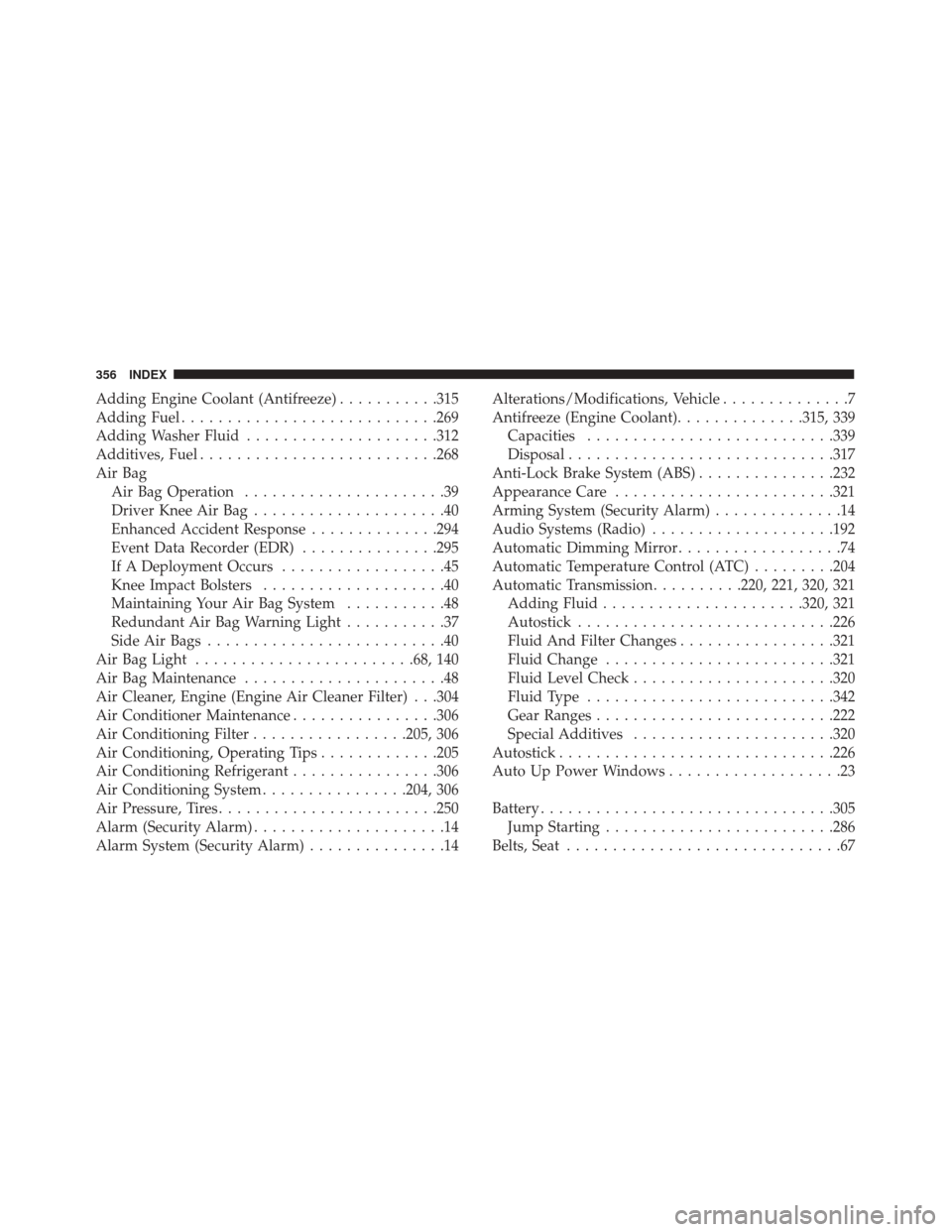
Adding Engine Coolant (Antifreeze)...........315
Adding Fuel ............................269
Adding Washer Fluid .....................312
Additives, Fuel ..........................268
Air Bag Air Bag Operation ......................39
Driver Knee Air Bag .....................40
Enhanced Accident Response ..............294
Event Data Recorder (EDR) ...............295
If A Deployment Occurs ..................45
Knee Impact Bolsters ....................40
Maintaining Your Air Bag System ...........48
Redundant Air Bag Warning Light ...........37
Side Air Bags ..........................40
Air Bag Light ........................68, 140
Air Bag Maintenance ......................48
Air Cleaner, Engine (Engine Air Cleaner Filter) . . .304
Air Conditioner Maintenance ................306
Air Conditioning Filter .................205, 306
Air Conditioning, Operating Tips .............205
Air Conditioning Refrigerant ................306
Air Conditioning System ................204, 306
Air Pressure, Tires ........................250
Alarm (Security Alarm) .....................14
Alarm System (Security Alarm) ...............14Alterations/Modifications, Vehicle
..............7
Antifreeze (Engine Coolant) ..............315, 339
Capacities .......................... .339
Disposal ............................ .317
Anti-Lock Brake System (ABS) ...............232
Appearance Care ........................321
Arming System (Security Alarm) ..............14
Audio Systems (Radio) ....................192
Automatic Dimming Mirror ..................74
Automatic Temperature Control (ATC) .........204
Automatic Transmission ..........220, 221, 320, 321
Adding Fluid ..................... .320, 321
Autostick ............................226
Fluid And Filter Changes .................321
Fluid Change ........................ .321
Fluid Level
Check ..................... .320
Fluid Type .......................... .342
Gear Ranges ..........................222
Special Additives ..................... .320
Autostick ............................. .226
Auto Up Power Windows ...................23
Battery ............................... .305
Jump Starting ........................ .286
Belts, Seat ..............................67
356 INDEX
Page 359 of 370
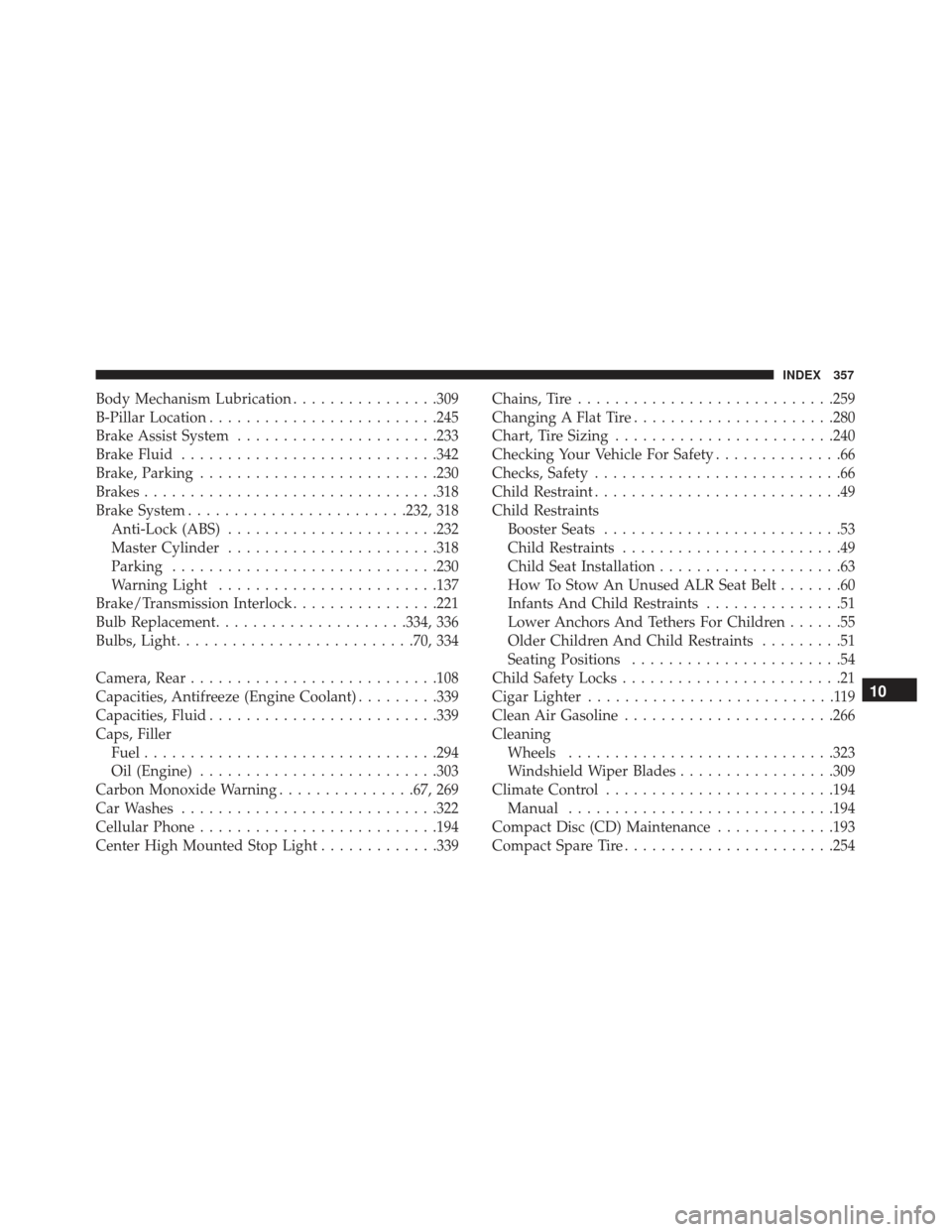
Body Mechanism Lubrication................309
B-Pillar Location ........................ .245
Brake Assist System ..................... .233
Brake Fluid ............................342
Brake, Parking ..........................230
Brakes ............................... .318
Brake System ........................232, 318
Anti-Lock (ABS) .......................232
Master Cylinder .......................318
Parking ............................ .230
Warning Light ........................137
Brake/Transmission Interlock ................221
Bulb Replacement .....................334, 336
Bulbs, Light ..........................70, 334
Camera, Rear .......................... .108
Capacities, Antifreeze (Engine Coolant) .........339
Capacities, Fluid ........................ .339
Caps, Filler Fuel ............................... .294
Oil (Engine) ..........................303
Carbon Monoxide Warning ...............67, 269
Car Washes ............................322
Cellular Phone ..........................194
Center High Mounted Stop Light .............339Chains, Tire
............................259
Changing A Flat Tire ..................... .280
Chart, Tire Sizing ........................240
Checking Your Vehicle For Safety ..............66
Checks, Safety ...........................66
Child Restraint ...........................49
Child Restraints Booster Seats ..........................53
Child Restraints ........................49
Child Seat Installation ....................63
How To Stow An Unused ALR Seat Belt .......60
Infants And Child Restraints ...............51
Lower Anchors And Tethers For Children ......55
Older Children And Child Restraints .........51
Seating Positions .......................54
Child Safety
Locks ........................21
Cigar Lighter ...........................119
Clean Air Gasoline .......................266
Cleaning Wheels ............................ .323
Windshield Wiper Blades .................309
Climate Control ........................ .194
Manual ............................ .194
Compact Disc (CD) Maintenance .............193
Compact Spare Tire .......................254
10
INDEX 357
Page 361 of 370
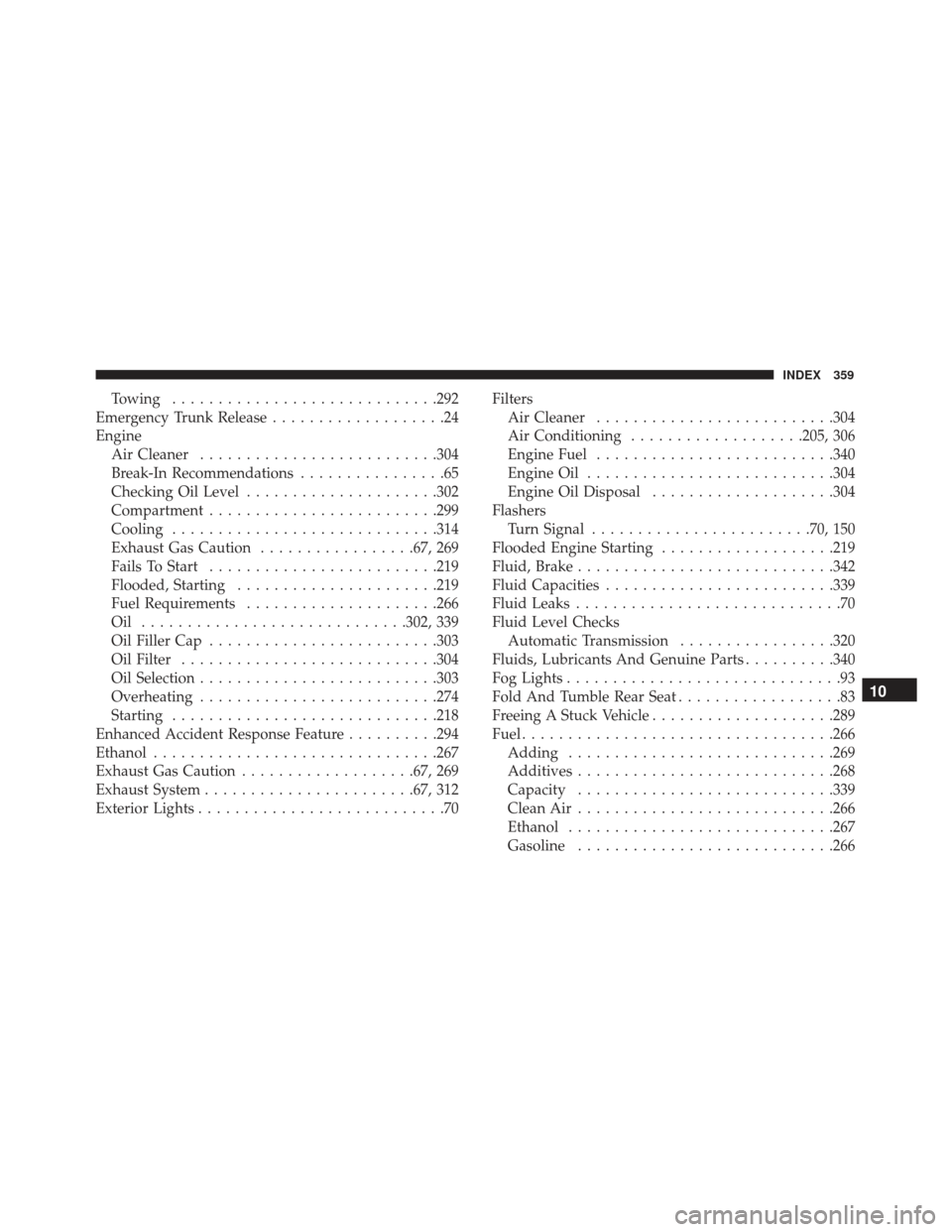
Towing............................ .292
Emergency Trunk Release ...................24
Engine Air Cleaner ..........................304
Break-In Recommendations ................65
Checking Oil Level .....................302
Compartment ........................ .299
Cooling ............................ .314
Exhaust Gas Caution .................67, 269
Fails To Start ........................ .219
Flooded, Starting ..................... .219
Fuel Requirements .....................266
Oil .............................302, 339
Oil Filler Cap ........................ .303
Oil Filter ............................304
Oil Selection ..........................303
Overheating ..........................274
Starting ............................ .218
Enhanced Accident Response Feature ..........294
Ethanol ...............................267
Exhaust Gas Caution ...................67, 269
Exhaust System .......................67, 312
Exterior Lights ...........................70 Filters
Air Cleaner ..........................304
Air Conditioning ...................205, 306
Engine Fuel ..........................340
Engine Oil .......................... .304
Engine Oil Disposal ....................304
Flashers Turn Signal ........................70, 150
Flooded Engine Starting ...................219
Fluid, Brake ............................342
Fluid Capacities ........................ .339
Fluid Leaks .............................70
Fluid Level Checks Automatic Transmission .................320
Fluids, Lubricants And Genuine Parts ..........340
Fog Lights .............................. 9
3
Fold And Tumble Rear Seat ..................83
Freeing A Stuck Vehicle ....................289
Fuel ................................. .266
Adding ............................ .269
Additives ............................268
Capacity ............................339
Clean Air ............................266
Ethanol ............................ .267
Gasoline ............................26610
INDEX 359