flat tire FIAT 500L 2017 2.G Owner's Manual
[x] Cancel search | Manufacturer: FIAT, Model Year: 2017, Model line: 500L, Model: FIAT 500L 2017 2.GPages: 370, PDF Size: 3.56 MB
Page 265 of 370
(20°C) and the measured tire pressure is 27 psi (186
kPa), a temperature drop to 20°F (-7°C) will decrease
the tire pressure to approximately 23 psi (159 kPa). This
tire pressure is sufficiently low enough to turn on the
Tire Pressure Monitoring Telltale Light. Driving the
vehicle may cause the tire pressure to rise to approxi-
mately 27 psi (186 kPa), but the Tire Pressure Monitor-
ing Telltale Light will still be on. In this situation, the
Tire Pressure Monitoring Telltale Light will turn off only
after the tires are inflated to the vehicle’s recommended
cold tire pressure value.
CAUTION!
•The TPMS has been optimized for the original
equipment tires and wheels. TPMS pressures and
warnings have been established for the tire size
equipped on your vehicle. Undesirable system
operation or sensor damage may result when
using replacement equipment that is not of the
same size, type, and/or style. Aftermarket wheels
can cause sensor damage. Using aftermarket tire
sealants may cause the Tire Pressure Monitoring
System (TPMS) sensor to become inoperable.
(Continued)
CAUTION! (Continued)
After using an aftermarket tire sealant it is recom-
mended that you take your vehicle to an autho-
rized dealership to have your sensor function
checked.
• After inspecting or adjusting the tire pressure,
always reinstall the valve stem cap. This will
prevent moisture and dirt from entering the valve
stem, which could damage the Tire Pressure
Monitoring Sensor.
NOTE:
• The TPMS is not intended to replace normal tire care
and maintenance, or to provide warning of a tire
failure or condition.
• The TPMS should not be used as a tire pressure
gauge while adjusting your tire pressure.
• Driving on a significantly under-inflated tire causes
the tire to overheat and can lead to tire failure.
Under-inflation also reduces fuel efficiency and tire
tread life, and may affect the vehicle’s handling and
stopping ability.
5
STARTING AND OPERATING 263
Page 266 of 370
•The TPMS is not a substitute for proper tire mainte-
nance, and it is the driver ’s responsibility to maintain
correct tire pressure using an accurate tire gauge,
even if under-inflation has not reached the level to
trigger illumination of the Tire Pressure Monitoring
Telltale Light.
• Seasonal temperature changes will affect tire pres-
sure, and the TPMS will monitor the actual tire
pressure in the tire.
Base System
This is the TPMS warning indicator located in
the instrument cluster.
The TPMS uses wireless technology with wheel rim
mounted electronic sensors to monitor tire pressure
levels. Sensors, mounted to each wheel as part of the
valve stem, transmit tire pressure readings to the Re-
ceiver Module.
NOTE: It is particularly important for you to check the
tire pressure in all of the tires on your vehicle regularly
and to maintain the proper pressure. The TPMS consists of the following components:
•
Receiver Module.
• Four Tire Pressure Monitoring Sensors.
• Tire Pressure Monitoring Telltale Light.
Tire Pressure Monitoring Low Pressure Warnings
The Tire Pressure Monitoring Telltale Light will illumi-
nate in the instrument cluster, an acoustic signal will be
activated, and the “Check left or right front/rear tire”
text message will display when one or more of the four
active road tire pressures are low. Should this occur, you
should stop as soon as possible, check the inflation
pressure of each tire on your vehicle, and inflate each
tire to the vehicle’s recommended cold placard pressure
value. The system will automatically update and the
Tire Pressure Monitoring Light will extinguish once the
updated tire pressures have been received. The vehicle
may need to be driven for up to 20 minutes above
15 mph (24 km/h) to receive this information.
Check TPMS Warnings
The Tire Pressure Monitoring Telltale Light will flash on
and off for 75 seconds and remain on solid when a
system fault is detected, an audible chime will be
264 STARTING AND OPERATING
Page 279 of 370
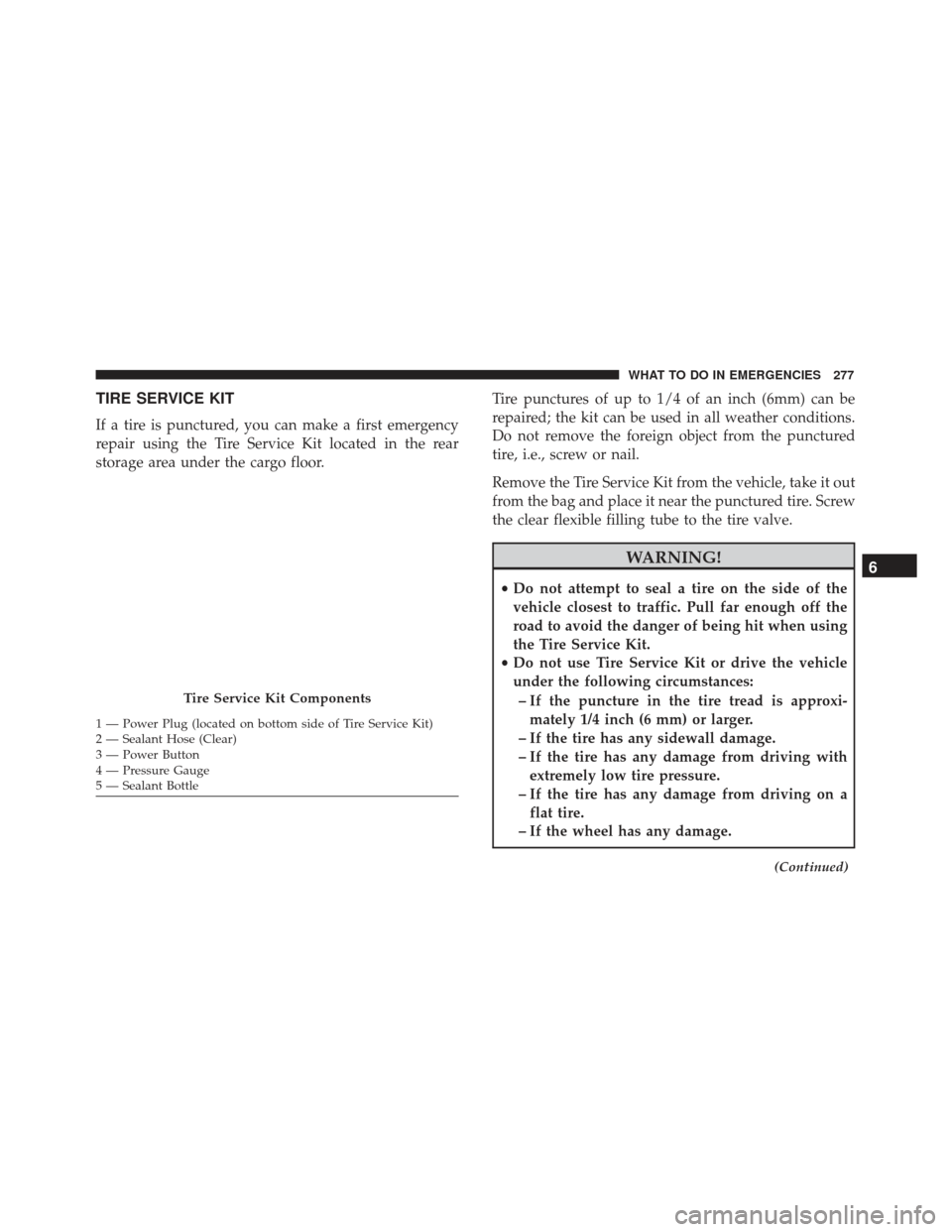
TIRE SERVICE KIT
If a tire is punctured, you can make a first emergency
repair using the Tire Service Kit located in the rear
storage area under the cargo floor.Tire punctures of up to 1/4 of an inch (6mm) can be
repaired; the kit can be used in all weather conditions.
Do not remove the foreign object from the punctured
tire, i.e., screw or nail.
Remove the Tire Service Kit from the vehicle, take it out
from the bag and place it near the punctured tire. Screw
the clear flexible filling tube to the tire valve.
WARNING!
•
Do not attempt to seal a tire on the side of the
vehicle closest to traffic. Pull far enough off the
road to avoid the danger of being hit when using
the Tire Service Kit.
• Do not use Tire Service Kit or drive the vehicle
under the following circumstances:
– If the puncture in the tire tread is approxi- mately 1/4 inch (6 mm) or larger.
– If the tire has any sidewall damage.
– If the tire has any damage from driving with extremely low tire pressure.
– If the tire has any damage from driving on a flat tire.
– If the wheel has any damage.
(Continued)
Tire Service Kit Components
1 — Power Plug (located on bottom side of Tire Service Kit)
2 — Sealant Hose (Clear)
3 — Power Button
4 — Pressure Gauge
5 — Sealant Bottle
6
WHAT TO DO IN EMERGENCIES 277
Page 280 of 370
WARNING!(Continued)
– If you are unsure of the condition of the tire or
the wheel.
• Keep Tire Service Kit away from open flames or
heat source.
• A loose Tire Service Kit thrown forward in a
collision or hard stop could endanger the occu-
pants of the vehicle. Always stow the Tire Service
Kit in the place provided. Failure to follow these
warnings can result in injuries that are serious or
fatal to you, your passengers, and others around
you.
• Take care not to allow the contents of Tire Service
Kit to come in contact with hair, eyes, or clothing.
Tire Service Kit sealant is harmful if inhaled,
swallowed, or absorbed through the skin. It
causes skin, eye, and respiratory irritation. Flush
immediately with plenty of water if there is any
contact with eyes or skin. Change clothing as soon
as possible, if there is any contact with clothing.
• Tire Service Kit Sealant solution contains latex. In
case of an allergic reaction or rash, consult a
physician immediately. Keep Tire Service Kit out
(Continued)
WARNING! (Continued)
of reach of children. If swallowed, rinse mouth
immediately with plenty of water and drink
plenty of water. Do not induce vomiting! Consult
a physician immediately.
Insert the power plug into the vehicle power outlet
socket. Start the vehicle engine.
Push the Tire Service Kit power button to the “I”
position. The electric compressor will be turned on,
sealant and air will inflate the tire.
Minimum 26 psi (1.8 bar) of pressure should be reached
within 20 minutes. If the pressure has not been reached,
turn off and remove the Tire Service Kit, drive the
vehicle 30 feet (10 meters) back and forth, to better
distribute the sealant inside the tire.
Attach the Clear flexible filling and tube of the com-
pressor directly to the tire valve and repeat the inflation
process.
When the correct pressure has been reached, start
driving the vehicle to uniformly distribute the sealant
inside the tire. After 10 minutes, stop and check the tire
pressure. If the pressure is below 19 psi (1.3 bar), do not
278 WHAT TO DO IN EMERGENCIES
Page 281 of 370
drive the vehicle, as the tire is too damaged, contact the
nearest authorized dealer.
WARNING!
Tire Service Kit is not a permanent flat tire repair.
Have the tire inspected and repaired or replaced
after using Tire Service Kit. Do not exceed 65 mph
(110 km/h) until the tire is repaired or replaced.
Failure to follow this warning can result in injuries
that are serious or fatal to you, your passengers, and
others around you. Have the tire checked as soon as
possible at an authorized dealer.
If the pressure is at 19 psi (1.3 bar) or above, repeat the
inflation process to reach the correct tire pressure and
continue driving.
Peel off the warning label from the bottle and place it on
the dashboard as a reminder to the driver that the tire
has been treated with the Tire Service Kit
WARNING!
The metal end fitting from Power Plug may get hot
after use, so it should be handled carefully. NOTE:
Replace the sealant canister prior to the expira-
tion date at your authorized dealer.
WARNING!
Store the sealant canister in its special compart-
ment, away from sources of heat. Failure to follow
this WARNING may result in sealant canister rup-
ture and serious injury or death.
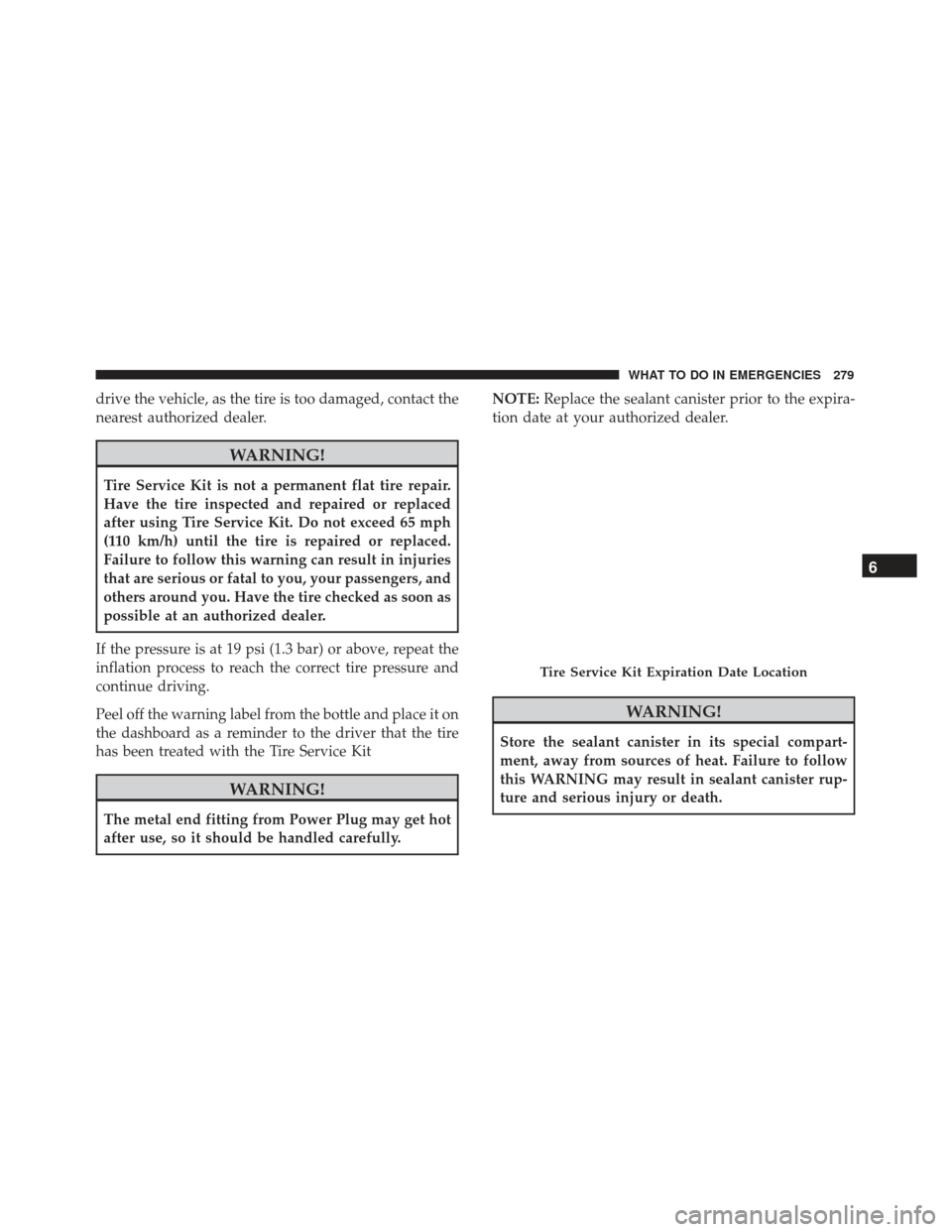
Tire Service Kit Expiration Date Location
6
WHAT TO DO IN EMERGENCIES 279
Page 285 of 370
CAUTION!
Do not attempt to raise the vehicle by jacking on
locations other than those indicated in the Jacking
Instructions for this vehicle.
1. Remove the spare tire, jack, and wheel bolt wrench.
2. If equipped with aluminum wheels where the center cap covers the wheel bolts, use the wheel bolt
wrench to pry the center cap off carefully before
raising the vehicle. 3. Before raising the vehicle, use the wheel bolt wrench
to loosen, but not remove, the wheel bolts on the
wheel with the flat tire. Turn the wheel bolts coun-
terclockwise one turn while the wheel is still on the
ground.
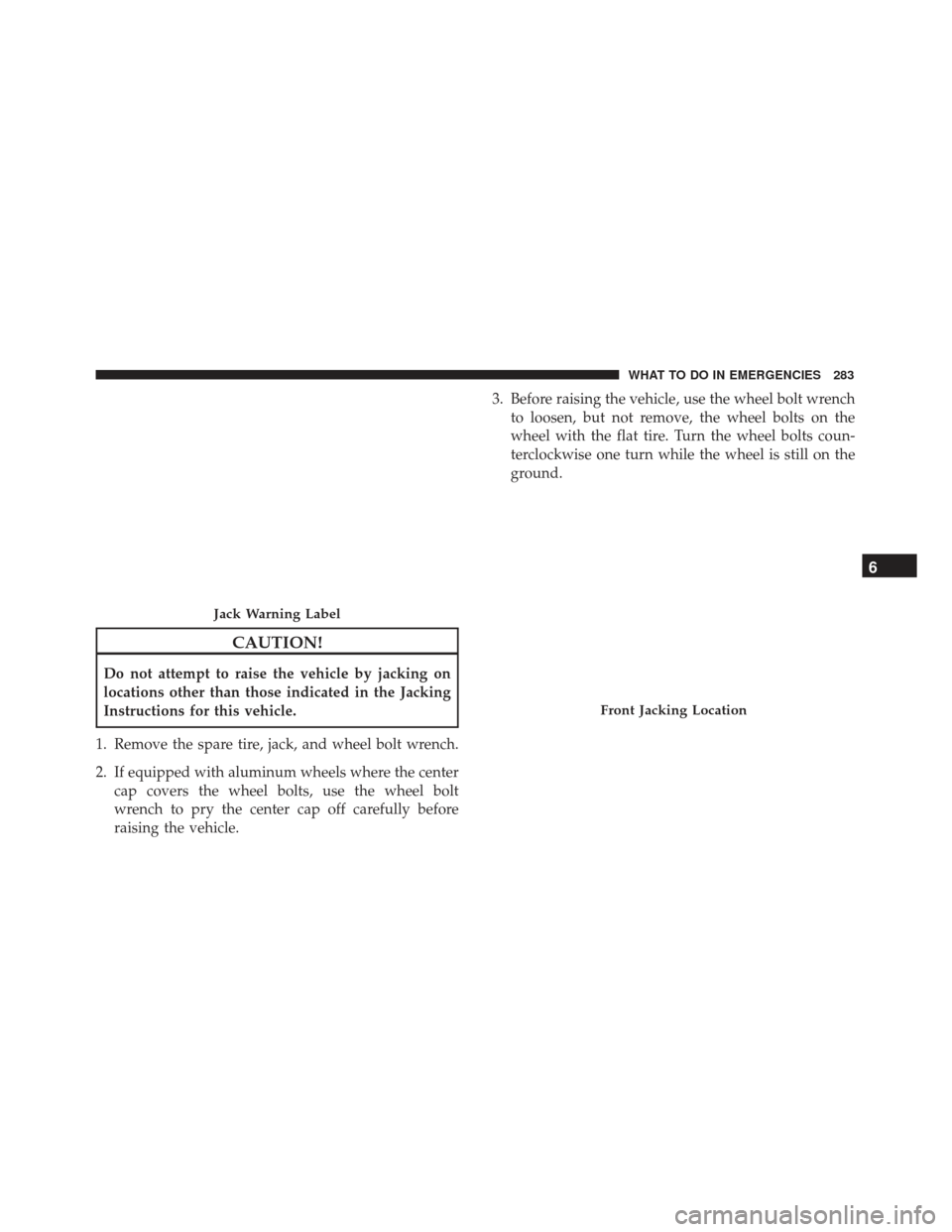
Jack Warning Label
Front Jacking Location
6
WHAT TO DO IN EMERGENCIES 283
Page 286 of 370
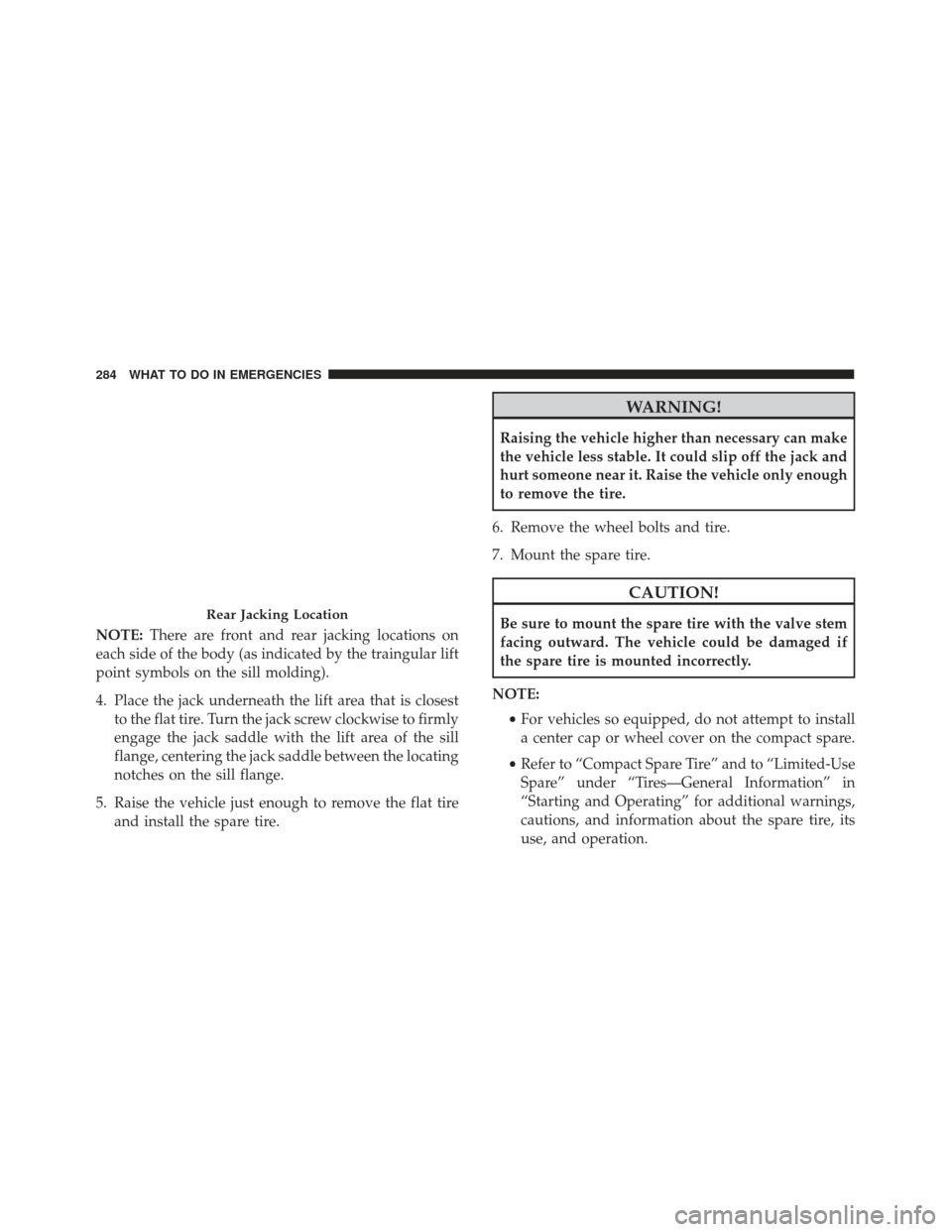
NOTE:There are front and rear jacking locations on
each side of the body (as indicated by the traingular lift
point symbols on the sill molding).
4. Place the jack underneath the lift area that is closest to the flat tire. Turn the jack screw clockwise to firmly
engage the jack saddle with the lift area of the sill
flange, centering the jack saddle between the locating
notches on the sill flange.
5. Raise the vehicle just enough to remove the flat tire and install the spare tire.
WARNING!
Raising the vehicle higher than necessary can make
the vehicle less stable. It could slip off the jack and
hurt someone near it. Raise the vehicle only enough
to remove the tire.
6. Remove the wheel bolts and tire.
7. Mount the spare tire.
CAUTION!
Be sure to mount the spare tire with the valve stem
facing outward. The vehicle could be damaged if
the spare tire is mounted incorrectly.
NOTE: •For vehicles so equipped, do not attempt to install
a center cap or wheel cover on the compact spare.
• Refer to “Compact Spare Tire” and to “Limited-Use
Spare” under “Tires—General Information” in
“Starting and Operating” for additional warnings,
cautions, and information about the spare tire, its
use, and operation.Rear Jacking Location
284 WHAT TO DO IN EMERGENCIES
Page 287 of 370
8. Install the wheel bolts with the threaded end of thewheel bolt toward the wheel. Lightly tighten the
wheel bolts.
WARNING!
•To avoid the risk of forcing the vehicle off the
jack, do not tighten the lug nuts fully until the
vehicle has been lowered. Failure to follow this
warning may result in personal injury.
• To avoid possible personal injury, handle the
wheel covers with care to avoid contact with any
sharp edges.
9. Lower the vehicle to the ground by turning the jack handle counterclockwise.
10. Finish tightening the wheel bolts. Push down on the wrench while at the end of the handle for increased
leverage. Tighten the wheel bolts in a star pattern
until each wheel bolt has been tightened twice.
Refer to Torque Specifications in this section for
proper lug nut torque. If in doubt about the correct
tightness, have them checked with a torque wrench
by your authorized dealer or at a service station. 11. Stow the jack, tools and flat tire.
WARNING!
A loose tire or jack thrown forward in a collision or
hard stop could endanger the occupants of the
vehicle. Always stow the jack parts and the spare
tire in the places provided. Have the deflated (flat)
tire repaired or replaced immediately.
Spare Tire Stowage
Rotate the jack wrench tool on the winch drive nut
clockwise (the flat tire must not be connected to the
winch) until effort becomes heavy and an audible click
is heard indicating the winch is properly stowed.
Cover the flat tire with the Emergency Spare Tire Bag
and stow the flat tire into the trunk.
CAUTION!
The winch mechanism is designed for use with the
jack wrench extension tool only. Use of air wrench
or power tool may damage the winch.
6
WHAT TO DO IN EMERGENCIES 285
Page 346 of 370
MAINTENANCE SCHEDULE
Your vehicle is equipped with an automatic oil change
indicator system. The oil change indicator system will
remind you that it is time to take your vehicle in for
scheduled maintenance.
Based on engine operation conditions, the oil change
indicator message will illuminate in the instrument
cluster. This means that service is required for your
vehicle. Operating conditions such as frequent short-
trips, trailer tow and extremely hot or cold ambient
temperatures will influence when the “Change Oil” or
“Oil Change Required” message is displayed. Severe
Operating Conditions can cause the change oil message
to illuminate as early as 3,500 miles (5,600 km) since last
reset. Have your vehicle serviced as soon as possible,
within the next 500 miles (805 km).
Your authorized dealer will reset the oil change indica-
tor message after completing the scheduled oil change.
If a scheduled oil change is performed by someone
other than your authorized dealer, the message can be
reset by referring to the steps described under “Instru-
ment Cluster Display” in “Understanding Your Instru-
ment Panel” for further information.NOTE:
Under no circumstances should oil change
intervals exceed 10,000 miles (16,000 km), twelve
months or 350 hours of engine run time, whichever
comes first. The 350 hours of engine run or idle time is
generally only a concern for fleet customers.
Severe Duty All Models
Change Engine Oil at 4,000 miles (6,500 km) if the
vehicle is operated in a dusty and off road environment
or is operated predominately at idle or only very low
engine RPM’s. This type of vehicle use is considered
Severe Duty.
Once A Month Or Before A Long Trip:
• Check engine oil level.
• Check windshield washer fluid level.
• Check the tire inflation pressures and look for un-
usual wear or damage.
• Check the fluid levels of the coolant reservoir, and
brake master cylinder reservoir, and fill as needed.
• Check function of all interior and exterior lights.
344 MAINTENANCE SCHEDULES
Page 359 of 370
Body Mechanism Lubrication................309
B-Pillar Location ........................ .245
Brake Assist System ..................... .233
Brake Fluid ............................342
Brake, Parking ..........................230
Brakes ............................... .318
Brake System ........................232, 318
Anti-Lock (ABS) .......................232
Master Cylinder .......................318
Parking ............................ .230
Warning Light ........................137
Brake/Transmission Interlock ................221
Bulb Replacement .....................334, 336
Bulbs, Light ..........................70, 334
Camera, Rear .......................... .108
Capacities, Antifreeze (Engine Coolant) .........339
Capacities, Fluid ........................ .339
Caps, Filler Fuel ............................... .294
Oil (Engine) ..........................303
Carbon Monoxide Warning ...............67, 269
Car Washes ............................322
Cellular Phone ..........................194
Center High Mounted Stop Light .............339Chains, Tire
............................259
Changing A Flat Tire ..................... .280
Chart, Tire Sizing ........................240
Checking Your Vehicle For Safety ..............66
Checks, Safety ...........................66
Child Restraint ...........................49
Child Restraints Booster Seats ..........................53
Child Restraints ........................49
Child Seat Installation ....................63
How To Stow An Unused ALR Seat Belt .......60
Infants And Child Restraints ...............51
Lower Anchors And Tethers For Children ......55
Older Children And Child Restraints .........51
Seating Positions .......................54
Child Safety
Locks ........................21
Cigar Lighter ...........................119
Clean Air Gasoline .......................266
Cleaning Wheels ............................ .323
Windshield Wiper Blades .................309
Climate Control ........................ .194
Manual ............................ .194
Compact Disc (CD) Maintenance .............193
Compact Spare Tire .......................254
10
INDEX 357