radio FIAT 500L 2017 2.G Owner's Guide
[x] Cancel search | Manufacturer: FIAT, Model Year: 2017, Model line: 500L, Model: FIAT 500L 2017 2.GPages: 370, PDF Size: 3.56 MB
Page 268 of 370
General Information
The following regulatory statement applies to all radio
frequency (RF) devices equipped in this vehicle:
This device complies with Part 15 of the FCC Rules and
with Industry Canada license-exempt RSS standard(s).
Operation is subject to the following two conditions:
(1) This device may not cause harmful interference, and
(2) This device must accept any interference received,
including interference that may cause undesired opera-
tion.
NOTE:Changes or modifications not expressly ap-
proved by the party responsible for compliance could
void the user ’s authority to operate the equipment.
FUEL REQUIREMENTS — 1.4L Turbo
This engine is designed to meet all
emission regulations, provide satis-
factory fuel economy and perfor-
mance when using high-quality un-
leaded “Regular” gasoline having a
posted octane number of 87 as speci-
fied by the (R+M)/2 method. For optimum performance and fuel economy the use of
“Premium” 91 octane gasoline or higher is recom-
mended.
While operating on gasoline with an octane number of
87, hearing a light knocking sound from the engine is
not a cause for concern. However, if the engine is heard
making a heavy knocking sound, see your dealer im-
mediately. Use of gasoline with an octane number lower
than 87 can cause engine failure and may void or not be
covered by the New Vehicle Limited Warranty.
Poor quality gasoline can cause problems such as hard
starting, stalling, and hesitations. If you experience
these symptoms, try another brand of gasoline before
considering service for the vehicle.
Reformulated Gasoline
Many areas of the country require the use of cleaner
burning gasoline referred to as “Reformulated Gaso-
line”. Reformulated gasoline contains oxygenates and
are specifically blended to reduce vehicle emissions and
improve air quality.
266 STARTING AND OPERATING
Page 276 of 370
HAZARD WARNING FLASHERS
The Hazard Warning flasher switch is located on the
instrument panel below the radio.Push the switch to turn on the Hazard Warning
flashers. When the switch is activated, all direc-
tional turn signals will flash on and off to warn oncom-
ing traffic of an emergency. Push the switch a second
time to turn off the Hazard Warning flashers.
Do not use this emergency warning system when the
vehicle is in motion. Use it when your vehicle is
disabled and it is creating a safety hazard for other
motorists.
If it is necessary to leave the vehicle to go for service, the
Hazard Warning flashers will continue to operate with
the ignition key removed and the vehicle locked.
NOTE: With extended use, the Hazard Warning flash-
ers may wear down your battery.
IF YOUR ENGINE OVERHEATS
In any of the following situations, you can reduce the
potential for overheating by taking the appropriate
action.
• On the highways — slow down. •
In city traffic — while stopped, place the transmis-
sion in NEUTRAL, but do not increase engine idle
speed.
NOTE: There are steps that you can take to slow down
an impending overheat condition:
• If your air conditioner (A/C) is on, turn it off. The
A/C system adds heat to the engine cooling system
and turning the A/C off can help remove this heat.
• You can also turn the temperature control to maxi-
mum heat, the mode control to floor and the blower
control to high. This allows the heater core to act as a
supplement to the radiator and aids in removing heat
from the engine cooling system.
WARNING!
You or others can be badly burned by hot engine
coolant (antifreeze) or steam from your radiator. If
you see or hear steam coming from under the hood,
do not open the hood until the radiator has had time
to cool. Never try to open a cooling system pressure
cap when the radiator or coolant bottle is hot.
274 WHAT TO DO IN EMERGENCIES
Page 289 of 370
WARNING!(Continued)
•Remove any metal jewelry such as rings, watch
bands and bracelets that could make an inadver-
tent electrical contact. You could be seriously
injured.
• Batteries contain sulfuric acid that can burn your
skin or eyes and generate hydrogen gas which is
flammable and explosive. Keep open flames or
sparks away from the battery.
1. Set the parking brake, place the transmission to PARK and turn the ignition to OFF.
2. Turn off the heater, radio, and all unnecessary elec- trical accessories.
3. Remove the protective cover over the remote posi- tive (+)battery post. To remove the cover, pull
upward on the cover.
4. If using another vehicle to jump-start the battery, park the vehicle within the jumper cables reach, set
the parking brake and make sure the ignition is OFF.
WARNING!
Do not allow vehicles to touch each other as this
could establish a ground connection and personal
injury could result.
Jump-Starting Procedure
WARNING!
Failure to follow this jump-starting procedure
could result in personal injury or property damage
due to battery explosion.
CAUTION!
Failure to follow these procedures could result in
damage to the charging system of the booster ve-
hicle or the discharged vehicle.
NOTE: Before connecting the jumper cables to the
discharged battery, the negative (-)battery cable must
be disconnected from the discharged battery. This is the
only way to successfully jump start the vehicle.
6
WHAT TO DO IN EMERGENCIES 287
Page 328 of 370
To minimize the possibility of scratching the lenses and
reducing light output, avoid wiping with a dry cloth. To
remove road dirt, wash with a mild soap solution
followed by rinsing.
Do not use abrasive cleaning components, solvents,
steel wool or other aggressive material to clean the
lenses.
Glass Surfaces
All glass surfaces should be cleaned on a regular basis
with MOPAR Glass Cleaner, or any commercial
household-type glass cleaner. Never use an abrasive
type cleaner. Use caution when cleaning the inside rear
window equipped with electric defrosters or windows
equipped with radio antennas. Do not use scrapers or
other sharp instrument that may scratch the elements.
When cleaning the rear view mirror, spray cleaner on
the towel or cloth that you are using. Do not spray
cleaner directly on the mirror.
Instrument Panel Cover
The instrument panel cover has a low glare surface
which minimizes reflections on the windshield. Do notuse protectants or other products which may cause
undesirable reflections. Use soap and warm water to
restore the low glare surface.
Instrument Panel Bezels
CAUTION!
When installing hanging air fresheners in your
vehicle, read the installation instructions carefully.
Some air fresheners will damage the finish of
painted or decorated parts if allowed to directly
contact any surface.
Cleaning Plastic Instrument Cluster Lenses
The lenses in front of the instruments in this vehicle are
molded in clear plastic. When cleaning the lenses, care
must be taken to avoid scratching the plastic.
1. Clean with a wet soft cloth. A mild soap solution
may be used, but do not use high alcohol content or
abrasive cleaners. If soap is used, wipe clean with a
clean damp cloth.
2. Dry with a soft cloth.
326 MAINTAINING YOUR VEHICLE
Page 334 of 370
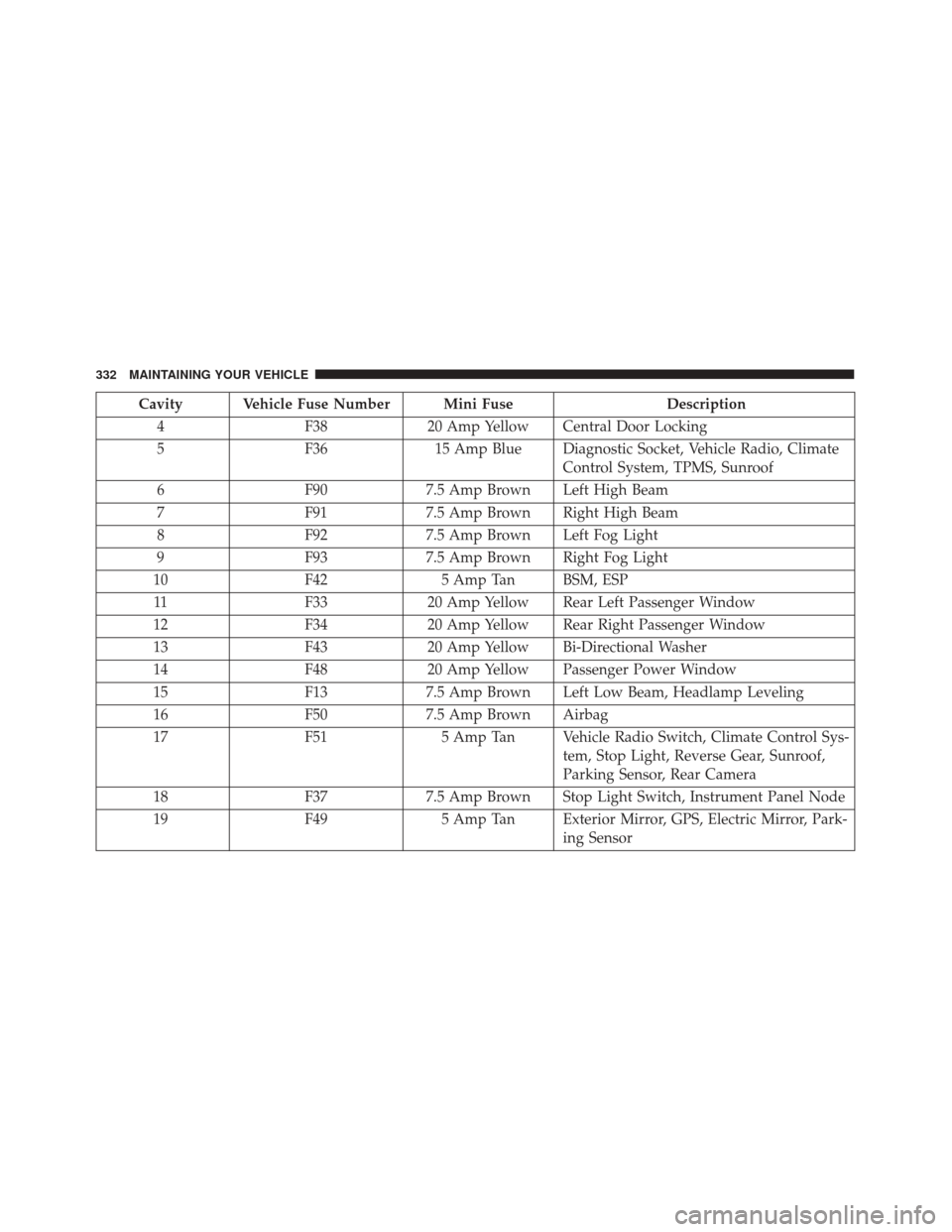
Cavity Vehicle Fuse Number Mini FuseDescription
4 F3820 Amp Yellow Central Door Locking
5 F3615 Amp Blue Diagnostic Socket, Vehicle Radio, Climate
Control System, TPMS, Sunroof
6 F907.5 Amp Brown Left High Beam
7 F917.5 Amp Brown Right High Beam
8 F927.5 Amp Brown Left Fog Light
9 F937.5 Amp Brown Right Fog Light
10 F425 Amp Tan BSM, ESP
11 F3320 Amp Yellow Rear Left Passenger Window
12 F3420 Amp Yellow Rear Right Passenger Window
13 F4320 Amp Yellow Bi-Directional Washer
14 F4820 Amp Yellow Passenger Power Window
15 F137.5 Amp Brown Left Low Beam, Headlamp Leveling
16 F507.5 Amp Brown Airbag
17 F515 Amp Tan Vehicle Radio Switch, Climate Control Sys-
tem, Stop Light, Reverse Gear, Sunroof,
Parking Sensor, Rear Camera
18 F377.5 Amp Brown Stop Light Switch, Instrument Panel Node
19 F495 Amp Tan Exterior Mirror, GPS, Electric Mirror, Park-
ing Sensor
332 MAINTAINING YOUR VEHICLE
Page 358 of 370
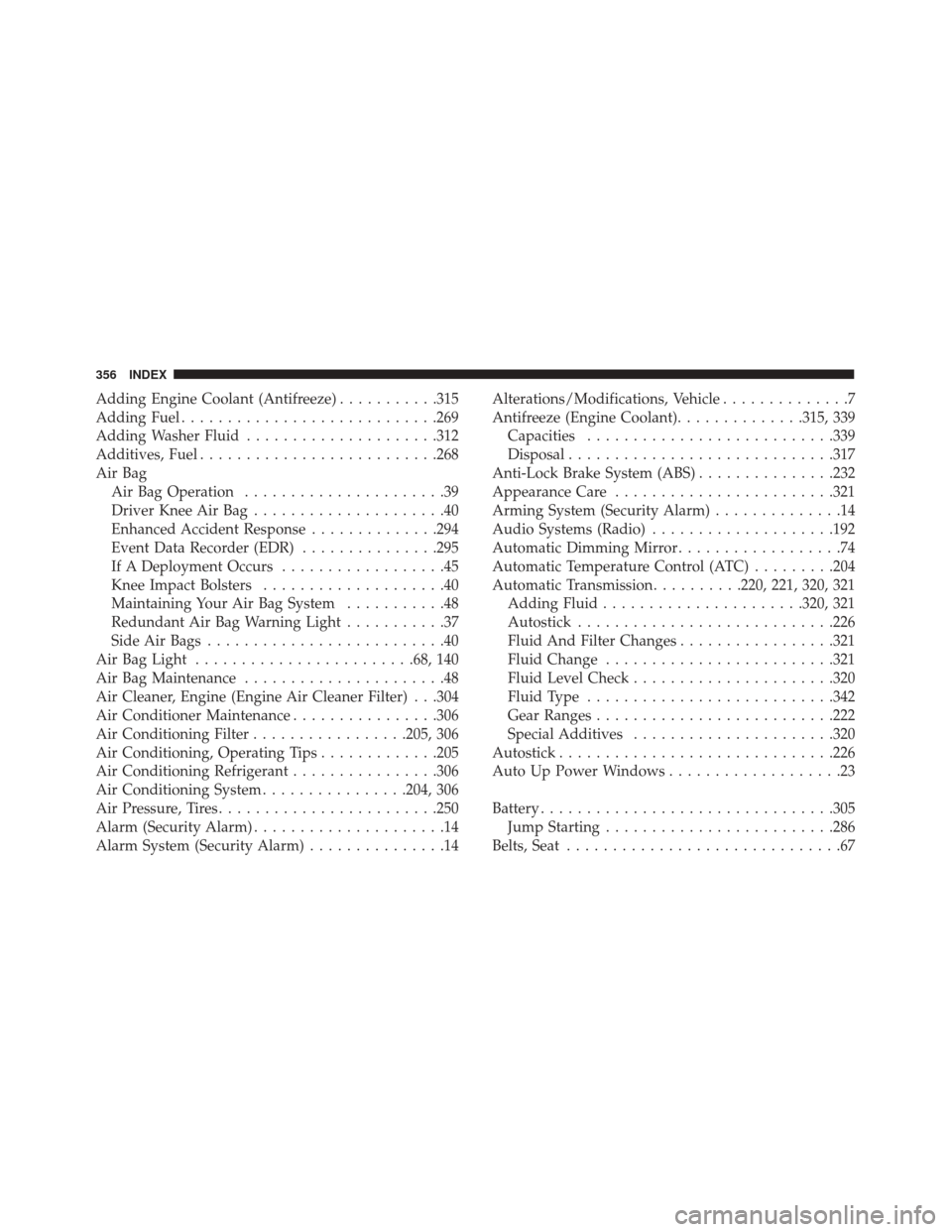
Adding Engine Coolant (Antifreeze)...........315
Adding Fuel ............................269
Adding Washer Fluid .....................312
Additives, Fuel ..........................268
Air Bag Air Bag Operation ......................39
Driver Knee Air Bag .....................40
Enhanced Accident Response ..............294
Event Data Recorder (EDR) ...............295
If A Deployment Occurs ..................45
Knee Impact Bolsters ....................40
Maintaining Your Air Bag System ...........48
Redundant Air Bag Warning Light ...........37
Side Air Bags ..........................40
Air Bag Light ........................68, 140
Air Bag Maintenance ......................48
Air Cleaner, Engine (Engine Air Cleaner Filter) . . .304
Air Conditioner Maintenance ................306
Air Conditioning Filter .................205, 306
Air Conditioning, Operating Tips .............205
Air Conditioning Refrigerant ................306
Air Conditioning System ................204, 306
Air Pressure, Tires ........................250
Alarm (Security Alarm) .....................14
Alarm System (Security Alarm) ...............14Alterations/Modifications, Vehicle
..............7
Antifreeze (Engine Coolant) ..............315, 339
Capacities .......................... .339
Disposal ............................ .317
Anti-Lock Brake System (ABS) ...............232
Appearance Care ........................321
Arming System (Security Alarm) ..............14
Audio Systems (Radio) ....................192
Automatic Dimming Mirror ..................74
Automatic Temperature Control (ATC) .........204
Automatic Transmission ..........220, 221, 320, 321
Adding Fluid ..................... .320, 321
Autostick ............................226
Fluid And Filter Changes .................321
Fluid Change ........................ .321
Fluid Level
Check ..................... .320
Fluid Type .......................... .342
Gear Ranges ..........................222
Special Additives ..................... .320
Autostick ............................. .226
Auto Up Power Windows ...................23
Battery ............................... .305
Jump Starting ........................ .286
Belts, Seat ..............................67
356 INDEX
Page 365 of 370
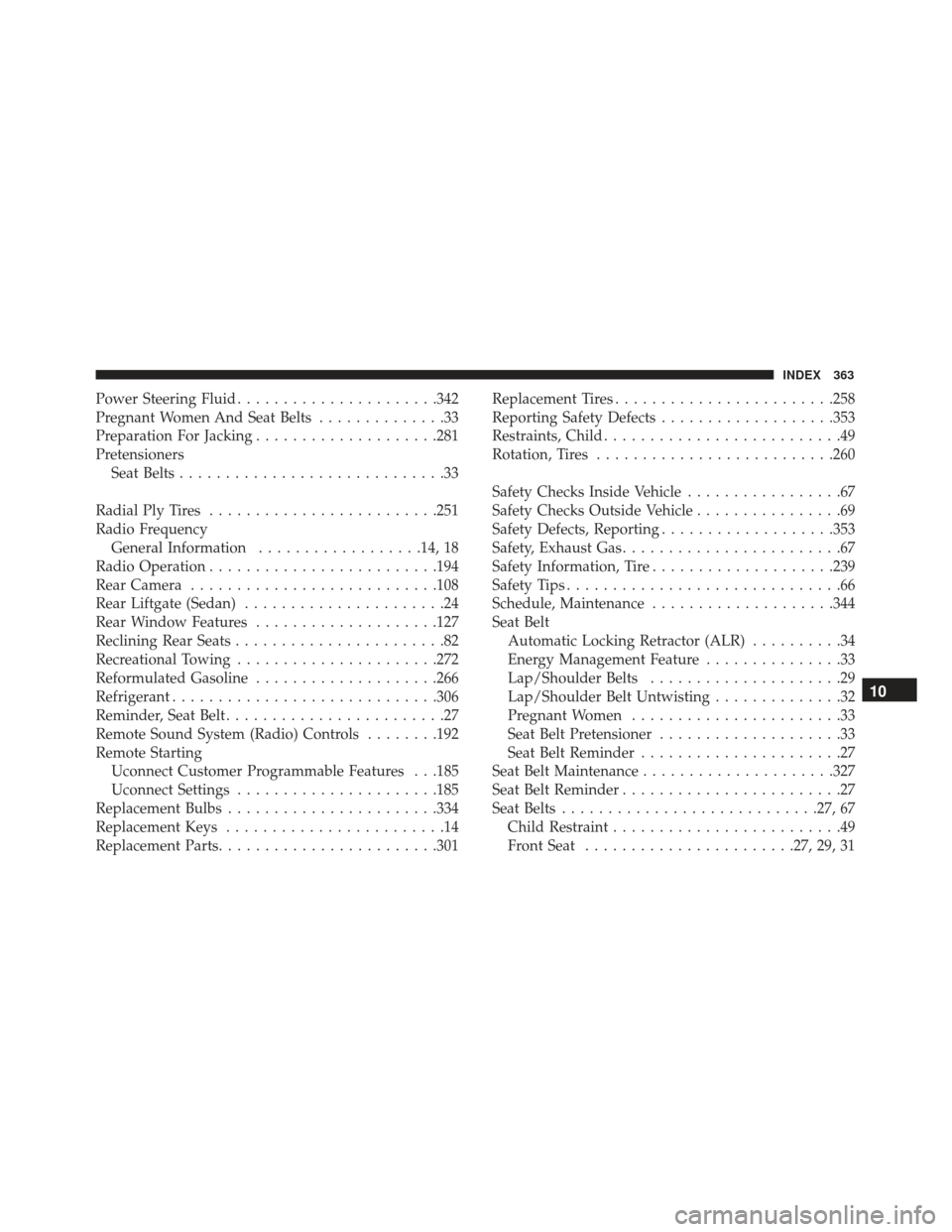
Power Steering Fluid..................... .342
Pregnant Women And Seat Belts ..............33
Preparation For Jacking ....................281
Pretensioners Seat Belts .............................33
Radial Ply Tires ........................ .251
Radio Frequency General Information ..................14, 18
Radio Operation ........................ .194
Rear Camera .......................... .108
Rear Liftgate (Sedan) ......................24
Rear Window Features ....................127
Reclining Rear Seats .......................82
Recreational Towing ..................... .272
Reformulated Gasoline ....................266
Refrigerant ............................ .306
Reminder, Seat Belt ........................27
Remote Sound System (Radio) Controls ........192
Remote Starting Uconnect Customer Programmable Features . . .185
Uconnect Settings ..................... .185
Replacement Bulbs .......................334
Replacement Keys ........................14
Replacement Parts ........................301 Replacement Tires
........................258
Reporting Safety Defects ...................353
Restraints, Child ..........................49
Rotation, Tires ..........................260
Safety Checks Inside Vehicle .................67
Safety Checks Outside Vehicle ................69
Safety Defects, Reporting ...................353
Safety, Exhaust Gas ........................67
Safety Information, Tire ....................239
Safety Tips ..............................66
Schedule, Maintenance ....................344
Seat Belt Automatic Locking Retractor (ALR) ..........34
Energy Management Feature ...............33
Lap/Shoulder Belts .....................29
Lap/Shoulder Belt Untwisting ..............32
Pregnant Women .......................33
Seat Belt Pretensioner ....................33
Seat Belt Reminder ......................27
Seat Belt Maintenance .....................327
Seat Belt
Reminder ........................27
Seat Belts ............................27, 67
Child Restraint .........................49
Front Seat .......................27, 29, 31
10
INDEX 363
Page 369 of 370
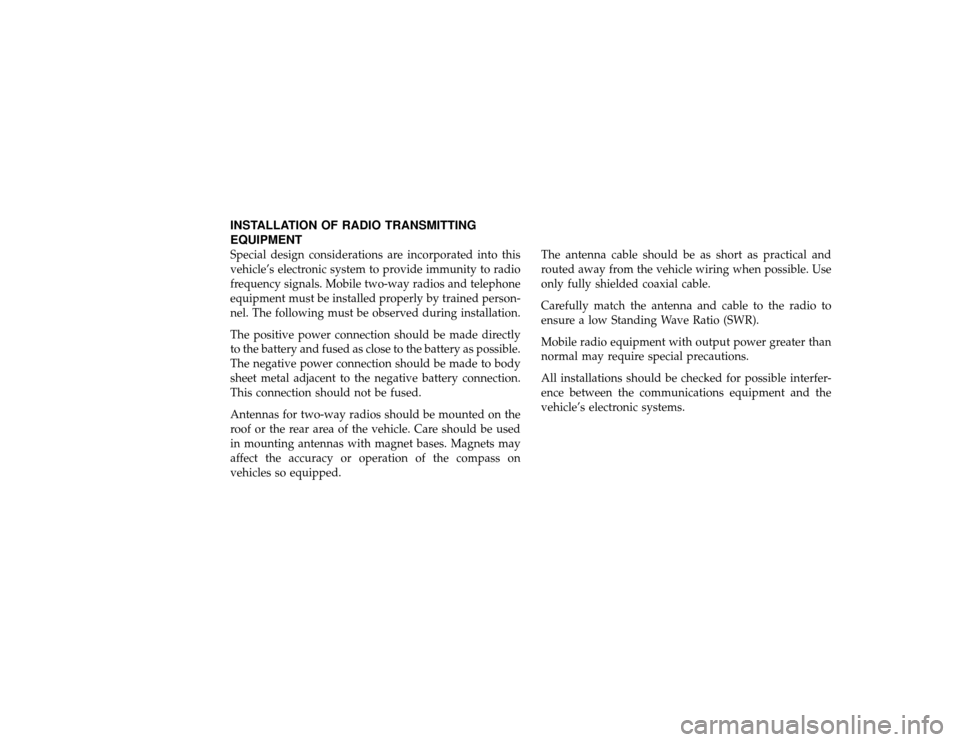
INSTALLATION OF RADIO TRANSMITTING
EQUIPMENTSpecial design considerations are incorporated into this
vehicle’s electronic system to provide immunity to radio
frequency signals. Mobile two-way radios and telephone
equipment must be installed properly by trained person-
nel. The following must be observed during installation.
The positive power connection should be made directly
to the battery and fused as close to the battery as possible.
The negative power connection should be made to body
sheet metal adjacent to the negative battery connection.
This connection should not be fused.
Antennas for two-way radios should be mounted on the
roof or the rear area of the vehicle. Care should be used
in mounting antennas with magnet bases. Magnets may
affect the accuracy or operation of the compass on
vehicles so equipped.The antenna cable should be as short as practical and
routed away from the vehicle wiring when possible. Use
only fully shielded coaxial cable.
Carefully match the antenna and cable to the radio to
ensure a low Standing Wave Ratio (SWR).
Mobile radio equipment with output power greater than
normal may require special precautions.
All installations should be checked for possible interfer-
ence between the communications equipment and the
vehicle’s electronic systems.