light FIAT 500X 2014 2.G Owners Manual
[x] Cancel search | Manufacturer: FIAT, Model Year: 2014, Model line: 500X, Model: FIAT 500X 2014 2.GPages: 476, PDF Size: 5.32 MB
Page 264 of 476
2.4L Engine
All available gasoline engines are
designed to meet all emissions regu-
lations and provide excellent fuel
economy and performance when us-
ing high quality unleaded “regular”
gasoline having a octane rating of 87
using the (R+M)/2 method. The use
of premium gasoline is not recommended, as it will not
provide any benefit over regular gasoline in these
engines.
While operating on gasoline with an octane number of
87, hearing a light knocking sound from the engine is
not a cause for concern. However, if the engine is heard
making a heavy knocking sound, see your dealer im-
mediately. Use of gasoline with an octane number lower
than 87 can cause engine failure and may void or not be
covered by the New Vehicle Limited Warranty.
Poor quality gasoline can cause problems such as hard
starting, stalling, and hesitations. If you experience
these symptoms, try another brand of gasoline before
considering service for the vehicle.
Reformulated Gasoline
Many areas of the country require the use of cleaner
burning gasoline referred to as “Reformulated Gaso-
line”. Reformulated gasoline contains oxygenates and
are specifically blended to reduce vehicle emissions and
improve air quality.
The use of reformulated gasoline is recommended.
Properly blended reformulated gasoline will provide
improved performance and durability of engine and
fuel system components.
Gasoline/Oxygenate Blends
Some fuel suppliers blend unleaded gasoline with
oxygenates such as ethanol.
CAUTION!
DO NOT use gasoline containing methanol or gaso-
line containing more than 15% ethanol (E-15). Use
of these blends may result in starting and drivabil-
ity problems, damage critical fuel system compo-
nents, cause emissions to exceed the applicable
standard, and/or cause the “Malfunction Indicator
(Continued)
262 STARTING AND OPERATING
Page 265 of 476
CAUTION!(Continued)
Light” to illuminate. Please observe pump labels as
they should clearly communicate if a fuel contains
greater than 15% ethanol (E-15).
Problems that result from using gasoline containing
more than 15% ethanol (E-15) or gasoline containing
methanol are not the responsibility of the manufacturer
and may void or not be covered under New Vehicle
Limited Warranty.
E-85 Usage In Non-Flex Fuel Vehicles
Non-Flex Fuel Vehicles (FFV) are compatible with gaso-
line containing up to 15% ethanol (E-15). Gasoline with
higher ethanol content may void the New Vehicle
Limited Warranty.
If a Non-FFV vehicle is inadvertently fueled with E-85
fuel, the engine will have some or all of these symp-
toms:
• Operate in a lean mode.
• OBD II “Malfunction Indicator Light” on.
• Poor engine performance.
• Poor cold start and cold drivability. •
Increased risk for fuel system component corrosion.
CNG And LP Fuel System Modifications
Modifications that allow the engine to run on com-
pressed natural gas (CNG) or liquid propane (LP) may
result in damage to the engine, emissions, and fuel
system components. Problems that result from running
CNG or LP are not the responsibility of the manufac-
turer and may void or not be covered under the New
Vehicle Limited Warranty.
MMT In Gasoline
Methylcyclopentadienyl Manganese Tricarbonyl
(MMT) is a manganese-containing metallic additive
that is blended into some gasoline to increase octane.
Gasoline blended with MMT provides no performance
advantage beyond gasoline of the same octane number
without MMT. Gasoline blended with MMT reduces
spark plug life and reduces emissions system perfor-
mance in some vehicles. The manufacturer recom-
mends that gasoline without MMT be used in your
vehicle. The MMT content of gasoline may not be
indicated on the gasoline pump, therefore, you should
ask your gasoline retailer whether the gasoline contains
MMT. MMT is prohibited in Federal and California
reformulated gasoline.
7
STARTING AND OPERATING 263
Page 266 of 476
Materials Added To Fuel
Besides using unleaded gasoline with the proper octane
rating, gasolines that contain detergents, corrosion, and
stability additives are recommended. Using gasolines
that have these additives will help improve fuel
economy, reduce emissions, and maintain vehicle per-
formance.Designated TOP TIER Detergent
Gasoline contains a higher level of
detergents to further aide in mini-
mizing engine and fuel system de-
posits. When available, the usage of
Top Tier Detergent gasoline is recom-
mended. Visit www.toptiergas.com
for a list of TOP TIER Detergent Gasoline Retailers.
Indiscriminate use of fuel system cleaning agents
should be avoided. Many of these materials intended
for gum and varnish removal may contain active sol-
vents or similar ingredients. These can harm fuel sys-
tem gasket and diaphragm materials.
Fuel System Cautions
CAUTION!
Follow these guidelines to maintain your vehicle’s
performance:
• The use of leaded gasoline is prohibited by Fed-
eral law. Using leaded gasoline can impair engine
performance and damage the emissions control
system.
• An out-of-tune engine or certain fuel or ignition
malfunctions can cause the catalytic converter to
overheat. If you notice a pungent burning odor or
some light smoke, your engine may be out of tune
or malfunctioning and may require immediate
service. Contact your authorized dealer for service
assistance.
• The use of fuel additives, which are now being
sold as octane enhancers, is not recommended.
Most of these products contain high concentra-
tions of methanol. Fuel system damage or vehicle
performance problems resulting from the use of
such fuels or additives is not the responsibility of
the manufacturer and may void or not be covered
under the New Vehicle Limited Warranty.
264 STARTING AND OPERATING
Page 273 of 476
3. Replace the tires when tread wear indicators firstbecome visible.
4. Keep tires properly inflated.
5. Maintain sufficient distance between your vehicle and the vehicle in front of you to avoid a collision in
a sudden stop.
DRIVING THROUGH WATER
Driving through water more than a few inches/
centimeters deep will require extra caution to ensure
safety and prevent damage to your vehicle.
Flowing/Rising Water
WARNING!
Do not drive on or across a road or path where water
is flowing and/or rising (as in storm run-off). Flowing
water can wear away the road or path’s surface and
cause your vehicle to sink into deeper water. Further-
more, flowing and/or rising water can carry your
vehicle away swiftly. Failure to follow this warning
may result in injuries that are serious or fatal to you,
your passengers, and others around you.
Shallow Standing Water
Although your vehicle is capable of driving through
shallow standing water, consider the following Cau-
tions and Warnings before doing so.
WARNING!
•Driving through standing water limits your vehi-
cle’s traction capabilities. Do not exceed 5 mph
(8 km/h) when driving through standing water.
• Driving through standing water limits your vehi-
cle’s braking capabilities, which increases stop-
ping distances. Therefore, after driving through
standing water, drive slowly and lightly press on
the brake pedal several times to dry the brakes.
• Failure to follow these warnings may result in
injuries that are serious or fatal to you, your
passengers, and others around you.
7
STARTING AND OPERATING 271
Page 274 of 476
CAUTION!
•Always check the depth of the standing water
before driving through it. Never drive through
standing water that is deeper than the bottom of
the tire rims mounted on the vehicle.
• Determine the condition of the road or the path
that is under water and if there are any obstacles
in the way before driving through the standing
water.
• Do not exceed 5 mph (8 km/h) when driving
through standing water. This will minimize wave
effects.
• Driving through standing water may cause dam-
age to your vehicle’s drivetrain components. Al-
ways inspect your vehicle’s fluids (i.e., engine oil,
transmission, axle, etc.) for signs of contamination
(i.e., fluid that is milky or foamy in appearance)
after driving through standing water. Do not
continue to operate the vehicle if any fluid ap-
pears contaminated, as this may result in further
damage. Such damage is not covered by the New
Vehicle Limited Warranty.
(Continued)
CAUTION! (Continued)
•Getting water inside your vehicle’s engine can
cause it to lock up and stall out, and cause serious
internal damage to the engine. Such damage is
not covered by the New Vehicle Limited War-
ranty.
POWER STEERING
The electric power steering system will give you good
vehicle response and increased ease of maneuverability
in tight spaces. The system will vary its assist to provide
light efforts while parking and good feel while driving.
If the electric steering system experiences a fault that
reduces assist or prevents the vehicle from providing
assist, you will still have the ability to steer the vehicle
manually.
WARNING!
Continued operation with reduced assist could pose
a safety risk to yourself and others. Service should
be obtained as soon as possible.
272 STARTING AND OPERATING
Page 278 of 476
Trailer Hitch Classification
The following chart provides the industry standard for
the maximum trailer weight a given trailer hitch class
can tow and should be used to assist you in selecting
the correct trailer hitch for your intended towing con-
dition.
Trailer Hitch Classification Definitions
Class Max. Trailer Hitch Industry Standards
Class I - Light Duty 2,000 lbs (907 kg)
Class II - Medium Duty 3,500 lbs (1,587 kg)
Class III - Heavy Duty 5,000 lbs (2,267 kg)
Class IV - Extra Heavy Duty 10,000 lbs (4,535 kg)
Refer to the “Trailer Towing Weights (Maximum Trailer Weight Ratings)” chart for the Maximum Gross Trailer
Weight (GTW) towable for your given drivetrain.
All trailer hitches should be professionally installed on your vehicle.
276 STARTING AND OPERATING
Page 283 of 476
Towing Requirements — Trailer Lights And
Wiring (If Equipped)
Whenever you pull a trailer, regardless of the trailer
size, stoplights and turn signals on the trailer are
required for motoring safety.
The Trailer Tow Package may include a four- and
seven-pin wiring harness. Use a factory approved
trailer harness and connector.
NOTE:Do not cut or splice wiring into the vehicles
wiring harness. The electrical connections are all complete to the vehicle
but you must mate the harness to a trailer connector.
Refer to the following illustrations.
NOTE:
•
Disconnect trailer wiring connector from the vehicle
before launching a boat (or any other device plugged
into vehicle’s electrical connect) into water.
• Be sure to reconnect after clear from water area.
7
STARTING AND OPERATING 281
Page 285 of 476
Towing Tips
Before setting out on a trip, practice turning, stopping,
and backing the trailer in an area located away from
heavy traffic.
Automatic Transmission — If Equipped
Select the DRIVE range when towing. The transmission
controls include a drive strategy to avoid frequent
shifting when towing. However, if frequent shifting
does occur while in DRIVE, you can use the AutoStick
shift control to manually select a lower gear.
NOTE:Using a lower gear while operating the vehicle
under heavy loading conditions will improve perfor-
mance and extend transmission life by reducing exces-
sive shifting and heat build up. This action will also
provide better engine braking.
AutoStick
• When using the AutoStick shift control, select the
highest gear that allows for adequate performance
and avoids frequent downshifts. For example, choose
“5” if the desired speed can be maintained. Choose
“4” or “3” if needed to maintain the desired speed. •
To prevent excess heat generation, avoid continuous
driving at high RPM. Reduce vehicle speed as nec-
essary to avoid extended driving at high RPM.
Return to a higher gear or vehicle speed when grade
and road conditions allow.
Speed Control — If Equipped
• Do not use in hilly terrain or with heavy loads.
• When using the speed control, if you experience
speed drops greater than 10 mph (16 km/h), disen-
gage until you can get back to cruising speed.
• Use speed control in flat terrain and with light loads
to maximize fuel efficiency.
Cooling System
To reduce potential for engine and transmission over-
heating, take the following actions:
City Driving
When stopped for short periods of time, shift the
transmission into NEUTRAL and increase engine idle
speed.
7
STARTING AND OPERATING 283
Page 291 of 476
HAZARD WARNING FLASHERS
The Hazard Warning flasher switch is located on the
switch bank below the radio.Push the switch to turn on the Hazard Warning
Flasher. When the switch is activated, all direc-
tional turn signals will flash on and off to warn oncom-
ing traffic of an emergency. Push the switch a second
time to turn off the Hazard Warning flashers.
This is an emergency warning system and it should not
be used when the vehicle is in motion. Use it when your
vehicle is disabled and it is creating a safety hazard for
other motorists.
When you must leave the vehicle to seek assistance, the
Hazard Warning flashers will continue to operate even
though the ignition is placed in OFF mode.
NOTE: With extended use the Hazard Warning flashers
may wear down your battery.
BULB REPLACEMENT
General Information
• Before you replace a bulb, check the contacts to be
sure they are not oxidized.
• Replace the bulbs with the same type and wattage.
• After replacing a light bulb, always check the correct
orientation.
• Before replacing a bulb that is not functioning, check
that the fuse is intact.
NOTE: Lens fogging can occur under certain atmo-
spheric conditions. This will usually clear as atmo-
spheric conditions change to allow the condensation to
change back into a vapor. Turning the lamps on will
usually accelerate the clearing process.
8
IN CASE OF EMERGENCY 289
Page 292 of 476
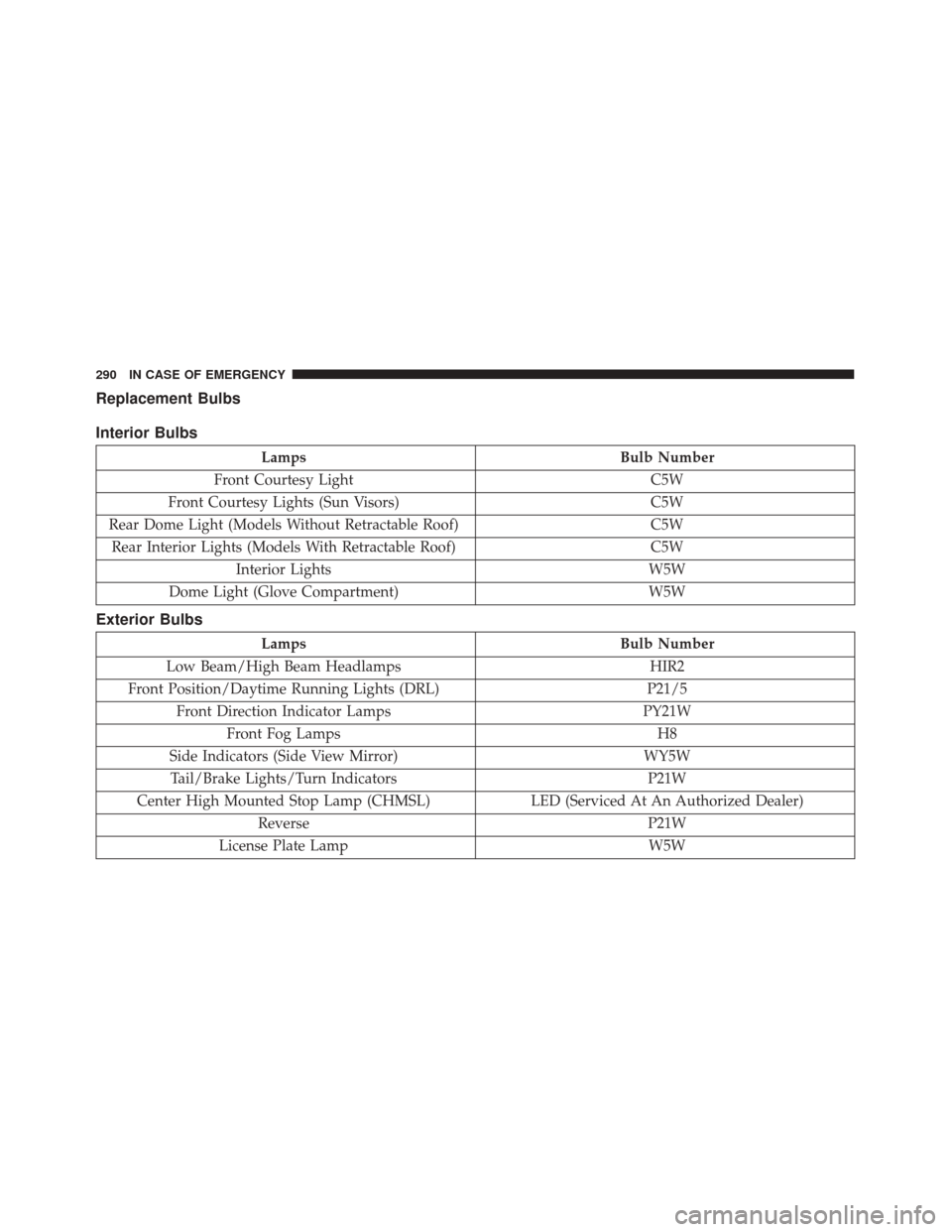
Replacement Bulbs
Interior Bulbs
LampsBulb Number
Front Courtesy Light C5W
Front Courtesy Lights (Sun Visors) C5W
Rear Dome Light (Models Without Retractable Roof) C5W
Rear Interior Lights (Models With Retractable Roof) C5W
Interior Lights W5W
Dome Light (Glove Compartment) W5W
Exterior Bulbs
LampsBulb Number
Low Beam/High Beam Headlamps HIR2
Front Position/Daytime Running Lights (DRL) P21/5
Front Direction Indicator Lamps PY21W
Front Fog Lamps H8
Side Indicators (Side View Mirror) WY5W
Tail/Brake Lights/Turn Indicators P21W
Center High Mounted Stop Lamp (CHMSL) LED (Serviced At An Authorized Dealer)
Reverse P21W
License Plate Lamp W5W
290 IN CASE OF EMERGENCY