warning FIAT 500X 2014 2.G Owners Manual
[x] Cancel search | Manufacturer: FIAT, Model Year: 2014, Model line: 500X, Model: FIAT 500X 2014 2.GPages: 476, PDF Size: 5.32 MB
Page 365 of 476
WARNING!
•Exhaust gases can injure or kill. They contain
carbon monoxide (CO), which is colorless and
odorless. Breathing it can make you unconscious
and can eventually poison you. To avoid breath-
ing CO, refer to “Safety Tips/Exhaust Gas” in the
“Safety” section for further information.
• A hot exhaust system can start a fire if you park
over materials that can burn. Such materials
might be grass or leaves coming into contact with
your exhaust system. Do not park or operate your
vehicle in areas where your exhaust system can
contact anything that can burn.
CAUTION!
• The catalytic converter requires the use of un-
leaded fuel only. Leaded gasoline will destroy the
effectiveness of the catalyst as an emissions con-
trol device and may seriously reduce engine per-
formance and cause serious damage to the engine.
• Damage to the catalytic converter can result if
your vehicle is not kept in proper operating
(Continued)
CAUTION! (Continued)
condition. In the event of engine malfunction,
particularly involving engine misfire or other
apparent loss of performance, have your vehicle
serviced promptly. Continued operation of your
vehicle with a severe malfunction could cause the
converter to overheat, resulting in possible dam-
age to the converter and vehicle.
Under normal operating conditions, the catalytic con-
verter will not require maintenance. However, it is
important to keep the engine properly tuned to assure
proper catalyst operation and prevent possible catalyst
damage.
NOTE: Intentional tampering with emissions control
systems can result in civil penalties being assessed
against you.
In unusual situations involving grossly malfunctioning
engine operation, a scorching odor may suggest severe
and abnormal catalyst overheating. If this occurs, stop
the vehicle, turn off the engine and allow it to cool.
Service, including a tune-up to manufacturer’s specifi-
cations, should be obtained immediately.
9
MAINTAINING AND CARING FOR YOUR VEHICLE 363
Page 366 of 476
To minimize the possibility of catalytic converter dam-
age:
•Do not shut off the engine or interrupt the ignition,
when the transmission is in gear and the vehicle is in
motion.
• Do not try to start the engine by pushing or towing
the vehicle.
• Do not idle the engine with any spark plug wires
disconnected or removed, such as when diagnostic
testing, or for prolonged periods during very rough
idle or malfunctioning operating conditions.
Cooling System
WARNING!
• Turn vehicle off and disconnect the fan motor
lead before working near the radiator cooling fan.
• You or others can be badly burned by hot engine
coolant (antifreeze) or steam from your radiator. If
you see or hear steam coming from under the
hood, do not open the hood until the radiator has
had time to cool. Never open a cooling system
(Continued)
WARNING! (Continued)
pressure cap when the radiator or coolant bottle is
hot.
• Keep hands, tools, clothing, and jewelry away
from the radiator cooling fan when the hood is
raised. The fan starts automatically and may start
at any time, whether the engine is running or not.
• When working near the radiator cooling fan,
disconnect the fan motor lead or turn the ignition
switch to the OFF position. The fan is temperature
controlled and can start at any time the ignition
switch is in the ON position.
• You or others can be badly burned by hot engine
coolant (antifreeze) or steam from your radiator. If
you see or hear steam coming from under the
hood, do not open the hood until the radiator has
had time to cool. Never try to open a cooling
system pressure cap when the radiator is hot.
Coolant Checks
Check engine coolant (antifreeze) protection every 12
months (before the onset of freezing weather, where
applicable). If the engine coolant (antifreeze) is dirty or
rusty in appearance, the system should be drained,
364 MAINTAINING AND CARING FOR YOUR VEHICLE
Page 369 of 476
If HOAT and OAT coolant are mixed in an emer-
gency, have a authorized dealer drain, flush, and
refill with OAT coolant (conforming to MS.90032) as
soon as possible.
Cooling System Pressure Cap
The cap must be fully tightened to prevent loss of
engine coolant (antifreeze) and to ensure that engine
coolant (antifreeze) will return to the radiator from the
coolant recovery tank.
The cap should be inspected and cleaned if there is any
accumulation of foreign material on the sealing sur-
faces.
WARNING!
•Do not open hot engine cooling system. Never
add engine coolant (antifreeze) when the engine
is overheated. Do not loosen or remove the cap to
cool an overheated engine. Heat causes pressure
to build up in the cooling system. To prevent
scalding or injury, do not remove the pressure cap
while the system is hot or under pressure.
(Continued)
WARNING! (Continued)
•Do not use a pressure cap other than the one
specified for your vehicle. Personal injury or
engine damage may result.
Disposal Of Used Engine Coolant
Used ethylene glycol-based engine coolant (antifreeze)
is a regulated substance requiring proper disposal.
Check with your local authorities to determine the
disposal rules for your community. To prevent ingestion
by animals or children, do not store ethylene glycol-
based engine coolant in open containers or allow it to
remain in puddles on the ground. If ingested by a child
or pet, seek emergency assistance immediately. Clean
up any ground spills immediately.
Coolant Level
The coolant expansion bottle provides a quick visual
method for determining that the coolant level is ad-
equate. With the engine off and cold, the level of the
engine coolant (antifreeze) in the bottle should be
between the “MIN” and “MAX” marks.
9
MAINTAINING AND CARING FOR YOUR VEHICLE 367
Page 371 of 476
WARNING!
Riding the brakes can lead to brake failure and
possibly a collision. Driving with your foot resting
or riding on the brake pedal can result in abnor-
mally high brake temperatures, excessive lining
wear, and possible brake damage. Riding the
brakes may also reduce braking capacity in an
emergency.
Brake Master Cylinder
The fluid level in the master cylinder should be checked
when performing under hood services, or immediately
if the “Brake Warning Light” is on.
Be sure to clean the top of the master cylinder area
before removing the cap. If necessary, add fluid to bring
the fluid level up to the requirements described on the
brake fluid reservoir. Fluid level can be expected to fall
as the brake pads wear. The brake fluid level should be
checked when the pads are replaced. However, low
fluid level may be caused by a leak and a checkup may
be needed.NOTE:
If your vehicle is equipped with a manual
transmission, the brake fluid reservoir supplies fluid to
both the brake system and the clutch release system.
The two systems are separated in the reservoir, and a
leak in one system will not affect the other system. The
manual transmission clutch release system should not
require fluid replacement during the life of the vehicle.
If the brake fluid reservoir is low and the brake system
does not indicate any leaks or other problems, it may be
a result of a leak in the hydraulic clutch release system.
See your local authorized dealer for service.
Use only manufacturer’s recommended brake fluid.
Refer to “Fluids, Lubricants, And Genuine Parts” in the
“Technical Data” section for further information.
WARNING!
• Use only manufacturer ’s recommended brake
fluid. Refer to “Fluids, Lubricants, And Genuine
Parts” in the “Technical Data” section for further
information. Using the wrong type of brake fluid
can severely damage your brake system and/or
impair its performance. The proper type of brake
fluid for your vehicle is also identified on the
(Continued)
9
MAINTAINING AND CARING FOR YOUR VEHICLE 369
Page 372 of 476
WARNING!(Continued)
original factory installed hydraulic master cylin-
der reservoir.
• To avoid contamination from foreign matter or
moisture, use only new brake fluid or fluid that
has been in a tightly closed container. Keep the
master cylinder reservoir cap secured at all times.
Brake fluid in a open container absorbs moisture
from the air resulting in a lower boiling point.
This may cause it to boil unexpectedly during
hard or prolonged braking, resulting in sudden
brake failure. This could result in a collision.
• Overfilling the brake fluid reservoir can result in
spilling brake fluid on hot engine parts, causing
the brake fluid to catch fire. Brake fluid can also
damage painted and vinyl surfaces, care should
be taken to avoid its contact with these surfaces.
• Do not allow petroleum-based fluid to contami-
nate the brake fluid. Brake seal components could
be damaged, causing partial or complete brake
failure. This could result in a collision.
CAUTION!
Use of improper brake fluids will affect overall
clutch system performance. Improper brake fluids
may damage the clutch system resulting in loss of
clutch function and the ability to shift the transmis-
sion.
Manual Transmission — If Equipped
Lubricant Selection
Use only the manufacturers recommended transmis-
sion fluid. Refer to “Fluids, Lubricants, And Genuine
Parts” in “Technical Data” for further information.
Please see your authorized dealer for service.
Fluid Level Check
Check the fluid level by removing the fill plug. The
fluid level should be between the bottom of the fill hole
and a point not more than 3/16 inch (4.7 mm) below the
bottom of the hole.
Add fluid, if necessary, to maintain the proper level.
Please see your authorized dealer for service.
370 MAINTAINING AND CARING FOR YOUR VEHICLE
Page 378 of 476
•For grease stains, apply Mopar Multi-Purpose
Cleaner to a clean, damp cloth and remove stain. Use
a fresh, damp towel to remove soap residue.
• Do not use any harsh solvents or any other form of
protectants on Stain Repel products.
Interior Care
Use Mopar Total Clean to clean fabric upholstery and
carpeting.
Use Mopar Total Clean to clean vinyl upholstery.
Mopar Total Clean is specifically recommended for
leather upholstery.
Your leather upholstery can be best preserved by regu-
lar cleaning with a damp soft cloth. Small particles of
dirt can act as an abrasive and damage the leather
upholstery and should be removed promptly with a
damp cloth. Stubborn soils can be removed easily with
a soft cloth and Mopar Total Clean. Care should be
taken to avoid soaking your leather upholstery with
any liquid. Please do not use polishes, oils, cleaning
fluids, solvents, detergents, or ammonia-based cleaners
to clean your leather upholstery. Application of a leather conditioner is not required to maintain the
original condition.
WARNING!
Do not use volatile solvents for cleaning purposes.
Many are potentially flammable, and if used in
closed areas they may cause respiratory harm.
CAUTION!
•
Direct contact of air fresheners, insect repellents,
suntan lotions, or hand sanitizers to the plastic,
painted, or decorated surfaces of the interior may
cause permanent damage. Wipe away immedi-
ately.
• Damage caused by these type of products may not
be covered by your New Vehicle Limited War-
ranty.
• Do not use Alcohol and Alcohol-based and/or
Keton based cleaning products to clean leather
seats, as damage to the seat may result.
376 MAINTAINING AND CARING FOR YOUR VEHICLE
Page 380 of 476
Cleaning Plastic Instrument Cluster Lenses
The lenses in front of the instruments in this vehicle are
molded in clear plastic. When cleaning the lenses, care
must be taken to avoid scratching the plastic.
1. Clean with a wet soft cloth. A mild soap solutionmay be used, but do not use high alcohol content or
abrasive cleaners. If soap is used, wipe clean with a
clean damp cloth.
2. Dry with a soft cloth.
Seat Belt Maintenance
Do not bleach, dye or clean the belts with chemical
solvents or abrasive cleaners. This will weaken the
fabric. Sun damage can also weaken the fabric.
If the belts need cleaning, use a mild soap solution or
lukewarm water. Do not remove the belts from the
vehicle to wash them. Dry with a soft cloth. Replace the belts if they appear frayed or worn or if the
buckles do not work properly.
NOTE:
If the belts retract slowly, inspect the upper
turning loop for soiling. If soiling is present, clean with
a wet soft cloth until all residue is removed.
WARNING!
A frayed or torn belt could rip apart in a collision
and leave you with no protection. Inspect the belt
system periodically, checking for cuts, frays, or
loose parts. Damaged parts must be replaced imme-
diately. Do not disassemble or modify the system.
Seat belt assemblies must be replaced after a colli-
sion if they have been damaged (i.e., bent retractor,
torn webbing, etc.).
378 MAINTAINING AND CARING FOR YOUR VEHICLE
Page 387 of 476
WARNING!
•Overloading of your tires is dangerous. Overload-
ing can cause tire failure, affect vehicle handling,
and increase your stopping distance. Use tires of
the recommended load capacity for your vehicle.
Never overload them.
• Improperly inflated tires are dangerous and can
cause collisions. Under-inflation increases tire
flexing and can result in over-heating and tire
failure. Over-inflation reduces a tire’s ability to
cushion shock. Objects on the road and chuck
holes can cause damage that results in tire failure.
Unequal tire pressures can cause steering prob-
lems. You could lose control of your vehicle.
Over-inflated or under-inflated tires can affect
vehicle handling and can fail suddenly, resulting
in loss of vehicle control. Always drive with each
tire inflated to the recommended cold tire infla-
tion pressure.
Example Tire Placard Location (Door)
Example Tire Placard Location (B-Pillar)
9
MAINTAINING AND CARING FOR YOUR VEHICLE 385
Page 390 of 476
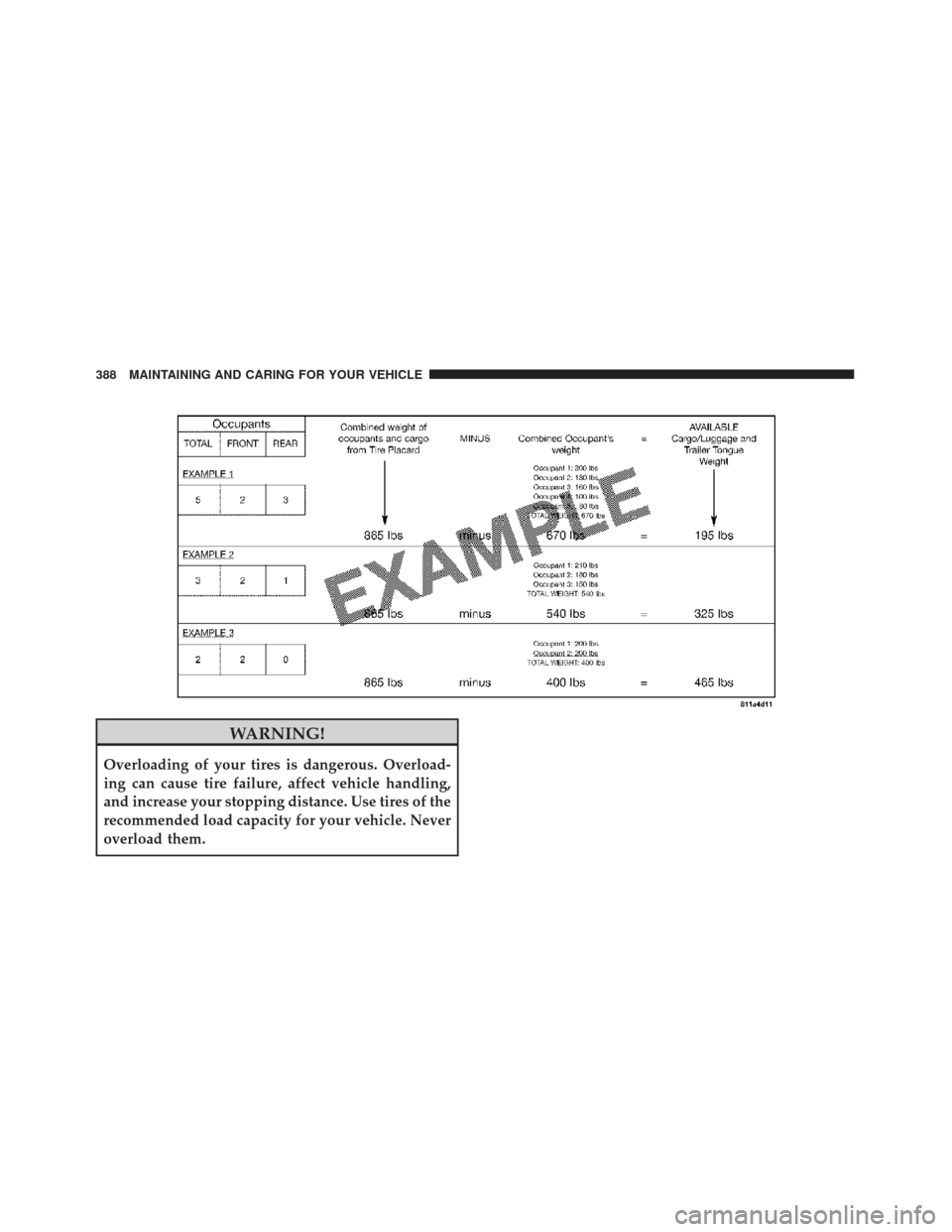
WARNING!
Overloading of your tires is dangerous. Overload-
ing can cause tire failure, affect vehicle handling,
and increase your stopping distance. Use tires of the
recommended load capacity for your vehicle. Never
overload them.
388 MAINTAINING AND CARING FOR YOUR VEHICLE
Page 391 of 476
TIRES — GENERAL INFORMATION
Tire Pressure
Proper tire inflation pressure is essential to the safe and
satisfactory operation of your vehicle. Four primary
areas are affected by improper tire pressure:
•Safety and Vehicle Stability
• Economy
• Tread Wear
• Ride Comfort
Safety
WARNING!
•Improperly inflated tires are dangerous and can
cause collisions.
• Underinflation increases tire flexing and can re-
sult in overheating and tire failure.
• Overinflation reduces a tire’s ability to cushion
shock. Objects on the road and chuckholes can
cause damage that result in tire failure.
(Continued)
WARNING! (Continued)
•Overinflated or underinflated tires can affect ve-
hicle handling and can fail suddenly, resulting in
loss of vehicle control.
• Unequal tire pressures can cause steering prob-
lems. You could lose control of your vehicle.
• Unequal tire pressures from one side of the ve-
hicle to the other can cause the vehicle to drift to
the right or left.
• Always drive with each tire inflated to the recom-
mended cold tire inflation pressure.
Both under-inflation and over-inflation affect the stabil-
ity of the vehicle and can produce a feeling of sluggish
response or over responsiveness in the steering.
NOTE:
• Unequal tire pressures from side to side may cause
erratic and unpredictable steering response.
• Unequal tire pressure from side to side may cause the
vehicle to drift left or right.
9
MAINTAINING AND CARING FOR YOUR VEHICLE 389